NYDN: Census Now Mapping Your Back Hallways
A bunch of leaders in NYC’s Muslim community have declined Mayor Mike Bloomberg’s invitation to an interfaith breakfast because of the racial profiling done by the NYPD’s intelligence division.

The move is interesting for the press it has generated–which in turn, has also (presumably, as designed) focused new attention on the racial profiling itself

It’s interesting, too, for the obnoxious editorial written in response from the NYDN. Along with lecturing these Muslim leaders about what invitations they should accept, the NYDN claims that the NYPD had done no more than map out census data.

The plain and salutary fact is that the NYPD’s counterterrorism unit has done no more than use census data to develop a portrait of Muslim New York and then follow leads, some sent the city’s way from abroad via the CIA, when they demanded investigation.

Many a plot has been disrupted by this type of perfectly proper nonintrusive vigiliance.

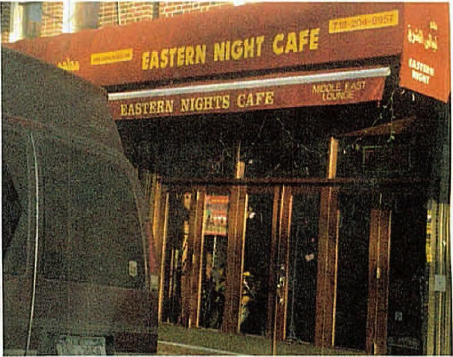
I find the claim that this all came from census data alarming, given that the NYPD has actually cased out a bunch of Middle Eastern restaurants in the city, including details such as what back passages the restaurants have, as in these details about the Eastern Nights Cafe.

The restaurant consists of two stores next to each other, connected to each other from the back of the store. The restaurant also has a back yard. The restaurant has access to the basement; the access door is located on the far right of the store.

Note, too, that while NYDN might be speaking generally about the “many a plot” that has been disrupted by mapping the back hallways of NY restaurants, this surveillance has not only disrupted primarily aspirational plots, but it damaged the FBI investigation into the real plot Najibullah Zazi had planned, because one of the NYPD’s own informants tipped the Zazis off to the investigation.

And the invitation declination is interesting, finally, for the way the Muslim leaders framed this issue–as part of a larger choice on the part of the NYPD to neglect law enforcement while it engages in civil rights abuses not just of Muslims, but of people of color and Occupy Wall Street protestors.

Mayor Bloomberg, the extent of these civil rights violations is astonishing, yet instead of calling for accountability and the rule of law, you have thus far defended the NYPD’s misconduct. We, on the other hand, believe that such measures threaten the rights of all Americans, and deepen mistrust between our communities and law enforcement. We are not alone in our belief. Many New Yorkers continue to express a variety of concerns centered on a lack of law enforcement accountability in our city, from stop and frisk procedures in African American and Spanish-speaking communities, to the tactics used in the evacuation of Zuccotti Park.

That’s really what the NYPD surveillance is about: prioritizing the profiling of an entire community (even while periodically and repeatedly stopping and frisking totally innocent people of color), rather than investigating and solving actual crimes.


Share this entry

“Oddly Passive” in the World of Drone Killing

The WaPo has an important piece on the use of drones. One thing bmaz noted about it on Twitter, for example, is that CIA had Anwar al-Awlaki under such multi-drone surveillance before they killed him, it is not credible that they killed Samir Khan, also an American, out of ignorance of his presence. Particularly given their claim they had made sure no “civilians wandered in the cross hairs.”

Two Predators pointed lasers at Awlaki’s vehicle, and a third circled to make sure that no civilians wandered into the cross hairs.

So the article makes it clear that the Administration doesn’t consider non-operational American citizen propagandists “civilians.”

But I’m particularly interested in what a “former official who served in both [the Bush and Obama] administrations and was supportive of the [drone] program” had to say about who was promoting increased use of drones. The official starts by pointing to Hillary Clinton, Leon Panetta, and John Brennan as the program’s champions.

Secretary of State Hillary Rodham Clinton, former CIA director and current Defense Secretary Leon E. Panetta, and counterterrorism adviser John O. Brennan seemed always ready to step on the accelerator, said a former official who served in both administrations and was supportive of the program. Current administration officials did not dispute the former official’s characterization of the internal dynamics.

And then calls the Commander-in-Chief “oddly passive” when it comes to drones.

Obama himself was “oddly passive in this world,” the former official said, tending to defer on drone policy to senior aides whose instincts often dovetailed with the institutional agendas of the CIA and JSOC.

The senior administration official [who also disputed that the drones were driving our counterterrorism policy and not vice versa] disputed that characterization, saying that Obama doesn’t weigh in on every operation but has been deeply involved in setting the criteria for strikes and emphasizing the need to minimize collateral damage.

“Everything about our counterterrorism operations is about carrying out the guidance that he’s given,” the official said. “I don’t think you could have the president any more involved.”

The description of a passive Obama accords with other descriptions of Obama’s role in the drone war. As I noted in October, even Obama’s “approval” of the Anwar al-Awlaki targeting, according to Mark Hosenball, consisted only of not rejecting the recommendations of the Principals Committee’s recommendation (and therefore people like Hillary, Brennan, and Panetta).

The role of the president in ordering or ratifying a decision to target a citizen is fuzzy. White House spokesman Tommy Vietor declined to discuss anything about the process.

[snip]

Other officials said the role of the president in the process was murkier than what Ruppersberger described.

They said targeting recommendations are drawn up by a committee of mid-level National Security Council and agency officials. Their recommendations are then sent to the panel of NSC “principals,” meaning Cabinet secretaries and intelligence unit chiefs, for approval. The panel of principals could have different memberships when considering different operational issues, they said.

[snip]

Several officials said that when Awlaki became the first American put on the target list, Obama was not required personally to approve the targeting of a person. But one official said Obama would be notified of the principals’ decision. If he objected, the decision would be nullified, the official said.

A former official said one of the reasons for making senior officials principally responsible for nominating Americans for the target list was to “protect” the president.

In addition, Joby Warrick’s description of the targeting approval process used before we killed Baitullah Mehsud and his young wife shows just the Director of the CIA signing off on the killing.

So it’s not news, exactly, that Obama has been given plausible deniability about the out-of-control backlash-creating program. Nor that the Administration wants to sustain that plausible deniability while still pursuing political advantage from the drone strikes.

But I am interested in the implication Greg Miller leaves as a result. Obama is passive, and so his senior aides control the program (perhaps one of the aides denying that Obama is passive?), and they, in turn, basically support the “the institutional agendas of the CIA and JSOC.”

Here’s what that senior aide had to say to try to deny that we’re letting a fondness for drones drive our counterterrorism policy.

“People think we start with the drone and go from there, but that’s not it at all,” said a senior administration official involved with the program. “We’re not constructing a campaign around the drone. We’re not seeking to create some worldwide basing network so we have drone capabilities in every corner of the globe.”

It seems there’s a third option, an alternative to “we’re building so many drone bases because we like drones” and “we have so many drones because there are so many possible targets for them.”

That third option is that JSOC and CIA have certain “institutional agendas” that center on wielding the power of drones anywhere in the world to implement a policy they’ve dreamt up rather than their civilian Commander-in-Chief. There’s a hint, at least, that drones not only take the human out of the cockpit, but also take the Commander-in-Chief out of the cockpit as well.

Share this entry

On the Manning Art. 32, Court Secrecy & Nat. Sec. Cases

I somehow stumbled into an article for The Nation by Rainey Reitman entitled Access Blocked to Bradley Manning’s Hearing. To make a long story short, in a Twitter exchange today with Ms. Reitman and Kevin Gosztola of Firedoglake (who has done yeoman’s work covering the Manning hearing), I questioned some of the statements and inferences made in Ms. Reitman’s report. She challenged me to write on the subject, so here I am.

First, Ms. Reitman glibly offered to let me use her work as “foundation” to work off of. Quite frankly, not only was my point not originally to particularly go further; my point, in fact, was that her foundation was deeply and materially flawed.

Reitman starts off with this statement:

The WikiLeaks saga is centered on issues of government transparency and accountability, but the public is being strategically denied access to the Manning hearing, one of the most important court cases in our lifetime.

While the “WikiLeaks saga” is indeed centered on transparency and accountability for many of us, that simply is not the case in regard to the US Military prosecution of Pvt. Bradley Manning. The second you make that statement about the UCMJ criminal prosecution of Manning, you have stepped off the tracks of reality and credibility in court reportage and analysis. The scope of Manning’s Article 32 hearing was/is were the crimes detailed in the charging document committed and is there reason to believe Manning committed them. Additionally, in an Article 32 hearing, distinct from a civilian preliminary hearing, there is limited opportunity for personal mitigating information to be adduced in order to argue for the Investigating Officer to recommend non-judicial punishment as opposed to court martial trial. That is it. There is no concern or consideration of “transparency and accountability”, within the ambit suggested by Ms. Reitman, in the least.

Calling the Manning Article 32 hearing “one of the most important court cases in our lifetime” is far beyond hyperbole. First off, it is, for all the breathless hype, a relatively straight forward probable cause determination legally and, to the particular military court jurisdiction it is proceeding under, it is nothing more than that. The burden of proof is light, and the issues narrow and confined to that which is described above. The grand hopes, dreams and principles of the Manning and WikiLeaks acolytes simply do not fit into this equation no matter how much they may want them to. Frankly, it would be a great thing to get those issues aired in this country; but this military UCMJ proceeding is not, and will not be, the forum where that happens.

Moving on, Reitman raises the specter of “the death penalty” for Manning. While the death penalty remains a technical possibility under one of the charges, the prosecution has repeatedly stated it will not be sought and, after all the statements on the record in that regard, there is simply no reason to embellish otherwise. Reitman next states:

This case will show much about the United States’s tolerance for whistleblowers who show the country in an unflattering light.

No, it most certainly will not. In fact, the Manning criminal military prosecution has nothing whatsoever to do with “whistleblowers”. Despite the loose and wild eyed use of the term “whistleblower” in popular culture, not to mention by supporters of Bradley Manning, the concept Read more

Share this entry

CIA: No Big Deal That We Trained NYPD to Conduct Domestic Spying

The CIA announced in September it was going to review a narrow aspect of the way CIA officers set up NYPD’s domestic spying agency in the wake of 9/11. As I pointed out then, the investigation was scoped to ignore key parts of the NYPD’s program.

The NYPD program is, by all appearances, a massive ethnic profiling operation that hasn’t been all that effectiveat finding potential terrorists. DOJ ought to be conducting this investigation as a potential civil rights violation.

But instead, CIA will conduct the investigation, meaning the chances the public will know the result are slimmer even than if DOJ conducted it.

[snip]

So is CIA particularly worried? Both James Clapper and the CIA flack appear to be narrowly parsing the potential problem: whether or not there are CIA officers on the streets of NY, whether they are investigating domestically as opposed to overseas (remember, the NYPD is sticking its nose into overseas investigations, too).

And, surprise surprise! CIA’s Inspector General just announced that it found no problem in its narrowly scoped investigation.

The agency’s inspector general concluded that no laws were broken and there was “no evidence that any part of the agency’s support to the NYPD constituted ‘domestic spying’,” CIA spokesman Preston Golson said.

[snip]

David Buckley, the CIA’s inspector general, completed his review in late October. It’s not clear if his report opens the door for other municipal police departments nationwide to work closely with the CIA in the war on terror.

Let the ineffective, wasteful domestic spying continue then, I guess!

Share this entry

Drone War Secrecy and Kill or Capture

As we stand on the doorstep of President Obama signing into law the new NDAA and its dreaded controversial provisions, there are two new articles out of interest this morning. The first is an incredibly useful, and pretty thorough, synopsis at Lawfare of the new NDAA entitled “NDAA FAQ: A Guide for the Perplexed”. It is co-written by Ben Wittes and Bobby Chesney and, though I may differ slightly in a couple of areas, it is not by much and their primer is extremely useful. I suggest it highly, and it has condensed a lot of material into an easily digestible blog length post.

The second is a long read from the Washington Post on how secrecy defines Obama’s drone wars:

The administration has said that its covert, targeted killings with remote-controlled aircraft in Pakistan, Yemen, Somalia and potentially beyond are proper under both domestic and international law. It has said that the targets are chosen under strict criteria, with rigorous internal oversight.
….
“They’ve based it on the personal legitimacy of [President] Obama — the ‘trust me’ concept,” Anderson said. “That’s not a viable concept for a president going forward.”

The article goes on to state how the CIA, and the majority of voices in the White House, are fighting tooth and nail for continued utmost secrecy lest any of our enemies somehow discover we are blowing them to bits with our drones. This is, of course, entirely predictable, especially now that the former head of the CIA leads the military and the former military chief for the greater Af/Pak theater which has long been ground zero for the drone kill program, Petraeus, is the head of the CIA.

But then the Post piece brings up our old friend, the OLC:

The Justice Department’s Office of Legal Counsel has opposed the declassification of any portion of its opinion justifying the targeted killing of U.S. citizen Anwar al-Awlaki in Yemen this year. Awlaki, a propagandist for the Yemen-based al-Qaeda affiliate whom Obama identified as its “external operations” chief, was the first American known to have been the main target of a drone strike. While officials say they did not require special permission to kill him, the administration apparently felt it would be prudent to spell out its legal rationale.
….
Under domestic law, the administration considers all three to be covered by the Authorization for Use of Military Force that Congress passed days after the Sept. 11, 2001, attacks. In two key sentences that have no expiration date, the AUMF gives the president sole power to use “all necessary and appropriate force” against nations, groups or persons who committed or aided the attacks, and to prevent future attacks.

The CIA has separate legal authority to conduct counterterrorism operations under a secret presidential order, or finding, first signed by President Ronald Reagan more than two decades ago. In 1998, President Bill Clinton signed an amendment, called a Memorandum of Notification, overriding a long-standing ban on CIA assassinations overseas and allowing “lethal” counterterrorism actions against a short list of named targets, including Osama bin Laden and his top lieutenants. Killing was approved only if capture was not deemed “feasible.”

A week after the Sept. 11 attacks, the Bush administration amended the finding again, dropping the list of named targets and the caveat on “feasible” capture.

“All of that conditional language was not included,” said a former Bush administration official involved in those decisions. “This was straight-out legal authority. . . . By design, it was written as broadly as possible.”

This brings us back to the notable October 8, 2011 article by the New York Times’ Charlie Savage on his viewing of the Awlaki targeting memo relied on by the Obama White House for the extrajudicial execution of Anwar al-Awlaki. Marcy, at the time discussed the incongruity of the collateral damage issue and the fact Samir Khan was also a kill in the targeted Awlaki strike.

I would like to delve into a second, and equally misleading, meme that has been created by the self serving and inconsistent secret law Obama has geometrically expanded from the already deplorable Bush/Cheney policy set: the false dichotomy in the kill or capture element of the Read more

Share this entry

Our Trade Pact Partners–Colombia and Panama–and Multinational Hezbollah Plots

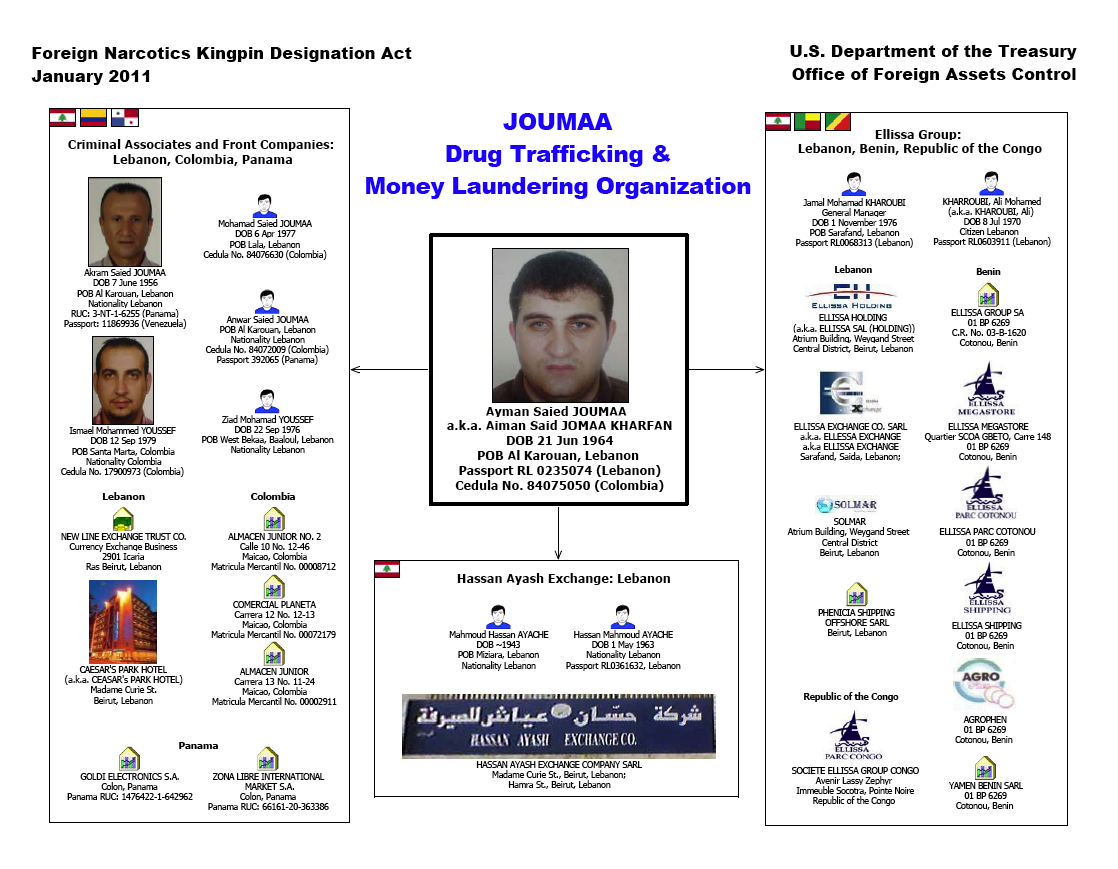
The government continues to crack down on Ayman Joumaa’s Hezbollah-tied money laundering ring, yesterday suing some exchange companies and the auto dealers tied the ring.

The announcement reads like a Bush Axis of Evil speech, emphasizing the role of Hezbollah even though just “tens of millions” of the hundreds of millions involved went via one channel to Hezbollah.

A network of money couriers controlled by Oussama Salhab, an alleged Hizballah operative living in Togo, transported tens of millions of dollars and Euros from Benin to Lebanon through Togo and Ghana.

And another of the key players is actually a Christian group, albeit one closely tied to Hezbollah.

Another drug trafficking organization, which is led by Maroun Saade, is also involved in the transportation and distribution of large quantities of narcotics in West Africa. Saade is a member of the Free Patriotic Movement, a Lebanese Christian organization closely allied with Hizballah, and has provided extensive services to Hizballah members engaged in narcotics trafficking and bulk cash smuggling in West Africa.

And the geography the government paints has the same focus: Lebanon, Benin, and–in their larger claims–Iran and Venezuela.

Funny. They seem to be de-emphasizing two other countries that are–according to the Treasury Department–central to Joumaa’s network: Colombia, where all the drugs derive from, and Panama. Not only does Joumaa have two locations in Panama and three in Colombia, but he and several of his alleged network members carry Colombian or Panamanian ID (one also has a Venezuelan passport).

You know? Two of the three countries we signed trade agreements with this year, between the time Treasury first started cracking down on this network and now? Panama, which opponents of the trade deals noted would probably serve as a vehicle for financial entities to launder money?

Now, I look forward to seeing more of the network–particularly whether this is a drug cartel using the services of a terrorist organization (as it seems) or a(nother) terrorist organization getting into the drugs business. Not to mention whether Manssor Arbabsiar had ties to the auto dealer plot (though he doesn’t appear in the list of 30 sanctioned dealers).

But while you’re watching, it’s worth keeping in mind that the US just strengthened its alliance with two of the key countries involved in this network.

Share this entry

The Scary Used Car Broker Plot

Consider these two data points. First, Jo Becker reports that the money laundering scheme run by the Canadian Lebanese Bank involved brokering used cars purchased in America.

In that inquiry, American Treasury officials said senior bank managers had assisted a handful of account holders in running a scheme to wash drug money by mixing it with the proceeds of used cars bought in the United States and sold in Africa. A cut of the profits, officials said, went to Hezbollah, a link the organization disputes.

[snip]

Eventually an American team dispatched to look into Mr. Joumaa’s activities uncovered the used-car operation. Cars bought in United States were sold in Africa, with cash proceeds flown into Beirut and deposited into three money-exchange houses, one owned by Mr. Joumaa’s family and another down the street from his hotel. The exchanges then deposited the money, the ostensible proceeds of a booming auto trade, into the Lebanese Canadian Bank, so named because it was once a subsidiary of the Royal Bank of Canada Middle East.

But the numbers did not add up. The car lots in the United States, many owned by Lebanese émigrés and one linked to a separate Hezbollah weapons-smuggling scheme, were not moving nearly enough merchandise to account for all that cash, American officials said. What was really going on, they concluded, was that European drug proceeds were being intermingled with the car-sale cash to make it appear legitimate.

Hezbollah received its cut either from the exchange houses, or via the bank itself, according to the D.E.A. And the Treasury Department concluded that Iran also used the bank to avoid sanctions, with Hezbollah’s envoy to Tehran serving as go-between.

And we only indicted the guy running this plot, Ayman Joumaa, in November, 10 months after Treasury designated Ayman Joumaa as a Specially Designated Narcotics Traffickers.

Of course, November 23 is roughly two months after Manssor Arbabsiar, an Iranian used car broker whose finances had a remarkable uptick in the last two years, during which period he largely left South Texas, was arrested.

And while all of the ties Treasury noted in January were to Colombian drug networks, November’s indictment rolled out this week includes a Los Zetas angle.

It was part of the conspiracy that the defendant and his co-conspirators coordinated the shipment of at least tens of thousands of kilograms of cocaine from Colombia, through Central America and Mexico, to the United States, including but not limited to 85,000 kilograms ofcocaine shipped from Colombia for sale to Los Zetas drug cartel from in and around 2005 through in and around 2007.

I’ll come back to this later–I’m watching Robert Mueller repeat that it’s more important for FBI to entrap Muslim kids than to crack down on financial fraud at SJC.

But I’d suggest that the discovery of Scary Iran Plot as a side angle to Scary Used Auto Broker Plot would explain a lot of the problems with the case.

Update: One other thing: I’m curious why DOJ sealed the Joumaa indictment from November 23 to December 12. I don’t know the answer to that, but it’s worth noting that Hezbollah and Iran rolled up US and Israeli spy rings during that period.


Share this entry

“This Isn’t the Assassination Surveillance Drone You’re Looking For”

[YouTube]vzcWPKAv2Ow[/YouTube]

Before you read this David Sanger/Scott Shane piece reporting that the RQ-170 Sentinel drone that just went down in Iran was, “among other missions, [] looking for tunnels, underground facilities or other places where Iran could be building centrifuge parts or enrichment facilities,” I invite you to review what David Sanger has been writing for the last few months. Sure, he’s been the key person orchestrating the IAEA Iran report story, going back months. There’s also this story, curiously mixing reporting on the capture of the drone with a report citing sources describing surveillance photos of the Iranian missile testing base conveniently blown up while Iran’s top missile expert was there.

And then there’s this story from last month, which is or was titled “The Secret War with Iran.” It suggests how the assassins targeting Iran’s nuclear scientists knew exact details of their daily commutes, and then went on to describe the centrality of drones to our surveillance efforts against Iran.

COMMUTING to work in Tehran is never easy, but it is particularly nerve-racking these days for the scientists of Shahid Beheshti University. It was a little less than a year ago when one of them, Majid Shahriari, and his wife were stuck in traffic at 7:40 a.m. and a motorcycle pulled up alongside the car. There was a faint “click” as a magnet attached to the driver’s side door. The huge explosion came a few seconds later, killing him and injuring his wife.

On the other side of town, 20 minutes later, a nearly identical attack played out against Mr. Shahriari’s colleague Fereydoon Abbasi, a nuclear scientist and longtime member of the Islamic Revolutionary Guards Corps. Perhaps because of his military training, Mr. Abbasi recognized what was happening, and pulled himself and his wife out the door just before his car turned into a fireball. Iran has charged that Israel was behind the attacks — and many outsiders believe the “sticky bombs” are the hallmarks of a Mossad hit.

[snip]

Iran may be the most challenging test of the Obama administration’s focus on new, cheap technologies that could avoid expensive boots on the ground; drones are the most obvious, cyberweapons the least discussed. It does not quite add up to a new Obama Doctrine, but the methods are defining a new era of nearly constant confrontation and containment. Drones are part of a tactic to keep America’s adversaries off balance and preoccupied with defending themselves. Read more

Share this entry

Mark Udall’s Unsatisfactory Solution to the Detainee Provisions

As I have repeatedly described, I have very mixed feelings about the debate over Detainee Provisions set to pass the Senate tonight or tomorrow. I view it as a fight between advocates of martial law and advocates of relatively unchecked Presidential power. And as I’ve pointed out, the SASC compromise language actually limits Presidential power as it has been interpreted in a series of secret OLC opinions.

Which is why I’m no happier with Mark Udall’s amendment than I am with any of the other options here.

On its face, Udall’s amendment looks like a reset: A request that the Executive Branch describe precisely how it sees the military should be used in detention.

SEC. 1031. REVIEW OF AUTHORITY OF THE ARMED FORCES OF THE UNITED STATES TO DETAIN COVERED PERSONS PURSUANT TO THE AUTHORIZATION FOR USE OF MILITARY FORCE.

(a) In General.–Not later than 90 days after the date of the enactment of this Act, the Secretary of Defense shall, in consultation with appropriate officials in the Executive Office of the President, the Director of National Intelligence, the Secretary of State, the Secretary of Homeland Security, and the Attorney General, submit to the appropriate committees of Congress a report setting forth the following:

(1) A statement of the position of the Executive Branch on the appropriate role for the Armed Forces of the United States in the detention and prosecution of covered persons (as defined in subsection (b)).

(2) A statement and assessment of the legal authority asserted by the Executive Branch for such detention and prosecution.

(3) A statement of any existing deficiencies or anticipated deficiencies in the legal authority for such detention and prosecution.

On one hand, this seems like a fair compromise. The Republicans want something in writing, Carl Levin claims SASC met just about every demand the Administration made in its attempt to codify the authority, but in response the President still issued a veto threat. So why not ask the President to provide language codifying the authority himself?

Read more

Share this entry

The Lessons of Iran-Contra 2.0

In “honor” of the 25th Anniversary of the press conference admitting to Iran-Contra on Friday, National Security Archive liberated memos an aide to Special Prosecutor Lawrence Walsh, Christian Mixter, wrote assessing the criminal liability of Reagan and Poppy Bush. The report found that a loophole Ed Meese suggested–basically using National Security Act to trump the Arms Control Export Control Act–would make it difficult to prosecute Reagan for hiding transfers of money.

On Reagan, Mixter reported that the President was “briefed in advance” on each of the illicit sales of missiles to Iran. The criminality of the arms sales to Iran “involves a number of close legal calls,” Mixter wrote. He found that it would be difficult to prosecute Reagan for violating the Arms Export Control Act (AECA) which mandates advising Congress about arms transfers through a third country-the U.S. missiles were transferred to Iran from Israel during the first phase of the operation in 1985-because Attorney General Meese had told the president the 1947 National Security Act could be invoked to supersede the AECA.

As the Iran operations went forward, some of Reagan’s own top officials certainly believed that the violation of the AECA as well as the failure to notify Congress of these covert operations were illegal-and prosecutable. In a dramatic meeting on December 7, 1985, Secretary of Defense Caspar Weinberger told the President that “washing [the] transaction thru Israel wouldn’t make it legal.” When Reagan responded that “he could answer charges of illegality but he couldn’t answer charge that ‘big strong President Reagan passed up a chance to free hostages,” Weinberger suggested they might all end up in jail. “Visiting hours are on Thursdays,” Weinberger stated. As the scandal unfolded a year later, Reagan and his top aides gathered in the White House Situation Room the day before the November 25 press conference to work out a way to protect the president from impeachment proceedings.

And you couldn’t prosecute Reagan for lying to the American people because doing that is not a crime.

Mixter also found that Reagan’s public misrepresentations of his role in Iran-Contra operations could not be prosecuted because deceiving the press and the American public was not a crime.

As to Poppy, he was intimately involved in all the same close calls decisions Reagan was, but since he was junior to Reagan, you couldn’t prosecute him either. (The memo was written before it became clear Poppy had been hiding his diaries from the investigation.)

The NSA report on the documents–particularly this detail…

The memorandum on criminal liability noted that Bush had a long involvement in the Contra war, chairing the secret “Special Situation Group” in 1983 which “recommended specific covert operations” including “the mining of Nicaragua’s rivers and harbors.” Mixter also cited no less than a dozen meetings that Bush attended between 1984 and 1986 in which illicit aid to the Contras was discussed.

… Reminded me of Sy Hersh’s description of a meeting at which the Iran-Contra dead-enders in the W Administration plotted how to improve on Iran-Contra.

They set about and talking about how to sabotage oversight. And what is the model for sabotaging oversight? The model turned out to be the Bill Casey model. Read more

Share this entry