Gaps in the Iran Plot Docket to Go Along with the Gaps in the Story

[youtube]WfsWIoO2CPc[/youtube]

Retired Lieutenant Colonel Anthony Shaffer has some questions about the Iran plot, based partly on what his friend at DOJ said about the lack of record on the purported asassination plot at DOJ.

I did talk to one of my inside guys today and he’s saying that he thinks the same thing–you know why? Because he can’t find any real information and he’s got a clearance. So that tells him that there’s something going on that’s extraordinary by the fact that he’s an inside investigator, knows what’s going on, and yet–I’m gonna quote here, “There’s nothing on this within the DOJ beyond what they’ve talked about publicly,” which means to him there’s something very wrong with it.

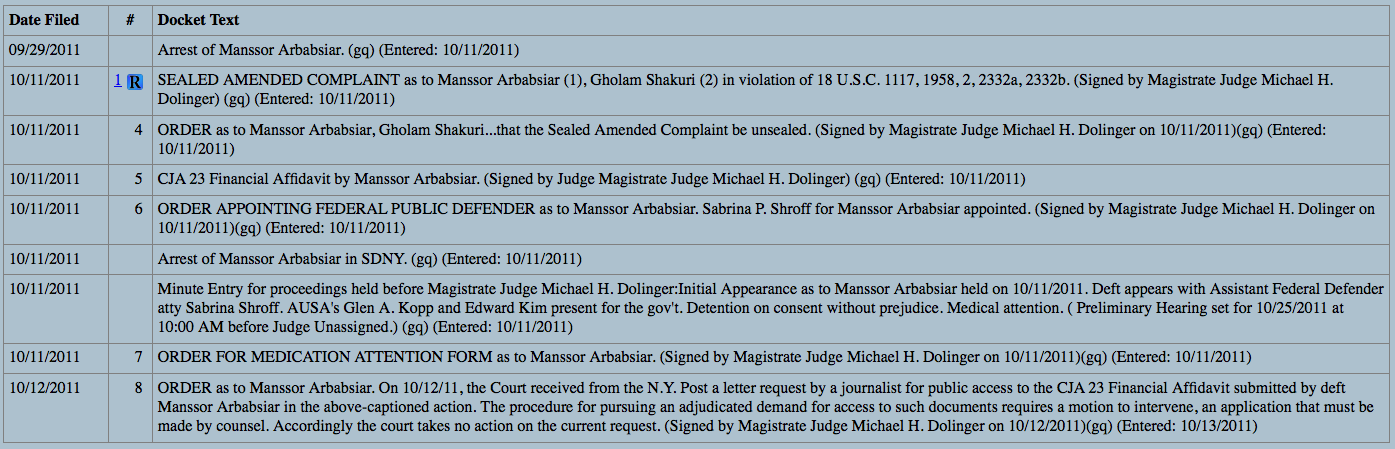
The docket in Manssor Arbabsiar’s case at least partly confirms what Shaffer’s buddy said, because there are things that would normally be there but aren’t.

There are a couple of weird aspects to the docket (click to enlarge).

First (and this is what got me looking at the docket in the first place), the complaint is an amended complaint. That says there’s a previous complaint. But that complaint is not in the docket. Not only is it not in the docket, but the docket starts with the arrest on September 29 (notice the docket lists his arrest twice, on both September 29 and October 11), but the numbering starts with the amended complaint (normally, even if there were a sealed original complaint, it would be incorporated within the numbering, such that the docket might start with the amended complaint but start with number 8 or something).

Two things might explain this. First, that there was an earlier unrelated complaint–say on drug charges, but the charges are tied closely enough to this op such that this counts as an amended complaint. Alternately, that Arbabsiar was charged with a bunch of things when he was arrested on September 29, but then, after at least 12 days of cooperation (during which he waived Miranda rights each day), he was charged with something else and the new complaint incorporated Ali Gholam Shakuri’s involvement, based entirely on Arbabsiar’s confession and Shakuri’s coded conversations with Arbabsiar while the latter was in US custody.

Both of those scenarios suggest that what we see–the WMD and terror charges–might be totally different charges than what the original complaint included (or just focused less closely on Arbabsiar). In any case, the presence of an original complaint, even putting the docket weirdness aside, makes it pretty likely that Arbabsiar decided to cooperate because of what was in that complaint.

Now look at his status. “Detention on consent without prejudice.” Arbabsiar wants to be in jail. Given that his cooperation and implication of the Qods Force has turned into an international incident, I don’t blame the guy.

All of which does sort of make you wonder what medical attention the court ordered for Arbabsiar.

Now we may find there are perfectly reasonable explanations for why an already funky complaint that goes to great lengths to pretend the spooks weren’t involved in the case when they played an explicitly critical role has some oddities in its docket. But I would suggest–and I hope to at more length tomorrow–that DOJ’s records system might be the wrong place to look for background information on Manssor Arbabsiar.

And at the very least, the gaps in the docket mean that DOJ is currently unwilling to tell us when and on what charges Arbabsiar was first charged, and on what basis he cooperated with the authorities.

Update: This post was tweaked for clarity.

Update: As I was responding to EH, I realized something. As I said to him, the least damning explanation for the two complaints is that the original complaint had the same charges–WMD, terrorism, etc.–but charging just Arbabsiar.

But that’s not right! Three of the four charges are conspiracy charges (the exception was Foreign Travel and Use of Interstate and Foreign Commerce Facilities in the Commission of Murder-for-Hire). Unless the government were preparing a really crazy prosecution theory, you don’t charge just one person with conspiracy. Which raises real questions about what the charges in the original complaint were, particularly given the only evidence they had were money transfers not tied directly to Qods Force. And some tapes (as well as some key conversations that were not taped). The missing tapes would be particularly problematic given that Arbabsiar claims he was not sent to do murder for hire, he was sent to do kidnapping, and those missing tapes might explain how the plot evolved).

Update: I think I finally got the August/September fix right. Thanks, MD.

Share this entry

The Narratology of the Russian Scientist We’re Allowed to Memorialize but Not Quote

I was meaning to write a post on this filing in the Jeffrey Sterling case, largely to point out the government is trying to prevent Sterling from arguing that everyone–particularly John Brennan–leaks.

The Court should bar the defendant from presenting any evidence, argument or comments of selective prosecution or that everybody leaks classified information.

[snip]

Not only is such evidence not probative on the issue of whether the defendant committed the charged crimes, but the introduction of such evidence or arguments would force mini-trials over the similarities and differences between the present prosecution and every other specific instance of leaked classified information. Fights over the classification levels of the information, the potential damage caused to the United States, and a host of other issues would consume and overwhelm the real issues in this case.

The motion is particularly amusing not just because it was submitted at the very same time senior officials–including Brennan, who was involved in the underlying issues in this case–were leaking state secrets for days. And because, a week after this, the Defense did file a still-sealed selective prosecution motion. Moreover, the government’s case citations don’t address the instant issue: that the prosecuting agency itself–DOJ–leaks with impunity. It’s one thing to say other non-governmental criminals commit the same crime without being prosecuted; it’s another to say the agency prosecuting Sterling doesn’t prosecute people within its own agency that commit the same alleged crime.

Alas, I am going to have to, instead, focus instead on the motion to prevent Sterling from presenting any evidence that the Russian Scientist tasked with handing off faulty blueprints to the Iranians might be James Risen’s source.

 The court should bar the defendant from presenting any evidence or any argument regarding alternative perpetrators absent some non-speculative evidence of a connection to Risen and some knowledge of or access to Classified Program No. 1. Specifically, absent such nonspeculative evidence, the caselaw forecloses the defendant from presenting any evidence or making any argument regarding the following:

[snip]

Arguments or comments that Human Asset No. 1 was Risen’s source and disclosed the national defense information contained within Chapter 9;

Of course, all this is happening while the government is simultaneously trying to get comments the Russian Scientist made to his case officer when Risen’s book came out admitted into evidence, while at the same time trying to prevent Sterling from subpoenaing the underlying documents that might show the Russian had to be Risen’s source.

The government, you see, wants to admit evidence that the Russian was scared Risen’s revelations put his safety at risk.

On or about January 23, 2006, after having read Chapter 9 and the information contained therein for the first time, Human Asset No. 1 contacted his CIA case officer and requested an unscheduled meeting. Human Asset No. 1 subsequently met with his CIA case officer and reported his fears and personal safety concerns for himself and his family. The case officer contemporaneously memorialized Human Asset No. 1’s fears in a cable. See Dkt. 153, CIPA Exhibit 47. That cable demonstrates that Human Asset No. 1 made his statements to his CIA case officer while still “under the stress of excitement” caused by the level of detail identifying him as the asset involved in Classified Program No. 1. In addition, the CIA case officer will testify at trial that he had never seen Human Asset No. 1 so shaken and scared than on that day as Human Asset No. 1 reported his fears and concerns to him.

The government moved to enter this cable after the defense had already apparently (the filing is heavily redacted) pointed out that Risen’s book had not identified the Russian scientist–the defense appears to want to call Pat Lang to support this point–but also to note that the Russian would have had as much reason to want to discredit the CIA as Sterling allegedly would after he had been put in the position of dealing bad documents to Iran.

More interesting, Sterling suggests that the Russian may be the only person who had a document mentioned in Risen’s book. One possibility is a written report the Russian made of his trip. Another is the content of the cover letter he wrote warning the Iranians that there was something wrong with the blueprints.

But most notably–given the claims and counter-claims about what Risen’s narrative style might indicate about his sources–the Defense notes that much of the narrative of MERLIN is focalized through the Russian.

Human Asset No. 1 obviously had knoweldge of almost all of the information that appears in Chapter Nine. Indeed, there are portions of that Chapter that detail actions about which only Human Asset No. 1 had first-hand knowledge and those portions of the Chapter are written from the perspective of Human Asset No. 1. See, e.g. State of War at 194-95 (“I’m not a spy, he thought to himself. I’m a scientist. What am I doing here?”); Read more

Share this entry

Project BACUS Facility at Dugway Has Both Fermentation and Weaponization Capabilities

A fermenter about twice the size of the one at the BACUS facility. (Novartis AG photo under Creative Commons license)

CNN informs us this morning that a report card issued by the bipartisan WMD Terrorism Research Center, headed by former Senators Bob Graham and Jim Talent, has issued failing grades to the US in its Bio-Response Report Card (pdf).  The primary news from the report card, according to CNN, is that “The United States remains largely unprepared for a large-scale bioterrorism attack or deadly disease outbreak”.  The grades:

The report card gave 15 F’s,15 D’s and no A’s in its assessment of current bio-defense capabilities in the United States.

As I was reading the report, however, one short passage jumped out at me since I have been concentrating recently on the anthrax attacks of 2001.  As noted in this diary, I was aware of Judy Miller’s reporting from September 4, 2001 on Project BACUS, which involved the construction and operation of a small facility capable of producing bioweapons:

In a nondescript mustard-colored building that was once a military recreation hall and barbershop, the Pentagon has built a germ factory that could make enough lethal microbes to wipe out entire cities.

Adjacent to the pool tables, the shuffleboard and the bar stands a gleaming stainless steel cylinder, the 50-liter (53-quart) fermenter in which germs can be cultivated.

The apparatus, which includes a latticework of pipes and other equipment, was made entirely with commercially available components bought from hardware stores and other suppliers for about $1 million — a pittance for a weapon that could deliver death on such a large scale.

Miller goes on to claim in this article that this facility “never made anthrax or any other lethal pathogen”.  Instead, she cites two production runs of biopesticides in 1999 and 2000.

The BACUS facility turns up in the WMD Terrorism Research Center’s Report Card.  In this case, the source cited is not the New York Times article I cite above, but Miller’s 2001 book, Germs: Biological Weapons and America’s Secret War:

The first piece of hard evidence regarding the capability of non-state actors to produce sophisticated biological weapons came in 1999 from a Defense Threat Reduction Agency study called Biotechnology Activity Characterization by Unconventional Signature (BACUS). The initial purpose of the study was to determine if a small-scale bioweapons production facility would produce an observable “intelligence signature.”

The answer was no. The study concluded that even when using “national technical means,” it would be extremely difficult, if not impossible, for the intelligence community to detect a clandestine production facility. This conclusion was somewhat expected. The surprise, however, came from an experiment conducted as part of the study. Individuals, with no background in the development and production of bioweapons and no access to the classified information from the former U.S. bioweapons program, were able to produce a significant quantity of high-quality weaponized Bacillus globigii—a close cousin to the well-known threat, Anthrax.

From the New York Times article, I had viewed the BACUS site as solely a fermentation site. This disclosure that the facility also is equipped to weaponize the material produced makes it even more likely that this site, or one very similar to it, could have served as the real source of the material used in the 2001 anthrax attacks.

The second important disclosure in this short passage from the report is that it was possible for people “with no background in the development and production of bioweapons” or access to US bioweapons technology could use this facility to produce “a significant quantity of high-quality weaponized” anthrax simulant.

So, now that we know that the BACUS facility was fully operational at the time of the anthrax attacks, that it could produce and weaponize spores and that it could be successfully operated by individuals without bioweapons expertise, how is it that the entire staff of the Dugway site, where the BACUS facility is located, was eliminated in the Amerithrax investigation? McClatchy reporter Greg Gordon shed some light on that topic yesterday in a live chat put on in coordination with the recent McClatchy/ProPublica/Frontline documentary on the Amerithrax investigation:

At Dugway, which unlike USAMRIID did make anthrax powder, the FBI examined who was present at work and during what hours on the days before the anthrax was postmarked. The bureau concluded that none of Dugway’s researchers could have flown to New Jersey and back during their windows of opportunity

It is clear from this description that the FBI prejudiced the investigation of Dugway personnel by looking only for “lone wolf” actors rather than allowing for the possibility of multiple personnel acting in concert to perpetrate the attacks. Even for a facility as small as BACUS, such an assumption becomes almost ludicrous on its face. I have experience with fermentation equipment such as the 50 liter fermenter installed at BACUS, and it is quite a stretch of the imagination that a single person could prepare the starter culture, prepare and sterilize the fermentation medium, monitor the 18-24 hour fermentation run, harvest and process the spores and then dry and weaponize them without help from another person. In this regard, note that the Report Card quote above implies that it was a team, rather than a single person, who carried out the demonstration run described. The team would not need to be huge, but at least two to three people working together would be my estimate of what it would take to successfully carry out the steps outlined above.

Did the FBI examine records of fermenter use at Dugway in the months preceding the attacks? Did they investigate whether the BACUS facility had been in use? Did they look for evidence of material being shipped from Dugway to a recipient on the East Coast who could have dropped the letters in the Princeton mailbox?

The combination of the full functionality of the BACUS facility, coupled with the description of the weak criteria on which Dugway personnel were eliminated as suspects in the Amerithrax investigation demands further attention from the FBI. But don’t hold your breath waiting for that to happen.

Share this entry

The Iran “Plot”: Hillary Tries to Involve the UN

Hillary Clinton has invoked a UN treaty protecting diplomats and country leaders in her effort to turn the absurd Iranian plot into an international incident.

If they were involved in a plot to kill Saudi Ambassador Adel al-Jubeir, that would likely violate the U.N. Convention on the Prevention and Punishment of Crimes Against Internationally Protected Persons.

[snip]

Secretary of State Hillary Clinton made a point on Wednesday of noting that Iran had agreed to the U.N. treaty.

“This kind of reckless act undermines international norms and the international system. Iran must be held accountable for its actions,” she said.

The United States has two options if Iran officially rejects the case, including pursuing action at the U.N. Security Council. That was done when Libya refused to hand over two men accused of the Pan Am 103 bombing over Lockerbie, Scotland.

The United States or Saudi Arabia could bring it to the United Nations and argue that “these are very obvious violations and for the Security Council to do nothing in light of this major attempted violation cheapens the words” of the treaty, Kaye said.

Another option, if there is a dispute under the U.N. treaty for protected persons, is that one side can seek an arbitration and ultimately a ruling from the Court of International Justice, located in the Netherlands.

How convenient that this plot would so neatly provide the US and Saudi Arabia opportunity to start demanding the extradition of Qods Force leaders.

But given the Intelligence Community’s acknowledged, though still unexplained role in this plot, and given that the development of a kidnapping plot into an assassination plot (both are covered by the UN treaty) may have happened during conversations where our experienced DEA informant somehow forgot to press the button on his tape recorder, and given that the FBI coached the DEA agent to invent all the details of this plot (including, potentially, its location in DC), shouldn’t Hillary be a little more cautious before she calls for the extradition of those who dreamt up this plot?

It would be terrible if our own people were held accountable for one of the many acts of attempted terrorism they’ve either incited or encouraged, after all.

Share this entry

How a Used Car Salesman’s Alleged Kidnapping Plot Turned into an International Incident

Let me correct something the press has almost universally gotten wrong about the Manssor Arbabsiar plot. He was not originally sent to assassinate the Saudi Ambassador to the US in a spectacular bombing plot. According to the complaint, after Arbabsiar offered up his service to his cousin, Abdul Reza Shahlai, sometime in early spring, Shahlai asked him to find a drug cartel that would kidnap the Saudi Ambassador. Sometime between that point and July 17, the plot evolved into a kill or kidnap operation, and then a kill operation. But key details of how and when this happened rather curiously were not taped by the informant (whom I refer to as Narc). This raises the possibility that Narc suggested the most spectacular aspects of this plot, both the bombing attempt and the assassination, after he got approached to kidnap Saudi Ambassador Adel Al-Jubeir. In other words, it is possible that Narc and his government handlers turned this from a kidnapping attempt into a terrorist plot complete with C4, which makes it a WMD plot.

I’ve got a timeline below, but first, a few points. There’s one section of the complaint that obscures the chronology of how the kidnapping plot turned into the assassination plot. Paragraphs 39 a-e describe what Arbabsiar said in his confession, but the events are dated only with the description, “upon his return to Iran.” There’s one period of time that, the complaint makes clear, Arbabsiar was in Iran, from July 20 through September 28; given the complaint’s clear signal he was in Iran in this period and the wiring of the payment, I’ve put the events described in his confession in that period. However, Arbabsiar was “traveling internationally” during another period, from May 30 to June 23, when Arbabsiar likely was also in Iran, so the events (and therefore the decision to assassinate the Ambassador) may have come earlier. I actually think the most likely scenario is that the first part of paragraph 39a–describing him reporting he had “located a drug dealer”–happened in that earlier window, but the other events happened in the later window.

There’s one other very critical issue about whether the assassination plot came from Narc or the Qods plotters. The complaint says clearly that the code name for the Ambassador assassination was “Chevrolet.” But a number of the other conversations with Shakuri (and, indeed, the September 2 call between Arbabsiar and Narc) talk about a building. And the complaint (and some of the quoted comments below) make it clear they were also talking about other operations with Narc. And when Shakuri first talks to Arbabsiar after he’s in FBI custody (remember, he believes Arbabsiar is with Los Zetas), he raises the building, not the Chevrolet, first. I actually suspect–given the discussion of “buying all of it”–that Chevrolet may actually refer to another plot, perhaps a drug deal (see Juan Cole’s speculation this might be about drugs), whereas the building refers to the assassination attempt. But in any case, at the very least it says that if Chevrolet was, indeed, the code, then Shakuri was most interested in the building plot, not the Chevrolet plot when he first talked to Arbabsiar.

Early Spring 2011: According to Arbabsiar’s confession, Shahlai approaches Arbabsiar and asked him to work with him. Arbabsiar offers up “that as a result of his business in both Mexico and the United States, he knew a number of people who traveled between the two countries, and some of those people, he believed, were narcotics traffickers. Shahlai responds, “that he wanted Arbabsiar to hire someone who could kidnap the Saudi Arabian Ambassador to the United States and that Arbabsiar should find someone in the narcotics business, because people in that business are willing to undertake criminal activity in exchange for money.”

After that meeting: According to Arbabsiar’s confession, Shahlai provided thousands of dollars for expenses. This is, at least from the detail given in the plot, the last that Shahlai is involved personally in the plot.

May 24, 2011: In one-day trip to Mexico from Texas, Arbabsiar meets with DEA informant posing as a Los Zetas member (Narc). The meeting is allegedly not recorded. After the meeting, Narc told his handlers that Arbabsiar was interested in, “among other things, attacking an embassy of Saudi Arabia.” According to Narc, Arbabsiar asked about his expertise, including on explosives. In response, Narc offered up that he was knowledgeable in C4.

Read more

Share this entry

Lisa Monaco Would Like to Thank the Academy

One nice touch of today’s press conference rolling out the latest FBI-created plot (aside from comedy lines like “they had no regard for the rule of law” and “we will not let other countries use our soil as their battleground”) is that the fairly new Assistant Attorney General for National Security, Lisa Monaco, got a speaking role.

That’s certainly not inappropriate; given that this plot was either invented by or targeted at Iran, the NSD would be right in the thick of the action.

It’s the content of her statements, focusing almost entirely on thanking participants in the “investigation,” I find so interesting. She started by thanking her reports in the NSD, particularly the Counterterrorism Section. Then the US Attorney’s Offices in Southern District of NY and Houston. Then the FBI, the DEA, and the NY Joint Terrorism Task Force. After having thanked those groups–two of which (FBI and DEA) are members of the Intelligence Community–she then thanked the Intelligence Community.

Finally, I want to thank the intelligence community for its critical role in this matter. The National Security Division was designed to serve as the place where intelligence and law enforcement come together at the Justice Department. I am proud to say that we served that purpose here. This case demonstrates exactly how the division is supposed to work and should serve as a model for future cases.

(Holder offers less demonstrative thanks to the intelligence community too.) In other words, the head of the NSD, which would handle cooperation between the ops side and the law enforcement side, dedicated one-fifth of her comments, a quarter of her thanks, to the IC members presumably above and beyond the FBI and DEA officers who led this sting.

By itself, that’s not a surprise. After all, even the recent model plane UAV plot the FBI invented would have involved the NSA and CIA closely because the FBI seems to have targeted Rezwan Ferdaus, the plotter, because of his comments in jihadist chat rooms. But by contrast with such operations as that one, the complaint in this case offers no obvious tip to the involvement of the IC.

Sure, there would be intelligence analysts, the experts on the Quds Force (though the FBI agent writing the complaint attributed information on the Quds to Treasury and State declarations and “other ‘open source’ information,” in the same way he attributes information on Los Zetas to “published reports”). There might be Treasury investigators, the people who use SWIFT to track the two international wire transfers that are the primary evidence in the case, but the FBI could probably track the transfers themselves, not least because the transfers ended up in an FBI bank account and I suspect they went through a friendly bank in NYC. You’d think the NSA would be involved, but the informant, who I call “Narc,” taped all the phone conversations himself until Arbabsiar’s arrest, after which the FBI taped his calls. There is a reference to pictures of Quds members, presumably taken by intelligence agencies.

But those are the only visible signs of IC involvement. Indeed, the complaint appears designed to hide any hint of IC involvement and the sting appears designed to avoid any obvious involvement from the IC. That is, from the looks of things, this arrest required less involvement from the IC than Fardaus’.

Which I assume is the point: to create the appearance of an FBI arrest that seems entirely unmotivated by underlying intelligence plots.

And yet unnamed agencies in the IC got prominent kudos for their “critical role in this matter.”

With that in mind, I wanted to point to a few interesting details in the complaint.

Perhaps most interesting, the complaint’s account of how a seeming incompetent like Arbabsiar got sent out to negotiate ties between the Quds and Los Zeta indicates Arbabsiar suggested he get involved, not his cousin Abdul Reza Shahlai (described here as Iranian Official #1).

ARBABSIAR told Iranian Official #1 that as a result of his business in both Mexico and the United States, he (ARBABSIAR) knew a number of people who traveled between the two countries, and some of those people, he (ARBABSIAR) believed, were narcotics traffickers. Iranian Official #1 told ARBABSIAR that he wanted ARBABSIAR to hire someone who could kidnap the Saudi Arabian Ambassador to the United States and that ARBABSIAR should find someone in the narcotics business, because people in that business are willing to undertake criminal activity in exchange for money.

And note how, at the start, Shahlai wanted only a kidnapping? Arbabsiar and Narc turned it into an assassination. And Narc offered up the C4 that is the entire basis of the WMD complaint (and, more largely, the terrorism charge).

Note, too, how it was orchestrated such that Arbabsiar would be in custody making calls back to Iran that would capture Arbabsiar’s co-conspirator, Gholam Shakuri, in the plot (every single one of these charges is a conspiracy charge, so getting some evidence against Shakuri was critical to even charging Arbabsiar without having him engage in an actual attack). The explanation was that Narc wanted something–either more money or Arbabsiar’s presence in Mexico–as a guarantee of the remainder of the $1.5 million payoff before he’d order the hit. Shakuri advised against Ababsiar traveling to Mexico.

SHAKURI stated that no more money should be given to [Narc], and advised ARBABSIAR against traveling back to Mexico. SHAKURI said that ARBABSIAR was responsible for himself if he did travel.

Then, when he was in custody pretending to be in Los Zetas custody, Arbabsiar called Shakuri and told him Narc wanted more money–presumably a ploy by the FBI to get Shakuri reconfirming the plan for the plot and his involvement in the money transfer. But Shakuri rejected that request.

SHAKURI then stated: “You said it yourself, they–from our point of view of–when we get our merchandise, we get our merchandise.” SHAKURI added, “We have guaranteed the rest. You were our guarantee.”

If this were a real plot and Los Zetas were really playing hardball for a bigger advance, then Shakuri’s decision might well have gotten Arbabsiar killed. At the very least, Shakuri’s refusal to pony up any more advance money suggests some ambivalence about the operation (or Arbabsiar’s life).

Now, it’s not clear when Arbabsiar decided to cooperate with the FBI–only when he was arrested (and promptly waived Miranda rights), or back in the spring when he proposed reaching out to Los Zetas to his cousin and along the way turned a kidnapping into a terrorist attack.

But it seems clear that someone orchestrated this sting from behind the scenes to create the appearance of a Quds-sponsored terrorism plot in the US. And for that reason, among the other players and directors and cinematographers Lisa Monaco thanked at the press conference, she also thanked the IC for the critical role they played in orchestrating the show.

Share this entry

The Iranian Plot: Bank Transfers of Mass Destruction

I’m sorry, but I’m having a really difficult time taking this latest terrorist plot seriously. Not just because the story is so neat, tying together all the enemies–the drug cartles and Iran–we’re currently supposed to hate, but because it elicited such comical lines from Eric Holder and NY US Attorney Preet Bharara about assassinating other government’s officials (like, say, Qaddafi’s son) and doing battle on other country’s soil (like, say, the entire world) and not taking sufficient precautions to prevent civilian casualties.

But just to unpack what the government claims it found, here’s the amended complaint.

The big action that, the government suggests, proves the case involves two bank transfers:

On or about August 1, 2011, MANSSOR ARBABSIAR, a/k/a “Mansour Arbabsiar,” the defendant, caused an overseas wire transfer of approximately $49,960 to be sent by a foreign entity from a bank located in a foreign country to an FBI undercover bank account (the “UC Bank Account”). Before reaching the UC Bank Account, the funds were transferred through a bank in Manhattan, New York.

On or about August 9, 2011, ARBABSIAR caused an overseas wire transfer of approximately $49,960 to be sent by a foreign entity from a bank located in a foreign country to an FBI undercover bank account (the “UC Bank Account”). Before reaching the UC Bank Account, the funds were transferred through a bank in Manhattan, New York.

And based on those transfers, one unsuccessful attempt to enter Mexico, and a lot of talk between an informant and one of the defendants, we’ve got another terrorist plot.

Admittedly, there’s a backstory to how that $100,000 got transferred.

As the FBI tells it, back in May, Manssor Arbabsiar traveled to Mexico to meet with a guy he thought was a member of Los Zetas but was instead a narcotics convict-turned-informant I’ll call “Narc.” As always with these narratives, the FBI doesn’t explain how Arbabsiar happened to choose Los Zetas for his hit squad, as implausible as that is. It says only that Arbabsiar’s cousin told him that people “in the narcotics business … are willing to undertake criminal activity in exchange for money.” How plausible would a drug hit on the Saudi Ambassador be? Furthermore, don’t Iranians have their own more subtle ways of working?

Nevertheless, we’re led to believe it is plausible and not at all overdetermined that the cousin of an Iranian spook would launder their assassination through a Mexican drug cartel.

In their first meeting, Narc offered up that he was skilled in the use of C4. This is important, because unless you have explosives, you can’t charge that someone wanted to use WMD. Semi-automatics or poison–which might be more apt weapons to assassinate a Saudi Ambassador (particularly since at one point Arbabsiar specified he’d prefer no civilian casualties)–legally don’t offer the same benefits. In fact, in spite of the fact that Arbabsiar is alleged to have originally sought to have the Ambassador kidnapped or killed, and said, “it doesn’t matter” in response to Narc’s offer to shoot or bomb the Ambassador, Arbabsiar still got that magic WMD charge.

Note, that first meeting took place on May 24. There were other meetings in June and July. It’s only a later meeting–a July 14 meeting–that the complaint first describes as being taped. That’s important not just because these earlier conversations always tend to be illuminating (the complaint notes that Arbabsiar “explained how he came to meet” Narc but doesn’t provide that detail), but also because those earlier, possibly untaped conversations describe the other targets.

Prior to the July 14, 2011 meeting, CS-1 had reported that he and ARBABSIAR had discussed the possibility of attacks on a number of other targets. These targets included foreign government facilities associated with Saudi Arabia and with another country, and these targets were located within and outside of the United States.

These include, according to reports, Israel.

The complaint makes a point to repeatedly provide “proof” that Ababsiar’s plot was paid for by the Iranian government.

This is politics, so these people [ARBABSIAR’s co-conspirators in Iran] they pay this government . . . he’s got [ARBABSIAR’s cousin has got] the, got the government behind him . . . he’s not paying from his pocket.

And the complaint describes Narc describing the fictional plot that Arbabsiar was going to pay for. Narc had all the touches: a fictional restaurant, frequented by fictional Senators, and hundreds of other diners. Just so as to provide Arbabsiar with an opportunity to say he was okay with the death of those fictional Senators, if it had to happen that way.

But here’s the thing I really don’t get.

This complaint charges Arbabsiar and Ali Gholam Shakuri, who is apparently a Colonel in the Quds force. But the whole plot was originally conceived of by his cousin (called “Individual 1” or “Iranian Official 1” in the complaint), who is a Quds General “wanted in America.” In addition, Arbabsiar spoke with another high-ranking Quds official. His cousin provided him the money for the plot, and directed him to carry it out.

And the FBI has evidence of the cousin’s involvement; as part of Arbabsiar’s confession (he waived the right to lawyer), he said,

men he understood to be senior Qods Force officials were aware of and approved, among other things, the use of [Narc] in connection with the plot; payments to [Narc]; and the means by which the Ambassador would be killed in the United States and the casualties that would likely result.

So the FBI had a Quds general directly implicated by his own cousin in a terrorist attack in the US, and another senior Quds official at least tangentially involved. But they don’t indict those two, too? (Note, Fran Townsend just tweeted that Treasury imposed sanctions on these guys; will update when I get that information. Update: see below.)

The complaint may suggest they had an entirely different plan. After Arbabsiar was arrested on September 29, the FBI had him call Shakuri on several different occasions–October 4, October 5, and October 7. Claiming to be in Mexico has guarantor for the remaining 1.4 million promised for the hit, Arbabsiar told Shakuri–the complaint describes, “among other things”–that Narc wanted more money. Shakuri refused to give it to him, reminding him that he was himself the guarantee Narc would get paid. Before Abrbabsiar purportedly went to Mexico, Shakuri had warned him not to go.

All this suggests the FBI was after something else–though it’s not clear what. The obvious thing is that they would use Arbabsiar as bait to get first Shakuri and possibly his cousin.

But I also note that the complaint refers to the cousin and the other Quds officer as men Arbabsiar knew to be Quds officers–as if they might be something else.

In any case, this indictment seems like a recruitment gone bad. If so, should we really have told the world we’re using Los Zetas members we flipped to try to recruit Iranian spies?

Update: This Treasury release explains who the other Quds officers are.

Here are the allegations Treasury made as justifications for the new sanctions designations:

Manssor Arbabsiar

Arbabsiar met on a number of occasions with senior IRGC-QF officials regarding this plot and acted on behalf of senior Qods Force officials – including his cousin Abdul Reza Shahlai and Shahlai’s deputy Gholam Shakuri – to execute the plot. During one such meeting, a $100,000 payment for the murder of the Saudi ambassador was approved by the IRGC-QF. After this meeting, Arbabsiar arranged for approximately $100,000 to be sent from a non-Iranian foreign bank to the United States, to the account of the person he recruited to carry out the assassination.

Qasem Soleimani

As IRGC-QF Commander, Qasem Soleimani oversees the IRGC-QF officers who were involved in this plot. Soleimani was previously designated by the Treasury Department under E.O. 13382 based on his relationship to the IRGC. He was also designated in May 2011 pursuant to E.O. 13572, which targets human rights abuses in Syria, for his role as the Commander of the IRGC-QF, the primary conduit for Iran’s support to the Syrian General Intelligence Directorate (GID).

Hamed Abdollahi

Abdollahi is also a senior IRGC-QF officer who coordinated aspects of this operation. Abdollahi oversees other Qods Force officials – including Shahlai – who were responsible for coordinating and planning this operation.

Abdul Reza Shahlai

Shahlai is an IRGC-QF official who coordinated the plot to assassinate the Saudi Arabian Ambassador to the United States Adel Al-Jubeir, while he was in the United States and to carry out follow-on attacks against other countries’ interests inside the United States and in another country. Shahlai worked through his cousin, Mansour Arbabsiar, who was named in the criminal complaint for conspiring to bring the IRGC-QF’s plot to fruition. Shahlai approved financial allotments to Arbabsiar to help recruit other individuals for the plot, approving $5 million dollars as payment for all of the operations discussed.

Update: Max Fisher also thinks this stinks.

But, for all the plausibility that Iran might be willing to blow up a Saudi ambassador, it’s not at all apparent what they would gain from it. Iran has never been shy about sponsoring terrorism, but only when it was within their interests, or at least their perceived interests. It’s hard to see how they could have possibly decided on a plot like the one that Holder claimed today.

What would it really mean for Iran if the Saudi ambassador to the U.S. were killed in a terrorist attack in Washington? The U.S.-Saudi relationship has been bad and getting worse since the start of the Arab Spring, with the Saudi monarchy working increasingly against the democratic movements that the U.S. supports. A senior member of the royal family even threatened to cut off the close U.S.-Saudi relationship if Obama opposed the Palestinian statehood bid, which he did. If the U.S. and Saudi Arabia really broke off their seven-decade, oil-soaked romance, it would be terrific news for Iran. Saudi Arabia depends on the U.S. selling it arms, helping it with intelligence, and overlooking its domestic and regional (see: Bahrain) abuses.

If the U.S.-Saudi alliance fell apart, the Shia-majority Islamic Republic of Iran would have an easier time pushing its regional influence against Saudi Arabia, especially in some of the crucial states between the two: Iraq, Bahrain, and the United Arab Emirates. Iran would be able to reverse its increasing regional isolation and perhaps flip some Arab leaders from the U.S.-Saudi sphere toward its own. The best part of this, for Iran, is that it probably wouldn’t even have to do anything: the U.S.-Saudi special relationship, if it collapses, would do so without Iran having to lift a finger. The dumbest thing that Iran could possibly do, then, would be stop the collapse, to find some way to bring the U.S. and Saudi Arabia back together. For example, by attempting to blow up the Saudi ambassador to the U.S. on American soil.

 

Share this entry

Ray Kelly Vs. Minimal Oversight

[youtube]xpOMlDVaXzc[/youtube]

In the AP’s first report on the NYPD’s CIA-on-the-Hudson, they quoted City Councilmen Peter Vallone reassuring that his private conversations with Ray Kelly were adequate oversight.

“Ray Kelly briefs me privately on certain subjects that should not be discussed in public,” said City Councilman Peter Vallone. “We’ve discussed in person how they investigate certain groups they suspect have terrorist sympathizers or have terrorist suspects.”

A month and a half of damning new revelations later, Vallone is not so sure.

Peter Vallone, the chairman of the council’s Public Safety Committee, said the council doesn’t have the power to subpoena the NYPD for its intelligence records. And even if it did, he said the operations are too sophisticated for city officials to effectively oversee. More oversight is likely needed, he said, perhaps from the federal government.

“That portion of the police department’s work should probably be looked at by a federal monitor,” he said after Police Commissioner Raymond Kelly testified Thursday at City Hall.

But Kelly–whose cops are being filmed on an increasingly frequent basis beating and pepper spraying peaceful protestors–likes it just fine with no oversight.

Kelly told council members that the department’s internal accountability was rigorous and ensured that civil rights were being protected. And he said everything the department does is in line with court rules, known as the Handschu guidelines, that limit how and why police can collect intelligence before there’s evidence of a crime.

“The value we place on privacy rights and other constitutional protections is part of what motivates the work of counterterrorism,” he said. “It would be counterproductive in the extreme if we violated those freedoms in the course of our work to defend New York.”

[snip]

“The AP stories make it hard to believe we’re getting the balance right,” said Brad Lander, a Brooklyn councilman.

“That’s your opinion,” Kelly said. “We’re following the Handschu guidelines.”

With regard to Kelly’s racial profiling program (as opposed to the overreaction to Occupy Wall Street), it’s not actually clear who, with City Council abdicating their oversight role, can perform that oversight. The AP notes that the Obama Administration and Congress aren’t in a rush to exercise oversight over the CIA-on-the-Hudson either.

Which is precisely how Ray Kelly gets away with doing what he’s doing.

Share this entry

All Sides Agree There Is Excessive Secrecy Surrounding Targeting Of US Citizens

The targeted execution of Anwar al-Awlaki struck different people along the political spectrum in the United States in many different ways, but it has been heartening most all have recognized it as a seminal moment worthy of dissection and contemplation. Despite all the discussion afforded the execution of Awlaki in the last few days, it cannot be emphasized enough how impossible it is to have a completely meaningful discussion on the topic due to the relentless blanket of secrecy imposed by the United States government. Before I get into the substantive policy and legal issues surrounding the targeting and assassination of American citizens, which I will come back to in a separate post, a few words about said secrecy are in order.

The first to note, and complain of, the strange secrecy surrounding not just the kill listing of Awlaki, but the entire drone assassination program, was Marcy right here in Emptywheel. Within a couple of hours of the news of the Awlaki strike, she called for the release of the evidence and information serving as the Administration’s foundation for the extrajudicial execution of an American citizen and within a couple of hours of that, noted the ironic inanity of the pattern and practice of the one hand of the Obama Administration, through such officials as Bob Gates, James Clapper and Panetta trotting out “state secrets” to claim drone actions cannot even be mentioned while the other hand, through mouthpieces such as John Brennan are out blabbing all kinds of details in order to buck up Administration policy.

Now, you would expect us here at Emptywheel to vociferously complain about the rampant secrecy and hypocritical application of it by the Executive Branch, what has been refreshing, however, is how broad the spectrum of commentators voicing the same concerns has been. Glenn Greenwald was, as expected, on the cause from the start, but so too have voices on the other side of the traditional spectrum such as the Brookings Institute’s Benjamin Wittes, to former Gang of Eight member and noted hawk Jane Harman, and current Senate Armed Services Chairman Carl Levin and Daphne Eviatar of Human Rights First.

But if there were any doubt that it was just left leaning voices calling for release of targeting and legal foundation information, or only sources such as Emptywheel or the New York Times pointing out the hypocrisy and duplicity with which the Administration handles their precious “state secret”, then take a gander at what former Bush OLC chief Jack Goldsmith had to say Monday, after a weekend of contemplation of the issues surrounding the take out of Awlaki:

I agree that the administration should release a redacted version of the opinion, or should extract the legal analysis and place it in another document that can be released consistent with restrictions on classified information.

I have no doubt that Obama administration lawyers did a thorough and careful job of analyzing the legal issues surrounding the al-Aulaqi killing. The case for disclosing the analysis is easy. The killing of a U.S. citizen in this context is unusual and in some quarters controversial. A thorough public explanation of the legal basis for the killing (and for targeted killings generally) would allow experts in the press, the academy, and Congress to scrutinize and criticize it, and would, as Harman says, permit a much more informed public debate. Such public scrutiny is especially appropriate since, as Judge Bates’s ruling last year shows, courts are unlikely to review executive action in this context. In a real sense, legal accountability for the practice of targeted killings depends on a thorough public legal explanation by the administration.

Jack has hit the nail precisely on the head here, the courts to date have found no avenue of interjection, and even should they in the future, the matter is almost surely to be one of political nature. And accountability of our politicians depends on the public havin sufficient knowledge and information with which to make at least the basic fundamental decisions on propriety and scope. But Mr. Goldsmith, admirably, did not stop there and continued on to note the very hypocrisy and duplicity Marcy did last Friday:

We know the government can provide a public legal analysis of this sort because presidential counterterrorism advisor John Brennan and State Department Legal Advisor Harold Koh have given such legal explanations in speeches, albeit in limited and conclusory terms. These speeches show that there is no bar in principle to a public disclosure of a more robust legal analysis of targeted killings like al-Aulaqi’s. So too do the administration’s many leaks of legal conclusions (and operational details) about the al-Aulaqi killing.

A full legal analysis, as opposed to conclusory explanations in government speeches and leaks, would permit a robust debate about targeted killings – especially of U.S. citizens – that is troubling to many people. Such an analysis could explain, for example, whether the government believed that al-Aulaqi possessed constitutional rights under the First, Fourth, Fifth or other amendments, and (assuming the government concluded that he possessed some such rights) why the rights were not implicated by the strike. It could also describe the limits of presidential power in this context.

The Obama administration frequently trumpets its commitment to transparency and the rule of law. The President and many of his subordinates were critical of what they deemed to be unnecessarily secretive Bush administration legal opinions, and they disclosed an unprecedented number of them, including many classified ones. Now is the time for the administration to apply to itself a principle that it applied to its predecessor.

Again, exactly right. From Marcy Wheeler, to Gang of Eight members, to Jack Goldsmith, the voice is both clear and consistent: The Obama Administration needs to come clean with as much of the legal and factual underpinnings as humanly possible short of compromising “means and methods” that truly are still secret. That would be, by almost any account, a lot of information and law with which the American public, indeed the world, could not only know and understand, but use to gauge their votes and opinions on. Doing so would make the United States, and its actions, stronger and more sound.

In the second part of this series, which I should have done by tomorrow morning sometime, I will discuss what we know, and what we don’t know, about the legal and factual underpinnings for targeted killing of US citizens, and sort through possible protocols that may be appropriate for placement of a citizen target and subsequent killing.

UPDATE: As MadDog noted in comments, Jack Goldsmith has penned a followup piece at Lawfare expounding on the need for release of the foundational underpinnings of how an American citizen such as Alawki came to be so targeted. Once again, it is spot on:

First, it is wrong, as Ben notes, for the government to maintain technical covertness but then engage in continuous leaks, attributed to government officials, of many (self-serving) details about the covert operations and their legal justifications. It is wrong because it is illegal. It is wrong because it damages (though perhaps not destroys) the diplomatic and related goals of covertness. And it is wrong because the Executive branch seems to be trying to have its cake (not talking about the program openly in order to serve diplomatic interests and perhaps deflect scrutiny) and eat it too (leaking promiscuously to get credit for the operation and to portray it as lawful). I do not know if the leaks are authorized in some sense or not, or where in the executive branch they come from, or what if anything the government might be doing to try to stop them. But of course the president is ultimately responsible for the leaks. One might think – I am not there yet, but I understand why someone might be – that the double standard on discussing covert actions disqualifies the government from invoking technical covertness to avoid scrutiny.

Second, there is no bar grounded in technical covertness, or in concerns about revealing means and methods of intelligence gathering, to revealing (either in a redacted opinion or in a separate document) the legal reasoning supporting a deadly strike on a U.S. citizen. John Brennan and Harold Koh have already talked about the legality of strikes outside Afghanistan in abstract terms, mostly focusing on international law. I don’t think much more detail on the international law basis is necessary; nor do I think that more disclosure on international law would do much to change the minds of critics who believe the strikes violate international law. But there has been practically nothing said officially (as opposed through leaks and gestures and what is revealed in between the lines in briefs) about the executive branch processes that lie behind a strike on a U.S. citizen, or about what constitutional rights the U.S. citizen target possesses, or about the limitations and conditions on the president’s power to target and kill a U.S. citizen. This information would, I think, matter to American audiences that generally support the president on the al-Aulaqi strike but want to be assured that it was done lawfully and with care. The government could easily reveal this more detailed legal basis for a strike on a U.S. citizen without reference to particular operations, or targets, or means of fire, or countries.

Listen, we may not always agree with Jack here, and both Marcy and I have laid into him plenty over the years where appropriate; but credit should be given where and when due. It is here. And, while I am at it, I would like to recommend people read the Lawfare blog. All three principals there, Ben Wittes, Goldsmith and Bobby Chesney write intelligent and thoughtful pieces on national security and law of war issues. No, you will not always agree with them, nor they with you necessarily; that is okay, it is still informative and educational. If nothing else, you always want to know what the smart people on the other side are saying.

[Incredibly awesome graphic by the one and only Darkblack. If you are not familiar with his work, or have not seen it lately, please go peruse the masterpieces at his homebase. Seriously good artwork and incredible music there.]

Share this entry

As NYPD Engages in New Civil Liberties Violations, Past Violations Under New Scrutiny

While supervisors from the NYPD are pepper-spraying peaceful political protestors, the Department is also coming under scrutiny for its past (and presumably ongoing) civil liberties abuse, the profiling of Muslim and Arab residents of NY.

As the original AP story on the NYPD’s profiling program described, in the 1980s, the city was put under court orders limiting the kind of intelligence-gathering programs it could conduct.

Since 1985, the NYPD had operated under a federal court order limiting the tactics it could use to gather intelligence. During the 1960s and 1970s, the department had used informants and undercover officers to infiltrate anti-war protest groups and other activists without any reason to suspect criminal behavior.

To settle a lawsuit, the department agreed to follow guidelines that required “specific information” of criminal activity before police could monitor political activity.

In September 2002, [NYPD Intelligence Unit Head David] Cohen told a federal judge that those guidelines made it “virtually impossible” to detect terrorist plots. The FBI was changing its rules to respond to 9/11, and Cohen argued that the NYPD must do so, too.

“In the case of terrorism, to wait for an indication of crime before investigating is to wait far too long,” Cohen wrote.

U.S. District Judge Charles S. Haight Jr. agreed, saying the old guidelines “addressed different perils in a different time.” He scrapped the old rules and replaced them with more lenient ones.

As the AP has been exposing the NYPD profiling program, it has never been entirely clear how this agreement simply got put aside, not least because the intelligence department was also involved in the 2004 RNC abuses.

And the question is more pressing given that Anthony Bologna, the pepper sprayer, is part of the NYPD’s counterterrorism group. I

It’s bad enough, after all, that the NYPD is profiling the city’s Moroccan restaurants, but it seems to be abusing the kind of political persecution the court order–Handschu v. Special Services Division–was supposed to prevent.

Today, the NYCLU is asking more questions about what is going on.

The New York Civil Liberties Union and partnering civil rights attorneys today filed papers in federal court seeking information on the NYPD’s surveillance of Muslims in New York City to determine whether the spying operation violates an existing court order. The filing is part of the Handschu v. Special Services Divisionproceedings, a decades-old federal case that has produced a series of court orders regulating NYPD surveillance of political and religious activity.

The filing asks the court to initiate a discovery process pertaining to the NYPD’s surveillance of Muslims to determine whether those efforts have violated a 1985 consent decree in the Handschu case that restricts the Police Department’s ability to conduct surveillance targeting political and religious activity. The filing also asks the court to order the NYPD to preserve any records relating to its surveillance of Muslims while the discovery process takes place.

“The NYPD’s reported surveillance of local Muslim communities raises serious questions concerning whether the Police Department has violated court-ordered restrictions on its ability to spy on and keep dossiers on individuals,” said NYCLU Legal Director Arthur Eisenberg. “In order to know whether the NYPD is violating the court order, we need a more complete explanation of the NYPD’s surveillance practices.”

To be clear, this is a response to the ethnic profiling, not the crack-down on #OccupyWallStreet.

But if the NYCLU effort succeeds, it may succeed in exposing a lot more about how the NYPD became the CIA-on-the-Hudson. Anthony Bologna’s aggression is already being investigated by the NYPD itself and the DA. But with this NYCLU action, other activities of the NYPD may get scrutinized by the courts, too.

Share this entry