The Mike Flynn Interviews (Updated)

Yesterday, DOJ turned over what was supposed to be all the Mike Flynn 302s to BuzzFeed (though they withheld at least the EDVA ones on his Turkish influence-peddling). Twice before (one, two), I’ve tracked his interviews. This post will attempt a third.

Below, I’ve got a list of Flynn’s known interviews, with the pre-December 2018 aborted sentencing numbered (there were supposed to be 19 before then). Generally, the headings consist of one of three things:

  • My summary of what got included in the Mueller Report (which is helpful to see what is new to this declassification)
  • “Missing” and/or EDVA, which is a reflection of what Bijan Kian’s lawyers claimed they had gotten by June 2019
  • New, with a description of the content

For the 302s released yesterday, I also include the Mueller attendees, when the interview got entered, and any notable remaining redactions (which may reflect ongoing investigations or suspect redactions). I’ll do a few posts on what this all shows, but generally, Flynn’s “cooperation” proceeded as follows:

  • Flynn lied extensively in his first proffer meeting (as prosecutors suggested he had as things started blowing up).
  • Even when he cooperated more, he was not always forthcoming; it took a while, for example, before he disclosed his full involvement in efforts to find Hillary’s deleted emails.
  • On January 19, 2018, Flynn professed absolutely no recall about whether Trump knew of his calls to Kislyak.
  • In spring 2018, he had several meetings that blended a discussion about WikiLeaks (another area he became less forgetful about) and the effort to get the Hillary emails.
  • In May 2018, he was asked twice about his IC badge being used to access an IC facility on April 3, 2017, after he had been stripped of clearance. No explanation ever appears in the 302s.
  • After that point, the interviews seemed to focus more on finding the sources for stories about the investigation and efforts by SJC staffer Barbara Ledeen and HPSCI staffer Derek Harvey to undermine the Mueller investigation.

1. November 16, 2017: Trump appoint Flynn as NSA, first call with Putin, Israel vote, communications with Kislyak, December Kislyak call

Mueller attendees: James Quarles, Aaron Zebley, Brandon Van Grack, Zainab Ahmad

Entered: January 5, 2018

Nine months after Mike Flynn got fired, ostensibly for lying to the Vice President, Mueller’s team invited him for a mulligan on his January 24, 2017 interview in which he lied several times to the FBI. In advance discussions about that interview, Brandon Van Grack alerted Flynn’s lawyers that there were likely things Mueller’s team knew that Flynn’s did not.

There is information that you or your client might not be aware of. From where we’re sitting, there might still be value in sitting down with your client. We have a good sense of what Flynn knows and what Flynn doesn’t know.

As one indication of how badly Flynn had misled his attorneys, Rob Kelner expressed surprise that Flynn might be exposed for false statements from his interview at the White House.

Frankly, we are surprised by that. That is not consistent with what we have learned from press reports and other sources.

Zainab Ahmad warned,

You don’t know everything he knows.

This first interview, then, might be considered a test, whether Flynn was willing to tell the truth about his actions and those of Trump’s associates. He failed.

The interview front-loaded general information (how he came to work for Trump, though even there, later interviews would offer slightly different details as to timing), and questions about topics that Flynn was a tangential participant in — the DNC emails, the June 9 meeting, meetings with Egypt and Mueller’s suspicion that Trump got $10 million from them, ties with Qatar, Manafort’s role in the platform change, Brad Parscale’s operation, an the hush hush meeting with the UAE.

Only after asking questions about all that did Mueller’s team ask Flynn the same questions the FBI had asked him nine months earlier. He answered the questions the same way. He lied to hide the specific requests of Russia on Egypt’s UN proposal and he lied about whether he had discussed sanctions with Sergey Kislyak and discussed them with the Transition team at Mar-a-Lago with Trump.

Topics:

  • How he came to work for Trump
  • The $10 million campaign contribution (Mueller suspected it to be sourced from Egypt)
  • Hillary’s emails (Flynn lied and claimed he had never looked for them)
  • The DNC emails (Flynn lied about discussions about the topic)
  • No knowledge about June 9 meeting
  • The meeting with Abdel Fattah el-Sisi (and those suspected of brokering it); Flynn later admitted he met with Egyptians on more than one occasion
  • A reference to Qatar
  • Flynn’s views about Manafort, including the platform change
  • Flynn’s views on Russia
  • Flynn’s review of Parscale’s operations
  • Early congratulation calls, including Egypt, a botched one to Taiwan, and the first call with Putin
  • The meeting with Kislyak (Flynn claimed a back channel did not come up)
  • The call with Sergey Kislyak on 12/6/16, which he always insisted he didn’t remember, and a follow-up on December 7
  • The UAE meeting in NY
  • The UN vote (Flynn repeated his lies from earlier that year, twice)
  • The sanctions discussion (Flynn repeated his lies from earlier that year)

Backup

  • 9/15/16 email to Bannon regarding Egypt (A)
  • 12/7/16 email RE: Russian Ambassador Sergey Kislyak (regarding deferring all conversations until after inauguration) (B and C)
  • 3/27/2017 NYT article describing Kushner meeting (D)
  • 12/12/16 meeting keep UAE meeting to small circle (E)
  • Another email on Egypt

That night, Flynn’s lawyers told him he had botched the interview.

That same evening, after concluding the first proffer, we returned to the Covington offices where my attorneys told me that the first day’s proffer did not go well and then proceeded to walk me through a litany of conceivable charges I was facing and told me that I was looking at the possibility of “fifteen years in prison.”

2, November 17, 2017: Israel vote, December Kislyak call, especially comms with Mar a Lago, re Ignatius Flynn said he had not talked sanctions, Mar a Lago with Trump, Flynn’s last meeting with Trump, “we’ll take care of you”

Mueller attendees: James Quarles, Aaron Zebley, Brandon Van Grack, Zainab Ahmad (Zebley and Quarles in and out)

Entered: 1/5/18

According to Flynn, overnight his attorneys coached him on language to

“get through” the next day’s proffer and satisfy the special counsel.

Flynn shaded the truth in his November 17 interview — about the Trump Transitions contacts with their predecessors, about his discussions about sanctions with KT McFarland and Steve Bannon, about why he left no written record of having discussed sanctions. Still, it was a better interview, and after being confronted with just a selection of the communications that had recorded these communications in real time, his story edged closer to the truth, even while denying things (such as the explicit nod to their calls from Kislyak) that were in FISA transcripts. Among the things Flynn admitted that day was that he “knew he got involved in U.S. policy when he called KISLYAK.”

In addition, Flynn provided Mueller’s team what must have been important insight. He said that when he resigned, “TRUMP was tired and visibly shaken or upset.” But then when Sean Spicer explained his resignation, “It bugged FLYNN that SPICER said he (FLYNN) had been untruthful.” Flynn’s sense of betrayal would, at times, be powerful motivation for his cooperation with Mueller, until it wasn’t anymore.

Topics:

  • Calls with Kislyak, including January 12 one, (several iterations); Flynn lies abt Bossert speaking with Monaco, claims not to remember specifics of discussion with McFarland, makes excuses for not including sanctions in email, then backtracked somewhat, makes excuse for not telling Trump, claims he didn’t discuss it with Bannon
  • Flynn’s lies to others, including knights of the round table
  • His first FBI interview (several iterations)
  • Covington asks who he spoke with after the call, includes people (like Ted Gistaro) whom he didn’t tell
  • His resignation

Backup

  • 12/29/16 Text messages to Sara Flaherty (possible some withheld on b3) (A)
  • Michael Ledeen report on sanctions (B)
  • 12/30/16 email from McFarland relaying the talking points (C)
  • D [possibly comms from after he spoke with Kislyak]
  • 12/31/16 Keith Kellogg email (E)
  • Probably Ignatius article

Ongoing: Individual words redacted to hide an investigation into Ignatius’ source

3. November 20, 2017: Whether he told others at MAL, response to Ignatius

Mueller attendees: James Quarles, Aaron Zebley, Brandon Van Grack, Zainab Ahmad

Entered : 1/5/18

On November 20, Flynn inched still closer to the truth about what happened during the Transition period. He clarified a key detail about the $10 million infusion of cash that, Mueller suspected, had come from Egypt. Flynn described how Trump blamed him for not informing Trump that Vladimir Putin had been the first to call Trump after inauguration — something Trump had told Jim Comey.

And after being shown texts of the communications he had with Mar-a-Lago surrounding his calls with Sergey Kislyak, he effectively admitted that he had coordinated with Mar-a-Lago. There were still gaps. He had no explanation for why there was a meeting between him, KT McFarland, and Trump at 5PM, which would have been shortly after his call with Kislyak. Flynn inched closer to admitting that he and McFarland had agreed to leave mention of sanctions out of his text summarizing the call. And he admitted that he may have spoken about the sanctions discussion in some meetings with Steve Bannon at the latter’s townhome after the calls.

Once Flynn’s admissions about his own actions got closer to the truth, Mueller’s team asked him questions about Jared Kushner’s actions, especially a secret meeting with Mohammed bin Zayed in mid-December 2016.

Topics:

  • The Infusion of cash (correcting earlier explanation)
  • Theresa May arrival (included in Comey’s notes)
  • Calls with Kislyak (including texts with Flaherty)
  • Texts excluding sanction discussion
  • Meeting with Trump at 5PM on 12/29
  • Meeting with Bannon
  • Kushner’s blueprint for Russia
  • McFarland January 5, 2017 email
  • January 6, 2017 ICA briefing
  • Dossier
  • Cohen’s Ukraine plan
  • Someone who also believed CIA was bloated (and discussed UAE and Libya)
  • Seychelles meeting
  • Egypt package

Backup

Classified: Rex Tillerson? Some details about early January

Ongoing: Two b7A paragraphs in follow-up to Egypt package

4. November 21, 2017: Whether he told others at MAL, response to Ignatius, meeting with Trump [Missing]

Mueller attendees: James Quarles, Aaron Zebley, Brandon Van Grack, Zainab Ahmad; Mueller, briefly; Zebley left

Entered: 1/5/18

Having given Mueller’s team a passable explanation for his own actions, they focused the last interview on fine tuning that — particularly his admission to discussing the sanctions with Bannon — while getting him to talk about all the times he had been thrown under the bus by those who were in the know on the sanctions discussion, Bannon and McFarland.

Mueller’s team also got him to go over Kushner’s involvement in foreign policy, the relationship with Egypt, and the UAE meeting.

Topics:

  • Logan Act
  • Bannon’s townhouse (Bannon already knew content of conversation)
  • Knights of the round table meeting, Bannon and McFarland silent
  • Another instance of being thrown under the bus
  • Kushner on Mexico
  • Egypt
  • Rick Gerson and Tony Blair, the UAE meeting (April 2017 Flynn contact with Gerson)

Backup [large b4 redactions likely hiding a bunch]

  • Email on el-Sisi meeting
  • 9/16/16 email between Ivanka and Phares
  • Photo of Rick Gerson
  • Kushner email on keeping meeting small

Large b4 redactions (trade secrets), addressing two topics, which leads into Kushner on foreign policy.

5. November 29, 2017: Peter Smith [Missing]

Mueller attendees: Brandon Van Grack, Zainab Ahmad

Entered: 1/5/18

The November 29, 2017 meeting, when the two sides were already discussing a plea deal, seems to be focused on answering questions that Mueller’s team didn’t know the answers to, unlike the prior proffers. This covered some of Flynn’s other legal exposure (such as his non-disclosure of foreign travel on his clearance form and his financial disclosure), just bits about his ties with Turkish officials, WikiLeaks and the Peter Smith attempt to find Hillary’s email, as well as other election year digital activities.

The interview ended with a discussion about language in a draft statement of offense admitting that Flynn had initially not told the government that he and Steve Bannon discussed sanctions. That language was cut from the final statement of offense, but it provides important background to interviews with others, including McFarland and Bannon.

Topics:

  • Op-ed on Libya relying on WikiLeaks docs
  • Discussions about WikiLeaks having Hillary’s emails, no direct contact
  • WikiLeaks following Flynn starting in October or November 2016, DMs him on 12/5/16
  • An NSC hire
  • Flynn notes on index cards
  • Meeting with Turkish officials, including sitting with Foreign Minister at Trump International Hotel in January
  • More Turkish
  • Svetlana Lokhova, including congratulations sent after election
  • Jobs after DIA
  • Meetings Flynn set up
  • Foreign travel not included in SF-86, financial disclosure
  • Peter Smith (original contact cyber business), probably downplaying extent of their contacts
  • Rick Gates during transition
  • Putin congratulatory phone call (possibly different details than original version), asked about a “signal”
  • Rick Gerson notes on 12/14/16
  • WikiStrat
  • PsyGroup
  • Donbass
  • Meeting with Susan Rice
  • Strong dollar
  • Bannon townhouse language in statement of offense

Backup

  • 10/6/16 Curtis Ellis email, possibly relating to an op-ed on Libya, using classified information that had shown up on WikiLeaks
  • Possible b7A
  • Possible SF-86 and financial disclosure form
  • 12/4/16 notebook entries re Rick Gerson meeting
  • Possible media report that Trump asked him about strong dollar

b7E redactions

Ongoing: Four b7A redactions in discussion of what he did after he left DIA.

6. January 11, 2018: November 30 meeting with Kislyak [Missing]

Mueller attendees: Brandon Van Grack, James Quarles

Entered: 2/22/18

Starts with admonishment.

In Flynn’s first interview after pleading guilty, Mueller’s team asked him more generic details — about how he used his classified phone, whether he used encrypted apps, whether he knew about the Seychelles meeting. It’s not clear he told truth about those questions or not, but he did provide other useful information, such as how often Erik Prince was at Transition headquarters.

Topics:

  • Classified emails
  • Flynn claims he only used classified phone with Susan Rice
  • Encrypted apps (he preferred Signal), especially whether Bannon and Kushner used them
  • Kislyak meeting, starting w/12/1/16 (obtained his bio), still claimed no back channel, did not recall sanctions discussion
  • UN calls (including Nikki Haley’s, Bannon’s involvement)
  • Rebuff of Manafort’s 1/15/17 email (Manafort at National Prayer Breakfast)
  • UAE meeting
  • Another discussion of fire-the-CIA guy (could be Prince)
  • Prince at Trump Tower on daily basis, no knowledge of Seychelles
  • Kevin Harrington: Russia trying to usurp US role
  • Gitmo transfer
  • Parscale meeting in September 2016
  • Whom he has heard from post-plea

Backup:

  • NYT article (described as WSJ one) on UNSC vote on Israel
  • 1/15/17 KT McFarland email chain involving Manafort
  • Possible b7A
  • Possible referral consult

Ongoing: Two b7A paragraphs between discussion of Manafort and Egyptian.

7. January 19, 2018: Flynn did not have specific recollection about telling POTUS on January 3, 2017

Mueller attendees: Brandon Van Grack, James Quarles, Andrew Goldstein

Entered: 6/21/18 [note: several other 302s have an entry date of 5/21, so this may be a typo]

In Flynn’s January 19, 2018 interview, he protected the President. He said, over and over, that he had no idea if he had spoken directly with Trump about sanctions, or even what he had said to KT McFarland. The Mueller team did not prompt him with information that might have been useful to force him to admit that he had told Trump.

Flynn did, however, admit that Trump had a better understanding of the timeline of Flynn’s calls with Kislyak than Flynn did, including a probable reference to Trump’s involvement in the December 22 call about Egypt.

This 302 was not finalized until June 21, a testament to how important Flynn’s claim not to remember discussing this with Trump was to Mueller’s case.

Topics:

  • Contacts with Mar-a-Lago, claims he assumed McFarland talked to Priebus and Bannon
  • Meeting with Bannon on 1/1/17
  • Whether it came up on 1/3/17
  • Ignatius, now says he’s worried he broke the law
  • His interview (with b5 that may have covered discussion within WH afterwards)
  • Trump corrects his date
  • Whether Trump specified calls with Daily Caller
  • Correcting Nikki Haley on Crimea

Backup:

  • Possibly Ignatius article

8. April 25, 2018: Peter Smith

Mueller attendees: Brandon Van Grack, Zainab Ahmad, Andrew Weissmann, Aaron Zelinsky

Entered: 5/21/18

On April 25, 2018, after most Trump associates had had their first interviews and the Mueller team had begun to unravel Roger Stone’s role, Flynn had his first interview discussing those issues. It appears he shaded the truth, disclaiming to have been certain that Russia had hacked the DNC and disclaiming awareness of all the discussions in the campaign about WikiLeaks.

Nevertheless, Flynn likely said things at this interview that betrayed knowledge of far more, even if he didn’t understand that.

Topics:

  • How he got involved in the campaign, including discussions of Russia and Sam Clovis’ role in it, dates involvement from 2/22/16; officially joined June 2016
  • RT trip
  • Regular contact with retired military officer, including email 6/29/16
  • DNC hack, Flynn claims he was uncertain abt attribution [break to walk Flynn through specific dates], Ledeen on missing emails, no memory of Stone, contact with FBI
  • Debate prep included “leverage” discussions about Assange, Flynn did not know under indictment (??)

Backup:

  • 6/29/16 Paul Vallely email

9. May 1, 2018: Peter Smith

Mueller attendees: Brandon Van Grack, Aaron Zelinsky

Entered: 5/21/18

In this interview, Stone prosecutor Aaron Zelinsky tried to pinpoint Flynn’s vague memories from August 2016, specifically regarding his first flight with the campaign on August 3, 2016, in the middle of a period when Stone was in close contact with the campaign about WikiLeaks. In this interview, Flynn admitted that he had much higher certainty that Russia had done the hack than he had said weeks earlier.

Mueller’s team also asked him what amount to counterintelligence questions and started to figure out who in the FBI was undermining their case in Flynn’s name.

The meeting ended with a question about who used his IC badge to enter a classified facility on April 3, 2017.

Topics:

  • First trip on plane was 8/3/16, to Jacksonville, Flynn’s own assessment would be high likelihood Russia did the hack
  • Russian born investment capitalist talked about Clinton’s emails a lot
  • WikiLeaks reaches out to Flynn on 6/22/16 via publisher (recurring)
  • Flynn email 7/24/16 about attribution showing certainty–he walked back his certainty by August 3
  • Series of emails with someone military who moved to DIA, around first meeting with Manafort on 6/23/16
  • Question abt bots and social media
  • Email 11/2/16 may have clicked on the link
  • Trump’s 7/27/16 comment, specifically asked if Stone put it in his head
  • Contact in USDI
  • Retired general
  • 6/29/16 email from someone he was respectful of
  • Email 9/10/16 about speaking to Russia on Syria, someone pro-Russian
  • Dmitri Simes
  • Email sent to someone he met in August 2015 on 8/20/16
  • Contacts in FBI
  • Digital response team v. Parscales
  • Email 10/9/16 with link to Podesta
  • Extended discussion of Erik Prince, including transition
  • DIA visit on 4/3/17 (discussion about his IC badge)

Backup

  • 7/24/16 email on who hacked DNC (when he believed it was Russian)
  • 7/15/16 email oninformation war
  • 6/21/16 emails starting on 6/21/16 (Vallely?)
  • 6/22/16 WikiLeaks outreach
  • 11/2/16 email
  • 10/29/16 email
  • 6/29/16 email (Vallely?)
  • 9/10/16 email (Vallely)
  • 8/1/16 email
  • 8/29/16 Chatham House email wrt Dmitri Simes
  • 8/20/16 email
  • 9/22/16 email involving Parscales (OPSEC)
  • 10/9/16 email including link to Podesta emails
  • Possible b7A
  • Wickr introduction

Ongoing: Two b7A paragraphs abt discreet subject/person between discussion about WikiLeaks and about Prince.

10. May 4, 2018: [New: Manafort, Ledeen, and badging]

Mueller attendees: Brandon Van Grack, Aaron Zelinsky

Entered: 5/21/18

The next meeting started with the unexplained use of his badge (Flynn claimed he still hadn’t found it). It hit on his efforts to find Hillary’s emails with Barbara Ledeen, their search for the emails on servers in Ukraine, and a long call Flynn had with Manafort in June, when the WikiLeaks effort first began.

Topics:

  • Use of his badge 4/3/17
  • Barbara Ledeen, including password protected email on 10/29/16
  • Servers in Ukraine
  • Micro-targeting
  • Hour-long call with Manafort on 6/23/16; first met Manafort on 6/30/16
  • The dossier and ICA briefing
  • Transition meeting, some Captain sharing information, and KT McFarland

11. May 17, 2018: [New: Ledeen’s tampering]

Mueller attendees: Brandon Van Grack, Zainab Ahmad

Entered: 6/1/18

Most of this meeting focused on ways that Flynn’s people were undermining the investigation, with a focus on Barbara Ledeen and Sara Carter (who published several false stories about the investigation). It also returned to the issue of what secure communications he used.

Topics:

  • Ledeen’s probes of the investigation
  • Sarah Carter’s propaganda (starting with possible immunity on 3/30/16)
  • Discussions about the investigation
  • Secure communications

12. May 23, 2018:

Mueller attendees: Brandon Van Grack, Zainab Ahmad

Entered: 5/29/18

While this meeting returned focus to two key prongs of the Middle Eastern part of this investigation, UAE and Qatar, it also probed more about Flynn’s current job and the FBI agents tracking his case.

Topics:

  • Qatar
  • 12/12/16 Trump Tower meeting, possibly with QIA
  • His then-current consulting gig
  • FBI agents, including retired, who are tracking his case

b3: An entire discussion covered by b3

13. June 13, 2018: [EDVA, Missing]

14. June 14, 2018: [EDVA, Missing]

15. June 25, 2018: [EDVA, Missing]

17. July 26, 2018, [EDVA, Missing, possibly two 302s]

18. September 17, 2018: [New: someone else’s tampering, probably Derek Harvey]

Mueller attendees: Brandon Van Grack, Zainab Ahmad

Entered: 9/28/18

The entirety of this, Flynn’s last meeting with the Mueller team, seems to focus on the role of Derek Harvey, whom Flynn hired into the NSC, and who played a key role in helping Devin Nunes undermine the entire investigation.

Topics:

  • Relationship with someone on HPSCI, probably Derek Harvey
September 26, 2018: Proffer response on meetings with Foresman

January 28, 2019: [EDVA Missing]

February 28, 2019: EDVA

April 5, 2019: [EDVA Missing]

June 6, 2019: EDVA — Flynn blows up his plea deal

Share this entry

Julian Assange Officially Asks Trump to Pardon Him for Helping Him Get Elected

As I have noted, there’s abundant evidence that Robert Mueller investigated pardon discussions between Julian Assange and Roger Stone; that investigation appeared to be ongoing at least as of October 2020. That should make any Trump pardon of Julian Assange at least as legally fraught as any of the others he has given or is expected to give, short of a self-pardon.

Predictably, Ken Vogel makes no mention of that in his story on two parallel efforts to obtain a pardon for Assange. Nor does Vogel note that the petition submitted by Assange’s US defense attorney, Barry Pollack, includes what would be that quid pro quo in the requested scope of the pardon.

Mr. Assange should be granted a pardon to cover the conduct at issue in the pending criminal case against him and any other conduct prior to the pardon grant that could be the basis for criminal charges against him in the United States.

If Trump gave Assange a pardon with this scope, the language would amount to a pardon for helping Trump get elected, a pardon under discussion within days of Trump’s 2016 victory if not even before it. This would amount to a more generous pardon than Trump gave his own rat-fucker, Roger Stone.

Along with a misrepresentation of what the current CFAA charge against Assange is and a claim that Assange, “has already been confined longer than any person ever charged or convicted under the Espionage Act in its more than 100-year history” (effectively counting time Assange chose to hide out in the Ecuadorian Embassy while still engaged in similar acts to those he’s being prosecuted for), Pollack presents a really hysterical subset of the files Assange leaked in 2016 and 2017:

In 2016, WikiLeaks published:

  • 19,252 e-mails and 8,034 attachments from the Democratic National Party leadership, which resulted in the resignation of five top officials who had taken actions during the primaries in favor of Hillary Clinton over Bernie Sanders.

In 2017,WikiLeaks:

  • exposed lax security in the CIA unit dedicated to malware development, a fact acknowledged by an internal CIA report into the publication, which was subsequently revealed by Senator Ron Wyden; and
  • published the “the Russia Spy files,” documents relating to Russia under Vladimir Putin, including releases about surveillance contractors in Russia.

Pollack leaves off, among other things, the Podesta files involved in the seeming quid pro quo (which I guess might otherwise make him party to the crime). And he includes the Russian files for the same reason WikiLeaks published the already published files — as propaganda to cover up his role as a cut-out for Russia. The Vault 7 release, of course, happened during the period when — Pollack claims — Assange was “confined” as if it had anything to do with Espionage charges.

The real focus of the Vogel story, however, is how — in the wake of Trump’s coup this week — a bunch of Australian buddies of Assange just signed a “pro bono” contract with a lobbyist to push for the pardon.

Mr. Davis, who is now a lawyer specializing in national security and whistle-blower cases, is on the board of Blueprint for Free Speech, an Australia-based nonprofit group that advocates for press freedoms and whistle-blower protections. The group, which was started by Suelette Dreyfus, a former journalist who is an old friend and collaborator with Mr. Assange, signed a pro bono contract on Saturday with the lobbyist Robert Stryk to seek a pardon for Mr. Assange.

During Mr. Trump’s presidency, Mr. Stryk, who is well connected in Trump administration circles, has developed a lucrative business representing foreign clients in precarious geopolitical situations.

He has worked for a jailed Saudi prince who had fallen out of favor with his country’s powerful de facto leader, as well as the administration of President Nicolás Maduro of Venezuela, which the Trump administration considers illegitimate. Mr. Styrk also worked for Isabel dos Santos, the daughter of Angola’s former president, who is accused of embezzling millions of dollars from a state oil company she once headed, as well as the government of the former Congolese president Joseph Kabila, which had faced American sanctions for human rights abuses and corruption.

Disclosure: my travel expenses were paid to speak at events in Australia in 2017 by Dreyfus’ organization.

Again, I’m perfectly happy with the decision that our prisons are too inhumane for Assange. Pollack is a superb lawyer and Assange is certainly entitled to a vigorous defense (the first real hint of which shows up in the petition). But this whole effort is yet more of a propaganda campaign hiding what Assange has become and the role Assange had in electing the guy who just attempted a coup to stay in power. That does not serve journalism, though it may give Trump enough cover to pay off his 2016 campaign dues to Russia.

Share this entry

Bill Barr Keeps Pretending (Falsely) That He Didn’t Encourage Yesterday’s Insurrection

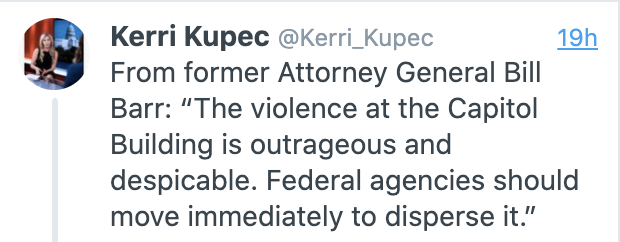
Disgraced former Attorney General Billy Barr has released two statements condemning yesterday’s terrorist attack on the Capitol. First, a comment released via his spox,

Then he released a statement to the AP’s Barr-chummy DOJ reporter:

Former Attorney General William Barr says President Donald Trump’s conduct as a violent mob of his supporters stormed the U.S. Capitol was a “betrayal of his office and supporters.”

In a statement to The Associated Press, Barr said Thursday that “orchestrating a mob to pressure Congress is inexcusable.”

Barr was one of Trump’s most loyal and ardent defenders in the Cabinet.

His comments come a day after angry and armed protesters broke into the U.S. Capitol, forcing Congress members to halt the ongoing vote to certify President-elect Joe Biden’s election and then flee from the House and Senate chambers.

Barr resigned last month amid lingering tension over the president’s baseless claims of election fraud and the investigation into Biden’s son.

Of course, Barr himself encouraged the violence yesterday.

That’s because, less than a year ago, he treated a threat against a sitting judge issued by some of the men who organized yesterday’s actions as a “technicality” not worthy of a sentencing enhancement for Roger Stone.

Two years ago, after Roger Stone posted a picture of Amy Berman Jackson with crosshairs on it, Jonathan Kravis asked Stone who came up with the picture. The President’s rat-fucker named two of his buddies who are key leaders of the Proud Boys, Jacob Engles and Enrique Tarrio.

Amy Berman Jackson. How was the image conveyed to you by the person who selected it?

Stone. It was emailed to me or text-messaged to me. I’m not certain.

Q. Who sent the email?

A. I would have to go back and look. I don’t recognize. I don’t know. Somebody else uses my —

THE COURT: How big is your staff, Mr. Stone?

THE DEFENDANT: I don’t have a staff, Your Honor. I have a few volunteers. I also — others use my phone, so I’m not the only one texting, because it is my account and, therefore, it’s registered to me. So I’m uncertain how I got the image. I think it is conceivable that it was selected on my phone. I believe that is the case, but I’m uncertain.

THE COURT: So individuals, whom you cannot identify, provide you with material to be posted on your personal Instagram account and you post it, even if you don’t know who it came from?

THE DEFENDANT: Everybody who works for me is a volunteer. My phone is used by numerous people because it can only be posted to the person to whom it is registered.

[snip]

Jonathan Kravis. What are the names of the five or six volunteers that you’re referring to?

Stone. I would — Jacob Engles, Enrique Tarrio. I would have to go back and look.

Not only did Stone appear at the rally before yesterday’s insurrection, but Tarrio was arrested on his way to the riot for crimes he committed during the last demonstration in support of Trump, an attack on a historic Black church in DC and possession of weapons.

Prosecutors asked Judge Jackson to add a two-level sentencing enhancement for this action, in which Stone’s Proud Boys associates crafted a threat against her.

Finally, pursuant to U.S.S.G. § 3C1.1, two levels are added because the defendant “willfully obstructed or impeded, or attempted to obstruct or impede, the administration of justice with respect to the prosecution of the instant offense of conviction.” Shortly after the case was indicted, Stone posted an image of the presiding judge with a crosshair next to her head. In a hearing to address, among other things, Stone’s ongoing pretrial release, Stone gave sworn testimony about this matter that was not credible. Stone then repeatedly violated a more specific court order by posting messages on social media about matters related to the case.

This enhancement is warranted based on that conduct. See U.S.S.G. § 3C1.C Cmt. 4(F) (“providing materially false information to a magistrate or judge”); see, e.g., United States v. Lassequ, 806 F.3d 618, 625 (1st Cir. 2015) (“Providing false information to a judge in the course of a bail hearing can serve as a basis for the obstruction of justice enhancement.”); United States v. Jones, 911 F. Supp. 54 (S.D.N.Y. 1996) (applying §3C1.1 enhancement to a defendant who submitted false information at hearing on modifying defendant’s conditions of release).

The sentencing memo that Bill Barr had drawn up to justify a more lenient sentence dismissed this enhancement which it admitted “technically” applied.

Notably, however, the Sentencing Guidelines enhancements in this case—while perhaps technically applicable— more than double the defendant’s total offense level and, as a result, disproportionately escalate the defendant’s sentencing exposure to an offense level of 29, which typically applies in cases involving violent offenses, such as armed robbery, not obstruction cases. Cf. U.S.S.G. § 2B3.1(a)-(b).

[snip]

Second, the two-level enhancement for obstruction of justice (§ 3C1.1) overlaps to a degree with the offense conduct in this case. Moreover, it is unclear to what extent the [defendant’s obstructive conduct actually prejudiced the government at trial.]

When ABJ gagged Stone in response to him posting the picture, she talked about the possibility that Stone’s post might incite his extremist followers to take action.

What concerns me is the fact that he chose to use his public platform, and chose to express himself in a manner that can incite others who may feel less constrained. The approach he chose posed a very real risk that others with extreme views and violent inclinations would be inflamed.

[snip]

The defendant himself told me he had more than one to choose from. And so what he chose, particularly when paired with the sorts of incendiary comments included in the text, the comments that not only can lead to disrespect for the judiciary, but threats on the judiciary, the post had a more sinister message. As a man who, according to his own account, has made communication his forté, his raison d’être, his life’s work, Roger Stone fully understands the power of words and the power of symbols. And there’s nothing ambiguous about crosshairs.

She repeated that sentiment when she overruled the Barr-authorized memo, judging the enhancement was appropriate.

Here, the defendant willfully engaged in behavior that a rational person would find to be inherently obstructive. It’s important to note that he didn’t just fire off a few intemperate emails. He used the tools of social media to achieve the broadest dissemination possible. It wasn’t accidental. He had a staff that helped him do it.

As the defendant emphasized in emails introduced into evidence in this case, using the new social media is his “sweet spot.” It’s his area of expertise. And even the letters submitted on his behalf by his friends emphasized that incendiary activity is precisely what he is specifically known for. He knew exactly what he was doing. And by choosing Instagram and Twitter as his platforms, he understood that he was multiplying the number of people who would hear his message.

By deliberately stoking public opinion against prosecution and the Court in this matter, he willfully increased the risk that someone else, with even poorer judgment than he has, would act on his behalf. This is intolerable to the administration of justice, and the Court cannot sit idly by, shrug its shoulder and say: Oh, that’s just Roger being Roger, or it wouldn’t have grounds to act the next time someone tries it.

Effectively, ABJ was warning against precisely what happened yesterday: that Stone (and Trump) would rile up extremists and those extremists would, predictably, take violent actions. ABJ judged that you can’t let the incitement go unpunished.

Barr, on the other hand, suggested that unless there was proof the incitement had an effect, it was just a technicality.

Bill Barr had a chance to stand against the incitement-driven terrorism led by the Proud Boys last year. And he chose to use his authority, instead, to protect Trump.

Share this entry

Russian Flight: The Timing of the Assange Charges

The Department of Justice charged Julian Assange when they did to stave off an attempt to help Assange flee to Russia.

That’s one important takeaway from the date of the complaint, December 21, 2017. Days earlier, Ecuador had submitted diplomatic credentials for Assange to the British government, with the intent that he would move (or, according to the less reliable Guardian, be secretly exfiltrated) to Russia under protection of diplomatic status.

Ecuador last Dec. 19 approved a “special designation in favor of Mr. Julian Assange so that he can carry out functions at the Ecuadorean Embassy in Russia,” according to the letter written to opposition legislator Paola Vintimilla.

“Special designation” refers to the Ecuadorean president’s right to name political allies to a fixed number of diplomatic posts even if they are not career diplomats.

But Britain’s Foreign Office in a Dec. 21 note said it did not accept Assange as a diplomat and that it did not “consider that Mr. Assange enjoys any type of privileges and immunities under the Vienna Convention,” reads the letter, citing a British diplomatic note.

Ecuador abandoned its decision shortly after, according to the letter.

British authorities have said they will arrest Assange if he leaves the embassy, meaning he would have needed to be recognized as a diplomat in order to travel to Moscow.

The US finalized the complaint the same day the UK rejected the Ecuadorian request (though the accompanying 26-page affidavit suggests it been in the works for some time). The next day the US sent a formal extradition warrant to the UK. All this happened under dramatically increased (and visible) surveillance from Ecuador’s security contractor, UC Global; Assange boosters have tried to spin this attempt as a US kidnapping attempt, which is presumably what they would have called a failed exfiltration attempt.

The timing of two of the other sets of charges against Assange can also be fairly readily explained. Assange was formally indicted on March 6, 2018, the day before the 8-year statute of limitations on the CFAA charge would expire. The most recent superseding indictment, obtained on June 24, 2020, expanded the CFAA conspiracy charge through 2015, which seems to be another effort to expand the conspiracy before statutes toll. The next overt acts in WikiLeaks’ efforts to undermine the US came in March and April 2016. Unless Assange is pardoned and released (as I’ve noted, a pardon may not have the effect Assange boosters want it to), I think it highly likely DOJ will supersede again after inauguration to include, at a minimum, the Vault 7 publication, and probably some overt acts tied to the 2016 election interference. Depending on UK willingness to add to the total charges, the US might well add foreign agent charges they’ve alluded to.

Only the timing of the indictment adding the Espionage charges on May 23, 2019 can’t be readily explained (though it came in the wake of the Mueller Report and the larger Russian investigation which is, per the SSCI Report, what led to a better understanding of the degree to which Russia had “co-opted” WikiLeaks).

It is a testament to the power of WikiLeaks’ propaganda efforts that the entire focus on Julian Assange’s prosecution has been on false claims about why DOJ decided to prosecute him while Trump was President and not on the specific timing of the first charge against him, which ties it to Assange’s relationship with Russia.

Quite honestly, the US probably would have been far better off had Assange’s attempt to flee to Russia succeeded. That would have made clear even to the dead-enders that Assange had become little more than a Russian tool, and thereby diminished WikiLeaks’ allure and efficacy as a cover for leaks going forward. Instead, they’ve made of Assange a martyr about whom most journalism organizations in the world are enthusiastically repeating false propaganda.

Share this entry

Four Years Ago Today, Russia Told Trump the Deep State Was Targeting Trump Along with Russia

Four years and a few days ago, when Trump’s Transition team learned that President Obama would impose sanctions on Russia, in part, to punish them for interfering in the election that got Trump elected, Mike Flynn and KT McFarland strategized about how to respond. Before Flynn returned a request for a call from Russian Ambassador Sergey Kislyak, McFarland asked Homeland Security Czar Tom Bossert to find out from his predecessor how Russia was responding to the sanctions. He came back with a report that he emailed to Trump’s top advisors, including Steve Bannon at his private email.

[Monaco] confirms the Russiand [sic] have already responded with strong threats, promising to retaliate. [She] characterized the Russian response as bellicose. My thoughts, sans the Russia angle, on which I defer to Mike and KT: [redacted] : Cyber attacks by forcing governments or anyone else are unacceptable and must be taken seriously. The alleged Russian hack of US entities involved in the US political process is a problem. Of course we must separate their attempts to influence our election from the rash conclusion that they succeeded in altering the views of any American voter. We must be wary of escalatory retaliation to follow.

Immediately after Bossert sent out this email, Flynn and McFarland talked about what he should say to Kislyak. We don’t know what they said. Shortly after they hung up, Flynn called Kislyak and asked him not to escalate. Among other things, Flynn told Kislyak that Russia would be sending a message that Trump’s team would recognize if they didn’t escalate.

Flynn: And please make sure that its uh — the idea is, be — if you, if you have to do something, do something on a reciprocal basis, meaning you know, on a sort of even basis. Then that, then that is a good message and we’ll understand that message. And, and then, we know that we’re not going to escalate this thing, where we, where because if we put out — if we send out 30 guys and you send out 60, you know, or you shut down every Embassy, I mean we have to get this to a — let’s, let’s keep this at a level that us is, even-keeled, okay? Is even-keeled. And then what we can do is, when we come in, we can then have a better conversation about where, where we’re gonna go, uh, regarding uh, regarding our relationship. [my emphasis]

About 12 minutes after Flynn and the Ambassador hung up, McFarland sent an email responding to Bossert’s (with at least Bannon using his personal email), purporting to strategize about a response, and claiming that Flynn would speak to Kislyak in the future (even though Flynn had already returned the call). Her email repeated some of the language Flynn had used — a (second) request that Russian not box Trump in, a hope to avoid a tit for tat escalation — in his call with Kislyak (which the analyst who transcribed the call thought might have been made on a speaker phone).

On Dec. 29, a transition adviser to Mr. Trump, K. T. McFarland, wrote in an email to a colleague that sanctions announced hours before by the Obama administration in retaliation for Russian election meddling were aimed at discrediting Mr. Trump’s victory. The sanctions could also make it much harder for Mr. Trump to ease tensions with Russia, “which has just thrown the U.S.A. election to him,” she wrote in the emails obtained by The Times.

[snip]

Mr. Obama, she wrote, was trying to “box Trump in diplomatically with Russia,” which could limit his options with other countries, including Iran and Syria. “Russia is key that unlocks door,” she wrote.

She also wrote that the sanctions over Russian election meddling were intended to “lure Trump in trap of saying something” in defense of Russia, and were aimed at “discrediting Trump’s victory by saying it was due to Russian interference.”

“If there is a tit-for-tat escalation Trump will have difficulty improving relations with Russia, which has just thrown U.S.A. election to him,” she wrote. [my emphasis]

The next day, Russia first announced, then backed off an escalation.

Then, on December 31, 2016, Kislyak called Flynn again. It had been two days since the calls Flynn made from a hotel phone in the Dominican Republic and the emails sent to insecure private emails. It had been over a week since Flynn foolishly blurted out to the Russian Ambassador that he wasn’t just trying to undermine President Obama’s policies with Russia; he was making similar calls to a bunch of other countries.

In short, it had been plenty of time for Russia to recognize there were likely insecure communications floating around talking about Flynn’s (and Trump’s) efforts to undermine the official policy of the United States.

In case Russia’s public “good message” to Flynn hadn’t been enough, Kislyak wanted to tell Flynn personally (on a phone he surely knew was bugged) that Putin had made his decision based on Flynn’s promise to operate with cooler heads. But along the way, he echoed something that McFarland had said in her own email.

Kislyak: Uh, you know I have a small message to pass to you from Moscow and uh, probably you have heard about the decision taken by Moscow about action and counter-action.

Flynn: yeah, yeah well I appreciate it, you know, on our phone call the other day, you know, I, I, appreciate the steps that uh your president has taken. I think that it was wise.

Kislyak: I, I just wanted to tell you that our conversation was also taken into account in Moscow and…

Flynn: Good

Kislyak: Your proposal that we need to act with cold heads, uh, is exactly what is uh, invested in the decision.

Flynn: Good

Kislyak: And I just wanted to tell you that we found that these actions have targeted not only against Russia, but also against the president elect.

Flynn: yeah, yeah

Kislyak: and and with all our rights to responds we have decided not to act now because, its because people are dissatisfied with the lost of elections and, and its very deplorable. So, so I just wanted to let you know that our conversation was taken with weight. [my emphasis]

As McFarland had said two days earlier, Kislyak echoed back: The sanctions weren’t [just] about punishing Russia for interfering in the election. They also targeted Trump.

Four years ago today, the Russian Ambassador secretly spoke to Flynn and told him that Russia and Trump had both been targeted, together, by the US government. That comment explains a lot of what happened since.

Share this entry

The Three Types (Thus Far) of Trump Mueller Pardons

To date, Trump has pardoned five people who were prosecuted by Mueller. I’m seeing a good deal of misunderstanding about what those pardons mean for any legal proceedings going forward, so I’d like to address some of that.

First, a lot of people say that accepting a pardon is tantamount to accepting guilt, under Burdick v.United States. It’s not. It’s narrower, though importantly goes to questions about whether a witness who has been pardoned has to testify or not. It also says that someone who has been pardoned must inform the court of the fact for it to be valid in any legal proceeding before the court.

That said, claims that Trump flunkies who’ve been pardoned have to testify are also too broad. If the people have any remaining legal exposure (as I’ll explain, Roger Stone and Paul Manafort do), they can still invoke the Fifth. That’s also true if they have state exposure for something like fraud or tax evasion. But in cases where the pardoned crime is only federal, such as Papadopoulos’ lies, it would be easy for prosecutors to immunize him in case he invoked his Fifth Amendment privileges, effectively forcing him to testify on penalty of contempt.

Thus far, Trump has issued three kinds of pardons for people prosecuted by Mueller:

  • Pardons for people with no further known (Mueller) legal exposure
  • Pardons for people with potentially grave further legal exposure
  • Fruit of the poison tree pardon for anything Mueller touched

Alex Van der Zwaan and George Papadopoulos:

Both Van Der Zwaan and Papadopoulos were pardoned for the single False Statements charge against them. Neither is known to have committed another crime. In Papadopoulos’ case, however, things could get dicey on several points. Trump forgave his $9,500 fine, which was the amount Papadopoulos accepted from suspected Israeli spooks. If he asks for that back that may raise questions about his exposure on FARA grounds. In addition, Papadopoulos has already testified before Congress that he called Marc Kasowitz after he was first interviewed by the FBI. If there were a larger prosecution about Trump’s obstruction, he might have been able to plead the Fifth for making that call — except he has already testified to it.

Papadopoulos withheld documents from Congress. With a DOJ that can enforce subpoenas, he might be asked to share those documents, which may require him to testify contrary to his 2018 OGR/HJC testimony.

If DOJ decided to reopen the investigation into a suspected Egyptian bribe to Trump because serving a subpoena on Trump Organization would now be less controversial than it was last summer, then Papadopoulos might be a key witness in that investigation, though since that’s unrelated to his charged false statements, he could still invoke the Fifth if questioned about it.

Roger Stone and Paul Manafort:

Like Van der Zwaan and Papadopoulos, Stone and Manafort were just pardoned for the crimes that they were found or pled guilty to, the money laundering, tax evasion, and FARA crimes in Manafort’s case, and the cover-up crimes in Stone’s case. For both, however, that’s not the full extent of what they were investigated or might be witnesses for.

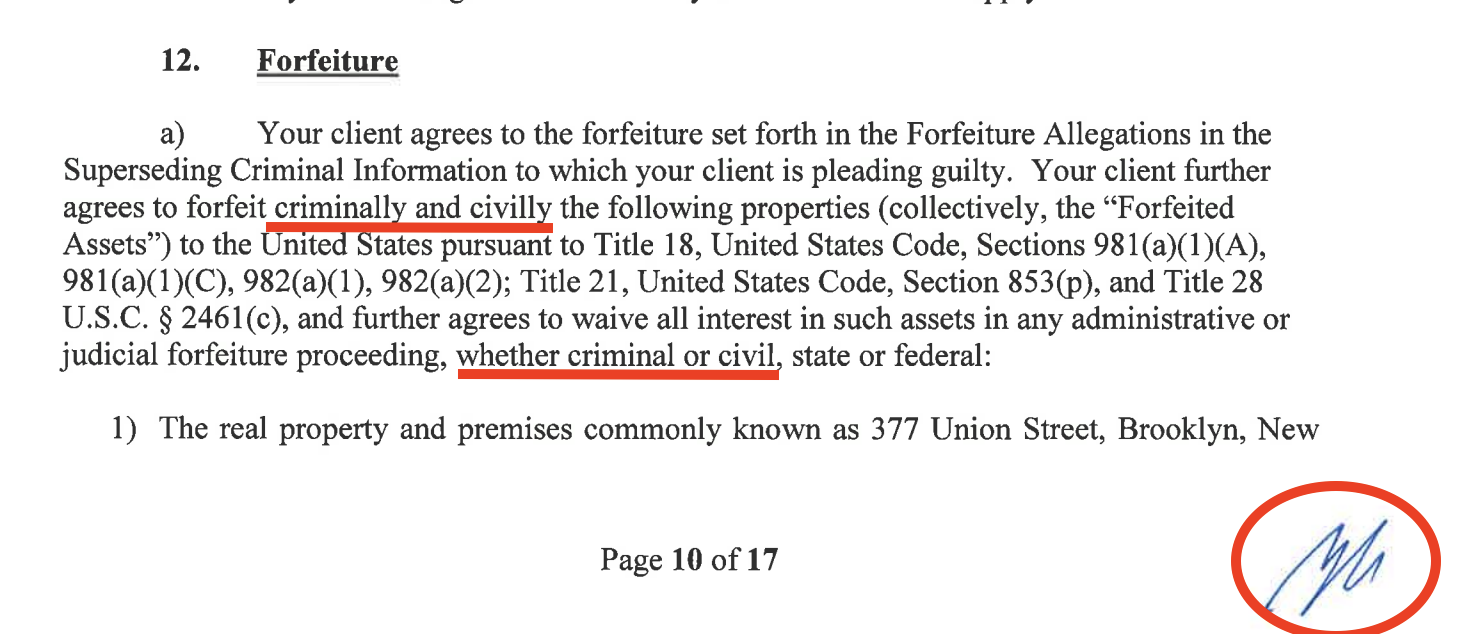
Before I get there, let me note that multiple sources are claiming that, because Trump included Manafort’s criminal forfeiture in the language of his pardon, he’ll get his ill-gotten gains back. I’m not an expert on this, but I do know that Manafort also civilly forfeited these goods in his plea agreement.

So to attempt to reverse this forfeiture, Manafort would have to spend a great deal of money litigating it, and it’s not at all clear it’d work.

Manafort was also referred for suspected FECA violations involving two PACs that, prosecutors suspected, he got paid through via a kickback system. These cases must be closed, because they were unsealed in the Mueller Report back in September. But Manafort may face more scrutiny on them if DOJ investigates Trump’s other corrupt PACs.

Unless he, too, is pardoned, Konstantin Kilimnik remains under investigation. That’s an area where things might get more interesting for Manafort, because during the period when he was purportedly cooperating, he lied about the fact that he had conspired with Kilimnik. In any case, until the Kilimnik and Oleg Deripaska investigations are closed, Manafort has some exposure.

Things are more complicated still for Stone. There were at least two investigations into Stone — probably on conspiracy and foreign agent crimes — still active in April. If the redactions if Mueller 302s are any indication, Barr shut parts of that investigation down since, which will be of interest on its own right (Congress learned of these ongoing investigations when they got unsealed portions of the Mueller Report that have only recently been made public, and I know there is some interest in learning what those investigations were or are, and that was true even before any discussions about Trump’s abuse of pardons).

In any case, the investigation into a pardon for Julian Assange was active at least as recently as October. Stone has already called on Trump to pardon Assange since his own pardon, potentially a new overt act in a conspiracy. And Trump might well pardon Assange; even pardoning him for the crimes currently charged would be a new overt act in that conspiracy, which would implicate Stone. So even if Barr shut that investigation down, there is already reason to reopen it.

So while Barr may have tried to clean up the remaining criminal exposure against Stone, it’s not clear he could succeed at doing so, much less without creating problems for others going forward.

Mike Flynn:

As I have written, Mike Flynn’s pardon was constructed in a way that attempted to eliminate all criminal exposure that might arise from anything associated with the Mueller investigation for him. In addition to pardoning Flynn for the false statements charge he pled guilty to, it pardons him for lying about being an Agent of Turkey, for being an Agent of Turkey, and for lying to Judge Sullivan.

But it also attempts to pardon Flynn for any crime that might arise out of facts known to Mueller. While, generally, I think the pardon power is very broad, this effectively tried to pardon Flynn for an investigation, not for crimes. Plus, the broadness of the pardon may backfire, insofar as it would strip Flynn of the ability to plead the Fifth more broadly. Even just a retrial of Bijan Kian (unless Trump pardons him and Mike Jr) might force Flynn to commit new crimes, because both telling the truth and lying about his secret relationship with Turkey would be a new crime.

Given his seditious behavior, Flynn might have entirely new criminal exposure by the time Joe Biden is sworn in any case. But the attempt to be expansive with Flynn’s pardon might backfire for him.

Of the five Mueller criminals pardoned so far, only Van der Zwaan is clearly free of danger going forward.

And these five don’t even cover some of the most complex pardon recipients. Any Assange pardon may be the most obviously illegal for Trump (save a self-pardon), because it would involve a quid pro quo entered before he was elected. With Steve Bannon, Trump will need to pardon for another crime, fraud associated with Build the Wall, but if it covers Mueller, it may make it easier for Bannon to repeat what truths he already told to the grand jury. With Rudy Giuliani, Trump will need to pardon for unidentified crimes currently under investigation, but also Rudy’s efforts to broker pardons, which may make the pardon itself more dicey. With Trump’s children (including Jared Kushner), I assume he’ll offer a Nixon type pardon for all crimes committed before the day of pardon. But there may be ways to make them admit to these crimes.

Billy Barr is the best cover-up artist in the history of DOJ. But Trump is attempting to pardon himself out of a dicier situation than Poppy Bush was in Iran-Contra. Plus, even assuming Mueller’s team left everything available for Barr’s discovery, Barr may be hamstrung by the fact that he doesn’t believe in most of the crimes Trump committed, something that could become especially problematic as the full extent of Trump’s dalliance with Russia becomes known going forward. Barr didn’t support some of these pardons, like a hypothetical Assange one. And now, in his absence, Trump has grown increasingly paranoid about Pat Cipollone, who will have to shepherd the rest.

The pardon power is awesome and fairly unlimited. But it’s not yet clear the Mueller pardons will do what Trump hopes they will. With virtually all of them, there are loose strings that, if they get pulled, may undo the immunity Trump has tried to offer.

Share this entry

Footnote: The Day Before Roger Stone Received a Pre-Written Pardon, He Lied about the Ongoing Investigation into His Conspiracy with Russia

As I noted here, Roger Stone’s pardon appears to have been all packaged up, covering only the crimes for which he has already been found guilty, before Billy Barr left DOJ and the pardons were rolled out.

Which is why I’m intrigued that Roger Stone went on The Gateway Pundit to lie about the investigation into him just yesterday. In what appears to be an interview of himself, Stone makes several assertions. First, he includes me among those who — he claims — were “obsessed with the idea that I was working with WikiLeaks and WikiLeaks was working with the Russians.”

It wasn’t just the nut jobs like Mother Jones ,the Daily Beast , Salon and nutty bloggers like Marcy Wheeler but allegedly responsible media outlets like the New York Times, the Washington Post, the Wall Street Journal and CNN and MSNBC became obsessed with the idea that I was working with WikiLeaks and WikiLeaks was working with the Russians.

I’m flattered Stone felt the need to include me in this esteemed list without, this time, threatening to sue me for reporting things that would later be confirmed in court documents. It’s a testament to how closely Stone has always read me.

Stone wrote this self-interview for a more specific purpose, however: To claim that the Mueller Report passages unsealed the day before the election concluded he had no ties to WikiLeaks.

At midnight on election day November 3rd, 2020- the busiest news day of the year and timed to get as little press coverage as possible, the United States Department of Justice released the remaining unredacted sections of the Mueller Report regarding me specifically, in which they had admitted that despite two years of intense investigation, spending millions to pour through every aspect of my life, dragging 36 witnesses to the grand jury and after obtaining all my electronic communications for four years ( literally millions of e-mails and pages of documents, tax returns, banking and financial records –they found no factual evidence of any collaboration or coordination between me and WikiLeaks regarding the release of emails regarding John Podesta, the Democratic National committee or Hillary Clinton or that I had any advance knowledge of the timing, content or source of their disclosures).

He says that this passage proves that:

“The Office determined that it could not pursue a Section 1030 conspiracy charge against Stone for some of the same legal reasons. The most fundamental hurdles, though, are factual ones.1279 As explained in Volume I, Section III.D.1, supra, Corsi’s accounts of his interactions with Stone on October 7, 2016 are not fully consistent or corroborated. Even if they were, neither Corsi’s testimony nor other evidence currently available to the Office is sufficient to prove beyond a reasonable doubt that Stone knew or believed that the computer intrusions were ongoing at the time he ostensibly encouraged or coordinated the publication of the Podesta emails. Stone’s actions would thus be consistent with (among other things) a belief that he was aiding in the dissemination of the fruits of an already completed hacking operation perpetrated by a third party, which would be a level of knowledge insufficient to establish conspiracy liability. See State v. Phillips, 82 S.E.2d 762, 766 (N.C. 1954) (“In the very nature of things, persons cannot retroactively conspire to commit a previously consummated crime.”) (quoted in Model Penal Code and Commentaries § 5.03, at 442 (1985).

[additional content that Stone doesn’t include]

“Regardless, success would also depend upon evidence of WikiLeaks’s and Stone’s knowledge of ongoing or contemplated future computer intrusions-the proof that is currently lacking.”

Unsurprisingly, Stone does not include the footnote modifying this passage which, as I noted at the time, made it clear there were still ongoing investigations, plural, into this question at the time Mueller closed up shop on March 22, 2019.

1279 Some of the factual uncertainties are the subject of ongoing investigations that have been referred by this Office to the D.C. U.S. Attorney’s Office.

That is, the passage said the exact opposite of what Stone said it did. It said that, presumably in part because Roger Stone’s aide Andrew Miller had stalled on his grand jury testimony for a year, the investigation into whether Stone could be charged in the CFAA conspiracy with Russia was not yet complete, not after two years of investigation.

And having lied about what the unsealed passage says, Stone then complains that Judge Amy Berman Jackson withheld it from his lawyers.

Judge Amy Berman withheld this from my lawyers at trial. The Mueller’s dirty cops concluded in their report that even if they had found evidence that I had received documents from Assange of WikiLeaks and passed them to anyone, which I did not and for which they found no evidence whatsoever, it would not have been illegal. The whole thing was a hoax.

ABJ withheld it, of course, because DOJ was still investigating, even as recently as April 2020 when DOJ unsealed warrants that made that clear. DOJ withheld that passage so Stone wouldn’t know that the witness tampering case into him was just one step in an ongoing investigation, one that remained focussed on whether Roger Stone conspired with Russia or — indeed — had even served as an Agent of Russia.

Stone goes on to complain that only BuzzFeed, along with right wing propaganda sites Washington Examiner (who launched the investigation into Stone in the first place) and Zero Hedge, misreported the significance of this detail.

The only three news outlets who reported on this shocking election day admission that there was no evidence found that would support this narrative were BuzzFeed, who successfully brought the lawsuit for the release of this material, the Washington Examiner and ZeroHedge. Where were the New York Times, the Washington Post, the Wall Street Journal, the Huffington Post, The Atlantic, The Hill, Politico, Salon, Vox, Vice, CNN, MSNBC, NBC and the Business Insider – all of who were quick to smear me as a “go-between for WikiLeaks and the Trump Campaign” but none of whom reported on the stunning conclusions of Mueller’s thugs.

He didn’t mention me in this case, because I correctly reported that the Mueller language actually said the exact opposite of what Stone claims.

Hours before he received a pardon for lying to cover up his real go-between with WikiLeaks — which a good deal of evidence suggests was Guccifer 2.0 — Roger Stone did an interview of himself where he falsely claimed the Mueller Report had finished its investigation only to fall short of proving that he was conspiring with Russia.

That’s a crime, it should be noted, for which Stone was not pardoned.

Share this entry
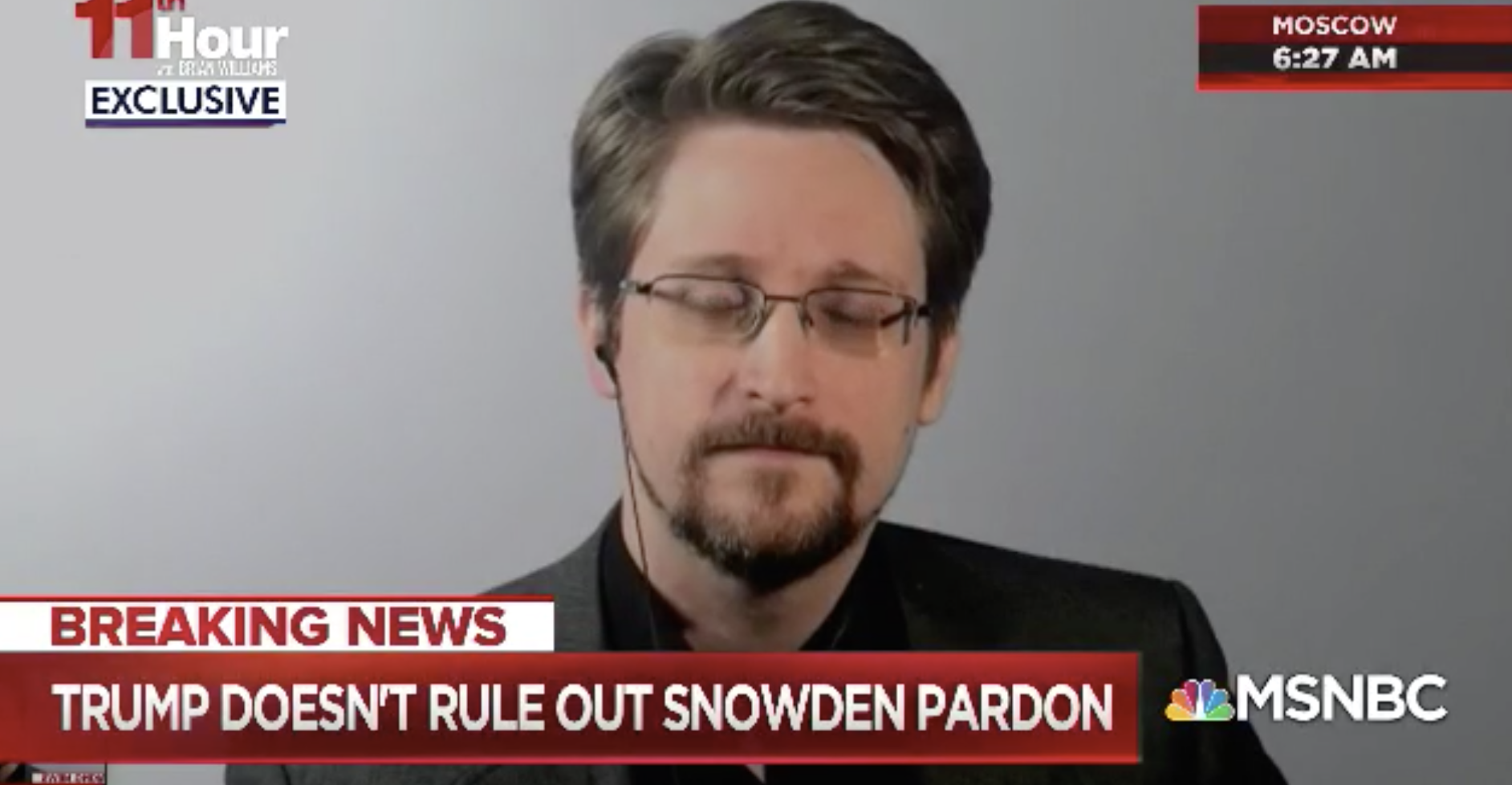
Snowden

Like Glenn Greenwald, Roger Stone Links a Pardon for Edward Snowden to a Corrupt Pardon for Julian Assange

After being pardoned for his crime of lying to Congress last night, Roger Stone called for a pardon for Julian Assange and Edward Snowden.

Stone welcomed the pardon and complained he’d been subjected to a “Soviet-style show trial on politically-motivated charges.”

The longtime political provocateur also urged the president to extend clemency to a key figure in the release of hacked emails during the 2016 campaign, Julian Assange, and to National Security Agency leaker Edward Snowden.

“Other good Americans have been victims of a corrupt system made to serve venal power-seekers,rewarding deceit and manipulation, rather than reason and justice. President Trump can be the purveyor of justice over the vile machinations of wicked pretenders to the mantle of public service,” Stone wrote.

Unless Bill Barr shut it down in preparation for the pardons to come (a very good possibility), DOJ has an ongoing investigation into the circumstances under which Roger Stone started pursuing a pardon for Assange, one that ties a pardon for Assange to Stone’s successful optimization of the release of the John Podesta files in October 2016. That might even make Stone’s call a new overt act in a conspiracy that started in 2016.

What it also does, though, is tie a hypothetical Snowden pardon — one that otherwise would have nothing to do with Trump’s crimes — to this quid pro quo.

Stone is not the first to do so in a corrupt way, of course. So did Glenn Greenwald, when he pitched such a dual pardon as a way for Trump to get back at The [American] Deep State on Tucker Carlson’s show, back in September.

Glenn: Let’s remember, Tucker, that the criminal investigation into Julian Assange began by the Obama Administration because in 2010 WikiLeaks published a slew of documents — none of which harmed anybody, not even the government claims that. That was very embarrassing to the Obama Administration. It revealed all kinds of abuses and lies that they were telling about these endless wars that the Pentagon and the CIA are determined to fight. They were embarrassing to Hillary Clinton, and so they conducted, they initiated a grand jury investigation to try and prosecute him for reporting to the public. He worked with the New York Times, the Guardian, to publish very embarrassing information about the endless war machine, about the Neocons who were working in the Obama Administration. To understand what’s happening here, we can look at a very similar case which is one that President Trump recently raised is the prosecution by the Obama Administration, as well, of Edward Snowden for the same reason — that he exposed the lies that James Clapper told, he exposed how there’s this massive spying system that the NSA and the CIA control, that they can use against American citizens. Obviously this isn’t coming from President Trump! He praised WikiLeaks in 2016 for informing the public. He knows, firsthand, how these spying systems that Edward Snowden exposed can be abused and were abused in 2016. This is coming from people who work in the CIA, who work in the Pentagon, who insist on endless war, and who believe that they’re a government unto themselves, more powerful than the President. I posted this weekend that there’s a speech from Dwight Eisenhower warning that this military industrial complex — what we now call the Deep State — is becoming more powerful than the President. Chuck Schumer warned right before President Obama — President Trump — took office that President Trump challenging the CIA was foolish because they have many ways to get back at anybody who impedes them. That’s what these cases are about Tucker, they’re punishing Julian Assange and trying to punish Edward Snowden for informing the public about things that they have the right to know about the Obama Administration. They’re basically saying to President Trump, “You don’t run the country even though you were elected. We do!” And they’re daring him to use his pardon power to put an end to these very abusive prosecutions. One which resulted in eight years of punishment for Julian Assange for telling the truth, the other which resulted in seven years of exile for Edward Snowden of being in Russia simply for informing the public and embarrassing political officials who are very powerful.

While there’s abundant evidence (which press organizations and journalists who’ve been personally involved are dutifully ignoring) that Julian Assange has been something other than he has been claiming for years, I have always believed a Snowden pardon is an entirely different thing, something far more justified. But if these people who were running interference for Guccifer 2.0 back in 2016 and have continued to do so to this day keep linking a corruptly negotiated Assange with a Snowden one, it does raise questions about whether there’s some closer tie.

Share this entry

On Bill Barr’s Last Day, Trump Commits the Crime Barr Affirmed in His Confirmation Hearing

In Bill Barr’s confirmation hearing, he affirmed on three different occasions (each time with lessening force) that it would be a crime to offer a pardon for false testimony.

Leahy: Do you believe a president could lawfully issue a pardon in exchange for the recipient’s promise to not incriminate him?

Barr: No, that would be a crime.

In Bill Barr’s resignation letter, he explained he would “spend the next week wrapping up a few remaining matters important to the Administration and depart on December 23rd.” Barr stopped off at the White House yesterday for a short visit. He and his spox wrote his good-byes during the day and then left DOJ in charge of Jeffrey Rosen.

And then after all that, Trump pardoned Paul Manafort and Roger Stone. The Manafort and Stone pardons — for which the paperwork must have been done ahead of time but held until Barr was no longer Attorney General — only cover the crimes for which they’ve been found guilty. That means both men would ostensibly remain under investigation for their coordination with Russian Agents during the election (and both men assuredly did coordinate with Russian Agents during the election.

If Bill Barr didn’t find a way to permanently end that investigation.

The question now is whether Bill Barr, cover-up artist, managed to cover his tracks this time as well as he did in Iran-Contra.

Share this entry

Three Inconvenient Truths about a Hypothetical Trump Pardon for Julian Assange

For the last several weeks, there have been floated hints that Donald Trump might pardon Julian Assange. Assange’s supporters — from frothy MAGAts to esteemed journalistic outlets — are fooling themselves about a possible Trump pardon on several counts.

Before I lay out what those are, let me reiterate, again, that I believe the Espionage Act charges against Assange pose a serious risk to journalism (though as written, the CFAA charge does not). I agree that the Chelsea Manning disclosures, which make up most but not all of the charges currently pending against Assange, included a large number of important revelations, many I relied on with gratitude. I’d be perfectly fine if Vanessa Baraitser ruled on January 4 that US prisons were too inhumane for Assange. And I agree that EDVA would be a horrible venue for Assange (though unlike other defendants, DOJ is not simply inventing that jurisdiction for the onerous precedents it offers out of thin air; it is the most obvious venue for Assange because of the Pentagon).

So this is neither disagreement on the risks an Assange prosecution poses, nor is it an endorsement of the prosecution of Assange as it exists. But a pardon would necessarily involve other crimes, in addition to the ones for which he has been charged, and those crimes go well beyond journalism. They may even involve crimes that Assange backers want no part in supporting.

A Donald Trump pardon of Julian Assange will be a very good way of making sure Assange comes to symbolize those other crimes, not earlier laudable releases, and it might not even end his imprisonment.

It may not work

If Trump gives Assange a pardon, it’s not actually clear it will end his legal jeopardy. The existing Espionage Act charges, particularly the ones for publishing names of coalition informants (which would include the UK) are actually more obviously illegal in the UK than the US. Two UK defendants have already pled guilty to a CFAA conspiracy that makes up part of the CFAA charge against Assange. And because the Vault 7 damage assessment presented at the Joshua Schulte trial explicitly included damage to foreign partners, that publication may expose Assange to Official Secrets Act charges in the UK as well. Plus, there are other aspects of the Vault 7 publication, including Assange’s efforts — with the help of a lawyer he shared with Oleg Deripaska — to coerce immunity from the US with them, that may pose legal jeopardy in the UK if he is pardoned in the US.

I’ve likened the Assange extradition to that of AQAP graphic designer Minh Quang Pham, and this may be another similarity. In that case, as soon as it became clear that the legal disposition that Theresa May was attempting in the UK might not work, SDNY promptly indicted Pham, ensuring Pham would remain in custody no matter what happened in the UK. I wouldn’t be surprised if the reverse happened in the eventuality of an Assange pardon in the US. That is, DOJ may already have sent the UK the evidence to support prosecution of Assange in the UK for some of the things the US would otherwise like to try him on. Indeed, that is consistent with the way the US charged Assange within a day of when Ecuador applied for diplomatic credentials for Assange; the UK has already proven to be in almost immediate coordination with the US on this.

The UK would surely rather the US do the job, but particularly because of the damage the Vault 7 release caused the Five Eyes, I don’t rule out the UK prosecuting Assange if the US could not.

A Trump pardon would have to pardon everything through current day

Assange’s boosters appear to think a pardon would cover just the existing Espionage charges pertaining to the Chelsea Manning leaks (plus the CFAA charge, which is no longer limited to the password crack attempt, though virtually all his boosters ignore the substance of that charge).

That, of course, wouldn’t work. Unless Assange were immediately whisked away to a country that doesn’t have an extradition treaty with the US, he could quickly be charged in a virtually identical indictment covering Vault 7 (and the US could charge it in any case as a way to pressure whatever country he was in). Only, on every charge, the claims now being made to defend Assange — about newsworthiness, about intentionality of revealing protected identities, about the push to leak entire databases — would be far weaker arguments with respect to Vault 7 than with respect to the Manning leaks. Just as one example, WikiLeaks left the identities of the people Joshua Schulte was angry at unredacted in the Vault 7 release, which would make it easier for prosecutors to show forethought and malice for revealing those identities than is the case in (especially) the Cable leaks. And that, again, ignores how Assange repeatedly used the files in an attempt to coerce immunity from the US.

Several close WikiLeaks associates have told me after the initial indictment they were glad it didn’t include Vault 7, because that’s a lot harder to defend against. The US might prefer it for that reason.

So an Assange pardon would have to include some language like, “all offenses against the United States prior to the pardon” — a pardon akin to what Gerald Ford gave Richard Nixon.

Surely, if Trump is going to pardon Assange anyway, he would be willing to do that. Trump’s gonna make Oprah look stingy in the next few weeks, after all. But legally, for a pardon for Julian Assange to stick, it would have to cover all crimes he committed against the US through the present day.

That of course shouldn’t bother Assange supporters — it accords him even broader protection than Mike Flynn got. But it does mean that the pardon would be assessed on the entirety of Assange’s actions, the record of which remains significantly classified and the public record with which virtually no Assange booster — up to and including extradition hearing “expert” witnesses — exhibit familiarity. In other words, they’re arguing blind, without knowing what they’re asking to pardon.

Because an Assange pardon would need to extend through the present it would be tainted by Trump’s own corruption, possibly including litigation

If a Trump pardon for Assange were written broadly enough to stick, it would almost certainly include a conspiracy involving Trump himself, possibly including Russia’s GRU, granting a pardon for Assange in exchange for the optimization of the Podesta files. The pardon itself would likely be a crime for Trump. And that raises the stakes on it.

When WikiLeaks supporters hear “Assange pardon,” they seem to immediately think, “Dana Rohrbacher.” That’s significantly because Assange’s lawyers, in a deliberate use of Assange’s extradition hearing to sow propaganda (of which this is by no means the only example), had Jen Robinson submit testimony describing how Rohrabacher attempted to broker a pardon for Assange in August 2017, a pardon that was contingent on claiming Russia was not behind the 2016 theft of DNC documents.  The testimony was meant to support Assange’s claim that his prosecution is political, a claim that involved misrepresenting the public record in many ways.

When Assange’s team brought this up in his extradition hearing, the lawyer for the US emphasized that Trump didn’t sanction this offer. That’s credible (and backed by contemporaneous reporting), mostly because at the time John Kelly was assiduously gate-keeping offers like this. So WikiLeaks’ focus on the Rohrabacher pardon dangle, while accurate (Robinson is far too ethical to misrepresent things), also falsely suggests that that pardon dangle was the only, or even the most important, pardon discussion between Trump and Assange. It wasn’t. And WikiLeaks knows that, because key WikiLeaks supporters — Randy Credico and Margaret Kunstler — were involved with the one still under criminal investigation.

It is a fact that the Mueller Report stated that they had referred ongoing investigations into whether Roger Stone took part in Russia’s hacking conspiracy to the DC US Attorney’s Office for further investigation. It is a fact that, when the court unsealed warrants against Stone in April, they revealed an ongoing investigation into Stone for the hacking, for conspiracy, and for serving as a foreign agent of Russia, one that Mueller had hidden from Stone. It is a fact that Randy Credico testified under oath he had put Stone in touch with Margaret Kunstler to discuss a pardon for Assange. Credico is evasive about when this discussion began, including whether the discussion started before the election. Texts submitted at trial show Stone and Credico discussed asylum and Credico’s tie to Kunstler on October 3, 2016, in a period when Stone had multiple phone calls with Credico as well as some presumed to be with Trump. Stone appears to have had lunch with Trump on October 8, the day after the Podesta emails dropped. Mike Flynn testified that after the Podesta files dropped, Trump’s closest advisors discussed reaching out to WikiLeaks. Shortly after that, Stone did reach out to WikiLeaks, and WikiLeaks reached out to Don Jr. WikiLeaks reached out to both after Trump won. And according to affidavits obtained against Stone, he and Kunstler started communicating over Signal starting on November 15, seven days after the election. As of October 1 of this year, significant swaths of Kunstler’s two interview reports with Mueller prosecutors remained sealed with redactions protecting an ongoing investigation.

If Stone is to be believed, he pursued this effort to get Assange a pardon at least through 2018. Two things are clear, however. Days after Stone told Assange he was working with the “highest level of Government” to resolve Assange’s issues, Trump directed Corey Lewandowski to direct Jeff Sessions to shut down the entire retroactive Russian investigation. Trump already took an overt act to respond to Stone’s entreaties to help Assange, one documented in Twitter DMs and notes Trump demanded Lewandowski take down. And after Mueller asked Trump about an Assange pardon, Don Jr’s best buddy Arthur Schwartz told Cassanda Fairbanks, “a pardon isn’t going to fucking happen” (she ultimately flew to London to tell Assange what Schwartz told her in person). Nevertheless, Stone’s buddy Tucker Carlson had Glenn Greenwald on pitching one to Trump — as a great way to get back at The [American] Deep State — in September.

To be clear: If Trump pardons Assange for all crimes against the United States, the pardon will still work for Assange (again, unless the UK decides to file charges against Assange instead). And I expect a great deal of Assange’s most loyal boosters won’t give a shit about what all was included in the pardon. Indeed, WikiLeaks’ most loyal fans believe it was a good thing for Assange to partner with the GRU in 2016 to undermine a democratic election.

But if Trump pardons Assange, these details are virtually guaranteed to come under close scrutiny in the months ahead, all the more so if he tries a self-pardon, because this would be one thing that even the 6 Republican majority on SCOTUS might find unreasonable, and it would be the quickest way to prove that not just Stone, but Trump himself, conspired to optimize the files stolen by Russia.

If all that were to happen after he was safe in Oz, Assange probably wouldn’t care, nor would I if I were in Assange’s position. But those backing an Assange pardon are — because of details that virtually none of them understand — cheering Trump to do one of the most corrupt things he would have done over the course of the last five years.

Share this entry