Posts

Jeanine Pirro Has a Black Powder Problem

At the hearing in accused pipe bomber Brian Cole’s case the other day, Magistrate Judge Matthew Sharbaugh ordered both sides to file their views about whether the indictment DOJ obtained against Cole from a Superior Court grand jury was valid; he ordered those filings to be posted to the public docket by end of business yesterday.

MINUTE ORDER as to BRIAN J. COLE, JR.: As discussed during today’s proceedings, the Court was presented yesterday afternoon with a two-count indictment in this case that was returned by a D.C. Superior Court grand jury, rather than a federal court grand jury. The indictment included the same two counts charged in the criminal complaint, namely 18 U.S.C. 844(d) and 844(i). In asking the Court to accept the indictment, the government invoked D.C. Code § 11-1916(a), which provides that “[a] grand jury serving in the District of Columbia may take cognizance of all matters brought before it regardless of whether an indictment is returnable in the Federal or District of Columbia courts.” The Court recognizes that Chief Judge Boasberg recently upheld the propriety of this approach based on that statute, concluding that Section 11-1916(a) authorizes local D.C. grand juries to return indictments in U.S. District Court (and vice versa). United States v. Stewart, 2025 WL 3237833 (Nov. 20, 2025). But Judge Boasberg then stayed that ruling pending appeal, stating in part that “the public interest lies in letting the Court of Appeals decide this issue before the Government moves forward both on this case and in similar fashion on other cases.” See Stewart, No. 25-mj-225, Order (Dec. 9, 2025). The Court yesterday deferred a decision on whether to accept the indictment pending further briefing from the parties on the question of whether Judge Boasberg’s stay order extends to the circumstances here. The parties were directed to submit briefing on that question, and the Court intends to issue a decision in short order on whether to accept the indictment as proposed. Meanwhile, the Court ORDERS that both sides shall file their respective briefs on the public docket by close of business on December 31, 2025. Either side may request redactions to their briefs the extent they believe it necessary, provided that the filing is accompanied by an appropriate motion to seal. SO ORDERED. Signed by Magistrate Judge Matthew J. Sharbaugh on 12/30/2025. [my emphasis]

According to Cole’s response, the government may have filed something under seal (I’m confused about the date here, because Cole’s response bears yesterday’s date, which would make the government filing, filed “yesterday,” on December 30).

Defendant Brian Cole Jr. respectfully submits this response in opposition to the government’s memorandum, filed late yesterday, December 29, 2025, asking this “Court [to] accept the indictment return,” referencing a document returned earlier that day not by a grand jury of this Court but rather by a grand jury organized by, and sitting at the behest of, the D.C. Superior Court. (Gov. Mem. at 7.)

But Jeanine Pirro went out partying last night before actually filing whatever they filed publicly.

And given the panic that Cole’s response describes, it suggests there may be real problems with the case.

The response provides the back story to their December 28 filing seeking to clarify that Tuesday’s hearing would include a probable cause inquiry.

On Christmas Eve, Cole’s attorneys asked prosecutors whether the December 30 hearing or whether they would indict before then.

We also need to know whether the government plans on holding a probabl[e] cause hearing on Tuesday [December 30, 2025]. We have received no information regarding an indictment and thus would like to know the government’s position on this. Please let us know by December 27, 2025.

Cole’s exasperated filing translated that inquiry this way: “Are you going to indict this case before next Tuesday?” [italics original].

The government used the holiday to stall almost two days, after which they asserted that the hearing would deal only with detention.

Tuesday’s hearing is a detention hearing under 18 U.S.C. § 3142(f). The government will be proceeding by proffer.

As Cole’s filing describes, nothing about that response made sense.

In this context, two options seemed likely: (1) the government had tried and failed to secure an indictment; or (2) it was still planning to obtain an indictment from the federal grand jury on Monday. To that end, Mr. Williams quickly wrote back:

Also, please tell us whether the government has sought an indictment before a grand jury on the charges against Brian Cole Jr. If an indictment was sought before a grand jury, we are requesting all documents demonstrating the outcome of the grand jury. For example, if a “No Bill” was rendered by the grand jury on Brian Cole Jr’s charges, please provide us with that. Please provide us with this documentation prior to this Monday.

On December 28 (that is, the day Cole’s attorneys filed that motion to clarify), AUSA Charles Jones responded that no grand jury was sitting after December 19, which surely he knew in real time.

As John [Shoreman] indicated below, the parties have not yet scheduled a Rule 5.1 preliminary hearing given the defense’s request to continue the December 15 detention hearing (at which we would typically have scheduled the preliminary hearing). Please let me know if you have a view on when to schedule that hearing.

Had there been a “no bill” in this matter, we would have promptly reported it to the Court pursuant to FRCP 6(f).[2] The government has not yet sought a grand jury indictment in this case given the defense’s request to continue the detention hearing and your agreement to exclude time under the Speedy Trial Act’s 30-day indictment deadline. Additionally, there are no sitting grand juries in D.C. District Court between 12/19 and 1/5.

Which Cole’s attorneys used to note that the FBI was surveilling Cole for a good deal of time before they arrested him.

2 The government must only make the report of a “No True Bill” under Fed. R. Crim. P. 6(f) “[i]f a complaint or information is pending against the defendant,” so the government’s response does not say whether it sought (and failed to receive) such an indictment prior to Mr. Cole’s arrest. From discovery, the defense team is aware that federal agents had placed the defendant under surveillance for a long period of time before his arrest, suggesting again that they had plenty of time to seek an indictment.

Cole’s team wonders whether they tried and failed to indict Cole; I repeat my observation that they did this last minute, in such a way that they would be unable to prosecute others.

This is when the filing gets a bit comical.

They translate what this means, again.

In turn, defense counsel finally had the answer to the question they had asked four days earlier: No, the government is not going to indict this case before next Tuesday. This meant, based on a plain reading of the relevant federal Rules and statutes, that there would have to be a preliminary or Mr. Cole would be released without conditions. [italics original, again]

In real time, Cole’s lawyers offered to forgo the probable cause inquiry if prosecutors would release him on bail.

(1) “We can exchange dates for the preliminary hearing;” and (2) “[W]ould the government be interested in waiving the preliminary hearing in exchange for bail under a strict set of agreeable conditions placed on Mr. Cole?”

That’s when Jones got obstinate: No release, no probable cause hearing until January 7.

23. About 20 minutes later, the government responded on these two points by writing: (1) “Would the afternoon on January 7 or January 8 work for a preliminary hearing?”; and (2) “We’re not willing to agree to release under conditions in exchange

Cole’s lawyers were not that stupid, as they describe.

Given that a federal grand jury would reconvene on January 6, 2025, it would have been malpractice for defense counsel to agree to delay the preliminary hearing again until a date as late as January 7, 2026.

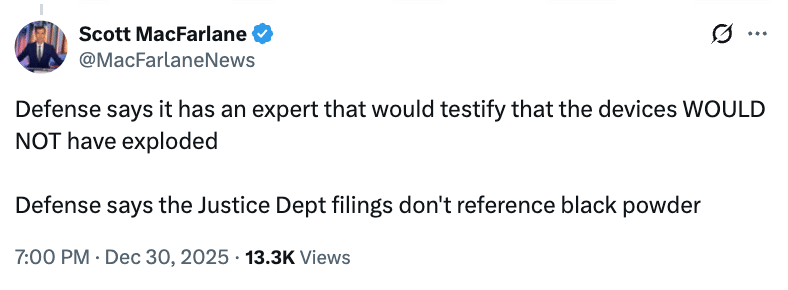
Jones went silent, so Cole’s lawyers flew out a witness who — they reportedly said during the hearing the other day — would have testified that the pipe bombs would not have exploded. They also noted what I did: neither the arrest affidavit nor the detention memo presented any evidence that Cole bought black powder or the potassium nitrate that he allegedly told them he used to make it.
If these weren’t bombs, they might not be able to charge Cole under the existing statute, and if they can’t, then the statute of limitations might run before a grand jury is seated to indict Cole with something else.

And in the government’s (apparently still sealed) filing, they try to blame Cole for adhering to Federal Rules of Criminal Procedure.

34. This is not hyperbole. The government admits as much, stating that it “would have sought [] an early indictment from a federal grand jury panel had there been any indication that the defense, contrary to all indications, intended to pursue a preliminary hearing on December 30, 2025.” In other words, the government expected defense counsel to drop the ball.3 That is not “changed circumstances.”

3 The government does not proffer any reason why competent defense counsel would agree to forego a preliminary hearing in the absence of receiving some benefit, such as an agreement to release the defendant from custody. That is because there is none—making the government’s purported reliance on this “indication[]” entirely unreasonable.

For what it’s worth, I think the government’s location data is also likely to be aggressively challenged.

But it sounds like the government also understands they’ve got a hole in their case where the actual explosives are supposed to be.

Update: Sharbaugh has dispatched with this process by, first, seemingly misrepresenting what the defense said about a probable cause hearing (and thereby granting himself the ability to determine probable cause without the hearing the defense wanted), then finding Cole should be detained. Then, after doing that, he said it was no harm no foul on forgetting to indict him and doing it in the DC Superior Court to avoid a hearing.

I don’t contest the decision, which seems reasonable enough (he relies heavily on DOJ’s representation of Cole’s confession, which his attorneys did not contest because they were making a procedural case), though I do think the procedural posture is a problem.
The National Security Letter Seamus Hughes Found When Looking for a Dan Richman Docket

Not long after something happened in November to prevent four Dan Richman dockets from being unsealed in DC District, Judge Anthony Trenga ordered a docket about a National Security Letter from the same period as the Dan Richman investigation (which he referred in 2019 to then Magistrate Judge Michael Nachmanoff) to be unsealed.

Both the four Dan Richman dockets and the NSL docket remain substantially sealed.

As I have laid out before, when Magistrate Judge William Fitzpatrick first held a hearing about DOJ’s bid to breach Jim Comey’s privilege on November 5, he started the hearing by focusing on all the sealed documents. When he asked Loaner AUSA Tyler Lemons about the status of the underlying warrants, Lemons equivocated.

THE COURT: Mr. Lemons, what’s the status of that?

MR. LEMONS: Thank you, Your Honor. Your Honor, we have made a request to the issuing district as to those search warrants, for them to be unsealed. My understanding, last speaking with an AUSA in that district, is that motion has not been filed at this time. They are preparing to provide notice to other potentially interested parties, per their practice and the rules they have to abide by in that district. So we requested it, and our understanding is at this time that the warrants all remain completely under seal. That is the only reason why the government designated these search warrants as protected material and filed them under seal and understands why the defense filed them under seal. If it was in my power and ability here today, those search warrants would be totally unsealed. [my emphasis]

After the hearing Fitzpatrick ordered that the parties take steps to unseal both the underlying warrant dockets and the sealed filings about them.

ORDERED that the Government shall, on or before November 10, 2025, move in the issuing district to unseal the four 2019 and 2020 search warrants referenced in the Government’s Reply to Defendant’s Response to the Government’s Motion for Implementation of Filter Protocol (ECF 132), together with all attendant documents, or, in the alternative, file a motion in the issuing district setting forth good cause as to why the subject search warrants and all attendant documents should remain under seal, in whole or in part; and it is further

[snip]

ORDERED that, if necessary, the Court shall hold a hearing on the pending motions to seal (ECFs 56, 72, 109, and 133) on November 21, 2025, at 10:00 a.m. in Courtroom 500, and the materials subject to those motions shall remain UNDER SEAL until further order of the Court; and it is further

ORDERED that, to the extent the Government seeks to seal Exhibit A to Defendant’s Response to the Government’s Motion for Expedited Ruling (ECF No. 55-1), the Government shall file a supporting brief in accordance with Local Criminal Rule 49 on or before November 12, 2025; Defendant may file a response on or before November 19, 2025; and, if necessary, the Court shall hold a hearing on the Government’s sealing request on November 21, 2025, at 10:00 a.m. in Courtroom 500;

Over a month ago, by November 10, the Loaner AUSAs in EDVA should have filed to unseal the four warrant dockets in DC or they should have filed a motion in DC “setting forth good cause as to why the subject search warrants and all attendant documents should remain under seal.”

If the Loaner AUSAs followed that order, it would seem to suggest someone insisted on keeping the dockets in DC sealed.

Fitzpatrick listed those dockets in a footnote of his November 17 opinion (that is, a week after DOJ would have had to file to keep everything sealed) granting Comey access to the grand jury transcripts in his case.

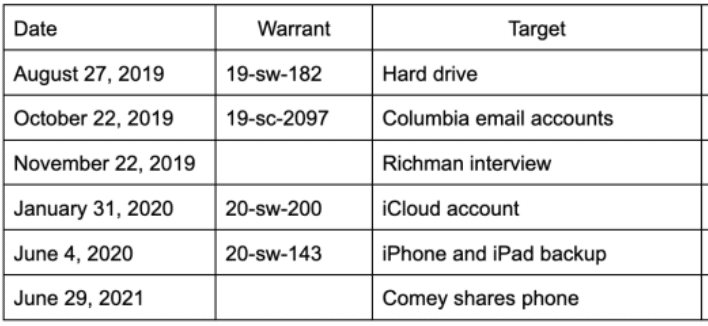
2 Search warrant 19-sw-182 was issued on August 27, 2019, and authorized the search of Mr. Richman’s hard drive from February 1, 2017 to April 30, 2017. ECF 89-1.

Search warrant 19-sc-2097 was issued on October 22, 2019, and authorized the search of Mr. Richman’s Columbia University and Law School email accounts from March 1, 2016 to May 30, 2017. ECF 89-2.

Search warrant 20-sw-200 was issued on January 31, 2020, and authorized the search of Mr. Richman’s iCloud account from March 1, 2016 to May 30, 2017. ECF 89-3. Attachment B to the warrant specifically limits the information to be seized to “non-privileged communications.” Id.

Search warrant 20-sw-143 was issued on June 4, 2020, and authorized the search of the backup files for Mr. Richman’s iPad and iPhone from March 1, 2016 to May 30, 2017. ECF 89-4. Attachment B to the warrant specifically limits the information to be seized to “non-privileged communications.” Id.

I just checked. They’re still sealed.

Some weeks ago, I did what any resourceful person would do to try to solve a docket mystery: I asked Seamus Hughes (of CourtWatch fame) if he could find anything.

He didn’t find any docket at DC asking to keep the files sealed.

What he did find is at least as interesting.

He found a docket, described as National Security Letter 19-498157 and listing Bill Barr as the defendant, which was originally referred to Michael Nachmanoff when he was a Magistrate Judge, with a recent update. On December 10, Judge Anthony Trenga, citing a response from DOJ on November 14 (which is sealed), ordered the docket about a 2019-2020 National Security Letter to be unsealed.

Aside from that order though, it remains substantially sealed.

This docket may be totally unrelated to the Comey case.

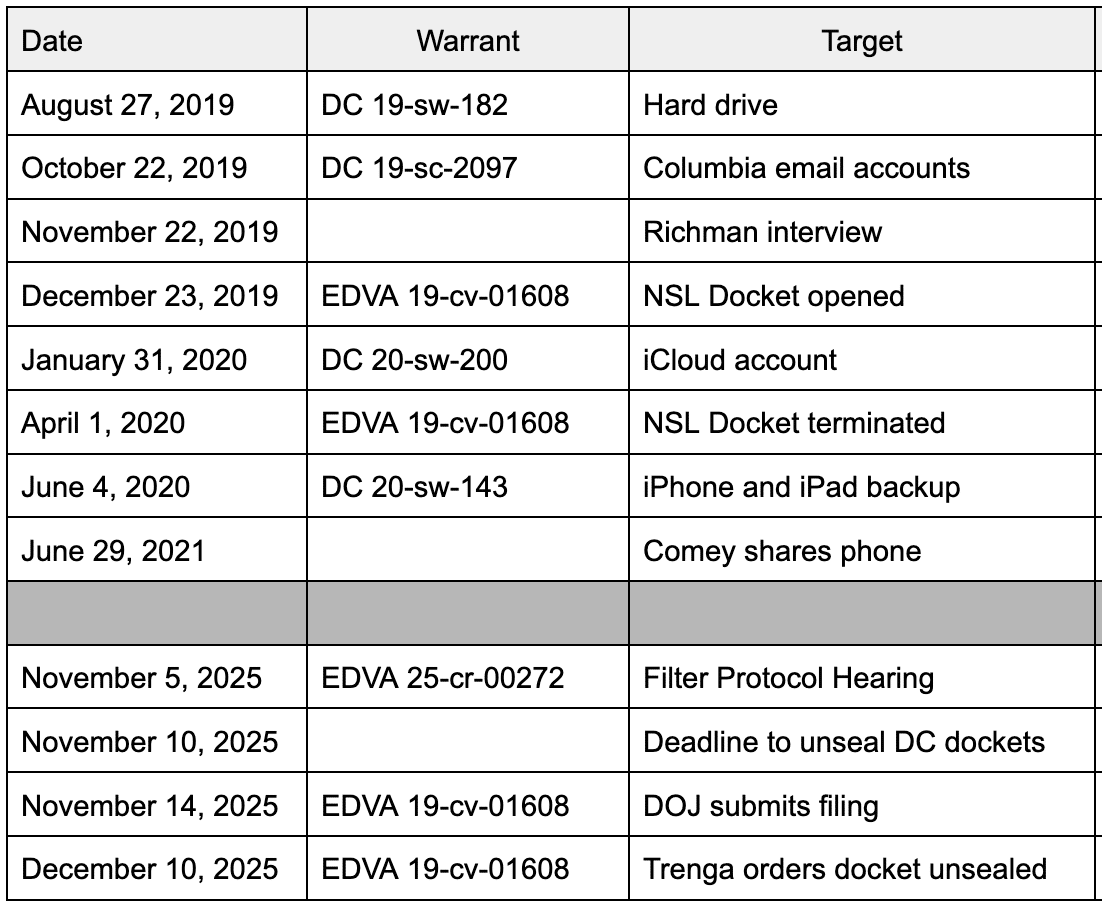
But the table above shows how neatly the two overlap. The NSL docket was opened a month after a Dan Richman interview in November 2019, and it was closed before DOJ obtained warrants to seize the iPhone which they’ve since been snooping into.

Maybe Santa can help us unwrap this in time for Christmas.

Judge Colleen Kollar-Kotelly Asks DOJ for Signs of Life

Judge Colleen Kollar-Kotelly granted Dan Richman his request for a Temporary Restraining Order, preventing the government from snooping in his stuff, one that goes through Friday. And while I agree with Gerstein and Cheney (and Bower and Parloff) that it could have the effect of thwarting another indictment of Jim Comey — indeed, it may undercut an attempt to stonewall Richman — I find KK’s order interesting for other reasons.

Partly, it’s the way she’s demanding signs of life from DOJ.

Judge KK attempts to forestall a stonewall

As a reminder, Judge Cameron Currie threw out the indictment against Jim Comey on November 24, the Monday of Thanksgiving week. Two days later, the day before Thanksgiving, Richman cited that dismissal and the expired Statute of Limitations in his bid to get his data back. As far as I know, no one noticed it until Anna Bower pointed to it on Tuesday.

Notably, Richman attached the warrants used to obtain his records as sealed exhibits.

The same day Bower noted it (the day it was assigned), December 2, Judge KK issued an order, half of which dealt with Richman’s sealing request, which she provisionally granted. But she also told him that if he wants to keep the government out of his data, he needs to get a Temporary Restraining Order. Her order emphasized that that request must submit some sign of life from DOJ.

Finally, Petitioner Richman’s 1 Motion requests that this Court “issue a temporary restraining order enjoining the [G]overnment from using or relying on in any way” the materials at issue in his 1 Motion while this matter is pending. Consistent with Local Rule of Civil Procedure 65.1, it is ORDERED that Petitioner Richman shall file his application for a temporary restraining order by separate motion, accompanied by a certificate of counsel that either (1) states the Government has received actual notice of the application and “copies of all pleadings and papers filed in the action to date or to be presented to the Court” in connection with the application; or (2) identifies “the efforts made by the applicant to give such notice and furnish such copies.”

A Certificate of Service Richman filed later that day explains part of the reason KK made that order: For some reason, the motion was not docketed. So, Richman attorney Mark Hansen explained that he formally served Jocelyn Ballantine and DC USAO on December 1.

This Corrected Certificate of Service corrects the service date listed for the public redacted Motion for Return of Property and accompanying attachments, see ECF No. 1 at 3, and the sealed version of that Motion with accompanying attachments, see ECF No. 2, from November 26, 2025, to December 1, 2025. Although Petitioner filed those papers on November 26, 2025 and intended to serve them on that date, the filings were not docketed at that time. I promptly caused the filings to be served on counsel for respondent upon receiving notification from the Clerk’s Office, on December 1, 2025, that the filings had been accepted for submission and docketed.

But to comply with the other part of her order, Richman’s attorneys also included the emails they exchanged with Ballantine. And among the things those emails showed is that after agreeing to attorney Nick Lewin’s midafternoon December 3 request to respond by close of day on December 4,

Based on the government’s use of such property in connection with the Comey case (as described in Judge Fitzpatrick’s November 17, 2025 opinion), we are concerned that, absent a TRO, the government may continue to use the property in a manner that violates Professor Richman’s rights – particularly in light of recent news reports that the DOJ may seek a new indictment of Mr. Comey. However, if the government has no such intention and will agree to refrain from searching, using, or relying in any way upon Professor Richman’s property pending resolution of the Rule 41(g) motion, that would address our concerns and obviate the need for a TRO.

Please let us know the government’s position by COB tomorrow.

[snip]

Nick,

Thanks for your email. I will reach out to the appropriate people at DOJ with your request and will respond to you tomorrow by COB.

Jocelyn

Ballantine had not responded by 9PM on December 4.

Hi Jocelyn,

Did you get an answer? Please let us know.

Ballantine had a good excuse: she was busy prosecuting accused pipe bomber Brian Cole. Nevertheless, when she did respond at 9:12PM Thursday night, she said that her leadership — Jeanine Pirro — had already engaged with DOJ leadership (Bondi spent part of Thursday with Pirro bragging about the pipe bomber arrest), but she would not have an answer until “early next week.”

Thank you so much for the prompt. I met with my leadership today, and they have engaged Department of Justice leadership. I have also shared your pleadings and request with the prosecutors who handled the Comey prosecution out of EDVA.

I do not have an answer for you this evening, but I expect to have one early next week.

That’s what led Richman to file his motion for a TRO, maybe around 10PM Friday night. Judge KK responded just under a day later.

Her order specifically ruled that DOJ knows about Richman’s request.

Third, the Court finds that the Government has received actual notice of Petitioner Richman’s [9] Motion, ensuring that the Government is positioned to act promptly to seek any appropriate relief from this Order. Specifically, counsel for the Government may move to dissolve or modify this Order immediately upon entering an appearance, and the Court will resolve any such motion “as promptly as justice requires.” Fed. R. Civ. P. 65(b). Under the circumstances, the Court will allow and consider such a motion at any time upon contemporaneous notice to counsel for Petitioner Richman. See id. (providing that such a motion may be filed “[o]n 2 days’ notice to the party who obtained the order” or “on shorter notice set by the court”).

And barring the government requesting a different schedule, Judge KK’s order set up the following schedule:

  • Richman should “promptly” serve Judge KK’s order and everything filed in the docket to Pam Bondi (KK identifies Bondi by title specifically).
  • By noon on Monday, “the Attorney General of the United States or her designee” must confirm “the United States,” so everyone!, is in compliance with KK’s order not to “access … share, disseminate, or disclose” Richman’s data “to any person.”
  • By Tuesday at 9AM, DOJ must respond to both of Richman’s requests.
  • He must reply by 5PM that day.
  • The order will expire at 11:59PM on Friday night if Judge KK has not issued an order first.

If DOJ follows Judge KK’s order, then it will have the effect of:

  1. Slightly accelerating the response deadline for DOJ, which may have been due sometime on Tuesday anyway, while dramatically accelerating Richman’s reply, which is now due that same day.
  2. Flip the default status of Richman’s data, restricting DOJ from accessing it before Judge KK issues an order rather that allowing them to access it until any such order is in place.

In other words, the government can’t stall Richman’s effort in a bid to use the data in the interim. If DOJ follows the order, then it would prevent DOJ from using the data to get a new indictment before such time as Ballantine responds, “early next week.” Unless DOJ got an indictment on Friday with hopes of a big show arrest tomorrow morning, then KK would have thwarted any effort to stonewall Richman’s assertion of his rights.

If DOJ blows off the order, it’ll make it even easier for Comey to argue any indictment is malicious (unless, of course, he has to argue that to Aileen Cannon).

Did Judge KK smell a rat?

That’s the logistics of the order. The other parts of it are more interesting.

First, KK’s analysis on the TRO is cursory: just one paragraph stating that the government probably has violated Richman’s Fourth Amendment rights by searching his data without a warrant.

The Court concludes that Petitioner Richman is likely to succeed on the merits of his claim that the Government has violated his Fourth Amendment right against unreasonable searches and seizures by retaining a complete copy of all files on his personal computer (an “image” of the computer) and searching that image without a warrant. See United States v. Comey, No. 1:25-CR272-MSN-WEF, 2025 WL 3202693, at *4–7 (E.D. Va. Nov. 17, 2025). The Court further concludes that Petitioner Richman is also likely to succeed in showing that, because of those violations, he is entitled to the return of the image under Federal Rule of Criminal Procedure 41(g).

That’s on the third page of the four-page memo.

Before she gets there (and in addition to formally finding that DOJ has notice of Richman’s request), she focuses on the way DOJ is playing dumb. She notes she has spoken to unnamed people from DC USAO, who were helpful on administrative matters, thank you very much.

First, although the Court has been in communication with attorneys from the U.S. Attorney’s Office for the District of Columbia, 1 the U.S. Attorney’s Office for the District of Columbia has not yet entered an appearance to make representations on behalf of the Government, and counsel for the Government has not yet been identified. See Pet’r’s Ex. A, Dkt. No. 9-2.

1 These attorneys have helpfully facilitated communication on administrative matters. The Court appreciates counsel’s prompt assistance on these matters.

But no one, including Jocelyn Ballantine, wants to put their name on this docket.

And that’s a problem, Judge KK notes, because until someone files notice of appearance, there’s no formal way to start figuring out who has the data.

Second, the Government has not yet indicated who has custody of the material at issue, and neither the Petitioner nor the Court can determine the identity of the custodian until the Government appears in this case. Given that the custody and control of this material is the central issue in this matter, uncertainty about its whereabouts weighs in favor of acting promptly to preserve the status quo.

Maybe it’s something those helpful DC USAO personnel told her. Maybe it’s the way Ballantine deftly shared Richman’s motion with the Loaner AUSAs at EDVA, but not the DOJ leadership with whom Pirro had consulted by late day Thursday.

It’s like Colleen Kollar-Kotelly suspects DOJ is hiding the ball, and that’s why she ordered Richman to go right to the top with his request, to ensure Pam Bondi can’t pretend she’s ignorant of his request.

The perma-sealed Bill Barr dockets

There’s something else sketchy going on here.

As I noted, Richman attached the warrants used to seize his stuff. They’re still sealed and Judge KK has provisionally permitted them to remain that way.

But why are they still sealed?

Back on November 5, Magistrate Judge William Fitzpatrick ordered the Loaner AUSAs to get them unsealed or, if not, then to file a motion justifying the seal in DC.

ORDERED that the Government shall, on or before November 10, 2025, move in the issuing district to unseal the four 2019 and 2020 search warrants referenced in the Government’s Reply to Defendant’s Response to the Government’s Motion for Implementation of Filter Protocol (ECF 132), together with all attendant documents, or, in the alternative, file a motion in the issuing district setting forth good cause as to why the subject search warrants and all attendant documents should remain under seal, in whole or in part;

In that same order, he ordered that there’d be a discussion about unsealing all the references to the warrants in the Comey docket on November 21, which was before Judge Currie dismissed the indictment on November 24. The government was also going to have to defend keeping the filing explaining the notice given to Comey — and submitted as an exhibit to his first response to the effort to get a taint team — sealed that same day.

ORDERED that, if necessary, the Court shall hold a hearing on the pending motions to seal (ECFs 56, 72, 109, and 133) on November 21, 2025, at 10:00 a.m. in Courtroom 500, and the materials subject to those motions shall remain UNDER SEAL until further order of the Court; and it is further ORDERED that, to the extent the Government seeks to seal Exhibit A to Defendant’s Response to the Government’s Motion for Expedited Ruling (ECF No. 55-1), the Government shall file a supporting brief in accordance with Local Criminal Rule 49 on or before November 12, 2025; Defendant may file a response on or before November 19, 2025; and, if necessary, the Court shall hold a hearing on the Government’s sealing request on November 21, 2025, at 10:00 a.m. in Courtroom 500;

Best as I can tell, that never happened. For example, there are no gaps in the Comey docket hiding a sealed discussion about these sealed warrants.

And that’s interesting because when Fitzpatrick asked about all this back on November 5 — this is the hearing that led to the order to unseal the warrants — Rebekah Donaleski revealed that they asked Loaner AUSA Tyler Lemons about the warrants twice at that point, but had gotten no response.

Before we begin, what I’d like to do is — before we address the underlying issues, the government’s motion for a filter protocol, the defendant’s position, we have four outstanding sealing motions, and I do think those sealing motions will touch, at least in some way, on this motion; if not, motions that you-all are going to argue in the future. So what I’d like to do is see if we can nail down what the parties’ positions are and see if we can kind of resolve some of those sealing issues now, if possible.

As I understand it, there are four sealing motions that are outstanding. The defense has filed three; the government has filed one. All these sealing motions deal with either warrants that were issued in a sister district or one document that the government has provided to the defense in discovery.

MS. DONALESKI: Thank you, Your Honor. With respect to the one document provided in discovery, that’s our position, we have no objection. With respect to the underlying warrants which we attached to our motions, my understanding from Mr. Lemons is that he has moved to unseal those. We don’t know where — he hasn’t moved to unseal them — when. We’ve asked him twice for that information, and he hasn’t provided it. The defense’s view is that we should be entitled to proposed reasonable redactions for PII of those warrant affidavits and warrant materials. We have asked for an opportunity to do that and have not heard from the government. So our position is, the information in our motions, in the motion papers themselves, we have no objection to that being under seal — to that being publicly filed; but with respect to the warrants, which my understanding is those remain under seal by the District of D.C. court, we would ask that we be permitted an opportunity to propose redactions with the government.

[snip]

But with respect to the information that we’ve described in our motion papers, specifically referring to the offenses at issue in the Artic Haze warrants, the dates that the warrants authorize to search, the defense believes that those should be discussed publicly and those can be discussed publicly.

THE COURT: What about the affidavits in support of the warrants?

MS. DONALESKI: Those remain under seal. I don’t expect that we’ll need to get into what is in those affidavits in this hearing today, but if the government or the Court feels differently, we’d welcome that discussion.

And when Fitzpatrick asked Lemons about the warrants, the Loaner AUSA got a bit squirmy. Lemons had asked the AUSA to unseal the warrants. He had not filed a motion to unseal them, as if someone — maybe the AUSA in question, who may be Jocelyn Ballantine — advised him that was not a good idea.

THE COURT: Mr. Lemons, what’s the status of that?

MR. LEMONS: Thank you, Your Honor. Your Honor, we have made a request to the issuing district as to those search warrants, for them to be unsealed. My understanding, last speaking with an AUSA in that district, is that motion has not been filed at this time. They are preparing to provide notice to other potentially interested parties, per their practice and the rules they have to abide by in that district. So we requested it, and our understanding is at this time that the warrants all remain completely under seal. That is the only reason why the government designated these search warrants as protected material and filed them under seal and understands why the defense filed them under seal. If it was in my power and ability here today, those search warrants would be totally unsealed. [my emphasis]

“Preparing to provide notice to other potentially interested parties”? Who else would need notice? Richman and Comey were the ones suspected of leaking!

It has been a month but these dockets remain sealed.

One possible explanation for that is that the Loaner AUSAs (or perhaps Ballantine) filed a motion in DC on November 10 that is under seal, one that should not be sealed for Judge KK. So perhaps everyone is trying to hide the fact that after being ordered by Fitzpatrick not to access this data, Kash Patel just dealt it to someone else (possibly Jason Reding Quiñones). That might explain why Judge KK ordered the government they can only contest her order after giving “contemporaneous notice to counsel for Petitioner Richman:” because (hypothetically), having been ordered by MJ Fitzpatrick to stay out of Richman’s data, they instead dove deeper into it without telling him.

Or maybe the squirminess is about hiding how the underlying warrants were managed … by Jocelyn Ballantine.

Revealing those warrants, after all, should not thwart the effort to keep snuffling about Richman’s data, except insofar as it would raise questions not directly addressed in Judge KK’s order. Just as one example, even though Richman in his initial motion and TRO request relied heavily on Magistrate Judge William Fitzpatrick’s opinion effectively describing rampant Fourth Amendment violations, he does not mention that when the FBI seized his iCloud account in 2020, they took content through August 13, 2019, more than two years after the date of the warrant (basically, through the date of the Comey Memo IG Report release).

According to an April 29, 2020 letter from Mr. Richman’s then-attorney to the government–produced to the Court ex parte by the defense–the Department of Justice informed Mr. Richman that the data it obtained from his iCloud account extended to August 13, 2019, well outside the scope of the warrant and well past the date on which Mr. Richman was retained as Mr. Comey’s attorney. ECF 181-6 at 20. The same letter further states that the Department of Justice informed Mr. Richman that it had seized data from Mr. Richman’s hard drive that extended to June 10, 2017–again well into the period during which Mr. Richman represented Mr. Comey–despite the warrant (19-sw-182) imposing a temporal limit of April 30, 2017. Id.

Did Ballantine — in whom Pirro has invested the trust to limit the blowback of the pipe bomb prosecution — allow the FBI to obtain data outside the scope of a warrant? Are there secret John Durham warrants someone is hiding?

It’s not clear who all this squirminess is designed to protect. But I feel like, whether or not Judge KK’s order halts DOJ efforts to dive into this unlawfully collected data, it may lead to some interesting disclosures about why everyone is so squirmy.

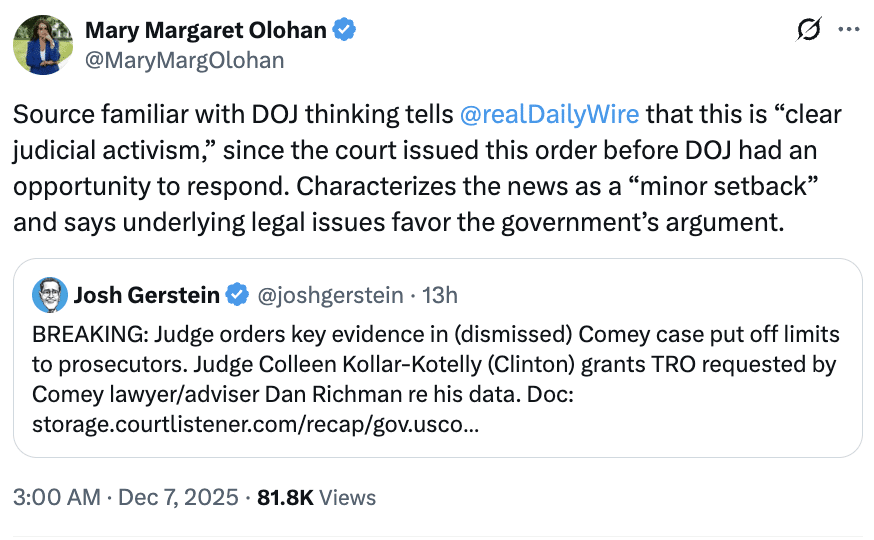
Update: Right wing propagandist (and daughter of a former whack job FBI agent) Mary Margaret Olohan gives the game away. One of her DOJ sources says this won’t be a setback … which sort of confirms that DOJ intends to continue to violate Richman’s Fourth Amendment.

What’s Not Being Said about the Alleged Pipe Bomber

The arrest affidavit for Brian Cole, the 30 year old guy charged as the pipe bomber today, is here.

The evidence consists of:

Phone records placing him on Capitol Hill at the time the FBI believes the bombs to have been placed.

The seven transactions between the COLE CELLPHONE and Provider’s towers occurred at approximately 7:39 p.m., 7:44 p.m., 7:59 p.m., 8:14 p.m., 8:23 p.m., and 8:24 p.m. Two transactions took place at 7:39 p.m. During this time period, the COLE CELLPHONE had transactions with five different sectors on Provider’s cell towers.

a. At approximately 7:39:27 p.m., the COLE CELLPHONE interacted with a particular sector of Provider tower 59323, which faces southeast (approximately 120˚) from its location at 103 G Street, Southwest in Washington, D.C. (“Sector A”). Also at 7:39:27 p.m., the COLE CELLPHONE interacted with a particular sector of Provider tower 126187, which faces east1 (approximately 90˚) from its location at 200 Independence Avenue, Southwest in Washington, D.C. (“Sector B”). Video surveillance footage shows that at approximately 7:39:32 p.m., the individual who placed the pipe bombs walked westbound on D Street, Southeast and then turned southbound on South Capitol Street, Southeast. These locations are consistent with the coverage areas of Sector A and B.

b. At approximately 7:44:36 p.m., the COLE CELLPHONE interacted with Sector B of Provider tower 126187. Video surveillance footage shows that at approximately 7:44:36 p.m., the individual who placed the pipe bombs walked east on Ivy Street, Southeast. This location is consistent with the coverage area of Sector B.

c. At approximately 7:59:36 p.m., the COLE CELLPHONE interacted with a particular sector of Provider tower 147990 which faces south (approximately 180˚) from its location at 200 Independence Avenue, Southwest in Washington, D.C. (“Sector C”). Video surveillance footage shows that at approximately 7:59:38 p.m., the individual who placed the pipe bombs walked southbound on New Jersey Avenue, Southeast then turned eastbound on E Street, Southeast. These locations are consistent with the coverage area of Sector C.

d. At approximately 8:14:36 p.m., the COLE CELLPHONE interacted with Provider tower 45111 which faces west (approximately 255˚) from its location at 101 Independence Avenue, Southeast in Washington, D.C. (“Sector D”). Video surveillance footage shows that at approximately 8:14:15 p.m., the individual who placed the pipe bombs exited Rumsey Court and walked westbound through an alley between the Capitol Hill Club and the RNC then walked northbound onto First Street, Southeast. This location is consistent with the coverage area of Sector D.

e. At approximately 8:23:59 p.m. and 8:24:06 p.m., the COLE CELLPHONE interacted with Provider tower 144340, which faces west (approximately 295˚) from its location at 600 Pennsylvania Avenue, Southeast in Washington, D.C. (“Sector E”). Video surveillance footage last captures the individual who placed the pipe bombs at 8:18 p.m. walking eastbound on Rumsey Court in the direction of tower 144340, which is approximately 1/2 mile east of the individual’s last recorded location. The last recorded location is consistent with the coverage area of Sector E.

A license plate reader showing his car arriving at Capitol Hill that evening.

On January 5, 2021, at approximately 7:10 p.m., COLE’s Nissan Sentra was observed driving past a License Plate Reader at the South Capitol Street exit from Interstate 395 South, which is less than one-half mile from the location where the individual who placed the devices was first observed on foot near North Carolina and New Jersey Avenues, Southeast at 7:34 p.m. Approximately 5 minutes later, at 7:39:27 p.m., the COLE CELLPHONE began to interact with Provider towers in the area.

Purchases of components consistent with the construction of the pipebombs, including paying cash for a battery connector consistent with the pipe bombs in 2019.

Both pipe bombs were manufactured using a nine-volt (9V) battery connector with attached red and black wires. The nine-volt battery connectors used in the pipe bombs had identifying information on the black and red insulated wires that were consistent with those distributed in North America by a known company and its predecessors (the “Nine Volt Distributor”). COLE purchased five of the Nine Volt Distributor’s nine-volt battery connectors from Micro Center in northern Virginia on or about November 12 and December 28, 2019, including cash purchases made during the December transaction. Fewer than 8,000 of Nine Volt Distributor’s nine-volt battery connectors were distributed in the United States between December 2017 and January 5, 2021. [my emphasis]

A purchase made across the street from the alley way on December 14.

Approximately three weeks before the pipe bombs were placed, on or about December 14, 2020, COLE made a purchase at a restaurant located near First and D Streets, Southeast. The restaurant is located across the street from the entrance to Rumsey Court on D Street, Southeast.

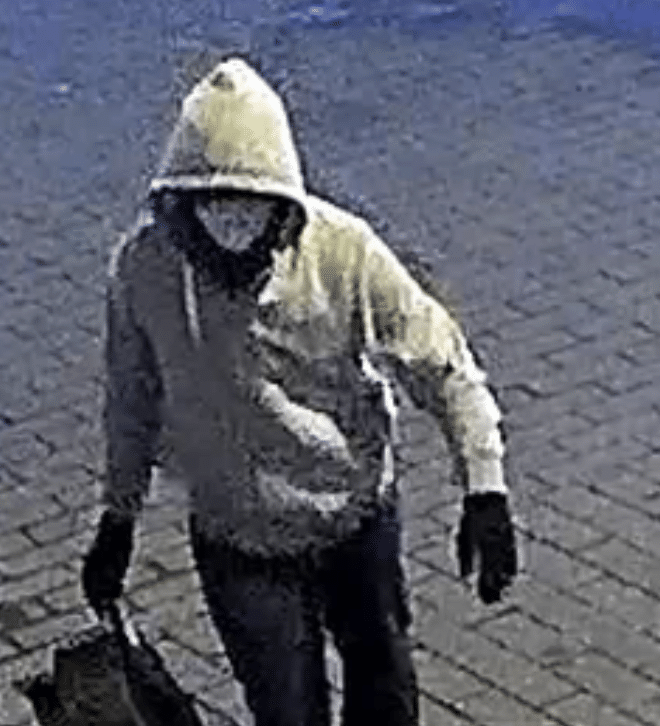
There’s nothing that ties those weird sneakers to Cole at all. [Corrected]

Certainly, he’s a candidate, and should have been IDed as such in 2021. But the affidavit lacks the kind of thing we saw all the time in real January 6 affidavits: Personal communications. Signs of planning in the period after Trump announced the rally. While there are a bunch of components purchased in November 2020, after the election, there’s not a single data point in the affidavit between when Trump announced the rally on December 19 and when Cole was on Capitol Hill on January 5, 2021.

Surely, FBI has already obtained warrants for all that and it is at least consistent with someone who had been playing with bomb-making for two years before placing these bombs.

But they’re not telling what’s in them.

You get the feeling they might not tell the story Kash Patel and Pam Bondi want to tell. What if finding the pipe bomber gets them fired, just like responding competently to COVID got Anthony Fauci fired and targeted?

DOJ has assigned Jocelyn Ballantine to this case. You may recall that she made false claims in support of efforts to throw out the Mike Flynn case in 2020.

Update: Per Ryan Reilly, Cole (who wouldn’t have been assigned an attorney yet) told the FBI that he believed in 2020 election fraud claims.

How J6C’s Obstinance on Transcripts Enabled Dominic Pezzola’s Attempt to Sow Conspiracy Theories

On Friday, lawyers for Proud Boy Dominic Pezzola (who are among the more conspiratorial of the Proud Boy defense attorneys) filed a motion for a mistrial claiming that the “Winter Palace” document Enrique Tarrio received from one of his at least three girlfriends was created by the government. Here’s how the document was admitted as evidence last Thursday.

At issue is testimony that Samuel Armes provided to the January 6 Committee (and, as we’ll see, a grand jury) regarding his recognition that a document he created as part of imagining how an attack on the electoral certification would happen was altered to become the Winter Palace document.

Pezzola’s lawyer, Robert Root (who joined his team days before trial started) argued that when Judge Kelly ruled the document was admissible back in December, defense attorneys had not yet seen Armes’ testimony, and so could not argue that Armes — who claimed he had been trained to be a spook — was a government agent framing the Proud Boys.

According to the Politico article, Ms. Flores also gave an interview to the Jan. 6 Committee. And Ms. Flores reportedly testified that Armes was the author of the entirety of “1776 Returns” and that this FBI and CIA member or associate asked her to share it with Tarrio.

If true, this means that the most damning document in this trial was authored by the intelligence community—someone “groomed” by the FBI itself. And this CIA and FBI asset requested Tarrio’s friend to share the document with Tarrio just prior to January 6. [emphasis original]

The filing relies heavily on this Politico story, which extrapolates about a communication the January 6 Committee had with the girlfriend in question, Eryka Flores, but which was not released as a transcript.

In my opinion, this filing was designed first and foremost as bait for Jim Jordan to claim that even the Proud Boy prosecution is just the Deep State trying to frame Donald Trump, and only secondarily as yet another of the often frivolous motions for a mistrial defense attorneys have lodged in this case.

But the government has responded in here, partly by (inappropriately, in my opinion) mocking the illogic of Pezzola’s challenge, before going on to explain how the testimony of Armes, at least, totally rebuts Pezzola’s claims.

The government strongly disagrees with Pezzola’s characterization of both the facts and the record with respect to these assertions. The government robustly agrees with defendant Pezzola that it would have been egregiously improper for a member of the U.S. Intelligence Community to have conducted a domestic intelligence operation targeting Enrique Tarrio, a U.S. Person, and providing him with a plan to “storm” (or “occupy” or “sit in”) House and Senate Office Buildings on January 6. It would have been even more improper for a member of the U.S. Intelligence Community to send this plan to the leader of the Proud Boys when, just months before, then-President Trump had exhorted the Proud Boys to “stand back and stand by” during a nationally televised debate. And it would have been egregious indeed for a member of the U.S. Intelligence Community to send such a document to the leader of the Proud Boys in advance of January 6, in the wake of the violent attacks the Proud Boys were associated with in Washington, D.C., on November 14, and December 12, 2020. Surely, had the government planted such a document in the inbox of defendant Tarrio (ECF 660 at 5), one would hope that the U.S. Intelligence Community would have hewed to the truth of what happened on January 6 and included the Capitol as one of the targeted buildings.

The filing notes that, contrary to the claimed late notice with the release of the transcripts, the Proud Boys already received October 7 grand jury testimony from Armes that tracks his J6C testimony, a transcript from Flores’s May grand jury testimony showing her invoking the Fifth repeatedly, and a third witness describing receiving the document from Flores on a date that would be before she sent it to Tarrio on December 30.

The information that Samuel Armes drafted a document that inspired portions of the Government Exhibit 528-1 was disclosed to defense counsel by the government on November 16, 2022, when it provided counsel with a copy of Armes’ October 7, 2022, grand jury testimony.

[snip]

Armes testified that he shared his “wargaming” exercise in the form of a three- to five-page Google document with “Erika Flores” sometime between August 2020 and January 2021. 7/18/2022 HSC Tr. at 12; 10/6/2022 Grand Jury Tr. at 26. When asked why Flores told the House Select Committee that Armes had drafted the document, he testified “I guess she is just blame shifting.” 7/18/2022 HSC Tr. at 20. Armes surmised that Flores had taken his “ideas as an inspiration, and her or some group of people then turned it into ‘1776 Returns.’” Id. Indeed, when subpoenaed to testify before the Grand Jury in this case on May 3, 2022, Flores answered only brief biographical questions and then invoked her fifth amendment right not to testify repeatedly in response to more than 50 transcript pages worth of questions by the government about the “1776 Returns” document. That transcript was provided to defense counsel on November 16, 2022.1

1 On that same day, counsel were provided with the grand jury transcript of another witness who testified that a girlfriend of Enrique Tarrio known as “Erika” had messaged a document to the witness about two weeks before January 6 and asked the witness to fill in the names of people to participate in an “infiltration plan.” The witness further recalled that the individuals were to dress like they belonged in the buildings and to have set up prior meetings to gain access. Compare Government Ex. 528-1 at pages 3, 6.

The third witness may be Jeremy Liggett, whom J6C investigators suggested had some tie to the document as well.

There are just three problems with this.

First, as Politico reported today, Flores didn’t invoke the Fifth to the J6C.

Two investigators familiar with her interview — an informal, untranscribed appearance in early 2022 — say that while she was a reluctant witness and initially planned to plead the Fifth, she ultimately agreed to answer some questions about the document.

“Instead of pleading the Fifth, we did an interview with her,” one of the investigators said, speaking on condition of anonymity to describe information the committee had not publicly released. “She gave us the name of Samuel Armes as the name of the individual who wrote the document.”

[snip]

The select committee investigators said they found Armes to be more forthcoming than Flores, who they said exhibited a “general apprehension.” Flores didn’t respond to messages and emails seeking comment.

“She acted like she didn’t know what it was at all,” said one of the investigators.

The two investigators said Flores indicated she had shared the document with Tarrio to impress him during a sensitive phase in their relationship and disclaimed specific knowledge about its contents.

The Stone-related witnesses very carefully manipulated the J6C, and Flores’ decision to testify may be an example. At the very least, Pezzola may have basis to demand that Kelly immunize Flores.

Another problem is that Jocelyn Ballantine is formally on the government response. I’ve noted before how insanely stupid it is for DOJ to have her in an increasingly senior role in the January 6 committee, and discovery disputes like this are precisely why.

The third problem with all this is that DOJ should be able to get Google metadata associated with the document to provide more clarity about the document. Perhaps a later witness will explain efforts to do so (thus far, it has just been introduced as an attachment to a Telegram text). But there are outstanding questions that may have answers.

In any case, this is now the second time that J6C’s refusal to turn over transcripts has endangered this prosecution.

Yes, It Turned Out January 6 Committee Endangered the DOJ Investigation by Withholding the Jeremy Bertino Transcript in June

I often get accused of being an uncritical booster for DOJ on the January 6 investigation. In reality, I have focused my criticism on real problems with the investigation.

In fact several of the criticisms I’ve raised have borne out in recent days, as an attorney-client conflict that should have been identified in June threatened (and still threatens) to bollox the Proud Boy Leader trial, and with it the larger effort to tie Trump’s immediate associates with the crime scene.

Twice, for example, I’ve discussed how central Joe Biggs’ actions the day of the attack were to understanding the larger event. In the first, I described how Biggs’ chumminess with FBI agents led them to overlook his plans for a terrorist attack on the Capitol.

Something brought Joe Biggs, Florida Oath Keepers Kenneth Harrelson and Jason Dolan, along with former Biggs employer Alex Jones to the top of the East steps, along with the mob that Jones brought on false pretenses. Shortly thereafter, Florida Oath Keeper head Kelly Meggs would bring a stack of Oath Keepers through the same door and — evidence suggests — in search of Nancy Pelosi, whom Meggs had talked about killing on election day.

Joe Biggs kicked off the riot on the West side of the building.

Then he went over to the East side to join his former employer Alex Jones and a bunch of Oath Keepers, led by fellow Floridians, to lead a mob back into the Capitol.

West side. Joe Biggs. East side. Joe Biggs.

This is the guy a couple of FBI Agents in Daytona believed was a credible informant against Antifa.

A month later, I described how problematic it was that an AUSA who played a part in Sidney Powell’s efforts to spread false claims about Mike Flynn and Joe Biden before the 2020 election had a role (now reportedly expanded) in overseeing the prosecution of Biggs.

Because of Joe Biggs’ role at the nexus between the mob that attacked Congress and those that orchestrated the mob, his prosecution is the most important case in the entire January 6 investigation. If you prosecute him and his alleged co-conspirators successfully, you might also succeed in holding those who incited the attack on the Capitol accountable. If you botch the Biggs prosecution, then all the most important people will go free.

Which is why it is so unbelievable that DOJ put someone who enabled Sidney Powell’s election season lies about the Mike Flynn prosecution, Jocelyn Ballantine, on that prosecution team.

All that was clear by September 2021.

In that same time period, I was complaining and complaining and complaining about DOJ’s lackadaisical approach to attorney conflicts, first as John Pierce racked up 20 clients, most who served as a firewall to Biggs and the other Proud Boy leaders, and later as DOJ waited three months before inquiring into Sidney Powell’s alleged role in funding some of the Oath Keeper’s defense teams.

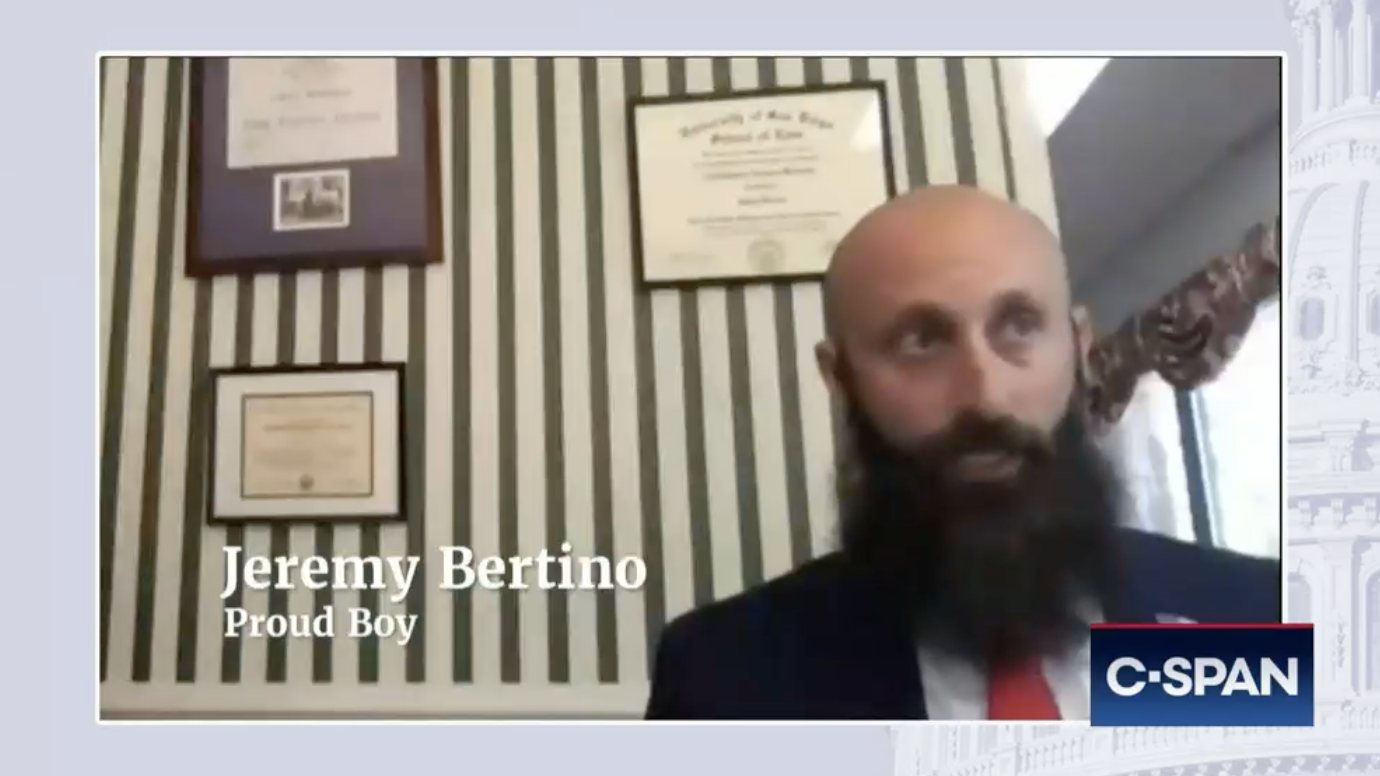
The importance to the Trump investigation of getting the militia conspiracies that implicate Roger Stone and Alex Jones right is one of the reasons I argued, in June 2022, that it was urgent for the Proud Boys’ prosecution team to get Jeremy Bertino’s transcript sooner rather than later.

On June 6, DOJ charged the Proud Boy Leaders with sedition. As I noted at the time, the single solitary new overt act described in the indictment involved Jeremy Bertino, Person-1, seeming to have advance knowledge of a plan to occupy the Capitol.

107. At 7:39 pm, PERSON-1 sent two text messages to TARRIO that read, “Brother. ‘You know we made this happen,” and “I’m so proud of my country today.” TARRIO responded, “I know” At 7:44 pm. the conversation continued, with PERSON-1 texting, “1776 motherfuckers.” TARRIO responded, “The Winter Palace.” PERSON-1 texted, “Dude. Did we just influence history?” TARRIO responded, “Let’s first see how this plays out.” PERSON-1 stated, “They HAVE to certify today! Or it’s invalid.” These messages were exchanged before the Senate returned to its chamber at approximately 8:00 p.m. to resume certifying the Electoral College vote.

Just days earlier, as part of a discovery dispute, prosecutors had provided this (dated) discovery index. For several reasons, it’s likely that at least some these entries pertain to Bertino, because the CE ones are from the Charlotte office, close to where he lives, because he’s one of the three uncharged co-conspirators of central importance to the Proud Boys efforts, and because we know FBI did searches on him.

In a hearing during the day on June 9, the Proud Boys’ attorneys accused DOJ of improperly coordinating with the January 6 Committee and improperly mixing politics and criminal justice by charging sedition just before the hearings start. In the hearing there was an extensive and repeated discussion of the deposition transcripts from the committee investigation. AUSA Jason McCullough described that there had been significant engagement on depositions, but that the January 6 Committee wouldn’t share them. As far as he knew, the Committee said they would release them in September, which would be in the middle of the trial. Joe Biggs’ attorney insisted that DOJ had the transcripts, and that they had to get them to defendants.

Judge Tim Kelly ordered prosecutors that, if they come into possession of the transcripts, they turn them over within 24 hours.

Hours later, during the first (technically, second) January 6 Committee hearing, the Committee included a clip from Bertino describing how membership in the Proud Boys had tripled in response to Trump’s “Stand Back and Stand By” comment.

His cooperation with the Committee was not public knowledge. I have no idea whether it was a surprise to DOJ, but if it was, it presented the possibility that, in the guise of cooperating, Bertino had just endangered the Proud Boy sedition prosecution (which wouldn’t be the first time that “cooperative” Proud Boys proved, instead, to be fabricators). At the very least, it meant his deposition raised the stakes on his transcript considerably, because DOJ chose not to charge him in that sedition conspiracy.

Today, in response to a bid by Dominic Pezzola and Joe Biggs to continue the trial until December, DOJ acceded if all defendants agree (Ethan Nordean won’t do so unless he is released from jail). With it they included a letter they sent yesterday to the Committee — following up on one they sent in April — talking about the urgency with which they need deposition transcripts.

We note that the Select Committee to Investigate the January 6th Attack on the United States Capitol (“Select Committee”) in its June 9, 2022 and June 13, 2022, hearings extensively quoted from our filings in active litigation and played portions of interviews the Select Committee conducted of individuals who have been charged by the Department in connection with the January 6th Attack on the United States Capitol.

It is now readily apparent that the interviews the Select Committee conducted are not just potentially relevant to our overall criminal investigations, but are likely relevant to specific prosecutions that have already commenced. Given this overlap, it is critical that the Select Committee provide us with copies of the transcripts of all its witness interviews. As you are aware, grand jury investigations are not public and thus the Select Committee does not and will not know the identity of all the witnesses who have information relevant to the Department’s ongoing criminal investigations. Moreover, it is critical that the Department be able to evaluate the credibility of witnesses who have provided statements to multiple governmental entities in assessing the strength of any potential criminal prosecutions and to ensure that all relevant evidence is considered during the criminal investigations. We cannot be sure that all relevant evidence has been considered without access to the transcripts that are uniquely within the Select Committee’s possession.

The discovery deadline for the Proud Boy case is tomorrow. If DOJ put Bertino before a grand jury and he said something that conflicts with what he told the Committee, it could doom his reliability as a witness, and with it the Proud Boys case, and with it, potentially, the conspiracy case against Trump.

Less than a week before I wrote that, there’s reason to believe, DOJ had flipped a key witness in the case.

It appears that DOJ did not get Jeremy Bertino’s transcript until around December 7. DOJ promised to give transcripts to the defendants within 24-hours after they received them, and DOJ provided 16-January 6 Committee transcripts on December 8.

And we now know the Bertino transcript was utterly critical to preparing for the trial, which is about to kick off. That’s because, in his deposition with the committee, Bertino explained at length both what appeared to be an attempt, by Joe Biggs’ attorney Dan Hull, to tie representation in a civil lawsuit to a deposition in the trial, and because Bertino had conversations with Hull on the day his girlfriend’s home was searched (which is probably when the FBI found the unregistered weapons described in Bertino’s plea paperwork).

A Yes. So I’m going to go back in my memory and try to remember the first time that I spoke with him. I believe it was after I received a civil suit from a church. I reached out to Enrique Tarrio and said, hey, I just got this subpoena or notice of civil suit. I think I need an attorney. And he’s like, oh, well, I’ll talk to Dan, my attorney, and I’ll see if he’ll take it for you. So I said okay. Couple of weeks went by, I didn’t hear anything. I got back in touch with Enrique and asked him, I said, hey, have you talked to your lawyer? And he’s, like, oh, yeah, Dan said he’ll do it for you pro bona because you were stabbed, but he wants to talk to you.

And so he sent me his phone number and I called Dan. I can’t remember when, what date, I don’t remember the specific details, but I do remember calling him and him basically asking me — or I was asking him about representing me in the case and he said oh, sure, sure, sure, we’ll get to that. But he was interested in possibly having me take the stand in the Joe Biggs’ trial about my stabbing to show why Joe was wearing body armor when he was in D.C. because there was a lot of talk after I was stabbed about guys making sure you had a stab proof vest on and stuff like that.

So I think his original intent was to get me on board to help his client. And then the next — I believe the next interaction I had was when I — Jay Thaxton reached out to me and was looking for representation for his deposition. And I said, hey, give this guy Dan a call. I sent him Dan’s number. And I guess Dan took care of his deposition, which I, you know, when I kind of heard what happened there, that’s when I became reluctant to have him represent me in this.

He didn’t seem very stable on the phone. I started to really listen to when he was talking and his rants, and I was, like, okay, this guy– I don’t think this guy’s great for me.

And then the morning that the FBI raided my girlfriend’s house I reached out to him because he was the only attorney that I knew and I was just kind of asking him for advice on how to handle everything.

And I specifically asked him for a retainer, like, can we sign a retainer paperwork, and he was, like, not right now, not right now. And I said okay.

Then a few days later, he asked — he called me — he would call me randomly late at night and go on, like, an hour rant about how the Proud Boys were little girls and just, I mean, off the rail conversations. I didn’t know what he was talking about. I was, like, my brain was popping trying to figure out what he was talking about. Then I believe he came to me and said, well, I’m going to — he said, do you want me to accept service on your behalf for the congressional thing, he said, but I’m not going to be able to be there because that date doesn’t work for me, so you’re going to have to go do it on your own.

I said no — and this was on a phone conversation, not a text conversation — I said no. He’s like, well, take 48 hours and think about it. This was on like a — I don’t even remember what day, but I believe it was the day before he actually accepted service from you guys. And he never got confirmation from me to accept service.

He said, well, just take 48 hours and think about it. I said, okay.

Next phone call I got from him was, hey, I accepted service, your date for your deposition is this day, and I’m not going to be there so you’re going to be on your own.

And that is pretty much when I cut off contact, I stopped responding to his calls and his text messages, and I hired Mr. Wellborn.

Bertino’s prior conversations with Hull were made all the more urgent because Norm Pattis, Alex Jones’ attorney, just got kicked off the case after having his license suspended in Connecticut for violating the Sandy Hook protective order, something we all knew was coming since November. [Update: Judge Tim Kelly is letting Pattis stay on the team, though it’s unclear in what role.]

Yesterday and today, Judge Tim Kelly hammered out some plan whereby Hull will be prevented from questioning Bertino, but that in no way eliminates the conflict. That in no way eliminates the risk of having Hull serve as the sole attorney in a case where he had privileged conversations with one of the key cooperating witnesses.

The J6C Committee is significantly to blame about this — at least by the time Bertino’s plea became public, they had to have recognized this conversation needed to be shared with prosecution.

But DOJ itself should have raised conflict issues with Pattis. At the time he joined Biggs’ team last summer, he was already representing Jones’ sidekick, Owen Shroyer, who had a bunch of calls with both Ethan Nordean and Biggs in advance of and during the attack.

Other, more prominent members of the Proud Boys appear to have been in contact with Jones and Shroyer about the events of January 6th and on that day. Records for Enrique Tarrio’s phone show that while the attack on the Capitol was ongoing, he texted with Jones three times and Shroyer five times.124 Ethan Nordean’s phone records reflect that he exchanged 23 text messages with Shroyer between January 4th and 5th, and that he had one call with him on each of those days.125 Records of Joseph Biggs’s communications show that he texted with Shroyer eight times on January 4th and called him at approximately 11:15 a.m. on January 6th, while Biggs and his fellow Proud Boys were marching at and around the Capitol.126

Meanwhile, the emergency motion to keep Pattis on the trial team claimed that both he and Hull are representing Jones.

He was suspended for disclosing confidential medical records to other lawyers working on related matters for our joint client, Alex Jones;

This is insanity! You’ve got two lawyers, both facing major ethical challenges, jointly representing Biggs, Jones, and Shroyer in prosecutions aiming to demonstrate that after Trump asked him to lead a mob to the Capitol, Jones coordinated the delivery of that mob to the Proud Boys.

And Pattis’ suspension will upend the prosecutions of both Shroyer — who at least claimed he would plead guilty at the end of this month — and a guy named Doug Wyatt, who has long been pegged by researchers as one of the rioters who seemed like he might be coordinating with others.

While a lot of people were wailing that J6C was way ahead of DOJ, I was raising concerns about the things that may upend the most important prosecution to date: that Bertino transcript and attorney conflicts.

It turns out I had reserved my complaints for the stuff that, as the trial kicks off, could be the thing that sinks it.

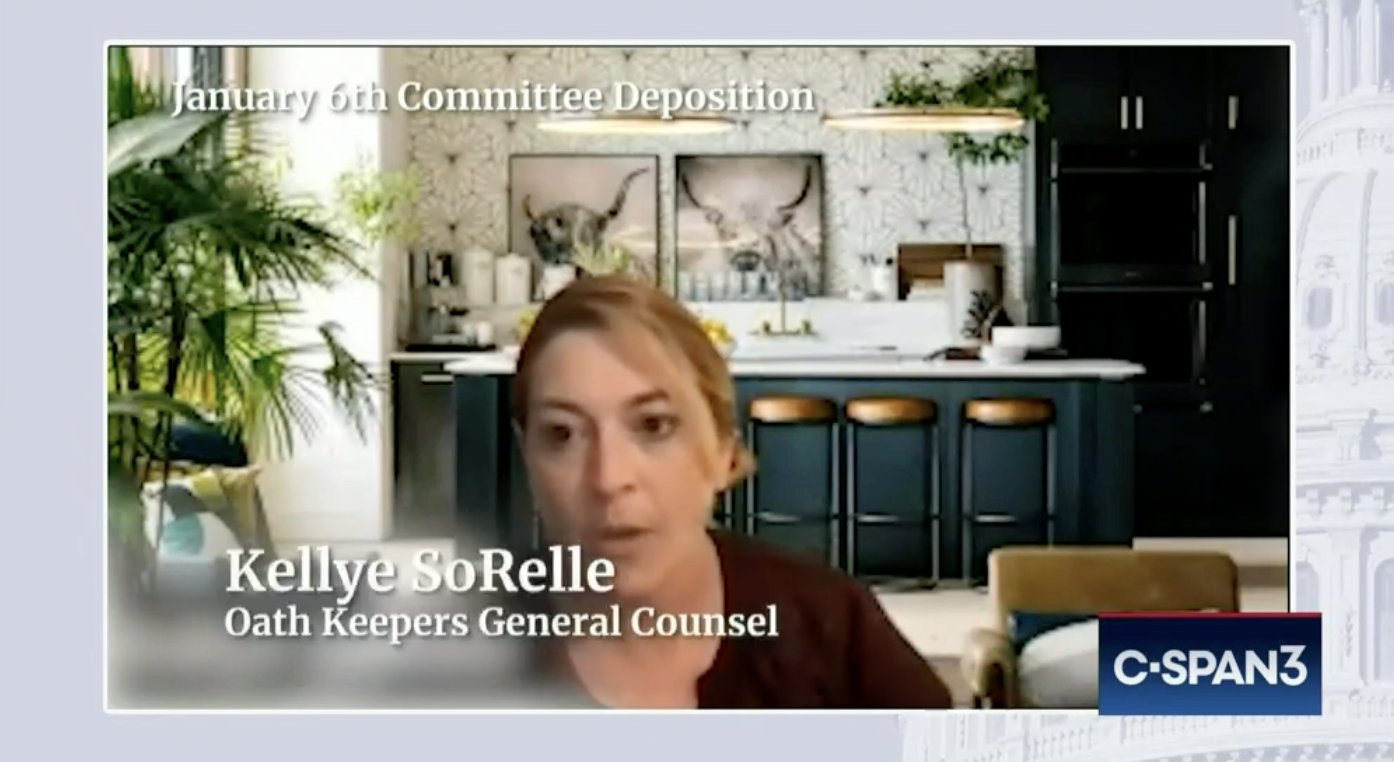
Kellye SoRelle: Oath Keeper Capper or Potential Pivot?

The government arrested Kellye SoRelle yesterday via an indictment charging three counts of obstruction and one count of trespassing. She’s best known as the lawyer for the Oath Keepers, though for a period she was acting as the President of the militia.

That she was arrested was not surprising. It has been known for some time that she’s the person who advised Rhodes to start deleting evidence of his activities on January 6, which he and others did. She even admitted it to MoJo’s Dan Friedman. Those who did delete their comms have all been charged for deleting evidence. The government even included that in Joshua James’ statement of offense, who is now cooperating with the government.

On January 8, 2021, James received a Signal message, in a group chat that included Rhodes, from an individual he understood to be an attorney for the Oath Keepers that stated, “STEWART: YOU ALL NEED TO DELETE ANY OF YOUR COMMENTS REGARDING WHO DID WHAT. You are under zero obligation to leave them up. You/we have not yet gotten a preservation order instructing us to retain those chat comments. So DELETE THEM. I can’t delete them because this is a legacy Signal chat that doesn’t let me delete comments. Only the comment author can delete a comment. So GET BUSY. DELETE your self-incriminating comments or those that can incriminate others. Start now …”

So it’s unsurprising that she was also charged under 18 USC 1512(b)(2) for corruptly persuading and attempting to corruptly persuade others to delete evidence.

On its face, the indictment against SoRelle is all about capping off the Oath Keeper conspiracy. Her arrest warrant lists the two conspiracies, 22-cr-15 (the Rhodes seditious conspiracy) and 21-cr-28 (the lesser conspiracy now named after Donovan Crowl), as related cases, landing her case before Judge Amit Mehta. All seven of the Oath Keeper prosecutors were listed on the motion to seal her arrest warrant.

At that level, charging her seems like a way to ensure defendants in the sedition trial cannot foist all the blame for deleting those communications off on an uncharged co-conspirator.  In fact, Gateway Pundit, which has invented some of the central conspiracy theories about this case (including one spun directly by SoRelle), yesterday complained that DOJ only charged SoRelle because she recently agreed to testify in Rhodes’ defense.

Gateway Pundit’s earlier conspiracy theory, based on claims made by another cooperating Oath Keeper witness, Jason Dolan, appears to be one of the ways prosecutors managed to argue that her communications were not privileged.

As such, much of this indictment is about capping off the Oath Keeper case. But there are a few details that I find interesting.

First, unlike Michael Greene (the field commander for the Oath Keepers the day of the attack), who was superseded into the Crowl (lesser) conspiracy case on June 22, SoRelle was charged via indictment with conspiracy by herself. By comparison, when DOJ spun Jonathan Walden off onto his own indictment, the conspiracy charge against him was dropped.

Perhaps DOJ treated her this way because she mostly just interacted with Rhodes on January 6, but since she didn’t do anything meriting a sedition charge, she was charged by herself?

But there are other details that make me wonder whether DOJ isn’t doing something more by charging her.

SoRelle was charged by the same grand jury that did the bulk of the investigative work against all January 6 attackers for all of 2021, but which focused especially on the Oath Keepers. Its work seemed to culminate in January with the seditious conspiracy indictment. Since then, its main public work was to supersede Greene into the lesser conspiracy, 17 months after it was convened, as well as supserseding the Rhodes indictment to tweak how sedition was charged, also in that 17th month.

But the indictment against SoRelle means that grand jury is still at work in the 19th month after it was convened. Grand juries are usually convened for 18 months, so this seems to suggest the Oath Keeper grand jury has been extended, and extended (thus far) solely to charge someone whose phone the government seized last September.

Meanwhile, SoRelle’s indictment seems to have been initialed by Jocelyn Ballantine.

Up until now, Ballantine was known only to have a (behind-the-scenes) role in managing the Proud Boys investigation, which is not only less orderly than the Oath Keepers investigation, but seems to be understaffed, particularly as compared to the consistent 7-person team that has relentlessly pursued the Oath Keepers.

One reason you might charge SoRelle, by herself, on a conspiracy indictment is to add others to it. And while she’s best known for her role with the Oath Keepers and this indictment is closely tied to the Oath Keepers prong of the investigation, she actually has a number of ties to other key players in January 6.

She was present at the January 4, 2021 parking garage meeting between Rhodes and Enrique Tarrio, for example. She would have been a key facilitator for it. At the time, she was serving as the lawyer for both the Oath Keepers and Latinos for Trump. (It was via Tarrio’s involvement in Latinos for Trump that he went on December tour of the White House, arranged by Bianca Gracia, who was also at that garage meeting.)

As Ryan Reilly noted yesterday, SoRelle was also a volunteer for Lawyers for Trump, and in that guise, Rhodes tried to get her to put him in touch with people in Trump’s orbit. SoRelle claims that she declined to do that.

In the weeks leading up to the Jan. 6 attack on the Capitol, Oath Keepers founder Stewart Rhodes tried to get the organization’s general counsel, Kellye SoRelle, to put him in touch with the White House, she told NBC News.

In addition to her work with the Oath Keepers, SoRelle was a volunteer for Lawyers for Trump during the 2020 election and was in contact with many of the people fighting a doomed legal battle to try to overturn the 2020 presidential election and keep former President Donald Trump in office. The contacts include, she said, people in Rudy Giuliani’s and Sidney Powell’s camps, as well as those inside the administration, although she added that she “wasn’t, like, communicating with Trump directly.”

Rhodes wanted her to put him in touch with the White House. “He was hitting me up for a contact,” said SoRelle, a family law lawyer who previously ran for the Texas state House. “He didn’t have any access points.”

As he prepared an open letter calling on Trump to invoke the Insurrection Act in the weeks leading up to Jan. 6, 2021, Rhodes asked SoRelle to send it to the White House. She says she declined.

SoRelle has been caught making false claims to the press before.

Finally, in the clip of SoRelle’s testimony to the January 6 Committee that has been made public, she described how Roger Stone, Alex Jones, and Ali Alexander took the lead on planning the Stop the Steal events.

JAMIE RASKIN: Kelly Sorrell, a lawyer who assists the Oath Keepers and a volunteer lawyer for the Trump campaign, explained to the committee how Roger Stone and other figures brought extremists of different stripes and views together. [Begin videotape]

UNKNOWN: You mentioned that Mr. Stone wanted to start the Stop the Steal series of rallies. Who did you consider the leader of these rallies? It sounds like from what you just said, it was Mr. Stone, Mr. Jones, and Mr. Ali Alexander. Is that correct?

KELLY SORRELL: Those are the ones that became like the — the center point for everything. [End videotape]

In other words, while SoRelle didn’t breach the Capitol in body armor like the rest of the Oath Keepers, she was (along with Roger Stone) one of the key pivots between the Oath Keepers and the rest of the organizing effort behind January 6. She was networked with other planners in a way that even Rhodes was not.

For over a year, I’ve been describing that the elegant thing about the obstruction conspiracy charges DOJ has used to charge the Oath Keepers, Proud Boys, and others, is those separate conspiracies might one day start to coalesce via the nodes between them. Kellye SoRelle has, by all appearances, been charged in a conspiracy with the Oath Keepers.But if she also conspired on other aspects of January 6 with other people and organizations, including White House lawyers, then the various existing conspiracies might network into a larger conspiracy.

The lead prosecutor on SoRelle’s case, incidentally, also happens to be the lead prosecutor on Owen Shroyer’s prosecution.

Update: Corrected that SoRelle stepped down as President when Rhodes was arrested.

John Durham Is Hiding Evidence of Altered Notes

On Monday, both John Durham and Michael Sussmann submitted their motions in limine, which are filings to argue about what can be admitted at trial. They address a range of issues that I’ll cover in several posts:

Sussmann:

Durham wants to:

  • Admit witnesses’ contemporaneous notes of conversations with the FBI General Counsel
  • Admit emails referenced in the Indictment and other, similar emails (see this post)
  • Admit certain acts and statements (including the defendant’s February 2017 meeting with a government agency, his December 2017 Congressional testimony, and his former employer’s October 2018 statements to the media) as direct evidence or, alternatively, pursuant to Federal Rule of Evidence 404(b)
  • Exclude evidence and preclude argument concerning allegations of political bias on the part of the Special Counsel (addressed in this post)
  • Admit an October 31, 2016 tweet by the Clinton Campaign

I will link my discussions in serial fashion.


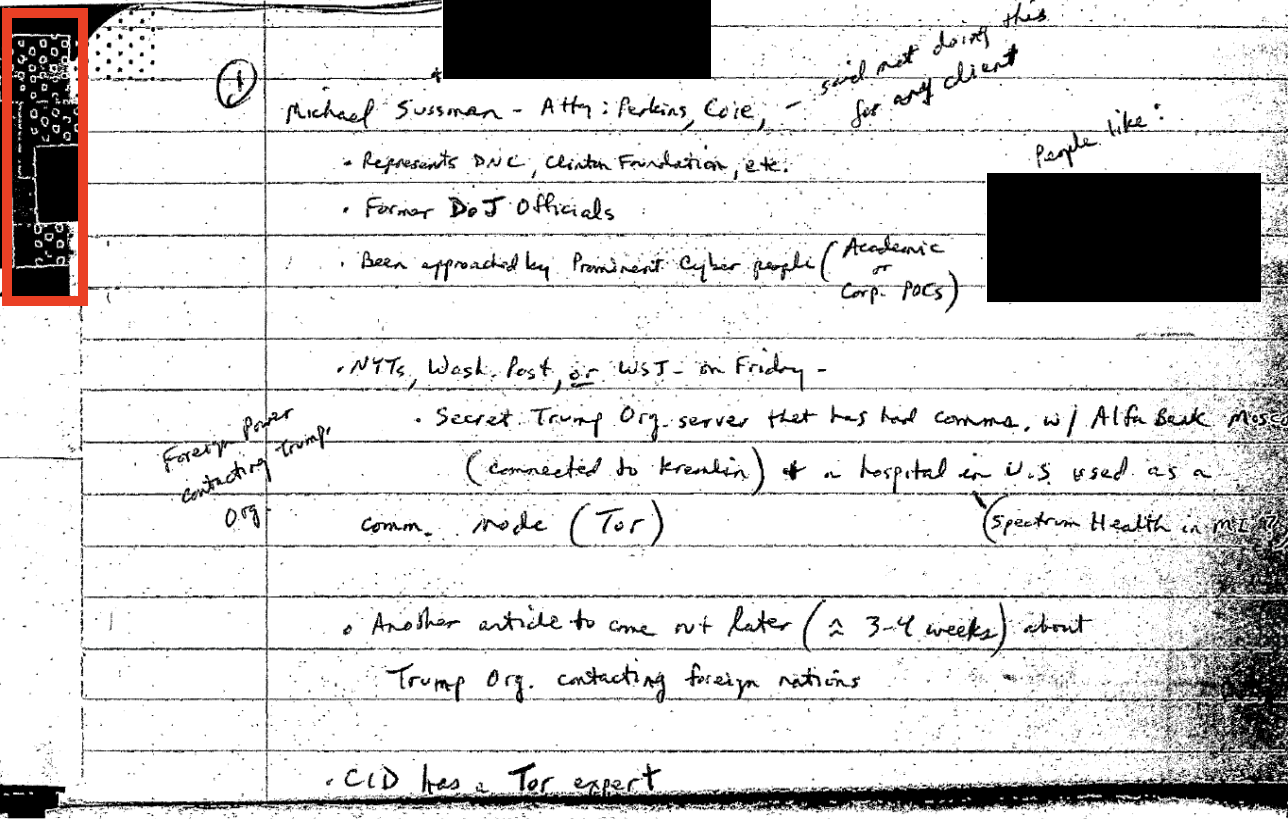
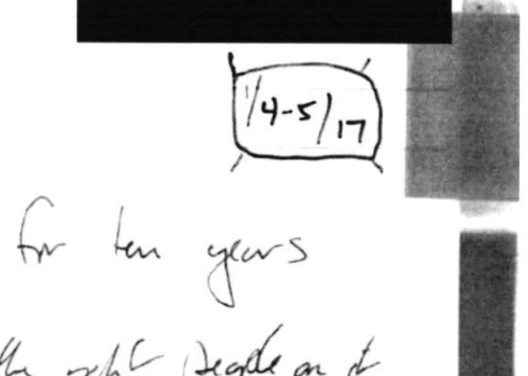
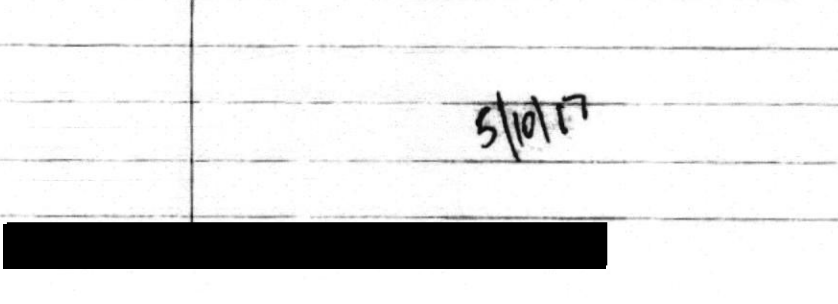
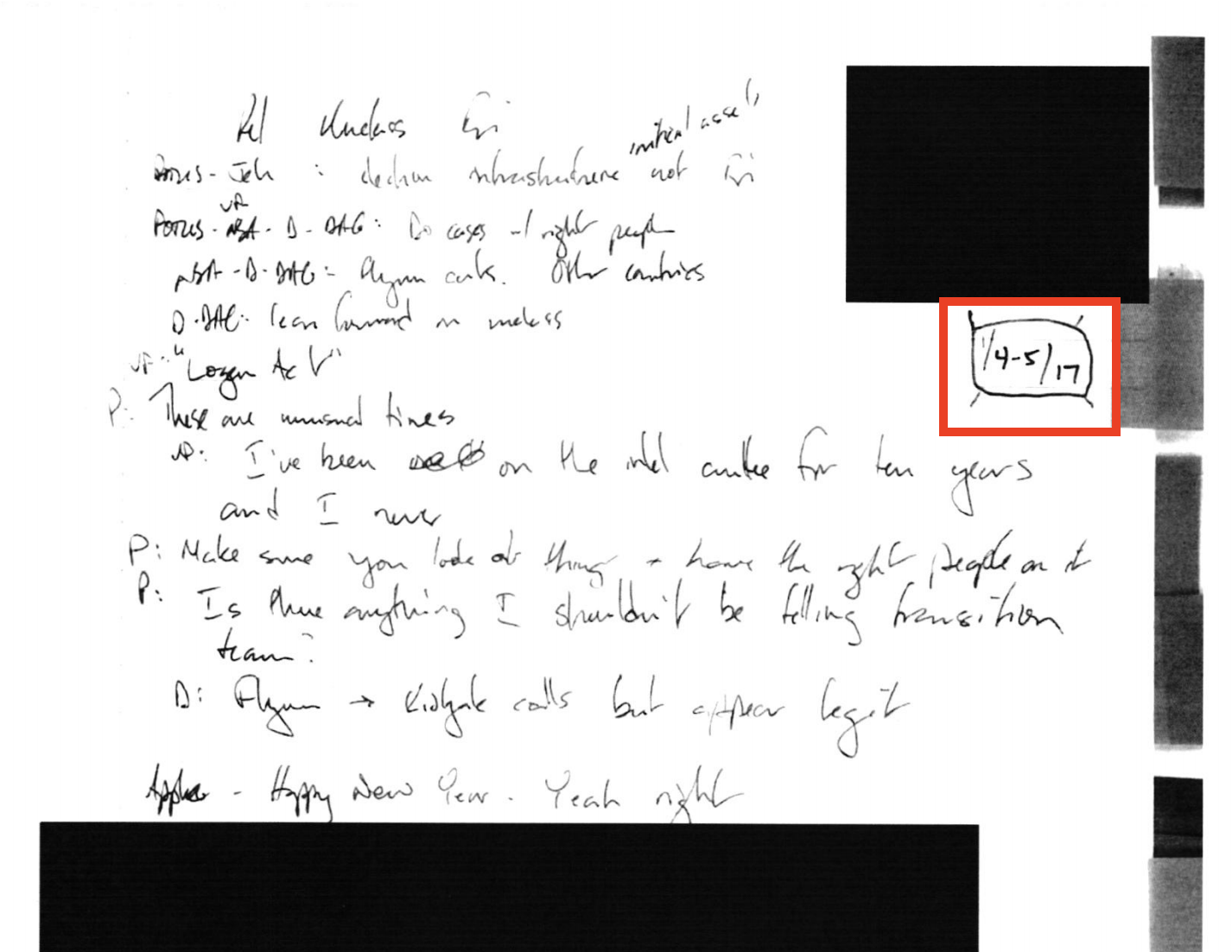
In John Durham’s bid to introduce notes from Bill Priestap and Trisha Anderson, he presented a color scan of Anderson’s notes [red annotation added]:

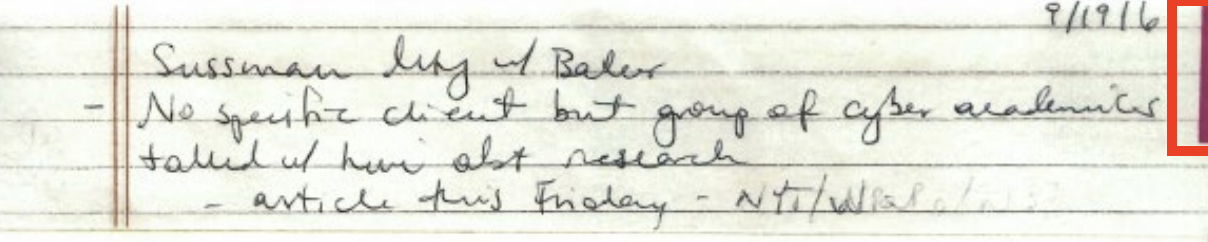
But he presented a black and white scan of Priestap’s notes [red annotation added]:

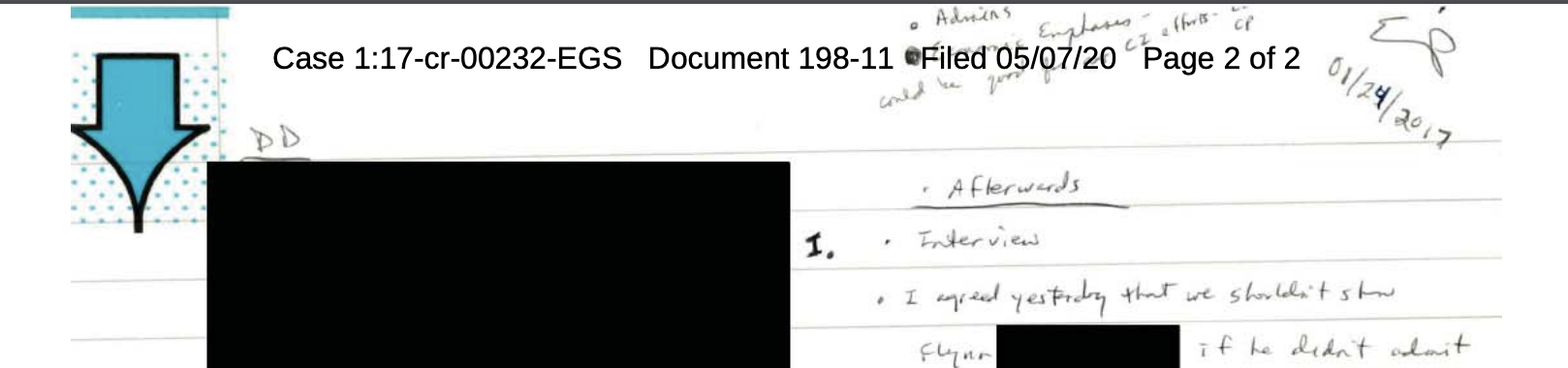
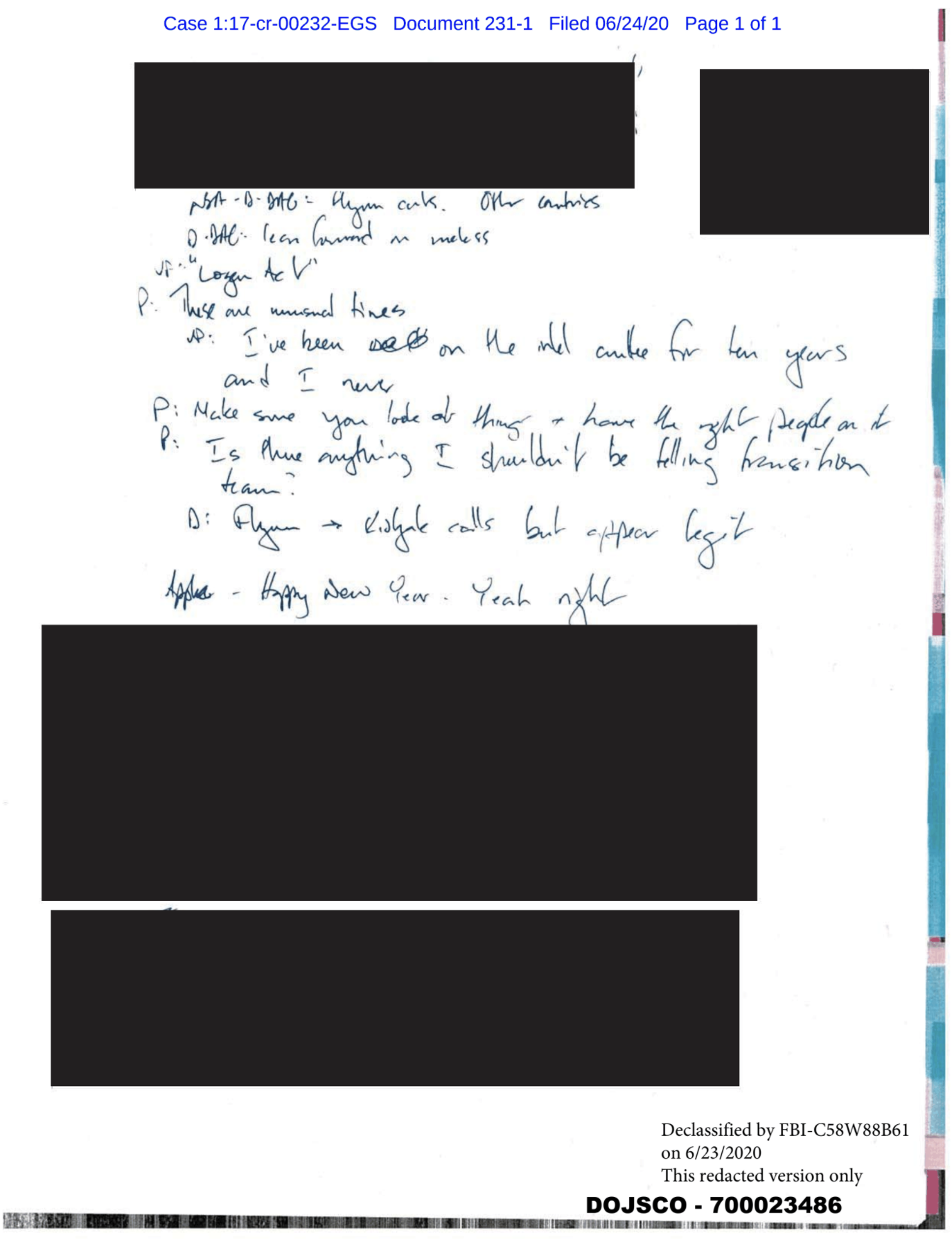
That’s important for two reasons. First, because blue sticky tabs were implicated in altered documents submitted in the Mike Flynn case. There was a blue sticky tab on another page of Priestap notes submitted in Flynn’s case.

There were what appear to be blue and red stickies visible on the original version of some Peter Strzok notes submitted in that case.

When the government ultimately confessed to adding dates (affirmatively misleading, in at least one case) to both that set of Strzok notes

And some Andrew McCabe notes

… The government claimed that the date added to some Andrew McCabe notes was added via a blue sticky — what sounds like the same sticky we saw in the Priestap notes.

In response to the Court and counsel’s questions, the government has learned that, during the review of the Strzok notes, FBI agents assigned to the EDMO review placed a single yellow sticky note on each page of the Strzok notes with estimated dates (the notes themselves are undated). Those two sticky notes were inadvertently not removed when the notes were scanned by FBI Headquarters, before they were forwarded to our office for production. The government has also confirmed with Mr. Goelman and can represent that the content of the notes was not otherwise altered.

Similarly, the government has learned that, at some point during the review of the McCabe notes, someone placed a blue “flag” with clear adhesive to the McCabe notes with an estimated date (the notes themselves are also undated). Again, the flag was inadvertently not removed when the notes were scanned by FBI Headquarters, before they were forwarded to our office for production. Again, the content of the notes was not otherwise altered. [my emphasis]

If that’s right, then whoever altered the McCabe notes altered them with the same kind of blue sticky note that appears on the Priestap notes that Durham wants to submit at trial.

Whether that date was added via blue sticky note has never been publicly tested. Rather than submitting unaltered versions of McCabe’s notes in the Flynn docket, DOJ — metadata suggests that Jocelyn Ballantine did this — simply digitally removed the date and a footer, effectively submitting a realtered exhibit in place of an altered one. So one cannot rule out that that date was written right onto the notes themselves. McCabe was being specifically prevented by DOJ from reviewing his original notes in the period, not even to prepare for Senate Judiciary Committee testimony, so he hasn’t been able to test that either.

That, by itself, suggests some of the alterations that were an issue in the Flynn docket were altered before they were shared with Jeffrey Jensen.

But that’s all the more interesting given a detail that Michael Sussmann included in his bid to exclude these notes. In Priestap’s grand jury testimony in this case, he testified he didn’t know why he wrote the “no specific client” comment on a slant, or why those notes were, “perhaps darker or thicker than some of the other notes.”

The Indictment characterizes the Priestap Notes as a contemporaneous record of Mr. Priestap’s conversation with Mr. Baker. See id. But beyond offering that they “looked like his writing and organizational style,” Mem. of Special Counsel’s June 2, 2021 Interview of E.W. Priestap, SCO-3500U-018701, at -01, Mr. Priestap said he “[doesn’t] remember why [he] wrote them down and who gave [him] the information,” E.W. Priestap’s June 3, 2021 Grand Jury Test., SCO-3500U-018746, at -98. Not only that, but Mr. Priestap “[does] not recall actually writing these notes,” id. at SCO-3500U-018815, nor can he confirm that the notes actually reflect any conversation he had with Mr. Baker, as opposed to a conversation he had with someone else, id. Indeed, Mr. Priestap “advised he did not remember Baker conveying to him the information about Sussmann,” Mem. of Special Counsel’s June 2, 2021 Interview of E.W. Priestap at SCO-3500U 018702, and was “not certain whether th[e] conversation reflected in the notes . . . was with Mr. Baker or maybe with someone else,” E.W. Priestap’s June 3, 2021 Grand Jury Test. at SCO3500U-018815. Mr. Priestap also has “[n]o idea” why the phrase “said not doing this for any client”—written diagonally to the side of the main body of the notes—was written at all, and could offer no explanation for why those words were “perhaps darker or thicker than some of the other notes.” Id. at SCO-3500U-018816.

The date in the January 24, 2017 Priestap notes is even more irregular — at cross-direction from his other notes on the page, and with uneven ink — and I have always wondered whether that date was added too.

And lo and behold, the Anderson notes also appear to have a sticky note right by the date (as annotated), albeit apparently a red one, though some of the tags on the Strzok notes were of a similar color. She also found aspects of her notes surprising.

Ms. Anderson’s notes (the “Anderson Notes”) include, on top, “Deputies Mtg. 9/19/16,” and then, after a redaction and under a second heading reading “9/19[/]16,” go on to state: “Sussman[n] Mtg w/ Baker” and “No specific client but group of cyber academics talked w/ him abt research,” followed by the phrase, “article this Friday – NYT/WaPo/WSJ.” Anderson Notes at SCO-3500U-000018. The relevant sentence fragment contains no subject revealing who had “[n]o specific client,” nor any other context for that phrase. Ms. Anderson, who was first asked about these notes by the Special Counsel over five years after they were written, has no meaningful memory of the notes or their context: she has only a “vague recollection” of discussing this topic with Mr. Baker and cannot “recall specifics.” Mem. of Special Counsel’s Jan. 5, 2022 Interview of T. Anderson, SCO-3500U-000087, at -88, -96. When shown the notes, Ms. Anderson stated that she had been “surprised” to learn about the “no specific client” phrase, and she “d[id] not now recall hearing from Baker his use” of that phrase; she could only assume that she got that phrase from Mr. Baker “because her notes reflect[ed] it.” Id. at -88.

Durham has only provided a partial scan of theses notes, hiding that the date, 9/19/16, appears earlier on the page, describing a different kind of meeting. That’s consistent with what the added date and the redaction on the McCabe notes did: It served to suggest that McCabe briefed the Flynn case to SSCI the day after Jim Comey was fired. Here, the September 19 date that appears next to the sticky is necessary for Durham’s case to claim that Anderson took these notes the same day of the meeting and not some time after that.

But why would Anderson date her notes twice?

According to a discovery filing in this case, Sussmann has reviewed redacted versions of the originals of the Priestap notes, which were still in the notebook Priestap took them in.

On October 13, 2021, the defense requested, among other things, to inspect the original notes that a former FBI Assistant Director of Counterintelligence took reflecting the defendant’s alleged false statement. The original notes were contained in a hard-bound notebook located at FBI Headquarters and contained extremely sensitive and highly classified information on a variety of topics and unrelated investigative matters. The Government immediately agreed to make the original notebook available to the defense in redacted form, and the defense conducted its review of the notebook on October 20, 2021.

But to test why all these notes have post-it notes on them and why the dates are so unreliable (and affirmatively misleading, in the case of the alteration in the January 5, 2017 Strzok notes), Sussmann would need to review all the notes together, probably with the assistance of the original authors.

It’s still not clear who altered the notes submitted in the Flynn docket, the extent of those alterations, or why the government is submitting exhibits with investigative stickies on them as evidence at trial. DOJ’s filing in the Flynn case blamed the misleading date on the Strzok notes on an FBI agent associated with the Jeffrey Jensen investigation (which would suggest that alteration post-dated Durham’s access to it), but it did not say who altered the McCabe notes.

But by showing that the blue sticky notes existed in Durham’s copy of the exhibits, Durham makes it clear some of the alterations exhibited in the Flynn docket happened before he shared the documents with Jensen’s investigation, if that’s how the notes got shared around.

The misleading date added to the Strzok notes ultimately was part of a packaged Trump attack on Joe Biden at the first debate, one that Sidney Powell, who has since been sanctioned for making fraudulent claims in an attempt to keep Trump in office, appears to have had a part in.

President Donald J. Trump: (01:02:22)
We’ve caught them all. We’ve got it all on tape. We’ve caught them all. And by the way, you gave the idea for the Logan Act against General Flynn. You better take a look at that, because we caught you in a sense, and President Obama was sitting in the office.

Given that even Chuck Grassley recognized the alteration added to the Strzok notes was incorrect, it’s hard to believe that was an innocent mistake.

And yet, 18 months later, DOJ is still trying to submit notes with all these investigative sticky notes as exhibits, without explaining why or how they appeared there.

And Durham’s choice to present the Priestap notes — with what appear to be the same blue sticky as appeared on his earlier notes, as well was the the blue sticky described to have been used to alter the McCabe notes — in black-and-white suggests he may know that’s a problem.

DOJ Put Someone Who Enabled Sidney Powell’s Lies — Jocelyn Ballantine — in Charge of Prosecuting the Proud Boys

Because of Joe Biggs’ role at the nexus between the mob that attacked Congress and those that orchestrated the mob, his prosecution is the most important case in the entire January 6 investigation. If you prosecute him and his alleged co-conspirators successfully, you might also succeed in holding those who incited the attack on the Capitol accountable. If you botch the Biggs prosecution, then all the most important people will go free.

Which is why it is so unbelievable that DOJ put someone who enabled Sidney Powell’s election season lies about the Mike Flynn prosecution, Jocelyn Ballantine, on that prosecution team.

Yesterday, at the beginning of the Ethan Nordean and Joe Biggs hearing, prosecutor Jason McCullough told the court that in addition to him and Luke Jones, Ballantine was present at the hearing for the prosecution. He may have said that she was “overseeing” this prosecution. (I’ve got a request for clarification in with the US Attorney’s office.)

Ballantine has not filed a notice of appearance in the case (nor does she show on the minute notice for yesterday’s hearing). In the one other January 6 case where she has been noticeably involved — electronically signing the indictment for Nick Kennedy — she likewise has not filed a notice of appearance.

Less than a year ago when she assisted in DOJ’s attempts to overturn the Mike Flynn prosecution, Ballantine did three things that should disqualify her from any DOJ prosecution team, much less serving on the most important prosecution in the entire January 6 investigation:

  • On September 23, she provided three documents that were altered to Sidney Powell, one of which Trump used six days later in a packaged debate attack on Joe Biden
  • On September 24, she submitted an FBI interview report that redacted information — references to Brandon Van Grack — that was material to the proceedings before Judge Emmet Sullivan
  • On October 26, she claimed that lawyers for Peter Strzok and Andrew McCabe had checked their clients’ notes to confirm there were no other alterations to documents submitted to the docket; both lawyers refused to review the documents

After doing these things in support of Bill Barr’s effort to undermine the Flynn prosecution (and within days of the Flynn pardon), Ballantine was given a confidential temporary duty assignment (it may have been a CIA assignment). Apparently she’s back at DC USAO now.

Three documents got altered and another violated Strzok and Page’s privacy

As a reminder, after DOJ moved to hold Mike Flynn accountable for reneging on his plea agreement, Billy Barr put the St. Louis US Attorney, Jeffrey Jensen, in charge of a “review” of the case, which DOJ would later offer as its excuse for attempting to overturn the prosecution.

On September 23, Ballantine provided Powell with five documents, purportedly from Jensen’s investigation into the Flynn prosecution:

I outlined the added date on the first set of Strzok notes here:

There was never any question that the notes could have been taken no earlier than January 5, because they memorialized Jim Comey’s retelling of a meeting that other documentation, including documents submitted in the Flynn docket, shows took place on January 5. Even Chuck Grassley knows what date the meeting took place.

But DOJ, while using the notes as a central part of their excuse for trying to overturn the Flynn prosecution, nevertheless repeatedly suggested that there was uncertainty about the date of the notes, claiming they might have been taken days earlier. And then, relying on DOJ’s false representations about the date, Sidney Powell claimed they they showed that Joe Biden — and not, as documented in Mary McCord’s 302, Bob Litt — was the one who first raised the possibility that Flynn may have violated the Logan Act.

Strzok’s notes believed to be of January 4, 2017, reveal that former President Obama, James Comey, Sally Yates, Joe Biden, and apparently Susan Rice discussed the transcripts of Flynn’s calls and how to proceed against him. Mr. Obama himself directed that “the right people” investigate General Flynn. This caused former FBI Director Comey to acknowledge the obvious: General Flynn’s phone calls with Ambassador Kislyak “appear legit.” According to Strzok’s notes, it appears that Vice President Biden personally raised the idea of the Logan Act.

During the day on September 29, Powell disclosed to Judge Sullivan that she had spoken to Trump (as well as Jenna Ellis) about the case. Then, later that night, Trump delivered a prepared attack on Biden that replicated Powell’s false claim that Biden was behind the renewed investigation into Flynn.

President Donald J. Trump: (01:02:22)
We’ve caught them all. We’ve got it all on tape. We’ve caught them all. And by the way, you gave the idea for the Logan Act against General Flynn. You better take a look at that, because we caught you in a sense, and President Obama was sitting in the office.

In a matter of days, then, what DOJ would claim was an inadvertent error got turned into a campaign attack from the President.

When DOJ first confessed to altering these notes, they claimed all the changes were inadvertent.

In response to the Court and counsel’s questions, the government has learned that, during the review of the Strzok notes, FBI agents assigned to the EDMO review placed a single yellow sticky note on each page of the Strzok notes with estimated dates (the notes themselves are undated). Those two sticky notes were inadvertently not removed when the notes were scanned by FBI Headquarters, before they were forwarded to our office for production. The government has also confirmed with Mr. Goelman and can represent that the content of the notes was not otherwise altered.

Similarly, the government has learned that, at some point during the review of the McCabe notes, someone placed a blue “flag” with clear adhesive to the McCabe notes with an estimated date (the notes themselves are also undated). Again, the flag was inadvertently not removed when the notes were scanned by FBI Headquarters, before they were forwarded to our office for production. Again, the content of the notes was not otherwise altered.

There are multiple reasons to believe this is false. For example, when DOJ submitted notes that Jim Crowell took, they added a date in a redaction, something that could in no way be inadvertent. And as noted, the January 5 notes had already been submitted, without the date change (though then, too, DOJ claimed not to know the date of the document).

But the most important tell is that, when Ballantine sent Powell the three documents altered to add dates, the protective order footer on the documents had been removed in all three, in the case of McCabe’s notes, actually redacted. When she released the re-altered documents (someone digitally removed the date in the McCabe notes rather than providing a new scan), the footer had been added back in. This can easily be seen by comparing the altered documents with the re-altered documents.

The altered January 5, 2017 Strzok notes, without the footer:

The realtered January 5, 2017 Strzok notes, with the footer:

The second set of Strzok notes (originally altered to read March 28), without the footer:

The second set of Strzok notes, with the footer.

The altered McCabe noteswith the footer redacted out:

The realtered McCabe notes, with the footer unredacted:

This is something that had to have happened at DOJ (see William Ockham’s comments below and this post for proof in the metadata that these changes had to have been done by Ballantine). The redaction of the footers strongly suggests that they were provided to Powell with the intention of facilitating their further circulation (the other two documents she shared with Powell that day had no protective order footer). In addition, each of these documents should have a new Bates stamp.

DOJ redacted Brandon Van Grack’s non-misconduct

On September 24, DOJ submitted a report of an FBI interview Jeffrey Jensen’s team did with an Agent who sent pro-Trump texts on his FBI-issued phone, Bill Barnett. In the interview, Barnett made claims that conflicted with actions he had taken on the case. He claimed to be unaware of evidence central to the case against Flynn (for example, that Flynn told Sergey Kislyak that Trump knew of something said on one of their calls). He seemed unaware of the difference between a counterintelligence investigation and a criminal one. And he made claims about Mueller prosecutors — Jeannie Rhee and Andrew Weissmann — with whom he didn’t work directly. In short, the interview was obviously designed to tell a politically convenient story, not the truth.

Even worse than the politicized claims that Barnett made, the FBI or DOJ redacted the interview report such that all reference to Brandon Van Grack was redacted, substituting instead with the label, “SCO Atty 1.” (References to Jeannie Rhee, Andrew Weissmann, and Andrew Goldstein were not redacted; there are probable references to Adam Jed and Zainab Ahmad that are not labeled at all.)

The result of redacting Van Grack’s name is that it hid from Judge Sullivan many complimentary things that Barnett had to say about Van Grack:

Van Grack’s conduct was central to DOJ’s excuse for throwing out the Flynn prosecution. Powell repeatedly accused Van Grack, by name, of engaging in gross prosecutorial misconduct. Yet the report was submitted to Judge Sullivan in such a way as to hide that Barnett had no apparent complaints about Van Grack’s actions on the Flynn case.

I have no reason to believe that Ballantine made those redactions. But according to the discovery letter she sent to Powell, she sent an unredacted copy to Flynn’s team, while acknowledging that the one she was submitting to the docket was redacted. Thus, she had to have known she was hiding material information from the Court when she submitted the interview report.

Ballantine falsely claimed Strzok and McCabe validated their notes

After some of these alterations were made public, Judge Sullivan ordered DOJ to authenticate all the documents they had submitted as part of their effort to overturn the Flynn prosecution. The filing submitted in response was a masterpiece of obfuscation, with three different people making claims while dodging full authentication for some of the most problematic documents. In the filing that Ballantine submitted, she claimed that Michael Bromwich and Aitan Goelman, lawyers for McCabe and Strzok, “confirmed” that no content was altered in the notes.

The government acknowledges its obligation to produce true and accurate copies of documents. The government has fully admitted its administrative error with respect to the failure to remove three reviewer sticky notes containing estimated date notations affixed to three pages of undated notes (two belonging to former Deputy Assistant Director Peter Strzok, and one page belonging to former Deputy Director Andrew McCabe) prior to their disclosure. These dates were derived from surrounding pages’ dates in order to aid secondary reviewers. These three sticky notes were inadvertently not removed when the relevant documents were scanned by the FBI for production in discovery. See ECF 259. The government reiterates, however, that the content of those exhibits was not altered in any way, as confirmed by attorneys for both former FBI employees. [underline original]

According to an email Bromwich sent Ballantine, when Ballantine asked for help validating the transcripts DOJ did of McCabe’s notes, McCabe declined to do so.

I have spoken with Mr. McCabe and he declines to provide you with any information in response to your request.

He believes DOJ’s conduct in this case is a shocking betrayal of the traditions of the Department of the Justice and undermines the rule of law that he spent his career defending and upholding. If you share with the Court our decision not to provide you with assistance, we ask that you share the reason.

We would of course respond to any request that comes directly from the Court.

And according to an email Goelman sent to Ballantine, they said they could not check transcriptions without the original copies of documents.

Sorry not to get back to you until now.  We have looked at the attachments to the email you sent yesterday (Sunday) afternoon.  We are unable to certify the authenticity of all of the attachments or the accuracy of the transcriptions.  To do so, we would need both more time and access to the original notes, particularly given that U.S. Attorney Jensen’s team has already been caught altering Pete’s notes in two instances.  However, we do want to call your attention to the fact that Exhibit 198-11 is mislabeled, and that these notes are not the notes of Pete “and another agent” taken during the Flynn interview.

Additionally, we want to register our objection to AUSA Ken Kohl’s material misstatements to Judge Sullivan during the September 29, 2020, 2020, [sic] telephonic hearing, during which Mr. Kohl inaccurately represented that Pete viewed himself as an “insurance policy” against President Trump’s election.

I have no reason to believe the content was altered, though I suspect other things were done to McCabe’s notes to misrepresent the context of a reference in his notes to Flynn. But not only had McCabe and Strzok not validated their notes, but they had both pointedly refused to. Indeed, during this same time period, DOJ was refusing to let McCabe see his own notes to prepare for testimony before the Senate Judiciary Committee. Nevertheless, Ballantine represented to Judge Sullivan that they had.

It baffles me why DOJ would put Ballantine on the most important January 6 case. Among other things, the conduct I’ve laid out here will make it easy for the defendants to accuse DOJ of similar misconduct on the Proud Boys case — and doing just that happens to be Nordean’s primary defense strategy.

But I’m mindful that there are people in DC’s US Attorney’s Office (not Ballantine) who took actions in the past that may have made the January 6 attack more likely. In a sentencing memo done on Barr’s orders, prosecutors attempting to minimize the potential sentence against Roger Stone suggested that a threat four Proud Boys helped Roger Stone make against Amy Berman Jackson was no big deal, unworthy of a sentencing enhancement.

Second, the two-level enhancement for obstruction of justice (§ 3C1.1) overlaps to a degree with the offense conduct in this case. Moreover, it is unclear to what extent the defendant’s obstructive conduct actually prejudiced the government at trial.

Judge Jackson disagreed with this assessment. In applying the enhancement, she presciently described how dangerous Stone and the Proud Boys could be if they incited others.

Here, the defendant willfully engaged in behavior that a rational person would find to be inherently obstructive. It’s important to note that he didn’t just fire off a few intemperate emails. He used the tools of social media to achieve the broadest dissemination possible. It wasn’t accidental. He had a staff that helped him do it.

As the defendant emphasized in emails introduced into evidence in this case, using the new social media is his “sweet spot.” It’s his area of expertise. And even the letters submitted on his behalf by his friends emphasized that incendiary activity is precisely what he is specifically known for. He knew exactly what he was doing. And by choosing Instagram and Twitter as his platforms, he understood that he was multiplying the number of people who would hear his message.

By deliberately stoking public opinion against prosecution and the Court in this matter, he willfully increased the risk that someone else, with even poorer judgment than he has, would act on his behalf. This is intolerable to the administration of justice, and the Court cannot sit idly by, shrug its shoulder and say: Oh, that’s just Roger being Roger, or it wouldn’t have grounds to act the next time someone tries it.

The behavior was designed to disrupt and divert the proceedings, and the impact was compounded by the defendant’s disingenuousness.

The people at DOJ who claimed that this toxic team was not dangerous in the past may want to downplay the critical role that Stone and the Proud Boys played — using the same kind of incendiary behavior — in the January 6 assault.

Whatever the reason, though, it is inexcusable that DOJ would put someone like Ballantine on this case. Given Ballantine’s past actions, it risks sabotaging the entire January 6 investigation.

DOJ quite literally put someone who, less than a year ago, facilitated Sidney Powell’s lies onto a prosecution team investigating the aftermath of further Sidney Powell lies.

Update: DC USAO’s media person refused to clarify what Ballantine’s role is, even though it was publicly acknowledged in court.

We are not commenting on cases beyond what is stated or submitted to the Court. We have no comment in response to your question.

Update: Added links to William Ockham’s proof that Ballantine made the realteration of the McCabe notes.

Update: One more point on this. I am not claiming here that anyone at DOJ is deliberately trying to sabotage the January 6 investigation, just that putting someone who, less than a year ago, made multiple representations to a judge that could call into question her candor going forward could discredit the Proud Boys investigation. I think it possible that supervisors at DC USAO put her on the team because they urgently need resources and she was available (possibly newly so after the end of her TDY). I think it possible that supervisors at DC USAO who are also implicated in Barr’s politicization, perhaps more closely tied to the intervention in the Stone case, put her there with corrupt intent.

But it’s also important to understand that up until February 2020, she was viewed as a diligent, ruthless prosecutor. I presume she buckled under a great deal of pressure after that and found herself in a place where competing demands — her duty of candor to the Court and orders from superiors all the way up to the Attorney General — became increasingly impossible to square.

Importantly, Lisa Monaco’s chief deputy John Carlin, and probably Monaco herself, would know Ballantine from their past tenure in the National Security Division as that heretofore ruthless national security prosecutor. The only mainstream outlet that covered anything other than DOJ’s admission they had added post-its to the notes was Politico. And the instinct not to punish career employees like Ballantine would mean what she would have avoided any scrutiny with the transition. So her assignment to the case is not itself evidence of an attempt to sabotage the prosecution.

Carter Page Believed James Wolfe Was Ellen Nakashima’s Source Disclosing His FISA Application Less than a Month After the Story

According to the Statement of Offense to which James Wolfe — the former Senate Intelligence Committee security official convicted of lying about his contacts with journalists — allocuted, Carter Page suspected Wolfe was the source for Ellen Nakashima’s story revealing Page had been targeted with a FISA order. When the former Trump campaign staffer wrote Nakashima to complain about the story less than four weeks after Washington Post published it, Page BCCed Wolfe. [Nakashima is Reporter #1 and Ali Watkins is Reporter #2.]

On May 8, 2017, MALE-1 emailed REPORTER #1 complaining about REPORTER #1’s reporting of him (MALE-1). According to the metadata recovered during the search of Wolfe’s email, Wolfe was blind-copied on that email by MALE-1.

That unexplained detail is important — albeit mystifying — background to two recent stories on leak investigations.

First, as reported last month, Nakashima was one of three journalists whose call records DOJ obtained last year.

The Trump Justice Department secretly obtained Washington Post journalists’ phone records and tried to obtain their email records over reporting they did in the early months of the Trump administration on Russia’s role in the 2016 election, according to government letters and officials.

In three separate letters dated May 3 and addressed to Post reporters Ellen Nakashima and Greg Miller, and former Post reporter Adam Entous, the Justice Department wrote they were “hereby notified that pursuant to legal process the United States Department of Justice received toll records associated with the following telephone numbers for the period from April 15, 2017 to July 31, 2017.” The letters listed work, home or cellphone numbers covering that three-and-a-half-month period.

The scope of the records obtained on the WaPo journalists last year started four days after the Page story, so while some May 11, 2017 emails between Nakashima and Wolfe would have been included in what got seized last year, any contacts prior to the FISA story would not have. And the public details on the prosecution of Wolfe show no sign that Nakashima’s records were obtained in that investigation (those of Ali Watkins, whom Wolfe was in a relationship, however, were). Indeed, the sentencing memo went out of its way to note that DOJ had not obtained deleted Signal texts from any journalists. “The government did not recover or otherwise obtain from any reporters’ communications devices or related records the content of any of these communications.”

That said, Nakashima’s reporting was targeted in two different leak investigations, covering sequential periods, three years apart.

It’s not clear how quickly the Page investigation focused on Wolfe. But it may have outside help. A CBP Agent unconnected to the FBI investigation grilled Watkins on her ties with Wolfe in June 2017.

The Sentencing Memorandum on Wolfe suggests the FBI came to focus on him — and excused their focus — after having learned of his affair with Watkins. They informed Richard Burr and Mark Warner, and obtained the first of several warrants to access his phone.

At the time the classified national security information about the FISA surveillance was published in the national media, defendant James A. Wolfe was the Director of Security for the SSCI. He was charged with safeguarding information furnished to the SSCI from throughout the United States Intelligence Community (“USIC”) to facilitate the SSCI’s critical oversight function. During the course of the investigation, the FBI learned that Wolfe had been involved in the logistical process for transporting the FISA materials from the Department of Justice for review at the SSCI. The FBI also discovered that Wolfe had been involved in a relationship with a reporter (referred to as REPORTER #2 in the Indictment and herein) that began as early as 2013, when REPORTER #2, then a college intern, published a series of articles containing highly sensitive U.S. government information. Between 2014 and 2017, Wolfe and REPORTER #2 exchanged tens of thousands of telephone calls and electronic messages. Also during this period, REPORTER #2 published dozens of news articles on national security matters that contained sensitive information related to the SSCI.

Upon realizing that Wolfe was engaged in conduct that appeared to the FBI to compromise his ability to fulfill his duties with respect to the handling of Executive Branch classified national security information as SSCI’s Director of Security, the FBI faced a dilemma. The FBI needed to conduct further investigation to determine whether Wolfe had disseminated classified information that had been entrusted to him over the past three decades in his role as SSCI Director of Security. To do that, the FBI would need more time to continue their investigation covertly. Typically, upon learning that an Executive Branch employee and Top Secret clearance holder had potentially been compromised in place – such as by engaging in a clandestine affair with a national security reporter – the FBI would routinely provide a “duty-to-warn” notification to the relevant USIC equity holder in order to allow the intelligence agencies to take mitigation measures to protect their national security equities. Here, given the sensitive separation of powers issue and the fact that the FISA was an FBI classified equity, the FBI determined that it would first conduct substantial additional investigation and monitoring of Wolfe’s activities. The FBI’s executive leadership also took the extraordinary mitigating step of limiting its initial notification of investigative findings to the ranking U.S. Senators who occupy the Chair and Vice Chair of the SSCI.2

The FBI obtained court authority to conduct a delayed-notice search warrant pursuant to 18 U.S.C. § 3103a(b), which allowed the FBI to image Wolfe’s smartphone in October 2017. This was conducted while Wolfe was in a meeting with the FBI in his role as SSCI Director of Security, ostensibly to discuss the FBI’s leak investigation of the classified FISA material that had been shared with the SSCI. That search uncovered additional evidence of Wolfe’s communications with REPORTER #2, but it did not yet reveal his encrypted communications with other reporters.

This process — as described by Jocelyn Ballantine and Tejpal Chawla, prosecutors involved in some of the other controversial subpoenas disclosed in the last month — is a useful lesson of how the government proceeded in a case that likely overlapped with the investigation into HPSCI that ended up seizing Swalwell and Schiff’s records. Given that Swalwell was targeted by a Chinese spy, it also suggests one excuse they may have used to obtain the records: by claiming it was a potential compromise.

Still, by the time FBI first informed Wolfe of the investigation, in October 2017, they had obtained his cell phone content showing that he was chatting up other journalists, in addition to Watkins — and indeed, he continued to share information on Page. By the time the FBI got Wolfe to perjure himself on a questionnaire about contacts with journalists in December 2017, they had presumably already searched Watkins’ emails going back years. Wolfe was removed from his position and stripped of clearance, making his indictment six months later only a matter of time.

All that said, the government never proved that Wolfe was the source for Nakashima. And Ballantine’s subpoena for HPSCI contacts, weeks later after FBI searched Wolfe’s phone, may have reflected a renewed attempt to pin the leak on someone, anyone (though it’s not clear whether investigators looked further than Congress, or even to Paul Ryan, who has been suspected of tipping Page off.

If the James Wolfe investigation reflects how they might have approached the HPSCI side, there’s one other alarming detail of this: The FBI alerted someone in Congress of the search, the Chair and Ranking Member of the Committee. But in HPSCI’s case, Schiff was the Ranking Member. Meaning it’s possible that, by targeting on Schiff, FBI gave itself a way to consult only with the Republican Chair of the Committee.

James Wolfe (and the investigation of Natalie Sours Edwards, who was sentenced to six months in prison last week) are an important lesson in leak investigations that serves as important background for Joe Biden’s promise that reporters won’t be targeted anymore. The way you conduct a leak investigation in this day and age is to seize the source’s phone, in part because that’s the only way to obtain Signal texts.

Timeline

March 2017: Exec Branch provides SSCI “the Classified Document,” which includes both Secret and Top Secret information, with details pertaining to Page classified as Secret.

March 2, 2017: James Comey briefs HPSCI on counterintelligence investigations, with a briefing to SSCI at almost the same time.

March 17, 2017: 82 text messages between Wolfe and Watkins.

April 3, 2017: Watkins confirms that Carter Page is Male-1.

April 11, 2017: WaPo reports FBI obtained FISA order on Carter Page.

June 2017: End date of five communications with Reporter #1 via Wolfe’s SSCI email.

June 2017: Using pretext of serving as a source, CBP agent Jeffrey Rambo grills Watkins about her travel with Wolfe.

October 2017: Wolfe offers up to be anonymous source for Reporter #4 on Signal.

October 16, 2017: Wolfe Signals Reporter #3 about Page’s subpoena.

October 17, 2017: NBC reports Carter Page subpoena.

October 24, 2017: Wolfe informs Reporter #3 of timing of Page’s testimony.

October 30, 2017: FBI informs James Wolfe of investigation.

November 15, 2017: 90 days before DOJ informs Ali Watkins they’ve seized her call records.

December 14, 2017: FBI approaches Watkins about Wolfe.

Prior to December 15, 2017 interview: Wolfe writes text message to Watkins about his support for her career.

December 15, 2017: FBI interviews Wolfe.

January 11, 2018: Second interview with Wolfe, after which FBI executes a Rule 41 warrant on his phone, discovering deleted Signal texts with other journalists.

February 6, 2018: Subpoena targeting Adam Schiff and others.

February 13, 2018: DOJ informs Watkins they’ve seized her call records.

June 6, 2018: Senate votes to make official records available to DOJ.

That the Chairman and Vice Chairman of the Senate Select Committee on Intelligence, acting jointly, are authorized to provide to the United States Department of Justice copies of Committee records sought in connection with a pending investigation arising out of allegations of the unauthorized disclosure of information, except concerning matters for which a privilege should be asserted.

June 7, 2018: Grand jury indicts Wolfe.

June 7, 2018: Richard Burr and Mark Warner release a statement:

We are troubled to hear of the charges filed against a former member of the Committee staff. While the charges do not appear to include anything related to the mishandling of classified information, the Committee takes this matter extremely seriously. We were made aware of the investigation late last year, and have fully cooperated with the Federal Bureau of Investigation and the Department of Justice since then. Working through Senate Legal Counsel, and as noted in a Senate Resolution, the Committee has made certain official records available to the Justice Department.

June 13, 2018: Wolfe arraigned in DC. His lawyers move to prohibit claims he leaked classified information.