Albright Discovers Puddles in Parchin

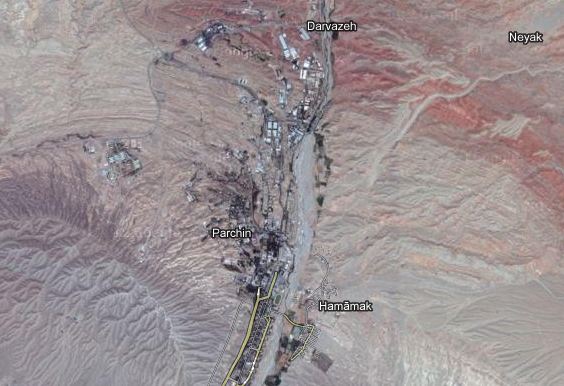
Google Maps image of Parchin, showing the dry landscape at over 5000 feet elevation. Note the extensive erosion patterns.

In March, Gareth Porter and I debunked claims that “diplomats” had fed to AP’s George Jahn. The diplomats asserted to Jahn that they had seen satellite photos depicting activity interpreted as attempts to clean the site at Parchin where they believe Iran has carried out work aimed at developing an explosive trigger device for a nuclear weapon.

Perhaps the biggest problem with the depiction of these activities as being aimed at cleaning the site is that, as I pointed out in the post linked above, it is virtually impossible to remove all traces of radioactive materials from a site where they have been used. The Iranians were very quick to point this out as well. No amount of cleaning will remove all of the residual radioactivity from the building or surrounding soil. I also pointed out in my post that no satellite photos purporting to show this cleaning activity had yet been made public.

Yesterday, David Albright and his Institute for Science and International Security dutifully stepped up to deliver what was intended as photographic proof. From Albright’s description:

 The new activity seen in the satellite image occurred outside a building suspected to contain an explosive chamber used to carry out nuclear weapons related experiments (see figure 1).  The April 9, 2012 satellite image shows items lined up outside the building.  It is not clear what these items are.  The image also shows what appears to be a stream of water that emanates from or near the building.  Based on new information that the IAEA received, the Agency asked Iran to visit this building at the Parchin site, but Iran has not allowed a visit.  IAEA Director General Yukiya Amano noted recently that the IAEA has “information that some activity is ongoing” at the Parchin site 1.  When asked if he was concerned that these activities could be associated with cleansing the site, Amano replied, “That possibility is not excluded…We cannot say for sure because we are not there.”  The items visible outside the building could be associated with the removal of equipment from the building or with cleansing it.  The stream of water that appears to emanate from the building raises concerns that Iran may have been washing inside the building, or perhaps washing the items outside the building.

The idea that Iran would want to wash the building or its contents, presumably in order to remove radioactive contamination from trigger-building experiments, and then just allow the wash water to run onto the ground surrounding the building is laughable on its face. As I noted in my March post, the Iranians pointed out that radioactive contamination can’t be eliminated from a site where such work has been carried out. Of course they would know that merely rinsing some of the radioactive material into the ground surrounding the building would do nothing to hide it from the sensitive detection equipment IAEA would bring to an inspection.

There are two potential explanations for the water seen in the photo labeled April 9, 2012. Read more

Share this entry

NYT Covers the War on Terror Drugs with No Mention of Larger Context

This NYT article, which describes how the US has adopted the Special Forces approaches used in Iraq and Afghanistan to fight the drug trade in Central America, rather bizarrely makes no mention of the larger context–growing opposition in Latin America to the War on Drugs as such. On the contrary, the NYT suggests there is consensus about drugs unlike the Cold War disagreements that existed when Oliver North built similar bases in Honduras to fight the Contras.

Narcotics cartels, transnational organized crime and gang violence are designated as threats by the United States and Central American governments, with a broader consensus than when that base was built — in an era when the region was viewed through a narrow prism of communism and anticommunism.

“The drug demand in the United States certainly exacerbates challenges placed upon our neighboring countries fighting against these organizations — and why it is so important that we partner with them in their countering efforts,” said Vice Adm. Joseph D. Kernan, the No. 2 officer at Southern Command, which is responsible for military activities in Central and South America.

Compare that formula–US demand creates the need for us to set up Forward Operating Bases out of which our Special Forces can operate–with that offered by Guatemala’s right wing President, Otto Pérez Molina, in his calls to legalize drugs. [This is my very rough translation.]

In part, we have seen an unequal struggle [against drugs] because America is not cooperating with Central America as it should on this problem.

[The fight against drugs] is a shared responsibility that has different levels and degrees that each country must take.

The US is the largest consumer and the final destination of all the drugs passing through Central America and therefore it has the greatest responsibility.

Read more

Share this entry

Marja Serves as Microcosm of Military Failure in Afghanistan, But Failure is Country-Wide

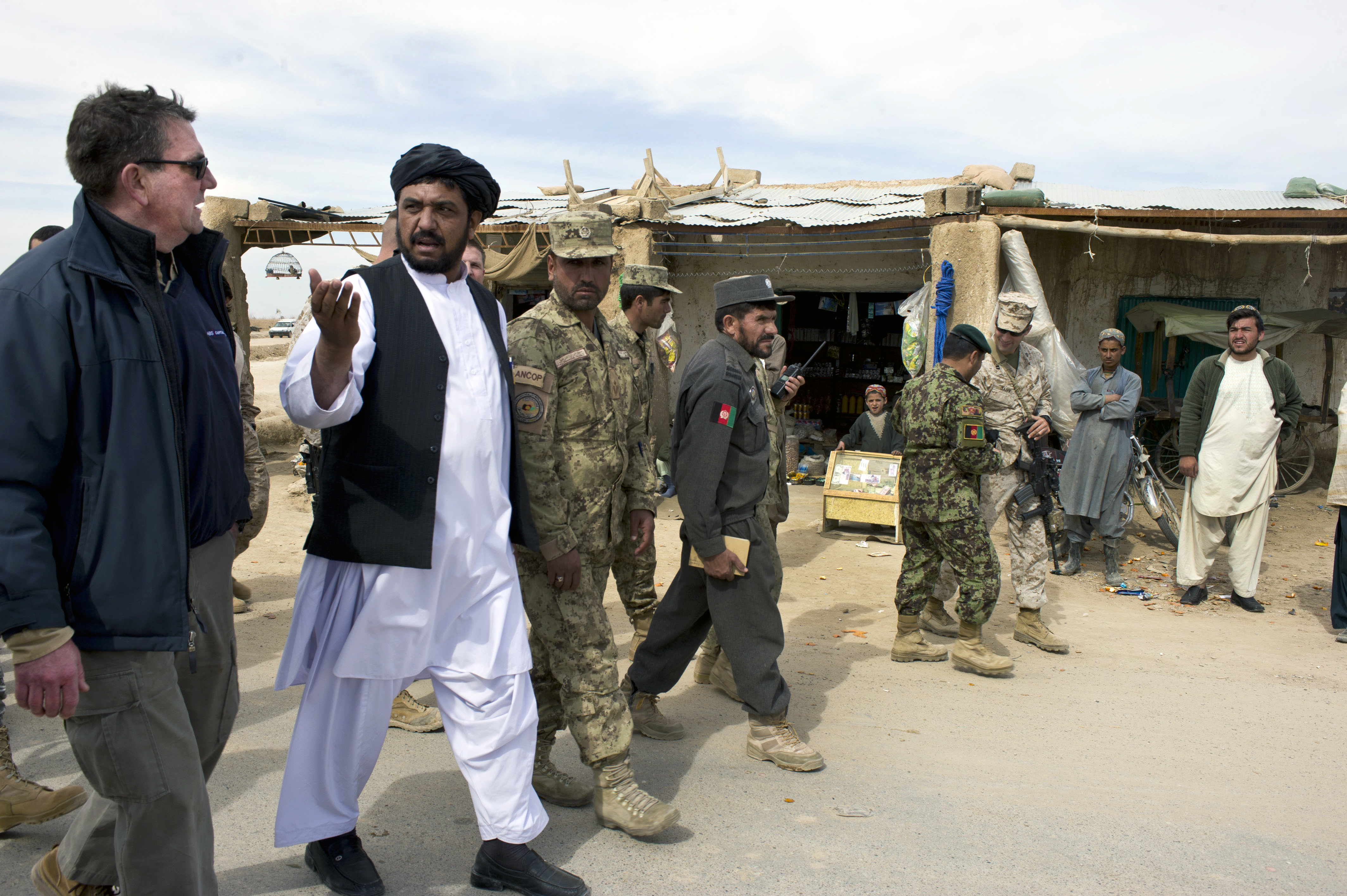
Deputy Defense Secretary Aston Carter strolls through Marja marketplace on February 24. How many security forces were present out of camera range?

Back in February of 2010, US President Barack Obama’s surge of troops in Afghanistan began its offensive by trying to take the Marja district of Helmand Province. Then US commander of forces in Afghanistan, General Stanley McChrystal famously touted his counterinsurgency program for the area, saying “We’ve got a government in a box, ready to roll in”.

Eight months into the battle for Marja, we had this:

As U.S. involvement in the war enters its 10th year, the failure to pacify this town raises questions about the effectiveness of America’s overall strategy. Similarly crucial operations are now under way in neighboring Kandahar province, the Taliban’s birthplace.

There are signs the situation in Marjah is beginning to improve, but “it’s still a very tough fight,” said Capt. Chuck Anklam, whose Marine company has lost three men since arriving in July. “We’re in firefights all over, every day.”

“There’s no area that’s void of enemy. But there’s no area void of Marines and [Afghan forces] either,” said Anklam, 34, of Fort Lauderdale, Fla. “It’s a constant presence both sides are trying to exert.”

/snip/

The result, so far at least: Residents say the town is more insecure than ever.

“There was peace here before you came,” farmer Khari Badar told one Marine patrol that recently visited his home. “Today, there is only fighting.”

Of course, the Defense Department would have us believe everything is now fine in Marja. They staged a stroll through the marketplace back in February by a Deputy Defense Secretary, presumably to mark the two year anniversary of the offensive. I wonder if this stroll was as heavily protected as John McCain’s 2007 stroll through a Baghdad marketplace.

But even though we are supposed to believe the offensive worked in Marja and the Taliban were routed, there was this from DoD on actions from April 15 of this year: Read more

Share this entry

The Bin Laden Document Dump

As MadDog noted, there is a big Bin Laden document dump today. Here is what appears to be the main 205 page pdf file released so far this morning. The first seven pages give a decent overview, lead off by this introduction paragraph:

This document provides a general description of the 17 declassified documents captured in the Abbottabad raid and released to the Combating Terrorism Center (CTC). For additional context please see the documents themselves and/or the CTC’’s report ““Letters from Abbottabad: Bin Ladin Sidelined?”” released in conjunction with this summary.

The ““Letters from Abbottabad: Bin Ladin Sidelined?”” is here.

I have not yet had a chance to look at these, so please feel free to dissect them and discuss them, with your analysis, in comments. Also, if more documents are released that I do not have up, drop a link into comments so that I see it and can add it into the main post.

Here is a very nice report and overview of the dump by our friend Spencer Ackerman at Wired.

Also, not necessarily exactly based on these same documents, Gareth Porter has a nice longform piece over at Jason’s joint, Truthout. The title is Finding Bin Laden: The Truth Behind the Official Story, and it makes a somewhat interesting juxtaposition to all the hype that has been being pitched by the Administration the last few days.

Happy Hunting!

Share this entry

After Obama Slips into Afghanistan Under Cover of Darkness, Taliban Attack at Dawn

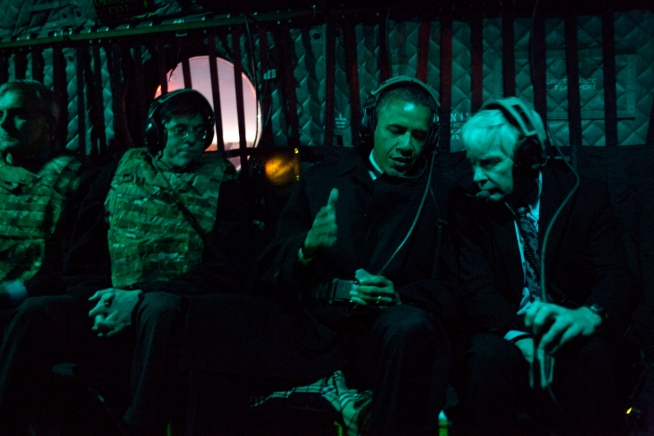
Obama chats with Ryan Crocker aboard a helicopter en route to Karzai's palace for the midnight signing ceremony. (White House photo)

Despite ongoing claims from the military that “progress” is being made in Afghanistan (but see this post for a direct contradiction to the claim violence fell 9% in 2011), the reality of the fragile security situation in Afghanistan dictated that President Obama’s trip to Afghanistan to sign the Strategic Partnership Agreement (which commits to exactly nothing) had to be unannounced and under cover of darkness. Obama and Afghanistan’s President Hamid Karzai signed the agreement around midnight in Karzai’s palace and then Obama left after a short visit with US troops at Bagram.

Just hours after Obama left before dawn on Wedesday morning, the Taliban attacked the Green Village around 6 am local time, killing at least seven people. This compound houses many foreign workers. Although the Taliban are claiming the attack was a direct response to Obama’s visit, it also seems likely the attack had been planned before the visit was known since it occurred on the one year anniversary of the killing of Osama bin Laden in Pakistan (which Obama could not visit now, even under cover of darkness, and especially on the anniversary of bin Laden’s death).

The readiness and capabilities of Afghan security forces lie at the center of both the Strategic Partnership Agreement and the Taliban’s attack Wednesday morning. At the same time that Obama and Karzai signed their agreement that rests on Afghanistan taking the lead for security as the US exits, the Taliban attacked one of the primary housing compounds for foreign workers in the nation’s capital, just two weeks after another brazen attack in Kabul. If Afghan security forces are seen as unable to prevent attacks on foreigners in the capital, then there could be serious fallout for groups that would be anticipated to be necessary for the “rebuilding” phase once US troops are gone.

Groups trying to asses just how bad the attack was this morning will find confusing information. This report by AP claims the attackers made it inside the walls of the protected area:

The violence began around 6 a.m. in eastern Kabul with a series of explosions and gunfire ringing out from the privately guarded compound known as Green Village that houses hundreds of international contractors.

Shooting and blasts shook the city for hours as militants who had stormed into the compound held out against security forces, according to an official who spoke on condition of anonymity because he was not authorized to release the information. Read more

Share this entry

AP’s Burns: ISAF Systematically Under-Reporting Green on Blue Attacks

For several months, I’ve been hammering on the Obama administration and the US military for describing green on blue attacks in Afghanistan, where Afghan military or police personnel attack NATO forces, as “isolated incidents“. In choosing the framing of isolated incidents, these officials are ignoring a seminal report issued just under a year ago, “A Crisis of Trust and Cultural Incompatibility” (pdf), which went into great detail in describing the cultural misunderstandings that lead Afghan forces to attack their coalition “partners”. Shortly after the report was released as unclassified, the US seemed to realize how damaging it is to the preferred narrative of isolated incidents explaining the attacks, and so it was decided that the report should be retroactively classified.

Yesterday, the AP’s Robert Burns made a major breakthrough in the story of green on blue attacks. Burns reported that the US military, in the form of ISAF, has maintained a policy of not reporting on soldiers who are wounded in green on blue attacks. As a result of reporting only fatalities, both the number of attacks and the number of coalition troops affected by them have been significantly under-reported:

The military is under-reporting the number of times that Afghan soldiers and police open fire on American and other foreign troops.

The U.S.-led coalition routinely reports each time an American or other foreign soldier is killed by an Afghan in uniform. But The Associated Press has learned it does not report insider attacks in which the Afghan wounds – or misses – his U.S. or allied target. It also doesn’t report the wounding of troops who were attacked alongside those who were killed.

/snip/

Jamie Graybeal, an ISAF spokesman in Kabul, disclosed Monday in response to repeated AP requests that in addition to 10 fatal insider attacks so far this year, there have been two others that resulted in no deaths or injuries, plus one attack that resulted in wounded, for a total of 13 attacks. The three non-fatal attacks had not previously been reported.

Graybeal also disclosed that in most of the 10 fatal attacks a number of other ISAF troops were wounded. By policy, the fact that the attacks resulted in wounded as well as a fatality is not reported, he said.

If the subject were not so serious, Graybeal’s explanation for why ISAF does not report incidents in which soldiers are wounded would be laughable:

Asked to explain why non-fatal insider attacks are not reported, Graybeal said the coalition does not disclose them because it does not have consent from all coalition governments to do so.

Never mind that since the bulk of forces in Afghanistan are US, most of those wounded would be US soldiers, Graybeal would have us believe that he can’t report on US soldiers being wounded because he doesn’t have express permission to report when soldiers from other coalition countries are wounded in green on blue attacks.

Burns got Graybeal to repeat the “isolated incident” mantra:

Graybeal said each attack in 2012 and 2011 was “an isolated incident and has its own underlying circumstances and motives.”

Burns completes that paragraph with a reference to and a quote from the retroactively classified report, but he merely refers to it as unclassified, passing over the hypocritical actions the military took in trying to classify the report once it began to be noticed.

Congratulations to Robert Burns on his excellent work in forcing ISAF, through Graybeal, to disclose what had previously been hidden intentionally.


Share this entry

Afghan Special Forces Soldier Joins Parade of “Isolated Incidents”, Kills US Trainer, Translator

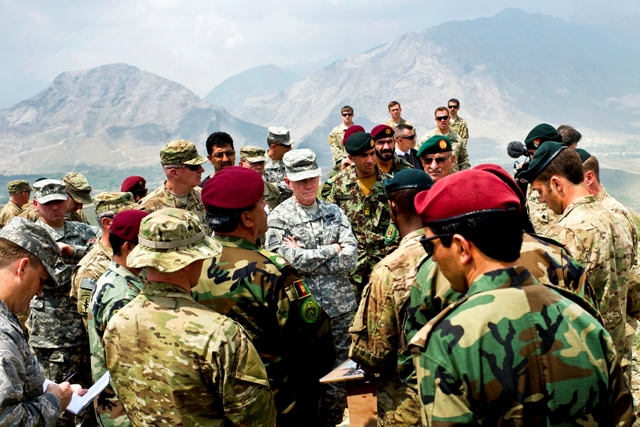
Joint Chiefs Chair General Martin Dempsey visiting the training center for Afghan special forces on Monday of this week. An Afghan special forces member killed his US mentor on Friday. (DoD photo)

As I noted just under two weeks ago, NATO used the occasion of the Taliban attacks across Afghanistan on April 15 to enhance the image of Afghan troops and emphasize the role that they played in ending the attacks. This followed only a week after the US and Afghanistan signed an agreement on night raids, putting Afghan special forces in charge of  night raids, with US forces playing a “support role”.

Although the agreement on night raids was one of the first times Afghan special forces entered the news, it appears that their training began about two years ago. Earlier this week, Joint Chiefs Chair General Martin Dempsey visited the training facility for Afghan special forces and posed for the photo above. He talked glowingly:

Army Gen. Martin E. Dempsey told American Forces Press Service while en route here for a meeting of NATO defense chiefs that he was especially impressed by yesterday’s visit to NATO Training Mission Afghanistan’s Special Forces Training Center at Camp Morehead in Kabul.

“I spent the better part of the day with the [Afghan] commandos and special forces and my counterpart, General [Sher Mohammad] Karimi, just to get their sense of how they feel about themselves,” the chairman said, noting that he also talked with the U.S. service members who mentor them. “I was encouraged on a couple of fronts.

“Their self-esteem is increasing,” he continued. “They’re very proud. They’ve got not only a good equipping and training model, but they’re building in a sense of purpose and values to the force … That part of the force is part of it that I hadn’t really confronted before, and I found it to be very capable, and, I think, moving apace to become a very important part of their security apparatus.”

The visit by Dempsey and his glowing statement about Afghan special forces now appears to have been very ill-timed:

An elite Afghan soldier shot dead an American mentor and his translator at a U.S. base, Afghan officials said on Friday, in the first rogue shooting blamed on the country’s new and closely vetted special forces.

The soldier opened fire at an American military base on Wednesday in Shah Wali Kot district, in volatile Kandahar province, said General Abdul Hamid, the commander of Afghan army forces in the Taliban’s southern heartland.

“The shooting took place after a verbal conflict where the Afghan special forces soldier opened fire and killed an American special forces member and his translator,” Hamid told Reuters.

In discussing the increasing frequency of these green on blue killings, NATO until now has taken the attitude that they are “isolated incidents” while dong their best to ignore the study (pdf) released last May, and then retroactively classified, which detailed the cultural incompatibilities that lead to the killings. In response to this latest incident of fratricide, however, NATO’s response is changing. Returning to the Reuters article: Read more

Share this entry

Rohrabacher’s Team for Decentralizing Afghan Government: War Criminal, Thief and War Hawk

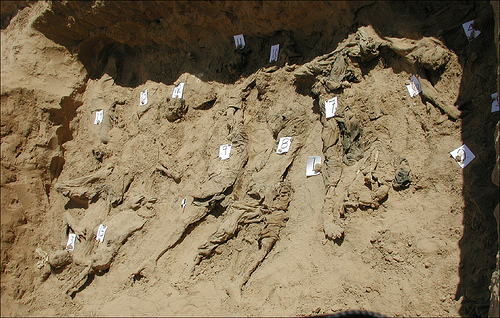
Portion of mass grave of Dostum's victims excavated in 2002 by Physicians for Human Rights. (Physicians for Human Rights photo)

Yesterday, I pointed out that Afghanistan’s President Hamid Karzai denied entry to his country by Representative Dana Rohrabacher (R-CA) over the weekend. At the end of that post, I posed a question:

Rohrabacher’s freedom-fighting then gave us a wonderful “hero” by the name of Osama bin Laden. Who will his latest adventures bring us?

It turns out that we can get a good handle on whom Rohrabacher wishes to promote in Afghanistan by going back to Rohrabacher’s own press release arising from his January 9 meeting in Berlin that brought his feud with Karzai to a head. Although Rohrabacher would like us to think that he is arguing for a more decentralized model of government in Afghanistan, his real motivation is revealed in the opening sentence of the press release, where he states he brought a group together “to discuss alternatives to Hamid Karazi’s consideration of including the Taliban in Afghanistan’s coalition government”.

Once again, we see Rohrabacher’s primary operating principle at work. His actions are determined by whom he has chosen as his enemy. Unfortunately, once Rohrabacher has chosen his enemy, all he seeks in an ally is someone who also opposes that enemy. As noted yesterday, that was the process that led him and his Freedom Fighters in the Reagan administration to ally us with Osama bin Laden against the Soviets when they were in Afghanistan. Now, with Karzai daring to negotiate with the Taliban, Rohrabacher has decided to team with anyone in Afghanistan whom he sees as opposing the Taliban. In doing so, he chose for his meeting in Berlin to present a group of “National Front Leaders” that contains the war lord responsible for the largest, most heinous war crime committed in Afghanistan since the turn of the century, a criminal former vice president of the country who was stopped with a suitcase containing $52 million and a former security chief described as an unapologetic hawk who advocates escalating the war in Afghanistan.

Batting leadoff for Rohrabacher’s All Stars is the notorious war criminal Rashid Dostum. Read more

Share this entry

Resistance Rabble-Rouser Rohrabacher Refused Entry to Afghanistan

Rohrabacher playing dress-up in Afghanistan. (Rohrabacher photo via Mother Jones)

Representative Dana Rohrabacher (R-CA) tried to pull a fast one over the weekend and sneak in as a “last minute replacement” on a Congressional delegation to Afghanistan. The problem was that, as BBC reported, the rest of the delegation had visas for entry but Rohrabacher did not. Afghanistan’s President Hamid Karzai learned that Rohrabacher had joined the group prior to it leaving Dubai for Kabul, and he instructed US Secretary of State Hillary Clinton to ground the flight until Rohrabacher was removed.

I find it really hard to believe that Rohrabacher did not plan to be a part of the trip from the start, but wanted to avoid advance publication of his plans. Back in January, Rohrabacher, along with his usual co-conspirators Louie Gohmert (R-TX) and Steve King (R-IA), somehow managed to get Representative Loretta Sanchez (D-CA) to lend a patina of “bipartisanship” to a meeting held in Berlin that many viewed as a call to partition Afghanistan and to arm opposition groups such as the Northern Alliance. This meeting made Karzai “incredibly angry”, giving Rohrabacher good reason to try to stay below Karzai’s radar. Further, Rohrabacher also held a Congressional hearing on establishing an independent Balochistan, which, if drawn according to cultural lines, would take territory from Pakistan, Iran and Afghanistan.

The full list of Congressmembers on the weekend trip to Afghanistan has not been disclosed, but the fact Politico reports that it was headed by Gohmert supports my suspicion that Rohrabacher planned to attend all along. The timing for additional meddling in US-Afghanistan relations could not have been worse, because Sunday was when it was announced that the US and Afghanistan had finally reached agreement on the outlines of a long term agreement for US support after the withdrawal of fighting forces. Rohrabacher seems to be quite entertained by Karzai’s response. Returning to the Politico article: Read more

Share this entry

US Achieves Sham Agreement Trifecta With Afghanistan

It is becoming a signature of the Obama administration that as self-imposed deadlines approach, the quality of agreements reached drops precipitously. Recall that Obama had worked furiously to be able to announce a mortgage fraud settlement in this year’s State of the Union speech. He missed that deadline by several weeks on the actual agreement, and so at the last minute developed the Schneiderman Mortgage Fraud Task Force to have something to announce in the speech.  Nearly three months later, the “task force” does not yet have the basics of an office, telephone number or executive director, but Obama got his big announcement.

With public opinion on the war in Afghanistan so low that even Republicans now see it as not worth the cost, Obama has been determined to have a long term agreement in place with Afghanistan prior to the upcoming NATO summit next month in Chicago, perhaps as a move to prevent calls for a strategic reassessment prior to November’s elections. The agreement has been broken into three pieces. Earlier, agreements on the handover of prisons and on night raids have been executed and we learned yesterday that an agreement on long term support for Afghanistan has been reached and is ready for approval.

Although stated as giving Afghanistan full control over operations, the prison agreement keeps the US in full control of veto power over the release of any prisoners, so the handover is far from complete in terms of who makes critical decisions. Similarly, the night raid agreement purports to put night raids completely under Afghan control, but US forces can still enter Afghan homes once Afghan forces invite them. Crucially, “planning and execution of future raids will still rely heavily on U.S. intelligence”, suggesting to me that the US is likely to maintain the lead role in choosing targets.

The early description of Sunday’s agreement on long term support for Afghanistan paints this agreement as the ultimate sham, as virtually all details appear to be subject to later change:

After more than a year of negotiations, U.S. and Afghan officials reached an agreement Sunday affirming the United States’ commitment to Afghanistan for a decade after its formal troop withdrawal in 2014.

The document, which must be reviewed by the Afghan parliament and U.S. security agencies and signed by both nations’ presidents, does not specify troop numbers or funding levels, but it offers a broad guarantee that the U.S. role here will not end as abruptly as some feared it might.

/snip/

But the specifics of the U.S. commitment have yet to be formally outlined and could be governed by future agreements.

Maybe Schniederman will be put in charge of filling in the details on the agreement, since he’s not very busy these days.

Share this entry