Obama’s Headlong Rush to Counterterrorism Transparency

By my count, Thursday will be the 100th day since Obama promised, in his State of the Union Adress delivered February 12, “to engage Congress to ensure not only that our targeting, detention and prosecution of terrorists remains consistent with our laws and system of checks and balances, but that our efforts are even more transparent to the American people and to the world.”

Back then there were, officially at least, just a handful of Gitmo detainees on hunger strike. And it’s possible — if DOJ used the two 45-day gags on subpoenas they permit themselves — a subpoena seizing the phone records for 21 AP phone lines had already been issued.

After Obama promised more transparency on drones and other counterterrorism programs, Members of Congress continued to have to demand minimal transparency. On February 20, Rand Paul sent his third request for that information. On February 27, House Judiciary Chairman Bob Goodlatte repeated that Committee’s request to see OLC’s drone targeting memos; he also expressed anger that the Administration had refused to send a witness to the hearing.

On March 7, Eric Holder hinted that we would “will hear from the President in a relatively short period of time” on drones and transparency and counterterrorism.  On March 8, guards at Gitmo shot non-lethal bullets at detainees. The following day US conducted a drone strike in Pakistan, one of two strikes that month.

On March 11, Progressive Members of Congress sent a letter asking for information on drone targeting.

On April 9, McClatchy reported that most drone strikes had hit low level militants, contrary to public claims; it also revealed the intelligence reports themselves were false.

On April 10, the House Judiciary Committee finally threatened to subpoena the OLC memos authorizing the killing of an American citizen; that was at least the 23rd request for such information from Congress. A week later the Committee would finally get a promise to see just those memos, memos squarely within the Committee’s oversight jurisdiction.

On April 13, the military locked down Gitmo, effectively depriving most detainees of the human company they had enjoyed for years. On that day, 43 men were hunger striking.

On April 14, Samir Haji al Hasan Moqbel described, in a NYT op-ed, “I’ve been on a hunger strike since Feb. 10 and have lost well over 30 pounds. I will not eat until they restore my dignity.” That same day, the US launched one of two drone strikes in Pakistan that month.

On April 15, the Tsarnaev brothers attacked the Boston Marathon, reportedly in retaliation for treatment of Muslims in Afghanistan and Iraq.

April 17, a US drone struck the Yemeni village of a Yemeni, Farea al-Muslimi, already scheduled to testify before the Senate Judiciary Committee about how drones turn Yemenis against the US.

On April 21, the number of hunger strikes at Gitmo reached 84 — over half the men there. Six days later, on April 27, that number reached 100. Three more men have since joined the hunger strike.

As those numbers were growing, on April 25, Dianne Feinstein called on Obama to transfer those detainees who have been cleared. On April 30, Obama renewed his promise to close Gitmo. The next day, the White House made clear that the moratorium preventing almost half the detainees, men who have been cleared for transfer, to return home to Yemen, remained in place.

On May 10, the AP learned that DOJ had seized phone records from 21 phone lines with no notice, potentially exposing the sources of up to 100 journalists.

On May 16, in a hearing querying whether Congress should eliminate or expand the September 18, 2001 Authorization to Use Military Force, Assistant Defense Secretary Michael Sheehan testified the war on terror would last at least 10-20 more years. He also said DOD won’t be taking over CIA’s side of the drone war anytime soon.

Saturday, a drone strike killed at least 4 thus far unidentified men in Yemen.

Which brings us to Thursday when, the WaPo details, Obama will give a speech telling us once again the drone strikes are legal, his desire to close Gitmo is real, and leaks his new CIA Director exacerbated are serious. He will, apparently, also tell us how he plans to make his counterterrorism plan look more like what he promised it would look like 4 years ago.

President Obama will deliver a speech Thursday at the National Defense University in which he will address how he intends to bring his counterterrorism policies, including the drone program and the military prison at Guantanamo Bay, Cuba, in line with the legal framework he promised after taking office.

In the interim between when he promised this transparency and when he’ll start to sort of deliver it (but not, apparently, any actions to close Gitmo), about 7% of his second term will have passed.

Some of the delay, apparently, comes from the need to address the issues that have been festering during the delay.

Obama was prepared to deliver the speech earlier this month, but it was put off amid mounting concerns over a prisoner hunger strike at Guantanamo Bay and more recently the Justice Department leaks investigation — both of which the revised speech may address.

But otherwise, it appears it has taken 100 days to be able to craft a speech good enough to make his paranoia about secrecy and lip service to human rights in counterterrorism look like something else.

Ah well, at least they’ve sharply curtailed drone strikes while they’ve been writing a speech.


Brennan Cedes to Feinstein on Torture Tape Destroyer But “Defiant” on Torture Report

The WaPo reports that the woman who helped Jose Rodriguez destroy the torture tapes will not — as had been floated — officially lead the Clandestine Services.

A female CIA officer who was the first woman to lead the agency’s clandestine service, but was also closely tied to the agency’s interrogation program, will not get to keep that job as part of a management shake-up announced Tuesday by CIA Director John O. Brennan, U.S. officials said.

The report (sourced to “US officials,” which can be code for members of Congress or staffers) emphasizes that the intervention of members of Congress — and Dianne Feinstein specifically — played in key role in persuading John Brennan such an appointment would be a problem.

But the woman, who remains under cover, faced opposition from senior lawmakers over her ties to an interrogation program that critics have said employed torture to get information from al-Qaeda captives after the Sept. 11, 2001, attacks.

[snip]

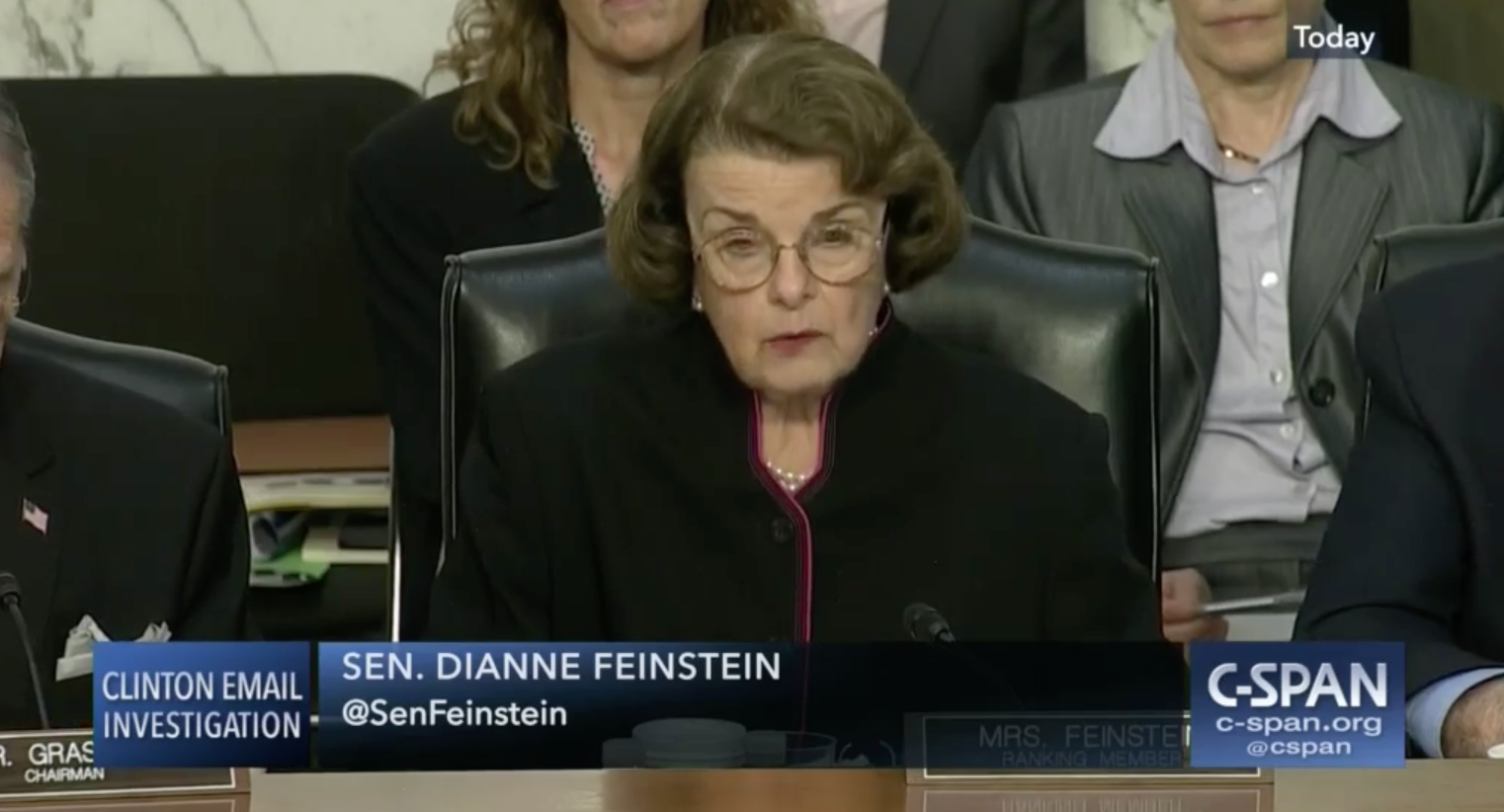
Sen. Dianne Feinstein (D-Calif.), the chairwoman of the Senate Intelligence Committee, had called Brennan to express concern over the possibility that someone so closely linked to the program would be put in position to lead the agency’s spying service.

Kudos to DiFi for what appears to be successful oversight.

The only problem is the same article notes that Brennan is preparing to blow off DiFi’s torture report.

The transition comes at a time when the agency is assembling what is said to be a defiant response to a recently completed report by the Senate Intelligence Committee that is sharply critical of the interrogation program and its results.

As I have noted in the past and elaborated on at Salon yesterday, Brennan’s “defiance” should not matter. Ultimately, the White House has the authority to release the report.

But it’s trying to dodge the issue.

And now, in spite of Panetta’s claims that the White House originally made torture a SAP, the White House has done nothing to accelerate the release of a report that — according to Democrats on the committee and John McCain — will correct many misconceptions about the torture program.

Of course, as president, Obama would have the authority to order John Brennan to declassify the report in any case. But the White House seems unwilling to acknowledge whether it possesses the sole authority over this decision. In response to a question whether — as Panetta’s statement indicates — the White House has classification authority over the program, NSC spokesperson Caitlin Hayden didn’t answer.

Instead, she used the same kind of stalling technique as the CIA:

The Administration is currently reviewing the full 6,000 page report at the invitation of the SSCI and we look forward to working with the Committee once that review is complete.

I suspect the White House will use Brennan’s “defiance” as cover for keeping the report hidden.

What Brennan does in personnel decisions that remain hidden won’t get the CIA out of the torture business. Only real transparency on it will.

Update: The Cable published the entire letter announcing the personnel changes at CIA. It ends with this claim about the woman passed over at Clandestine Services.

The assertion she was not chosen because of her affiliation with the CT mission is absolutely not true.

I guess for the CIA, destroying evidence of torture is considered “the [counterterrorism] mission.”


If 40 Months of Drone Strikes in Yemen Haven’t Made Transfers Safe …

When on January 5, 2010 President Obama announced a halt to all transfers of Yemeni Gitmo detainees, he reiterated his intent to close the prison, even noting that AQAP formed, in part, in response to Gitmo (recall that Said al-Shihri, one of AQAP’s actual operational leaders, had been a Gitmo detainee).

Finally, some have suggested that the events on Christmas Day should cause us to revisit the decision to close the prison at Guantanamo Bay. So let me be clear. It was always our intent to transfer detainees to other countries only under conditions that provide assurances that our security is being protected.

With respect to Yemen in particular, there’s an ongoing security situation which we have been confronting for some time, along with our Yemeni partner. Given the unsettled situation, I’ve spoken to the Attorney General and we’ve agreed that we will not be transferring additional detainees back to Yemen at this time.

But make no mistake: We will close Guantanamo prison, which has damaged our national security interests and become a tremendous recruiting tool for al Qaeda. In fact, that was an explicit rationale for the formation of al Qaeda in the Arabian Peninsula.

The announcement came less than a week after John McCain, Lindsey Graham, and Joe Lieberman released a statement (citing Shihri explicitly) complaining about the imminent release of 6 Yemeni detainees; Dianne Feinstein and Kit Bond issued their own request. Jane Harman and Crazy Pete Hoekstra were also calling for a halt to transfers to Yemen (Hoekstra, of course, was also leaking NSA intercepts to fearmonger against Anwar al-Awlaki). The day after the announcement, DOD sources leaked a report that would later be released in more detail showing 20% of Gitmo detainees released had joined or rejoined al Qaeda. In short, in significant part it came in response to political pressure to halt transfers, something DiFi admits readily.

But the halt in transfers also came among Obama Administration guarantees that their new strategy against Yemen would quickly bring results. Brennan described the new security agreements put into place at the January 2, 2010 David Petraeus-Ali Abudullah Saleh meeting (this is where Brennan estimated the number of AQAP militants to be “several hundred”) at which Saleh agreed to let fixed wing planes, including drones, operate in his country.

WALLACE: Let me widen this discussion in that sense. Not only as you point out, obviously, were you in Yemen earlier, but General Petraeus, the head of Central Command, was in Yemen yesterday.

The British overnight have announced that the U.S. and the British are going to be co-funding a new Yemeni anti-terror counter-terror police force.

Is it fair to say that we are opening up a second front in our war on terror outside the Afghanistan-Pakistan theater in Yemen?

BRENNAN: I wouldn’t say we’re opening up a second front. This is the continuation of an effort that we’ve had under way since, as I said, the beginning of this administration.

David Petraeus has been out to Yemen several times. I spoke with him yesterday after he met with President Salih. We’re continuing to have a very close and ongoing dialogue with the Yemeni government. The cooperation is on the security, intelligence and military fronts.

We’ve had close consultations with the British. I spoke with the British last night also about the types of things that we can do together in support of the Yemeni government. So this is a determined and concerted effort.

We’re not going to let Al Qaeda continue to sort of make gains in Yemen, because we need to take whatever steps necessary to protect our citizens there as well as abroad.

WALLACE: Could that mean U.S. troops on ground in Yemen?

BRENNAN: We’re not talking about that at this point at all. The Yemeni government has demonstrated their willingness to take the fight to Al Qaeda. We — they’re willing to accept our support. We’re providing them everything that they’ve asked for.

And they’ve made some real progress. And over the past month, Al Qaeda has taken a number of hits, and a number of Al Qaeda leaders in Yemen are no longer with us because of this determined and aggressive action.

The day after Obama announced the moratorium on Yemen transfers, Robert Gibbs claimed (perhaps because several Yemenis had been transferred in December) that the moratorium came as a result of a recent decline in security.

MR. GIBBS: I have not seen or heard about the latest report that you refer to and I don’t have handy what numbers had been for similar reports in years past. Yesterday’s determination was made and announced very much on what you heard John Brennan say over the weekend. We never had a plan to transfer anybody either to their home country or to a third country that we believe — we have reason to believe will present a security situation for us or for that country. And in relating to Yemen, I think you heard John say nobody was going to be transferred back that we did not believe that the Yemeni government could handle.

The determination was made that given the — as you heard the President say — the swift change in the security environment even over the last few weeks in Yemen caused the President and the Attorney General to agree that pausing any of those transfers was the right policy right now.

Continue reading


Feinstein Calls for Review of Her Moratorium on Release of Yemeni Prisoners from Gitmo

Finally sensing that US policy on Yemeni prisoners at Guantanamo is a disaster of epic proportions, and after playing a key role in putting the moratorium on release of Yemeni prisoners into place, Dianne Feinstein on Thursday took the first step toward trying to resolve the crisis before hunger striking prisoners begin to die in large numbers. Feinstein penned a letter to National Security Director Tom Donilon on Thursday, asking for renewed efforts to release those Guantanamo prisoners who have been cleared for release. It is clear that a central step in that process is to review the moratorium on release of cleared Yemeni prisoners.

There is a craven semantics game that is played in the arena of prisoners who have been cleared for release. Government and military officials only ever refer to “detainees” who are cleared for “transfer”, even when those prisoners have been completely cleared of any wrong-doing. Because of that semantics problem, the Guantanamo Review Task Force final report (pdf), issued in January of 2010, provides a muddled description of two groups of Yemeni prisoners who are cleared at various levels for release:

Falling into the category of those who really should be released outright, but classed in the report as “Detainees Approved for Transfer”, we see 29 from Yemen:

29 are from Yemen. In light of the moratorium on transfers of Guantanamo detainees to Yemen announced by the President on January 5, 2010, these detainees cannot be transferred to Yemen at this time. In the meantime, these detainees are eligible to be transferred to third countries capable of imposing appropriate security measures.

A second category of Yemeni detainees cleared for release are those that the government believes still warrant some sort of detention in Yemen. They appear in the category “Detainees Approved for Conditional Detention”:

30 detainees from Yemen were unanimously approved for “conditional” detention based on current security conditions in Yemen.

The status of these prisoners is described further:

After carefully considering the intelligence concerning the security situation in Yemen, and reviewing each detainee on a case-by-case basis, the review participants selected a group of 30 Yemeni detainees who pose a lower threat than the 48 detainees designated for continued detention under the AUMF, but who should not be among the first groups of transfers to Yemen even if the current moratorium on such transfers is lifted.

These 30 detainees were approved for “conditional” detention, meaning that they may be transferred if one of the following conditions is satisfied: (1) the security situation improves in Yemen; (2) an appropriate rehabilitation program becomes available; or (3) an appropriate third-country resettlement option becomes available. Should any of these conditions be satisfied, however, the 29 Yemeni detainees approved for transfer would receive priority for any transfer options over the 30 Yemeni detainees approved for conditional detention.

About that “moratorium” on release of Yemeni prisoners. The review task force report informs us that of 36 Yemeni detainees initially cleared for full release, one was released by court order in September 2009 and another six were released in December 2009. But then the Undie Bomber episode took place on Christmas Day of 2009, and the release of Yemeni prisoners somehow became politically impossible. From the review report: Continue reading


The Intelligence Committee’s “Secret” Briefings on the Boston Attack

There are 15 members of the Senate Intelligence Committee. By my count, at least 5 of them revealed some part of what they got briefed on the Boston attack yesterday afternoon to the press.

Saxby Chambliss says an agency may not have shared one piece of evidence.

“There now appears that may have been some evidence that was obtained by one of the law enforcement agencies that did not get shared in a way that it could have been. If that turns out to be the case, then we have to determine whether or not that would have made a difference,” Chambliss said.

Though Chambliss would not get into specifics on  the information or whether or not the bombing could have been prevented, he told Channel 2 Action News that they will find out if someone dropped the ball.

“Information sharing between agencies is critical. And we created the Department of Homeland Security to supervise that. We created the National Counter Terrorism Center to be the collection point for all of this information, and we’re going to get to the bottom of whether or not somebody along the way dropped the ball on some information and did not share it in a way that it should have been shared.”

Chambliss also suggested that some of the walls that had been eliminated after 9/11 may have been unintentionally recreated.

“Post-911 we thought we had created a systems that would allow for the free flow of information between agencies,” said Senator Saxby Chambliss, a Republican from Georgia and member of the intelligence panel. “And I think there have been some stone walls .. .that have been re-created that were probably unintentional.”

Richard Burr revealed that FSB had contacted the government more than the single, January 2011 time that has been reported; it contacted us (he didn’t say what agency) at least once since October 2011.

Russian authorities alerted the US government not once but “multiple’’ times over their concerns about Tamerlan Tsarnaev — including a second time nearly a year after he was first interviewed by FBI agents in Boston — raising new questions about whether the FBI should have focused more attention on the suspected Boston Marathon bomber, according to US senators briefed on the probe Tuesday.

[snip]

In a closed briefing on Tuesday, members of the Senate Intelligence Committee learned that Russia alerted the United States about Tsarnaev in “multiple contacts’’ — including “at least once since October 2011,’’ said Richard Burr, a Republican of North Carolina, speaking with reporters afterward.

Susan Collins revealed that one agency even had problems sharing information within its own agency and repeated that magic word, “stovepipe.”

“But I’m very concerned that there still seem to be serious problems with the sharing of information, including critical investigative information,’’ she said after emerging from the closed-door committee briefing. “That is troubling to me, this many years after the attacks on our country in 2001, that we still seem to have stovepipes that prevent information from being shared effectively, not only among agencies but also with the same agency in one case.”

Russian authorities alerted the US government not once but “multiple’’ times over their concerns about Tamerlan Tsarnaev — including a second time nearly a year after he was first interviewed by FBI agents in Boston — raising new questions about whether the FBI should have focused more attention on the suspected Boston Marathon bomber, according to US senators briefed on the probe Tuesday.

The FBI has previously said it interviewed Tsarnaev in early 2011 after it was initially contacted by the Russians. After that review, the FBI has said, it determined he did not pose a threat.

In a closed briefing on Tuesday, members of the Senate Intelligence Committee learned that Russia alerted the United States about Tsarnaev in “multiple contacts’’ — including “at least once since October 2011,’’ said Richard Burr, a Republican of North Carolina, speaking with reporters afterward.

Marco Rubio shared details echoing those reported elsewhere, that the brothers had gotten both their beliefs and bomb instructions online. Dianne Feinstein — the only Democrat I found blabbing to the press — said to hold off on making judgments.

Now, none of these details are that informative. I’m interested in the multiple follow-up complaints from Russia, particularly given that other reports say FBI asked for follow-up information from Russia three different times and got nothing (was FSB sharing it with the CIA?). I’m interested in the agency that couldn’t share information within its own agency.

Other than that, I get the impression this is more of what plagues our counterterrorism efforts in the first place: a flood of information with an imperfect ability to sort it (not to mention the very distinct possibility that there were no definitive pieces of intelligence that would have alerted authorities to the brothers’ violent intent).

But I wonder, given that no one seems to take the “closed” part of “closed hearings” very seriously. Why can’t we just brief this stuff publicly, so taxpayers and citizens can learn whether the billions we’ve spent on counterterrorism have done anything more than create even more bureaucracies.

Update: This story confirms that the second request was to CIA, which referred it back to the FBI.

Meanwhile, a review of Russia’s contacts with the U.S. authorities, shows that six months after the Russians asked the FBI to review the activities of Tsarnaev’s brother, Tamerlan, Russian authorities made an identical request to the CIA.

The official, who is not authorized to comment publicly, said the CIA was aware of the FBI’s prior review—which turned up nothing improper—and referred the Russian request back to the FBI.

The CIA is prohibited from conducting intelligence operations on U.S. soil.

The FBI, which had closed its review on Tsarnaev in June 2011 after sharing its results with Russian officials, again contacted their Russian counterparts, asking if they had developed additional information on the Cambridge, Mass., man.

But the official said Russian authorities never responded.

This story notes that FSB has been accompanying the FBI as it questions the Tsarnaev parents and provides background on all the ways US-Russian relations are strained right now.


I Hate to Say I Told You So, John Brennan Covering Up Torture Report Edition

Man, have the Democrats on the Senate Intelligence Committee — particularly Dianne Feinstein and Jay Rockefeller — been pawned. One of their key issues during John Brennan’s confirmation was the declassification of the 6,000 page torture report.

Based on both Saxby Chambliss’ representation of comments Brennan made in their private meeting and on the delayed CIA response about the report, I predicted Brennan would be stating publicly what he stated privately (not having read most of the report yet) to Saxby.

During John Brennan’s confirmation process, he answered questions about the Senate Intelligence Committee report on torture with two faces. To Saxby Chambliss in private, he said he thought the report was a prosecutorial document, set up to come to pre-ordained conclusions. Publicly, to Democrats, he said he was shocked–shocked!–by what he had read in the Executive Summary of the report.

It was quite clear that Brennan was playing the lawmakers who would get to vote on his confirmation, but they didn’t delay his confirmation to resolve the report declassification.

When Brennan’s confirmation got delayed by demands to exercise oversight, the CIA delayed its response — originally due February 15 — on the contents of the report. Indefinitely.

All of this, of course, sets up Brennan to refuse to declassify the report because he believes (and, importantly, believed from the start, according to Saxby Chambliss) that the people who have now rushed his confirmation through were acting in an unfairly prosecutorial mode when they spent 5 years documenting what CIA did in its torture program.

Here’s what Brennan said to Jan Schakowsky yesterday when she asked about the report.

SCHAKOWSKY: Let me ask you also, Mr. Brennan, as you know, the Senate Intelligence Committee report on former CIA detention and interrogation practices is under review with the — within the administration and the agency. Comments were originally due back to the committee on February 15, though the reply has now been delayed indefinitely.

On March 7 in the New York Times, former CIA Senior Analyst, Emile Nakhleh said that if any person can take this on, it would be you, Director Brennan. It’s you and that, quote, “the institution would benefit from the eventual — eventual declassification and release of the study.”

What is the current status of the review of the report and can you please just, if you could, discuss the importance as a leader of the — the leader of the CIA of its release?

BRENNAN: Well, clearly, it’s — it’s an important report that was issued by the — the Senate Select Committee on Intelligence. I have as — as recently as earlier this [week] spoken with both the chairman and the vice chairman of the — the committee telling them that I am in the process of the reviewing of the — the document and will be getting back to them shortly. This is a 6,000 page document that has, you know, millions of pages behind it in terms of what was reviewed.

And so it’s my obligation as the Director of CIA to make sure that my response back to them is going to be thorough and as accurate as possible and will convey my views about what that report portrays about CIA’s past practices, what we have learned from that experience running the program as well as from that report and also to identify things that I might think that the — the committee may have — the committee’s report might not accurately represent. [my emphasis]

Schakowsky asked about the import of releasing the report, and Brennan instead responded by talking about using the report as a lessons learned document and also objecting to some of the things found in it.

But it sure looks like, unless someone starts pulling teeth, CIA will be “learning from this experience as well as from the report” in private, because Brennan pointedly didn’t respond to Schakowsky’s question about releasing the document publicly.


John Brennan Says All the Bad Reports about CIA Are Inaccurate

Kudos to Jan Schakowsky, who used today’s hearing on global threats to ask John Brennan some of the questions he so rarely gets asked.

She started by asking him generally about drones and his previous public comments about them. He responded by noting that he was a White House figure then, now he’s CIA Director (implying, I guess, that he shouldn’t be held to his previous comments).

She then asked specifically about Jonathan Landay’s reporting on the drone strikes — which, as you’ll recall, is reported directly from intelligence reports on drone strikes. Brennan responded, ”A lot of things in press are reported inaccurately, in my opinion.” (Mind you, Landay’s reports did give Brennan an excuse for having lied so blatantly about civilian casualties in the past, so I guess his reporting is inaccurate, even though it helps Brennan!)

Schakowsky then asked about the difference between targeted and signature strikes. Brennan pointed back to the earlier dog and pony show on drones, which pretended signature strikes didn’t exist.

Schakowsky then asked for an update on the torture report. Brennan revealed he had spoken with Dianne Feinstein and Saxby Chambliss earlier this week. He told them he was in the process of reviewing the report (keep in mind, the original response to SSCI was due February 15, almost two months ago) and was doing a “thorough” review of some things he believed the committee did not report accurately.

If you’re John Brennan, if internal reports on drones make the CIA look bad, and if internal reports on torture make the CIA look bad, they are by definition inaccurate.


CIA’s Drone Lies and Congressional Oversight

Remember when House Intelligence Chair Mike Rogers said that public reports of civilian drone casualties are wildly wrong?

“I think that you would be shocked and stunned how wrong those public reports are about civilian casualties,” Rogers said on the House floor.

“Those reports are wrong. They are not just wrong, they are wildly wrong. And I do believe that people use those reports for their own political purposes outside of the country to try to put pressure on the United States,” Rogers said.

Remember when Senate Intelligence Chair Dianne Feinstein said that civilian casualties have been in the single digits (and then went on to admit that she didn’t know about the “military aged male” standard)?

I’ve also been attempting to speak publicly about the very low number of civilian casualties that result from such strikes. I’ve been limited in my ability to do so. But for the past several years, this committee has done significant oversight of the government’s conduct of targeted strikes, and the figures we have obtained from the executive branch, which we have done our utmost to verify, confirm that the number of civilian casualties that have resulted from such strikes each year has typically been in the single digits.

These statements from members of the Gang of Four who have gotten the most unfettered sharing of intelligence on the drone strikes are why Jonathan Landay’s reports on what CIA’s own reporting shows are so important.

As I noted, Landay’s confirmation that CIA self-reported only one civillian casualty in the 12 months before September 2011 make it clear that CIA did not count any of the 40-something dead killed on May 17, 2011 at Datta Khel as civilian casualties.

At least 265 of up to 482 people who the U.S. intelligence reports estimated the CIA killed during a 12-month period ending in September 2011 were not senior al Qaida leaders but instead were “assessed” as Afghan, Pakistani and unknown extremists. Drones killed only six top al Qaida leaders in those months, according to news media accounts.

Forty-three of 95 drone strikes reviewed for that period hit groups other than al Qaida, including the Haqqani network, several Pakistani Taliban factions and the unidentified individuals described only as “foreign fighters” and “other militants.”

During the same period, the reports estimated there was a single civilian casualty, an individual killed in an April 22, 2011, strike in North Waziristan, the main sanctuary for militant groups in Pakistan’s tribal areas.

CIA reported no civilian casualties at Datta Khel even in spite of Mark Mazzetti’s report that “many American officials believed that the strike was botched, and that dozens of people died who shouldn’t have.”

Nor did the CIA count any of the (by my count) 51-176 civilian casualties reported by The Bureau on Independent Journalism for that period (2010; 2011; note, I counted September 1 to September 1).

In short, these reports prove that the CIA — and the intelligence community generally, given that these are described as US intelligence reports — are doing precisely what they did with the torture program: “repeatedly provid[ing] inaccurate information” to Congress.

Nevertheless, even as DiFi, at least, was seeing volumes and volumes of evidence that CIA had lied to Congress about torture in the very recent past, Gang of Four member staffers apparently didn’t read the public reporting on drones closely enough to realize that that public reporting was more credible than CIA reporting.

As a result, in spite of all the boasts of close oversight, CIA’s lies have turned the Gang of Four into propagandists for a program that they’re less well-informed about than many outside observers.

The intelligence oversight committees have become a classic case of Garbage In, Garbage Out, not only defying the entire point of oversight, but serving instead as a legally protected source of propaganda.

As we discuss releasing the torture report, we should also be discussing the larger issue of how CIA has perverted the only oversight structure it has. Because it has clearly become a pattern.


The Moral Rectitude Torture Cover-Up Promotion Czar

Oh hi! Are you folks still here? Missed you!

First off, thanks to bmaz and Jim and Rayne for holding down the fort while Mr EW, McCaffrey the MilleniaLab, and I explored Kentucky. There are many wonderful aspects of the state: the sandstone arches, the ham, and I think we’re even finally beginning to get this Bourbon thing!

I’ll be catching up for a few days, probably commenting on things that broke while I’m away. Such as this news, that John Brennan is showing his leadership at CIA by having three former CIA people weigh in on whether he should retain the woman who destroyed the torture tapes as the head of the clandestine service (she’s the acting head now, Brennan is considering making her appointment permanent; Mark Mazzetti has more details on her career here).

To help navigate the sensitive decision on the clandestine service chief, Brennan has taken the unusual step of assembling a group of three former CIA officials to evaluate the candidates. Brennan announced the move in a previously undisclosed notice sent to CIA employees last week, officials said.

[snip]

“Given the importance of the position of the director of the National Clandestine Service, Director Brennan has asked a few highly respected former senior agency officers to review the candidates he’s considering for the job,” said Preston Golson, a CIA spokesman.

The group’s members were identified as former senior officials John McLaughlin, Stephen Kappes and Mary Margaret Graham.

Note that at least two of these three were deeply implicated in the torture program, with McLaughlin involved in decisions and briefing of the program itself (and also vouching for Brennan’s claimed opposition to torture back when it mattered, solely because he’s “honest”), and Kappes involved in covering up the Salt Pit killing of Gul Rahman, among other things. So they’re not exactly neutral on the contributions of people who cover up the CIA’s torture program. While the selection of these three is being spun as expertise (I suspect they were also selected because Dianne Feinstein respects them, though that’s a guess), it should be clear that they are not neutral on torture.

But I’m just as amused at how this process — Brennan’s fairly transparent attempt to outsource the morally repugnant decision to promote someone involved in torture and its cover-up — undermines all the carefully cultivated claims about Brennan’s role as the priest serving as a moral compass for others, at least on the drone program.

Among other descriptions offered of the guy in charge of drone assassinations, Harold Koh described him as a priest.

“If John Brennan is the last guy in the room with the president, I’m comfortable, because Brennan is a person of genuine moral rectitude,” Mr. Koh said. “It’s as though you had a priest with extremely strong moral values who was suddenly charged with leading a war.”

That same formulation–moral rectitude–shows up in Karen DeYoung’s profile of John Brennan today.

Some White House aides describe him as a nearly priest-like presence in their midst, with a moral depth leavened by a dry, Irish wit.

One CIA colleague, former general counsel John Rizzo, recalled his rectitude surfacing in unexpected ways. Brennan once questioned Rizzo’s use of the “BCC” function in the agency’s e-mail system to send a blind copy of a message to a third party without the primary recipient’s knowledge.

“He wasn’t joking,” Rizzo said. “He regarded that as underhanded.”

Back when Brennan’s boosters were promising he’d be a controlling figure at CIA, they suggested he’d make these decisions based on a priest-like moral compass.

Yet, just weeks into the job, he has instead asked those who benefitted from this woman’s cover-up to bless her promotion, thereby dodging the responsibility himself.

I warned that this moral rectitude thing was just a myth when Brennan was nominated. It sure didn’t take long to be proven right.


The Bipartisan Effort to Keep Robert Mueller on at FBI Starts

I’m watching the Senate Intelligence Committee’s hearing on Global Threats.

And I’m a bit alarmed that both Dianne Feinstein and Saxby Chambliss used their statements to suggest Robert Mueller should stay beyond the end of his already-extended term this year.

DiFi said,  ”unless Congress intervenes again, this threats hearing will be the last one for Robert Mueller” and then looked at him and said, “it could happen.”

Then Saxby repeated that line, saying he would shortly approach Mueller to ask him to stay on again.

Before his statement, James Clapper also nodded to Mueller, noting he has served as Director for 12 years.

We have terms for FBI Director for good reason. Not just to prevent the rise of another J Edgar Hoover, one person with an empire over the secret information collection in the US. But also to bring a fresh approach to such things as our manufacturing of “terrorists.”