Mueller’s Presser

Robert Mueller just gave a press conference, at which he announced the conclusion of the investigation, the formal closure of the office, and his resignation.

The press conference emphasized several things:

  • There were “multiple systematic efforts to interfere in our election and that allegation deserves the attention of every American”
  • There was “insufficient evidence to charge a broader conspiracy” between Trump and Russia
  • They didn’t charge Trump for obstruction because of the OLC memo
  • The OLC memo nevertheless permits an investigation of the President, in part to gather and preserve evidence
  • Mueller’s office also did not charge Trump out of fairness, because there would not be a venue for him to assert his innocence
  • Mueller will not testify to Congress beyond the report
  • Any further “access to our underlying work product” is not being handled by the office

Mueller just made it clear this was an impeachment referral. Now it’s time for HJC to act on it.

Here are his full comments:

Two years ago, the Acting Attorney General asked me to serve as Special Counsel, and he created the Special Counsel’s Office.

The appointment order directed the office to investigate Russian interference in the 2016 presidential election. This included investigating any links or coordination between the Russian government and individuals associated with the Trump campaign.

I have not spoken publicly during our investigation. I am speaking today because our investigation is complete. The Attorney General has made the report on our investigation largely public. And we are formally closing the Special Counsel’s Office. As well, I am resigning from the Department of Justice and returning to private life.

I’ll make a few remarks about the results of our work. But beyond these few remarks, it is important that the office’s written work speak for itself.

Let me begin where the appointment order begins: and that is interference in the 2016 presidential election.

As alleged by the grand jury in an indictment, Russian intelligence officers who were part of the Russian military launched a concerted attack on our political system.

The indictment alleges that they used sophisticated cyber techniques to hack into computers and networks used by the Clinton campaign. They stole private information, and then released that information through fake online identities and through the organization WikiLeaks. The releases were designed and timed to interfere with our election and to damage a presidential candidate.

And at the same time, as the grand jury alleged in a separate indictment, a private Russian entity engaged in a social media operation where Russian citizens posed as Americans in order to interfere in the election.

These indictments contain allegations. And we are not commenting on the guilt or innocence of any specific defendant. Every defendant is presumed innocent unless and until proven guilty in court.

The indictments allege, and the other activities in our report describe, efforts to interfere in our political system. They needed to be investigated and understood. That is among the reasons why the Department of Justice established our office.

That is also a reason we investigated efforts to obstruct the investigation. The matters we investigated were of paramount importance. It was critical for us to obtain full and accurate information from every person we questioned. When a subject of an investigation obstructs that investigation or lies to investigators, it strikes at the core of the government’s effort to find the truth and hold wrongdoers accountable.

Let me say a word about the report. The report has two parts addressing the two main issues we were asked to investigate.

The first volume of the report details numerous efforts emanating from Russia to influence the election. This volume includes a discussion of the Trump campaign’s response to this activity, as well as our conclusion that there was insufficient evidence to charge a broader conspiracy.

And in the second volume, the report describes the results and analysis of our obstruction of justice investigation involving the President.

The order appointing me Special Counsel authorized us to investigate actions that could obstruct the investigation. We conducted that investigation and we kept the office of the Acting Attorney General apprised of the progress of our work.

As set forth in our report, after that investigation, if we had confidence that the President clearly did not commit a crime, we would have said that.

We did not, however, make a determination as to whether the President did commit a crime. The introduction to volume two of our report explains that decision.

It explains that under long-standing Department policy, a President cannot be charged with a federal crime while he is in office. That is unconstitutional. Even if the charge is kept under seal and hidden from public view—that too is prohibited.

The Special Counsel’s Office is part of the Department of Justice and, by regulation, it was bound by that Department policy. Charging the President with a crime was therefore not an option we could consider.

The Department’s written opinion explaining the policy against charging a President makes several important points that further informed our handling of the obstruction investigation. Those points are summarized in our report. And I will describe two of them:

First, the opinion explicitly permits the investigation of a sitting President because it is important to preserve evidence while memories are fresh and documents are available. Among other things, that evidence could be used if there were co-conspirators who could now be charged.

And second, the opinion says that the Constitution requires a process other than the criminal justice system to formally accuse a sitting President of wrongdoing.

And beyond Department policy, we were guided by principles of fairness. It would be unfair to potentially accuse somebody of a crime when there can be no court resolution of an actual charge.

So that was the Justice Department policy and those were the principles under which we operated. From them we concluded that we would not reach a determination – one way or the other – about whether the President committed a crime. That is the office’s final position and we will not comment on any other conclusions or hypotheticals about the President.

We conducted an independent criminal investigation and reported the results to the Attorney General—as required by Department regulations.

The Attorney General then concluded that it was appropriate to provide our report to Congress and the American people.

At one point in time I requested that certain portions of the report be released. The Attorney General preferred to make the entire report public all at once. We appreciate that the Attorney General made the report largely public. I do not question the Attorney General’s good faith in that decision.

I hope and expect this to be the only time that I will speak about this matter. I am making that decision myself—no one has told me whether I can or should testify or speak further about this matter.

There has been discussion about an appearance before Congress. Any testimony from this office would not go beyond our report. It contains our findings and analysis, and the reasons for the decisions we made. We chose those words carefully, and the work speaks for itself.

The report is my testimony. I would not provide information beyond that which is already public in any appearance before Congress.

In addition, access to our underlying work product is being decided in a process that does not involve our office.

So beyond what I have said here today and what is contained in our written work, I do not believe it is appropriate for me to speak further about the investigation or to comment on the actions of the Justice Department or Congress.

It is for that reason that I will not take questions here today.

Before I step away, I want to thank the attorneys, the FBI agents, the analysts, and the professional staff who helped us conduct this investigation in a fair and independent manner. These individuals, who spent nearly two years with the Special Counsel’s Office, were of the highest integrity.

I will close by reiterating the central allegation of our indictments—that there were multiple, systematic efforts to interfere in our election.

That allegation deserves the attention of every American.


Note: The DC Circuit Court issued its mandate in the Andrew Miller subpoena yesterday, and there were two sealed filings in the District docket yesterday. That likely means Miller has complied and that’s what Mueller was waiting on.


Update: Katelyn Polantz reports that Miller will testify Friday at 9:30.

Share this entry

Mike Flynn Doesn’t Want the Brazenness of His Lies to become Public

When the WaPo graciously liberated some of the documents pertaining to Mike Flynn’s sentencing, I noted they hadn’t included his original 302. WaPo has now even more graciously submitted a request to Judge Emmet Sullivan (who seems keen to unseal as much of these materials as he can) to get that unsealed as well.

Their request reveals that both the government and Flynn did not consent to the request.

The Post has conferred with the parties in the Flynn Case (who have now appeared in this action as well), and they do not consent to this relief.

Though it sounds like the government is amenable to reviewing the 302 to see what can be released, as it did with the other documents; it just doesn’t want to be ordered to release the whole thing.

At a minimum, the Government should be required to reassess whether it believes continued sealing is necessary in light of changed circumstances, and to seek unsealing as appropriate (as it did with respect to the documents at issue in the Original Motion). At the teleconference among the parties, the Government agreed to initiate that review, with the expectation that any determination will be made by or before the agreed-upon response date of June 7, 2019. The Post appreciates the Government’s efforts on this front to date, but, ultimately, it is the Court that must determine whether compelling interests justify the continued redaction of any material that the Government seeks to keep under seal. See Press-Enter. Co. v. Superior Court of California, Riverside Cty., 464 U.S. 501, 510 (1984).

The motion is silent about whether Flynn is objecting to any further unsealing of the FBI record that he got forced to reveal in the first place by being too cute in his sentencing submission, or just to personal details such as his date of birth coming out. But his date of birth (Christmas Eve in 1958) is one of the only personal details in the 302.

As I laid out when this came out, the other existing redactions probably include:

  • A comment about the fact that Russia did not acknowledge that Flynn’s GRU counterpart — whose death he used as an excuse to reach out to Sergey Kislyak — died in Lebanon rather than Russia
  • Details about how he excused his RT-funded trip to Moscow (and whether he acknowledged a meeting with his son and Sergey Kislyak before the trip) in December 2015
  • Details about the scope of the outreach to Kislyak he had made (possibly including discussions during the election)
  • Kislyak’s request that Flynn set up a conference call with Putin shortly after inauguration*
  • Details on their discussion about sending an American observer to Syrian peace talks hosted by Russia and Turkey in Astana, Kazakhstan (there are probably several references to this, as it is how Flynn excused this call)
  • Details on Israel’s feelings about Egypt’s attempt to condemn Israeli settlers*
  • A fairly extensive discussion about what Flynn claimed happened in the meeting where Jared Kushner asked Kislyak for a back channel to contact Russia*

The three bullets with asterisks are at least partly covered in the Mueller Report, and so should be releasable. Some of the others (such as the reference about the dead GRU counterpart and the mention of Israel and Egypt’s views), DOJ will likely want to keep redacted for foreign policy reasons.

Some of the other details, however, are among the counterintelligence details that I’ve noted don’t appear in the Mueller Report. It’ll be interesting to see whether DOJ continues to keep those details sealed.

In any case, thanks to WaPo’s graciousness, we may soon learn what uncharged lies Flynn told to cover that back channel discussion. They may make it easier for Judge Sullivan to find an excuse to give Flynn prison time.

As I disclosed last July, I provided information to the FBI on issues related to the Mueller investigation, so I’m going to include disclosure statements on Mueller investigation posts from here on out. I will include the disclosure whether or not the stuff I shared with the FBI pertains to the subject of the post. 

Share this entry

The Game of Telephone that Has Attorney General William Barr in a Lather

When, close to the end of a day-long interview with Congress last October, Mark Meadows asked George Papadopoulos what he wanted to tell the American people about himself, the President’s former foreign policy advisor insisted he had had “no Russia connection whatsoever.” Instead, he insisted, the things that happened to him in 2016 and 2017 were just a conspiracy spun by Western diplomats and spies, not Russian ones.

Mr. Papadopoulos. George Papadopoulos has no Russia connection whatsoever, never did. He found himself mired in a Russia conspiracy, which makes no sense to him and I assume probably everyone in this room, and probably half the American public. I had many contacts with western intelligence and western diplomats. Some might have been masquerading as something they were not, like I assume Joseph Mifsud was, if his lawyer is to be believed. Stefan Halper, Alexander Downer. And I just really want to get to the bottom of why I was targeted by these very seasoned diplomats and intelligence officials, and what I was used for. And I think everybody really wants to figure that out, because I think figuring that out will unlock many mysteries in this entire investigation. And that’s why I think — that’s really what I’m at the core of, not the core of a Russia conspiracy.

But when he described what he was thinking when he pled guilty in October 2017 to one false statements charge instead of multiple false statements charges, an obstruction charge, and possibly serving as a unregistered Agent of Israel, Papadopoulos described believing that he was “in the middle of a real Russia conspiracy.”

And just going back in my memory, I guess the logic behind my guilty plea was that I thought I was really in the middle of a real Russia conspiracy, that this was all real, and that I had to plead out or face life in prison, the way they were making it seem.

Over the course of an interview where he frequently contradicted himself, Papadopoulos provided ample evidence that he did — almost certainly correctly — think he was being cultivated by people with ties to Russia during and after the election. There’s the description — the timeline of which Papadopoulos significantly distorts — of how he balked at an offer Sergei Millian made to be paid $30,000 a month so long as he worked in the Administration, but then still spent the night of the inauguration drinking with Millian in DC.

A Mostly talking about the potential that if I had formally left the campaign, which I had considered around certain months, that we would engage in some legitimate business that he might have. And then I made it clear to him that any business that we would be talking about would be completely illegal. I wouldn’t be part of the Trump campaign organization or have absolutely nothing to do with Trump himself if I’m going to work with you, or anybody else, by the way. And then he decided to present some sort of ambiguous business proposal to me. One day, in October or November in Chicago, where I felt that he was wearing a wire or he was setting me up for something about this proposal that he was talking about. He came to Chicago, we met at Trump Tower. He was very nervous, and he started telling me yet this deal that I think is for $30,000 a month, it’s a PR gig for a contact of mine in Russia.

Q Contact of his?

A His. Something — I never, to this day, I never really understood what this was. And but you have to understand, George, that if we do this you still have to work for Trump. And he was looking at me with his eyes really bogged out, very nervous. And I just looked at him, like this guy is on an operation against me right now trying to set me up for something. And I flatly told him, as far as I remember, No, I’m not taking this offer, because it’s illegal what you’re talking about, at least I thought it was illegal.

And there’s the way he moves from his false description that he stopped communicating with Joseph Mifsud in summer 2016 (on October 1, 2016, he sent Mifsud a link over Facebook to the Interfax column that got him fired from the campaign) to describing how Mifsud was actually still reaching out after the FBI interviewed Papadopoulos in January 2017, trying to set him up in business with his Swiss lawyer Stephan Roh.

Q Yes. So you stated earlier that as of summer 2016, you stopped communicating with Mr. Mifsud?

A That’s what I re — I believe that’s when I stopped talking to him, yes.

Q So after you stopped talking to Mr. Mifsud, did he ever attempt to reach out to contact you?

A What I remember is — I don’t know the months, okay? So I’m just letting you know what he was trying to accomplish, after it seems that I kicked him to the side about the campaign involvement, he introduced me over email to his current lawyer, Stephan Roh, as somebody that I might be interested in working with or on a project with. I — then I had a couple of Skype calls with Stephan Roh, and then, I believe, Mifsud was actually reaching out to me at the same time the FBI came to my house.

In both cases, Papadopoulos now dismisses that outreach claiming it came from Western, not Russian, intelligence because the people making the outreach made the claim. Thus the narrative: George has no Russia connection whatsoever, it was all a big Western intelligence trap for Donald Trump.

At the time he did this interview, Papadopoulos had gotten a new lawyer, Caroline Polisi, who was prepping a challenge to his incarceration. The whole interview — which was done without having any documentation that might have forced Papadopoulos to stick to the actual written record — was designed to feed that effort. Polisi repeatedly prevented Democrats from asking legitimate questions about what Papadopoulos actually did — including why he deactivated his Facebook account the day after his second FBI interview and why he called Trump’s then defense attorney, Marc Kasowitz, after he had been asked to wear a wire by the FBI.

But the interview is a significant part of the basis for the current effort to discredit the Russian investigation by declassifying materials that — proponents of the effort, including Trump, Mark Meadows, Jim Jordan, and Attorney General Barr claim — will show that Trump was spied on in inappropriate ways.

Of course, then, as in Barr’s May 1 testimony to Congress, a significant part of the “evidence” that something untoward happened is actually the absence of evidence: because the FBI — having been directed not to do anything overt on this investigation during the campaign precisely to avoid affecting the election — did not interview Papadopoulos until January 2017, Republican staffer Ryan Breitenbach suggests that’s proof of something illegal.

Q We understand now that — I believe, previously, Congressman Ratcliffe was indicating that you are generally considered the predication for the entire Trump-Russia investigation, which we now understand to have started at the end of July of 2016. So between July of 2016 and January 2017, you are the predicate of the investigation, but you’re not interviewed until January of 2017. Is that correct?

A That’s correct.

Q And throughout that intervening period, from July of 2016 through January of 2017, you don’t recall any instances where the FBI or anyone in the U.S. Government was attempting to contact you or interview you?

[snip]

Mr. Papadopoulos. No, no, absolutely not. I don’t have — I don’t recall any U.S. Government official or intelligence official openly reaching out to me to talk about this —

The other pieces of “proof” that something untoward came out of this hearing are even more crazy.

First, there’s Papadopoulos’ suspicion, generated after a year of mostly ignorant claims in the press about Carter Page’s FISA application, suggesting there must have been a FISA order targeting him because the FBI knew, when they first interviewed him in January 2017, that he had significant ties to Israel.

Mr. Papadopoulos. I– the reason I’m suggesting that there was a FISA was because there was tremendous scrutiny on — with my ties to Israel, to the point where I had apparently a formal charge of acting as an agent of Israel, which I don’t know how that’s even possible really, but there was a charge. And by the time I had my first interview with the FBI, they led me to believe that they knew about certain meetings I was having, who I knew in the Israeli Government domestically and abroad. That’s how I remember it. And that they were very angry almost about my ties to Israel, to the extent, as I mentioned, during my second encounter I remember the agent, Curtis Heide, telling me, oh, you don’t want to wear a wire, just know that you’re lucky Israel is an ally or else we would be going after you, something incredibly bizarre.

Mr. Meadows. So what you’re saying is, they had knowledge of private conversations and communications that you had with other individuals that would have taken extraordinary measures to find out. They couldn’t have found it on Facebook or read it in The Hill or someplace.

Mr. Papadopoulos. That’s — that’s what I believe, yes.

To be absolutely clear: I think it quite possible the FBI, later, got a FISA order targeting Papadopoulos (perhaps around April 2017, once they discovered that he had lied at this interview). But it’s unlikely they had one in January 2017, in part because they were unaware of his conversations with Ivan Timofeev. A deep knowledge of his ties to Israel but not his ties to Russian-linked individuals is what you might expect from FISA orders (and 12333 collection and HUMINT) targeting others, not Papadopoulos.

And Mark Meadows, whose job it is to oversee FISA, is supposed to know that. Papadopoulos is not. Nevertheless, Meadows allows a guy who has an ulterior motive but no actual knowledge to convince him of something that Meadows, at least, should have the knowledge to be skeptical of.

Then there’s what Republicans believe will be exculpatory information from a suspected recording taken by Stefan Halper in his FBI-arranged meeting with Papadopoulos in September 2016. The belief there’s a transcript (which may be true) comes not from actual knowledge, but from the fact that Papadopoulos’ original lawyers (who have said publicly there was nothing untoward about his treatment by the FBI) also knew that when Halper met with him, Papadopoulos used the word “treason” to deny any ties to the Russian hack-and-leak operation.

Mr. Meadows. About recordings or transcripts of Mr. Halper?

Mr. Papadopoulos. I never saw anything, but my lawyers, to be clear, they had made a passing remark about something that I said about treason —

Meadows leads Papadopoulos to describe the Halper interview. Because of the cues Meadows uses, which describe “benefitting from Hillary Clinton emails” as “collusion,” in the exchange he gets Papadopoulos describing simply benefitting from the emails (something that the Mueller Report describes Roger Stone to have done, on the orders of then candidate Trump) to be treason.

Mr. Papadopoulos. And after he was throwing these allegations at me, I —

Mr. Meadows. And by allegations, allegations that the Trump campaign was benefiting from Hillary Clinton emails?

Mr. Papadopoulos. Something along those lines, sir. And I think I pushed back and I told him, I don’t know what the hell you’re talking about. What you’re talking about is something along the lines of treason. I’m not involved. I don’t know anyone in the campaign who’s involved. And, you know, I really have nothing to do with Russia. That’s — something along those lines is how I think I responded to this person.

Mr. Meadows. So essentially at this point, he was suggesting that there was collusion and you pushed back very firmly is what it sounds like.

I actually think that if there is a transcript, it would show that what Halper asked more specifically about — and so what Papadopoulos called “treason” — was whether the campaign was involved in or knew of the Russian hacking, not just whether they had worked hard to benefit from the emails after they had been hacked, as Papadopoulos describes here.

And all of a sudden he pulls out his phone — remember, this phone element again — and he puts it in front of him and he begins to start talking about Russia and hacking and if I’m involved, if the campaign is involved, if it’s benefiting the campaign. Something along those lines. I’m sure the transcript exists and you’ve probably read it, so I don’t want to be wrong on exactly what he said.

But Meadows, either because he’s a frightfully stupid man or bad at playing his designated hoaxster role, instead defines “collusion” to be simply benefitting from the emails — something that the campaign did and was still doing at the time of the Halper interview — he sets up that the key point of Papadopoulos’ interview to be that he denied, in strong terms, something that, in fact, the campaign (though Papadopoulos was too junior to be involved) was doing, with the knowledge of Trump himself.

Still, a transcript showing Papadopoulos denying that he knew of any campaign involvement in the emails, even while he labeled some form of it to be treason, would not be exculpatory. Rather, it would explain why, when asked directly about such things the following year, Papadopoulos lied and tried to hide evidence. That is, declassifying a transcript that showed Papadopoulos treated what the campaign was doing as treason would actually be inculpatory because it would explain why he lied: because he thought he might be on the hook for treason.

But Meadows (again, perhaps because he’s a frightfully stupid man) instead believes that if the transcript shows that Papadopoulos pushed back aggressively on a topic that the FBI later showed him to be (and he pled guilty to have) lying about, it would be proof that the investigation should never have started.

Mr. Meadows. So on a scale of 1 to 10, with 10 being the most aggressive in terms of your pushback, what number would you categorize your pushback from Mr. Halper when he was asking you about your involvement with Russia?

Mr. Papadopoulos. Ten.

Mr. Meadows. It’s a ten?

Mr. Papadopoulos. Yeah.

Mr. Meadows. So what you’re telling me is that colluding with the Russians was the last thing on anybody’s mind at that particular point?

Mr. Papadopoulos. Last thing on my mind, certainly, I can only speak for myself.

This thread of questioning is all the more problematic because Papadopoulos answers some questions about what he was doing at the time inconsistently in the hearing, and they’re questions he has obstructed on in the past.

For example, in response to a question from Democratic staffer Susanne Sachsman Grooms, Papadopoulos claims he doesn’t know whether Walid Phares was part of a discussion about setting up a meeting in London with Putin’s office in September 2016, the same month Papadopoulos met Halper.

Q Did you discuss your efforts to set up the Putin-Trump meeting with Mr. Phares?

A I’m not sure he was copied on those particular emails, but I could send whatever emails I have with him to the committee. It’s fine with me.

Papadopoulos admits Republican staffer Art Baker precisely the details he denies to Sachsman Grooms.

And who did you discuss with at the campaign the idea of campaign officials going to go meet with Russian officials abroad? A I believe that there was a short period in which Sam Clovis, myself, and Walid Phares were discussing this potential trip. There could have been others copied on an email, something like that. But that’s what I remember at this moment.

More importantly, as the Mueller Report makes clear, this is a topic that Papapdopoulos refused to cooperate on during his proffers with the FBI. Here are Papadopoulos’ notes planning that “lot of risk meeting,” which the report notes he, “declined to assist in deciphering … telling investigators that he could not read his own handwriting from the journal.”
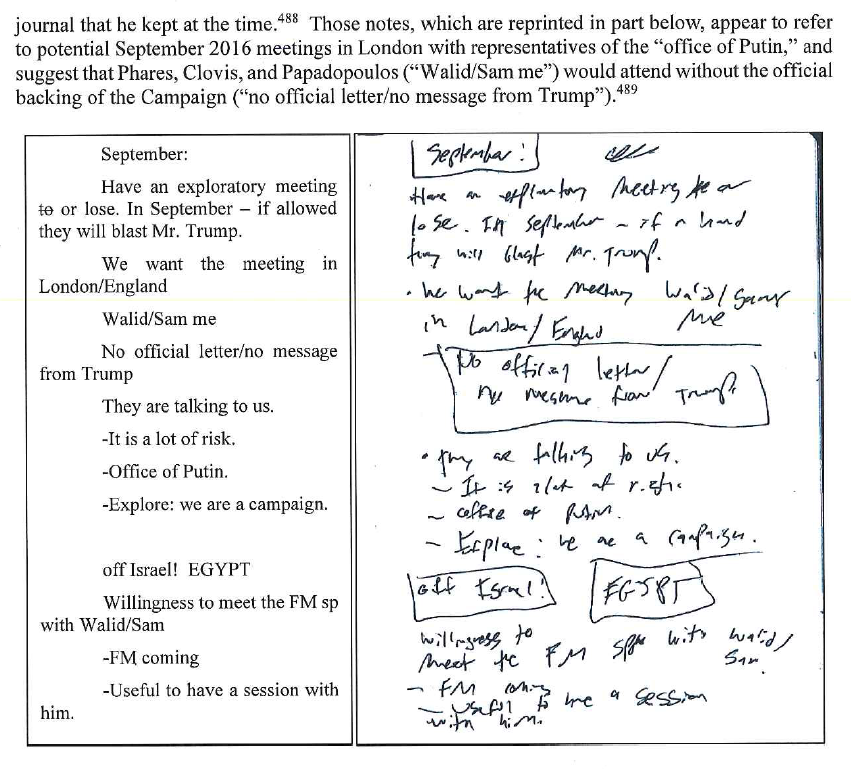
Similarly, Papadopoulos claims to remember stopping communicating with Mifsud in summer 2016.

Q When was the last time you remember communicating with Professor Misfud?

A Off the top of my memory I think it was the summer of 2016.

Q Do you remember why you stopped communicating with him?

A I can’t remember exactly, I just didn’t really think he was a man of real substance at some point.

Not only did he appear to still be communicating with him in 2017, but an October 1, 2016 Facebook message to Mifsud was among the things the FBI said Papadopoulos was trying to hide when he tried to delete his Facebook account the day after his second FBI interview.

The Facebook account that PAPADOPOULOS shut down the day after his interview with the FBI contained information about communications he had with Russian nationals and other foreign contacts during the Campaign, including communications that contradicted his statements to the FBI. More specifically, the following communications, among others, were contained in that Facebook account, which the FBI obtained through a judicially authorized search warrant.

[snip]

On or about October 1, 2016, PAPADOPOULOS sent [Mifsud] a private Facebook message with a link to an article from Interfax.com, a Russian news website. This evidence contradicts PAPADOPOULOS’s statement to the Agents when interviewed on or about January 27, 2017, that he had not been “messaging” with [Mifsud] during the campaign while “with Trump.”

In other words, at precisely the time he was interviewed by Halper, Papadopoulos was still in touch with Mifsud, and after being arrested for hiding that fact in 2017, he continued to obscure that detail when asked what his mindset was in 2016 when asked about it in 2018.

By all means, let’s see that transcript discussing what Papadopoulos thought amounted to treason. But I doubt it’s going to be exculpatory.

Finally, the craziest aspect of this game of chicken is how the Republicans on the committee repeatedly get him to reveal his beliefs about what happened to him actually come from press reporting on his case.

To explain his belief that Mifsud actually worked for Western intelligence, Papadopoulos cited Chuck Ross.

Papadopoulos continues to tell tales. When giving testimony to Congress, Papadopoulos cited a Daily Caller article to claim that Joseph Mifsud worked with Western intelligence. “I don’t want to espouse conspiracy theories because, you know, it’s horrifying to really think that they might be true, but just yesterday, there was a report in the Daily Caller from his own lawyer that he was working with the FBI when he approached me. And when he was working me, I guess — I don’t know if that’s a fact, and I’m not saying it’s a fact — I’m just relaying what the Daily Caller reported yesterday, with Chuck Ross, and it stated in a categorical fashion that Stephan Roh, who is Joseph Mifsud’s, I believe his President’s counsel, or PR person, said that Mifsud was never a Russian agent.

To explain his belief that there was a transcript of his conversations with Stefan Halper, he cites John Solomon.

And all of a sudden he pulls out his phone — remember, this phone element again — and he puts it in front of him and he begins to start talking about Russia and hacking and if I’m involved, if the campaign is involved, if it’s benefiting the campaign. Something along those lines. I’m sure the transcript exists and you’ve probably read it, so I don’t want to be wrong on exactly what he said. But —

Mr. Meadows. You say a transcript exists. A transcript exists of that conversation?

Mr. Papadopoulos. That’s I guess what John Solomon reported a couple days ago. Mr. Meadows. So are you aware of a transcript existing? I mean —

Mr. Papadopoulos. I wasn’t aware of a transcript existing personally.

And to explain his opinions about “Azra Turk” being a honey pot, he says he has no independent memory, but is relying on what the NYT reported (though I’m not sure which story).

She then apparently — I don’t remember it, I’m just reading The New York Times. She starts asking me about hacking. I don’t remember her actually asking me that, I just read it in The New York Times. Nevertheless, she introduces me the next time to Stefan Halper.

Mr. Meadows. She asked you about hacking?

Mr. Papadopoulos. I don’t remember it. I just — I think I read that particular —

Mr. Meadows. You’ve read that?

Mr. Papadopoulos. Yes, that’s what I — I think I read it in The New York Times.

Much of the current investigation into the investigation, then, stems from a hearing where:

  • Mark Meadows and other Republicans let Papadopoulos testify about what he read in the news, but not key details about his first hand knowledge of events
  • Papadopoulos’ inconsistent testimony replicated his past obstruction
  • Meadows let someone who should know less than Meadows himself does about FISA misrepresent how it works as testimony
  • Once again, FBI’s conservative approach with this investigation is instead cited as proof of spying

This is what has Attorney General in a lather right now: claims originating in this hearing.

As I disclosed last July, I provided information to the FBI on issues related to the Mueller investigation, so I’m going to include disclosure statements on Mueller investigation posts from here on out. I will include the disclosure whether or not the stuff I shared with the FBI pertains to the subject of the post. 

Share this entry

There’s a Discrepancy about When Papadopoulos Left the Trump Campaign

The other day I laid out what the campaign officially said about George Papadopoulos’ status on the campaign.

The Mueller Report — based off having a whole bunch of documentation — describes that Papadopoulos got dismissed after he wrote a column arguing against sanctions on Russia.

Papadopoulos was dismissed from the Trump Campaign in early October 2016, after an interview he gave to the Russian news agency InterFax generated adverse publicity.492

492 George Papadopoulos: Sanctions Have Done Little More Than to Turn Russia Towards China, Interfax (Sept. 30, 2016).

A recent profile reveals that Papadopoulos has been lying about the campaign response to his Interfax column (though I think this downplays the encouragement Papadopoulos got from Brian Lanza).

The book claims that Trump headquarters informed him of an interview request from Russian news service Interfax and gave him instructions about what to say, complimenting him afterward. In reality, Interfax contacted Papadopoulos directly, and though the campaign okayed the interview, the feedback afterward apparently wasn’t positive. Papadopoulos wrote to campaign official Michael Glassner to ask if he was, as others had told him, “off the campaign because of an interview I gave.”

Papadopoulos told HJC/OGR something different: He told them he never left the campaign.

Mr. Ratcliffe. How did you leave the campaign? First of all, when did you leave the campaign?

Mr. Papadopoulos. I don’t know if I ever really left the campaign. I think I was involved throughout the whole way in different ways. I mean, one — in one manner I’m helping edit the first foreign policy speech and I’m setting up, helping set up this meeting with the Egyptian President, and then I’m kind of just feeding information into the campaign from March until — all through the transition, quite frankly. So I don’t think I really ever left the campaign, if that makes sense.

Mr. Ratcliffe. Okay.

Mr. Papadopoulos. I was considering leaving, but I don’t think I ever submitted some sort of resignation to the campaign that would — that would suggest I would formally abdicate my duties on the campaign.

The claim he continued through the Transition doesn’t match other things he said in his testimony. But he might want to claim he never left because that gives Republicans a far greater stake into the investigation into him than they otherwise might. By the same token, Trump had an incentive to claim he was a “coffee boy.”

Papadopoulos was never paid, so in a sense, he could never really be dismissed (indeed, he claims he doesn’t have any more paperwork than some emails about when he started; he does seem to have expected he’d get paid, only to discover Trump doesn’t pay anyone. Since he got paid, the distinction here may be semantics. Except that it does significantly change the stakes for the Republican investigation into the investigation.

As I disclosed last July, I provided information to the FBI on issues related to the Mueller investigation, so I’m going to include disclosure statements on Mueller investigation posts from here on out. I will include the disclosure whether or not the stuff I shared with the FBI pertains to the subject of the post. 

Share this entry

Ted Stevens, The “Toobz”, And The Idiocy Of The Internet

Alright, this will be a fairly short post, but I would like to remind people of some things. Namely, regarding Ted Stevens. As background, Marcy wrote a serious, and important, post on the Trumps Organization’s curious, and semi-hilarious, use of Microsoft. And, yes, Marcy is right, it was amazingly stupid. From clackers whining that Hillary Clinton had insecure internet. If it was not so stupid, it would be extra laughable.

But I want to cut back to something different. In comments, Rayne Loled at Ted Stevens and, then, a relatively new commenter (like just today as far as I can tell), “CJ” chimed in with:

Bizarrely, it’s not an entirely bad metaphor, though that’s probably accidental on his part. See, e.g., Andrew Blum’s “Tubes: A Journey to the Center of the Internet”.

This is bunk. Blum, and his book, tried to make hay off of Stevens, and at his expense, but without giving him much of his due, nor acknowledging how the “tubes” of the internet falsely allowed the demonization of Stevens and cheerleader his prosecution. A prosecution that turned out to be false and craven. In a review in the New York Times in 2012, Dwight Garner noted:

Reading this, you wish Mr. Stevens, who died in an airplane crash in 2010, were here to savor it. “Inside those tubes (by and large) are glass fibers,” the author continues. “Inside those fibers is light. Encoded in that light is, increasingly, us.”

That is exactly right, although Blum never really went deeper into the fraud by the Department of Justice that took Ted Stevens down before his untimely demise by plane crash.

So, as a bit of retrospective:

Say what you will about Ted Stevens, and much of that may be fair. But what was done to him at the end was wrong and a travesty. And the DOJ could not even deal with that then. Much less the pervasive and consuming wrong that is at hand today with Bill Barr and the DOJ he now administers.

For anybody that does not remember just how egregious and blatant the government/DOJ action against Ted Stevens was, here is one of my takes from 2008, and yet another in followup, from 2012.

You can joke about Toobz Stevens, and we have here before, but what happened to him was a complete travesty of justice. And there are serious lessons from that to keep in mind today. Without the “toobz” of the internet, I am not sure the reckless and false case against Stevens could have ever made it as far as it did. There is great irony in that, and it is a lesson that ought remain remembered, not just joked about.

That was a different, and in popular lore, more benevolent and honest era. So, what do you think are the odds for far worse from Trump and Barr? Somewhere, Ted Stevens has an idea.

Share this entry

George Papadopoulos’ Changing Tune about Working for Trump

I want to point out a small discrepancy in George Papadopoulos’ story about his ties to Sergei Millian. The Mueller Report notes that, when Millian started pitching business deals to Papadopoulos the day after the election, he cooled when Papadopoulos said ht wasn’t really interested in working in the Administration. Remember: Millian was pitching Papadopoulos on an arrangement where he’d get monthly fees while working in the Administration.

The Office investigated another Russia-related contact with Papadopoulos. The Office was not fully able to explore the contact because the individual at issue-Sergei Millian-remained out of the country since the inception of our investigation and declined to meet with members of the Office despite our repeated efforts to obtain an interview. Papadopoulos first connected with Millian via Linkedln on July 15, 2016, shortly after Papadopoulos had attended the TAG Summit with Clovis.500 Millian, an American citizen who is a native of Belarus, introduced himself “as president of [the] New York-based Russian American Chamber of Commerce,” and claimed that through that position he had ” insider knowledge and direct access to the top hierarchy in Russian politics.”501 Papadopoulos asked Timofeev whether he had heard of Millian.502 Although Timofeev said no,503 Papadopoulos met Millian in New York City.504 The meetings took place on July 30 and August 1, 2016.505 Afterwards, Millian invited Papadopoulos to attend-and potentially speak at-two international energy conferences, including one that was to be held in Moscow in September 2016.506 Papadopoulos ultimately did not attend either conference.

On July 31 , 2016, following his first in-person meeting with Millian, Papadopoulos emailed Trump Campaign official Bo Denysyk to say that he had been contacted “by some leaders of Russian-American voters here in the US about their interest in voting for Mr. Trump,” and to ask whether he should “put you in touch with their group (US-Russia chamber of commerce).”507 Denysyk thanked Papadopoulos “for taking the initiative,” but asked him to “hold off with outreach to Russian-Americans” because “too many articles” had already portrayed the Campaign, then-campaign chairman Paul Manafort, and candidate Trump as “being pro-Russian.”508

On August 23, 2016, Millian sent a Facebook message to Papadopoulos promising that he would ” share with you a disruptive technology that might be instrumental in your political work for the campaign.”509 Papadopoulos claimed to have no recollection of this matter.510

On November 9, 2016, shortly after the election, Papadopoulos arranged to meet Millian in Chicago to discuss business opportunities, including potential work with Russian “billionaires who are not under sanctions.”511 The meeting took place on November 14, 2016, at the Trump Hotel and Tower in Chicago.512 According to Papadopoulos, the two men discussed partnering on business deals, but Papadopoulos perceived that Millian’s attitude toward him changed when Papadopoulos stated that he was only pursuing private-sector opportunities and was not interested in a job in the Administration.513 The two remained in contact, however, and had extended online discussions about possible business opportunities in Russia. 514 The two also arranged to meet at a Washington, D.C. bar when both attended Trump’s inauguration in late January 2017.515

500 7/15/16 Linkedln Message, Millian to Papadopoulos.

501 7 /15/16 Linkedln Message, Millian to Papadopoulos.

502 7/22/16 Facebook Message, Papadopoulos to Timofeev (7:40:23 p.m.); 7/26/16 Facebook Message, Papadopoulos to Timofeev (3:08:57 p.m.).

503 7/23/16 Facebook Message, Timofeev to Papadopoulos (4:31:37 a.m.); 7/26/16 Facebook Message, Timofeev to Papadopoulos (3:37: 16 p.m.).

504 7/16/16 Text Messages, Papadopoulos & Millian (7:55:43 p.m.).

505 7/30/16 Text Messages, Papadopoulos & Millian (5:38 & 6:05 p.m.); 7/31/16 Text Messages, Millian & Papadopoulos (3:48 & 4:18 p.m.); 8/ 1/16 Text Message, Millian to Papadopoulos (8:19 p.m.).

506 8/2/16 Text Messages, Millian & Papadopoulos (3 :04 & 3 :05 p.m.); 8/3/16 Facebook Messages, Papadopoulos & Millian (4:07:37 a.m. & 1:11:58 p.m.).

507 7/31/16 Email, Papadopoulos to Denysyk (12:29:59 p.m.).

508 7 /31/16 Email, Denysyk to Papadopoulos (21 :54:52).

509 8/23/16 Facebook Message, Millian to Papadopoulos (2:55:36 a.m.).

510 Papadopoulos 9/20/17 302, at 2.

511 11/10/16 Facebook Message, Millian to Papadopoulos (9:35:05 p.m.).

512 11/14/16 Facebook Message, Millian to Papadopoulos (1 :32: 11 a.m.).

513 Papadopoulos 9/19/17 302, at 19.

514 E.g., 11/29/16 Facebook Messages, Papadopoulos & Millian (5:09 – 5:11 p.m.); 12/7/16 Facebook Message, Millian to Papadopoulos (5:10:54 p.m.).

515 1/20/17 Facebook Messages, Papadopoulos & Millian (4:37-4:39 a.m.).

The FBI interview where he claimed he didn’t want to work in the Administration was the same one where Papadopoulos, “declined to assist in deciphering his notes, telling investigators that he could not read his own handwriting” from a journal entry showing plans to have a September 2016 meeting with Clovis, Phares, and Putin’s office in September 2016.

But in the sentencing memorandum submitted by his lawyers, Papadopoulos claimed that he had lied to preserve hopes of getting a job in the Administration.

Mr. Papadopoulos misled investigators to save his professional aspirations and preserve a perhaps misguided loyalty to his master.

[snip]

George explained that he was in discussions with senior Trump administration officials about a position and the last thing he wanted was “something like this” casting the administration in a bad light. The agents assured him that his cooperation would remain confidential.

[snip]

George lied about material facts central to the investigation. To generalize, the FBI was looking into Russian contacts with members of the Trump campaign as part of its larger investigation into Russian interference with the 2016 election. This issue had dominated the news for several months with stories concerning Carter Page and Paul Manafort. The agents placed this issue squarely on the table before George and he balked. In his hesitation, George lied, minimized, and omitted material facts. Out of loyalty to the new president and his desire to be part of the administration, he hoisted himself upon his own petard.

That’s not necessarily a conflict. Papadopoulos may have told Millian he didn’t want to work in the Administration just to deflect an offer that was obviously improper. But if that’s why he did it, it would reflect awareness on Papadopoulos’ part that something more than a job offer was on the table, in the same way that he reportedly told Stefan Halper that being involved in the hack-and-leak would amount to treason.

But the discrepancy is significant given that Papadopoulos accused the FBI of making a head fake in his interview by suggesting they wanted to interview him (only) about Millian but instead raising Joseph Mifsud as well.

On the morning of January 27, 2017, as George stepped out of the shower at his mother’s home in Chicago, two FBI agents knocked on the door seeking to interview him. The agents asked George to accompany them to their office to answer a “couple questions” regarding “a guy in New York that you might know[,] [t]hat has recently been in the news.” George thought the agents wanted to ask him about Russian businessman Sergei Millian. Wanting clarification, he asked the agents, “…just so I understand, I’m going there to answer questions about this person who I think you’re talking about.” The agents assured George that the topic of discussion was Mr. Millian who had been trending in the national media.

[snip]

Seemingly as promised, the agents began their questioning about George’s relationship with Sergei Millian. George knew Mr. Millian only as a businessman pitching an opportunity to George in his personal capacity. The agents asked how they first met, what they discussed, how often they talked or met in person, if George knew whether Mr. Millian was connected to Russia or a foreign intelligence service, and who else on Mr. Trump’s campaign may have been in contact with Mr. Millian. George answered their questions honestly.

Less than twenty minutes into the interview, the agents dropped the Millian inquiry and turned to recent news about Russian influence in the presidential election.

The Mueller Report suggests that Papadopoulos may not have even been honest about all this, given the comment that Papadopoulos did nothing when offered a “disruptive technology” that would help his work on the campaign.

But he does seem to have been willing to explain his relationship with Millian.

As I disclosed last July, I provided information to the FBI on issues related to the Mueller investigation, so I’m going to include disclosure statements on Mueller investigation posts from here on out. I will include the disclosure whether or not the stuff I shared with the FBI pertains to the subject of the post. 
Share this entry

The FBI Went to Microsoft, not Trump Organization, for Emails Incriminating Individual-1

I’m working on a post showing how slow the investigation into Donald Trump and his associates was, contrary to the President’s squeals. That led me to realize something about this August 1 search warrant application for Michael Cohen’s Trump Organization email.

Trump Organization used Microsoft to host their email.

54. On or about July 14,2017, the Federal Bureau of Investigation sent a request, pursuant to l8 U.S.C. $ 2703(f), to Microsoft, requesting that Microsoft preserve all content for all email accounts associated with the domain “trumporg.com,” which included the Target Account.

55. On or about July 20,2017 and again on or about July 25,2017,in response to a grand jury subpoena, Microsoft confirmed that the Target Account was an active account associated with the domain trumporg.com. Microsoft also provided records indicating that email accounts associated with the domain “trumporg.com” are being operated on a Microsoft Exchange server. According to publicly available information on Microsoft’s website, Microsoft hosts emails for clients on Microsoft Exchange servers, while allowing customers to use their own domain (as opposed to the publicly available email domains supplied by Microsoft, such as hotmail.com). According to information supplied by Microsoft, the domain trumporg.com continues to operate approximately 150 active email accounts through Microsoft Exchange, meaning that data associated with trumporg.com still exists on Microsoft’s servers.

[snip]

62. On or about June 21, 2017, the Federal Bureau of Investigation sent a request, pursuant to 18 U.S.C. $ 2703(f), to Microsoft, requesting that Microsoft preserve all content associated with the Target Account.

That means Microsoft — and not (just) Trump Organization — controlled access to these accounts.

This is something that has long been an unrecognized problem. If the government wants your email and your business or university has Microsoft or Gmail host email for them, the tech giants will get and respond to a law enforcement request, not the entity that might make privilege or First Amendment legal challenges to the subpoena. For example, the government would have gotten Xiaoxiang Xi and Ally Watkins’ Temple University email from Google, not the University, preventing both from making a First Amendment challenge to the warrant.

Microsoft sued over the sheer number of gags on such subpoenas in 2016; few people realized that they were concerned primarily about businesses like Trump Organization, not individual customers. That suit settled on October 24, 2017 after DOJ agreed to provide Microsoft more leeway to notice its customers.

But that agreement would have come too late for Michael Cohen and anyone else at Trump Organization who might have been investigated by DOJ. Since June 21, 2017, Cohen’s emails were preserved, and since July 14, 2017 — just after the June 9 meeting arranged via what appears to be Don Jr’s Trump Organization email became public — all Trump Organization emails have been preserved.

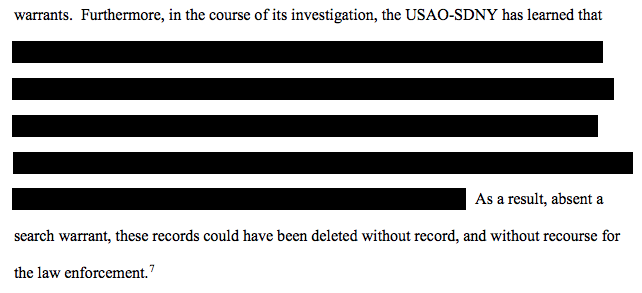
In DOJ’s opposition to Michael Cohen’s efforts to get a restraining order on the materials seized in the April 9, 2018 raid on him, there was a redacted reference suggesting that some materials may have gotten destroyed.

Mueller didn’t subpoena documents from Trump Organization directly until March 2018. So if they discovered documents via email searches direct from Microsoft that were withheld in that March subpoena — such as the emails that Cohen received on Trump Tower Moscow — it might explain this redaction.

This is the kind of thing that Trump might make a big stink about, if he ever figures it out (or if it gets Trump Organization lawyer Alan Garten in trouble for blowing off subpoenas — they were already non-responsive in response to the May HPSCI subpoena). But it’s the kind of thing that businesses and universities everywhere are exposed by.

As I disclosed last July, I provided information to the FBI on issues related to the Mueller investigation, so I’m going to include disclosure statements on Mueller investigation posts from here on out. I will include the disclosure whether or not the stuff I shared with the FBI pertains to the subject of the post. 
Share this entry

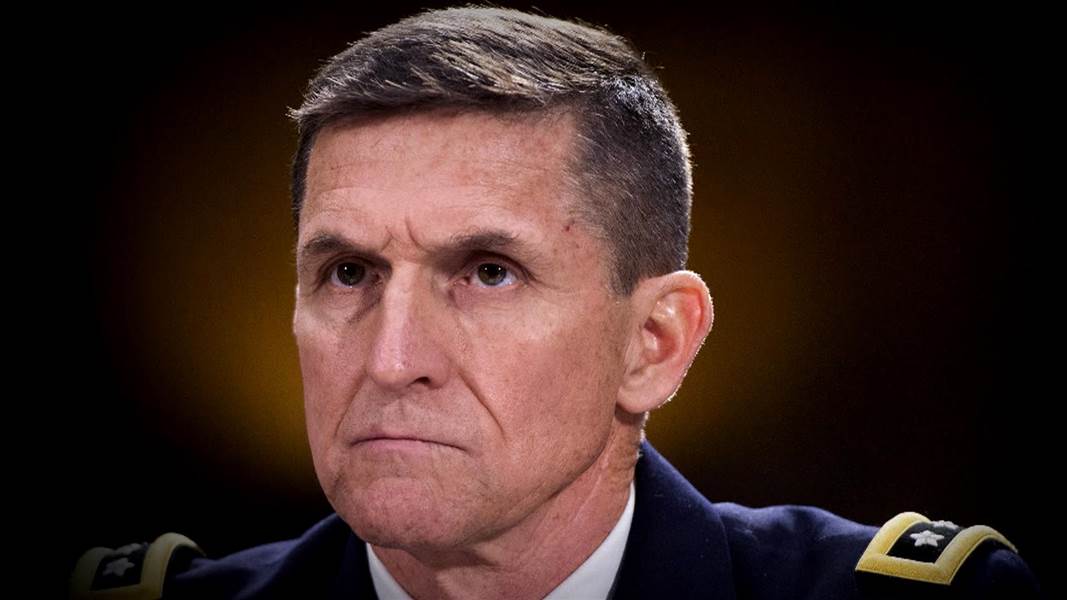
Mike Flynn Was Renting His Name to the Highest Bidder While Ostensibly Working for Trump

In this post, I noted that for three initial subjects of the FBI’s investigation into Trump associates’ ties with Russia — Paul Manafort, Carter Page, and George Papadopoulos — the campaign gave similar reasons for firing them as the Mueller Report laid out about their behavior.

The fourth initial subject of the investigation is Mike Flynn. The campaign did not fire Flynn for his ties to Russia; in fact, according to some Flynn associates, Trump directed him to reach out to Russia during the campaign.

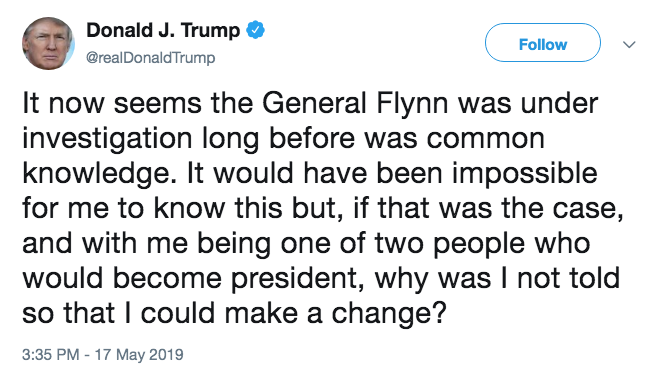
Nevertheless, last week, Trump complained that he hadn’t been informed that Flynn was under investigation earlier (presumably asking why he wasn’t given a defensive briefing that discussed the investigation into Flynn specifically).

Of course, as I mentioned, we know how Trump would have responded to a warning because we know how Trump responded to Obama’s warning about Flynn: he blew it off.

Still, that should in no way undermine the investigation into Flynn.

The Russian side of the investigation into Flynn, partly for his trip to Moscow where he sat with Vladimir Putin in December 2015, goes largely unmentioned in the Mueller Report, suggesting it may have become a counterintelligence investigation into Russia instead.

But we can review the Bijan Kian indictment — which is based significantly off Flynn’s cooperation — to see how sleazy Flynn was acting while ostensibly serving as one of Trump’s top advisors on the campaign trail.

After the failed coup attempt against Recep Tayyip Erdogan in July 2016 — around the same time Flynn was leading chants of “Lock her up” at the RNC — Erdogan was trying to persuade the American government to extradite Fethullah Gulen, using the coup as an excuse to crack down on a source of power that challenged his regime. After DOJ determined there was still no basis to extradite Gulen, Kian, Ekim Alptekin, and some high ranking Turkish officials reached out to Flynn’s consulting company. They asked what kind of spin Flynn and Kian could generate “on the short and mid-term,” but warned not to read anyone else in.

On July 30 — three months before the election — Kian and Flynn pitched a 3-month plan, again emphasizing the secrecy of the project. On August 2 — the same day Trump’s campaign manager got together with someone suspected of ties to Russian intelligence to talk about how to win Michigan and carve up Ukraine — Kian nudged Alptekin, again emphasizing the secrecy. On August 8, Alptekin approached the Turkish government.

This was also the period when Flynn started getting involved in an effort to find Hillary’s deleted emails from any possible source, including foreign intelligence services.

On August 11 — as the Turkish government grew closer to a deal and as Trump’s campaign manager started engaging in bigger and bigger lies to hide that he had been an Agent of Ukraine — Kian changed the name of the project, which had been “Truth” to “Project Confidence” and introduced Alptekin’s company, Inovo, as the funder as a cut-out t0 hide that Turkey was behind the plan. From that point forward, both Trump’s soon-t0-be-former campaign manager and one of his top national security advisors were engaged in subterfuge in an attempt to hide their work for foreign countries. In Flynn’s case, he was doing that work even as he campaigned for Trump.

On August 17, while negotiating a deal with the government of Turkey, Flynn accompanied Trump for his first intelligence briefing.

Flynn’s deal with Turkey was confirmed, with a 20% kickback to Alptekin for his company’s role as a cut-out, on August 25 and 26. When Kian put together the contract for the project on September 3, he set the start date two weeks after they really started it to hide that it was the same project for Turkey.

On September 8, Flynn would politicize the intelligence briefings he was attending with Trump while being paid by Turkey, claiming briefers indicated some policy differences with Obama.

“The intelligence we’ve received in the last two briefings were in stark contrast to the policy decisions being made,” Flynn said.

“They would say the intelligence professionals, as they should, they would say those are policy decisions,” Flynn continued. “So Donald Trump, in a very, very sophisticated way, was asking tough questions, and they would back off and say, ‘That is not our job, those are policy decisions at the—in this case the White House is making.’ And we would sit there and go, OK, we understand.”

Flynn, however, caught some controversy himself when NBC News reported on Thursday that Flynn was unruly in one of the briefings. The report stated that Trump’s transition chief, Chris Christie, had to calm Flynn down after he repeatedly interrupted intelligence officers with pointed questions.

On September 9, the first check arrived, $200,000, of which $40,000 went back to Alptekin as a kick-back.

On September 19, Flynn and his partners met with Turkish Foreign Minister Mevlut Cavusoglu and Turkish Energy Minister (and Erdogan son-in-law) Berat Albayrak in New York and discussed how to bring about Gulen’s extradition. James Woolsey, attending the meeting as an advisory board member with Flynn’s firm, described the meeting as “a covert step in the dead of night to whisk this guy away.” Woolsey declined his consulting fee after attending the meeting, in part out of legal concern, and let Joe Biden know about it via a mutual friend.

That was a week before the first Presidential debate.

On October 11, two days after the second presidential debate, the second check arrived, $185,000, with another $40,000 kicked back to Alptekin. Two days later, Flynn started reading from talking points scripted by Kian: funding, “Islamists,” and Mullahs.

On October 22, two days after the third debate, Flynn wrote members of the project team, referencing the Turkish officials who were the real customers for the project.

On November 2, days before Americans went to the polls, Flynn’s cut-out demanded more: private investigative work targeting Gulen’s supporters, congressional hearings on his schools. That same day, Kian sent Alptekin an op-ed he had drafted. Kian told Flynn the next day an editor was tightening it up before showing it to Flynn. November 4, Kian sent it to Alptekin, who loved it.

Flynn signed his name to Kian’s work and it was published in The Hill, blaming Gulen for the attempted coup, invoking “professionals in the intelligence community” viewing “the stamp of terror” in Gulen’s ideology, but the language was really written by Kian. The paid op-ed would go on to complain about Gulen’s “vast network of public relations” and his “false façade.”

On November 10, two days after Flynn’s op-ed and Trump’s victory and the day Obama warned Trump against picking Flynn to be his National Security Advisor, the third check came, another $200,000 to do the bidding of Turkey.

Even after the FARA office started nagging Flynn about registering, he stalled for the entire time he was in the White House, even while engaging Turkey and Russia in their joint peace plan for Syria. When he finally submitted his FARA filing on March 7, 2017, he falsely claimed he had written the op-ed as a public figure, not in the service of Turkey.

Trump may not have fired him. But both his wails that he should have been informed Flynn was under investigation (at a briefing Flynn attended) and that this investigation was in any way without predicate belie the sheer audacity with which Flynn sold his name to the highest bidder even while claiming to work for Trump.

As I disclosed last July, I provided information to the FBI on issues related to the Mueller investigation, so I’m going to include disclosure statements on Mueller investigation posts from here on out. I will include the disclosure whether or not the stuff I shared with the FBI pertains to the subject of the post. 
Share this entry

The Logic of Assange’s EDVA Indictment Is Inconsistent with Mueller’s Apparent Logic on Assange’s Declination

As Emma Best has noted, shortly before GRU targeted John Podesta in a spear-phishing attack, WikiLeaks offered a reward for Hillary’s speech transcripts like the excerpts that were released as part of the John Podesta release.

Hours before Russian hacking operations targeted Hillary Clinton’s campaign in the spring of 2016, WikiLeaks discussed offering a monetary reward for transcripts of her speeches at Goldman Sachs. Soon after, Russian hackers launched a spear phishing campaign that resulted in John Podesta’s email account being compromised. Emails containing excerpts from the speeches were included in the first day of the Podesta email releases. A week later, emails containing the transcripts themselves were released. WikiLeaks heralded these transcripts as their “holy grail.”

The story began on March 9, 2016, when WikiLeaks sent a tweet with a poll asking if they should add Hillary Clinton’s Goldman Sachs speeches to their ”Most Wanted” page for six figure rewards for materials. When the poll completed twenty four hours later, 93% of respondents said that WikiLeaks should offer a reward for the speeches. The Russian hackers at Fancy Bear may have been listening and been inspired by WikiLeaks’ comment. Unpublished targeting data collected by Secureworks shows the hacking campaign began earlier than the Mueller indictment reveals. A week and a half later, after dozens of attempts to penetrate the accounts of Podesta and other Clinton staffers and associates, Fancy Bear sent the phishing email that successfully tricked Podesta into compromising his account and the Goldman Sachs speeches along with it.

Secureworks’ unpublished breakdown of the Russian spear phishing and hacking effort, which AP described last year, shows that the campaign to penetrate the account began hours after WikiLeaks teased the possibility of offering a reward for the information. The tweet first mentioning the potential of a reward for the Goldman Sachs transcripts was sent at 8:16 P.M. Moscow time. At 11:56 AM the next day, less than sixteen hours later, Russian hackers began a campaign that would target “over 300 individuals affiliated with the Clinton Campaign, DCCC, and DNC.“ Podesta’s emails accounts were targeted in the days that followed and successfully compromised a week later, resulting in the exfiltration of nearly 60,000 emails.

Under what I’ve called Theory One of the superseding Julian Assange indictment, WikiLeaks’ publication of a wish list that was subsequently fulfilled would qualify it (or Julian Assange) for a conspiracy charge. Given what we’ve seen of Roger Stone’s actions, it might qualify him for a conspiracy charge as well (though we still don’t know via what means he contacted WikiLeaks).

But this 2.5 page redaction in the Mueller Report appears to explain why they didn’t charge WikiLeaks (and so by association, Stone) in that conspiracy.

We don’t know what that redaction says, though the unredacted footnote makes it clear that in the case of emails stolen from Hillary, DOJ determined that sharing of stolen property does not constitute a crime.

We do, however, have a sense of how the Attorney General understands this declination, because he used it to exonerate Trump, even in spite of Trump’s active role in pushing Roger Stone to optimize the WikiLeaks releases for the campaign. In one of his explanations for the WikiLeaks declination — one that may more directly allude to Stone’s involvement — Bill Barr said that publication of stolen emails would not be criminal “unless the publisher also participated in the underlying hacking conspiracy.”

The Special Counsel also investigated whether any member or affiliate of the Trump campaign encouraged or otherwise played a role in these dissemination efforts.  Under applicable law, publication of these types of materials would not be criminal unless the publisher also participated in the underlying hacking conspiracy.  Here too, the Special Counsel’s report did not find that any person associated with the Trump campaign illegally participated in the dissemination of the materials.

In the case of election interference, then, Barr does not consider the publication of documents identified on a wish list that hackers subsequently steal to amount to joining a conspiracy.

But in the case of Chelsea Manning’s leak, his DOJ does.

There’s obviously a distinction: John Podesta’s risotto recipes are not classified, whereas much of the stuff (but not all) Manning leaked was. But the role of a wish list is not functionally different, and Russian officers were charged both for hacking and dissemination.

I’m still working on a post describing how unbelievably stupid the EDVA case is, both for the press and for DOJ’s hopes to lay a precedent.

But at least at a structural level, the prosecution is also inconsistent with the decisions DOJ made about WikiLeaks on the election year operation.

As I disclosed last July, I provided information to the FBI on issues related to the Mueller investigation, so I’m going to include disclosure statements on Mueller investigation posts from here on out. I will include the disclosure whether or not the stuff I shared with the FBI pertains to the subject of the post. 
Share this entry

For Three of the Four Early FBI Subjects Tied to the Trump Campaign, the Campaign Agreed with the Mueller Report Conclusions

Of the first four people tied to Trump’s campaign who were investigated by the FBI — Carter Page, George Papadopoulos, and Paul Manafort — the Mueller Report came to remarkably similar conclusions as the campaign did when all three were fired in 2016. As I’ll show in a follow-up post, the FBI’s concerns about the fourth — Mike Flynn — have proven even better founded.

This shows how ridiculous it is for Bill Barr to go after the origins of the investigation. The Trump campaign itself, institutionally, agreed in real time with the conclusion of the investigation.

On August 19, 2016, Trump forced his campaign manager, Paul Manafort, to resign. Sources told the press he was ousted because of his “involvement with Russia” and the fact that “he hadn’t been entirely forthright about his activities overseas.”

In recent days, Manafort had lost the confidence of Jared Kushner, Trump’s son-in-law and one of his closest advisers, and other members of Trump’s family, according to a source close to the campaign. Kushner had once been a major backer of Manafort and was instrumental in his elevation — and the downfall of Corey Lewandowski, Trump’s former campaign manager.

The family was particularly troubled by reports of Manafort’s involvement with Russia and felt he hadn’t been entirely forthright about his activities overseas, the source said. Family members were also unhappy about changes made to the GOP platform that were seen as beneficial to Russia, which they felt Manafort played a role in, the source added.

On February 13, Judge Amy Berman Jackson ruled that Paul Manafort had lied — both to the FBI and to the grand jury — about his interactions and communications with Konstantin Kilimnik. Among the things Manafort lied about, according to the Mueller Report, was an August 2, 2016 meeting where Manafort told Kilimnik how the campaign planned to win Michigan and two other swing states, Kilimnik pitched Manafort on a plan to carve up Ukraine, and also told ways he could be paid by his Ukrainian and Russian paymasters. Mueller ultimately, “could not reliably determine Manafort’s purpose in sharing internal polling data with Kilimnik during the campaign period” and raised his lies to question whether he spoke to people on the campaign about the plan to carve up Ukraine.

In other words, the Trump family members who ousted Manafort came to precisely the same conclusion Mueller did: Manafort was lying about his suspicious ties to Russia.

On September 24, 2016, the Trump campaign severed all ties with unpaid foreign policy advisor Carter Page. The next day, Hope Hicks sent out an email instructing that, “Page was announced as an informal adviser in March. Since then he has had no role or official contact with the campaign. We have no knowledge of activities past or present and he now officially has been removed from all lists etc.”

It was untrue that the campaign had no knowledge of Page’s activities. After all, on July 9, 2016, he wrote Sam Clovis about his activities in Moscow.

Russian Deputy Prime minister and NES board member Arkady Dvorkovich also spoke before the event. In a private conversation, Dvorkovich expressed strong support for Mr. Trump and a desire to work together toward devising better solutions in response to the vast range of current international problems. Based on feedback from a diverse array of other sources close to the Presidential Administration, it was readily apparent that this sentiment is widely held at all levels of government.5

That said, even after surveilling Page for at least a year, the Mueller investigation likewise only gained limited understanding of Page’s activities. “Page’s activities in Russia–as described in his emails with the Campaign–were not fully explained.” And a redaction explaining why Page wasn’t charged as a foreign agent suggests it had been a close call.

In other words, Mueller came to the same conclusion that the Trump campaign did when they severed all ties with Page.

The Mueller Report is more circumspect about why George Papadopoulos got fired.

Papadopoulos was dismissed from the Trump Campaign in early October 2016, after an interview he gave to the Russian news agency Inter/ax generated adverse publicity.492

492 George Papadopoulos: Sanctions Have Done Little More Than to Turn Russia Towards China, Interfax (Sept. 30, 2016).

But a recent profile reveals that Papadopoulos has been lying about the campaign response to his Interfax column.

The book claims that Trump headquarters informed him of an interview request from Russian news service Interfax and gave him instructions about what to say, complimenting him afterward. In reality, Interfax contacted Papadopoulos directly, and though the campaign okayed the interview, the feedback afterward apparently wasn’t positive. Papadopoulos wrote to campaign official Michael Glassner to ask if he was, as others had told him, “off the campaign because of an interview I gave.”

This is the column that Papadopoulos shared with Joseph Mifsud (though that is not discussed in the report), and then lied about to the FBI.

On or about October 1, 2016, PAPADOPOULOS sent Foreign Contact 1 a private Facebook message with a link to an article from Interfax.com, a Russian news website. This evidence contradicts PAPADOPOULOS’s statement to the Agents when interviewed on or about January 27, 2017, that he had not been “messaging” with Foreign Contact 1 during the campaign while “with  Trump.”

It’s unclear whether the campaign distanced itself from Papadopoulos because of the press coverage of this article or because of what he said (an earlier WaPo report on it reveals how enthusiastic the pre-approval for it was, including the promise that Trump would work with Russia on Syria). If they fired him because he misrepresented the campaign’s friendliness with Russia, then it would support the Mueller Report’s conclusion that there was evidence to investigate but not to charge.

In particular, the Office did not find evidence likely to prove beyond a reasonable doubt that Campaign officials such as Paul Manafort, George Papadopoulos, and Carter Page acted as agents of the Russian government-or at its direction, control, or request-during the relevant time period. 1282

If the campaign fired Papadopoulos because he said things that were inconvenient, it would support the worth of his obstruction charge, which he of course pled guilty to.

Given the seriousness of the lies and omissions and their effect on the FBI’s investigation, the Office charged Papadopoulos with making false statements to the FBI, in violation of 18 U.S.C. § 1001. Information, United States v. George Papadopoulos, No. l:17-cr-182 (D.D.C. Oct. 3, 2017), Doc. 8. On October 7, 2017, Papadopoulos pleaded guilty to that charge pursuant to a plea agreement.

In either case, the campaign didn’t want to be associated with Papadopoulos’ pro-Russian public comments.

Update, 5/27/19: Papadopoulos actually told HJC/OGR that he never left the campaign.

Mr. Ratcliffe. How did you leave the campaign? First of all, when did you leave the campaign?

Mr. Papadopoulos. I don’t know if I ever really left the campaign. I think I was involved throughout the whole way in different ways. I mean, one — in one manner I’m helping edit the first foreign policy speech and I’m setting up, helping set up this meeting with the Egyptian President, and then I’m kind of just feeding information into the campaign from March until — all through the transition, quite frankly. So I don’t think I really ever left the campaign, if that makes sense.

Mr. Ratcliffe. Okay.

Mr. Papadopoulos. I was considering leaving, but I don’t think I ever submitted some sort of resignation to the campaign that would — that would suggest I would formally abdicate my duties on the campaign.

The Attorney General is carrying out an unprecedented investigation into a counterintelligence investigation targeting the suspected infiltration of a campaign by men working on behalf of Russia. In real time, the campaign acted to distance itself from all three men for precisely that reason.

In other words, Bill Barr is targeting the intelligence agencies for agreeing with the Trump campaign about the suspect ties of three of the initially predicated subjects of the investigation.

As I disclosed last July, I provided information to the FBI on issues related to the Mueller investigation, so I’m going to include disclosure statements on Mueller investigation posts from here on out. I will include the disclosure whether or not the stuff I shared with the FBI pertains to the subject of the post. 
Share this entry