It Doesn’t Matter for Prosecutors’ Case that Randy Credico Was Bragging or (Purportedly) Drunk

Some reporters appear to be getting their understanding of the Roger Stone trial from Stone’s defense attorneys rather than from actually reading the indictment and the trial exhibits, because they report as truth that it will harm prosecutors’ case if Credico can be shown to be drunk or bragging when he suggested to Stone he had ties to Julian Assange. Here’s the NYT:

Complicating the prosecution’s case, both men appear to have repeatedly lied to and about each other. And both appear to have exaggerated their connections with WikiLeaks, either privately or publicly.

Mr. Credico testified that many of his claims regarding WikiLeaks amounted to “braggadocio” and that he repeatedly overstated his access to Mr. Assange partly as a way to “one-up” Mr. Stone.

While it is true that Stone’s lawyers are arguing that poor little Roger with the Nixon-tattoo Stone got lied to by both Credico and Jerome Corsi, that defense doesn’t actually exonerate Stone of the charges against him (which is noteworthy in and of itself). Stone is not accused of having a back channel to WikiLeaks, which claims about Credico’s credibility might undermine; he’s accused of lying about his claims about having one and who that is. Most notably, Stone is accused of lying about how he communicated with his claimed back channel(s), and no attacks on Credico can make the abundant correspondence between Stone and Credico disappear.

Consider the evidence presented to prove that Stone lied just last week, on top of what was already referenced in the indictment (which I laid out here).

1. STONE testified falsely that he did not have emails with third parties about Assange, and that he did not have any documents, emails, or text messages that refer to Assange.

In addition to having Credico and Steve Bannon introduce their own emails (and texts in the case of Credico) that mention Assange, FBI Agent Michelle Taylor introduced the Erik Prince texts described in the indictment that reference Assange (and confirm that those texts were with Prince), as well as an October 3, 2016 Stone email to Prince stating that he, “Spoke to my friend in London last night. The payload is still coming.”

2. STONE testified falsely that his August 2016 references to being in contact with the head of WikiLeaks were references to communications with a single “go-between,” “mutual friend,” and “intermediary,” who STONE identified as Credico.

As noted, the only evidence that Credico and Stone spoke about Assange post-dates the days in early August when Stone claimed to have an intermediary. Multiple comms from Credico show him pointing that out to Stone over and over and over (once even before the election and more explicitly in early 2017): he couldn’t be Stone’s intermediary because all their discussions of Assange post-date Stone’s claims to having an intermediary. Indeed, Credico and Stone even spoke about Stone’s intermediary when Stone appeared on Credico’s show on August 23, 2016.

To disprove that Credico could not be his intermediary, Stone would need to introduce evidence he and Credico talked about WikiLeaks before that. All Stone offered to disprove that were some Credico tweets from 2016 dated June 17, July 22, and July 24, none of which were addressed to Stone and only the first of which addresses upcoming email drops.

In addition, the government introduced communications that make it clear Stone was aware of Corsi’s import before he testified. For example, on March 24, 2017, Stone sent Corsi and Gloria Borger his attorneys’ letter to HPSCI stating he was “anxious to redress the false and misleading way he has been portrayed by some on the Permanent Select Committee.” That letter got sent one day after Corsi had posted the cover story he and Stone started working on the previous year.

Further, one of the most damning exhibits introduced last week shows that on October 19, 2017, Stone forwarded Credico an email from his attorney, Grant Smith, with the subject line “Credico Paragraph.” The email purported to share the paragraphs in an October 13, 2017 letter to HPSCI naming Credico as Stone’s source. But the version Smith sent to Stone which got forwarded to Credico materially differs from the one sent to HPSCI, in part by offering a half paragraph of complimentary language on Stone’s relationship with Credico that wasn’t actually included in the letter to HPSCI.

But it also includes this paragraph:

Mr. Stone noticed Credico had traveled to London on at least two occasions and conducted two landmark interviews with Julian Assange on WBAI. To be absolutely clear, Credico was only asked to confirm for Mr. Stone that the postings and interviews by Assange in which he claimed to have the Clinton data ,both of June 21 [sic], were accurate. Mr. Credico never said he knew or had any information as to source or content of the material. Mr. Credico never said he had confirmed this information with Mr. Assange himself. Mr. Stone knew Credico had his own sources within WikiLeaks and is credible. Mr. Stone concedes that describing Credico as a go-between or intermediary is a bit of salesmanship for his InfoWars audience but the confirmation by Credico turned out to be 100 % accurate. [emphasis original]

The unitaliczed text does show up in a form in Stone’s letter, albeit phrased in a way to downplay any potential request from Stone. But the italicized language does not show up in Stone’s letter. It’s effectively a script for Credico, one that might placate Credico’s concerns about Stone overstating his knowledge, but one that was false on its face.

3. STONE testified falsely that he did not ask the person he referred to as his “go-between,” “mutual friend,” and “intermediary,” to communicate anything to the head of Organization 1 and did not ask the intermediary to do anything on STONE’s behalf.

As I noted in this post, there are emails showing Stone requested both Corsi and Credico do things with regards to Assange. Two emails introduced last week prove that Stone knew he had such emails. On April 3, 2018, Stone’s lawyer Grant Smith wrote Stone cc’ing Corsi stating, “At Roger’s request, I attach the only 2 emails on the subject between the two of you.” That wasn’t true: An August 15, 2016 Corsi email stating, “More to come than anyone realizes,” is almost certainly also a reference to stolen emails.

Tellingly, the very next day, April 4, 2018, Stone sent Credico an email saying, “Everything I know about the WikiLeaks disclosures I heard from you and can prove it.”

More damning still, on March 10, 2018, Stone forwarded Credico the thread of emails, dating from September 2016, in which he requested that Credico ask Assange if he had emails on Libya. The thread includes Credico claiming, “I asked one of [Assange’s] lawyers,” a reference to Margaret Ratner Kunstler. Stone sent it as a threat — and indeed, his threats to attack Kunstler were probably among the most effective Stone used with Credico, per Credico’s testimony. But by sending it (this time not even involving his lawyers), Stone proved that he knew of the request he made of Credico in September 2016, and knew he had communications reflecting the request.

4. STONE testified falsely that he and the person he referred to as his “go-between,” “mutual friend,” and “intermediary” did not communicate via text message or email about WikiLeaks.

As the above shows, Stone not only did communicate extensively with Credico — his claimed intermediary — via text and email, but he was aware of it. Likewise, he was aware that he had communicated via email, the intermediary the government suggests he was trying to hide, with Corsi.

5. STONE testified falsely that he had never discussed his conversations with the person he referred to as his “go-between,” “mutual friend,” and “intermediary” with anyone involved in the Trump Campaign.

Ultimately, the government argues that this trial is going to be about Stone trying to hide how damning all this is for Trump, and it’s in Stone’s communications with the campaign that are most damning. Stone already proved he knew of the Bannon email introduced at trial last week when he shared it after Bannon went to the NYT. Much of the rest of the proof of this will show up in this week’s testimony, not least from Rick Gates.

Which is why Stone’s current defense story is so interesting: because it highlights that Stone continues to lie to cover up the Trump campaign’s knowledge of all this. By suggesting that Stone believed Corsi was also an intermediary for him, Stone’s lawyers are basically pleading guilty to several of the false statements charges against Stone — lies 1 through 4 as numbered here — as part of his defense! Effectively, this is not a defense to the charges against Stone. It is, instead, a new lie, meant to deny what he did not in his HPSCI testimony, that he had an intermediary, as a retreat position on his larger lie, that Trump didn’t know about any of this.

That Stone is still obstructing that fact is made all the more clear by two other exhibits introduced last week.

First, the government introduced the letter by which Stone cleaned up his lie denying speaking to any Russians. On June 15, 2018, after Michael Caputo described his testimony with Mueller’s team, Stone’s lawyer, Grant Smith, sent a letter to Devin Nunes admitting he and Stone entertained Henry Greenberg’s (whom Caputo correctly introduced to him as a Russian) offer of dirt on Hillary, only to say Stone and Trump wouldn’t spend money for such things.

Smith sent another letter on December 20, 2018, in which he asserted that, “Mr. Stone’s testimony provided during the interview was forthcoming, truthful, and wholly consistent with his many detailed public statements on the matters being investigated.” In other words, as recently as December of last year, Smith reaffirmed that Stone’s claims to have one intermediary who was Credico remained the operative story.

Given that Stone cleaned up the Greenberg story, it raises real questions why, at a time when Stone knew people had testified against him and after months during which emails proving Stone’s lies about having communications about Assange were lies had been aired publicly, Stone didn’t clean up his intermediary story in the December letter by saying what his attorneys are now arguing in court, that an epic rat-fucker was duped by a comedian and a hoaxster. That would have saved him a year of legal fees and a significantly diminished ability to work.

But it would have served to acknowledge that Corsi was an interlocutor before Robert Mueller closed up shop.

Update, 2/17/20: Fixed date on Credico email.

As I disclosed last year, I provided information to the FBI on issues related to the Mueller investigation, so I’m going to include disclosure statements on Mueller investigation posts from here on out. I will include the disclosure whether or not the stuff I shared with the FBI pertains to the subject of the post. 

Share this entry

Why Won’t Sean Hannity Defend Trump against Impeachment Under Oath?

Yesterday, the Republicans released their list of requested witnesses for the public impeachment hearings this week. The list includes:

  • Devon Archer, Hunter Biden’s business partner
  • Hunter Biden
  • Alexandrea Chalupa, the DNC consultant who conducted oppo research on Manafort [corrected] via non-official sources
  • Undersecretary of State David Hale, who gave a private deposition the details of which have not yet leaked
  • Tim Morrison, the NSC staffer who was on the Trump call but has said (in part because saying anything else would implicate him criminally) nothing he heard was a problem
  • Nellie Ohr, whom Nunes falsely accuses of assisting with the Steele dossier, but who collected oppo research on Trump based off leads which were in turn based off open source research
  • Kurt Volker
  • The whistleblower
  • The whistleblower’s sources

I’m amuses me they think Volker will help them, as it reflects their inability to process information as it has come in. In his testimony, Volker made a concerted effort to spin what happened in the least damaging way for Trump. He based much of that defense on the then-operative understanding that Trump had never mentioned Burisma in his conversation with Volodymyr Zelensky, thereby suggesting that that improper request never got beyond Rudy Giuliani to the President. But we now know that Trump did explicitly invoke Burisma in the call, but that it got redacted out by John Eisenberg and others. That is, precisely the detail that Volker used to exonerate the President has now been overtaken by events. Volker will likely spend part of his public testimony backtracking off the stances Republicans believe help the President.

While I assume Schiff will accept the request to call witnesses he himself has asked for depositions, Schiff has already ruled out calling Hunter Biden or the whistleblower.

Still, the most telling part of this list is that the most loyal defender of the President, Sean Hannity, is not on it.

It is now clear that Hannity is a key player in this information operation (unsurprisingly, given what we know about his efforts to coordinate Paul Manafort’s defense). Unlike John Solomon, Hannity’s personal implication in the slimy nest of legal conflicts that the President calls legal representation seem to have ended when Michael Cohen got busted. Unlike Rudy, Hannity’s status as a journalist should protect him from legal liability.

So there’s no reason — besides the fact he’d be under oath — why he shouldn’t be willing to testify about the several key events he played a part in.

For example, Marie Yovanovitch testified that she understands during a period when Hannity was attacking her personally, someone close to Mike Pompeo called Hannity and asked him to either substantiate the charges or stop.

THE CHAIRMAN: And did you ever find out when, you know, the allegations were being made or the attacks were being made by Donald Trump, )r., or Rudy Giuliani, did you ever find out what the Secretary of State’s position, whether the Secretary of State was going to defend you or not, apart from the refusal by the Secretary to issue a statement in your defense?

MS. YOVANOVITCH: What I was told by Phil Reeker was that the Secretary or perhaps somebody around hjm was going to place a call to Mr. Hannity on FOX News to say, you know, what is going on? I mean, do you have proof of these kinds of allegations or not? And if you have proof, you know, telI me, and if not, stop. And I understand that that call was made. I don’t know whether it was the Secretary or somebody else in his inner circle. And for a time, you know, things kind of simmered down.

THE CHAIRMAN: I mean, does that seem extraordinary to you that the Secretary of State or some other high-ranking official would call a talk show host to figure out whether you should be retained as ambassador?

MS . YOVANOVITCH: Wet 1 , I ‘m not sure that’ s exactly what was being asked.

THE CHAIRMAN: Well , they were aski ng i f what basi s they was Hannity one of the people criticizing you?

MS. Y0VANOVITCH: Yes. THE CHAIRMAN: 5o some top administration official was going to him to find out what the basis of this FOX host was attacking you tor?

YOVANOVITCH: Uh- huh.

THE CHAIRMAN: And did you ever get any readout on what the result of that conversation was?

MS. YOVANOVITCH: No, I didn’t, although I was told that it did take place.

Then later in the same deposition, Yovanovitch described how, in an appearance on Hannity’s show, the President pivoted from a question about Russia to focus on Ukraine, which the Ambassador thought might also be targeted at her.

[Dan Goldman] Are you also aware that on the night of April 25th that President Trump went on Sean Hannity’s show and discussed Ukraine?

A Yes. He was asked a question about Russia and he answered by responding about Ukraine.

Q And what was your reaction to that?

A Well, you know, I mean, I was concerned about what this would all mean.

Q In what way?

A Well, obviously, for me personally, not to make it all about me, but for me personally. But also, what does this mean for our policy? Where are we going?

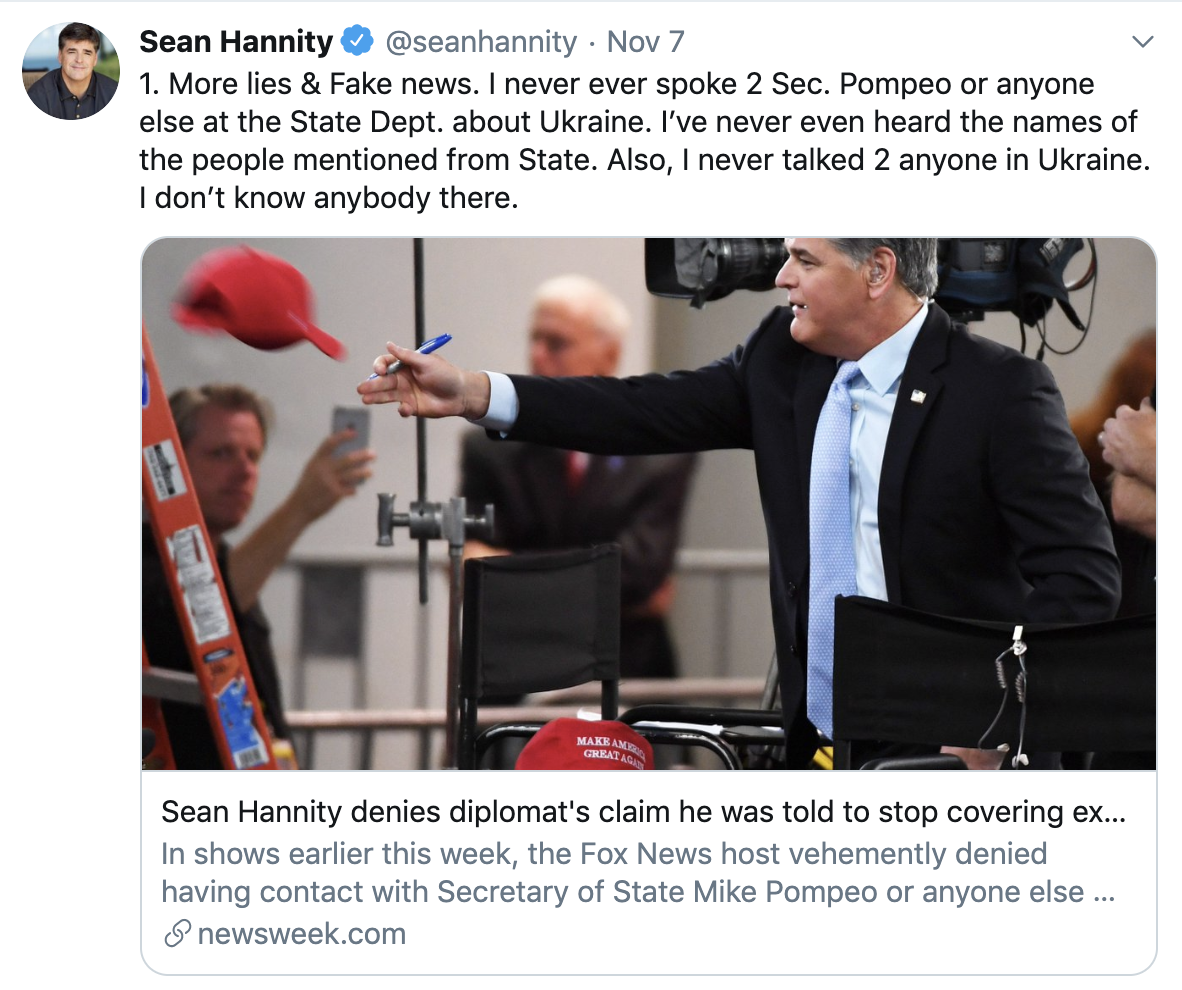
In response, Hannity issued two angry denials on Twitter, not under oath, then linked to a (!!!) now debunked John Solomon piece, as if that did anything but confirm he was part of an information operation.

If Hannity wants to clear his name, surely he’s willing to do so under oath? While there, he can also explain why he keeps bringing Solomon, Joe DiGenova, and Victoria Toensing on his show, and why he doesn’t disclose that the latter two are working for mobbed up Ukrainian oligarch Dmitry Firtash.

Hannity has repeatedly hosted Joseph diGenova and Victoria Toensing, lawyers for Ukrainian oligarch Dmitry Firtash.

According to a Media Matters database, diGenova has appeared on Hannity’s show at least 37 times in 2018 and 2019. His partner Toensing has appeared on Hannity’s show at least 20 times during the same period.

Additionally, Hannity has hosted conservative writer John Solomon over 100 times in 2018 and 2019. Solomon, now a Fox News contributor, is also a client of Toensing and diGenova, and he coordinated with personal Trump lawyer Rudy Giuliani to inject his Ukraine disinformation into the media.

More importantly, when testifying under oath before the impeachment inquiry, Hannity can explain why Rudy’s Ukrainian grifters, Lev Parnas and Igor Fruman, were setting up an interview between him and Ukrainian prosecutor Viktor Shokin in Vienna, where Firtash has been bankrolling this entire influence operation.

While questions in Washington swirl around Shokin’s role in this controversy, Giuliani, Parnas, Fruman had specific plans for the former Ukrainian official up until the day of their arrest. According to those four sources, they told others they were headed to Vienna to help with a planned interview the next day: Shokin, they said, was scheduled to do an interview from the Austrian capital with Sean Hannity.

Through a spokesperson, Hannity said that “we never reveal our sources, potential sources, or persons they may or may not request to interview. Sean Hannity takes the first amendment seriously.”

He might even be able to explain whether, in Attorney General Barr’s visit to Rupert Murdoch’s home the night the grifters got arrested trying to flee the country (and so the night before Hannity was supposed to interview Shokin), he tipped off Hannity not to get on any planes?

Sean Hannity is a far more central fact witness on events associated with the impeachment than Biden, Archer, Chalupa, or Ohr. He’s one of Trump’s most loyal fans, so if there’s a defense of the President to be made, surely he’s willing to make it … under oath.

And yet, either Republicans aren’t willing to risk Hannity’s reputation, or Hannity is unwilling to repeat his claims denying involvement under oath.

Share this entry

Rick Gates Got Sent Two Key Jerome Corsi Posts

Last year, as Mueller was managing the failed Jerome Corsi cooperation deal, I did a series of posts suggesting that Corsi and Stone seemed to have gotten advanced information about the John Podesta email dump. I argued that, in part, because the two started crafting an elaborate Matryoshka cover-up by the end of August to excuse away Stone’s “time in the barrel tweet.” More importantly, Corsi wrote a piece picking up what the two men had been plotting in August on October 6, seemingly anticipating John Podesta documents that would only be dumped on October 11. In other words, Corsi and Stone seemed to know by mid-August what WikiLeaks would drop in October.

I posted the first of those posts on October 22.

Three days later, Mueller’s team interviewed Rick Gates (PDF 39). According to the headings in the interview, which were dates, the interview traced the key milestones of the WikiLeaks dump:

  • June 12, 2016 to July 22, 2016
  • Post July 22, 2016 WikiLeaks Releases
  • October 4, 2016
  • October 7, 2016
  • [Redacted]

Much of the content below that last redacted heading is redacted, but it’s clear the section as a whole relates to the two Corsi pieces that bookend my theory that he and Stone got the files ahead of time.

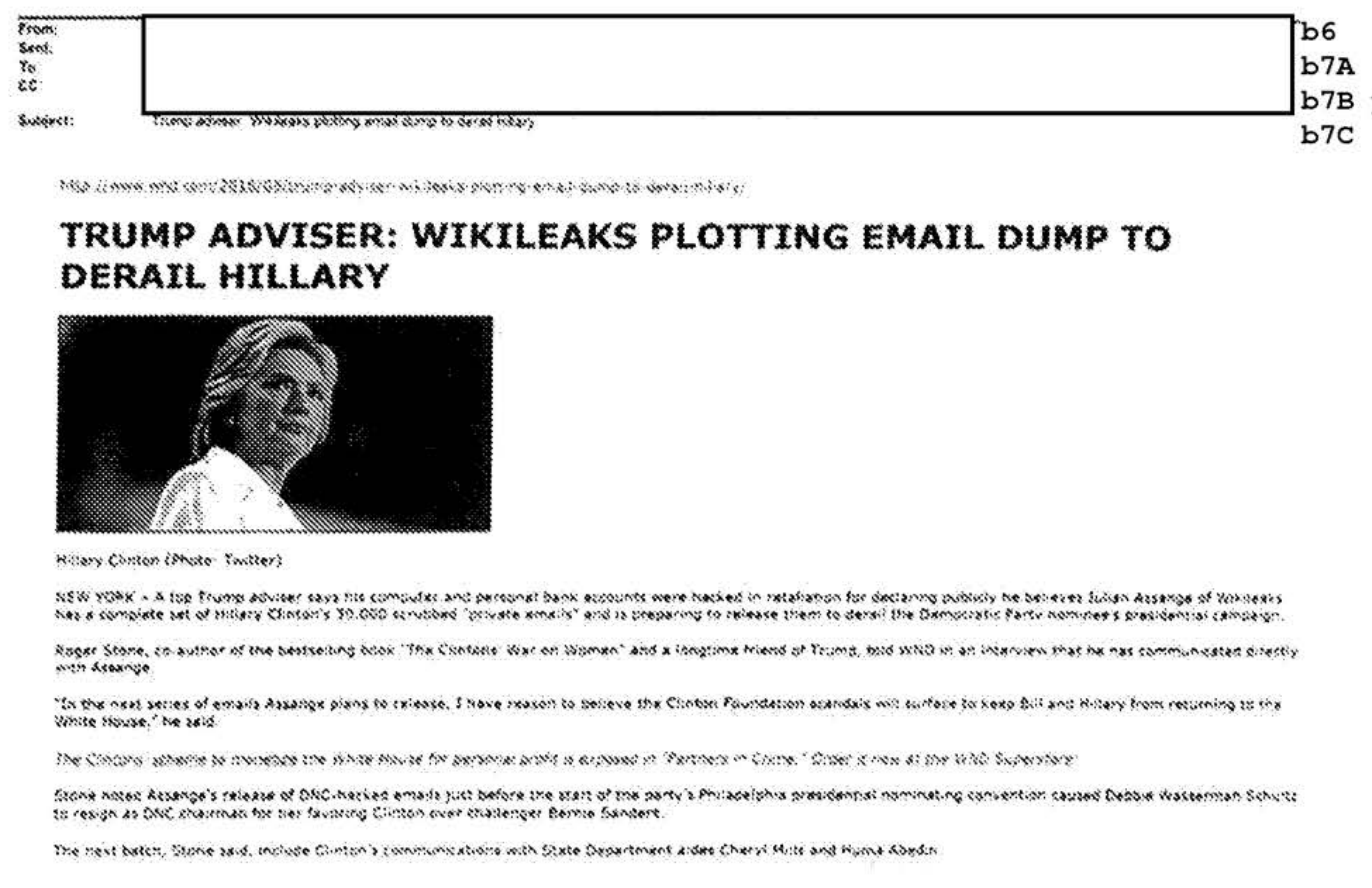
** Gates was shown an email [redacted] containing the subject line “Trump adviser: WikiLeaks plotting email dump to derail Hillary” **

Gates did not recall receiving the aforementioned email.

[redacted]

** Gates was shown an email [redacted] containing the subject line “Russia? Look who’s really in bed with Moscow — Podesta & Clinton Foundation money-laundering with Russia” **

[redacted]

The FOIAed backup for this interview includes the emails by which the articles were sent.

They obscure the date that the first one was sent, though it was posted on August 15; the second, which Corsi published on October 6, got sent 15 hours later, so just before mid-day on October 7. (Steve Bannon’s assistant Alexandra Preate sent Stone a text at 6:30PM telling him “Well done,” presumably for the actual WikiLeaks releases).

But it sure seems like the campaign was in the loop on some of this.

I’m fairly certain none of this will be aired at the Stone trial. The government doesn’t even plan to enter Stone’s “time in a barrel” tweet into evidence and there’s nothing in the draft exhibit list that looks like it could be these emails. Plus, much of their case seems designed not to have to rely on Corsi.

But it sure seems to have been of interest last year.

Share this entry

Three Questions Not Asked of Steve Bannon

The Roger Stone trial is done for the week, with Randy Credico getting through his testimony (though probably without substantiating the witness tampering charge tied to him), with Margaret Kunstler confirming that Credico had never provided information from Assange to Stone through her, and with a very short appearance from Steve Bannon.

Bannon’s appearance was most interesting, in my opinion, for what he wasn’t asked. Here’s CNN’s coverage.

Prosecutor Michael Marando asked Bannon what he made of Stone’s August 18 email — introduced in Aaron Zelinsky’s opening — telling Bannon, ““I do know how to win this but it ain’t pretty.” Bannon responded by calling Stone some lame euphemism for “rat-fucker,” and observed that Stone is highly experienced in such things. But Bannon was not asked whether there was any follow-up to the email. That’s particularly interesting given the possibility that it pertains to another investigation, albeit one not related to the core Russian issues.

As expected, Marando asked Bannon about his emails to Roger Stone on October 4, 2016.

Tuesday, October 4, 2016
FROM: Steve Bannon
TO: Roger Stone
EMAIL:

What was that this morning???

Tuesday, October 4, 2016
FROM: Roger Stone
TO: Steve Bannon
EMAIL:
Fear. Serious security concern. He thinks they are going to kill him and the London police are standing done.

However —a load every week going forward.

Roger stone

Tuesday, October 4, 2016
FROM: Steve Bannon
TO: Roger Stone
EMAIL:

He didn’t cut deal w/ clintons???

Marando used Bannon’s request to Stone as a way to premise that Bannon believed that Stone was the campaign point person on any outreach to WikiLeaks.

But Bannon wasn’t asked about the last email in that thread, which asked Bannon to tell Rebecca Mercer to send him some money. That’s significant, because the government wants to show that Stone lied to HPSCI about discussing his dark money shenanigans with the campaign (but that he cleaned that lie up). Since that exchange amounts to Stone telling Trump’s campaign manager what he was up to, I had thought Bannon might be asked to elaborate on that. He was not.

Finally, Bannon was not asked about his response to an email Paul Manafort sent to Jared Kushner and David Bossie on November 5, 2016 about how to “secure the victory.”

Later, in a November 5, 2016 email to Kushner entitled “Securing the Victory,” Manafort stated that he was “really feeling good about our prospects on Tuesday and focusing on preserving the victory,” and that he was concerned the Clinton Campaign would respond to a loss by “mov[ing] immediately to discredit the [Trump] victory and claim voter fraud and cyber-fraud, including the claim that the Russians have hacked into the voting machines and tampered with the results.”

Bannon responded to that email by saying, (PDF 258)

We need to avoid this guy like the plague

They are going to try and say the Russian worked with wiki leaks to give this victory to us

Paul is nice guy but can’t let word out he is advising us

Of course, this is the Roger Stone trial, not any of Paul Manafort’s multiple trials. So it’s unsurprising that this didn’t come up. But, particularly given the way it reflected a tie between Russia, WikiLeaks, and Manafort, it might have.

Especially given that, when Bannon was asked about this on a February 14, 2018, he appears to have invoked Stone in his not entirely truthful answer.

Candidate Trump never said to Bannon that he was in contact with [5 letter name redacted for ongoing proceeding] or Manafort. Bannon knew they were going to win, and in this email he wanted to avoid Manafort because Bannon believed that if people could link them to Manafort, they could then try to link them to Russia.

That redacted name could not be Gates, the other 5-letter name associated with Manafort, because he remained on the campaign after Manafort left. And the FOIA exemption is most consistent with a Stone redaction.

In other words, a month after Bannon had the exchange about WikiLeaks with Roger Stone that did show up in the trial, he tied Stone, Manafort, WikiLeaks, and Russia together in his mind.

None of this (besides, I guess, the lack of follow-up on the August 18 email) is particularly surprising. But it is notable that Bannon wasn’t asked about a range of tangential issues, even issues that will be aired in different ways at the trial.

Share this entry

The Cognitive Dissonance of Learning about Roger Stone’s “Collusion”

On March 27, just days after Bill Barr issued his “summary” of the Mueller Report but well before the Report got released publicly, I wrote a post laying out how Barr obviously understated the complicity of Trump and his flunkies. I noted how he focused exclusively on what the campaign (and not its satellite ratfuckers) did, and only on what they may have done with Russia. As a result, it left a big space for what Roger Stone, according to his indictment, did: attempt to (with uncertain success) optimize the release of the stolen emails.

Stone was not charged with conspiring with WikiLeaks. But then, short of making an argument that WikiLeaks is a known agent of Russia — which the US government has never done — optimizing the WikiLeaks release is not a crime. But assuming that Corsi is correct that Stone got WikiLeaks to hold the Podesta release to dampen the impact of the Access Hollywood video, it is absolutely coordination. And even according to Stone — who believed Trump needed to avoid alienating women to win — dampening the release of the video influenced the election.

Now consider how this behavior falls into Barr’s supposed exoneration of Trump campaign involvement in the hack-and-leak.

First, there’s Barr’s truncated citation of a Mueller Report sentence. [my emphasis throughout]

As the report states: “[T]he investigation did not establish that members of the Trump Campaign conspired or coordinated with the Russian government in its election interference activities.”

Then a footnote defining what the word “coordinated” means in that sentence.

In assessing potential conspiracy charges, the Special Counsel also considered whether members of the Trump campaign “coordinated” with Russian election interference activities. The Special Counsel defined “coordinated” as an “agreement–tacit or express–between the Trump Campaign and the Russian government on election interference.”

Finally, there’s Barr’s own version.

The second element involved the Russian government’s efforts to conduct computer hacking operations designed to gather and disseminate information to influence the election. The Special Counsel found that Russian government actors successfully hacked into computers and obtained emails from persons affiliated with the Clinton campaign and Democratic Party organizations, and publicly disseminated those materials through various intermediaries, including WikiLeaks. Based on these activities, the Special Counsel brought criminal charges against a number of Russian military officers for conspiring to hack into computers in the United States for purposes of influencing the election. But as noted above, the Special Counsel did not find that the Trump campaign, or anyone associated with it, conspired or coordinated with the Russian government in these efforts, despite multiple offers from Russian-affiliated individuals to assist the Trump campaign.

The exoneration for coordination in Mueller’s language, at least, extends only to the Trump campaign, not to rat-fuckers working on the side (one of the things Mueller reportedly asked a lot of witnesses was precisely when and why Stone left the campaign). And at least according to this language, Mueller’s assessment of coordination extended only to coordination with the Russian government. So even if Mueller and the US government are getting close to labeling WikiLeaks a Russian entity, it still wouldn’t count for this assessment. Unsurprisingly, Barr relies on that language to give the Trump campaign a clean bill of health on the hack-and-leak side.

Most cynically, though, even after Barr acknowledges that the Russians used WikiLeaks to disseminate the stolen emails, the very next sentence doesn’t mention the charges Mueller brought against Stone for hiding his own (and through him, the campaign’s, including Donald Trump’s) coordination of the releases “for purposes of influencing the election.”

But we know Stone’s indictment has to be in the report. That’s because the report, by regulation, must list all Mueller’s prosecutorial decisions. So not only would Mueller describe that he indicted Stone, but he probably also explains why he didn’t include a conspiracy charge in Stone’s indictment (which probably relates primarily to First Amendment concerns, and not any illusions about WikiLeaks’ willing service for Russia on this operation). So it must be in the report. But Barr doesn’t mention that, indeed, the Trump campaign, through their associated rat-fucker, did actually coordinate on the hack-and-leak and did actually influence the election by doing so, they just didn’t coordinate directly with the Russian government.

On this matter, it’s crystal clear that Barr cynically limited his discussion of the report to obscure that Mueller had, indeed, found that the campaign “coordinated” on the hack-and-leak for purposes of influencing the election.

When the Report came out, it became clear I was more right than I expected. First, there were two previously unknown incidents showing the evidence against Stone to be worse than previously known. The report showed Rick Gates witnessing a call where Stone, presumably, informed Trump that more files were coming. But it also included testimony from Ted Malloch who, contrary to being an intermediary to Assange (as Corsi had claimed) instead described learning from Corsi that WikiLeaks would drop John Podesta emails, backing the claim that Corsi and/or Stone got advanced information about the releases.

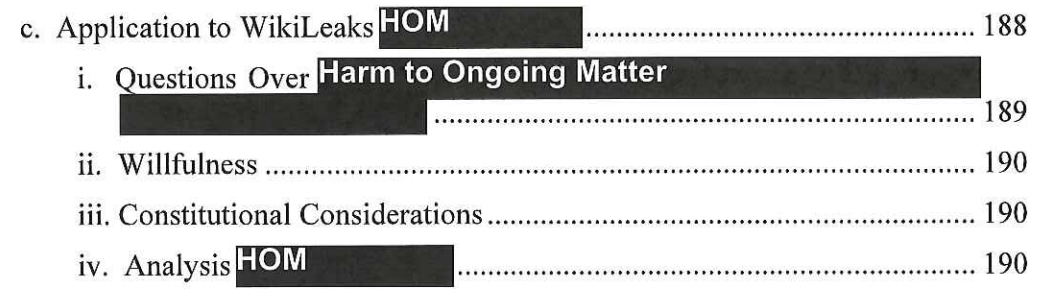
But the Report also had an almost entirely redacted section that — the TOC makes clear — includes analysis about whether optimizing email releases with WikiLeaks constitutes a campaign donation.

As noted, that section is almost entirely redacted, at least in part because of the Stone trial. Nevertheless, in most parts, it parallels the analysis done, in unredacted form, on the June 9 meeting. It has a section on whether these emails constitute a thing of value and whether the benefit was obtained willfully (that part is unredacted and suggests there might be difficulties on this front as well). But it also includes a section on the constitutional implications of defining optimized releases of emails as a campaign finance violation.

So we should assume that Mueller didn’t charge what we’re seeing in part for very good First Amendment reasons (though the EDVA indictment of Julian Assange seems to conflict with that analysis).

I raise all this by way of explanation to the many people wondering how the abundant evidence that not just Stone, but Trump himself, worked to optimize the release of the stolen emails did not get charged. Mueller considered it, and in part for reasons that we should all respect, did not charge it.

All that said, people experiencing cognitive dissonance should remember something else.

Mueller’s Report only addressed crimes he charged or declined to charge. It did not — he said explicitly on page 2 — address collusion. And while Bill Barr tried to define “collusion” as “conspiracy between the campaign itself and the Russian government,” and having done so exonerated Trump of all collusion, the report itself does not do so.

Which is why I keep going back to how Mark Meadows defined “collusion” in a hearing a year ago. In walking George Papadopoulos through his claimed ignorance of any attempt to optimize the emails that Joseph Mifsud told him about, Meadows defined “collusion” as “benefiting from Hillary Clinton emails.”

Mr. Papadopoulos. And after he was throwing these allegations at me, I —

Mr. Meadows. And by allegations, allegations that the Trump campaign was benefiting from Hillary Clinton emails?

Mr. Papadopoulos. Something along those lines, sir. And I think I pushed back and I told him, I don’t know what the hell you’re talking about. What you’re talking about is something along the lines of treason. I’m not involved. I don’t know anyone in the campaign who’s involved. And, you know, I really have nothing to do with Russia. That’s — something along those lines is how I think I responded to this person.

Mr. Meadows. So essentially at this point, he was suggesting that there was collusion and you pushed back very firmly is what it sounds like. [my emphasis]

One of Trump’s top backers in Congress defines “collusion” as whether the campaign benefitted from the release of Hillary’s stolen emails. And while we haven’t yet seen in trial exhibits that Stone did succeed (though the Malloch testimony seems to suggest we will), what we have seen is that the campaign, from Trump on down, made significant efforts to “collude.”

That’s where I predicted we’d end up after hearing Barr’s very narrow exoneration but before seeing the report: that the campaign “colluded” in ways that Mueller could not charge criminally.

Share this entry

After Engaging in Multiple Overt Acts Benefitting a Conspiracy, Bill Barr Had Kerri Kupec Commit the Most Overt Act

Before I get into how gullible DOJ reporters continue to be in this WaPo story relaying how Bill Barr refused to publicly announce that the President broke no law in his July 25 phone call with Volodymyr Zelensky, let me review a series of overt acts that might fairly be deemed part of what DOJ has already charged as a conspiracy.

DOJ fails to do the most basic “connect-the-dots” assessment implemented after 9/11

First, after John Demers went to the White House and discovered that his boss was implicated in a phone call that a whistleblower had complained about, when the Intelligence Community Inspector General sent a more formalized complaint to DOJ, DOJ limited the scope of their review of the complaint to one small part of it, just the TELCON, not the full complaint. This had the effect of preventing anyone from doing what the entire surveillance apparatus of FBI has been designed to do since 9/11, which is to search in their databases for all the people mentioned in a lead to find out if that lead connects to other known criminals. Here’s some of what DOJ knew when on the Ukraine investigation.
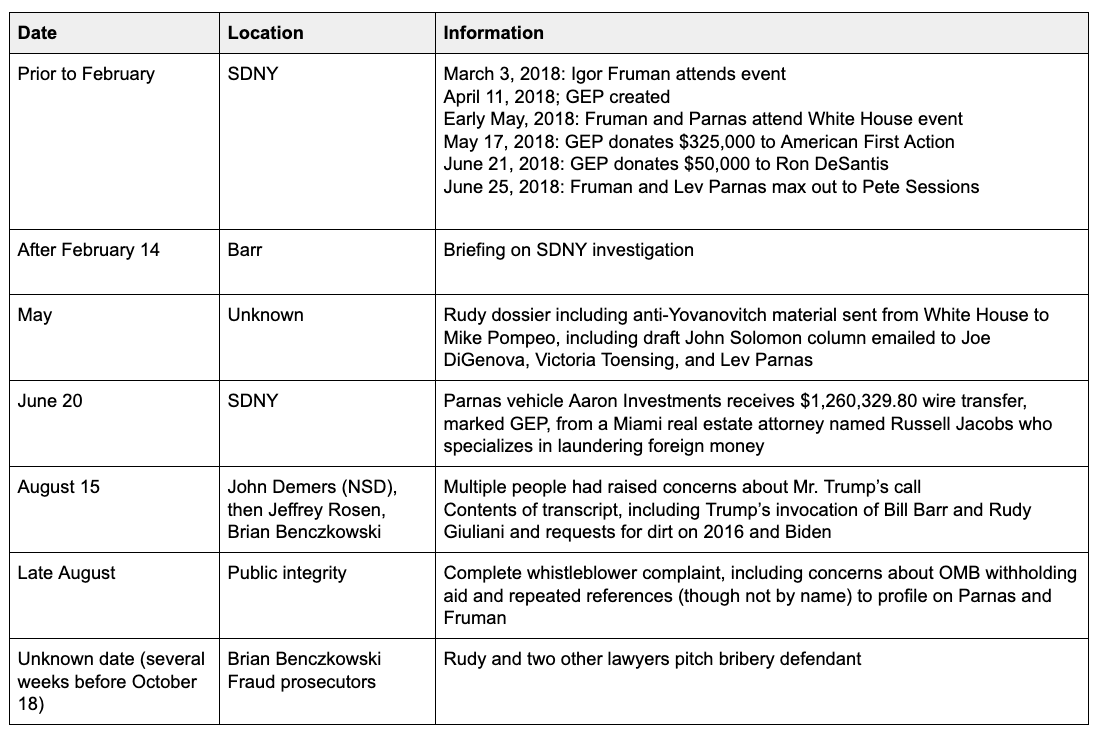
Had anyone followed the standard connect-the-dot rules in reviewing the whistleblower complaint, they would have searched on all the names in the references in the complaint, including those in this OCCRP piece, which was mentioned multiple times in the complaint.

That piece is a profile of Igor Fruman and Lev Parnas.

So if any person reviewing the whistleblower complaint had followed the approach put into place to protect the nation after 9/11, that person would have discovered:

  • Fruman and Parnas were making big donations to Republicans tied to certain policy outcomes and paying for those donations through a shell company
  • Parnas was also involved in propaganda sent, on White House stationery, to State in support of the same policy outcomes
  • The money for the shell company came from a lawyer who specializes in laundering money through real estate for foreigners
  • One policy issue Fruman and Parnas were pushing with their donations was one of the policy outcomes described in the Trump-Zelensky call, the withdrawal of Marie Yovanovitch

In short, there is no way a competent investigator would have done a connect-the-dots assessment on the whistleblower complaint and not realized it was closely related to a Full Investigation bearing down on an indictment in SDNY.

Instead of doing that marginally competent assessment, DOJ instead gave the whistleblower complaint the all-clear, in part by severing the transcript (which was damning enough) from the backup (which described OMB withholding funds, which is a separate crime, but also included the reference to the profile on suspects against whom SDNY had a fully predicated investigation into related actions). The decision to consider only the transcript affirmatively prevented DOJ from doing the kind of dot-connecting everything since 9/11 has claimed to support.

Whoever made that decision — whether willfully or unknowingly — prevented DOJ from formally realizing that the President’s call was closely tied to behavior that DOJ would indict less than two months later.

DOJ fails to share the whistleblower complaint with the FEC

At that point in late August, having decided that no crimes were committed, DOJ should have shared the whistleblower complaint — which even DOJ acknowledged raised possible election related crimes — with the Federal Election Commission under the terms of a Memorandum of Understanding they have. As of October 18, according to a letter from Ellen Weintraub responding to questions from Amy Klobuchar, DOJ had not done so.

This is the second time that you, as Ranking Member of the Senate Rules Committee with jurisdiction over federal elections, have written to commissioners of the Federal Election Commission to get a simple Yes or No answer to the question: Did the Department of Justice (DOJ) notify the FEC about or refer to the FEC a campaign finance complaint regarding potential violations of the foreign national political-spending ban by the President? Your October 2 letter specifically referenced a New York Times op-ed referring to a complaint reportedly originating with the Office of the Inspector General of the Intelligence Community.1 As noted in the Commission’s October 8 response, the FEC does not generally confirm or deny the agency’s receipt of notice or a referral from DOJ.2 However, you have asked me an important question in the exercise of your oversight authority, and commissioners should be responsive if it is legal for us to do so. It is.

For these reasons, I am answering your question: No. The FEC has not received a notification or referral from DOJ regarding the complaint you reference.

While DOJ is empowered to make any decisions about whether the call involved a crime, FEC is empowered to make decisions about whether it merits a civil penalty. And FEC might have connected the dots DOJ failed to. They would have seen that the phone call related to a campaign finance complaint plus follow-up it had already received on Parnas and Fruman, so it would have known almost as much as DOJ, had DOJ tried to connect the dots.

It turns out, it is a crime to prevent the FEC from learning information it needs to do its job. It’s not only the crime DOJ is about to charge the Russian Internet Research Agency trolls with a superseding indictment for, but it’s the crime that SDNY charged Parnas and Fruman with even before Weintraub sent her letter.

DOJ might have decided that they didn’t need to forward the complaint because Republican Matthew Petersen resigned from the FEC on the suspiciously timed August 26 and so ensured FEC couldn’t conduct any official business. But as the timing of the Parnas and Fruman indictment — which Bill Barr knew about — makes clear, DOJ still believes it can charge people for withholding information from FEC.

DOJ delays notifying Congress and hides Bill Barr’s involvement by overclassifying their OLC memo

Then, having prevented FEC from receiving information that would alert them that the President had a dodgy call that related to an existing campaign finance complaint, OLC tried to prevent Congress from learning of this — as required by whistleblower laws — by writing an OLC memo saying that this complaint did not amount to an official action.

OLC head Steve Engel wrote that memo on September 3, by which day DOJ should have alerted the Intelligence Committees of the complaint. That memo was used as an excuse to delay informing Congress. That delay included over a week during which the Administration continued to illegally withhold duly authorized security funding from Ukraine without explaining to Congress why it was doing so, a delay that Bill Taylor said (in his testimony to Congress) did real harm to Ukraine. All told, the OLC memo succeeded in delaying sharing the complaint with Congress for 23 days, something that DOJ’s own Inspector General noted (in a letter written on behalf of 70 Inspectors General) was a clear violation of the Intelligence Community Whistleblower Protection Act.

As Congress has done in every other whistleblower law passed since 1978, it entrusted IGs to play a central role in the evaluation of the information provided. Specifically, the ICWPA requires an IG to make within 14 days a factual determination as to whether an alleged urgent concern provided to the IG “appears credible.” If the IG determines that the allegation appears credible, which necessarily includes a determination by the IG that it involves an “urgent concern,” the IG is required to forward the allegation to the head of the agency and the agency head “shall” forward it to Congress within 7 days “with any comments.” The ICWPA’s use of the word “shall” makes it clear that the statute does not authorize the agency head, or any other party for that matter, to review or second-guess an IG’s good faith determination that a complaint meets the ICWPA’s statutory language.

Worse still, DOJ tried to delay informing Congress that Bill Barr was personally implicated by this call by overclassifying the OLC memo — in part by treating Barr’s implication in it, which the White House had deemed Secret, as Top Secret — and having done so, sharing a water-downed version of its own OLC memo with Congress on September 24 that hid Barr’s role and other key details.

Bill Barr continues to engage in overt acts in a conspiracy to provide John Durham propaganda to support an investigation into those who investigated Trump

And all this while — in the period while DOJ was scoping its own investigation to avoid connecting the dots and while DOJ was preventing FEC from learning of the whistleblower complaint and while DOJ was preventing Congress from receiving the complaint (the latter two acts in contravention of the law) — Bill Barr continued to engage in overt acts in the broader conspiracy to collect and provide to John Durham corroboration (no matter how sketchy or obviously coerced) that the investigation into Trump’s ties to Russia was ginned up by the Deep State.

Mind you, Barr may have already committed an overt act in the Ukrainian side of this conspiracy. By September 25, according to a DOJ statement, individual Ukrainians had already “volunteered” information to Durham.

A Department of Justice team led by U.S. Attorney John Durham is separately exploring the extent to which a number of countries, including Ukraine, played a role in the counterintelligence investigation directed at the Trump campaign during the 2016 election,” DOJ spokeswoman Kerri Kupec said Wednesday. “While the Attorney General has yet to contact Ukraine in connection with this investigation, certain Ukrainians who are not members of the government have volunteered information to Mr. Durham, which he is evaluating.”

Barr is micromanaging Durham’s investigation, so there’s little chance that these “volunteers” got from Rudy Giuliani to Durham without Barr’s own involvement.

In addition, Barr took a meeting with Victoria Toensing and Joe DiGenova to talk about their client, the mobbed up Dmitry Firtash, which was something valuable the lawyers could offer to the Firtash in exchange for him funding the Parnas and Fruman influence operation. To be sure, the Supreme Court has determined that taking a meeting does not amount to a thing of value amounting to bribery. But their ability to get such a meeting was nevertheless one of the reasons Firtash replaced Lanny Davis with Toensing and DiGenova and, in exchange, helped them feed propaganda to the Durham investigation.

The head of the Criminal Division, Brian Benczkowski, also took a meeting with Rudy in this time period (it’s unclear which client Rudy was pitching), but he claims to be unaware of the investigation into Rudy that was ongoing at SDNY, which may well be true but if so is tantamount to a confession that Benczkowski did not attempt to connect any dots on the whistleblower complaint.

But as to Barr, even as this story was breaking, Barr was in Italy pretending to be a Line FBI Agent, watching movies created by the Russian linked lawyer for Joseph Mifsud, in hopes of getting Italy to tell him and Durham that Mifsud was actually a Western intelligence asset and not the Russian one that Mueller (and abundant public evidence) suggested him to be.

In other words, by September 25, someone had already shared “evidence” with the Barr-micromanaged Durham investigation from the Ukrainian side of this information operation, and Barr was in Italy looking for more propaganda, to say nothing of how his meeting with Dmitry Firtash’s lawyers helped fund the information operation.

Barr did not publicly exonerate Trump personally — he had Kerri Kupec do it for him

I apologize for being long-winded. But all that is the necessary context that DOJ beat reporters should bring to a story on what Barr did in response to a request from Trump to make a public statement exonerating the President. Here’s the news in the WaPo piece, amid a bunch of Barr’s past PR and absent most of the details I’ve laid out above.

President Trump wanted Attorney General William P. Barr to hold a news conference declaring that the commander in chief had broken no laws during a phone call in which he pressed his Ukrainian counterpart to investigate a political rival, though Barr ultimately declined to do so, people familiar with the matter said.

The request from Trump traveled from the president to other White House officials and eventually to the Justice Department. The president has mentioned Barr’s declination to associates in recent weeks, saying he wished Barr would have held the news conference, Trump advisers say.

[snip]

The request for the news conference came sometime around Sept. 25, when the administration released a rough transcript of the president’s July phone call with Ukrainian President Volodymyr Zelensky.

[snip]

As the rough transcript was released, a Justice Department spokeswoman said officials had evaluated it and the whistleblower complaint to see whether campaign finance laws had been broken, determined that none had been and decided “no further action was warranted.”

It was not immediately clear why Barr would not go beyond that statement with a televised assertion that the president broke no laws, nor was it clear how forcefully the president’s desire was communicated. A Justice Department spokeswoman declined to comment. A senior administration official said, “The DOJ did in fact release a statement about the call, and the claim that it resulted in tension because it wasn’t a news conference is completely false.”

So, at a time after someone had already shared Ukrainian information with the Barr-micromanaged Durham investigation, after Barr had met with lawyers who were trading that access for propaganda to feed Durham, after Barr’s DOJ had scoped the whistleblower complaint to ensure it would not tie the complaint to the fully predicated criminal investigation in SDNY, after DOJ failed to turn over the complaint to FEC as required by a memorandum of understanding, after DOJ created an excuse to delay sharing the whistleblower complaint with Congress as mandated by law, after DOJ tried to hide Barr’s own involvement from Congress by overclassifying that fact … after all those overt acts that, depending on Barr’s understanding of what he got briefed way back in February and learned in multiple different ways since then, might amount to overt acts in the conspiracy SDNY has already charged Parnas and Fruman in, Barr declined to go out before cameras and comment on an ongoing investigation (which is, remember, what Jim Comey was ostensibly fired for) by publicly exonerating the President.

Instead, he had DOJ’s spox Kerri Kupec do so, in a statement that offered up excuses for why DOJ failed to connect the dots on a complaint that tied to a fully predicated investigation being conducted by SDNY.

Had Barr made that public comment, with his knowledge that the subject of the complaint connected to an ongoing investigation in SDNY into the underlying information operation that led up to the President’s call, his involvement in the Durham investigation that had already been fed by that information operation, and his meeting with lawyers that helped to provide a payoff for some of that information operation, it would have been an overt act that even Barr, with his abundant flair for PR (as witnessed by this WaPo article), could not deny was an overt act in a conspiracy being investigated by his subordinates.

So instead, he had a different subordinate (there is no evidence Kupec had any knowledge of these other acts) do that.

But that is not — as portrayed by the WaPo — evidence of distance between Barr and the White House. Rather, it’s evidence that Barr recognizes his own risk of becoming an active member of the conspiracy his DOJ went to great lengths to avoid investigating.

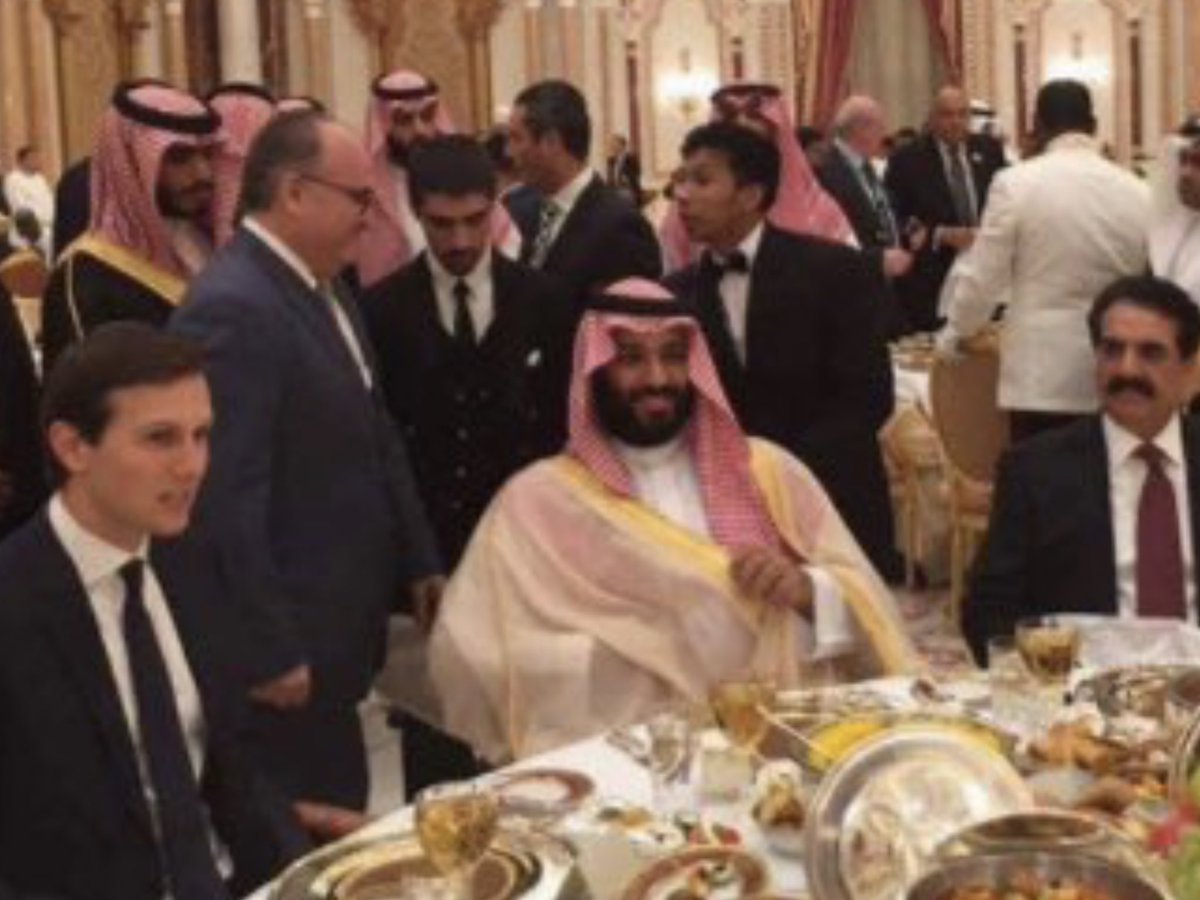
And all that’s before Barr slinked into a meeting with Rupert Murdoch as Sean Hannity was about to become part of the conspiracy.

Share this entry

The Narrative and Legal Tensions Set on Day One of Roger Stone’s Trial

I tried to travel to DC to cover the Roger Stone trial, but it didn’t happen. So I’m working second-hand to get details I’d like to have.

But I’ve got three questions from day one of Roger Stone’s trial that go to both the narrative tension prosecutors are setting and, probably, some legal traps as well. I won’t lay all of them out, but here are three.

Aaron Zelinsky introduces only the calls on which (prosecutors claim) they don’t know what happened

Aaron Zelinsky, one of the only remaining Mueller prosecutors still on this team, did the opening. He went after Trump from the start, making it clear that Stone lied to protect Trump. He described previously unknown calls between Stone and Trump on June 14 — after the WaPo reported on the DNC hack, on June 30 — after Guccifer 2.0 posted an FAQ claiming not to be Russian, and on August 31 — just before emailing Corsi and telling him to go meet Assange.

Unless I missed it, neither Zelinsky nor the former FBI Agent who took the stand first mentioned the August 3 call Stone already admitted. That was the same day that Stone wrote Manafort and told him “I have an idea to save Trump’s ass.” That’s also one of the days when (in an email to Sam Nunberg the next day) Stone claimed to have spoken with Julian Assange.

More interestingly, Zelinsky didn’t mention that Rick Gates would testify to witnessing Trump take a call — almost certainly from Roger Stone — after which he told Gates that there were more WikiLeaks emails coming. He didn’t mention a similar, earlier call Michael Cohen witnessed, where Stone predicted the WikiLeaks emails would dump later in the week of July 18 or 19, but it’s not clear whether Cohen will testify (which would explain why Zelinsky wouldn’t mention it).

In other words, Zelinsky didn’t mention the most damning calls we know of.

That’s probably about creating narrative tension — saving the best for last — but also making visible the problem with Stone’s obstruction. We don’t know what was said on those calls because Stone (and Trump, in his written answers to Mueller) denied they even existed.

What’s up with Jerome Corsi?

Zelinsky made it clear that Gates (who we knew about), Credico (who’s the key witness, and probably beginning his testimony tomorrow), and Steve Bannon (about whom I had my doubts) will testify.

The sense I got from reporters at the trial, however, is that the government would not call Jerome Corsi.

I mean, why would you? He entered into a cooperation agreement, then blew it up. He’s a batshit conspiracy theorist. When Stone submitted his exhibit list back in September, the government even challenged the relevance of both Stone’s John Podesta-related emails (an August 15 one, as well as the more famous “time in the barrel” one), as well as a contact with Corsi that must pertain to their effort to start crafting a cover story even in August.

All that suggests the government doesn’t want to get into the most damning aspects of Stone’s interactions with Corsi, but instead just wants to make it clear that Stone’s earlier communications with him makes it clear he lied to the House Intelligence Committee about Credico to hide (the government suggests) what he was up to with Corsi.

Meanwhile, Stone’s defense — such as it exists — amounts to arguing that Credico and Corsi were just pulling a fast one on poor little Rog, pretending they had ties to WikiLeaks but lying about it. That’s all well and good with Credico, who has admitted he was fluffing his ties with WikiLeaks. It is likely also true that Corsi was.

But how will Stone prove that Corsi was overstating his access to Assange if you don’t call him to testify?

Nevertheless, it seems like Corsi will be the giant black hole of this trial, with his referral for lying to the grand jury and all the other reasons why he’s a disaster witness hanging in the background.

Why did Mueller refer what appears to be a follow-up on a Bannon email that will be litigated at this trial elsewhere?

One email Zelinsky did promise we’d learn more about, however, is an August 18 one (some outlets date this to August 16, but it appears to be exhibit 28) that Stone sent to Bannon promising, “I do know how to win this but it ain’t pretty.”

That seems to suggest that the email is the one discussed in hearings on how Paul Manafort breached his plea agreement, in part, by lying to investigators on another investigation.

Effectively, Manafort was asked some questions in a proffer session before his plea on September 13, in response to which he offered information that implicated someone with a 7-character name. [These dates are in the government’s January 15 filing at 23.] Then, in a debriefing on October 5, he changed his story to make it less incriminating — and to match the story the subject of the investigation was telling to the FBI at the time (last fall). When pressed by his lawyers, Manafort mostly changed his story back to what it had been. But the head fake made Manafort useless as a witness against this person.

Judge Amy Berman Jackson summed up this change this way:

The allegation is that the defendant offered a version of events that downplayed [redacted; “the President’s” or “the Candidate”s might fit] role and/or his knowledge. Specifically, his knowledge of any prior involvement of the [16-17 character redaction] that was inconsistent with and less incriminating of [7 character redaction] than what he had already said during the proffer stage and now consistent with what Mr. [7 character redaction] himself was telling the FBI.

This investigation pertains to events that happened “prior to [Manafort] leaving the campaign (on August 19).” [January 15 filing at 26]

As Andrew Weissman described in the breach hearing, Manafort’s version of the story first came when prosecutors, “were asking questions about an e-mail that Mr. [5 character name] had written about a potential way of saving the candidate. That’s sort of paraphrasing it. And this was a way of explaining, or explaining away that e-mail.” In the Janaury 15 filing, this conversation arises to explain “a series of text messages.” [See 25]

Weissmann describes that the revised story Manafort told was, “quite dramatically different. This is not I forgot something or I need to augment some details of a basic core set of facts.” Manafort’s original story involved Mr. [7 character redaction] providing information about a [redacted] who was doing something. Manafort appears to have made a representation about what Mr. [7 character name] believed about that (likely important to proving intent).

But in the second session, Manafort appears to have shifted the blame, implicating Mr. [5 character name] whom, “Mr. Manafort had previously said, I did not want to be involved in this at all,” but leaving out what Mr. [7 character name] had said. Manafort’s testimony effectively left out that when Mr. [5 character name] had called previously, Manafort had said, “I’m on it, don’t get involved.” It appears that Weissmann surmised that Manafort changed the story because his version would make it central to the question of criminality [this might be a reference to being related to the Mueller investigation], so he revised it in an attempt to avoid providing anything that might be helpful to implicating Mr. [7 character name].

Effectively, in the wake of an email written by someone with a 5-character name (so stone would fit) in the days before Manafort resigned on August 19 (so either August 16 or 18 would fit) that promised, “a potential way of saving the candidate,” someone else (my wildarseguess is Kushner) got involved. But once he got his plea agreement, Manafort changed his story to blame the guy who sent the email (in this scenario, Stone) and not the other guy.

There’s just one problem with this presumption that the email Zelinsky described and the one invoked in this investigation are one and the same.

By September of 2018, this was a separate investigation being conducted by “another district.”

The investigation is in another district.  The initial government 12/7 filing says that explicitly at 8. The breach filing at 112 says they had the other investigative team “come here.”

I find it perplexing that some other US Attorney’s office — even DC — would be investigating the aftermath of the Stone to Bannon email discussed today, when such an email (if it related to Stone and WikiLeaks) would be central to what Mueller was still investigating. Corsi hadn’t blown up his plea deal yet. And Bannon’s interview where he presumably told truths he didn’t tell in February 2018 wasn’t until October 26. I mean, I have theories. I can come up with theories for just about anything. But still, why would this email be central to Zelinsky’s opening in a trial where Steve Bannon will testify unless it remained solidly within Mueller’s purview in October 2018?

Anyway, these are the big questions I take away from the first day of Stone’s trial. I think they suggest both narrative and legal plot twists that no one is expecting.

Share this entry

emptywheel Fact Check Service — DOJ, 1-1 // Sidney Powell, 0-29

The other day, I noted an error in the government surreply to Sidney Powell. The government said Peter Strzok raised a question left in a draft 302. But it appeared — comparing the question with the notes in question — that the question had to come from Joe Pientka, based on DOJ’s representation of whose notes were whose.

Update: I think I found another error. The government says that the only thing interesting in the February 10 redline of the 302 is Strzok indicating he didn’t remember two details — that Flynn said he had no particular affinity for Russia, and that he didn’t remember that Flynn said his government Blackberry wasn’t working in the Dominican Republic.

Contrary to the defendant’s assertion, there were no material changes made after February 10, 2017, to the draft of the January 24 interview report. See Reply at 26. On February 10, 2017, DAD Strzok highlighted two—and only two—sentences where he did not recall a statement that the other interviewing agent included in the draft of the report.

But this must actually be Pientka not remembering these things, because both details show up in Flynn’s notes.

The government just informed Sidney Powell and Emmet Sullivan of the error, which was actually the reverse of what I surmised, that they had the ID on the notes backwards.

Last evening, we received word that our Surreply may have misidentified the authorship of the handwritten notes from the January 24, 2017 interview of your client. Specifically, we were informed that the notes we had identified as Peter Strzok’s, were actually the other agent’s notes (see Surreply, Exhibit 1), and what we had identified as the other agent’s notes were in fact Strzok’s notes (see Surreply, Exhibit 2).

This morning, we asked the FBI to re-examine the electronic records from the January 24 interview, and they confirmed that the government mistakenly identified these notes in its March 13, 2018 discovery letter. Strzok’s notes are those numbered DOJSCO-700021192—DOJSCO700021195; and the other agent’s notes are those numbered DOJSCO-700021196—DOJSCO700021198. We understand that this has caused some confusion, and we regret our error. The government has no other corrections to make about the notes.

I don’t know that I’m the one who gets credit for spotting the error, though I know lawyers in every case I’ve covered closely have followed my own coverage closely (DOJ’s press people have been really uninterested in speaking to me of late, for possibly justifiable reasons, so I didn’t call and ask).  But I certainly IDed this as an error, and it got fixed, the second day after the weekend.

So I’m running 1-1 correction rate on the substantive errors I’ve found in the government’s briefs.

Compare that with the errors and misrepresentations I’ve found in Sidney Powell’s briefs in just five months. Among the errors or lies I’ve IDed are:

  1. Falsely claims things don’t show up in the Strzok and Pientka notes that she hides with a sketchy cut and paste job (here, here)
  2. Whether DOJ provided everything considered Brady before Flynn pled guilty a second time (here, here)
  3. How long it took to move Peter Strzok off of Mueller’s team (here)
  4. Why Lisa Page left FBI (here)
  5. Whether Flynn had the Strzok-Page texts before pleading guilty (here)
  6. Claims Strzok texts saying he was concerned about leaks about Trump associates is proof of bias against Trump (here)
  7. Whether Strzok treated Flynn fairly given the record (here)
  8. Egregiously misquotes a Strzok 302 (here)
  9. Ignores that a Lisa Page 302 proves her misquote is wrong (here)
  10. Presents proof that everyone recognized Flynn lied then claims it proves the opposite (here, here
  11. Claims DOJ didn’t notice Flynn about something Comey said that Emmet Sullivan was in the loop on (here)
  12. Misstates the seniority of Bruce Ohr (here)
  13. Whether Bruce Ohr continued to serve as a back channel for Steele intelligence when in fact he was providing evidence to Bill Priestap about its shortcomings (whom the filing also impugns) (here)
  14. Whether the Ohr memos pertain to Flynn; none of the ones released so far have the slightest bit to do with Flynn (here)
  15. Misstates the timing of (and therefore who paid for) Nellie Ohr’s research into Flynn (here)
  16. Whether Andrew Weissmann was in charge of the Flynn prosecution (here)
  17. How many meetings Weissman and Zainab Ahmad had with Ohr — the only known meeting with him took place in fall 2016 — before Flynn committed the crimes he pled guilty to; the meeting likely pertained to Paul Manafort, not Flynn (here)
  18. Includes a complaint from a Flynn associate that pertains to alleged DOD misconduct (under Trump) to suggest DOJ prosecutors are corrupt (here)
  19. Whether a polygraph Flynn passed in 2016 has any import to crimes he committed in 2017 (here)
  20. When Flynn joined the Trump campaign, which if true, means she’s accusing Flynn of lying to the FBI (here)
  21. The import of key details in a timeline (here)
  22. Treats the standard for charging counterintelligence crimes as the standard for opening an investigation into them (here)
  23. Complains that a redaction hiding that there was no FISA order targeting Flynn hides FISA abuse on him (here)
  24. Claims that an order showing problems with FISA 702 — some committed while Flynn was NSA and none used before June 2017 against Trump’s people, after which those abuses were fixed — proved Flynn had been a victim of FISA abuse (here)
  25. Completely misunderstands the FISA 702 memo (here)
  26. Claims the use of EO 12333 collected information — something her client did for 30 years — was against the law (here)
  27. Claims phones that have nothing to do with her client prove her client is innocent (here)
  28. Claims Flynn’s meetings with her on how to blow up his plea deal were actually meetings during which he was cooperating with EDVA’s prosecutors (here)
  29. Claims a letter in which Chuck Grassley demands that Flynn be given exculpatory information is instead a Grassley assertion that DIA material Flynn already received that the govt says is inculpatory is exculpatory (here)

Again, these are not even all the errors I’ve found in Powell’s briefs.

Yet, as far as I know, she has never corrected a single one of these for Emmet Sullivan — she hasn’t even stopped making some of these key false claims.

I’ll grant you that the government’s error is embarrassing. I shouldn’t need to fact check the FBI 18 months after the fact!

But it also happens to undermine several of Powell’s claims. It means Strzok, who was the main interviewer, really did take sketchier notes, as Powell says he would have. It means that Pientka, not Strzok, is the one who took notes so OCD that Powell says he shouldn’t investigate her client — but also means that the Agent she has no gripe with took the more substantive notes. It means that the redline shows Strzok challenging Pientka about material he included that Strzok didn’t remember.

In other words, it undermines yet more of Powell’s conspiracy theories.

And it doesn’t change that both sets of notes and all three 302s back the charges of false statements that Flynn pled guilty to.

Updated to include a 29th false claim of Powell’s because it’s a particularly galling one.

Share this entry

What Prosecutors Need to Show to Prove Roger Stone Guilty

There has been some absolutely shitty coverage in advance of Roger Stone’s trial that doesn’t even understand the indictment. So to try to minimize the bad coverage, I’m going to lay out what the prosecutors need to prove to show that Roger Stone is guilty.

Stone is accused of telling 5 lies to the House Intelligence Committee, plus intimidating Randy Credico in an attempt to talk him out of testifying honestly. Together, those actions will prove the obstruction charges.

I’ve mapped out each of the lies, below, with what the government needs to do to prove they’re lies, and the evidence the government has already said it’ll offer to prove that. The italicized sentences come from the indictment; where I didn’t otherwise replace it, Organization 1 is WikiLeaks.

Stone has emails with others mentioning Julian Assange and knew that when he testified

STONE testified falsely that he did not have emails with third parties about the head of Organization 1, and that he did not have any documents, emails, or text messages that refer to the head of Organization 1.

The government needs to show not only that he had emails with others (and documents and texts) talking about Julian Assange but that he knew that when he testified.

The emails and texts they’ll use to prove this include:

  • A July 25, 2016 email to Corsi with the subject line, “Get to [the head of Organization 1].” The body of the message read, “Get to [the head of Organization 1] [a]t Ecuadorian Embassy in London and get the pending [Organization 1] emails . . . they deal with Foundation, allegedly.” On or about the same day, Person 1 forwarded STONE’s email to an associate who lived in the United Kingdom and was a supporter of the Trump Campaign (GX35)
  • A July 31, 2016 email to Corsi with the subject line, “Call me MON.” saying that Ted Malloch, “should see Assange.” (GX 36)
  • An August 2, 2016 email from Corsi to Stone stating that, “Word is friend in embassy plans 2 more dumps. One shortly after I’m back. 2nd in Oct. Impact planned to be very damaging. … Time to let more than [the Clinton Campaign chairman] to be exposed as in bed w enemy if they are not ready to drop HRC. That appears to be the game hackers are now about. Would not hurt to start suggesting HRC old, memory bad, has stroke – neither he nor she well. I expect that much of next dump focus, setting stage for Foundation debacle.” (GX 37)
  • An August 19, 2016 text from Credico saying, “I’m going to have [Assange] on my show next Thursday.” (GX 46)
  • An August 21, 2016, text from Credico saying, “I have [Assange on Thursday so I’m completely tied up on that day.” (GX 46)
  • An August 26, 2016 text exchange with Credico where Credico said, “[Assange] talk[ed] about you last night,” Stone asked what Assange said, and Credico responded, “He didn’t say anything bad we were talking about how the Press is trying to make it look like you and he are in cahoots.” (GX 47)
  • August 27, 2016 text messages from Credico saying, “We are working on a [Assange] radio show,” and that, “[Assange] has kryptonite on Hillary.”
  • A September 18, 2016, email to Credico asking, “Please ask [Assange] for any State or HRC e-mail from August 10 to August 30—particularly on August 20, 2011 that mention [the subject of the article] or confirm this narrative.” (GX 48)
  • A September 19, 2016, text to Credico writing, “Pass my message . . . to [Assange].” Credico responded, “I did.” (GX 49-57)
  • An October 1, 2016, text from Credico claiming, “big news Wednesday . . . now pretend u don’t know me . . . Hillary’s campaign will die this week.” (GX 58)
  • An October 2, 2016, email from Stone to Credico saying “WTF?,” linking an article saying that Assange was canceling “highly anticipated Tuesday announcement due to security concerns.” Credico responded, “head fake.” (GX 59)
  • An October 2, 2016, text to Credico stating, “Did [Assange] back off.” On October 3, 2016, Credico responded, “I can’t tal[k] about it.” Then said, “I think it[’]s on for tomorrow.” Credico added later that day, “Off the Record Hillary and her people are doing a full-court press they [sic] keep [the head of Organization 1] from making the next dump . . . That’s all I can tell you on this line . . . Please leave my name out of it.” (GX 58)
  • An October 3, 2016 email or text, probably to Erik Prince, stating, “Spoke to my friend in London last night. The payload is still coming.”
  • An October 3, 2016 email from Matthew Boyle asking, “Assange – what’s he got? Hope it’s good.” Stone responded, “It is. I’d tell [Bannon] but he doesn’t call me back.” (GX 31)
  • An October 4, 2016 email between Bannon and Stone asking what Assange had. (GX 32)
  • An October 4 2016 text, probably from Prince, saying “hear[d] anymore from London,” to which Stone replied, “Yes – want to talk on a secure line – got Whatsapp?” (GX 32)
  • An October 7, 2016 text from Bannon assistant Alexandra Preate saying “well done.” (GX44)

The government also has to prove that Stone knew he had all these comms. One way they’ll do so is by showing they were still in Stone’s possession when they searched his home. Another way they’ll prove it is by showing that Stone shared many of them, on the record, with reporters as he was trying to walk back his story.

Stone’s references to an intermediary are not to Credico

STONE testified falsely that his August 2016 references to being in contact with the head of WikiLeaks were references to communications with a single “go-between,” “mutual friend,” and “intermediary,” who STONE identified as Credico.

The government has to prove that 1) Credico could not have been the intermediary Stone referred to publicly in early August and 2) there was at least one other person that Stone was using as an attempted intermediary to Assange.

To prove this, first of all, the government will show that there were no communications between Credico and Stone until Credico told Stone that he was going to have Assange on his show on August 19, which was after Stone repeatedly claimed to have an intermediary.

The government will also show that Stone had communications with Corsi that amount to treating him as an intermediary. It will do this by showing the following communications:

  • A July 25, 2016 email to Corsi with the subject line, “Get to [the head of Organization 1].” The body of the message read, “Get to [the head of Organization 1] [a]t Ecuadorian Embassy in London and get the pending [Organization 1] emails . . . they deal with Foundation, allegedly.” On or about the same day, Person 1 forwarded STONE’s email to an associate who lived in the United Kingdom and was a supporter of the Trump Campaign
  • A July 31, 2016 email to Corsi with the subject line, “Call me MON.” saying that Ted Malloch, “should see Assange.”
  • An August 2, 2016 email from Corsi to Stone stating that, “Word is friend in embassy plans 2 more dumps. One shortly after I’m back. 2nd in Oct. Impact planned to be very damaging. … Time to let more than [the Clinton Campaign chairman] to be exposed as in bed w enemy if they are not ready to drop HRC. That appears to be the game hackers are now about. Would not hurt to start suggesting HRC old, memory bad, has stroke – neither he nor she well. I expect that much of next dump focus, setting stage for Foundation debacle.”

The government will further show that Stone knew Credico couldn’t be the intermediary because he spoke to both Credico and Corsi about that. For example, they’ll show

  • On January 6, 2017, Credico texted Stone, “Well I have put together timelines[] and you [] said you have a back-channel way back a month before I had [the head of Organization 1] on my show . . . I have never had a conversation with [the head of Organization 1] other than my radio show . . . I have pieced it all together . . .so you may as well tell the truth that you had no back-channel or there’s the guy you were talking about early August.” (GX 61)
  • On November 30, 2017, after Stone asked Corsi to write something about about Credico, Corsi asked, “Are you sure you want to make something out of this now? Why not wait to see what [Person 2] does. You may be defending yourself too much—raising new questions that will fuel new inquiries. This may be a time to say less, not more.” (GX 41)

The government may show there was another intermediary (probably the source Corsi refused to give up when he stopped cooperating) — and in fact, this prosecution may be an attempt to force Stone to admit that.

Stone asked for favors from his intermediaries to Assange

STONE testified falsely that he did not ask the person he referred to as his “go-between,” “mutual friend,” and “intermediary,” to communicate anything to the head of Organization 1 and did not ask the intermediary to do anything on STONE’s behalf.

The government will need to prove that he asked for favors from intermediaries. This will show, at least:

  • The July 25, 2016 email to Corsi with the subject line, “Get to [the head of Organization 1].” The body of the message read, “Get to [the head of Organization 1] [a]t Ecuadorian Embassy in London and get the pending [Organization 1] emails . . . they deal with Foundation, allegedly.” On or about the same day, Person 1 forwarded STONE’s email to an associate who lived in the United Kingdom and was a supporter of the Trump Campaign. This was a request not for information about emails, but the emails themselves.
  • A September 18, 2016, email to Credico asking, “Please ask [Assange] for any State or HRC e-mail from August 10 to August 30—particularly on August 20, 2011 that mention [the subject of the article] or confirm this narrative.”
  • A September 19, 2016, text to Credico writing, “Pass my message . . . to [Assange].” Credico responded, “I did.”

The government will prove he remembered that when he testified because after he testified, he threatened Margaret Kunstler, through whom Credico asked Assange for help. I suspect they have additional proof on this front.

Stone communicated with an intermediary about Assange

STONE testified falsely that he and the person he referred to as his “go-between,” “mutual friend,” and “intermediary” did not communicate via text message or email about WikiLeaks.

The government can prove this with both the Credico and Corsi communications (though I suspect it knows of more). As above, they can prove Stone knew he had these communications because he offered them up to people and indicated he knew of them in real time to Corsi.

Stone discussed his outreach via an intermediary with the Trump campaign

STONE testified falsely that he had never discussed his conversations with the person he referred to as his “go-between,” “mutual friend,” and “intermediary” with anyone involved in the Trump Campaign.

The government needs to show Stone passed on information he represented as coming from an intermediary to Assange to the Trump campaign. To prove this the government will show:

  • Starting in June, Stone told Trump campaign officials that emails were coming.
  • Around July 18, Stone called Trump at his Trump Organization phone (patched through via Rhona Graff) and told Trump the emails would be coming out that week.
  • Sometime after the July 22 release, Stone called Trump on his cell phone and told him more emails were coming; after Trump hung up, he told Rick Gates (who was driving with him to Laguardia) that more emails were coming.
  • In October, Stone claimed to have information from WikiLeaks to both Bannon and Erik Prince.

The government will prove Stone remembered this with comms with Credico and Corsi, making it clear he was protecting Trump (any one of his pleading emails telling Trump he was protecting him since then would do the trick, as well).

The government will also show that Stone was discussing his campaign finance shenanigans with the campaign, and lied about that to HPSCI, before he cleaned up his testimony.

Stone tried to prevent Credico from telling HPSCI that he was not Stone’s intermediary

The government will show abundant communications, including from third parties, to document the pressure Stone put on Credico to lie for him. That includes:

  • A November 19, 2017 text instructing Credico to, “‘Stonewall it. Plead the fifth. Anything to save the plan’ . . . Richard Nixon.” (GX 63)
  • Multiple texts, starting on December 1, 2017, instructing Credico to do a Frank Pentangeli.” (GX 69)
  • On December 1, 2017, Stone texted Credico stating, “And if you turned over anything to the FBI you’re a fool.” Later that day, Credico responded, “You need to amend your testimony before I testify on the 15th.” Stone responded, “If you testify you’re a fool. Because of tromp I could never get away with a certain [sic] my Fifth Amendment rights but you can. I guarantee you you are the one who gets indicted for perjury if you’re stupid enough to testify.” (GX 69)
  • On or about December 24, 2017, Credico texted Stone, “I met [the head of Organization 1] for f[i]rst time this yea[r] sept 7 . . . docs prove that. . . . You should be honest w fbi . . . there was no back channel . . . be honest.” Stone replied approximately two minutes later, “I’m not talking to the FBI and if your smart you won’t either.” (GX 69)
  • On April 9, 2018, emailed Credico, “You are a rat. A stoolie. You backstab your friends-run your mouth my lawyers are dying Rip you to shreds.” Stone also threatened to take Bianca away: “take that dog away from you,” and then added, “I am so ready. Let’s get it on. Prepare to die [expletive].” (GX 112-114)
  • When Credico emailed Stone on May 21, 2018, “You should have just been honest with the house Intel committee . . . you’ve opened yourself up to perjury charges like an idiot.” Stone replied, “You are so full of [expletive]. You got nothing. Keep running your mouth and I’ll file a bar complaint against your friend [Margaret Kunstler].” (GX 124-126)

The government will also show that when Stone got in trouble for 2007 for leaving a threat for Eliot Spitzer’s father, he blamed it on Credico.

Share this entry

When Your Joint Defense Agreement with the Russian Mob Blows Up in Your Face

Last month, I argued that the John Dowd letter mapping out what amounted to a Joint Defense Agreement between the President, Rudy Giuliani, Lev Parnas, Igor Fruman, and Dmitry Firtash (with Victoria Toensing, Joe DiGenova, and Dowd himself as the glue holding this orgy of corruption together) would one day go in a museum to memorialize how crazy things are. Right alongside that — I think after reading this NYT story — will go Trump’s written waiver of privilege as obtained by Jay Sekulow.

Mr. Parnas initially remained in Mr. Trump’s camp after House Democrats on Sept. 30 requested documents and testimony from him and Mr. Fruman. The men hired John Dowd, a lawyer who had earlier represented the president at one stage of the investigation by Robert S. Mueller III, the special counsel, into Russian interference in the 2016 election.

Mr. Trump signed off on the hiring of Mr. Dowd, according to an Oct. 2 email reviewed by The New York Times.

“I have discussed the issue of representation with the president. The president consents to allowing your representation of Mr. Parnas and Mr. Furman,” Jay Sekulow, another lawyer for Mr. Trump, wrote to Mr. Dowd, misspelling Mr. Fruman’s surname.

Dowd claims, his batshit letter notwithstanding, there was no tie between his representation of Trump and the magical selection of a bunch of grifters involved in Trump’s efforts to coerce electoral advantage from foreign countries.

Mr. Dowd said in an interview that Mr. Trump’s approval was sought “simply as a courtesy to the president,” because of the lawyer’s previous work for him. Mr. Dowd said he still represents Mr. Fruman.

A person close to Mr. Trump said that the email did not demonstrate that the president knew Mr. Parnas or Mr. Fruman personally but rather knew of them from media reports.

But now Parnas has decided to cooperate with the impeachment inquiry because Trump pretended not to know Parnas.

“We are willing to comply with the subpoena to the extent that it does not violate any appropriate privilege that Mr. Parnas may properly invoke,” said Joseph A. Bondy, who along with Edward B. MacMahon, Jr. now represents Mr. Parnas.

Mr. Bondy said that given the federal criminal charges, his client may invoke his right under the Fifth Amendment not to incriminate himself.

The turnabout occurred after Mr. Trump denied knowing Mr. Parnas when he was arrested.

“Mr. Parnas was very upset by President Trump’s plainly false statement that he did not know him,” said Mr. Bondy, whose client has maintained that he has had extensive dealings with the president.

This move comes after Parnas’ (alleged) partner in crime, Igor Fruman, met spectacular failure at getting his bail conditions changed, after the prosecutor provided compelling evidence he tried to flee the country as soon as Congress subpoenaed him.

“What is clear is he was subpoenaed by Congress on October 7th, on the 8th he booked a one-way flight to Vienna, and on the 9th he was arrested on the jetway,” Roos said. “What was his reason to leave on such short notice? … Why such a rush to leave the country?”

Roos went on to detail Fruman’s many financial and political connections to Europe, attempting to demonstrate that Fruman could live a very pleasant life abroad if he were able to flee.

“He operates a bar called Buddha Bar” abroad, Roos said. He held up a printout of a glossy hotel brochure for the court to see, saying it listed Fruman as the president and CEO of a “luxury group” that owns a hotel, “restaurants, a beach club, and retail stores,” Roos told the court.

So maybe Parnas decided that “cooperating” (and I mean those scare quotes to be enormous) with Congress might be a quicker path to freedom.

Most other times that someone has protected Trump by demanding a pardon, Trump still held the leverage (in part, because they were dealing with DOJ, not an impeachment inquiry).

But at this point, I suspect, Parnas holds the upper hand, in part because SDNY is not that far into its investigation of the larger point of Parnas’ funding of the Republican Party (meaning, he has a pretty good idea of how bad things could get if the investigation is allowed to proceed unimpeded), and in part because the impeachment inquiry makes Parnas’ knowledge a far greater risk to Trump. He may be a grifter, but he put the pieces into place to  ensure he could take others down with him. And his marks were very easy marks. Plus, given he can claim both attorney-client and Fifth Amendment privileges, he may be able to neatly tailor what information he wants to release.

Share this entry