A DOJ IG Investigation Is Insufficient to Investigate Trump’s Attempt to Get DOJ Help to Steal the Election

As many news outlets are reporting, DOJ’s Inspector General Michael Horowitz is opening an investigation into whether any former or current DOJ official helped Trump try to overturn an election.

The DOJ Office of the Inspector General (OIG) is initiating an investigation into whether any former or current DOJ official engaged in an improper attempt to have DOJ seek to alter the outcome of the 2020 Presidential Election.  The investigation will encompass all relevant allegations that may arise that are within the scope of the OIG’s jurisdiction.  The OIG has jurisdiction to investigate allegations concerning the conduct of former and current DOJ employees.  The OIG’s jurisdiction does not extend to allegations against other government officials.

The OIG is making this statement, consistent with DOJ policy, to reassure the public that an appropriate agency is investigating the allegations.  Consistent with OIG policy, we will not comment further on the investigation until it is completed.  When our investigation is concluded, we will proceed with our usual process for releasing our findings publicly in accordance with relevant laws, and DOJ and OIG policies.

This is welcome news, but nowhere near as big a deal as people are making out. That’s true for several reasons. First, while DOJ IG will have access to internal DOJ communications, DOJ IG cannot compel testimony of former employees. So if Jeffrey Bossert Clark — or any of the sources leaking anonymously with no threat of legal consequences — don’t want to cooperate with this inquiry, they can avoid doing so.

More importantly, as Horowitz notes, his office’s jurisdiction, “does not extend to allegations against other government officials.” He can’t investigate Scott Perry, the GOP Congressperson who was reportedly involved in this, he can’t investigate Pat Cipollone, who reportedly sided with others at DOJ to undercut Trump’s efforts, and he can’t investigate Trump himself.

Still, it will serve one welcome purpose. As I noted in this post, one way to get investigations into Trump conduct started without appearing as if Joe Biden’s DOJ has it in for Trump is to start them with Inspectors General. A year from now, DOJ IG will likely produce a report showing improper behavior from Clark (probably because he went around his superiors, not for any good legal reason), while noting that he was unable to get further cooperation. That could provide predicate for opening an investigation into the Former President.

Share this entry

Some Key Gaps in the January 6 Story [Updated]

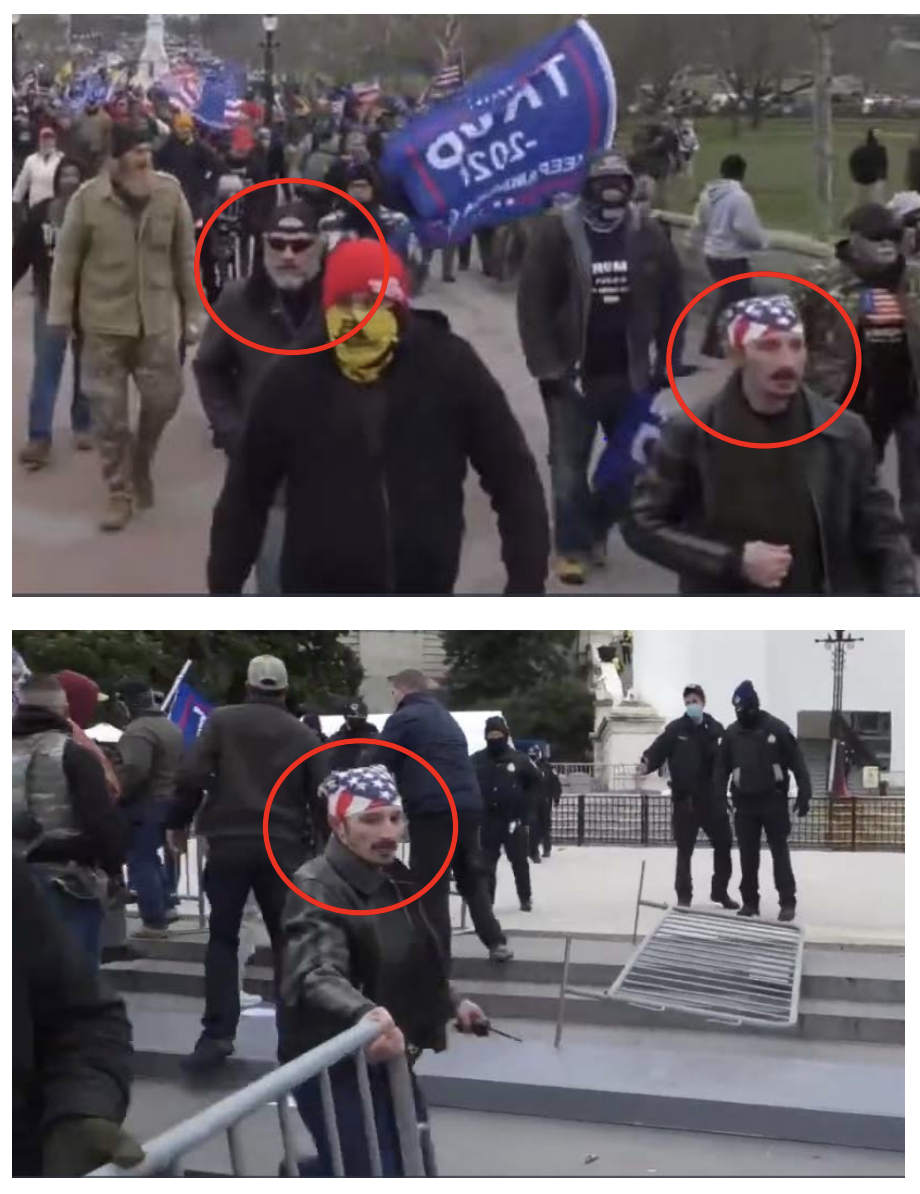
DOJ continues to roll out arrests of people involved in the January 6 coup attempt.

But there are some obvious gaps in the (public) story so far.

Arrests relating to over 100 police assaults

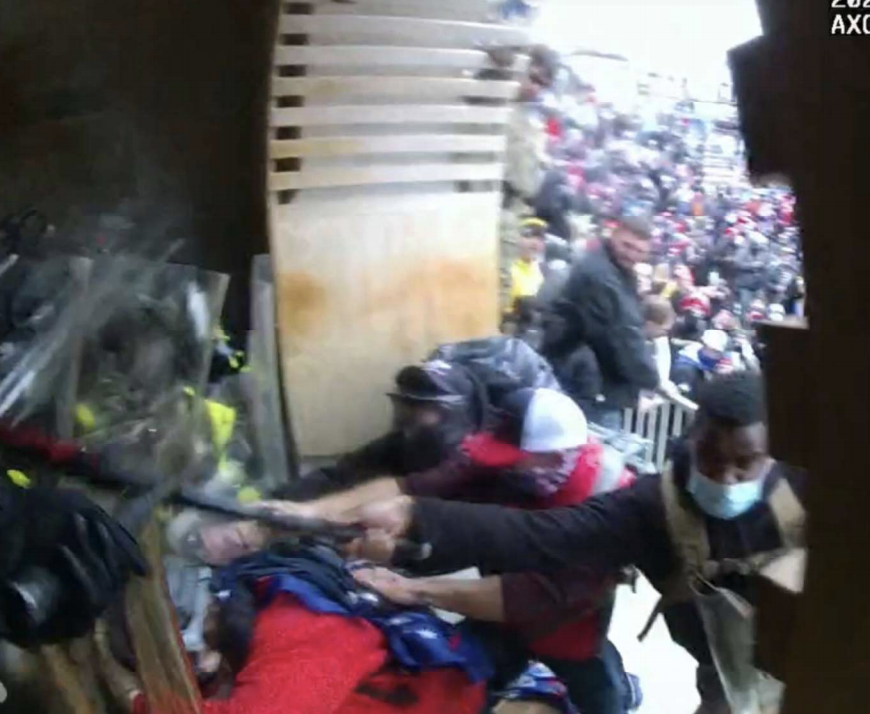
In a filing submitted over the weekend, the government asserted that 139 cops were assaulted during the insurrection.

In the course of the insurrection, approximately 81 Capitol Police and 58 MPD officers were assaulted,

In its website tracking the people arrested so far, DOJ describes assault charges being filed against 12 people (updated on 2/1 to total 17 people):

  1. Daniel Page Adams, whose arrest affidavit describes engaging in a “direct struggle with [unnamed] law enforcement officers” (his cousin, Cody Connell, described the exchange as a “civil war”).
  2. Zachary Alam, who pushed cops around as he was trying to break into the Speaker’s Lobby.
  3. Matthew Caspel, who charged the National Guard.
  4. Scott Fairlamb, who was caught in multiple videos shoving and punching officers (one who whom is identified but not named); Cori Bush has said she was threatened by him last summer.
  5. Kyle Fitzsimons, who charged officers guarding the doorway of the Capitol.
  6. Alex Harkrider, who after being filmed fighting with police at the door of the Capitol, posted a picture with a crowbar labeled, “weapon;” he was charged with abetting Ryan Nichols’ assault.
  7. Michael Foy, a former Marine who was caught on multiple videos beating multiple cops with a hockey stick.
  8. Robert Giswein, who appears to have ties to the Proud Boys and used a bat to beat cops.
  9. Emanuel Jackson, whom videos caught punching one officer, and others show beating multiple officers with a metal baseball bat.
  10. Chad Jones, who used a Trump flag to break the glass in the Speaker’s Lobby door just before Ashli Babbitt was shot and may have intimidated three officers who were pursuing that group.
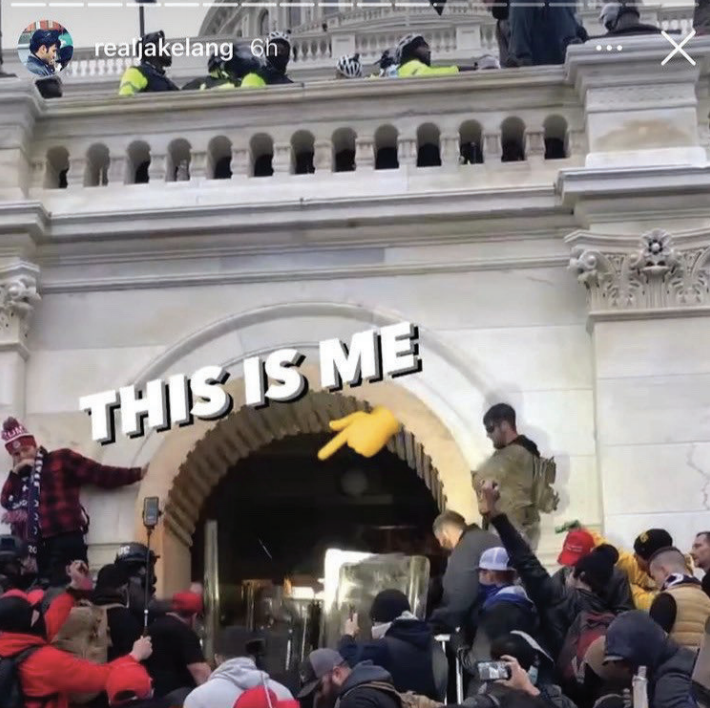
  11. Edward Jacob Lang, who identified himself in a screen cap of a violent mob attacking cops and who was filmed slamming a riot shield into police and later fighting them with a red baseball bat.
  12. Mark Jefferson Leffingwell, whom a Capitol Police officer described in an affidavit punching him.
  13. Patrick Edward McCaughey III, who was filmed crushing MPD Officer Daniel Hodges in one of the doors to the Capitol.
  14. Ryan Nichols, who was filmed wielding a crowbar and yelling, “This is not a peaceful protest,” then spraying pepper spray against police trying to prevent entry to the Capitol.
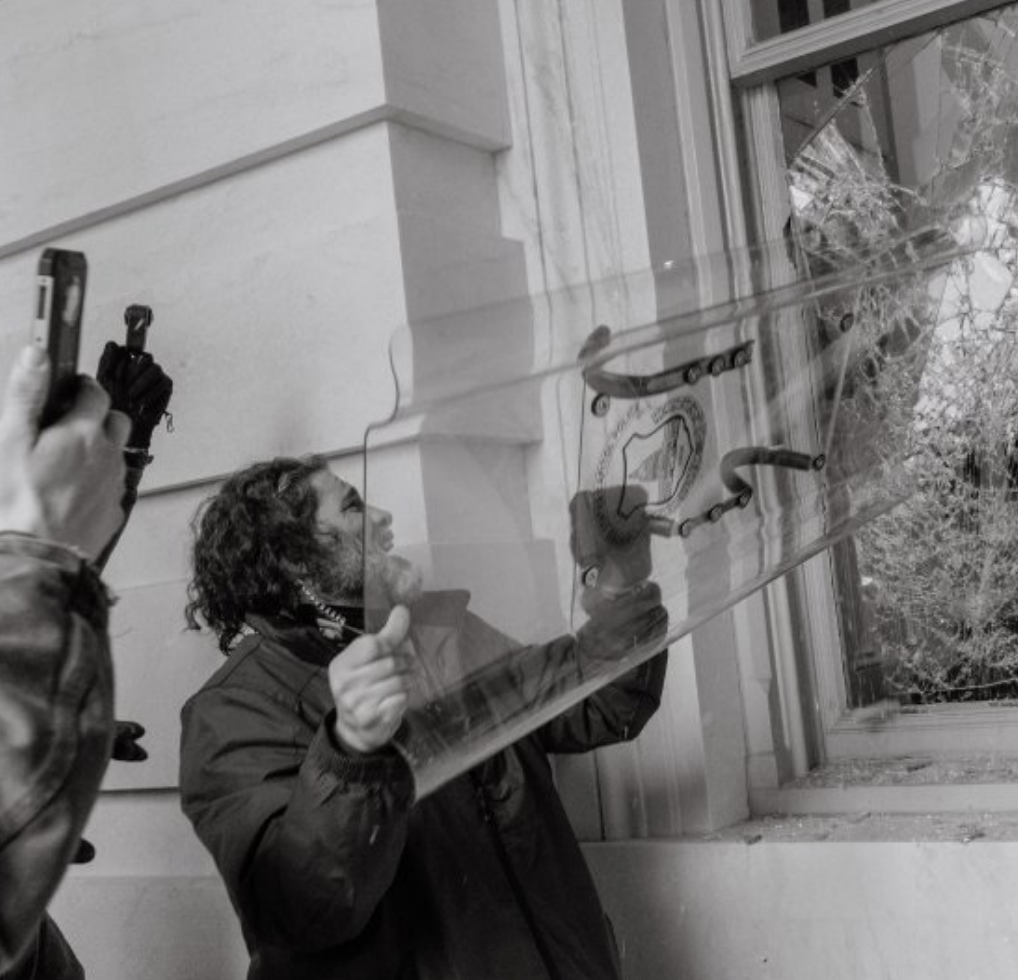
  15. Dominic Pezzola, a Proud Boy who stole a shield from cops.
  16. Ryan Samsel, who set off the riot by giving a cop a concussion; he appears to have coordinated with Joe Biggs.
  17. Robert Sanford, who was filmed hitting Capitol Police Officer William Young on the head with a fire extinguisher.
  18. Peter Schwartz, a felon who maced several cops.
  19. Barton Wade Shively, who pushed and shoved some police trying to get into the Capitol, punched another, then struck one of those same cops later and kicked another.

While a number of these men — Fairlamb, Jackson, Nichols, Shively, among others — allegedly assaulted multiple cops, that’s still far below the total of 139 alleged assaults.

That says the FBI is still looking for a significant number of people in assaults on police. Over the weekend, the FBI released BOLO posters showing 12 other men believed to have assaulted police — including two targeting individuals specifically.

The murder of Brian Sicknick

Of particular note, while the FBI has released a BOLO poster focused on the men who assaulted MPD Officer Michael Fanone, no such post has identified suspects as those suspected of killing Brian Sicknick (though note that Robert Sanford did assault a different officer with a fire extinguisher). There are many possible explanations for why his murder might be treated differently (not least that the culprits are more likely to flee).

But we haven’t seen anything to suggest who assaulted Sicknick badly enough to lead to his death.

The DNC and RNC bomber

On January 21, the FBI increased their reward for information leading to the guy believed to have planted pipe bombs at the DNC and RNC. But there’s no sign they’ve found the guy yet.

Rudy’s interlocutors

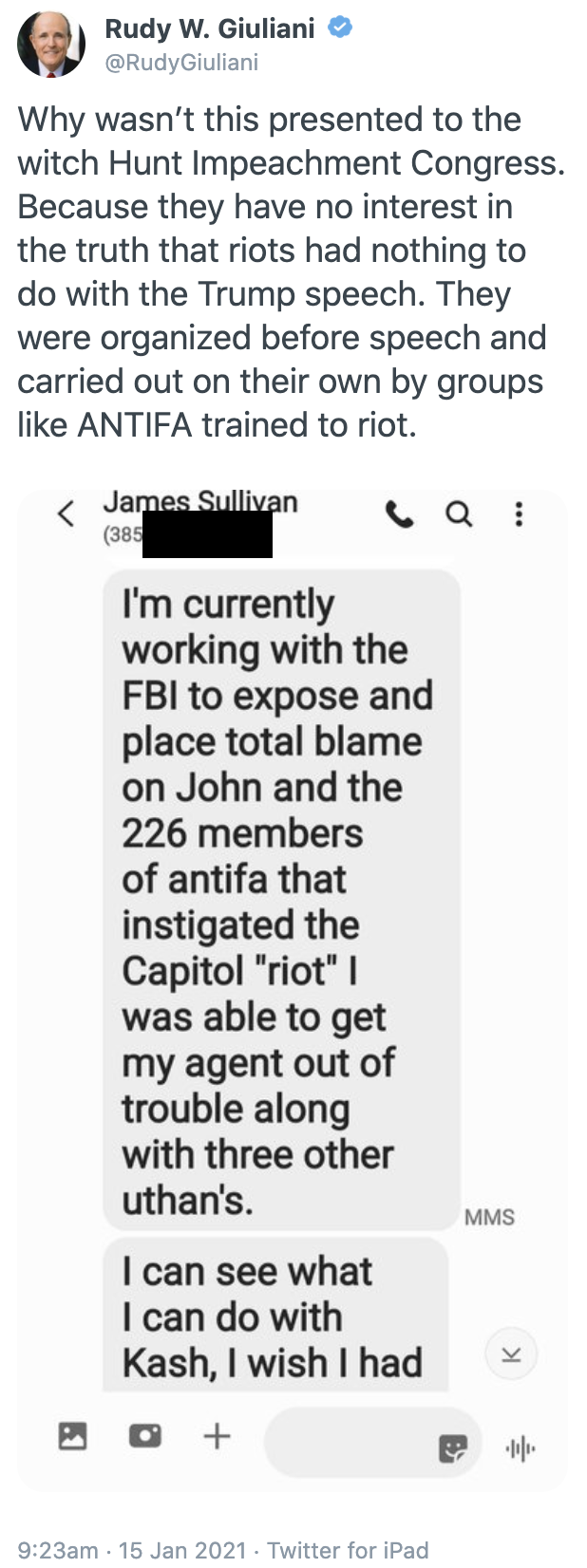
On January 15, Rudy Giuliani posted texts involving “James Sullivan” claiming he was going to blame the riot on “John,” that he had gotten “my agent out of trouble along with three other” Utahans, and mentioning “Kash.”

“John” is James’ brother, John Sullivan, someone long ago IDed by leftist activists as a provocateur who had been charged two days earlier. He was arrested on January 14, but bailed the next day.

“Kash,” is Kash Lee Kelly, whose parole officer IDed him at the scene. His bail in the gang-related drug conviction he was awaiting sentencing for in IL was revoked on January 14.

John Sullivan is the only Utahan that GWU identifies as being from Utah, meaning the three Utahans, in addition to James Sullivan, he claims to have gotten out of trouble thus far are (publicly at least) still not in trouble. No one yet arrested is identifiable as his “agent,” either.

That means, key people who might be a pivot between the rioters and Rudy Giuliani, who was coordinating events in Congress with an eye to how much time the rioters would give him, remain (again, publicly at least) at large.

There are around 73 sealed cases in the DC District, many of which probably having nothing to do with the January 6 insurrection and some of which are surely defendants already publicly charged whose cases have not yet been unsealed in the DC docket. The reasons for unsealing could vary — though the most common would be that someone hasn’t been arrested yet). Still, some of these sealed cases may be people who’ve already moved to cooperate.

Update, 2/1: I’ve updated the list of those charged with assault.

Share this entry

Bill Barr’s Entire DOJ Chased Trump Conspiracy Theories and Plotted Inappropriately

When Bill Barr resigned rather than do the President’s bidding to challenge elections that were perfectly fair, he could have revealed that fact publicly, okayed the indictment of one of the chief purveyors of election conspiracies, Rudy Giuliani, and admitted that the entire basis for undermining the prosecution of Mike Flynn — who had already called for martial law and an election do-over — was based on conspiracy theories spun by the same woman spinning the worst election hoaxes, Sidney Powell.

He didn’t do that.

Instead, he announced his resignation with a page of abject sycophancy that repeated the conspiracy theory that got Barr hired: that the Russian investigation was, “an effort to cripple, if not oust, your Administration with frenzied and baseless accusations of collusion with Russia.”

Even before that, though, Barr launched his letter with an ambiguous statement about the election, one that might be read either as endorsing Trump’s conspiracy theories or debunking them:

I appreciate the opportunity to update you this afternoon on the Department’s review of voter fraud allegations in the 2020 election and how these allegations will continue to be pursued. At a time when the country is so deeply divided, it is incumbent on all levels of government, and all agencies acting within their purview, to do all we can to assure the integrity of elections and promote public confidence in their outcome.

At a moment where he had maximal power to halt Trump’s efforts to overturn an election, then, Barr instead just cowered, resting on the one public statement that there was not sufficient fraud to overturn the election that had gotten him ousted.

Which is to say that to the end, Barr never foreswore the conspiracy theories he adopted in service to Donald Trump.

Now, however, others who also facilitated Donald Trump’s conspiracy theories for years until they, in the final days, didn’t, are seeding stories to suggest that Jeffrey Bossert Clark was in any way unique for doing so.

The story starts with a tale that suggests the top leaders in a DOJ that had broken all norms in service of Donald Trump weren’t, themselves, in the “Trumpist faction” of the Republican Party.

It was New Year’s Eve, but the Justice Department’s top leaders had little to celebrate as they admonished Jeffrey Clark, the acting head of the civil division, for repeatedly pushing them to help President Donald J. Trump undo his electoral loss.

Huddled in the department’s headquarters, they rebuked him for secretly meeting with Mr. Trump, even as the department had rebuffed the president’s outlandish requests for court filings and special counsels, according to six people with knowledge of the meeting. No official would host a news conference to say that federal fraud investigations cast the results in doubt, they told him. No one would send a letter making such claims to Georgia lawmakers.

When the meeting ended not long before midnight, Acting Attorney General Jeffrey A. Rosen thought the matter had been settled, never suspecting that his subordinate would secretly discuss the plan for the letter with Mr. Trump, and very nearly take Mr. Rosen’s job, as part of a plot with the president to wield the department’s power to try to alter the Georgia election outcome.

It was clear that night, though, that Mr. Clark — with his willingness to entertain conspiracy theories about voting booth hacks and election fraud — was not the establishment lawyer they thought him to be. Some senior department leaders had considered him quiet, hard-working and detail-oriented. Others said they knew nothing about him, so low was his profile. He struck neither his fans in the department nor his detractors as being part of the Trumpist faction of the party, according to interviews.

The department’s senior leaders were shocked when Mr. Clark’s machinations came to light. They have spent recent weeks debating how he came to betray Mr. Rosen, his biggest champion at the department, and what blend of ambition and conviction led him to reject the results of the election and embrace Mr. Trump’s claims, despite all evidence to the contrary, including inside the department itself. [my emphasis]

You’ll note that the NYT didn’t explain why it granted six surely very powerful people, mostly lawyers, anonymity to spin this tale?

Buried much deeper in the story, however, after retelling all the ways Clark broke normal procedure while running the Environmental Division, the NYT then explains how he came to be Acting head of the Civil Department and in that role took a number of inexcusable steps that neither Bill Barr nor Jeffrey Rosen objected to (indeed, those may have been the steps that drove Jody Hunt away and won Clark the job).

While Mr. Clark oversaw environmental cases, sometimes working late into the night and personally reviewing briefs, the department’s civil division was in turmoil. Its leader, Jody Hunt, sometimes clashed with the White House Counsel’s Office and, later on, with Attorney General William P. Barr, over how best to defend the administration.

Mr. Hunt resigned with no warning in July, leaving his deputy to run the division while Mr. Barr and Mr. Rosen searched for an acting leader among the department’s thinned-out ranks. Mr. Clark wanted the job, which was a considerable step up in stature, and Mr. Rosen supported the idea even though he was already a division head, according to three people with knowledge of the situation.

After he took the helm of the civil division in September, colleagues began seeing flashes of unusual behavior. Mr. Clark’s name appeared on eyebrow-raising briefs, including what would turn out to be an unsuccessful effort to inject the government into a defamation lawsuit against Mr. Trump by a woman who has said he raped her more than two decades ago. He also signed onto an attempt to use the Justice Department to sue a former friend of the first lady at the time, Melania Trump, for writing a tell-all memoir.

Remember: the currently operative story is that Clark didn’t know Trump until Congressman Scott Perry introduced them, presumably after the election.

It was Mr. Perry, a member of the hard-line Freedom Caucus, who first made Mr. Trump aware that a relatively obscure Justice Department official, Jeffrey Clark, the acting chief of the civil division, was sympathetic to Mr. Trump’s view that the election had been stolen, according to former administration officials who spoke with Mr. Clark and Mr. Trump.

Mr. Perry introduced the president to Mr. Clark, whose openness to conspiracy theories about election fraud presented Mr. Trump with a welcome change from the acting attorney general, Jeffrey A. Rosen, who stood by the results of the election and had repeatedly resisted the president’s efforts to undo them.

He didn’t get the Civil job because Trump picked him or because he promised to turn DOJ into Trump’s own personal law firm. Someone else must have picked him. That means Clark’s other decisions — one of which he took the day after he was installed and which were “Trumpist” by any definition of the term — had the full approval of the people now suggesting he went rogue later in the year. Indeed, those interventions may have been the entire reason he got picked to run the Civil Division.

Sure, Jeffrey Bossert Clark should be shunned in the respectable legal profession for helping Trump attempt a coup. But so should the men who willfully let DOJ champion Trump’s conspiracy theories for the two years before that.

Share this entry

Prosecuting the Trump Coup Attempt Compared to the J20 Prosecution

Yesterday, WaPo published a story describing that there’s a debate over whether to charge all the people can identifiably entered the Capitol during the January 6 coup attempt.

Federal law enforcement officials are privately debating whether they should decline to charge some of the individuals who stormed the U.S. Capitol this month — a politically loaded proposition but one alert to the practical concern that hundreds of such cases could swamp the local courthouse.

The internal discussions are in their early stages, and no decisions have been reached about whether to forgo charging some of those who illegally entered the Capitol on Jan. 6, according to multiple people familiar with the discussions.

Justice Department officials have promised a relentless effort to identify and arrest those who stormed the Capitol that day, but internally there is robust back-and-forth about whether charging them all is the best course of action. That debate comes at a time when officials are keenly sensitive that the credibility of the Justice Department and the FBI are at stake in such decisions, given the apparent security and intelligence failures that preceded the riot, these people said, speaking on the condition of anonymity to discuss legal deliberations.

Federal officials estimate that roughly 800 people surged into the building, though they caution that such numbers are imprecise, and the real figure could be 100 people or more in either direction.

Among those roughly 800 people, FBI agents and prosecutors have so far seen a broad mix of behavior — from people dressed for military battle, moving in formation, to wanton vandalism, to simply going with the crowd into the building.

Due to the wide variety of behavior, some federal officials have argued internally that those people who are known only to have committed unlawful entry — and were not engaged in violent, threatening or destructive behavior — should not be charged, according to people familiar with the discussions.

The story explains some of the concerns: If all the evidence that they have shows some sympathetic person entering the Capitol non-violently and then leaving, they might lose. These are [largely white] people with no arrest records. Lots of defendants are likely to invoke Trump to justify their actions. Prosecuting everyone will overwhelm the courts.

Nevertheless, these people said, some in federal law enforcement are concerned that charging people solely with unlawful entry, when they are not known to have committed any other bad acts, could lead to losses if they go to trial.

“If an old man says all he did was walk in and no one tried to stop him, and he walked out and no one tried to stop him, and that’s all we know about what he did, that’s a case we may not win,” one official said.

Another official noted most of those arrested so far have no criminal records.

Meanwhile, defense lawyers for some of those charged are contemplating something akin to a “Trump defense” — that the president or other authority figures gave them permission or invited them to commit an otherwise illegal act.

“If you think of yourself as a soldier doing the bidding of the commander in chief, you don’t try to hide your actions. You assume you will be held up as a hero by the nation,” criminal defense lawyers Teri Kanefield and Mark Reichel wrote last week.

Such a defense might not forestall charges but could be effective at trial or sentencing.

[snip]

There is also a question over whether charging all of the rioters could swamp the federal court system. In 2019, D.C. federal courts recorded only about 430 criminal cases, and fewer than 300 last year, when the legal system slowed significantly due to the pandemic. Many of those cases, however, had multiple defendants.

I’m very sympathetic with the last issue: while I’d love to use Trump’s crimes as an excuse to expand the number of DC District Judges, there will always be a bottleneck to present anything to a grand jury, because of COVID. I’m unworried that a bunch of people will get a misdemeanor record for participating in a coup attempt.

I think the expressed worries about Trump suggest that someone at DOJ or FBI doesn’t yet realize that Trump must be a part of this, even to hold the more dangerous insurrectionists to account. And if I had to choose whether DC’s prosecutors focus on making that case — that Trump’s efforts to undermine legitimate election results in multiple states and Rudy’s coordination with members of Congress tie directly to the mob they used to delay the certification of the vote — or charging 400 of 800 people with misdemeanors, I say focus on Trump and his co-conspirators.

I think DOJ is right that they will lose some of these cases (all the more so if, as the story suggests might be one way for DOJ to deal with the surge, the trials were moved out of DC). It turns out white supremacists sometimes get a more sympathetic take from jurors than black people do.

That said, I want to consider that concern in light of a comparison someone made: the J20 protestors arrested on the day of former President Trump’s inauguration. While a handful of them pled guilty early, many of the other cases were ultimately thrown out.

Even ignoring the context of Trump’s attempt to use the mob in an effort to steal the election, two things distinguish the two events.

First, as one of the people arrested in 2017 described last week, cops immediately arrested hundreds of people at the Trump protests, both those who had committed vandalism and those who did not.

On Jan. 20, 2017, around the time Trump was sworn in, D.C. police cornered a couple hundred people — largely protesters but also bystanders, journalists and legal observers — onto a street corner far from the White House or the Capitol grounds. The justification for the mass arrests was that a handful of protesters in the crowd had destroyed the windows of several businesses, including a Starbucks and Bank of America branch, and damaged private vehicles parked on the street. I was covering the protest as a freelance reporter and, after catching an eyeful of pepper spray, I got caught up in the mass arrest while trying to leave. We spent the night in jail; police confiscated our phones.

At first, I figured we’d all be charged with contestable misdemeanors. Instead, the U.S. attorney’s office conjured up a radical conspiracy theory that rested on defining the protest march as a black bloc riot in which every alleged participant was guilty for all property damage, ultimately charging more than 200 people. Our indictments referenced protest chants captured on video as evidence. Although my actions, as alleged in the indictment against me, consisted of walking and wearing dark clothing, I was charged with more than half a dozen felony riot and destruction charges. It’s hard to convey the terror I felt, especially as Trump loyalists cheered on my prosecution because I was a journalist, gleefully using racial slurs.

Almost no one was arrested at the Capitol, meaning everyone is having to be identified after the fact, largely from social media and videos of the event. It appears that DOJ is already conducting a kind of triage process, focusing on those who were obviously violent or ties to a more organized group. So the arrests are already selecting for prosecutable behavior.

Also, by comparison with the Trump protestors who were arrested on a public street, merely entering into the Capitol building in an attempt to stop the vote count amounts to two crimes, with which most current defendants are being charged:

18 U.S.C. § 1752(a), which makes it a crime to (1) knowingly enter or remain in any restricted building or grounds without lawful authority to do; (2) knowingly, and with intent to impede or disrupt the orderly conduct of Government business or official functions, engage in disorderly or disruptive conduct in, or within such proximity to, any restricted building or grounds when, or so that, such conduct, in fact, impedes or disrupts the orderly conduct of Government business or official functions; (3) knowingly, and with the intent to impede or disrupt the orderly conduct of Government business or official functions, obstruct or impede ingress or egress to or from any restricted building or grounds; or (4) knowingly engage in any act of physical violence against any person or property in any restricted building or grounds; or attempts or conspires to do so. For purposes of Section 1752 of Title 18, a restricted building includes a posted, cordoned off, or otherwise restricted area of a building or grounds where the President or other person protected by the Secret Service is or will be temporarily visiting; or any building or grounds so restricted in conjunction with an event designated as a special event of national significance; and

40 U.S.C. § 5104(e)(2)(D), which makes it a crime for an individual or group of individuals to willfully and knowingly (A) enter or remain on the floor of either House of Congress or in any cloakroom or lobby adjacent to that floor, in the Rayburn Room of the House of Representatives, or in the Marble Room of the Senate, unless authorized to do so pursuant to rules adopted, or an authorization given, by that House; (B) enter or remain in the gallery of either House of Congress in violation of rules governing admission to the gallery adopted by that House or pursuant to an authorization given by that House; (C) with the intent to disrupt the orderly conduct of official business, enter or remain in a room in any of the Capitol Buildings set aside or designated for the use of— (i) either House of Congress or a Member, committee, officer, or employee of Congress, or either House of Congress; or (ii) the Library of Congress; (D) utter loud, threatening, or abusive language, or engage in disorderly or disruptive conduct, at any place in the Grounds or in any of the Capitol Buildings with the intent to impede, disrupt, or disturb the orderly conduct of a session of Congress or either House of Congress, or the orderly conduct in that building of a hearing before, or any deliberations of, a committee of Congress or either House of Congress; (E) obstruct, or impede passage through or within, the Grounds or any of the Capitol Buildings; (F) engage in an act of physical violence in the Grounds or any of the Capitol Buildings; or (G) parade, demonstrate, or picket in any of the Capitol Buildings.

The former, unless done with a weapon, is just a misdemeanor, what most of the 400 people who might not otherwise be charged would be charged with. But as noted, DOJ (probably correctly) believes that some people will be able to argue they thought they were permitted in, especially if they claim to have operated on Trump’s orders.

There are two other lessons in the J20 case, though, both of which offer important lessons here.

First, in an attempt to claim that the protest was planned to be violent, DOJ relied on a video from Project Veritas which was — unsurprisingly — edited to be misleading. But they withheld the most exculpatory parts.

While the government used some recordings from the right-wing group — which has frequently been found to selectively edit its videos — in Inauguration Day cases that went to trial, a judge later found that prosecutors were wrong not to disclose an additional cache of videos and audio recordings in their possession. The judge also ruled that prosecutors violated evidence disclosure rules in not revealing video edits that the government made.

[snip]

Defense lawyers also complained that the government originally didn’t disclose Project Veritas as the source of the recordings, and that the defense lawyers had to piece together the connection through their own research. Speaking at Friday’s hearing, Elizabeth Lagesse, one of the defendants whose case was dropped, questioned whether the secrecy surrounding the videos was the result of an arrangement between the government and Project Veritas.

The judge then asked Goodhand if there was any agreement to keep Project Veritas’s identity secret. Goodhand said he didn’t know. Morin ordered him to file a supplement to the government’s court papers with an answer.

The government will also have to rely on unofficial videos to prosecute the insurrectionists. While there’s little reason to believe they’re intentionally edited (in many cases they’re not edited at all), there will be a provenance issue.

More importantly, DOJ tried, but failed, to get an expansive warrant for the website of the organization that planned the protest, partly an effort to get the IP address of everyone who accessed the site.

DOJ initially demanded that DreamHost turn over nearly 1.3 IP addresses on visitors to the site. Millions of visitors—activists, reporters, or anyone who just wanted to check out the site—would have records of their visits turned over to the government. The warrant also sought production of all emails associated with the account and unpublished content, like draft blog posts and photos.

The new warrant parameters exclude most visitor logs from the demand, set a temporal limit for records from July 1, 2016 to January 20, 2017, and also withdraw the demand for unpublished content, like draft blog posts and photos. This was a sensible response on DOJ’s part—both legally and politically.

But the new warrant is not without its flaws. First, it’s not clear from either the warrant itself or the facts of the case whether DOJ is ordering DreamHost to turn over information on one account or multiple accounts. At a minimum, DOJ should be required to specify which accounts are subject to the order. More fundamentally, DOJ is still investigating a website that was dedicated to organizing and planning political dissent and protest. That is activity at the heart of the First Amendment’s protection. If, as DOJ claims, it has no interest in encroaching on protected political activity and organizing, then it should allow a third-party—like a judge, a special master, or a taint team—to review the information produced by DreamHost before it is turned over to the government. Anything less threatens to cast a further shadow on the legitimacy of this investigation.

Again, I highly doubt DOJ would go this aggressively after the groups as groups. Indeed, at least from public reports, DOJ has obtained very little legal process yet, and what they’ve gotten has been targeted at individuals already arrested. (Though there are reports that they’re getting location data from the cells in and around the Capitol.)

Because of the difference I’ve already laid out — that violent entry into the Capitol is a crime — DOJ won’t be forced to try to tie all the rioters together in one intent (though, again, Trump offers them that and they should use it). So long as they can show the violence and illegal entry should have been obvious, they won’t need to prove that everyone came in with the intent to cause damage.

Still, this all comes back to the context — a context that report after report seems to suggest DOJ is not vigorously pursuing yet.

To the extent a mob descended on the Capitol to prevent the certification of the vote — and defendant after defendant posted evidence to their social media showing that’s what they understood they were doing — then you have a conspiracy.

Ironically, then, Trump ended his presidency providing the legal case his DOJ tried to trump up on its first day.

Share this entry

The Baraitser Decision’s Impact (or Not) on Journalism

Before and since Joe Biden was inaugurated, Julian Assange supporters are unsurprisingly pushing for Biden to direct DOJ to adopt a different stance in the prosecution of Assange.

I suspect that’s unlikely. Indeed, while I’m not sure how any of this would work under the extradition law or be tempered by the UK’s rejection of extradition based on humanitarian grounds and ongoing appeal of that decision, I think it more likely that DOJ does one of the following:

  • Supersedes the existing indictment to incorporate (at least) Vault 7
  • Adds conspiring with Russia, potentially showing a timeline of doing so that goes back up to a decade
  • Charges non-national security crimes (the quid pro quo for the pardon and possibly extortion) as a way to get around the finding that he’d be put in a SuperMax
  • Indicts an omnibus conspiracy naming others, or
  • Asks the UK to prosecute Assange under the equivalent crimes (including, possibly, for Vault 7)

I think that not because I believe Joe Biden will be shitty or good on issues pertaining to journalism or because I have it in for Assange. I think that because unlike virtually everyone weighing in on this topic (Alexa O’Brien is the sole exception I know of) I’ve actually been covering what has happened to WikiLeaks cases in the US and the public record shows that the US government as a whole and DOJ as an institution — not Presidents Obama, Trump, or Biden — have come to the conclusion that WikiLeaks is not a journalistic institution.

To that end, I want to return to Vanessa Baraitser’s ruling in Assange’s case, because most people weighing in about how and why Biden might change course are misrepresenting what she said about two issues.

The first issue pertains to the impact of her ruling on journalism. Yes, Baraitser ruled for the US. But all she had to do on this issue was weigh whether the crimes alleged in the indictment have a parallel in UK law (which in this case would be the far more onerous Official Secrets Act) and are permitted under European Convention on Human Rights law’s Article 10.

With regards to the former, Baraitser could have just noted that the Official Secrets Act clearly criminalizes the publication of classified information like that covered by the indictment. That was what most people I know honestly expected (even if they didn’t say as much publicly).

She didn’t. With regards most charges, her ruling relied heavily on the intersecting conspiracies alleged in the superseding indictment that most Assange boosters have not read, one to violate the Espionage Act and the other to violate CFAA (hacking). For the bulk of the charges (the ones covered by Theory One in this post), Baraitser described what Assange does to include a hacking element.

Mr. Assange is accused of aiding and abetting Ms. Manning in her theft and disclosure of the information, as an accessory to her offending. The defence submits that no offence is committed by Mr. Assange unless he has engaged in a criminal activity separate from Ms. Manning’s act of whistle-blowing. However, in my judgment, Mr. Assange’s alleged activities went beyond the mere encouragement of a whistle-blower.

Tseehe [sic] design and purpose of WikiLeaks, it is alleged, was to obtain protected information and publish it. Mr. Assange was willing to achieve this, it is alleged, through computer hacking, both by engaging in hacking activities himself but also by recruiting and soliciting others to do the same. This is amply demonstrated in the request in his work with various hacking groups. His work with Ms. Manning, it is alleged, was part of this plan.

[snip]

At the same time as these communications, it is alleged, he was encouraging others to hack into computers to obtain information. This activity does not form part of the “Manning” allegations but it took place at exactly the same time and supports the case that Mr. Assange was engaged in a wider scheme, to work with computer hackers and whistle blowers to obtain information for Wikileaks. Ms. Manning was aware of his work with these hacking groups as Mr. Assange messaged her several times about it. For example, it is alleged that, on 5 March 2010 Mr. Assange told Ms. Manning that he had received stolen banking documents from a source (Teenager); on 10 March 2010, Mr. Assange told Ms. Manning that he had given an “intel source” a “list of things we wanted and the source had provided four months of recordings of all phones in the Parliament of the government of NATO country-1; and, on 17 March 2010, Mr. Assange told Ms. Manning that he used the unauthorised access given to him by a source, to access a government website of NATO country-1 used to track police vehicles. His agreement with Ms. Manning, to decipher the alphanumeric code she gave him, took place on 8 March 2010, in the midst of his efforts to obtain, and to recruit others to obtain, information through computer hacking

[snip]

In relation to Ms. Manning, it is alleged that Mr. Assange was engaged in these same activities. During their contact over many months, he encouraged her to obtain information when she had told him she had no more to give him, he identified for her particular information he would like to have from the government database for her to provide to him, and, in the most obvious example of his using his computer hacking skills to further his objective, he tried to decipher an alphanumeric code she sent to him. If the allegations are proved, then his agreement with Ms. Manning and his agreements with these groups of computer hackers took him outside any role of investigative journalism. He was acting to further the overall objective of WikiLeaks to obtain protected information, by hacking if necessary. Notwithstanding the vital role played by the press in a democratic society, journalists have the same duty as everyone else to obey the ordinary criminal law. In this case Mr. Assange’s alleged acts were unlawful and he does not become immune from criminal liability merely because he claims he was acting as a journalist.

Thus, even though she didn’t have to do so to rule for the US on this point, she nevertheless distinguished what Assange does from what journalists do because, as alleged in the indictment and in actual fact, hacking is such a central part of what Assange does. It’s not clear she would have gotten to this ruling without the language included in the superseding indictment (a superseding indictment which, again, virtually all Assange boosters either willfully ignore or are genuinely ignorant exists). But as it happened, she relied heavily on the language in the superseding indictment and very clearly distinguished what Assange does from what journalists do.

Of particular interest (because this is the language in the indictment that I believe sets up adding Vault 7 to the indictment), Baraitser accepted the US government’s description of Assange recruiting people to hack.

Mr. Assange, it is alleged, had been engaged in recruiting others to obtain information for him for some time. For example, in August 2009 he spoke to an audience of hackers at a “Hacking at Random” conference and told them that unless they were a serving member of the US military they would have no legal liability for stealing classified information and giving it to Wikileaks. At the same conference he told the audience that there was a small vulnerability within the US Congress document distribution system stating, “this is what any one of you would find if you were actually looking”. In October 2009 also to an audience of hackers at the “Hack in the Box Security Conference” he told the audience, “I was a famous teenage hacker in Australia, and I’ve been reading generals’ emails since I was 17” and referred to the Wikileaks list of “flags” that it wanted captured. After Ms. Manning made her disclosures to him he continued to encourage people to take information. For example, in December 2013 he attended a Chaos computer club conference and told the audience to join the CIA in order to steal information stating “I’m not saying don’t join the CIA; no, go and join the CIA. Go in there, go into the ballpark and get the ball and bring it out”.

Again, it’s not just that Assange solicited people to share classified information with him (which journalists do), but that he also explicitly encourages people to hack to get it.

And while the way Baraitser distinguished Assange from others in her ruling on the three most dangerous charges, publishing informants’ identities (Theory Three in this post), is less compelling, she nevertheless went beyond a ruling on the act itself. She distinguished Assange’s publication online (in bulk, though that distinction is less clear and not one of great comfort to someone who also publishes online) from traditional journalism.

More importantly, Baraitser talked about the balancing involved in Article 10 (particularly with regards to the right of private life).

The defence submits that, by disclosing Ms. Manning’s materials, Mr. Assange was acting within the parameters of responsible journalism. The difficulty with this argument is that it vests in Mr. Assange the right to make the decision to sacrifice the safety of these few individuals, knowing nothing of their circumstances or the dangers they faced, in the name of free speech. In the modern digital age, vast amounts of information can be indiscriminately disclosed to a global audience, almost instantly, by anyone with access to a computer and an internet connection. Unlike the traditional press, those who choose to use the internet to disclose sensitive information in this way are not bound by a professional code or ethical journalistic duty or practice. Those who post information on the internet have no obligation to act responsibly or to exercise judgment in their decisions. In the modern era, where “dumps” of vast amounts of data onto the internet can be carried out by almost anyone, it is difficult to see how a concept of “responsible journalism” can sensibly be applied.

[comparison with other outlets and their condemnation of him]

The law already constrains in various ways what may be published in order to avoid damage to private interests. For example, the High Court recently awarded damages against the Associated Newspaper Ltd, after the MailOnline website published an article , reporting on the arrest of the claimant in the aftermath of the Manchester Arena bombing, and disclosing details capable of leading to his identification (Alaedeen Sicri v Associated Newspapers Limited, [2020] EWHC 3541 (QB)). Free speech does not comprise a ‘trump card’ even where matters of serious public concern are disclosed (see Stoll above), and it does not provide an unfettered right for some, like Mr. Assange, to decide the fate of others, on the basis of their partially informed assessment of the risks.

This was not necessarily a national security stance. Rather, in language that would apply equally to Assange’s indiscriminate publication of the DNC and Podesta emails (as well as the publication of the Turkish and Saudi emails), Baraitser argued that Assange’s publication in bulk was not protected because it did not and could not properly weigh the risk to others.

This part of the ruling, in particular, would not translate into US law. There is no such privacy balance in the US outside of much weaker defamation laws. And so this part of the ruling does not offer much comfort with regards the existing charges as precedent in the US context.

But that’s an issue Assange supporters have with US law, not with the Baraitser ruling.

With regards to the impact on journalism, Baraitser ruled that the charges before her (which contrary to a lot of WikiLeaks propaganda, doesn’t include the Collateral Murder video) were distinguishable from what journalists do.

As such, unless press organizations want to claim hacking is within the job description of journalists, this ruling should not chill journalism.

There’s certainly real concern about the charges as precedent in the US, particularly the publishing charges. But that’s different than the Baraitser ruling itself.

Update: Corrected ECHR thanks to Chetnolian.

Share this entry

Productive Ways to Hold Trump Accountable

On Friday, Jonathan Rauch published a god-awful argument for pardoning Trump. Today, Quinta Jurecic published a much better argument that a Truth Commission would be the ideal way to hold Trump accountable, but because that probably won’t work, we need to pursue other alternatives, including prosecution.

I’ve already laid out one reason why I think we need to prosecute Trump for his role in the insurrection: because if we don’t, it’ll hamper the ability to hold dangerous people accountable. Another reason is that so many defendants are excusing their actions because the then-President ordered them to storm the Capitol (indeed, that’s one reason, according to a new WaPo report, why DOJ might not charge some of the insurrectionists), the government must make it clear that order was illegal.

Still, I think there are solutions to the problem that both Rauch and Jurecic want to resolve: how to find accountability without derailing President Biden’s Administration.

Jurecic acknowledges that Republican resistance to accountability measures will exacerbate current political divisions.

[A] post-Trump investigation pursued along partisan lines could be doomed from the start. This is the irony: The exact conditions that led to and sustained the Trump era—white grievance, a polluted media ecosystem, and political polarization—are the same conditions that will likely prevent a truth commission from succeeding.

[snip]

In the short run, any of these measures could risk making the country’s social and political divisions worse.

Rauch argues that prosecutions will derail the Biden Administration.

If we want Biden’s presidency to succeed, accountability to be restored and democracy to be strengthened, then a pardon would likely do more good than harm.

Consider, first, Biden’s presidency.

Biden has made clear in every way he can that he does not want or intend to be President Not Trump. He has his own agenda and has been impressively disciplined about not being defined by opposition to Trump. He knows Trump will try to monopolize the news and public discourse for the next four years, and he needs Trump instead to lose the oxygen of constant public attention.

Legal proceedings against Trump, or even the shadow of legal proceedings, would only keep Trump in the headlines.

Rauch also argues (fancifully, for precisely the reasons Jurecic gives that a Truth Commission would be undermined by polarization) that a non-criminal counterintelligence investigation will succeed in a way criminal investigations won’t.

It is important, then, that Trump’s presidency be subjected to a full-scale, post hoc counterintelligence scrub. There should be a public element, modeled on the 9/11 commission, and also a nonpublic, classified element. Both elements could be complicated and hindered by the criminal investigation of Trump. The criminal and counterterrorism investigations would need to be continually deconflicted; Congress would be asked to back away from inquiries and witnesses that step on prosecutors’ toes; Trump himself could plead the Fifth Amendment—an avenue not open to him were he to accept a pardon.

Ignoring for the moment the necessity of including Trump in an investigation into January 6, I agree that, to the extent possible, there needs to be some kind of accounting of what happened during the Trump Administration without turning it into partisan warfare.

Here are some ways to contribute to doing that.

Drain the swamp

Investigations into Trump for things that either are already (Russia or Ukraine) or can be (the election) turned into a tribal issue will absolutely exacerbate political division.

But there are some topics where former Trump supporters can quickly be shown how he hurt them.

For example, an inquiry into Trump’s trade war, especially into the harm done to farmers, will provide a way to show that Trump really devastated a lot of the rural voters who, for tribal reasons, nevertheless support him.

Or Trump’s grifting. In the wake of the Steve Bannon pardon, a number of Trump supporters were furious that Bannon was pardoned for cheating them, even while rioters or other more favored pardon candidates were not. Bannon’s not the only Trump grifter whose corruption demonstrably hurt Trump voters. There’s Brad Parscale’s grifting. There’s Jared Kushner’s favoritism in COVID contracting, which made the country less safe. There’s PPP abuse by big corporations at the expense of small businesses. None of this has to be explicitly about Trump; it can instead be an effort to crack down on corruption generally which by its very nature will affect Trump’s flunkies.

Have Trump dead-enders approve charges

With the exception of some egregious US Attorneys, Biden has asked the remaining US Attorneys to stay on for the moment. That defers any political blowback in the case of John Durham (who in addition to being CT US Attorney is also investigating the Russian investigation) and David Weiss (who is investigating Hunter Biden).

But it also allows people who are nominally Trump appointees to preside over at least the charging of existing investigations targeting Trump or his flunkies. The one place this is known to be true is in Southern District of New York (where Rudy is being investigated). It might be true in DC US Attorney’s office (though Billy Barr shut a lot of investigations, including into Roger Stone and Erik Prince, down). There’s Texas, where Ken Paxton is under investigation.There were hints of investigations into Jared in Eastern District of New York and, possibly, New Jersey.

If Trump US Attorneys aren’t replaced before they charge Trump or his allies, then the act of prosecution will be one approved by a Trump appointee.

Give Republicans what they think they want

Because they’re gullible, Republicans believe that the record of the Russian investigation shows corruption. What is in fact the case is that a cherry-picked and selectively-redacted set of records from the Russian investigation can be gaslit to claim corruption.

But since they’ve been clambering for Trump to declassify it all (even while both John Ratcliffe and Andrew McCabe have suggested that might not show what Republicans expect), it gives Biden’s Administration a way to declassify more. For example, there’s at least one Flynn-Kislyak transcript (from December 22, 2016) that Trump’s Administration chose not to release, one with closer Trump involvement then the others. There are materials on Alex Jones’ interactions with Guccifer 2.0. There are Peter Strzok notes showing him exhibiting no ill-will to Mike Flynn. There are records regarding Paul Manafort’s interactions with Konstantin Kilimnik on April 2016. That’s just the tip of an iceberg of very damning Russian-related records that Trump chose not to release, but which GOP demands for more can be used to justify.

Fully empower Inspectors General

One particularly absurd part of Rauch’s piece is his claim that we know all of Trump’s criminal exposure.

If he committed crimes that we don’t already know about, they are probably not of a new kind or magnitude.

As for what we do know about, it seems clear that he committed criminal obstruction of justice, for example by ordering his White House counsel to falsify federal records. But his obstruction was a process crime, already aired, of limited concern to the public and hard to get a conviction on as a stand-alone charge. There might be more to the Ukraine scandal than we know, but that matter, too, has been aired extensively, may not have been a legal violation and was appropriately (if disappointingly) handled by impeachment. Trump might have committed some form of sedition when he summoned his supporters to the streets to overturn the election, but he would have a colorable First Amendment defense, and sedition is a complicated and controversial charge that would open a legal can of worms. The real problem with Trump is not that we do not know his misdeeds but that we know so much about them, and yet he remained in office for a full term.

One piece of evidence Rauch is mistaken is his certainty that Trump’s only exposure in the Russian investigation is regarding obstruction, when (just as one example) there’s an ongoing investigation into an Assange pardon that appears to be closer to a quid pro quo; or the closed investigation into a potential bribe from Egypt. Democrats were denied a slew of documents pertaining to the Ukraine scandal, especially from the State Department. Democrats were similarly denied records on Trump’s abuse of clearance and non-official records.

One way to deal with the outstanding questions from the Trump Administration is simply to fully staff and empower the Inspectors General who have been undermined for four years. If, for example, State’s IG were to refer charges against Mike Pompeo or DOD’s IG were to refer charges pertaining to Kash Patel’s tenure, it wouldn’t be Democrats targeting them for investigation, it would be independent Inspectors General.

DOJ must be a key part of this. DOJ’s IG has already said it is investigating BJ Pak’s forced resignation. Democrats should insist this is expanded to review all of Barr’s politicized firings of US Attorneys.

As part of an effort to make sure Inspectors General do the work they should have done in real time, Biden should support the end of the OPR/IG split in DOJ, which means that the decisions of lawyers at DOJ (including those pertaining to the Ukraine scandal) are only reviewed by inspectors directly reporting to the Attorney General.

Respect FOIA

Joe Biden might not want to focus on Trump. But the press will continue to do so.

And if Biden orders agencies to treat FOIA like it is supposed to be treated, rather than forcing the press to sue if they want anything particularly interest, the press will do a lot of the accountability that courts otherwise might (and might provide reason for prosecutions). The press already has FOIAs in that have been undermined by improper exemption claims. For example, Jason Leopold has an existing FOIA into Bill Barr’s interference into the Roger Stone and Mike Flynn prosecutions. American Oversight has a FOIA into why Paul Manafort was sprung from jail when more vulnerable prisoners were not. FOIA into Trump’s separation policies have been key at reuniting families.

If such FOIAs obtained more visibility than they currently do, it would provide the visibility into some of the issues that people would love criminal investigations into.

One of the biggest scandals of the Trump Administration is how he undermined normal institutions of good governance, especially Inspectors General. If those institutions are restored and empowered, it will likely do a surprising amount of the accountability work that is so badly needed.

Share this entry

Larry King Is Dead, Long Live The King

Probably the world knows by now that broadcasting legend Larry King has died at 87. He was not necessarily a journalist, per se, even if news was often broken on his show. He was a massive media presence, and a good one. Unlike so many others, he did not get in the way of his guests and interviewees letting themselves be themselves, for better or worse.

CNN is doing some larger biography, and it is worth watching for a little bit. But King brought together Rabin, Hussein and Arafat on a TV show. You don’t see that every day. Then there was all the OJ Simpson charges and trial coverage. There are a lot of people still in the public view today that came out of that. Some rightfully, some not as much so.

As a parting thought, some love for Ted Turner. He took King off of late night talk radio, that I sometimes listened to on a timed clock radio while falling asleep, before his CNN TV gig, to grow the fledgling CNN. Ted Turner innovated so much it is almost silly. Elon Musk will never, even in his dreams, accomplish as much as the great Ted Turner.

Do you have any memories?

Share this entry

Zip-Tie Guy’s Release on Bail Is Why Donald Trump Must Be Prosecuted

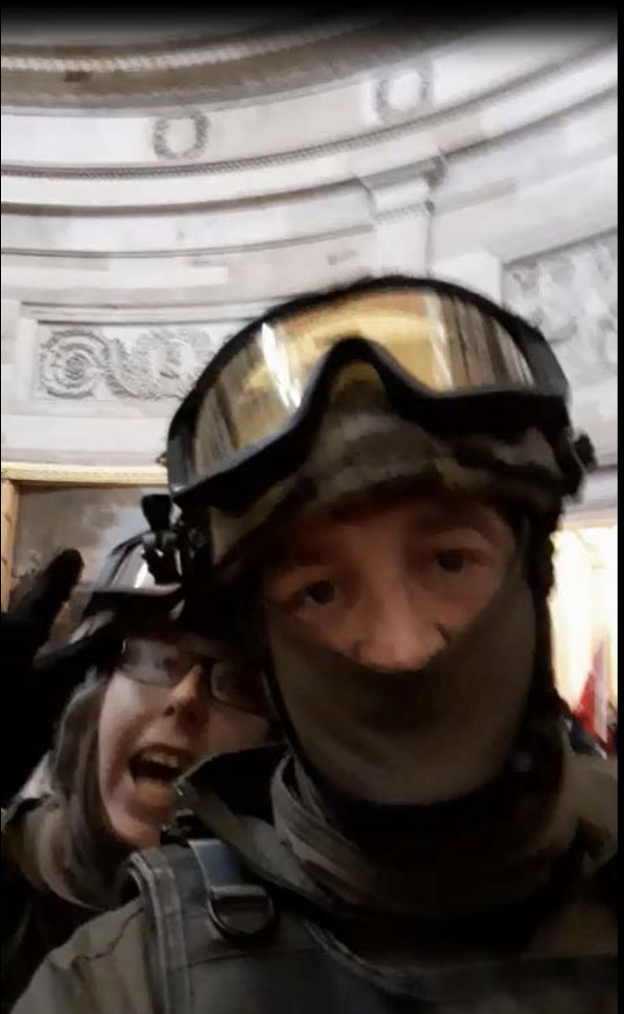
Yesterday, a magistrate judge in Nashville, Chip Frensley, gave Eric Munchel bail. He’s the guy who has become known as “Zip-Tie Guy” because of a picture of him taken in the Senate during the January 6 coup attempt, showing him dressed in tactical gear and holding zip ties.

The government will appeal the decision to DC Chief District Judge Judge Beryl Howell over the weekend, and thus far she has granted such requests from the government, so it’s certainly possible he will ultimately be held.

The bail hearing demonstrates one of the problems with the government’s investigation and prosecution going forward, one which demonstrates the necessity of prosecuting former President Donald Trump (see also this live tweet of the hearing and Politico’s account).

Munchel got charged, along with his mom, Lisa Marie Eisenhart, with the two trespassing charges used for most defendants, conspiracy among themselves, along with obstructing law enforcement during civil disorder.

The filing supporting detention described that Munchel must be found guilty of attempting to impede law enforcement during civil disorder.

To prove a violation of 18 U.S.C. § 231(a)(3), the government must show (1) that a civil disorder existed at the time of any alleged violation; (2) that such civil disorder was resulting in interference with a federally protected function; (3) that one or more law enforcement officers were lawfully engaged in the lawful performance of their official duties incident to and during the commission of such civil disorder; (4) that the defendant attempted to commit an act for the intended purpose of obstructing, impeding, or interfering, either by himself or with someone else, in a violent manner with such law enforcement officer or officers; and (5) that such attempt to act was done willfully and knowingly. United States v. Casper, 541 F.2d 1275, 1276 (8th Cir. 1976).

The evidence doesn’t show Munchel doing that — though shows his mom yelling at the cops. Indeed, the judge in the hearing described video showing him being deferential to cops inside the Capitol. The fact he grabbed the zip ties and said he wanted to seize the Senate gavel suggests he targeted Congress, not the cops.

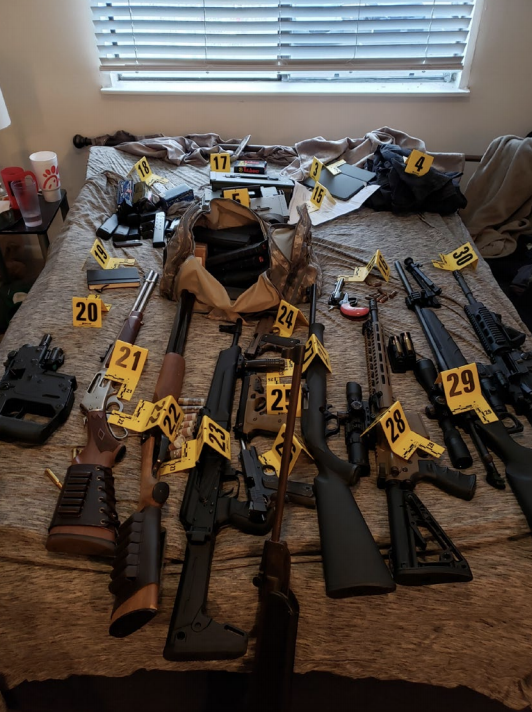
What the evidence does show is Munchel is a gun nut who wanted to terrorize lawmakers. His mom spoke more explicitly of violent revolution.

“It was a kind of flexing of muscles,” said Munchel, who wore a bulletproof vest and complained that police confiscated his Taser during the riot. “The intentions of going in were not to fight the police. The point of getting inside the building is to show them that we can, and we will.”

Preparing for their 10-hour drive home, the 30-year-old clamoured for greater organisation in the next steps to fight against Biden’s America. He worried that many pro-Trump warriors were individualists and lamented that potential leaders in the Make America Great Again (Maga) movement faced difficulty in rallying troops due to banishment from mainstream social media sites. “Our biggest struggle is getting together, knowing where to go, what to do and who to go to,” said Munchel despondently.

His mother agreed: “The left has everything: the media, organisations, the government. We have to organise if we’re going to fight back and be heard.” Eisenhart, a nurse, added that a violent revolution has long been on the cards thanks to last year’s racial justice protests, anti-police riots and “unnecessary” coronavirus lockdowns.

“This country was founded on revolution. If they’re going to take every legitimate means from us, and we can’t even express ourselves on the internet, we won’t even be able to speak freely, what is America for?” said a teary-eyed Eisenhart, biting into a hotdog. “I’d rather die as a 57-year-old woman than live under oppression. I’d rather die and would rather fight.”

The most compelling piece of evidence that Munchel could have coordinated with a more organized plot involves an exchange he had with the Oath Keepers as he headed into the building.

As MUNCHEL and Eisenhart make their way to the Capitol, they encounter several members of the “Oathkeepers,” a militia group that is distrustful of government authority. One of the Oathkeepers says, “There’s 65 more of us coming.” MUNCHEL, when he recognizes them, says in affirmation, “Oathkeepers,” and bumps fists with one of the men.

But that does’t show pre-planning nor does it tie his possession of the zip ties to any plan the Oath Keepers had.

The government clearly either fears that Munchel will engage in violence or it wants to make sure it keeps its showy zip-tie guy on ice to include kidnapping among the parts of the plot they’ll eventually lay out. But the judge is right that, thus far, the government hasn’t shown evidence that he coordinated with anyone except his mom.

Silent in all this (because, unlike the other kitted-out guy in the Senate that day, Munchel was not shown to have told a reporter that he responded to the call of the then-President to come to DC to engage in that show of force) is the framework of Trump’s calls to overturn an election. The evidence even suggests that Eisenhart claims to have believed Trump’s Big Lie of a stolen election (and it may well be true that she does believe it). But that’s the single factor that makes Zip-Tie Guy’s actions, with his mom, dangerous. He wanted to scare lawmakers, and he wanted to do it in the context of a plea to illegally retain power. A plea from Donald Trump.

Until such time as prosecutors are ready to argue that this show of terrorism was intended to support false claims of election theft mobilized in an attempt to overthrow the Constitutional government of the United Staes, judges are going to find that guys like Munchel owned their arsenals legally and — while violating specific laws protecting the Capitol and the counting of the votes — do not pose a grave threat to our country.

I’m not saying I believe that. I’m not even sure Frensley does.

But absent closer ties to the Oath Keepers (who did clearly pre-plan), the thing that makes the raid on the Capitol especially dangerous, the thing that makes Munchel’s grab for the gavel and the zip-ties criminal, is Trump’s illegal plan. And so, until prosecutors start naming Trump as a co-conspirator, start naming the Big Lie of a stolen election as the motivating cause of the violence, guys like Munchel are going to continue to get bail.

Update: Mirriam Seddiq did a video talking about how conspiracy works in US law, as applied to Trump’s incitement of an insurrection that lays out how this should be presented to judges.

Update: Over the weekend, Beryl Howell granted the government’s emergency motion for detention. The motion included an additional allegation against Munchel, that he had assaulted Bloomberg journalist William Turton.

On the evening of January 6, 2021, after the insurrection, an individual posted a video of the Grand Hyatt hotel lobby on Twitter. The person then posted a message that read: “After I took this video, several Trump supporters harassed me and tried to follow me to my room. One accused me of being ‘antifa.’3 Hotel security intervened and moved me to new room. What a weird day.” See https://twitter.com/WilliamTurton/status/1346980284252745729 (Last accessed on January 23, 2021). The person added: “The Trump supporters demanded that I delete the video. One woman flashed her taser at me, and threatened to mace me.” See https://twitter.com/WilliamTurton/status/1347024856416714752 (last viewed January 23, 2021). Two days later, on January 8, based on another video from the Grand Hyatt posted to social media, the person identified the defendant as “one of the people in the hotel lobby who demanded I delete the video, put his hands on me, and screamed at me . . . .” See https://twitter.com/WilliamTurton/status/1347699125408641024 (last viewed January 23, 2021); https://twitter.com/WilliamTurton/status/1347699345345417217 (last viewed January 23, 2021). Evidence of this encounter was not presented at the preliminary and detention hearing in the Middle District of Tennessee.

It also more aggressively described what Munchel had done as insurrection.

Finally, it is difficult to fathom a more serious danger to the community—to the District of Columbia, to the country, or to the fabric of American Democracy—than the one posed by armed insurrectionists, including the defendant, who joined in the occupation of the United States Capitol. Every person who was present without authority in the Capitol on January 6 contributed to the chaos of that day and the danger posed to law enforcement, the Vice President, Members of Congress, and the peaceful transfer of power. The defendant’s specific conduct aggravated the chaos and danger. It was designed to intimidate Members of Congress and instigate fear across the country. Make no mistake: the fear the defendant helped spread on January 6 persists—the imprint on this country’s history of a militia clad insurrectionist standing over an occupied Senate chamber is indelible. Only detention mitigates such grave danger.

It makes it clear Munchel may be facing additional charges.

The evidence amassed so far subjects the defendant to felonies beyond that with which he has been charged so far, including obstructing Congress, interstate travel in furtherance of rioting activity, sedition, and other offenses. These offenses carry substantial penalties, which incentivizes flight and evading law enforcement—a thought that the defendant already appears to have contemplated by virtue of avoiding his residence and workplace, terminating his Facebook account, and leaving his cell phone with an associate.

Share this entry

The DOD Flunkies’ Convenient Lapse of Executive Privilege

The first thing you should take away from this long Vanity Fair profile of the Trump loyalists who led DOD during the Transition period is that Kash Patel has a very selective approach to Executive Privilege. Deep in the story, when caught in a lie about a plot to have him replace CIA Director Gina Haspel, Patel invokes Executive Privilege to refuse to answer.

I asked Patel about an Axios story that broke just before we sat down to talk. It asserted that CIA director Gina Haspel threatened to resign after learning that Trump planned to install Patel as her deputy. “I’m not going to comment on what the president wanted to do or didn’t want to do, but there’s no conversations of that now or this week or this year,” he replied. But he seemed to be playing coy. The CIA gambit took place last year. In fact, when I had spoken with Cohen about the matter, he had told me, “The idea was to put Kash in as the deputy, which doesn’t require Senate approval, and then to fire Gina the next day, leaving Kash in charge…. Robert O’Brien, [Trump’s national security adviser], is the one who deep-sixed it.” When I pressed Patel further about these machinations, which had occurred in December, I saw him turn lawyerly: “That stuff is between me and the boss. That’s the only thing I don’t comment on. Ever. It’s executive privilege.”

But in the first lines of the profile, both he and former Acting Secretary of Defense Christopher Miller happily offer up a tale of how Trump not only claimed to know what an appropriate deployment of National Guard troops would be in preparation for January 6, but ordered DOD to have them deployed.

On the evening of January 5—the night before a white supremacist mob stormed Capitol Hill in a siege that would leave five dead—the acting secretary of defense, Christopher Miller, was at the White House with his chief of staff, Kash Patel. They were meeting with President Trump on “an Iran issue,” Miller told me. But then the conversation switched gears. The president, Miller recalled, asked how many troops the Pentagon planned to turn out the following day. “We’re like, ‘We’re going to provide any National Guard support that the District requests,’” Miller responded. “And [Trump] goes, ‘You’re going to need 10,000 people.’ No, I’m not talking bullshit. He said that. And we’re like, ‘Maybe. But you know, someone’s going to have to ask for it.’” At that point Miller remembered the president telling him, “‘You do what you need to do. You do what you need to do.’ He said, ‘You’re going to need 10,000.’ That’s what he said. Swear to God.”

I could not recall the last time a contingent that large had been called up to supplement law enforcement at all, much less at a demonstration—the Women’s March and the Million Man March sprang to mind—and so I asked the acting SECDEF why Trump threw out such a big number. “The president’s sometimes hyperbolic, as you’ve noticed. There were gonna be a million people in the street, I think was his expectation.” Miller maintained that initial reports on the anticipated crowd size were all over the map—anywhere from 5,000 to 40,000. “Park Police—everybody’s so hesitant to give numbers. So I think that was what was driving the president.”

There’s a lot of reason to believe this is bullshit. Trump wouldn’t ask for the Guard if he wanted a show of force, he’d ask for a helicopter flyover or something else inappropriate.  Trump isn’t a detail guy. Miller and Patel offered up a key (and dubious) excuse used elsewhere — that they hadn’t been told the Park Service had expanded the Trump rally to 30,000 attendees.

Most importantly, Patel demonstrated that he believes his actual conversations with Trump should be protected by Executive Privilege. Certainly, he would refuse to say anything bad about Trump.

Ezra Cohen[-Watnick], by contrast, isn’t prompted to. While he is permitted to claim that Trump threw everyone — the entire country — under the bus, he’s not asked about his mentor Mike Flynn’s role in the conspiracy.

Ezra Cohen, another of Miller’s top confidants, believes that his colleagues’ words and deeds may be well and good, but are beside the point: “The president threw us under the bus. And when I say ‘us,’ I don’t mean only us political appointees or only us Republicans. He threw America under the bus. He caused a lot of damage to the fabric of this country. Did he go and storm the Capitol himself? No. But he, I believe, had an opportunity to tamp things down and he chose not to. And that’s really the fatal flaw. I mean, he’s in charge. And when you’re in charge, you’re responsible for what goes wrong.”

[snip]

His promotion was fodder for trolls of every stripe. “To the left I became this horrible person that enabled the president, attacking [Obama officials] and all this other stuff like that,” Cohen contended as we sat in his kitchen and later drove through a Chick-fil-A before tooling around northern Virginia. “And then to the crazy people on the right—that are dangerous people that did the horrible, antidemocratic behavior with the Capitol—these nutjobs are saying that I am QAnon.”

The silence about Flynn’s call for martial law is all the more telling given Cohen’s nod to the way QAnon has worked him into their conspiracies. Flynn played a key role in mobilizing QAnon to serve as Trump’s army.

Also missing from this profile? Any mention of Flynn’s brother, Charles, who participated in a call with local DC officials calling for more help but whose role DOD hid until after Biden was inaugurated.

There are other silences as well, perhaps most notably Miller’s stubborn effort to burrow in a fourth ally, Mike Ellis, at NSA in the last hours of the Trump Administration.

So even before you get into the details, this profile should be regarded as an effort by three very slick dudes to recast their role as Trump flunkies in the wake of an inexcusable event.

With all that said, it appears to differ in key ways from the timeline DOD released days after the coup attempt. The Vanity Fair narrative makes several claims that are probably true: That Miller came to work expecting he might not get home that night (though didn’t stay in DC even as the National Guard did in advance of the inauguratoin), and that DOD was chastened given the gross abuse in response to June protests.

But it also suggests Muriel Bowser called for help 48 minutes after DOD’s timeline shows she did.

On the morning of January 6, as Miller recounted, he was hopeful that the day would prove uneventful. But decades in special operations and intelligence had honed his senses. “It was the first day I brought an overnight bag to work. My wife was like, ‘What are you doing there?’ I’m like, ‘I don’t know when I’m going to be home.’” To hear Patel tell it, they were on autopilot for most of the day: “We had talked to [the president] in person the day before, on the phone the day before, and two days before that. We were given clear instructions. We had all our authorizations. We didn’t need to talk to the president. I was talking to [Trump’s chief of staff, Mark] Meadows, nonstop that day.”

The security posture and response on January 6 did not occur in a vacuum. June 1, 2020, had been a perilous precedent. On that day federal police had expelled peaceful protesters from Lafayette Square to facilitate the president’s saunter over to St. John’s Church for a publicity stunt. But the brute force displayed to clear out the area proved a national embarrassment and allegedly influenced Washington mayor Muriel Bowser’s view, come January, about how the capital should be policed—and by whom. On the day before all hell broke loose on the Hill, she made it clear the D.C. police (MPD) would be running the show on the 6th, though 340 unarmed National Guard troops had been requested to help with traffic: “The District of Columbia is not requesting other federal law enforcement personnel and discourages any additional deployment without immediate notification to, and consultation with, MPD.”

Miller told me that when Trump made him head of the Pentagon, in November, “the bar was pretty low.” He had three goals. “No military coup, no major war, and no troops in the street,” before observing dryly, “The ‘no troops in the street’ thing changed dramatically about 14:30…. So that one’s off [the list].”

The day began with a lull. “We had meetings upon meetings. We were monitoring it. And we’re just like, Please, God, please, God. Then the damn TV pops up and everybody converges on my office: [Joint Chiefs of Staff] chairman [Mark Milley], Secretary of the Army [Ryan] McCarthy, the crew just converges.” And as intelligence started cycling in, things went from watch and see to “a current op.” Miller recalled, “We had already decided we’re going to need to activate the National Guard, and that’s where the fog and friction comes in.”

“The D.C. mayor finally said, ‘Okay, I need more,’” Kash Patel would tell me. “Then the Capitol police—a federal agency and the Secret Service made the request. We can support them under Title 10, Title 32 authorities for [the] National Guard. So [they] collectively started making requests, and we did it. And then we just went to work.”

With his use of the word “finally,” Patel insinuates there was a delay before Bowser called and asked for help. Meanwhile, Miller suggests that DOD’s response took place at 2:30PM.

The timeline, however, shows that Bowser requested help 29 minutes after DOD says they got “open source reports” of demonstrators moving on the Capitol.

1305: A/SD receives open source reports of demonstrator movements to U.S. Capitol.

1326: USCP orders evacuation of Capitol complex.

1334: SECARMY phone call with Mayor Bowser in which Mayor Bowser communicates request for unspecified number of additional forces.

1349: Commanding General, DCNG, Walker phone call with USCP Chief Sund. Chief Sund communicates request for immediate assistance.

1422: SECARMY phone call with D.C. Mayor, Deputy Mayor, Dr. Rodriguez, and MPD leadership to discuss the current situation and to request additional DCNG support.

1430: A/SD, CJCS, and SECARMY meet to discuss USCP and Mayor Bowser’s requests. 1500: A/SD determines all available forces of the DCNG are required to reinforce MPD and USCP positions to support efforts to reestablish security of the Capitol complex.

1500: SECARMY directs DCNG to prepare available Guardsmen to move from the armory to the Capitol complex, while seeking formal approval from A/SD for deployment. DCNG prepares to move 150 personnel to support USCP, pending A/SD’s approval.

1504: A/SD, with advice from CJCS, DoD GC, the Chief of the National Guard Bureau (CNGB), SECARMY, and the Chief of Staff of the Army, provides verbal approval of the full activation of DCNG (1100 total) in support of the MPD. Immediately upon A/SD approval, Secretary McCarthy directs DCNG to initiate movement and full mobilization. In response, DCNG redeployed all soldiers from positions at Metro stations and all available non-support and non-C2 personnel to support MPD. DCNG begins full mobilization.

The Vanity Fair profile suggests DOD made the decision based off watching TV — presumably those open source reports — that reinforcements would be needed. But they didn’t even begin to “discuss” doing so until 2:30, and didn’t move to make that deployment until 3:04 (so 34 minutes after Miller describes).

Plus, Patel makes no mention of the call from Capitol Police at 1:49.

Ezra Cohen would like you to believe that he got thrown under the bus along with all the people supporting rule of law. Patel would like you to believe the failures of DOD under his watch were not attributable to the Chief of Staff. And Miller would like you to know his family doesn’t much like Donald Trump.

But the whole story reads like a fairy tale.

Share this entry

Now We Know Why Jeffrey Rosen Has Been Silent, How About Chris Wray?

Since the attempted coup, both Jeffrey Rosen and Chris Wray (and Wray’s then-Deputy David Bowdich) were almost silent about the attack. A week after the attack, Rosen  a video in the middle of the night, explaining what he had done during the coup.

The day after, Wray released a short statement. More than a week later, he spoke at a closed-press meeting on inauguration security. Neither provided the kind of daily updates one would expect after such an attack.

Last night (as Rayne laid out here), NYT reported on why Rosen was so silent: because he’s a witness in what should be a criminal investigation into how the attack relates to the effort to overturn the election.

As the NYT lays out, in the days leading up to the coup attempt, Trump already tried to replace Rosen with someone, Jeffrey Bossert Clark, who would be willing to take steps to overturn the vote.

The effort to force Rosen to use DOJ resources to undermine a democratic election started on December 15, the day after Bill Barr resigned.

When Mr. Trump said on Dec. 14 that Attorney General William P. Barr was leaving the department, some officials thought that he might allow Mr. Rosen a short reprieve before pressing him about voter fraud. After all, Mr. Barr would be around for another week.

Instead, Mr. Trump summoned Mr. Rosen to the Oval Office the next day. He wanted the Justice Department to file legal briefs supporting his allies’ lawsuits seeking to overturn his election loss. And he urged Mr. Rosen to appoint special counsels to investigate not only unfounded accusations of widespread voter fraud, but also Dominion, the voting machines firm.

Then, over the weekend in advance of the certification, Assistant Attorney General Jeffrey Bossert Clark told Rosen Trump was going to make him Attorney General so he could chase Rudy Giuliani’s conspiracy theories.

On New Year’s Eve, the trio met to discuss Mr. Clark’s refusal to hew to the department’s conclusion that the election results were valid. Mr. Donoghue flatly told Mr. Clark that what he was doing was wrong. The next day, Mr. Clark told Mr. Rosen — who had mentored him while they worked together at the law firm Kirkland & Ellis — that he was going to discuss his strategy to the president early the next week, just before Congress was set to certify Mr. Biden’s electoral victory.

Unbeknown to the acting attorney general, Mr. Clark’s timeline moved up. He met with Mr. Trump over the weekend, then informed Mr. Rosen midday on Sunday that the president intended to replace him with Mr. Clark, who could then try to stop Congress from certifying the Electoral College results. He said that Mr. Rosen could stay on as his deputy attorney general, leaving Mr. Rosen speechless.

In a replay of the 2004 Hospital Hero moment, the others involved (including White House Counsel Pat Cipollone) agreed they’d resign en masse if Trump replaced Rosen, which led him to back off the plan.

NYT had four sources for this story, all of whom fear — even after Trump has been relegated to Florida — retaliation.

This account of the department’s final days under Mr. Trump’s leadership is based on interviews with four former Trump administration officials who asked not to be named because of fear of retaliation.

Clark claimed there were errors in this story, but ultimately he claimed Executive Privilege (his statement to WaPo on the topic, which I’ve used here, is more expansive).

In a statement that seemed to draw on language in the New York Times account, Clark said, “I categorically deny that I ‘devised a plan . . . to oust’ Jeff Rosen. . . . Nor did I formulate recommendations for action based on factual inaccuracies gleaned from the Internet.”

“My practice is to rely on sworn testimony to assess disputed factual claims,” Clark said. “There were no ‘maneuver[s].’ There was a candid discussion of options and pros and cons with the President. It is unfortunate that those who were part of a privileged legal conversation would comment in public about such internal deliberations, while also distorting any discussions. . . . Observing legal privileges, which I will adhere to even if others will not, prevent me from divulging specifics regarding the conversation.”

The WaPo version of this story names all who were involved in the confrontation with Trump (though the sources for the story are likely, in part, their aides).

At the meeting were Trump, Clark and Rosen, along with Richard Donoghue, the acting deputy attorney general; Steven A. Engel, the head of the department’s Office of Legal Counsel; and Pat Cipollone, the White House counsel, the people familiar with the matter said. The people said Rosen, Donoghue, Engel and Cipollone pushed against the idea of replacing Rosen, and warned of a mass resignation.

Clark says he will only respond to a sworn statement. By all means, the impeachment managers should demand sworn testimony, from all involved.

Of course, that would mean Pat Cipollone, who led the former President’s defense in his first impeachment trial, would be asked about the second time Trump tried to use government resources to cheat. Steve Engel, who authorized the withholding of a whistleblower complaint describing Trump’s earlier attempt, would also testify. Rosen, who participated in having DOJ chase Sidney Powell’s conspiracy theories about Mike Flynn, would be asked to testify about why the conspiracy theories about Dominion machines were any less credible than the Flynn ones. And Donoghue, who served as a filter for some of the conspiracy theories Rudy Giuliani had been fed by men who have since been named Russian agents, would be asked to testify about why Rudy wasn’t a credible source.

Rosen was silent in his final two weeks, presumably, for fear he might get fired and replaced by someone who would be more pliant to a coup attempt. But he — and the three others — are also witnesses to a larger plot that ended up in violence and death.

I wonder if Chris Wray has similar evidence he’ll be asked to share.

Share this entry