Follow the Money, Break the Attorney-Client Wall of Obstruction

The other day I noted that there were at least 25 lawyers who were key witnesses or subjects of the Trump investigations investigating his parallel attempts to steal classified documents and the 2020 election. I was right to say, “at least.” I forgot Christina Bobb in my count, a key witness for both investigations (though she has always been candid that she did not play the role of a lawyer in the stolen document case).

For all the TV lawyers who spend all their time talking about these investigations, none have really articulated the difficulties this created for this investigation. It created 26 walls of privilege around many of the key events under investigation. There are numerous cases where we know an event or document exists, for example, but actually getting to that evidence or witness testimony involves jumping through extra hoops.

Robert Mueller is not known to have attempted to breach the privilege of Jay Sekulow (who, at least according to Michael Cohen’s testimony, dangled pardons and participated in writing Michael Cohen’s false testimony) or others; Jack Smith doesn’t have that luxury.

Keep that detail in mind as you consider all the reports of subpoenas sent out in the last two months, asking for far more details of the disposition of Trump’s various PAC funds.

CNN was the first to report that Rudy had received a subpoena, asking for information about finances.

Special counsel Jack Smith’s team has subpoenaed Donald Trump’s former attorney Rudy Giuliani, asking him to turn over records to a federal grand jury as part of an investigation into the former president’s fundraising following the 2020 election, according to a person familiar with the subpoena.

The subpoena, which was sent more than a month ago and has not been previously reported, requests documents from Giuliani about payments he received around the 2020 election, when Giuliani filed numerous lawsuits on Trump’s behalf contesting the election results, the person said.

Prosecutors have also subpoenaed other witnesses who are close to Trump, asking specifically for documents related to disbursements from the Save America PAC, Trump’s primary fundraising operation set up shortly after the 2020 election, according to other sources with insight into the probe.

The Guardian, which dates the subpoena to late November, described that it was looking for Rudy’s retainer agreements.

The source said the subpoena sought, among other things, copies of any retainer agreements between Trump and Giuliani, or the Trump campaign and Giuliani, and records of payments and who made those payments.

The WaPo followed with a report describing a subpoena seeking — in addition to documents on Smartmatic and Dominion voting machines — a slew of other financial information.

One part of the four-page legal document asks recipients to reveal if anyone other than themselves are paying for legal representation — and if so, to provide a copy of the retention agreement for that legal work. At least one other former campaign official also received the subpoena, according to that person’s lawyer, who also spoke on the condition of anonymity to avoid drawing attention to his client.

[snip]

The subpoena shows the Justice Department is interested in other Trump entities besides the Save America PAC — which The Post and others reported earlier this year was a subject of inquiry by investigators. It seeks “all documents and communications” related to a panoply of other Trump-affiliated groups, including the Make America Great Again PAC, the Save America Joint Fundraising Committee and the Trump Make America Great Again Committee.

Recipients are asked to produce documents related to the “formation, funding and/or use of money” of the groups and to show all employment contracts or correspondence with the groups or officials affiliated with them.

Recipients were also asked for documents related to the genesis of an “Election Defense Fund,” an entity that Trump officials created to raise money from grass-roots donors after the election. Officials later testified to the House committee investigating the events of Jan. 6, 2021, that such a fund never technically existed but was a mechanism to generate funds from people who believed and were outraged by Trump’s false election-fraud claims.

This is likely not just (as the WaPo correctly notes) a follow-up on Cassidy Hutchinson’s cooperation with the investigation. By the time this subpoena was sent, DOJ would have known of several other scams associated with legal representation — and had been investigating Sidney Powell’s own scam (possibly including her payment of Oath Keeper defense attorneys) for 15 months. For example, I showed how Alex Cannon (who has been a key source to these journalists elsewhere), who would necessarily be a witness in the stolen documents case, was implicated in any alleged attempt to silence Hutchinson. He himself was represented, pro bono, by Marc Kasowitz’s firm. The same piece described how the evolving story from Ken Klukowski, who is the lawyer that sent out detailed instructions for the fake electors plot, including observations about how they were exposed legally, was being represented by Big Dick Toilet Salesman Matt Whitaker’s legal firm, perhaps paid for by alleged groper Matt Schlapp.

I recommend you bookmark this Politico piece, which catalogs who was represented by whom for their appearances before the January 6 Committee (a number of people have gotten new lawyers since), because it gives a sense of what kind of witnesses were represented by what kind of lawyers.

Add to the fact that even key participants refused to claim that at least two key players — Jenna Ellis and Boris Epshteyn (the latter of whom had his phone seized in September and who got access to Trump during the period the former President refused to return stolen classified documents by arranging his legal representation) — were playing a legal rather than a PR or logistical role. Plus, a number of key lawyers had up to three different roles in the short post-election time period, which would limit which days they could claim to be working for Trump rather than (in the case of Klukowski) purportedly working for US taxpayers.

The important point, however (and at least one story covering these late subpoenas got this detail wrong), details about your retention of someone, as opposed to the advice offered as part of it, is not privileged. Indeed, Donald Trump and all his frothers cheered wildly when Perkins Coie had to provide billing records to John Durham and Marc Elias had to testify about the ties between Perkins Coie and the Hillary campaign. Durham tried it, successfully with Fusion GPS, as a means to breach privilege. But what he found on at least two occasions was that his conspiracy theories about what Democrats were hiding behind claims of privilege were wrong. Jack Smith already has a lot of documentation documenting real conspiracies to prevent the peaceful transfer of power, such as those notes from Klukowski detailing the laws that might present particular legal risk for Nevada’s fake electors; what he needs now are cooperating witnesses, including, necessarily, some lawyers.

And collecting the records of how false claims about voter fraud paid for efforts to obstruct the subsequent investigation — how Trump duped his followers to ensure that he would be safe while all of them would face jail time — will be one way to map the structure of this larger massive effort. It may also be a way to chip away at the large number of Trump witnesses who — at least before the January 6 Committee — were still telling wildly improbable stories to hide details of Trump’s actions.

Share this entry

BREAKING: James Comer Jumps Right on Hunter Biden’s Dick Pics

As expected, James Comer has wasted no time after getting the House Oversight gavel before launching an investigation into Hunter Biden.

ABC reports that, in addition to demanding SARs relating to Hunter Biden (at least some of which Ron Johnson already got), Comer has scheduled testimony for three former Twitter executives — Jim Baker, Yoel Roth, and Vijaya Gadde.

Comer sent letters to former top Twitter employees including former Twitter lawyer Vijaya Gadde, former head of trust and safety Yoel Roth, and former deputy general counsel James Baker, requesting that they testify at a public hearing during the week of Feb. 6.

“Your attendance is necessary because of your role in suppressing Americans’ access to information about the Biden family on Twitter shortly before the 2020 election,” Comer wrote to the former employees.

Among the things Twitter “suppressed access to” before the November 2020 election, of course, was access to Hunter Biden’s dick pics.

Indeed, we know some of those dick pics were sent out as part of a coordinated campaign pushed by Steve Bannon associate Guo Wengui.

Starting on October 22, 2020, Guo then personally managed minute details of the distribution of pictures and videos. In audio messages he sent to groups of supporters using WhatsApp, which I obtained, he set up a process in which key backers would post Hunter Biden pictures on his streaming website, GTV—a sort of Chinese-language YouTube knockoff—and others would then amplify them. He decreed that much of the material would first be posted by followers living abroad, to help prevent any lawsuits seeking to block the effort.

“Look at the video copied from Hunter’s computer,” Guo said in a WhatsApp messages to underlings on October 27. (He spoke in Chinese. The messages have been translated.) In another message, referring to various Hunter videos, Guo ordered: “Post one right now, one every hour from now on…I want everyone to fully promote it.”

In other words, James Comer has made it his top priority — one of the very first things he did as Chair! — to schedule a hearing so he can learn why Twitter prevented him from accessing pictures of Hunter Biden’s dick leading up to the 2020 election.

It is the top priority of the House GOP to inquire why Twitter took down non-consensually posted revenge porn posted by an associate of a top GOP propagandist.

Update: Axios’ story on this is even worse than ABC’s. It falsely suggests the only thing that Twitter only suppressed access to the NY Post story on the “Hunter Biden” “laptop” (and doesn’t note that even Fox wouldn’t report it), giving Comer a pass for prioritizing Hunter Biden’s dick pics.

Driving the news: House Oversight Chair James Comer (R-Ky.) sent letters Wednesday to several former Twitter executives who were involved in the decision to suppress the New York Post’s reporting about Hunter Biden.

Update: Bloomberg’s Billy House also doesn’t think it worth mentioning that James Comer has called a hearing, in part, because Twitter took down non-consensual dick pics.

Share this entry

Matt Taibbi Confesses He Hasn’t Read His Own Twitter Files

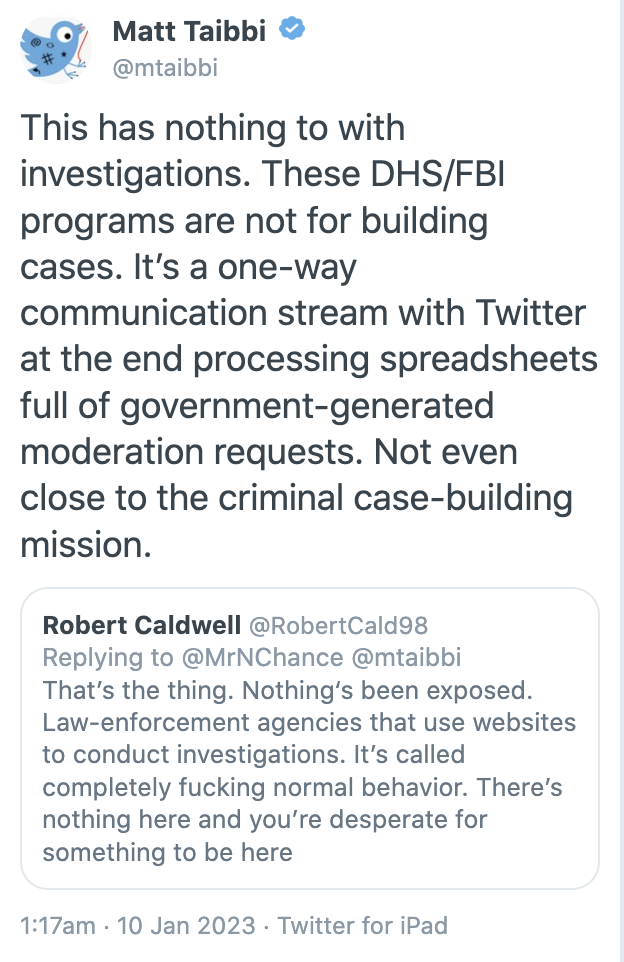
Matt Taibbi, whom I have taken to calling “#MattyDickPics” for his wails about tweets that were part of a coordinated revenge porn campaign targeting Hunter Biden being taken down, confessed yesterday he knows virtually nothing about his own “Twitter Files” campaign, including what he himself has posted. In response to a Twitter account with just four followers that observed that his campaign had exposed nothing, MattyDickPics tweeted the following:

Before I use MattyDickPics to debunk MattyDickPics, let’s first unpack his claims: He says that, “These DHS/FBI programs are not for building cases” which he judges is “Not even close to the criminal case-building mission.”

Let’s talk about his premise, first of all — the claim that the “mission” is about “criminal case-building.”

The Cybersecurity & Infrastructure Security Agency, the part of DHS that runs what Taibbi calls a “program,” describes its public-facing mission this way:

The Cybersecurity and Infrastructure Security Agency (CISA) leads the national effort to understand, manage, and reduce risk to our cyber and physical infrastructure. We connect our stakeholders in industry and government to each other and to resources, analyses, and tools to help them build their own cyber, communications, and physical security and resilience, in turn helping to ensure a secure and resilient infrastructure for the American people.

In his January 6 Committee testimony, former CISA Director Chris Krebs described the kinds of things CISA would do to help protect the vote.

In terms of the bidding internal to the U.S. Government on who had lead in those three areas [targeting of campaigns, targeting of election infrastructure, disinformation], it was clear, you know, once Jeh Johnson, the prior Secretary in 2017, January of 2017, designated election infrastructure critical infrastructure, it was, you know, CISA had the lead for working with State and local election officials on protecting critical infrastructure — or election infrastructure. That’s the systems. That’s the hardware. That’s the equipment and the processes associated with conducting an election.

Q Ands so can stop you there for a second?

A Yes.

Q Is that primarily protecting against what we would think of as hacking?

A No, not necessarily. It’s, again, critical infrastructure, we had an all-hazards approach. So we worked with election officials to conduct active shooter drills and 13 assessments. We would go look at election warehouses where equipment is stored in the off season, do physical risk assessments. In the wake of hurricanes, we would work with election officials. In fact, Kyle Ardoin, who’s the Secretary of State in Louisiana, in 2000 — the summer of 2020, I guess, where they got hit pretty hard by an election, we helped him work with FEMA and some of the response efforts there to get resources he needed to be able to conduct the election in 2020. So it was not just cyber. That tended to be the public – at least what the public cared about or the media cared about, just because it’s 2016, but it was – again, it was an all hazards. And we did — I don’t want to put numbers on it, because I don’t recall, again, off the top of my head, but a significant number of physical assessments of election facilities.

[snip]

Q You talked earlier about the infrastructure and protecting that. How did you work with State officials to make sure that their – to help them ensure that their equipment was safe and secure?

A We had a number of different offerings that we had. There’s an entire catalog. There’s an election security catalog. It’s not in here because it’s thick. But we would go out and conduct things like security and vulnerability assessments. We could do red team. We could do fairly in-depth assessments of voter registration database configurations 1) We had a, what’s known as cyber hygiene scan that they would sign up for and we’d do a regular scan to see if anything touching the internet was mis- – well, not misconfigured, but running an old vulnerable version. We developed in the summer before the election a product called – or tool called Crossfeed, which was a little bit more in-depth of assessing vulnerabilities of systems and websites that are touching the internet. ~ And then we would provide them reports and technical assistance on how they might secure things.

The stuff that MattyDickPics is concerned about was an effort to facilitate state election officials’ ability to rebut false claims about elections.

Q We’ve seen some documents that were produced by DHS relating to efforts to connect with social media platforms, Twitter, for example, to working with State and local officials to try to address claims that were being made on Twitter that were false.

A Uhhh,

Q Are you familiar generally with that initiative?

A I think generally, yes. And I gave an example of the 2018 election, at least, how we were able to connect I think it was Ohio with one of the platforms.

Q And it seemed as if that was a fairly robust — I was going to say operation. That’s probably too strong a word. But there was a fairly – it looked to be, from the documents I’ve seen, a fairly well-coordinated effort to put State officials in touch with the social media platforms and try to provide the information necessary to address what were false claims in their respective jurisdictions.

A I think certainly the efforts to make those connections was a priority. We had frequent — I think it was monthly – at least monthly I think monthly, let me put it that way meetings between interagency partners, so FBI, DNI, and CISA, with representatives from the social media platforms. And we sometimes did those out in California. You know, I would attend every now and then some of those meetings. Now, State and local partners were not there. This was just making sure the Federal Government and the social media platforms were connected and were sharing kind of our understanding of how things were playing out, what our concerns were.

None of that, CISA’s role in information-sharing, is law enforcement. The one example Krebs mentioned that involved an attempted hack, CISA passed off to the FBI and intelligence agencies.

And there was a State, Delaware observed an unknown actor trying to exploit an Oracle database vulnerability that they had had patched. So what we were able to do is Delaware let us know. We said, that’s interesting. ~ But because we were integrated with the FBI and the intelligence community and others, we could actually say, hey, 12 guys so it wasn’t just for our benefit, like | said, decision support. We were able to share it with our operational partners for them to go do whatever they need to do. Soit was a functional operational watch cell, also coordinating situational awareness, coordinating action. And that was and that was the day.

CISA didn’t ask for anything back from Twitter because CISA is not a law enforcement agency (note: one other thing MattyDickPics is referencing is that a Signal thread the FBI used for sharing information was treated as one way, but according to Chan, the social media companies would respond by other channels). It has no law enforcement mandate. Is has no case-building mandate.

With regard to CISA — and MattyDickPics is not alone in this gross misunderstanding of CISA’s mandate or legal status — MattyDickPics’ entire premise is false.

But that also means his complaint is wrong. Is MattyDickPics complaining that people make an effort to correct errors about the election? Would he prefer that local election authorities try to chase down rumors and false claims themselves, even as they’re putting in 16-hour days trying to run an election? Does he think that deliberate misinformation about elections, like non-consensually posted dick pics, must be protected on social media sites? Is he angry — as Elon Musk seems to be — that social media sites choose not to be the vehicle for messaging that makes it harder to conduct successful elections?

If you’re complaining that an information-sharing agency is sharing information, then ultimately your complaint is that you don’t think that information should be shared, that you don’t think election officials should make an effort to ensure information about elections is clear and accurate — or at least, you don’t think the federal government should do anything to protect elections. If that’s your view, own it.

Even with FBI, MattyDickPics’ premise that the mission is “case-building” is partly wrong. In addition to its law enforcement mission, FBI has a counterintelligence mission, which would cover a good deal of interaction with social media sites. Indeed, a great deal of entire threads of MattyDickPics’ rants pertain to the FBI passing on assessments about such operations, as when accounts associated with the Internet Research Agency were shared. The FBI has built several cases against the IRA, but that’s not the primary goal. The primary goal is to track how Russia and China and Iran attempt to interfere in our country.

Some of what MattyDickPics seems to misunderstand about this is that foreign spooks will pretend to be Americans as part of their efforts to fuck in democratic elections. For example, MattyDickPics has said nothing about the most significant hack-and-disinformation campaign from 2020, an Iranian attempt to pose as Proud Boys to send messages to Democrats to discourage them from voting. It’s not impossible that some of what he has portrayed as FBI interest in “Americans” was actually an effort to adopt the identity of Proud Boys — effectively maligning right wing Trump supporters — as cover for their operation. This kind of FBI investigation might never result in charges — because you’re never going to arrest the Iranian spooks behind it — but posing as American Proud Boys to interfere in the election could be charged under FARA laws.

One can complain about FBI’s dual mission — lord knows I have! But one cannot claim that FBI has exclusively a case-building mission and be entirely accurate.

Still, maybe all that can be excused because MattyDickPics decided to respond to a 4-follower Twitter account that also misunderstood the premise of some of what this information sharing is about.

It’s the claim that the FBI “program,” at least, is not about building cases, that I find outrageous.

Among the single screen caps that Twitter Files followers have latched onto most — along with one about Adam Schiff inappropriately and unsuccessfully trying to use Twitter’s QAnon rules to protect staffers (I won’t link that because MattyDickPics doxxed the person in question), a CIA official asking to be included in a public event, and the NSA asking whether Twitter still prohibited Dataminr from sharing the “firehose” of Twitter content with intelligence agencies (they did, though under Elmo, the Saudis and Qataris will reportedly be given access to it) — is this one, which they claim is proof that the FBI asked for location data without legal process:

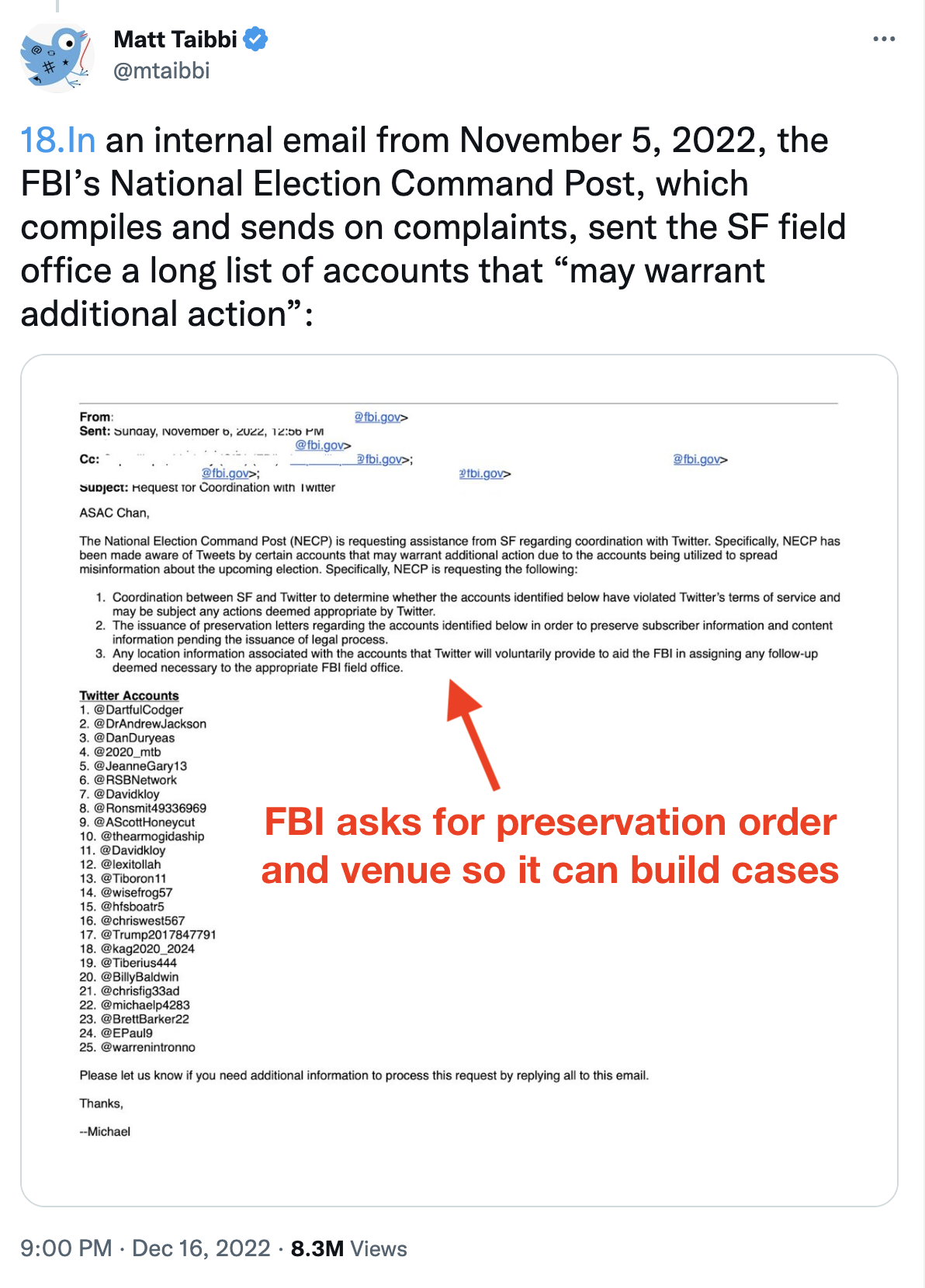
As a threshold matter, note what this is not: an email from Elvis Chan, the guy in charge of San Francisco’s Election Command Post, to Twitter. It is an email from the National Election Command Post to Chan. MattyDickPics doesn’t explain how Twitter got this. He has “censored” how Chan sent this to Twitter.

Before I get into the content, let me repeat some background that two of Elmo’s pets, at least, claim to be familiar with, which I laid out here. Here’s how Chan explained the actions of both the National and San Francisco Election Command Post, which is behind a great deal of the FBI to Twitter requests MattyDickPics wails about.

A. During FBI San Francisco’s 2020 election command post, which I believe was held from the Friday before the election through election night, that Tuesday at midnight, information would be provided by other field offices and FBI headquarters about disinformation, specifically about the time, place or manner of elections in various states. These were passed to FBI San Francisco’s command post, which I mentioned to you before I was the daytime shift commander, and we would relay this information to the social media platforms where these accounts were detected. So I do not believe we were able to determine whether the accounts that were posting time, place or manner of election disinformation, whether they were American or foreign.

Q. But you received reports, I take it, from all over the country about disinformation about time, place and manner of voting, right?

A. That is — we received them from multiple field offices, and I can’t remember. But I remember many field offices, probably around ten to 12 field offices, relayed this type of information to us. And because DOJ had informed us that this type of information was criminal in nature, that it did not matter where the — who was the source of the information, but that it was criminal in nature and that it should be flagged to the social media companies. And then the respective field offices were expected to follow up with a legal process to get additional information on the origin and nature of these communications.

Q. So the Department of Justice advised you that it’s criminal and there’s no First Amendment right to post false information about time, place and manner of voting?

[snip]

A. That was my understanding.

Q. And did you, in fact, relay — let me ask you this. You say manner of voting. Were some of these reports related to voting by mail, which was a hot topic back then?

A. From my recollection, some of them did include voting by mail. Specifically what I can remember is erroneous information about when mail-in ballots could be postmarked because it is different in different jurisdictions. So I would be relying on the local field office to know what were the election laws in their territory and to only flag information for us. Actually, let me provide additional context. DOJ public integrity attorneys were at the FBI’s election command post and headquarters. So I believe that all of those were reviewed before they got sent to FBI San Francisco.

Q. So those reports would come to FBI San Francisco when you were the day commander at this command post, and then FBI San Francisco would relay them to the various social media platforms where the problematic posts had been made, right?

A. That is correct.

Q. And then the point there was to alert the social media platforms and see if they could be taken down, right?

A. It was to alert the social media companies to see if they violated their terms of service.

[snip]

Q. And this command post was chosen to be — I mean, it addresses nationwide election-related information, right?

A. So every field office, every FBI field office was mandated by headquarters to stand at a command post at least on election day. And FBI San Francisco was responsible for relaying any time, place or manner disinformation or malign-foreign-influence information to the social media companies as well as accepting any referrals from the social media companies.

Q. So FBI San Francisco had the special job of referring concerns to social media companies?

[snip]

THE WITNESS: Yes, and the reason for that is because the majority of the social media companies are headquartered in FBI San Francisco’s territory. [my emphasis]

That is, much of this activity (including this screen cap in particular) came in the context of a DOJ Public Integrity determination that lying about the time, place, or manner of voting might be a crime, and — Chan’s understanding at least — referrals to Twitter had already been vetted by a Public Integrity prosecutor.

As I’ve noted, this is not a frivolous claim. In early 2021, one of Bill Barr’s closest associates, Seth DuCharme, then serving as EDNY US Attorney, charged a Jack Posobiec associate named Douglass Mackey with violations of the Ku Klux Klan Act for doing this kind of thing at scale, by tweeting that users could text their vote in rather than show up and cast it, in 2016. Almost 5,000 people responded to this campaign and texted in their “vote” for President. It took two years and some HuffPo reporting before Mackey was identified and several more years to charge him.

Mackey is aggressively contesting the charge, including on First Amendment grounds; his trial is scheduled to start on March 13.

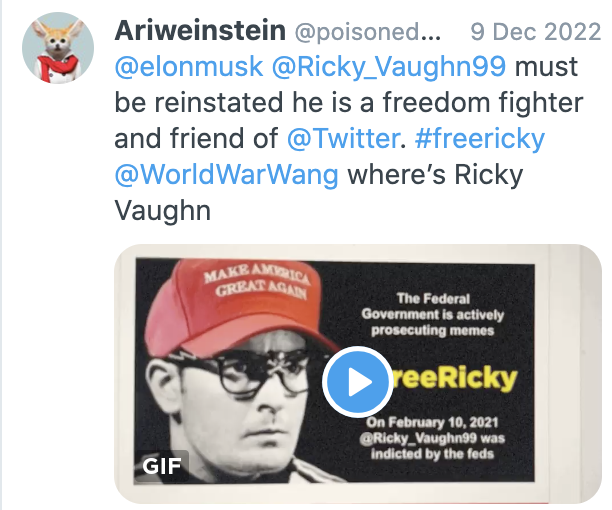
There’s even a tie between Mackey’s campaign and Elmo’s efforts to restore white supremacists to the platform. Right wingers have been lobbying Elmo to reinstate the pseudonymous Ricky_Vaughn99 account.

That’s what this is about: Efforts, some conducted at scale, to suppress the vote of certain Americans by lying to them about how or when or where to vote. And the involvement of prosecutors on the front end indicates that this was not just an effort to alert Twitter to misinformation so it could remove it if it chose to. This activity — which, again, makes up a great deal of what MattyDickPics has wailed about — was conducted in the context of law enforcement investigations.

But MattyDickPics has already confirmed that. The very screen cap in question — one of the screen caps that MattyDickPics’ frothers are most outraged about (caveating, again, that MattyDickPics chose to “censor” how Chan actually passed this onto Twitter) — asks for the following regarding 25 accounts that are “spread[ing] misinformation about the upcoming election:”

  1. Coordination between [San Francisco’s Field Office] and Twitter to determine whether the accounts identified below have violated Twitter’s terms of service and may be subject any actions deemed appropriate by Twitter.
  2. The issuance of preservation letters regarding any of the accounts identified below to preserve subscriber information and content information pending the issuance of legal process.
  3. Any location information associated with the accounts that Twitter will voluntarily provide to aid the FBI in assigning any follow-up deemed necessary to the appropriate FBI field office.

MattyDickPics has focused primarily on Bullet 1: If this violates Twitters terms of service, then — the FBI request suggests — Twitter can choose to do what it wants. That’s the “censorship” of efforts to dupe people into wasting their ability to participate in democracy that MattyDickPics is so outraged about.

Bullet 2, however, single-handedly refutes MattyDickPics’ claim from yesterday. Chan was supposed to ask for preservation letters, a request that Twitter preserve the account long enough that the FBI could follow up with a subpoena and/or warrant to get the subscriber information and then the content. This screen cap is explicitly about FBI’s case-building mission. MattyDickPics proved, on December 16, that MattyDickPics’ claims yesterday are false.

And even Bullet 3 — the reason this was deemed such an abuse — is about building a case. The National Command Post was not asking, voluntarily, for information that would help it identify whose mother’s basement this disinformation campaign was launched from, whether Brooklyn or Iran. Rather, it was asking for location information sufficiently detailed such that DOJ could assign follow-up leads to a US Attorney’s office that might be able to prosecute it. In fact, Mackey is challenging his prosecution, in part, by challenging venue in Brooklyn, a subject on which Judge Nicholas Garaufis has reserved judgment. That request for location information — accompanied as it was by a request for preservation order to get location information with a warrant — was all part of building a case.

One can certainly argue that the prosecution of Mackey and people like him for trying to affect the election by duping people out of their vote is a violation of the First Amendment, just like one can argue, as MattyDickPics is, that Twitter should be forced to permit users to use the platform to dupe others — Mackey allegedly targeted Blacks and Spanish speakers — out of casting their vote.

That’s a debate we can have.

But there’s no debate about whether these Command Post requests came in a framework that envisioned the possibility of case-building. MattyDickPics has already proven that MattyDickPics is lying about that.

Share this entry

At Least 25 Lawyers Are Subjects or Witnesses in the Various Trump Investigations

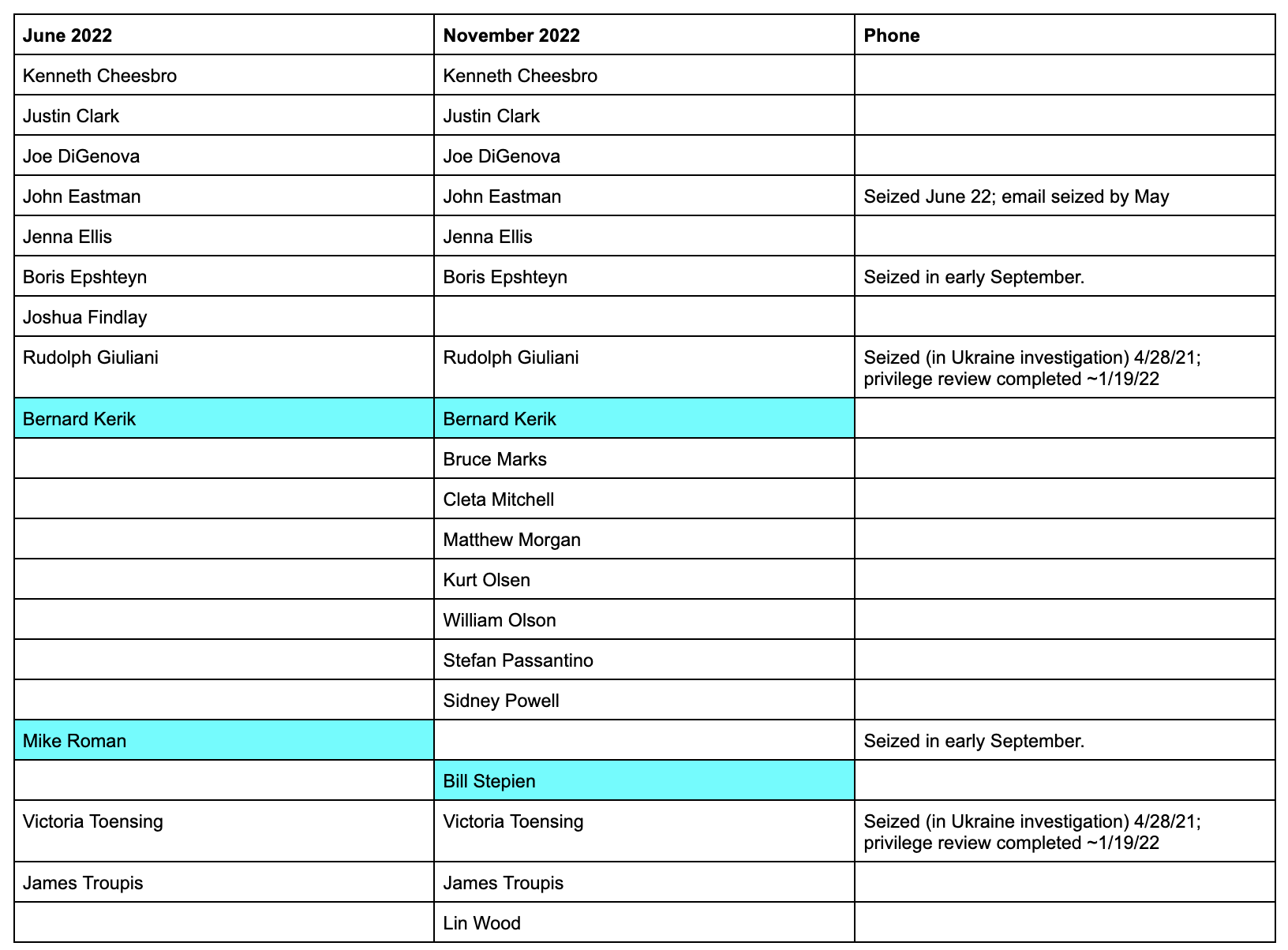
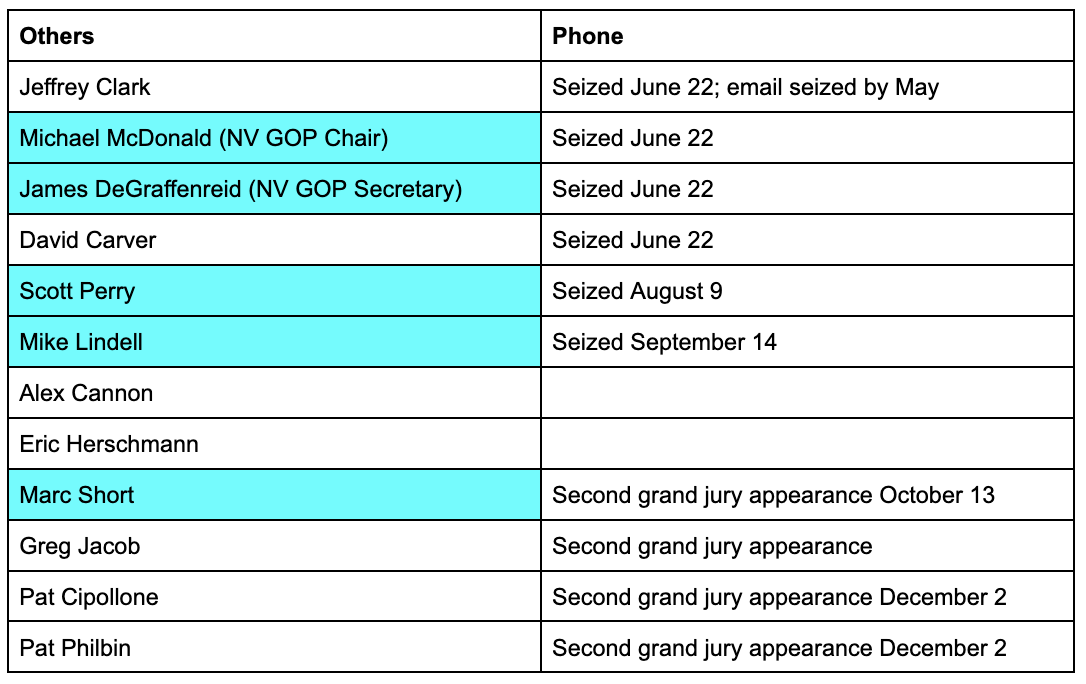
Between the release of the January 6 Committee transcripts and the unsealing of some grand jury orders from last summer, I’ve been pondering how many lawyers were central to Trump’s efforts to steal the 2020 election. Consider this table, for example, which is based on two separate sets of subpoenas (June, November) sent out to the swing states Trump tried to steal. Only the people marked in blue are not lawyers.

Eighteen people on this list — all people who played key roles in one or various plots — have a colorable claim to have played the role of an attorney, though the J6C transcripts show that for some — Boris Epshteyn and Jenna Ellis, for example — there was some dispute about whether they were functioning as lawyers or some other role, like spokesperson. And Sidney Powell was famously formally separated from the campaign.

Add those 18 people to the lawyers on this list, which includes state officials reported to have had their phones seized, Jeffrey Clark (who’s not on the fake elector warrants but is a subject based on other factors), Mike Lindell (whose phone was seized as part of the Colorado investigation into accessing voter machines) as well as five other lawyers known to be witnesses to key parts of the various plots.

Four of these people — the two Pats, Greg Jacob, and Marc Short — were reported to have had Trump’s Executive Privilege claims overridden by Chief Judge Beryl Howell for follow-on appearances before grand juries.

With seven more lawyers added to the list, that’s a total of 25 witnesses, all of whom have to be treated with kid gloves to avoid blowing the entire case.

That’s one reason I’m interested in a detail from the February 24 J6C transcripts from Michael McDonald (NV GOP Chair) and James DeGraffenreid (another NV fake elector). Both men pled the Fifth — there were aspects of Nevada’s fake elector certificates that even Trump’s people admitted presented more serious legal problems. Neither man is an attorney. And both men claimed to have retained the Signal and Telegram texts they had sent using their phones.

Q On your personal devices, did you use any secured messaging applications like Signal, telephone [sic], or WhatsApp?

A Yes, sir.

Q And did you search those applications for any materials that might be responsive to the subpoena?

A Yes, sir.

We saw that DOJ used Scott Perry’s role in the Jeffrey Clark node to identify unprivileged communications (though that approach also yielded a lot of junk communications). I would imagine that that makes people like Mike Roman (who ferried fake elector certificates around but has been dropped from subpoenas) and the two NV fake electors particularly important to chiseling away at privilege claims.

Share this entry

Donald Trump’s Contemptuous Leaking

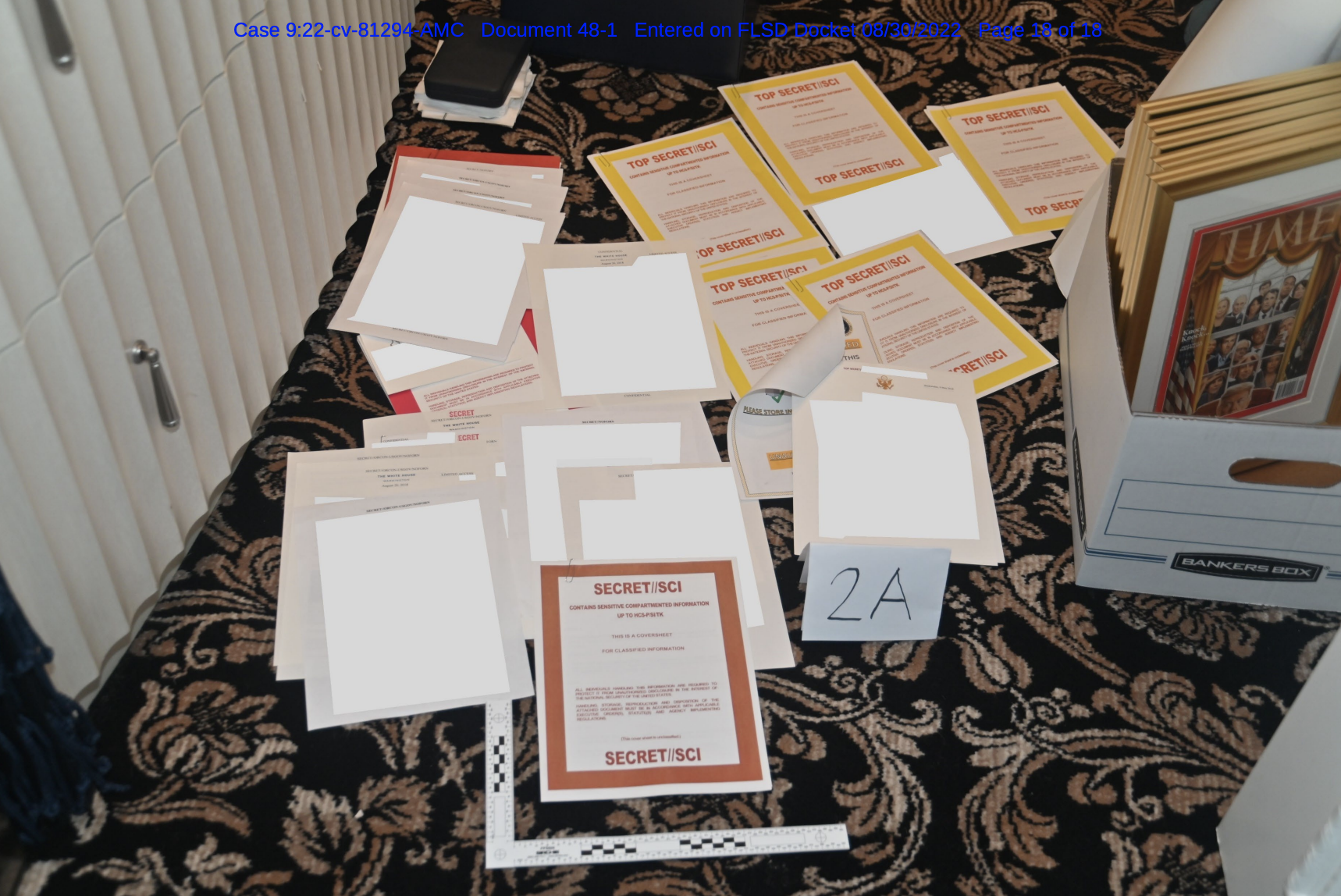
A month ago, I noted that several stories about Trump’s engagement of a firm to search for additional stolen documents were wildly inconsistent.

WaPo and CNN both have stories about searches by a professional firm on additional Trump properties, looking for stolen classified documents.

In addition to at least three paragraphs that are affirmatively misleading (one that does not push back on a bullshit quote about how cooperative Trump has been, one that described Trump’s outright obstruction as a “breakdown … in trust,” and one that claims Trump is trying to avoid another high profile search when the further search was ordered by Chief Judge Beryl Howell) WaPo describes only searches of Bedminster and, later, Trump Tower.

Trump’s legal team hired an outside firm to carry out the search of his golf club in Bedminster, N.J., and, more recently, Trump Tower in New York, according to the people, who spoke on the condition of anonymity to discuss sensitive information.

In one paragraph, it describes that Trump’s lawyers told DOJ they did not turn up more documents, but in a follow-up, WaPo describes an attestation that may or may not apply to just Bedminster.

I did the post because of the inconsistency, but also because, in the past, when we’ve seen aggressive pitches from Trump like this (his cover story about putting a lock on the storage facility where he had stashed his stolen documents is another example), it has generally been an attempt to get ahead of something really damning.

Two days later, WaPo seemed to report that Trump had managed to get through whatever damning bit he was trying to hide. It stated as fact that Chief Judge Beryl Howell would not hold Trump in contempt.

A federal judge on Friday declined to hold former president Donald Trump’s office in contempt for not fully complying with a May subpoena to return all classified documents in his possession, according to people familiar with the proceedings.

U.S. District Judge Beryl A. Howell told Justice Department lawyers and Trump’s legal team to come to an agreement themselves over what actions or assurances by Trump’s office would satisfy the government, according to these people, who spoke on the condition of anonymity to describe sealed court proceedings.

“The President and his counsel will continue to be transparent and cooperative,” Trump spokesperson Steven Cheung said in a statement to The Washington Post.

But a report from Alan Feuer yesterday describes that Howell has not yet made a decision about whether to hold Trump in contempt or not.

At a court hearing held behind closed doors last month, Judge Howell put off ruling on the government’s contempt request. The judge has still not issued a decision, according to the people familiar with the matter.

As Feuer describes it, on Wednesday, Howell ordered Trump to share the names of the people who did the search with DOJ. Trump had tried to shield those names — purportedly out of concern about leaks, which has consistently been a bullshit line Trump’s lawyers have used. But it’s more likely his team was concerned that the PIs would have to appear before the grand jury themselves.

A federal judge has ordered lawyers for former President Donald J. Trump to give the government the names of the private investigators who searched Mr. Trump’s properties late last year for any remaining classified documents, part of what appeared to be a step by the Justice Department toward questioning the investigators about their efforts, two people familiar with the matter said.

The order, issued on Wednesday by Beryl A. Howell, the chief judge of the Federal District Court in Washington,

[snip]

The more recent spat began when prosecutors asked Mr. Trump’s lawyers for the names of the investigators who searched the storage facility and other Trump properties — among them, Mar-a-Lago; Mr. Trump’s golf club in Bedminster, N.J.; and Trump Tower in New York.

According to the people familiar with the matter, the lawyers offered to make the investigators available for questioning but wanted their identities shielded by a protective order, out of concern that the government might leak the information to the news media.

It’s certainly possible Trump worries that allowing an independent interview of these people will disclose areas where they were not permitted to search (or other games like the others Trump already got caught playing).

Whatever it is, though, this suggests that Trump continued to bullshit the press after his first attempts to do so regarding the follow-on searches.

And the lies to the press aren’t going to keep Trump from being held in contempt (and then jailed until he complies with a subpoena).

Share this entry

Norm Pattis’ Sandy Hook Fuckup May Roil January 6 Investigation

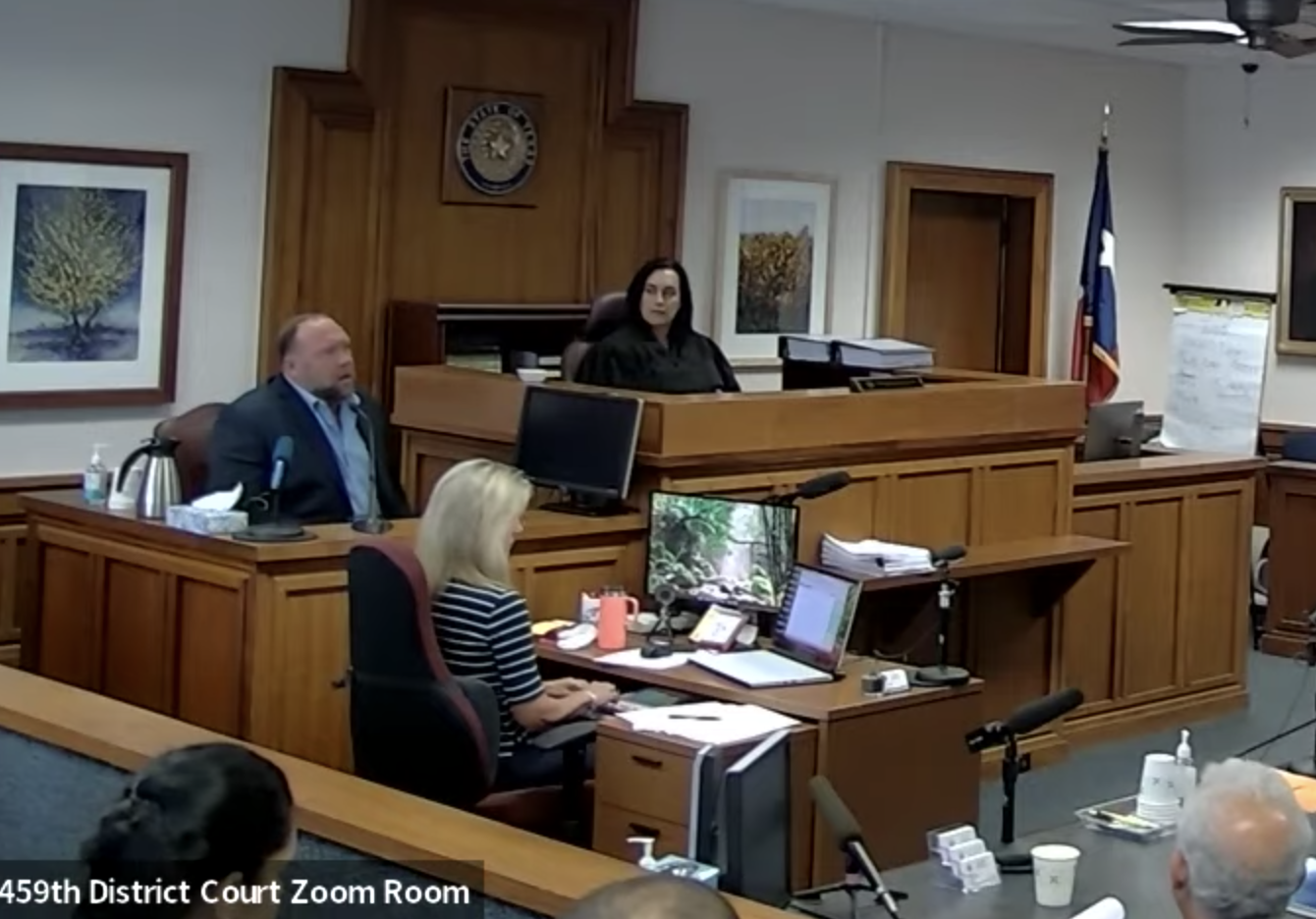
Connecticut judge Barbara Bellis suspended Alex Jones’ lawyer, Norm Pattis, for sending the medical information of Connecticut Sandy Hook plaintiffs to lawyers from both sides of the Texas Sandy Hooks lawsuit.

“Simply put, given his experience, there is no acceptable excuse for his misconduct,” Judge Barbara Bellis said in a court decision released Thursday.

Pattis is one of the state’s most well-known defense attorneys. He said he plans to appeal the decision.

“We cannot expect our system of justice or our attorneys to be perfect but we can expect fundamental fairness and decency. There was no fairness or decency in the treatment of the plaintiffs’ most sensitive and personal information, and no excuse for the respondent’s misconduct,” Bellis wrote.

She goes on to say that because of this, the court agrees with the Disciplinary Counsel’s recommendation to suspend Pattis from practicing law for several months.

As Pattis noted in a statement to NBC, however, he’s not just Alex Jones’ attorney. He’s also one of two lawyers representing Joe Biggs in the Proud Boys case, which is in the final day of voir dire today. And he represents Jones sidekick Owen Shroyer, who is tentatively due to plead guilty at the end of the month.

The Proud Boy defendants are already asking for a delay of their trial so they can read the January 6 Committee transcripts (though note they’ve had 16 of those transcripts since early December). But this decision seems likely to cause a delay, because the case really is difficult for one attorney to manage, but Judge Tim Kelly will want to avoid any claim by Biggs that he was no competently represented by Pattis.

Update: Here’s the ruling, which among other things describes how it happened that Pattis shared such highly confidential information — after blowing the protective order early in the case!

Share this entry

Shrug: Beau Harrison’s Renewed Memory about Trump’s Lunge

One trick of trying to map the DOJ investigations into Trump onto the testimony available from the January 6 Committee is that so many Trump associates could be witnesses on so many aspects of the investigation.

I noted, for example, how Alex Cannon is a direct witness to matters pertaining to the stolen documents, Trump’s Big Lie, Trump’s misuse of money raised to combat voter fraud, and the effort to take care of Cassidy Hutchinson. When Stephen Miller appeared before a grand jury twice in eight days, did he appear on different issues, or the same? When the two Pats, Cipollone and Philbin, split a long day in grand jury rooms, were they both exclusively in a January 6 grand jury, or did they also testify before the stolen documents one?

And when three Trump aides — Dan Scavino, William Russell, and Beau Harrison– appeared before a grand jury on December 1, did they all appear before the same grand jury and for the same prong of the investigation? Their subpoenas were first reported in a NYT article that revealed the focus on Trump’s use of PAC financing. All three continued their association with Trump after he left the White House. But that doesn’t mean their testimony only relates to the financial part of the investigation. Beau Harrison’s two interviews with J6C reveal why.

I’m not aware that an interview with Russell has been released (more on him here).

Scavino refused to cooperate with J6C, for which DOJ declined to prosecute him, though the J6C report did focus on how Scavino has been paid by Save America PAC.

[F]rom July 2021 to the present, Save America has been paying approximately $9,700 per month to Dan Scavino,171 a political adviser who served in the Trump administration as White House Deputy Chief of Staff.172 Save America was also paying $20,000 per month to an entity called Hudson Digital LLC. Hudson Digital LLC was registered in Delaware twenty days after the attack on the Capitol, on January 26, 2021,173 and began receiving payments from Save America on the day it was registered.174 Hudson Digital LLC has received payments totaling over $420,000, all described as “Digital consulting.”175 No website or any other information or mention of Hudson Digital LLC could be found online.176 Though Hudson Digital LLC is registered as a Delaware company, the FEC ScheduleB listing traces back to an address belonging to Dan and Catherine Scavino.177

That leaves just Beau Harrison’s two J6C appearances (April 7, 2022; August 18, 2022).

Harrison played an Advance role in the White House and was one of several witnesses with incomplete memories about January 6 who reported to Deputy Chief of Staff Tony Ornato. In fact, Harrison shared a small office with Ornato (parts of whose unpersuasive testimony I tweeted about here).

Three things stick out about Harrison’s testimony. First, Trump’s Executive Assistant Molly Michael (who is a known witness in the stolen documents prong of the investigation and who was interviewed by the committee on March 24, 2022) named Harrison in her list of people who was employed by Save America PAC.

And how many other people from the White House staff did go onto Florida to work with him, your current colleagues or otherwise associated with the former President?

A A small handful

Q Who else was on that list besides you, Ms. Michael?

A Someone that works for the First Lady, Hayley D’Antuono.

Q Okay. She was in the White House and now works in Florida for the First Lady, correct?

A Yes.

Q Okay. Who else?

A Someone that worked in operations named Beau Harrison.

Q Okay. Mr. Harrison works for – he’s actually engaged to Ms. D’Antuono, right?

A That’s correct.

Q Okay. And what’s his role currently down in Florida?

A He continues in an operations role.

Q Okay. Are they all, like you, employed by the Save America PAC?

A Yes.

When asked about Save America in his second interview in August, here’s how Harrison answered.

Q Has anyone told you to not provide certain information, even if it’s the answer to a question that the select committee poses?

A No.

Q And then just a final set of questions. Are you receiving any assistance from anyone or entity to help cover your legal costs related to the select committee only, nothing else?

A Yes. I’m not personally — I’m not personally paying for legal representation.

Q Do you know who is, who’s covering those costs?

A Not specifically, which may be something I probably should know, but that I don’t Know.

Q Do you know what the Save America PAC is?

A Yes

Q Do you know if they have any role in helping to cover your legal costs or find somebody who would cover your legal costs?

A They — I don’t know if they are covering them. They are associated with — with whoever — whoever it may be that is.

Q Do you have a contact there who — who you talk to about issues related to this?

A The only — the only time it’s ever come up — or the only contact, you know, related to this would be when I got the initial phone call, whenever, you know, whenever, a couple months ago. whenever it was. And I contacted Justin Clark.

Like Cassidy Hutchinson, Justin Clark helped arrange for a lawyer. Like Cassidy Hutchinson, Stefan Passantino represented Harrison, including in this second interview.

A far more important part of Harrison’s testimony pertains to Trump’s reported request to be taken to the Capitol on January 6. Though the final J6C report focused closely on the story Cassidy Hutchinson first relayed about Trump lunging in his limo when informed he couldn’t be driven to the Capitol, it makes no mention of Harrison’s testimony on the issue.

In his first interview, Harrison claimed not to remember much of anything unusual about the day. The security alerts he elevated to Mark Meadows, including Ashli Babbit’s shooting, were just normal security alerts, per that testimony. Though he played a security liaison role, there was virtually nothing unusual about the day when Trump’s mob attacked the Capitol.

In that first appearance, over and over, Harrison denied recalling details of Trump’s interest in going to the Capitol. After explaining that he learned of Trump’s call to walk to the Capitol from Twitter, Harrison provided these answers about specific knowledge of discussions of Trump going to the Capitol.

Q Do you know whether Mr. Ornato or anybody else talked to the Secret Service or anyone about making arrangements for the President to goto the Capitol that day?

A I mean, I think that — again, I don’t know this for fact or specifics, but remember, you know, the – kind of the understanding was If for whatever reason it were to come up, it should be directed as with any game-time decision, it should be directed to the Secret Service, to, you know, Bob Engel or Robert Engel, you know, if that could happen.

Q Okay. And after the President said he was going to march or even shortly before, but on that day of January 6th, are you aware of those conversations or communications happening with the Secret Service or otherwise?

A No.

In his second interview, however, Harrison had a much clearer memory of Bobby Engel stopping in the office he shared with Tony Ornato than he did before Cassidy Hutchinson testified publicly in June (after she got a new lawyer to replace Passantino). In his revised memory, Harrison said that Bobby Engel described Trump “shrugg[ing] off” the instructions from Secret Service that he would not be taken to the Capitol.

Q When the President came back, do you remember Bobby Engel ever coming to your office or the office you shared with s Mr. Ornato?

A Yes

Q Tell us about that. What was he there for? What happened? What did you guys talk about?

A So as Bobby Engel normally would do, so, you know, the limo would drop off, depending on where the President was, if they were arriving on the south grounds, you know, if the President was going up to the residence, it would stop at the portico there, you know, kind of the center of the residence. If he was going the — the President was going back to his office, they would pull forward. And, you know, he could walk. There’s a little pathway from. you know, you’ve probably seen that. There was a, you know, a pathway from the drop point to the corner of the, you know, the door of the in between the Oval Office and the Rose Garden that he would use. Tony — or Bobby would be in the car with him and would, obviously, he wouldn’t go back into the Oval Office. But he would continue through the West Wing back through his office in the EEOB. You know, one of the common things that he would do would be he would, you know, pop in our office and just kind of give us an update of how the trip went or what — really anything.

And so when they got back that afternoon, again, I don’t remember the time, when they got back. I remember Bobby popped into our office. It was the three of us — Tony, Bobby, myself. And he gave an update of, you know, kind of the events there at the Capitol.

I have a memory of Bobby saying that, before the President went onstage there at the offstage announce area, you know, the whole question of should he go up to the Capitol, should he go up to the Capitol. That was kind of getting tossed around. A lot of it was — was getting directed back to Bob Engel as kind of the deciding, you know, with the events in real time, you know. Anything like that would go — would run through Bobby.

I remember Bobby, you know, saying, hey, you know, we can’t do that. You know, we have no plan for that. There are no plans to do — to do that. You know, we couldn’t — we couldn’t secure that in this amount, short amount of time, on and on like, you know, as we talked about last time. You know, further than, that he said the President went on stage, gave his remarks. And this is Bobby told Tony and myself that, you know, he was like — it was almost like he had to ask. And then when he was told that, hey, you can’t go to the Capitol, he was like, you know, kind of, again, shrugged it off and was like, all right, at least I asked. And that was it.

Now, there are a lot of ways in which this (and other parts of his) testimony conflicts with what Harrison had already said, what Engel testified to later, what records subsequently shared with the committee (and so far more readily available to DOJ) revealed.

But it’s not this conflict that I find most interesting. It’s the conflict between what Tony Ornato had to say about talking to Harrison and what Harrison had testified to months earlier.

When Liz Cheney asked Ornato whether he had spoken to anyone after Hutchinson’s testimony, he admitted speaking to the Secret Service people about Hutchinson’s testimony, but claimed that a conversation he had with Harrison was about real estate.

Ms. Cheney. Anyone else from the administration?

The Witness. I have talked to [Beau] Harrison, who has left the — Trump’s — at this point, but nothing about any testimony or anything of that nature. It was more about real estate and him moving to the area.

Ms. Cheney. Did you speak with the Secret Service spokesperson following Ms. Hutchinson’s testimony?

The Witness. I recall, that day after Ms. Hutchinson’s testimony, going to the Secret Service Counsel and being in his office and then the Secret Service spokesperson asking me about what my recollection was of that story. And I relayed that that is not a story I recollect and I don’t recall that story happening and the first time hearing it is when she had said it.

Harrison told the story differently. In an exchange just after Passantino piped in to make sure the record reflected Harrison saying that Trump “shrugged it off” rather than “shrugged his shoulders” in response to being told he couldn’t go to the Capitol, Harrison assured the committee he would know if this kind of conflict had taken place.

Q Uh-huh. so I think [redacted] had asked you about there was public reporting about a heated argument that occurred in the — and I’ll take it in two parts. First the heated argument, did you hear anything to that effect?

A No.

Q And how about what, as you said, you described, you saw Ms. Hutchinson’s testimony on TV. Is that — I want to make sure heard you correctly. Was that the first time you heard that testimony in terms of what occurred in the vehicle, as she said, relayed by Mr. Engel?

A Yes. Her — the story that was — the story that was told during her public testimony was the first I had heard of you know, anything like that being described.

Q Was there any kind of discussion, putting aside the testimony, but the days following, did you learn of anything that occurred that was more than just a back and forth of as you’re describing, of can I go and I guess Mr. Engel saying no? Was there anything in that range of more of a request, anger, heated 6 argument, altercation, anything?

A No.

Q Did you see —

A I would — I’m sorry

Q That’s okay.

A I would also add that, if something like had been described had occurred, I percent would have known about it and would have heard that.

Q And why do you say that?

A Because that is something that would have, you know — that’s — that’s the report that Bobby would share when he got — when he got back. You know, that would fall into the, hey, how’d it go and he’d be like, oh, you know. like, you know, this — this — let me tell you. But —

Q If it was shared only with Mr. Ornato, would Mr. Ornato have shared that with you?

A If it was shared with Tony, yes, Tony would have shared it with me.

Harrison similarly assured the committee, even less convincingly, that there’s no way Trump’s limo was left running to keep open the possibility of a trip to the Capitol without him knowing.

But then the committee asked Harrison, three months before Ornato would answer the same question, whether he had spoken to Ornato about this.

In addition to explaining that he’s “kind of a big brother” to Ornato’s son, Harrison revealed that Ornato called Harrison immediately after (during, maybe!?!?) Hutchinson’s testimony.

Q What about with Tony Ornato, have you talked to him about January 6th or anything that happened on January 6th before your testimony today?

A The only — the only, you know, time that we — again. Tony and I are personal friends and have talked about — you know, I’m — I’m kind of a big brother to his son and to, you know — he — we’re personal friends. The only thing that we’ve talked about on this matter is during Cassidy’s testimony, he just — he basically said, can you — you know, can you believe this? And — and that was that. You know, nothing further — nothing further. you know, was — was discussed on the matter of — aside from the fact of like, you know. where is this coming from?

Q How did he say that to you? Did he call you? Did he send you a text message?

A I believe it was a phone call. And — and I think it was more of, you know, he was like, did I — you know, did I miss something or am I — am I — you know, clearly this did not happen, but how — how is this being — you know, where is this story even coming from or, you know, where could this even, you 12 know, be coming from.

Q In that conversation, did he — he told you it didn’t happen? What portion of the testimony did he say didn’t happen in that phone call with you?

A I –well, I mean, as it was described when — you know, the whole — the whole story of — the whole story of Bob Engel returning to our office, you know, and going into the — going into the — you know, the story about the President being irate and, you know, the President grabbing Bob Engel’s neck and grabbing for the steering wheel, you know, that was the part he was like, you know — like, did that happen? Did the — you know, did that — did — was that even discussed? Was that — did that ever come up? And at that point I said —

Q In that —

A I’m sorry, go ahead.

Q Go ahead. I’m sorry. I cut you off right before you were about to say what you said in response.

A And I’m saying, no, you know, the first — the first I had even — I have ever even heard of this was. you know, just this afternoon, this afternoon when it was being described, you know, that way on TV.

Q In that conversation, did Mr. Ornato kind of relay his recollection of the events to you?

A That, I don’t remember. But, I mean, I don’t think he went, you know, play by play of what happened. I think it was mainly just kind of just, you know, kind of shock as to, you know, getting associated with and being the kind of the source of that type of information.

Harrison and Ornato could — and one day may — testify in defense of Trump at some trial. On the issue of whether he responded angrily when told he could not going to the Capitol, their testimony might just present a conflicting account to that of Hutchinson and others (and some documentary records).

But on the issue of the conversation that Harrison had with Ornato, there’s a dramatic conflict, real estate versus a direct response to Hutchinson’s testimony, possibly even as she testified.

And that’s what I mean about how interlocking all these issues are. Sure, Harrison may have been interviewed about being paid out of funds originally raised based on false claims of voter fraud.

But it’s hard to separate those payments from his evolving testimony about that shrug.

Update: At the very end of Ornato’s testimony, after learning Engel’s testimony conflicted with his and learning that Hutchinson had shared Signal texts Ornato had sent her, he described speaking to both Engel and Harrison during Hutchinson’s testimony, a clear conflict with his earlier answer about real estate.

A No, sir. The only time I had reached out to Mr. Engel was when Cassidy Hutchinson was testifying during her – as she was testifying, and I was I wasn’t watching it, was called to put it on, and I was shocked and surprised of her testimony and called Mr. Engel and asked him, What’s she talking about? And his response was, I don’t know.

And then I then proceeded to say I said, Let me listen to the rest of this now. I have no idea And that was the only time I had — I had reached out to Mr. Engel. I actually reached out to Mr. Harrison as well, because I knew Beau was in my office. And I said, Beau, what’s she talking about? And Beau said the same thing. He said, I don’t know. I don’t remember her being in your office. that was just shocked and surprised at – of the testimony, and I did reach out 9 during her testimony, I believe, to the both of them to ask that. ~ But, at that point, after I~ my head settled down, I didn’t discuss it any further.

Share this entry

How the January 6 Committee Investigation Maps onto DOJ’s Known Investigation

I’m going to attempt to do a live post mapping what we’re learning from the January 6 Committee investigation onto what we know about the multi-prong DOJ investigations. Before I do so, however, I want to point out several ways this matters, by showing how the multiple investigations intersect and how testimony to J6C may be useful for DOJ.

Ken Klukowski’s two interviews

I raised one example in this thread on Ken Klukowski, the lawyer who wrote the memo associated with John Eastman and Jeffrey Clark meant to justify a late-December DOJ intervention in Georgia. Klukowski is one of four people (and three lawyers) involved in a grand jury proceeding partially unsealed in December. By May 2022, DOJ had shown probable cause that one of his email accounts would include evidence of a crime, but DOJ also spent much of last summer working through the dicey privilege problems posed by an investigation involving a bunch of lawyers.

We now know the grand jury matters were unsealed after such time as DOJ first got some of the J6C transcripts, per this filing in the Proud Boys case, which shows DOJ passed on 16 Proud Boy transcripts before December 8.

Klukowski sat for two interviews with J6C — one on February 15, 2022, when he came off as a cooperative witness, and one on June 10, when the committee asked him about a bunch of documents involving John Eastman that Judge David Carter had released, some under a crime-fraud exception. At least during the interviews, Klukowski was represented by lawyers from Matt “Big Dick Toilet Salesman” Whitaker’s firm; see this exchange from Justin Caporale’s interview about how Matt Schlapp arranged for the defense of some Trump flunkies via the firm, and this reference to funding going to Schlapp from the J6C Report. In Klukowski’s second interview, the one discussing documents that had been liberated in part under a crime-fraud exception, one of Klukowski’s lawyers objected to the possibility that Klukowski might have to reassert privilege claims under oath. Whether these transcripts are part of why DOJ unsealed the grand jury materials or not, the two transcripts show how liberating the Eastman communications undercut much of what Klukowski had originally said about his involvement. And because he had already testified, this second interview provided useful backtracking on his earlier interview. The two transcripts may serve as useful tools in further breaching the privilege claims of these three lawyers, if not obtaining cooperation from one or several of them.

Alex Cannon’s two interviews

Alex Cannon is another example. Trump whisperers Josh Dawsey and Maggie Haberman have given him good press for his role in the stolen documents case. In February 2022, they tell us, Cannon refused to certify that Trump had turned over the the documents the President took from the White House.

Shortly after turning over 15 boxes of government material to the National Archives in January, former President Donald J. Trump directed a lawyer working for him to tell the archives that he had returned all the documents he had taken from the White House at the end of his presidency, according to two people familiar with the discussion.

The lawyer, Alex Cannon, had become a point of contact for officials with the National Archives, who had tried for months to get Mr. Trump to return presidential records that he failed to turn over upon leaving office. Mr. Cannon declined to convey Mr. Trump’s message to the archives because he was not sure if it was true, the people said.

[snip]

The conversation between Mr. Trump and Mr. Cannon took place after officials at the archives began asking Mr. Cannon, following the return of the 15 boxes, whether additional classified material was at Mar-a-Lago. It was when Mr. Cannon raised this with Mr. Trump that Mr. Trump told him to tell the archives he had given everything back, the people familiar with the discussion said.

At the time, the various investigations related to the Jan. 6 attack on the Capitol by Mr. Trump’s supporters were ramping up, with a number of requests for documents, the people familiar with the discussion said. Mr. Cannon told people that he was concerned that if Mr. Trump was found to be withholding material related to Jan. 6, he would be in a worse situation, according to people familiar with the discussions.

But Cannon’s two transcripts (April 13 and August 18, 2022) put that seeming scrupulousness in different light. Much of the first one establishes how, because of the jobs he was given as a campaign lawyer, he was in a position to understand that the claims made in fundraising emails sent after the election conflicted with the evidence showing no significant vote fraud. At the very end of that first interview, though, investigators asked Cannon why he was claiming privilege over discussions with Jared Kushner about forming a PAC when he was working with a campaign that should not legally coordinate with such a PAC (to say nothing of Cannon’s admitted inexperience on campaign finance law).

In that first interview, Cannon agreed that money raised after the election would have to be spent on recounts or debt retirement. His second interview (which took place ten days after the Mar-a-Lago search) focused more closely on how money raised in the guise of fighting vote fraud was actually spent. In it, Cannon bristled when investigators suggested campaign money could only be spent on debt retirement or recounts.

Then in Cassidy Hutchinson’s September interviews (September 14 and 15) — the two focused on attempts to obstruct her testimony — she described how Cannon first helped set her up with Trump lawyer Stephen Passantino, and then tried to get her several jobs. Hutchinson also described how Passantino claimed that Cannon (as well as Eric Herschmann, another person heroically portrayed in Maggie stories) was involved in the manipulation of stories with Maggie Haberman.

When J6C made its referrals, it made clear that DOJ was already aware of efforts to tamper with Hutchinson’s testimony. Hutchinson started cooperating with DOJ shortly after her solo J6C testimony, in July. So even before the raid on Mar-a-Lago, then, DOJ likely understood that Cannon’s role was more complex than you might understand from reading a Maggie Haberman story. Importantly, Cannon’s role in allegedly tampering with Hutchinson’s J6C testimony would span the time when (per Maggie’s reporting) he heroically refused to certify Trump’s February 2022 production and the time in May 2022 when Trump’s team tried to find ways to stave off further investigation. These strands overlap temporally.

That puts Cannon’s role as a witness in much different light, because it would give him different visibility — and criminal exposure — on several different things: Trump’s document theft, Trump’s lies about vote fraud, Trump’s efforts to tamper with witnesses, and Trump’s spending of money raised to combat vote fraud.

And that’s important background when you consider CNN’s reporting about the financial side of DOJ’s investigation, which described that “in recent months” an existing year-long investigation into the financing of the attack has shifted (like the J6C focus has) to how money raised purported in support of election integrity actually got spent.

Another top prosecutor, JP Cooney, the former head of public corruption in the DC US Attorney’s Office, is overseeing a significant financial probe that Smith will take on. The probe includes examining the possible misuse of political contributions, according to some of the sources. The DC US Attorney’s Office, before the special counsel’s arrival, had examined potential financial crimes related to the January 6 riot, including possible money laundering and the support of rioters’ hotel stays and bus trips to Washington ahead of January 6.

In recent months, however, the financial investigation has sought information about Trump’s post-election Save America PAC and other funding of people who assisted Trump, according to subpoenas viewed by CNN. The financial investigation picked up steam as DOJ investigators enlisted cooperators months after the 2021 riot, one of the sources said.

When Cannon refused to certify Trump’s production in February 2022, he had personal exposure in January 6. Refusing to certify documents because withholding some might amount to obstruction is far less heroic than the Trump whisperers have made out. But in ensuing months, as the complexity of Cannon’s role has become clear, it would provide DOJ many angles for DOJ to persuade Cannon to cooperate.

Other privilege claims

The grand jury release last month made me realize just how complex it is to investigate suspected crimes in which at least 12 lawyers were involved. But the transcripts should help DOJ pierce other privilege claims as well. For example, multiple witnesses were asked and mocked the idea that their own conversations with Jenna Ellis — who is a lawyer whose name was on many of the subpoenas DOJ has sent out but was often described as playing a spokesperson role — might be privileged. The same is true of lawyer Boris Epshteyn, described as playing a logistics, not legal role.

So in the same way that DOJ seemed to focus on emails involving Scott Perry with the Eastman, Jeffrey Clark, and Klukowski seizures, the J6C testimony will provide many more levers to use to chip away at attorney-client privilege claims (on top of what seems to be a slew of subpoenas that will partly serve the same purpose).

At some point in recent weeks, Jack Smith returned to the US to oversee the investigation he has been leading since November. The belated sharing of J6C transcripts will likely provide a big boost to that investigation.

Share this entry

Proving Trump’s Corrupt Purpose: The Forgotten Unpermitted March

It’s an object of blind faith among TV lawyers that DOJ must prove that Donald Trump knew he lost the election to be able to charge him under 18 USC 1512(c)(2). That blind faith seems to come from several places. It was part of David Carter’s opinion — which applied 9th Circuit precedentfinding that Trump and John Eastman had the corrupt intent necessary such that Eastman’s communications about efforts to pressure Trump were crime-fraud excepted.

A person violates § 1512(c) when they obstruct an official proceeding with a corrupt mindset. The Ninth Circuit has not defined “corruptly” for purposes of this statute.222 However, the court has made clear that the threshold for acting “corruptly” is lower than “consciousness of wrongdoing,”223 meaning a person does not need to know their actions are wrong to break the law. Because President Trump likely knew that the plan to disrupt the electoral count was wrongful, his mindset exceeds the threshold for acting “corruptly” under § 1512(c). President Trump and Dr. Eastman justified the plan with allegations of election fraud— but President Trump likely knew the justification was baseless, and therefore that the entire plan was unlawful.

Although Dr. Eastman argues that President Trump was advised several state elections were fraudulent,224 the Select Committee points to numerous executive branch officials who publicly stated225 and privately stressed to President Trump226 that there was no evidence of fraud. By early January, more than sixty courts dismissed cases alleging fraud due to lack of standing or lack of evidence,227 noting that they made “strained legal arguments without merit and speculative accusations”228 and that “there is no evidence to support accusations of voter fraud.”229 President Trump’s repeated pleas230 for Georgia Secretary of State Raffensperger clearly demonstrate that his justification was not to investigate fraud, but to win the election: “So what are we going to do here, folks? I only need 11,000 votes. Fellas, I need 11,000 votes. Give me a break.”231 Taken together, this evidence demonstrates that President Trump likely knew the electoral count plan had no factual justification.

Many TV lawyers seem to exist in a Green Room bubble, largely insulated from familiarity with the actual DOJ investigation, where they reinforce each other’s blind faith. Stunningly, few of these actual lawyers have paid attention to the long debate over obstruction as DOJ has actually applied it to January 6, not even the December 12 DC Circuit hearing on DOJ’s appeal of a Carl Nichols opinion sharply limiting its application. The TV lawyers rely far more on the Carter opinion than on the Amit Mehta one that — while applying a lower civil standard and addressing an earlier and therefore thinner body of claims — nevertheless was written by a judge who had already written a long 1512 opinion directly relevant to January 6. That is, most TV lawyers’ analysis of any potential case against Trump largely stems from a Ninth Circuit standard, not the hotly debated standard specifically addressing January 6, and largely stems from the white collar crimes Trump is alleged to have committed with John Eastman, not any of his other potential criminal exposure.

It will likely be a few weeks before we learn how the DC Circuit will rule, but my read of the hearing is that Trump appointee Greg Katsas was strongly opposed to DOJ, Trump appointee Justin Walker started out not quite as strongly opposed, but seemed to grow increasingly peeved by defense attorney Nick Smith’s minimization of the uniqueness of January 6, and Biden appointee Florence Pan (who presided over her share of January 6 cases before being elevated to the DC Circuit) favored DOJ’s views. But it’s more complex than that: The Republican judges seemed inclined to overturn DOJ not on the basis before them — whether 1512(c)(2) had to have a documentary component — but on the definition of corrupt purpose, precisely the basis on which TV lawyers rely on Carter’s opinion. Anything could happen: Katsas and Walker could rule against DOJ on the Nichols appeal, only to have DOJ appeal to the full DC Circuit. While procedurally unusual, Katsas and Walker suggested they might remand to Nichols to consider the corrupt purpose definition, in which case it’ll come back on appeal. Or Walker and Pan could rule narrowly for DOJ, with the defendants appealing, possibly directly to the Trump-heavy SCOTUS.

As I alluded in this post, no matter how the DC Circuit rules, it’s likely the ruling would still permit charges against Trump, even while roiling all the cases against the mobsters. That’s because with Trump, there’s a documentary component to his obstruction of the vote certification — the fake elector certificates that Trump associates were flying into DC — that is more attenuated for the mobsters; Trump would meet Nichols’ standard even while the mobsters arguably would not. And with Trump, if Walker were to write an opinion that sided with Pan on the documentary issue but argued for a much more stringent standard on corrupt purpose, requiring a personal benefit to the corruption, it would still apply to Trump. There’s no more obvious example of corruptly chasing a personal benefit than trying to remain President by obstructing the votes from being counted even though Joe Biden had received more votes. It’s probably in this latter scenario where the blind faith claim by TV lawyers that DOJ needs to prove that Trump knew he lost would come into play; because DOJ would likely appeal such an outcome in any case, it’s still more likely that DOJ would be dealing with the standard that most DC District judges have adopted.

That’s why I often return to Dabney Friedrich’s standard, because it is fairly stringent — starting from an analysis of whether someone engaged in otherwise illegal activity. It’s a higher standard than Judge Carter used, but not unlikely to be where we end up for the application of obstruction to January 6.

There are still multiple ways to get there with Trump:

  • Conspiring to making false statements (or even a forgery) to the Federal government with the fake elector certificates, which would require proving that Trump knew of the efforts to deliver those certificates
  • Ordering Mike Pence to do something Trump knew to be illegal, rejecting the certified votes, which would require proving Trump knew the request was illegal
  • Aiding or abetting the violence on January 6, an allegation bolstered by J6C’s focus on Trump’s awareness that his mob was armed when he told them to march on the Capitol
  • Conspiring to obstruct the vote certification by occupying the Capitol, which would require showing that Trump entered into an agreement with people like Alex Jones and Ali Alexander and through them with the Proud Boys and others or by treating his multiple calls to the mob as entering into a conspiracy and his tweet targeting Pence during the riot as ratification of it

The latter description is one of the ways that Judge Mehta ruled that Trump might have conspired with the mob on January 6.

But, as I laid out here, Mehta focused on another element to get to find it plausible that Trump bore responsibility for the attack, which is a fifth way Trump might have exposure: the unpermitted march.

President Trump also allegedly participated directly in the planning. He was involved in decisionmaking about the speaking lineup and music selection. Thompson Compl. ¶ 69. And, critically, to the surprise of rally organizers, President “Trump and his campaign proposed that the rally include a march to the Capitol,” even though the permit they had obtained did not allow for one. Id. ¶¶ 69, 90 (alleging that the permit expressly provided: “This permit does not authorize a march from the Ellipse”).

[snip]

[T]he President ended his speech by telling the crowd that “we fight like hell and if you don’t fight like hell, you’re not going to have a country anymore.” Almost immediately after these words, he called on rally-goers to march to the Capitol to give “pride and boldness” to reluctant lawmakers “to take back our country.” Importantly, it was the President and his campaign’s idea to send thousands to the Capitol while the Certification was underway. It was not a planned part of the rally. In fact, the permit expressly stated that it did “not authorize a march from the Ellipse.”

[snip]

That is why the court determines, as discussed below, that Giuliani’s and Trump Jr.’s words are protected speech. But what is lacking in their words is present in the President’s: an implicit call for imminent violence or lawlessness. He called for thousands “to fight like hell” immediately before directing an unpermitted march to the Capitol, where the targets of their ire were at work, knowing that militia groups and others among the crowd were prone to violence.

Absent a claim of incitement, asking his followers to march to the Capitol would, generally, be legal. But even before you include the incitement, if Trump knew that he was asking his followers to do something that was not permitted, it would add one more prong showing corrupt purpose.

Mehta relies on this part of his judgment on Bennie Thompson’s own complaint, citing parts of the amended complaint filed in April 2021.

69. After Defendant Trump decided he would speak at the Save America rally on January 6, he became more actively involved in decisions concerning the event, including the speaking lineup and even the music that would be played. Defendant Trump and his campaign proposed that the rally include a march to the Capitol. An organizer of the Save America rally later told reporters he was surprised to learn that the even would involve a march from the Ellipse to the Capitol. Before the White House became involved, he said, the plan had been to stay at the Ellipse until the counting of the Electoral College votes was completed.

[snip]

90. The permit obtained for the Save America rally expressly provided: “This permit does not authorize a march from the Ellipse.” Defendant Trump nevertheless instructed the angry crowd to march from the Ellipse to the Capitol for the purpose of “fight[ing] like hell,” and therefore directed the crowd to take action outside the bounds of what the permit authorized.

That complaint was written in April, before J6C was constituted, much less before it got a ton of witness testimony about how the march came about.

The January 6 Report focuses on the march — particularly, in other sections, on Trump’s desire to participate in it — but it only addresses the issue of permitting of the march (as opposed to other events) in an appendix. [links added]

Within a few days, the White House began to take a more direct role in coordinating the rally at the Ellipse.421 In a December 29th text to Wren, Caporale wrote that after the President’s planned speech there “maybe [sic] a call to action to march to the [C]apitol and make noise.”422 This is the earliest indication uncovered by the Select Committee that the President planned to call on his supporters to march on the U.S. Capitol. But it wasn’t the last. On January 2nd, rally organizer Katrina Pierson informed Wren that President Trump’s Chief of Staff, Mark Meadows, had said the President was going to “call on everyone to march to the [C]apitol.”423 Inside the White House, the President’s intent was well-known. CassidyHutchinson, an aide to Meadows, recalled in her testimony that she overheard discussions to this effect toward the end of December or early January. One such discussion included an exchange between Meadows andRudolph Giuliani that occurred on January 2nd.424 Hutchinson understood that President Trump wanted to have a crowd at the Capitol in connection with what was happening inside—the certification of the electoral count.425 Hutchinson also recalled that President Trump’s allies in Congress were aware of the plan. During a call with members of the House FreedomCaucus, the idea of telling people to go to the Capitol was discussed as a way to encourage Congress to delay the electoral college certification and send it back to the States.426 On January 4th, WFAF’s Kylie Kremer informed Mike Lindell, the CEO of MyPillow and an ally of President Trump, that “POTUS is going to have us march there [the Supreme Court]/the Capitol” but emphasized that the plan“stays only between us.”427 The “Stop the Steal” coalition was aware of the President’s intent. OnJanuary 5th, Ali Alexander sent a text to a journalist saying: “Ellipse thenUS capitol [sic]. Trump is supposed to order us to the capitol [sic] at the end of his speech but we will see.”428

6.14 “WELL, I SHOULD WALK WITH THE PEOPLE.”

President Trump wanted to personally accompany his supporters on the march from the Ellipse to the U.S. Capitol. During a January 4th meeting with staffers and event organizer Katrina Pierson, President Trump emphasized his desire to march with his supporters.429 “Well, I should walk with the people,” Pierson recalled President Trump saying.430 Though Pierson said that she did not take him “seriously,” she knew that “he would absolutely want to be with the people.”431 Pierson pointed out that President Trump “did the drive-by the first time and the flyover the second time”—a reference to the November and December 2020 protests in Washington, DC.432 During these previous events, President Trump made cameo appearances to fire up his supporters. Now, as January 6th approached, the President again wanted to be there, on the ground, as his supporters marched on the U.S. Capitol. The President’s advisors tried to talk him out of it. White House Senior Advisor Max Miller “shot it down immediately” because of concerns about the President’s safety.433 Pierson agreed.434 But President Trump was persistent, and he floated the idea of having 10,000 National Guardsmen deployed to protect him and his supporters from any supposed threats by leftwing counter-protestors.435 Miller again rejected the President’s idea, saying that the National Guard was not necessary for the event. Miller testified that there was no further conversation on the matter.436 After the meeting, Miller texted Pierson, “Just glad we killed the national guard and a procession.”437 That is, President Trump briefly considered having the National Guard oversee his procession to the U.S. Capitol. The President did not order the National Guard to protect the U.S. Capitol, or to secure the joint session proceedings. Although his advisors tried to talk the President out of personally going, they understood that his supporters would be marching.438 Pierson’s agenda for the meeting reflected the President’s plan for protestors to go to the U.S. Capitol after the rally.439 But President Trump did not give up on the idea of personally joining his supporters on their march, as discussed further in Chapter 7.

[snip]

At no point was any permit granted for a march from the Ellipse to the Capitol. The President planned to announce that march “spontaneously.”114

422. Select Committee to Investigate the January 6th Attack on the United States Capitol, Deposition of Justin Caporale, (Mar. 1, 2020), p. 44; Documents on file with the Select Committee to Investigate the January 6th Attack on the United States Capitol (Caroline Wren Production), REVU_0644 (December 29, 2020, text messages with Justin Caporale).

423. Select Committee to Investigate the January 6th Attack on the United States Capitol, Transcribed Interview of Katrina Pierson, (Mar. 25, 2022), pp. 79-82; Documents on file with the Select Committee to Investigate the January 6th Attack on the United States Capitol (Caroline Wren Production), REVU_0181 (January 2nd email from Katrina Pierson to CarolineWren and Taylor Budowich).

424. Select Committee to Investigate the January 6th Attack on the United States Capitol, Transcribed Interview of Cassidy Hutchinson, (Feb. 23, 2022), pp. 32-33, 41; Select Committee to Investigate the January 6th Attack on the United States Capitol, Continued Interview of Cassidy Hutchinson, (June 20, 2022), pp. 107-08, 135.

425. Select Committee to Investigate the January 6th Attack on the United States Capitol, Transcribed Interview of Cassidy Hutchinson, (Feb. 23, 2022), p. 42.

426. Select Committee to Investigate the January 6th Attack on the United States Capitol, Transcribed Interview of Cassidy Hutchinson, (Feb. 23, 2022), pp. 44-45, 47, 52-54; Select Committee to Investigate the January 6th Attack on the United States Capitol, Continued Interview of Cassidy Hutchinson, (June 20, 2022), p. 87.

427. Documents on file with the Select Committee to Investigate the January 6th Attack on the United States Capitol (Kylie Kremer Production), KKremer5447, p. 3 (January 4, 2021, text message from Kylie Kremer to Mike Lindell at 9:32 a.m.).

428. Documents on file with the Select Committee to Investigate the January 6th Attack on the United States Capitol (Ali Alexander Production), CTRL0000017718, p. 41 (January 5, 2021 text message with Liz Willis at 7:19 a.m.).

429. See Select Committee to Investigate the January 6th Attack on the United States Capitol, Transcribed Interview of Katrina Pierson, (Mar. 25, 2022), pp. 120-21.

430. Select Committee to Investigate the January 6th Attack on the United States Capitol, Transcribed Interview of Katrina Pierson, (Mar. 25, 2022), p. 121.

431. Select Committee to Investigate the January 6th Attack on the United States Capitol, Transcribed Interview of Katrina Pierson, (Mar. 25, 2022), p. 121.

432. Select Committee to Investigate the January 6th Attack on the United States Capitol, Transcribed Interview of Katrina Pierson, (Mar. 25, 2022), p. 121.

433. Select Committee to Investigate the January 6th Attack on the United States Capitol, Deposition of Max Miller, (Jan. 20, 2022), pp. 91-92.

434. Select Committee to Investigate the January 6th Attack on the United States Capitol, Transcribed Interview of Katrina Pierson, (Mar. 25, 2022), p. 123.

435. Select Committee to Investigate the January 6th Attack on the United States Capitol, Transcribed Interview of Katrina Pierson, (Mar. 25, 2022), pp. 121-26.

436. Select Committee to Investigate the January 6th Attack on the United States Capitol, Deposition of Max Miller, (Jan. 20, 2022), pp. 98-99.

437. Documents on file with the Select Committee to Investigate the January 6th Attack on the United States Capitol, (Max Miller Production) Miller Production 0001, p. 1 (January 4, 2021, text message from Max Miller to Katrina Pierson).

438. Select Committee to Investigate the January 6th Attack on the United States Capitol, Transcribed Interview of Katrina Pierson, (Mar. 25, 2022), p. 121.

439. Select Committee to Investigate the January 6th Attack on the United States Capitol, Transcribed Interview of Katrina Pierson, (Mar. 25, 2022), p. 95; Documents on file with the Select Committee to Investigate the January 6th Attack on the United States Capitol (Katrina Pierson Production), KPierson0180, at 180, 196-97 (January 4, 2021, President TrumpMeeting Agenda).

While the report shows that Trump was directly involved in several meetings about plans to march to the Capitol, it doesn’t address whether he was told that there not only wasn’t a permit for the march, but that the National Park Service had specifically prohibited such a march. And several people did know that.

Justin Caporale, the guy at Event Strategies whom the report describes the White House selecting to put on the event, described the decision not to formally plan for the march this way.

Q Understood, and I appreciate that. Let’s move on. Mr. Caporale, during the planning for the January 6th event, did you hear anyone suggest that rally-goers should march or walk to the Capitol following the President’s speech?

A In the early days of the planning around that end-of-December timeframe, you know, it was discussed that it would include a march. And after consulting and working with the National Park Service, we decided not to move forward with planning, you know, a march from the Ellipse to anywhere.

Q When you say “it was discussed,” who were those discussions with?

A The National Park Service.

Q Sorry, it sounded like you said it was discussed that there might be a march, and then you had consultations with the Park Service. Were there discussions about a march before you brought it up with the Park Service?

A There were — I don’t recall the exact discussions, no. But I remember talking with the Park Service about it during the permit and application process under the general question of, you know, what is the vision for your event.

Q Let’s go ahead and take a look at exhibit 3, and this might refresh your recollection a little bit. Exhibit 3 are your text messages with Caroline Wren. And if we go to page 7, she sends you an image with a question right there in the middle. And we can zoom in a little bit. This is December 29th, about 2:00 in the afternoon. She writes, any updates from WH on your end? And you write back later that evening, schedule proposal will work its way around tomorrow. Noon seems to be a good time. Then maybe a call to action to march to the Capitol and make noise. Did you have conversations with people in the White House about having a call to action to march to the Capitol and make noise? A No, not to my recollection.

Q So where did you get this information that you sent to Caroline Wren about a call to action to march to the Capitol and make noise?

A I would really view my response at 10:50 as two separate conversations. 14 So, the scheduling proposal will work its way around about noon, noon seems to be a 15 good time, that was in reference to any updates from the White House on your end. 16 And then maybe a call to action to march to the Capitol and make some noise is referring 17 to the discussions we as planners were having with the National Park Service to see if that 18 would be something that would even be possible given the timeframe that we had to 19 plan. 20 Q So my question is, whose idea was it to have a march to the Capitol and 21 make noise?

A I don’t recall whose idea it came from. It was, again, conversations with 23 the client at that point. You know, their event was branded, March for Trump, and it 24 had been for the year leading up to it. So, it was part of those natural discussions, well, 25 should we, you know, submit a permit for a march and coordinate that end of things.

Q I think we’ve established that by this point you had been in touch with folks 2 from the White House. That text message you sent to your parents was December 27th, 2 days before, and this is the same day, December 29th, that you’re texting Max Miller about Women for America First submitting the permit for the Ellipse. Was anybody in5 the White House conveying to you plans about having a call to action to march to the Capitol and make noise at this time?

A No, sir.

Q Why don’t we take a look then at exhibit 15. This is from — this is a text message that you produced. KP is Katrina Pierson, and the other person on the thread is Taylor Budowich. And on January 3rd, at 10:10 in the morning, Ms. Pierson texts, 11 “WH has not approved these speakers. I was asked to modify, and I’ll send over a new draft to you guts” — I think it’s a typo for “guys” — “and POTUS.” And then she writes, “POTUS expectations are intimate and then send everyone over to the Capitol.” So by this time, were you aware that the White House, or representatives from the White House, were considering sending rally-goers to the Capitol following the President’s speech?

A My awareness was limited to, you know, receiving a text message like this. But I was, you know, never given official instructions by my client or anybody to coordinate a march, to plan a march, and we didn’t.

Q Okay. You say you were never given any instructions from your client to plan or coordinate a march?

A No.

Q So what was the December 29th message to Caroline Wren about a call to action to march to the Capitol and make noise about?

A I’m sorry, if I can, let me be a little bit more clear. So in the text message that you’re referring to earlier in late December, that’s when the conversations were happening between myself and the client, is do we want to include a request for a march in our permit process. During that late December time period, we would host calls with National Park Service every morning that included, you know, members of Metro PD and Park Police, all the relevant authority members in the permitting process. Sometime in that late December, I don’t remember the exact date, it became very clear that, given the timeframe we had to plan, you know, the manpower that it would take and the resources that it would take, that we — we were not going move forward with planning a march. So in that time period, you know, we decided, the client decided that they no longer wanted to pursue that, and that we would focus our attention on the event on the Ellipse and in our permitted area. And that’s what we did.

As the report noted, Caporale redacted his own December 29 description of a call to action in a text to Caroline Wren.

One of his close friends and contacts at the White House who was present for a January 2 meeting between Katrina Pierson and Mark Meadows at which the possibility of using 10,000 National Guards to make the march possible was floated and rejected claimed he simply didn’t hear that part of the conversation. He and Caporale are both among the Trumps staffers represented by former Acting Attorney Matt “Big Dick Toilet Salesman” Whitaker’s law firm, a topic about which one of the attorneys in question got really confrontational.

It’s unclear whether Caporale’s reference to a client was to Caroline Wren or Kylie Kremer, but the latter specifically said she chose not to apply for a permit for a march because she couldn’t do it truthfully.

Now, I think that that is important because when I had this conversation and took over the permitting process for January 6th, Marissa made it very clear that if you are putting something on a document that you know to be invalid, that’s a major issue because this is a Federal Government form that you’re filling out and you’re willingly putting something that is not truthful. So I was horrified when I found that out because it was the opposite of what Cindy had told me, and that’s one of the main reasons that we decided from that point not to pursue the marching permit because there was no way, whatever those current COVID restrictions were — I don’t know if it was 50 people or 500 people — whatever they were at that time, there was no way that I was going to put our organization’s name and my name on a permit that I knew would greatly exceed that number and then face potential ramifications.

[snip]

Q So was the plan at this point — and I know I’ve asked this before. I’m going to ask you probably each iteration. Was there a plan to march to SCOTUS or the Capitol Grounds at this point when you were planning at the Ellipse?

A I don’t believe so because I believe before I filed those permits, the numbers that were used were as accurate and the best of my ability, and that is when I told you that I believe I was told by Marissa, I guess it could have been Deborah Deas, but I believe it was Marissa telling me specifically about the numbers and how, you know, you can’t lie on an application like that even knowing which was a red flag to me because, clearly, she probably told Cindy that too.

Here’s how she explained a text to Mike Lindell confiding there would be a march but asking him to keep it under wraps.

Q I know this jumps ahead of where we just were, Ms. Kremer, so I’ll give you a second to read this message, the longer one that you sent Mr. Lindell on January 4th of 2021. The part that I’m going to ask you specifically about is where you say: This stays only between us. We’re having a second stage at the Supreme Court after the Ellipse. POTUSs going to have us march there, the Capitol. It can also not get out about the march because I will be in trouble with the National Park Service and all agencies, but POTUS is going to call for it in quotes – it looks like, unexpectedly. Only myself and Katrina know full story of what is actually happening, and we’re having to appease many by saying certain things.

So the first question is, how did you know that President Trump was going to have people march to the Capitol after his speech at the Ellipse?

[snip]

A Because — right. Because I – I, we, Women for America First, are not responsible and giving people the directive to go and march. People are able to do whatever they want. So, if they want to come to the Ellipse and come to the event that is presented by Women for America First and then they want to go to an event with, let’s say, Jericho March or “Stop the Steal” or whatever, people are free to make their own decisions. And that was a conversation that had continuously been had with NPS, that other events were being permitted and that we could not control any sort of, you know, when do you leave, when do you stay because that was something that was discussed about an exit plan, right, of how do we talk – or how do we plan to get all of these people that are coming to D.C., what is the plan for them to leave? And so that was something that was confusing in the process to me too,

Wouldn’t it make it easier if there was a permit to march because then things could be more controlled? There could be more law enforcement, and NPS and whoever these different agencies that I was speaking with, both on Zoom calls and then also individual conversations that were being had, it did not make sense to me. But I was being continuously told by NPS that we could not have a permit to march, and if we did or promoted a march, then the Ellipse permit would be revoked, or we would not officially get the final one.

Here’s how she tried to claim she learned about the march from social media.

So, when I’m talking about that and saying about social media, it’s not specifically from Trump social media that the President and/or his staff were tweeting out. It was social media of people from anywhere talking about what had previously happened. Obviously, there was going to be a joint session in Congress. It doesn’t take a rocket scientist to figure it out, if the first event is at the Ellipse, that they’re going to go to the second location, putting pressure on Members of Congress to say: Hey, we’re here. We’re watching. I mean, the fact that this is news that NPS and everybody else were putting pressure on me, saying there should be no marching, I mean, I had this conversation with them multiple times. It was obvious what was going on

Q Ms Kremer

A and that people were going to go and leave.

Later in her testimony, she specifically denied learning from Pierson — who had just met with Trump and Mark Meadows the day before — that Trump would call for a march.

So, Ms. Kremer, we know that Katrina Pierson spoke with folks at the White House, including Mark Meadows, on January 2nd, which is days before the text message we are looking at that you sent to Mr. Lindell, about the President’s participation in the Ellipse rally. We know that she received guidance about what the President hoped would happen at the Ellipse rally. And we know that that guidance included that the President wanted to send people from the Ellipse to the Capitol. In that text message, you say, “only me and Katrina know the real plan or know the truth about what we tetyingto do. So, when you say that the President is going to announce unexpectedly, encourage people, in quotes, “unexpectedly” to go down to the Capitol, that’s because: Katrina told you that, right?

A No a

Q So Katrina never told you that the President had hoped to send people to the White House before you sent this text message to Mr. Lindell?

A I–to my best recollection, I do not believe that that specific directive was told to me via Katrina.

There’s good reason to believe that the reference to the Guard — Trump’s proposal that 10,000 National Guard could protect him and his followers — was actually pitched as a solution to the one the Park Service kept raising: there was no way to properly staff a march of this size, short of Trump calling out an army.

This is not an issue the available evidence clarifies. It raises more questions about the veracity of certain witnesses than others.

But it is squarely among the things that recent subpoenas sought to address.


Share this entry

Ali Alexander Asked for 5-Minute Updates on Trump’s Actions on January 6

Amid the release of the January 6 Committee transcripts, I’ve been vacating a bit. But I wanted to do a post on what I have been reading.

Let’s start with the fact that at 12:19PM on January 6, Ali Alexander texted Caroline Wren with a request that she update him every five minutes on POTUS’ plan to walk to the Capitol.

At 12:19 p.m. you ask Ms. Wren — so I’m assuming this is after you’ve left The Ellipse — if POTUS is walking and for her to give you an update every 5 minutes. So at 12:19 pm. on January 6th, was it your understanding that President Trump was going to come to the Capitol?

This reference is not mentioned in the final report.

Caroline Wren is the fundraiser (she reported to Kim Guilfoyle during the campaign) who arranged for Publix heir Julie Fancelli to provide $3 million in support of the rally. She provided J6C a good deal of records regarding her involvement and provided testimony that — while it shaded her knowledge of threats of violence and pitched some dodgy fundraising as a normal approach to finance — more closely resembled the truth than a lot of other witnesses. She is one of five women, along with the Kremers, Katrina Pierson, and Cindy Chafian, whose in-fighting has dominated the coverage of the planning for January 6, undoubtedly distracting from some other key players. Pierson described her as aligned with Alex Jones and the others, though in her testimony, Wren provided not unreasonable explanations for her ties to Alex Jones and Roger Stone, not least that Fancelli had donated money believing that crazies like Jones and Stone would have a big role.

It wasn’t that she was close to Jones and Stone, it’s that she was trying to meet the expectations of the donor who had paid for the whole thing.

As you no doubt know, Ali Alexander is the Roger Stone protégé who ran Stop the Steal. His December 9 testimony, at which he was represented by the lawyer who helped a Roger Stone protégé stall the Mueller investigation for a year, Paul Kamenar, is epic, hilarious, and not very honest. At times he shaded or lied to protect Roger Stone, various members of Congress, and Alex Jones. He explicitly said that he distanced himself from the White House during the post-election period so no one could blame Trump for any threats (described as political pressure, not violence) Alexander made against them.

So whenever I’m talking to a State legislator or someone, and saying this is the political fallout, I don’t want anyone to think President Trump told this kid to come up and threaten me.

He seems to suggest in his testimony that they funded buses through Turning Point to hide Stop the Steal’s involvement. His explanations for why he got the permit for his own rally under a cover name are epic.

He invented a bullshit line in response to a question about his Signal texts relating to January 6.

Q don’t recall in your production. Please correct me if I’m wrong. Did we get any Signal chats you from?

A I provided one with Charlie Kirk. ~ They auto-disappeared. That’s like a data retention policy. So don’t -in response to the committee’s investigation on the Capitol attack, and then as you guys widened it, in my opinion, to cover legally permissible events that I wanted to cooperate with this committee about like January 6th, I don’t recall having any in my possession from Signal. Most of what I did was verbal. Some of what did is in text message.

Perhaps a result, while J6C had an extended discussion about a Signal chat with Oath Keepers Alexander was privy to (one that referenced 13 people who had already been indicted by that point), they did not raise the Friends of Stone Signal chat at all during that interview.

In short, Alexander’s testimony was not all that helpful for understanding his central role in January 6.

But both Alexander and Wren provided some telephony texts to the committee, and as a result, this text was available to ask Alexander about.

At 12:19 PM on January 6, Alexander asked Wren to give him updates every five minutes on Trump’s progress. In response to the question about the text, Alexander bullshitted a bit until he explained, simply, that Wren was at the Ellipse.

A One, really appreciate you pointing out this text. This is helpful. I’s also helpful that | use the word “walking,” and you characterized it as marching before you read out the quote. And my understanding is informed by a lot of things, you know, my race, my faith, my profession. And professionally, I’m sorry to bore you guys, but professionally, in my interactions with observing Secret Service over the years, observing Democrat nominees and Republican nominees and Presidents is, something like thats just not allowed to happen  But I do know that we live in interesting times. ~ And if it were to happen, I would like an advance notice. And, again, I’m sorry. I saw the faces, but I’m sorry if my answer is weird. Trying to be helpful.

Q So based upon this text, you were asking Ms. Wren, because you presume she would know if President Trump was going to walk to the Capitol?

A She was physically at The Ellipse, and I wasn’t.

Q All right.

This seemed to satisfy investigators, and they moved into where Alexander headed from there (Alexander seems to have obscured his actions during the Ellipse speech with conflicting claims, first, that he was able to move in and out of the VIP section, but also that Secret Service was limiting the number of people who were permitted to leave with him and Alex Jones via what he described as a special exit).

This text is, in my opinion, really significant. The J6C Report does not provide a very satisfying answer about the genesis of the request, which Alex Jones said came from the White House, for him to lead the march from the Ellipse to the Capitol. In significant part, it concludes that when Alexander and Jones told others they were in contact with the White House — including the request to lead the march to the Capitol — they were using shorthand for Wren, in spite of wild obfuscation from Alexander about it, his obvious ties to Stone, and his bullshit answer about how he knew what “POTUS wants.”

Q May just ask, Mr. Alexander, was there anyone other than Caroline Wren a who you were talking to at the time who claimed to be speaking on behalf of the White House that you can remember whether about this or any other aspect of that event?

A Oh man, that.

Q On behalf of the White House.

A Well, you said White House, and I haven’t said White House at all.

Q On behalf – replaying what the President’s plans were.

A There was a lot of chatter and in these situations, sometimes you’ll hear something third party and it is credible and sometimes not. ~ And, you know, as a professional in this space, somebody — what I will say is unique about Donald J. Trump to politics is everyone thinks they are his adviser, that everyone thinks they know exactly what he’s saying. It has been very widely reported that that, you know, the last thing said in his ear is the thing he’ll do. And, so, if I gave you a specific answer, it wouldn’t be doing you justice or me justice. My main point of contact with what I’m calling Trump world was Caroline Wren regarding what I consider the scope of the committee, and that’s January 6th.

To be sure, Alexander did attribute the request to Wren (though could not date it).

Q And the plan — we talked about right when we started the deposition about how you walked, marched, whatever you want to call it, from the Ellipse to the Capital, and that when it actually happened you were with Alex Jones and Owen Shroyer. Am I right?

A [Nonverbal response]

Q When did you come to know that you were going to make that movement, walk with them, those two particular men? Was it just the morning of January 6th, or had that always been the plan, that the three of you together would walk up there?

A There was no plan for Owen to walk with us.

Q okay.

A I don’t know when there was a plan. I wouldn’t even call it a plan. The idea that Roger Stone, myself, and Alex Jones would go at the end of Trump’s speech and position ourselves at the front of the overflow crowd and figuring out how logistically that worked so we didn’t have to go out the same exit as everybody was something that Caroline Wren first proposed to me — don’t know when — and I thought, okay, cool idea.

Q But before the morning of the 6th?

A Certainly we talked about the idea, yeah.

Q Okay. And did you ever talk with Mr. Jones about this before the morning of the 6th, this plan to march or walk, whatever you call it?

A I’m not sure

Q Is it possible you did and you just don’t remember?

A It’s possible.

Q Is Mr. Jones someone you would speak to on the phone, only in person, or what was the nature of the relationship?

A Yeah, would speak on the phone. I appeared on his show a few times. I could call a security guard if couldn’t get ahold of his head of security. I could call if didn’t get ahold of Alex.

Q Is that Tim Enlow?

A I know his name is Tim.

Q Okay. And for the record, E-n-l-o-w. And what do you remember before January 6th about Mr. Jones telling you, if you do remember anything, about walking from the Ellipse to the Capitol? Do you remember him saying anything about that event?

A No

Q All right. So you’ve never heard it from his lips to you that he spoke with someone in the White House or Trump about him walking from the Ellipse to the Capitol?

A don’t recall anything like that.

Q Okay. Now, are you aware that he said publicly that that happened, that he had that he was told by Trump to walk from the Capitol from the Ellipse to the Capitol?

A I’m not aware of that. Alex is prone to exaggeration and/or could have been referencing Caroline Wren.

Q Understood. When it comes to Mr. Stone, do you know — he has said publicly that he was told, whether by Trump or the White House, that he was going to lead or be a part of leading the walk from the Ellipse to the Capitol. Are you aware that he said that publicly?

A I believe so.

Q All right. Did he ever talk to you about that before January 6th, what his thoughts or what his beliefs were about what was going to happen in terms of that march?

A Not to the best of my recollection.

Q So whether anybody –whether Trump or the White House told him that he was going to be part of that march?

A Again, I think this was an idea, as best that I understood it, that originated with Caroline, pinged off me, I said okay, and then was given to Alex and Roger, if it was given to them at all. I could have given –I could have talked to them about it.

Q That’s why we’re asking.

A Okay. Yeah, l don’t know.

Q We’re trying to understand.

A Yeah. And don’t know what the play byplay of all of that was.

The Report doesn’t rely on any of this blather from Alexander for its conclusion that Wren is probably the one who requested that Jones et al lead the mob to the Capitol. They rely primarily on Wren, and an Alex Jones broadcast that should be treated with the same reliability as his claims that Sandy Hook victims were crisis actors.

It is likely that both got that idea from Caroline Wren, a Republican fundraiser who helped organize the Ellipse event.111 Jones texted Wren at 12:27 p.m., asking when he should leave the Ellipse and begin the march.112 While Wren originally expected Jones, Roger Stone, and retired Lt. Gen. Michael Flynn to march to the Capitol, Stone did not attend the Ellipse rally and so he was not present to accompany Jones on the march as planned.113 Additionally, while President Trump was delivering his speech, Wren askedFlynn if he was going to march with Jones. Flynn responded, “Hell, no. It’s freezing.”114

While Stone and Flynn did not march, Jones and Alexander led others to the Capitol, though it is not clear how many people followed them.115

112. Select Committee to Investigate the January 6th Attack on the United States Capitol, Deposition of Alexander Jones, (Jan. 24, 2022), Ex. 13 at 0:29 (Excerpt from The Alex Jones Show on Jan. 7, 2022); Documents on file with the Select Committee to Investigate the January 6th Attack on the United States Capitol (Caroline Wren Production), REVU_000475 (Jan. 6, 2021, Alex Jones text message to Caroline Wren); Documents on file with the Select Committee to Investigate the January 6th Attack on the United States Capitol (Caroline Wren Production), REVU_000484 (Jan. 5, 2021, Tim Enlow text message to Caroline Wren).

113. Select Committee to Investigate the January 6th Attack on the United States Capitol, Deposition of Caroline Wren, (Dec. 17, 2021), p. 244.

114. Select Committee to Investigate the January 6th Attack on the United States Capitol, Deposition of Caroline Wren, (Dec. 17, 2021), p. 244.

Perhaps they found Wren more credible than Alexander, which she is. Except according to her version, it would be impossible for Alexander to have floated the idea to Stone and Jones, because in her telling, he was added on at the last minute, and not because he was a key part of Jones’ retinue, but because he had a rally to run.

Q But, at some point, you have conversations with Alex Jones or All Alexander, right, about how are you going to get them out of the VIP area so they can get to the Capitol?

A Right

Q And what do those discussions include?

A Alex wanted to go with Roger Stone. Ali wasn’t really a part of that Ali — so now — I didn’t really get the sense that Ali and Alex like knew each other very well or — like, it was never a group text. Like, the conversations were kind of isolated. So I  just never — they may be very good friends, they might not know each other. So — but Alex Jones’ expectation was that he and Roger Stone would lead a march from the Ellipse to their rally at the Capitol. That also was Ali’s rally or something. And — but ~ and they’d asked about like directions or things to do. And those were things I never could get or did get answers to. [my emphasis]

I won’t get into all the ways that this testimony is inconsistent with the relationship that Wren described that she had with Alexander, or the reasons why.

Just understand, for the moment, that the J6C conclusion that the White House requested this probably came from her is not consistent with the documentary or testimonial record and comes in the face of Jones and Stone refusing to cooperate and the fact that everyone was lying about Signal text communications, including known “group texts” of the sort that Wren disavows possibility of.

More importantly, because J6C was so determined to come up with some conclusion about who directed Jones to lead the mob to the Capitol, it ignored several things.

First, even ignoring Roger Stone’s likely role in all this, Alexander told J6C he had another White House source: Garrett Ziegler. In fact, his attribution of stuff to Wren came specifically with a disavowal of Ziegler’s role in all this.

The person that talked to was Caroline Wren, and to make a duplicative effort to me would seem a waste of resources or my time. I talk to hundreds of people probably a day. I mean, I was like the busiest person in America. I know some people don’t like that, but a lot of other people love it. And another gentleman I talked to at the White House was — and we did talk about election integrity, but I don’t recall talking about the 6th – Garrett Ziegler, who worked for Mr. Navarro. And I know we talked about election integrity. I don’t recall talking to him about the 6th or the 5th. And I don’t see how he would be in any authority to kind of do anything like that.

Alexander did attribute his understanding of events about January 6 in December to Ziegler, however.

Q So, on December 19th, what people from the White House were you in contact with?

A I don’t know who I was referencing. Mary [sic] — maybe it was Garrett Ziegler.

Q I don’t see Garrett Ziegler in any of your productions. Was it a phone call –

A We

Q I was going to say was it a phone call, was it a text message, or was it an email?

A I believe having the phone call with him. I don’t remember receiving any emails from him.

Ziegler, recall, was the guy who let Mike Flynn and Sidney Powell into the White House on December 18, hours before Trump first tweeted about the January 6 event that Alexander was (per his own testimony) already planning.

In spite of the possibility that Ziegler was another White House contact with Alexander during this period, in his own deposition — scheduled in July, at a time when J6C would have had a much clearer idea of the problems with Alexander’s testimony, especially — no one asked him about Alexander (or Jones or Stone), at all. To be sure, Ziegler invoked the Fifth about everything. He wouldn’t have answered any questions in any case. But neither in Alexander’s deposition nor in Ziegler’s do they pursue the possibility that he might have had a more central role in this than they let on (though there are a few others that’s true of as well).

What I’m interested in is the more alarming possibility: that Alexander’s request for five minute updates on Trump played a part in execution that day.

As noted above, the report does not mention that Alexander asked Wren for five minute updates on the movements of the President.

It also does not mention that at 12:59, Wren texted Alexander and told him “POTUS not walking.”

Q Thats fine. We saw a text message earlier you saw where Caroline Wren told you

A What time was it at?

Q 12:59, POTUS not walking. Do you remember that?

J6C uses this to establish that when Alex Jones used the promise that Trump would speak on the East side of the building to lure people to form a second front, Alexander, at least, had the expectation Trump would not come (though that overstates things — this text would have been before the confrontation in the limo and this text could have meant only that Trump was not walking but might ride to the Capitol).

But they ignore another possibility: that Alexander and Jones and Owen Shroyer (the latter of whom now shares an attorney with Joe Biggs) were relaying updates to people at the Capitol.

The report does lay out, for example, how much traffic was passing between the Jones group and the Proud Boys based on the limited telephony call records they managed to obtain (though it rather infuriatingly doesn’t provide the times of these communications).

Proud Boys were among the crowd Jones gathered during his march. Matthew Walter, president of a Tennessee chapter of the organization,122 was near the National Mall with two other Proud Boys from Tennessee and decided to join Jones.123 Other, more prominent members of the Proud Boys appear to have been in contact with Jones and Shroyer about the events of January 6th and on that day. Records for Enrique Tarrio’s phone show that while the attack on the Capitol was ongoing, he texted with Jones three times and Shroyer five times.124 Ethan Nordean’s phone records reflect that he exchanged 23 text messages with Shroyer between January 4th and 5th, and that he had one call with him on each of those days.125 Records of Joseph Biggs’s communications show that he texted with Shroyer eight times on January 4th and called him at approximately 11:15 a.m. on January 6th, while Biggs and his fellow Proud Boys were marching at and around the Capitol.126

122. Select Committee to Investigate the January 6th Attack on the United States Capitol, Deposition of Matthew Walter, (Mar. 9, 2022), p. 78.

123. Select Committee to Investigate the January 6th Attack on the United States Capitol, Deposition of Matthew Walter, (Mar. 9, 2022), p. 75.

124. Documents on file with the Select Committee to Investigate the January 6th Attack on the United States Capitol (Google Voice Production, Feb. 25, 2022).

125. Documents on file with the Select Committee to Investigate the January 6th Attack on the United States Capitol (Verizon Production, Nov. 19, 2021).

126. Documents on file with the Select Committee to Investigate the January 6th Attack on the United States Capitol (AT&T Production, Nov. 24, 2021).

And this summary of communications does not include comms using other than telephony (like Signal texts or radios).

At the very least, the information Wren passed to Alexander may have influenced Jones’ decision to hold up at Freedom Plaza for a period, before continuing on to the Capitol. But given the solid evidence that former Infowars employee Biggs was coordinating with this group, it seems likely that Alexander’s information got shared with those modulating the attack on the Capitol.

In other words, it’s not just that someone asked Alex Jones to lead the mob to the Capitol. It’s not just that, when he arrived, Alex Jones moved them to the East side where hundreds played a role in the second major front of the attack. But it’s that Jones and Alexander easily could have relayed information from those handling Trump to those handling the mob at the Capitol.

For a year, I’ve been describing how the relationship between the Proud Boys and Alex Jones’ crew was a pivot between the mob and the President, one through which DOJ could charge a conspiracy with those who attacked cops and stormed the Capitol. That’s all pending the outcome of the Proud Boy Leader trial, opening arguments for which start this week. It’s a complex trial and I have no idea what to expect.

As J6C releases transcripts, we’ve learned that Jones’ role was even more central than I imagined. While J6C doesn’t focus enough on the role of the Stop the Steal events in posing a real threat to legislators who ignored Trump, the transcripts do reveal more details about how Alexander deployed that threat. Jones was central to Julie Fancelli’s decision to fund the event. According to Alexander, about a third of the mob were Jones’ fans. In spite of months of effort, J6C was never able to explain how or who gave the order to Jones to lead the mob to the Capitol (and the Ziegler silence and the Stone disinterest are not the only gaps in their efforts to explain it so far).

J6C’s failure to answer that question was largely attributable to the efforts, by virtually all those personally involved, to obstruct the investigation. DOJ has some, but not unlimited, tools to overcome such obstruction (including several cooperating witnesses from both primary militia conspiracies and full exploitation of several phones involved, including those of Enrique Tarrio and Owen Shroyer).

Jones’ (and Alexander’s and Stone’s) roles look just as important to understanding the plan on January 6 as they did a year ago. But there’s even more reason to believe that Jones was not just a dumb guy with a megaphone leading sheep to slaughter. Jones and Alexander were in a position to help those kicking off the attack account for the involvement — or not — of the President.

Back-up material

Ali Alexander: Live tweet; December 9, 2021 transcript

Julie Fancelli: Live tweet; February 18, 2022 transcript

Alex Jones: January 24, 2022 transcript

Charlie Kirk: May 24, 2022 transcript

Roger Stone: December 17, 2021 transcript

Caroline Wren: Live tweet; December 17, 2021 transcript

Garret Ziegler: Post; July 19, 2022 transcript

Share this entry