Bill Keller Blames Leak Arrests that Preceded WikiLeaks on WikiLeaks

Bill Keller has another narcissistic column attacking Julian Assange. The whole thing is rubbish not worth your time, but I did want to unpack the complaint with which Keller ends his column.

“A lot of attention has been focused on WikiLeaks and its colorful proprietors,” Aftergood told me. “But the real action, it turns out, is not at the publisher level; it’s at the source level. And there aren’t a lot of sources as prolific or as reckless as Bradley Manning allegedly was.”

For good reason. The Obama administration has been much more aggressive than its predecessors in pursuing and punishing leakers. The latest case, the arrest last month of John Kiriakou, a former C.I.A. terrorist-hunter accused of telling journalists the names of colleagues who participated in the waterboarding of Qaeda suspects, is symptomatic of the crackdown. It is this administration’s sixth criminal case against an official for confiding to the media, more than all previous presidents combined. The message is chilling for those entrusted with keeping legitimate secrets and for whistleblowers or officials who want the public to understand how our national security is or is not protected.

Here’s the paradox the documentaries have overlooked so far: The most palpable legacy of the WikiLeaks campaign for transparency is that the U.S. government is more secretive than ever. [my emphasis]

The Obama Administration has charged 6 people with some kind of espionage charge for leaking:

  • Thomas Drake was indicted on April 10, 2010, just days after the release of the Collateral Murder video and before Bradley Manning first contacted Adrian Lamo; he was charged for purported leaks going back to February 2006
  • Shamai Leibowitz was first investigated in mid-2009, before Manning leaked anything to WikiLeaks; he was charged on December 4, 2009 and sentenced on May 24, 2010, the day the government was first learning about Lamo’s conversations with Manning
  • Stephen Jin-Woo Kim was indicted on August 19, 2010, around the time DOD first started trying to figure out what Manning allegedly sent to WikiLeaks; he is alleged to have leaked in June 2009
  • Manning was arrested on May 29, 2010 and will be formally charged this week for leaks allegedly starting in November 2009
  • Jeffrey Sterling was indicted on December 22, 2010, around the time the government was trying to pressure Manning into testifying about Assange; his leaks allegedly started in 2001
  • John Kiriakou was charged on January 23, 2012 for leaks dating back to 2007

All the non-WikiLeaks leaks allegedly took place before Manning’s. All were formally charged before Manning, and all but two men were arrested before Manning.

And yet Bill Keller, in a demonstration of his typical reporting skill though not Newtonian physics, suggests that WikiLeaks caused the crackdown on leaks.
Read more

Share this entry

The Government Doesn’t Want to Talk about Collecting Domestic Communications under FAA

On Friday, the government appealed the 2nd Circuit’s decision that Amnesty International and other NGOs and individuals have standing to challenge the FISA Amendments Act. I’ll have a post on the implications of their substantive argument shortly. But in the meantime, I wanted to note what they’re not even addressing.

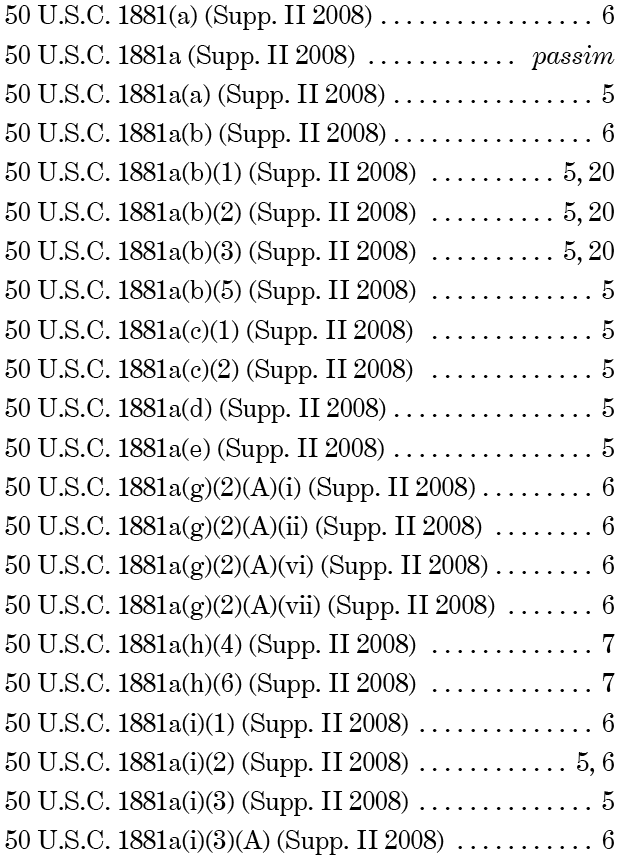
The image to the left is a fragment of the government’s references to statutes and regulation mentioned in its brief; it’s the part of the list referring to the part of the FAA in question. As you can see, it almost–but not quite–lists every clause of the law.

One clause notably missing from the almost-sequential list above is 1881a(b)(4), which reads,

[An acquisition authorized under subsection (a)] may not intentionally acquire any communication as to which the sender and all intended recipients are known at the time of the acquisition to be located in the United States;

And while it mentions clauses that refer back to this restriction (for example, 1881a(c)(1), 1881a(d), 1881a(g)(2)(A)(i), etc), it never goes back and includes this language–the requirement that the government not intentionally acquire communications that are located entirely within the US–in its argument. (There are other clauses the brief ignores, a number of which pertain to oversight of the certifications the government has made; I may return to these at a future time.)

Or, to put it another way, the government never admits that the FAA permits the purportedly unintentional collection of entirely domestic communication.

And yet that is a part of this lawsuit. The original complaint in this suit invoked this clause:

An acquisition under section 702(a) may not … “intentionally acquire any communication as to which the sender and all intended recipients are known at the time of the acquisition to be located in the United States

[snip]

Moreover, the Attorney General and the DNI may acquire purely domestic communications as long as there is uncertainly about the location of one party to the communications.

And the 2nd Circuit opinion (authored by Gerard Lynch) referenced this clause:

“Targeting procedures” are procedures designed to ensure that an authorized acquisition is “limited to targeting persons reasonably believed to be located outside the United States,” and is designed to “prevent the intentional acquisition of any communication as to which the sender and all intended recipients are known at the time of the acquisition to be located in the United States.”

[snip]

In addition, the certification must attest that the surveillance complies with statutory limitations providing that it:

[snip]

(4) may not intentionally acquire any communication as to which the sender and all intended recipients are known at the time of the acquisition to be located in the United States;

[snip]

Under the FAA, in contrast to the preexisting FISA scheme, the FISC may not monitor compliance with the targeting and minimization procedures on an ongoing basis. Instead, that duty falls to the AG and DNI, who must submit their assessments to the FISC, as well as the congressional intelligence committees and the Senate and House Judiciary Committees.

[snip]

But the government has not asserted, and the statute does not clearly state, that the FISC may rely on these assessments to revoke earlier surveillance authorizations.

Now, to some degree, the government might argue it ignored the clause prohibiting intentional–but not accidental–targeting of domestic communications because the plaintiffs’ primary basis for establishing standing is their frequent communication with likely targets overseas. As I’ll show, the government wants to make this case about a particular definition of a target, and key to that argument is a claim that it is impossible for the plaintiffs to be targets.

Yet therein lies one of the key problems with their argument, given that 1881a(b)(4) only prohibits the plaintiffs from being intentional targets; the FAA very pointedly did not prohibit the government from keeping US person information it “unintentionally” collected. In fact, Mike McConnell and Michael Mukasey started issuing veto threats when Russ Feingold tried to restrict the ongoing use of domestic communications identified as such after the fact.

Finally, in the one case that approved this kind of collection (though under the Protect America Act, not the FAA) used targeting procedures to substitute for particularity required under the Fourth Amendment. Under PAA, those procedures were not mapped out by law; under FAA they are, partly in the clause the government wants to ignore.

And yet, remarkably, the government doesn’t want that clause to be part of its discussion with SCOTUS. Seeing as how even the FISA Court of Review finds that substitute for particularity–the targeting procedures–to be a key part of compliance with the Fourth Amendment, you’d think that would be relevant.

Share this entry

DOJ’s Untracked Email Spying

As Wired reports, DOJ blew off the requirement that it tell Congress how many pen registers and trap and trace devices they used for the entire Bush Administration.

[…]the Justice Department was not following the law and had not provided Congress with the material at least for years 2004 to 2008. On the flip side, Congress was not exercising its watchdog role, thus enabling the Justice Department to skirt any oversight whatsoever on an increasingly used surveillance method that does not require court warrants, according to Justice Department documents obtained via the Freedom of Information Act.

But just as interesting as DOJ’s failure to follow the law on disclosing these surveillance tools are two details from the emails Chris Soghoian liberated to make all this clear.

First, note the December 23, 2009 email from Janet Webb (on PDF 4) revealing that DOJ’s agencies weren’t tracking email pen registers (that is, lists of who was emailing each other), and one of them–they speculate DEA–still wasn’t in 2009.

FBI only began keeping computer intercept stats a couple of years ago. The other agency may be DEA.

From which we might assume DEA is engaging in a ton of email tracking they don’t want to tell anyone about?

Wired suggests why they may not be tracking such information.

Another feature of [the Electronic Communication Privacy Act] had once protected Americans’ electronic communications from the government’s prying eyes, but it has become so woefully outdated that it now grants the authorities nearly carte blanche powers to obtain Americans’ e-mail stored in the cloud, such as in Gmail or Hotmail — without a court warrant.

That is, we probably should assume these email numbers are so small–and DEA isn’t tracking them at all–because they’re just taking them, with no court oversight at all.

The other detail to remember about these reports is they include only criminal surveillance, not intelligence surveillance. Russ Feingold staffer Lara Flint makes that clear in her request, and DOJ staffer Mark Agrast makes it clear in his response. They’re getting that information via other means, presumably NSLs or Section 215.

So while they’re hiding a lot of the cloud computer spying they’re doing in the name of criminal investigations, that doesn’t even scratch the surface of the degree to which they’re tracking who emails whom.

Share this entry

William Welch Probably NOT One of the Attorneys Who Engaged in Gross Prosecutorial Misconduct in Stevens Case

As Ryan Reilly reported, Judge Emmet Sullivan is moving forward with his plan to release the scathing report on the Ted Stevens prosecution showing the prosecution was “permeated by the systematic concealment of significant exculpatory evidence.”

Back when descriptions of this report first surfaced, I asked, “Why Is William Welch, Whose Team Is Accused of Intentional Prosecutorial Misconduct, Still at DOJ?

Given Sullivan’s latest order, I think the answer must be that Welch is not one of the four DOJ lawyers most badly implicated in the report. That’s because DOJ, which after all still employs Welch to prosecute whistleblowers, had no objection to the report being released on March 15.

The Department of Justice’s Notice advised the Court that it “does not intend to file a motion regarding Mr. Schuelke’s report” and that “[t]he government does not contend that there is any legal prohibition on the disclosure of any references in Mr. Schuelke’s report to grand jury material, court authorized interceptions of wire communications, or any sealed pleadings or transcripts that have now been unsealed.” Notice of Dep’t of Justice Regarding Materials Referenced in Mr. Schuelke’s Report, at 1-2 (“DOJ Notice”). In addition, the Department of Justice informed the Court that it was not asserting any deliberative process or attorney-work product privilege with respect to the information contained in Mr. Schuelke’s Report.

Criminal Division head Lanny Breuer has already proven himself more than willing to hide the misconduct of his prosecutors; I have no doubt he’d do so here if it badly implicated any of his current attorneys.

So I’m guessing–though that is a guess–that Welch is not one of the four fighting to prevent this release.

Share this entry

The Home of the Free Got Foreclosed

On Wednesday’s Gitmo anniversary, Jonathan Turley had a WaPo column listing 10 reasons why the US was no longer the “land of the free.” I thoroughly endorse his list:

Assassination of US citizens

Indefinite detention

Arbitrary justice

Warrantless searches

Secret evidence

War crimes (impunity for torture)

Secret court

Immunity from judicial review

Continual monitoring of citizens

Extraordinary renditions

But I do think the list skews (not surprisingly, given that it was a GItmo anniversary piece) to ways the war on terror have circumscribed our civil rights and rule of law generally.

It’s worth noting that the same things have been happening domestically, with at best only a tangential tie to “security.” For example, where Turley describes renditions and indefinite detention, he might as well have included the immigration deportation system, which like the terrorism one operates with a great deal of arbitrariness, but which also rounds up more American citizens. Turley discusses surveillance generally, but we should note that some of that war on terror surveillance–National Security Letters and drones, for example–are being used increasingly in criminal law enforcement. Add in the increasing militarization of the police–some of which came directly from the drug war, some of which has been reapplied generally in the name of national security.

And then there’s the courts. Even putting the defunding of legal aid aside, even putting aside the broad push to force consumers and employees into privatized arbitration rather than courts, even our legal system itself is showing signs of failure. Most spectacularly, that failure shows in efforts to let banks steal homes so as to pass all the losses of the banks’ own failures onto homeowners.

Turley is right that the war on terror has chipped away at fundamental freedoms. But so has increased corporate power and related efforts to coerce the 99%.

It’s not just that Al Qaeda bombed the land of the brave; so, too, did America’s own corporations foreclose on the home of the free.

Share this entry

“Crackpots don’t make good messengers”

For the record, I have no intention of voting for Ron Paul in the General election (though depending on how the GOP primary rolls out, I might consider crossing over to vote for Paul in the MI primary, for similar reasons as I voted for John McCain in the 2000 primary: because I knew my vote wouldn’t matter in the Democratic primary and I hoped a McCain win might slow down George Bush’s momentum and focus some attention on campaign finance reform, McCain’s signature issue at the time).

I don’t want Ron Paul to be President and, for all my complaints with Obama, he is a less bad presidential candidate than Paul.

But that’s an entirely different question then the one Kevin Drum purports to address with this post:

Should we lefties be happy he’s in the presidential race, giving non-interventionism a voice, even if he has other beliefs we find less agreeable? Should we be happy that his non-mainstream positions are finally getting a public hearing?

Drum doesn’t actually assess the value of having a non-interventionist in the race, or even having a civil libertarian in the race (which he largely dodges by treating it as opposition to the drug war rather than opposition to unchecked executive power), or having a Fed opponent in the race.

Instead, he spends his post talking about what a “crackpot” Paul is, noting (among other things), that Paul thinks climate change is a hoax, thinks the UN wants to confiscate our guns, and is a racist.

Views, mind you, that Paul shares in significant part with at least some of the other crackpots running for the GOP nomination.

Of course, Paul does have views that none of the other Republicans allowed in Presidential debates share. And that’s what Drum would need to assess if he were genuinely trying to answer his own question: given a field of crackpots, several of whom are explicit racists, several of whom make claims about cherished government programs being unconstitutional, most of whom claim to believe climate change doesn’t exist, is it useful that one of the candidates departs from the otherwise universal support for expanded capitulation to banks, authoritarianism, and imperialism? Read more

Share this entry

In Jewel Decision, Article III Uses Article I to Rebut Article II

The 9th Circuit just released its decisions in two warrantless wiretap suits: Jewel, which claimed that the dragnet collection of communications from the Folsom Street AT&T facility violated FISA, Electronic Communication Privacy Act, and the Stored Communications Act; and Hepting, which argued that the FISA Amendments Act–which grated the telecoms retroactive immunity for their illegal wiretapping–was unconstitutional. Both opinions were authored by Margaret McKeown.

The Hepting decision is a slam dunk win for the telecoms. While there are some interesting–and perhaps dubious moves–in the decision, the Circuit completely upheld Vaughn Walker’s District Court ruling that the retroactive immunity granted to the telecoms was constitutional.

But that huge win for the telecoms relies on the Circuit’s observation that Congress has the authority to pass laws regarding surveillance. And that’s what gets the government in trouble in Jewel. The Circuit based its decision that Carolyn Jewel had standing to sue the government for collecting her communications on that same principle–that Congress could and had passed laws that regulate surveillance–including the private right of action for claims of illegal surveillance.

Both the ECPA and the FISA prohibit electronic interception of communications absent compliance with statutory procedures. The SCA likewise prohibits the government from obtaining certain communication records. Each statute explicitly creates a private right of action for claims of illegal surveillance.

McKeown’s opinion then uses the authority of Congress to dismiss the notion that this question–whether the Executive could be punished for its illegal surveillance of Jewel–should be thrown back in Congress’ lap. Congress has already weighed in on the issue, McKeown points out, both in the underlying statutes (providing for a judicial avenue of relief), and in the FAA (granting immunity to the telecoms but not the government).

After labeling Jewel’s claim as an effort “to redress alleged malfeasance by the executive branch,” the district court stated that “the political process, rather than the judicial process,” may be the appropriate avenue. There is little doubt that Jewel challenges conduct that strikes at the heart of a major public controversy involving national security and surveillance. And we understand the government’s concern that national security issues require sensitivity. That being said, although the claims arise from political conduct and in a context that has been highly politicized, they present straightforward claims of statutory and constitutional rights, not political questions. See Japan Whaling Ass’n v. Am. Cetacean Soc., 478 U.S. 221, 230 (1986).

The district court’s suggestion that Congress rather than the courts is the preferred forum ignores two important points: To begin, Congress already addressed the issue and spelled out a private right of action in the FISA, ECPA and SCA. Read more

Share this entry

Drone War Secrecy and Kill or Capture

As we stand on the doorstep of President Obama signing into law the new NDAA and its dreaded controversial provisions, there are two new articles out of interest this morning. The first is an incredibly useful, and pretty thorough, synopsis at Lawfare of the new NDAA entitled “NDAA FAQ: A Guide for the Perplexed”. It is co-written by Ben Wittes and Bobby Chesney and, though I may differ slightly in a couple of areas, it is not by much and their primer is extremely useful. I suggest it highly, and it has condensed a lot of material into an easily digestible blog length post.

The second is a long read from the Washington Post on how secrecy defines Obama’s drone wars:

The administration has said that its covert, targeted killings with remote-controlled aircraft in Pakistan, Yemen, Somalia and potentially beyond are proper under both domestic and international law. It has said that the targets are chosen under strict criteria, with rigorous internal oversight.
….
“They’ve based it on the personal legitimacy of [President] Obama — the ‘trust me’ concept,” Anderson said. “That’s not a viable concept for a president going forward.”

The article goes on to state how the CIA, and the majority of voices in the White House, are fighting tooth and nail for continued utmost secrecy lest any of our enemies somehow discover we are blowing them to bits with our drones. This is, of course, entirely predictable, especially now that the former head of the CIA leads the military and the former military chief for the greater Af/Pak theater which has long been ground zero for the drone kill program, Petraeus, is the head of the CIA.

But then the Post piece brings up our old friend, the OLC:

The Justice Department’s Office of Legal Counsel has opposed the declassification of any portion of its opinion justifying the targeted killing of U.S. citizen Anwar al-Awlaki in Yemen this year. Awlaki, a propagandist for the Yemen-based al-Qaeda affiliate whom Obama identified as its “external operations” chief, was the first American known to have been the main target of a drone strike. While officials say they did not require special permission to kill him, the administration apparently felt it would be prudent to spell out its legal rationale.
….
Under domestic law, the administration considers all three to be covered by the Authorization for Use of Military Force that Congress passed days after the Sept. 11, 2001, attacks. In two key sentences that have no expiration date, the AUMF gives the president sole power to use “all necessary and appropriate force” against nations, groups or persons who committed or aided the attacks, and to prevent future attacks.

The CIA has separate legal authority to conduct counterterrorism operations under a secret presidential order, or finding, first signed by President Ronald Reagan more than two decades ago. In 1998, President Bill Clinton signed an amendment, called a Memorandum of Notification, overriding a long-standing ban on CIA assassinations overseas and allowing “lethal” counterterrorism actions against a short list of named targets, including Osama bin Laden and his top lieutenants. Killing was approved only if capture was not deemed “feasible.”

A week after the Sept. 11 attacks, the Bush administration amended the finding again, dropping the list of named targets and the caveat on “feasible” capture.

“All of that conditional language was not included,” said a former Bush administration official involved in those decisions. “This was straight-out legal authority. . . . By design, it was written as broadly as possible.”

This brings us back to the notable October 8, 2011 article by the New York Times’ Charlie Savage on his viewing of the Awlaki targeting memo relied on by the Obama White House for the extrajudicial execution of Anwar al-Awlaki. Marcy, at the time discussed the incongruity of the collateral damage issue and the fact Samir Khan was also a kill in the targeted Awlaki strike.

I would like to delve into a second, and equally misleading, meme that has been created by the self serving and inconsistent secret law Obama has geometrically expanded from the already deplorable Bush/Cheney policy set: the false dichotomy in the kill or capture element of the Read more

Share this entry

No, the Iraq War Is NOT Over

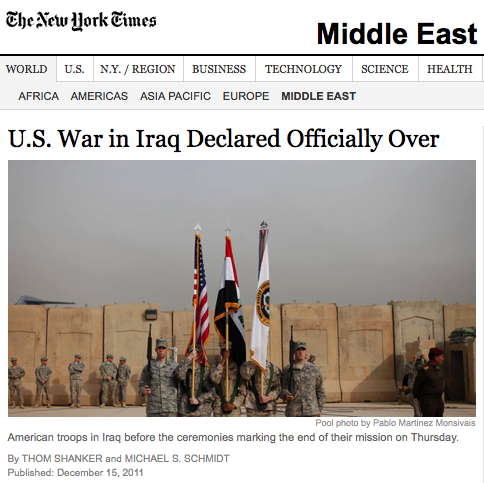
The NYT, which played a key propaganda role in getting us into the Iraq war, has a 1000-word article telling us the Iraq war has officially been declared over.

And while it is true that the Administration had a campaign event dog and pony show yesterday declaring the war over, it is not.

After all, Rand Paul tried to formally, legally end the Iraq war last month. And 67 Senators refused to do so.

The fact that the Iraq AUMF remains on the books matters. It matters because no matter how many times we wax eloquent about Iraqis controlling their own destiny, Nuri al-Maliki knows that little prevents Obama from bringing in troops again–or dropping drones in his country. Maybe that’s why Maliki is doing unfathomable things like laying a wreath at the military cemetery of the country that has occupied and ravaged his country for 8 years.

And, as I keep noting, the Iraq AUMF serves another purpose. That AUMF’s general language on “terrorism” has been used to authorize the use of “war powers” against people the Executive Branch claims are terrorists who have nothing to do with al Qaeda. The Iraq AUMF has been interpreted by the Executive Branch to authorize a war against all so-called terrorists, not just the terrorists who hit us on 9/11. And based on that argument, it was used to authorize the wiretapping of American citizens in the US.

Credulous journalists may want to accept the Administration’s propaganda about the Iraq war ending. But until we take the expanded powers given to the President pursuant to a vile propaganda campaign away from him, the Iraq war is not over. And Obama should not be able to use it as a campaign line until he actually gives up those powers.

Share this entry

Serial Abuser of Executive Branch “Flexibility,” John Brennan, Making Veto Case on Detainee Provisions

I have already said I think Obama needs to veto the Defense Authorization because of the detainee provisions. And I have argued that the Administration needs to lay the groundwork for doing so right now, preferably by fear-mongering about how much less safe presumptive military detention would make us.

Obama claims he’s still going to veto the Defense Authorization because of these detainee provisions. Good. I think he should. But if he really plans to do so, someone needs to be fear-mongering 24/7 about how much less safe these provisions will make us (and they will).

But I’m dismayed the Administration has chosen John Brennan, of all people, to do so. (h/t Ben Wittes)

The Administration has chosen someone who served as a top CIA executive during the period it developed its torture program to go out and argue the Executive Branch needs “flexibility” in detention to collect intelligence.

And so, what we’ve tried to do in this administration is to maintain as much flexibility as possible. And anything that restricts our flexibility in terms of how we want to detain them, question them, prosecute them is something that counterterrorism professionals and practitioners really are very concerned about.

[snip]

What we want to do is to extract the intelligence from them so that we can keep this country safe. We cannot hamper this effort. It’s been successful to date and this legislation really puts that at risk. [my emphasis]

We let a President have that kind of unrestricted flexibility on how to detain suspected terrorists and he used it to order Brennan’s agency to engage in torture.

But it’s not just with torture that John Brennan has been party to the Executive Branch’s abuse of this kind of unfettered “flexibility” in the past.

As I’ve pointed out, one of the problems (for the Administration) with the AUMF-affirming language in the Senate detainee provisions is that it may circumscribe the Administration’s ability to claim that terrorists with no ties to al Qaeda are legitimate military targets. That broader interpretation, relying on the Iraq AUMF, was implemented in 2004 to authorize things that presumably were already being done with the illegal wiretap program. When that May 2004 opinion was written, John Brennan oversaw the targeting–relying on that expansive definition–for the illegal wiretap program.

And then there’s the Administration’s insistence that no court should be able to review their decisions about who is and is not an enemy under the AUMF and whether those enemies represent an imminent threat. They prevented such a review with Anwar al-Awlaki, in part, by invoking state secrets over the precise terms at issue in the detainee language. Yet after the Administration killed Awlaki, Administration officials spilled state secrets repeatedly, at times solely to boast about the kill. Brennan even provided details covered under state secrets declarations on the record. The Administration’s badly hypocritical approach to secrecy in the case of Awlaki, particularly its failure to prosecute John Brennan for leaking state secrets, makes it clear their state secrets invocation had nothing to do with national security, but instead had to do with remaining free from any oversight–with retaining the maximum “flexibility,” if you will–over precisely the issues at the core of the detainee provisions. And as with torture and illegal wiretapping, John Brennan was at the center of that gross abuse of executive power as well.

There are some superb reasons to veto the Defense Authorization because of the detainee provisions: largely because DOJ has proven best able to interrogate and prosecute terrorists in the last decade. And there are some horrible reasons to do so: to allow the Executive Branch to continue to wield expanded powers with almost no oversight.

John Brennan is, in this Administration at least, the personification of all the horrible reasons.

Update: The AP reports the Administration is conducting a “full court press” to get changes to the bill. But look at what they point to to justify their “flexibility:”

The administration insists that the military, law enforcement and intelligence agents need flexibility in prosecuting the war on terror. Obama points to his administration’s successes in eliminating Osama bin Laden and al-Qaida figure Anwar al-Awlaki. Republicans counter that their efforts are necessary to respond to an evolving, post-Sept. 11 threat, and that Obama has failed to produce a consistent policy on handling terror suspects. [my emphasis]

Frankly, they’d probably be able to assassinate Awlaki under the new bill. But it’s telling they point to it–based as it is on their ability to interpret the AUMF in secrecy and with no oversight–as their justification for “flexibility.”

Share this entry