About the Reuters DEA Special Operations Division Story

Reuters is out this morning with what is being hailed as somewhat of an eye opening expose on the Drug Enforcement Agency’s Special Operations Division. The article is very good and should be read in full, but I would like to make a couple of quick points.

First, the headline is misleading. The caption is:

Exclusive: U.S. directs agents to cover up program used to investigate Americans

Well, not really (and, in fairness, the actual body of the article is about a practice that is a result of the SOD). DEA’s Special Ops Division is neither new nor secret in the least, and there is no way to “cover it up”. Google it; I got “About 289,000 results (0.29 seconds)” as a return. You will get something similar. The revelation that SOD was used in the Viktor Bout case is also not new, here is a Time story detailing it from 2011.

In fact, any criminal defense attorney who did cocaine hub conspiracy cases in the 90’s could have told you most of the Reuter’s article in their sleep. That was exactly the scene that DEA-SOD was born from. As the war on drugs went nuclear, the DEA devised what they termed the “Kingpin Strategy”:

In 1992, the DEA instituted the Kingpin Strategy that focused investigative and enforcement efforts on specific drug trafficking organizations. The DEA planned to dis- able major organizations by attacking their most vulnerable areas—the chemicals needed to process the drugs, their finances, communications, transportation, and leadership structure.

The Kingpin Strategy held that the greatest impact on the drug trade took place when major drug organizations were dis- rupted, weakened, and destroyed. This strategy focused enforcement efforts and resources against the highest-level traffickers and their organizations, and provided a systematic way of attacking the various vulnerabilities of the organiza- tions. By systematically attacking each of these vulnerabilities, the strategy aimed to destroy the entire organization, and with it, the organization’s capacity to finance, produce, and distrib- ute massive amounts of illegal drugs. Each blow weakened the organization and improved the prospects for arresting and prosecuting the leaders and managers of the organizations.

The Kingpin Strategy evolved from the DEA’s domestic and overseas intelligence gathering and investigations.

And from Kingpin sprung the Special Operations Division:

Under the original Kingpin Strategy, DEA headquarters often dictated the selection of Kingpin targets. In response to the SACs’ concerns, Administrator Constantine agreed to allow them more latitude in target selection. In conjuction with this decision, he established the Special Operations Division at Newington, Virginia, in 1994 to coordinate multi-jurisdictional investigations against major drug trafficking organizations responsible for the flow of drugs into the United States.

The above is from a history of the DEA right there on the Justice Department’s website, so “covering up” SOD is kind of a non-starter. However, what IS being covered up, and what really is the substance of the body of the Reuter’s article, is the practice of “parallel construction” of cases:

The undated documents show that federal agents are trained to “recreate” the investigative trail to effectively cover up where the information originated, a practice that some experts say violates a defendant’s Constitutional right to a fair trial. If defendants don’t know how an investigation began, they cannot know to ask to review potential sources of exculpatory evidence – information that could reveal entrapment, mistakes or biased witnesses.
…..
After an arrest was made, agents then pretended that their investigation began with the traffic stop, not with the SOD tip, the former agent said. The training document reviewed by Reuters refers to this process as “parallel construction.”

The two senior DEA officials, who spoke on behalf of the agency but only on condition of anonymity, said the process is kept secret to protect sources and investigative methods. “Parallel construction is a law enforcement technique we use every day,” one official said. “It’s decades old, a bedrock concept.”

Yes. Exactly. And, as the “senior DEA officials” admitted, this, too, is not new in the least. Again, the Reuter’s quote of the incredulous former Judge Nancy Gertner aside, any number of longtime members of NACDL could have told you all of this at any point in time since the mid 90’s.

The takeaway that is important from the Reuters piece is that all the frothing about “golly, what if those NSA capabilities bleed out of terrorism and into traditional criminal cases” is nuts. It already is, and has been for a long time. It is the “clean teaming” of criminal prosecutions. And it is a direct and tangible fraud upon defendants, the courts, Due Process and several other important Constitutional concepts.

It is not a matter of what if it happens, it IS happening.

Share this entry

NSA’s PRISM and the Oddity of PalTalk

[graphic: GuardianUK (mod)]

[graphic: GuardianUK]

Remember this presentation slide on PRISM from last month’s blockbuster report by the Guardian-UK?

Remember the one outlier right smack in the middle of the slide — the company name most folks don’t recognize?

PalTalk.

Very few news outlets tackled PalTalk, explaining what the business is and asking why it was included in the program. There was little more than cursory digging; Foreign Policy looked into PalTalk’s background, while PCMag merely asked in a snarky piece why PalTalk instead of a myriad of other larger alternative social media platforms.

It’s still a good question, but the answer might be right in front of us with a little more analysis.

PalTalk is an “online video chat community,” according to its own description. This means it is in the same competitive space as AOL and Skype, as well as Microsoft’s Hotmail IM and Yahoo Messenger.

The slide we’ve seen doesn’t tell us if access to AOL, Microsoft, and Yahoo was limited to email only, however. We can’t be certain PRISM and the other programs referenced in this particular NSA presentation weren’t also permitted access to live chat environments hosted by these companies. Foreign Policy sidled up to the issue, mentioning Yahoo as well as PalTalk, but didn’t follow through. It’s been relatively easy to see how interest veered away from this question; many news outlets focused on email metadata, not chat.

Squirrel away the unasked, unanswered question(s) about chat someplace for future reference.

With regard to PalTalk, Foreign Policy noted the organization was singular among the companies cited in the NSA slide as it was not a Silicon Valley firm. PalTalk is based in New York. The line of inquiry here went no further.

Hello, New York? This small business is co-located in an AT&T facility in Manhattan, and in New Jersey according the firm’s CEO and founder Jeffrey Katz in a Forbes article dd. 2003 to which FP linked:

“…He rents space in two AT&T data centers, one in Manhattan, another in Secaucus, N.J., with $700,000 worth of computer equipment, including 80 lower-end servers from Dell Computer and five IBM Unix servers. …”

This should raise numerous questions at this point. Manhattan must be an extremely expensive place to run a data center, cheek-and-jowl with financial traffic demanding extremely high uptime. Because of the frequency with which New York was mentioned in published content about PalTalk, the New Jersey location is likely a redundant facility for the purposes of business continuity if the main facility is disrupted.

You’ll recall the last major disruptions to data traffic out of New York were due to Hurricane Sandy and 9/11.

Why would a tiny online video chat community need a data center likely to have world-class uptime and redundancy of a nature a company might need only twice a decade? Read more

Share this entry

Negative Manning Decision and the Future of Investigative Journalism

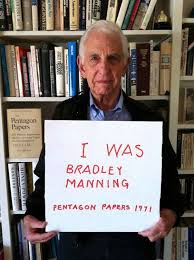
imagesLittle more than few hours ago, a critical ruling was handed down by Judge Denise Lind in the Bradley Manning UCMJ prosecution ongoing at Fort Meade. The decision was on based on this motion by the defense seeking dismissal of the “Aiding the Enemy” charge, among others in the prosecution.

To make a long, even if sadly predictable, story short, the motion was denied by Judge Lind and the charge will proceed to determination on the merits. This is, to be sure, a nod to the prosecution (which is actually the standard in such motions for directed verdicts during trials; that is the facts are taken in the light most favorable to the non-moving party, the government). It is also, obviously, a blow to the defense, although undoubtedly an expected one for defense attorney David Coombs. There is a very outside chance of a silver lining I will discuss below.

Julie Tate at the Washington Post sets the table:

The motion to dismiss the charge was filed July 4 by Manning’s civilian defense attorney. He argued that the government had failed to show that Manning “had ‘actual knowledge’ that by giving information to WikiLeaks, he was giving information to an enemy of the United States.” He said the government did introduce evidence “which might establish that PFC Manning ‘inadvertently, accidentally, or negligently’ gave intelligence to the enemy,” but that this was not enough to prove the most serious charge against him, known as an Article 104 offense.

On two separate occasions, Lind, an Army colonel, had questioned military prosecutors about whether they would be pursuing the charge if the information had been leaked directly to The Washington Post or the New York Times. Each time, the prosecution said it would. That troubles advocates for whistleblowers, who fear that the leaking of national defense information that appears online, as it inevitably does, can be construed as assisting the enemy.

If convicted of aiding the enemy, Manning, an intelligence analyst who served in Iraq, could face life in prison.

That describes the motion and the stakes as to Manning. Julie’s article also gives more particulars on the denial this morning, and is worth a read. For a tick tock, please see the continuously good coverage by Kevin Gosztola of Firedoglake.

But as enormous as the stakes are for Bradley Manning, the enterprise of investigative journalism is also on trial, even if in an indirect manner.

Yet another journalist who has tirelessly, and superbly, covered the Manning prosecution, Alexis O’Brien, has written at the Daily Beast, the stakes for investigative journalism are also life and/or death in the face of the security/surveillance state. Citing the in court, and on the trial record, compelling testimony of Professor Yochai Benkler of Harvard Law School, Alexis related:

In a historic elocution in court last week, Prof. Yochai Benkler, co-director of the Berkman Center for Internet and Society at Harvard Law School, told Lind that “the cost of finding Pfc. Manning guilty of aiding the enemy would impose” too great a burden on the “willingness of people of good conscience but not infinite courage to come forward,” and “would severely undermine the way in which leak-based investigative journalism has worked in the tradition of [the] free press in the United States.”

“[I]f handing materials over to an organization that can be read by anyone with an internet connection, means that you are handing [it] over to the enemy—that essentially means that any leak to a media organization that can be read by any enemy anywhere in the world, becomes automatically aiding the enemy,” said Benkler. “[T]hat can’t possibly be the claim,” he added.

Benkler testified that WikiLeaks was a new mode of digital journalism that fit into a distributed model of emergent newsgathering and dissemination in the Internet age, what he termed the “networked Fourth Estate.” When asked by the prosecution if “mass document leaking is somewhat inconsistent with journalism,” Benkler responded that analysis of large data sets like the Iraq War Logs provides insight not found in one or two documents containing a “smoking gun.” The Iraq War Logs, he said, provided an alternative, independent count of casualties “based on formal documents that allowed for an analysis that was uncorrelated with the analysis that already came with an understanding of its political consequences.”

Those really are the stakes in the, now, not all that new age of digital journalism. When the prosecutors in the Manning trial, upon direct questioning by Judge Lind as to whether they would still prosecute Manning if his leaks had been delivered straight to the New York Times or Washington Post, it had to be a wake up call for traditional media. Or so you would think. But, really, the outrage has been far greater over the James Rosen/Fox subpoena that could, and arguably should, be considered relative peanuts.

But, Yochai Benkler is right as to the import of the consideration as to Wikileaks in the Manning case.

In closing, the one slim and thin ray of limited hope from today’s ruling by Denise Lind: If I were Lind and cared at all about the ultimate verdict on Pvt. Bradley Manning, I too would have made this ruling. Why, you ask? Well, because a dismissal on the motion would have been the equivalent of a directed verdict on the law and would be far easier to overturn on appeal than a decision on the merits that the government has not met its burden of proof. Is this possible; sure, it certainly is. Is this likely; no, I would not make any substantial bets on it.

Share this entry

The 3 Hop Scotch of Civil Liberties and Privacy

I was in court, so I didn’t see it, but apparently there was a little hearing over at House Judiciary Committee this morning on “Oversight of the Administration’s Use of FISA Authorities“. There was an august roll of Administration authorities and private experts: Mr. James Cole, United States Department of Justice; Mr. John C. Inglis, National Security Agency; Mr. Robert S. Litt, ODNI; Ms. Stephanie Douglas, FBI National Security Branch; Mr. Stewart Baker; Mr. Steven G. Bradbury; Mr. Jameel Jaffer; and Ms. Kate Martin.

Hmmm, let’s take a look and see if anything interesting occurred (as reported by Pete Yost of AP). Uh, well, there was THIS:

For the first time, NSA deputy director John C. Inglis disclosed Wednesday that the agency sometimes conducts what’s known as three-hop analysis. That means the government can look at the phone data of a suspect terrorist, plus the data of all of his contacts, then all of those people’s contacts, and finally, all of those people’s contacts.

If the average person calls 40 unique people, three-hop analysis could allow the government to mine the records of 2.5 million Americans when investigating one suspected terrorist.
….
The government says it stores everybody’s phone records for five years. Cole explained that because the phone companies don’t keep records that long, the NSA had to build its own database.

Go read all of Yost’s report, there is quite a bit in there that is stunning in the blithe attitude the Administration takes on this hoovering of data and personal information. Also clear: Congress has no real grasp or control of the government’s actions. The Article I brakes are out and the Article II car is accelerating and careening down the road.

Share this entry

Was Inspire a British-Made Product?

Amid a longer story about one-time Brits stripped of their citizenship and handled according to the Administration Disposition Matrix, Ian Cobain fills out the story of Minh Quang Pham (whose identity in the UK is protected under a legal gag and so is referred to as B2). Among other things, Cobain answers the question I raised here: how Pham materially supported Al Qaeda in the Arabian Peninsula by (we infer) helping to produce Inspire between the time he was arrested upon returning from Yemen in July 2011 and the time the British Home Secretary Theresa May tried to strip him of citizenship in December of that year (see my timelines here): he was out on bail.

On arrival back at Heathrow airport, the Vietnamese-born man was searched by police and arrested when a live bullet was found in his rucksack. A few months later, while he was free on bail, May signed an order revoking his British citizenship.

But that would mean Pham was materially contributing to Inspire at a time when he was in the UK. The Brits have much stronger laws against even possessing Inspire. If we (and by association they) had evidence he was producing Inspire while out on bail, it should be easy to try him there.

Which is part of Pham’s current complaint, as he tries to avoid extradition to the US: he could have and should have been charged in the UK.

Within minutes of SIAC announcing its decision and granting B2 unconditional bail, he was rearrested while sitting in the cells at the SIAC building. The warrant had been issued by magistrates five weeks earlier, at the request of the US Justice Department. Moments after that, the FBI announced that B2 had been charged with five terrorism offences and faced up to 40 years in jail. He was driven straight from SIAC to Westminster magistrates’ court, where he faced extradition proceedings.

B2 continues to resist his removal to the US, with his lawyers arguing that he could have been charged in the UK. Indeed, the allegations made by the US authorities, if true, would appear to represent multiple breaches of several UK laws: the Terrorism Act 2000, the Terrorism Act 2006 and the Firearms Act 1968. Asked why B2 was not being prosecuted in the English courts – why, in other words, the Americans were having this particular headache, and not the British – a Crown Prosecution Service spokesperson said: “As this is a live case and the issue of forum may be raised by the defence in court, it would be inappropriate for us to discuss this in advance of the extradition hearing.”

One of the charges against Pham is that he conspired to obtain military training. Which would seem to rely on Ahmed Warsame’s testimony. But it’s not clear how much of the material support charges Warsame could support, given that Pham’s material support period extends a number of months beyond Warsame’s arrest.

Note, however, that there may be overlap between the UndieBomb 2.0 mole working with AQAP (who may have arrived in AQAP 2 months before Pham left) and the tail end of the charge. In which case they may be shipping Pham to the US to better hide the mole’s role in all this.

Of course, all these charges may primarily be about protecting the mole.

Share this entry

Chuck Schumer Must Want All American Brown Youth Stop and Frisked

I thought Chuck Todd was speculating in that beltway fashion when he said he had heard people suggest Ray Kelly should replace Janet Napolitano as Department of Homeland Security Secretary.

But apparently, Chuck Schumer actually thinks it’s a good idea.

It’s leader needs to be someone who knows law enforcement, understands anti-terrorism efforts, and is a top-notch administrator, and at the NYPD, Ray Kelly has proven that he excels in all three.  As a former head of the Customs and Border patrol, he has top-level federal management experience. There is no doubt Ray Kelly would be a great DHS Secretary, and I have urged the White House to very seriously consider his candidacy.

Not only is this a batshit crazy idea because of all the authoritarian things Ray Kelly has done in NYC, from harassing hundreds of thousands of African American and Latino youths to spying on Muslims.

But note how Schumer doesn’t mention the other, equally important part of Homeland Security: keeping the country safe from things like Chinese hackers and natural disasters.

How’d Kelly do at organizing a response to Hurricane Sandy? Maybe we should ask Occupy Sandy about that?

Share this entry

MEK Stirs Pot in Iran Despite Improved Negotiation Outlook After Rohani’s Election

In a remarkably welcome surprise, moderate cleric Hassan Rohani won last month’s presidential election in Iran and did so with a large enough margin to avoid a runoff. In the immediate aftermath of the election, there was hope that the heated rhetoric on both sides of the dispute over Iran’s nuclear technology would calm a bit:

Though thousands of jubilant Iranians poured onto the streets in celebration of the victory, the outcome will not soon transform Iran’s tense relations with the West, resolve the row over its nuclear program or lessen its support of Syria’s president in the civil war there – matters of national security that remain the domain of Supreme Leader Ayatollah Ali Khamenei.

But the president runs the economy and wields broad influence in decision-making in other spheres. Rohani’s resounding mandate could provide latitude for a diplomatic thaw with the West and more social freedoms at home after eight years of belligerence and repression under President Mahmoud Ahmadinejad, who was legally barred from seeking a third consecutive term.

“This victory is a victory of wisdom, a victory of moderation, a victory of growth and awareness and a victory of commitment over extremism and ill-temper,” Rohani told state television, promising to work for all Iranians, including the hardline so-called “Principlists” whom he defeated at the poll.

Alas, those who favor violence over negotiation don’t intend to sit idly while moderation has a chance of breaking out. Today, we have a new “revelation” brought to us in a Reuters article:

An exiled opposition group said on Thursday it had obtained information about a secret underground nuclear site under construction in Iran, without specifying what kind of atomic activity it believed would be carried out there.

/snip/

The NCRI said the site was inside a complex of tunnels beneath mountains 10 km (6 miles) east of the town of Damavand, itself about 50 km northeast of Tehran. Construction of the first phase began in 2006 and was recently completed, it said.

The group released satellite photographs of what it said was the site. But the images did not appear to constitute hard evidence to support the assertion that it was a planned nuclear facility.

The Reuters article identifies NCRI as the National Council of Resistance of Iran and in addition to identifying them as “exiled dissedents” also mentions affiliation with the “People’s Mujahideen Organisation of Iran (PMOI)” without noting that the more commonly used acronym for the latter group is MEK. That would be the same MEK that was only de-listed by the US Department of State as a terrorist organization last year. Promptly after de-listing, the group moved to register as lobbyists:

An Iranian group that was listed as a terrorist organization until last year has formally registered to lobby the Obama administration.

The National Council of Resistance of Iran told the Justice Department that it plans to “educate” the public and the U.S. government about the need to pursue an Iran policy “based on respect for human rights, non-proliferation, and promotion of democracy.” The council is an umbrella group of five Iranian opposition groups, the largest of which is the delisted terror group Mujahedin-e-Khalq, or MEK.

/snip/

The State Department closed the council’s Washington office in 2002, calling it a front group for the MEK. Since then, the group has earned the good graces of U.S. conservatives by drawing international attention to Iran’s clandestine uranium enrichment facility in Natanz.

That bit about NCRI exposing the Natanz facility? Even though it also is cited in today’s Reuters article, there is good reason to believe that MEK came into the information through a leak to them rather than their own intelligence-gathering: Read more

Share this entry

Did Umar Patek Lead the US to Osama bin Laden?

Yesterday, Al Jazeera published a leaked copy of the final report from the Abbottabad Commission appointed by Pakistan’s government to investigate both how Osama bin Laden could have lived within Pakistan (on military land!) for so long and how the US was able to carry out its mission to kill him without Pakistan’s military responding in any way.

The report is published as a pdf file of what is clearly a photocopy of the report. The English version has a few translation and/or transcription errors where a word here and there does not make sense. The copy is nearly complete, but Al Jazeera notes that every copy they saw was missing a page in which former ISI director Pasha described conversations Musharraf had with the US just after 9/11.

I’m about a third of the way through reading the report. So far, it has been organized as summaries of the testimony from individuals who had some sort of role at bin Laden’s compound or a role in government or law enforcement that intersected with the event. Each summary of testimony is followed by a bit of reaction from the commission itself, and this reaction can be quite pithy at times. The commission found Shakeel Afridi’s testimony completely unbelieveable, as he claimed to have no knowledge at all that he was working with the CIA. The commission also, in response to the testimony of a lower level local police figure, ascribed the abdication of duty as due to “government implosion syndrome”, adding that “This explains a lot without excusing it.”

What stands out to me in the reading so far is the role that Umar Patek could have played in aiding the US to find bin Laden. Recall that so far, the party line from the US is that bin Laden’s compound was located in Abbottabad by tracing the two couriers who lived there. However, Indonesian bomber Umar Patek was arrested in Abbottabad in January of 2011, just a few months before the May raid by the US.

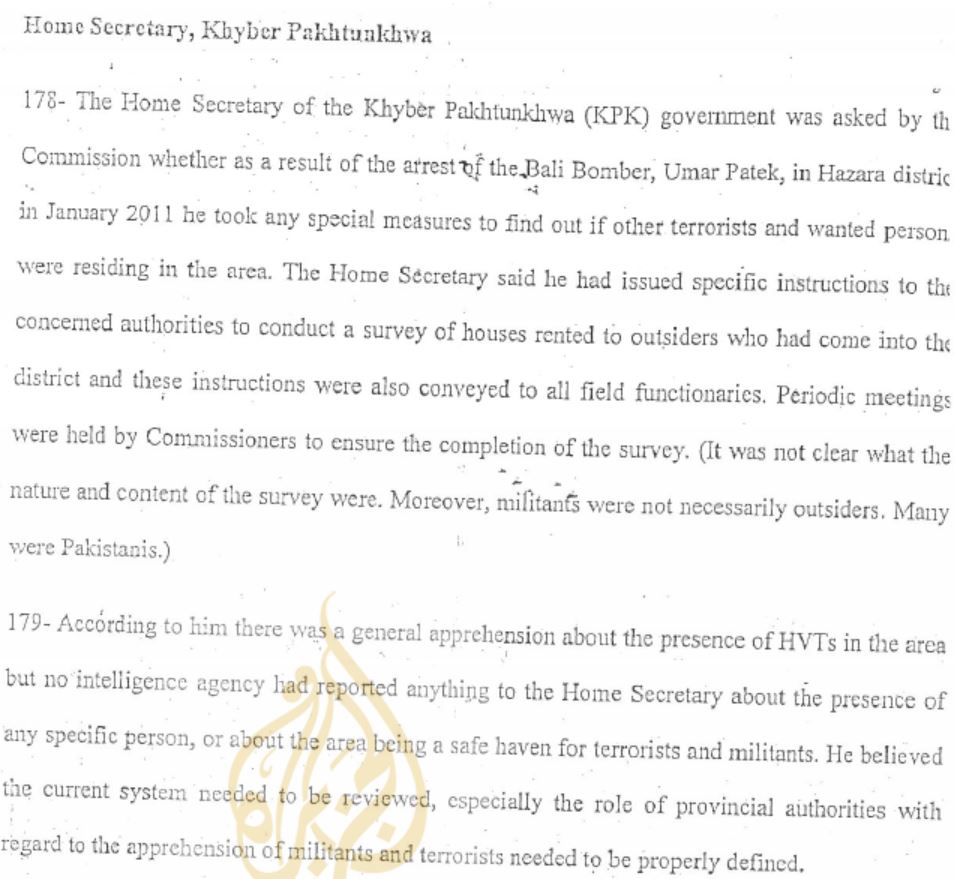
Here is a bit of the testimony from the Home Secretary of Kyhber Pakhunkhwa Province (so as not to add further transcription errors, I am relying on partial screen captures of the pdf document that is in a form not allowing text to be copied):

KP Home Sec re Umar Patek


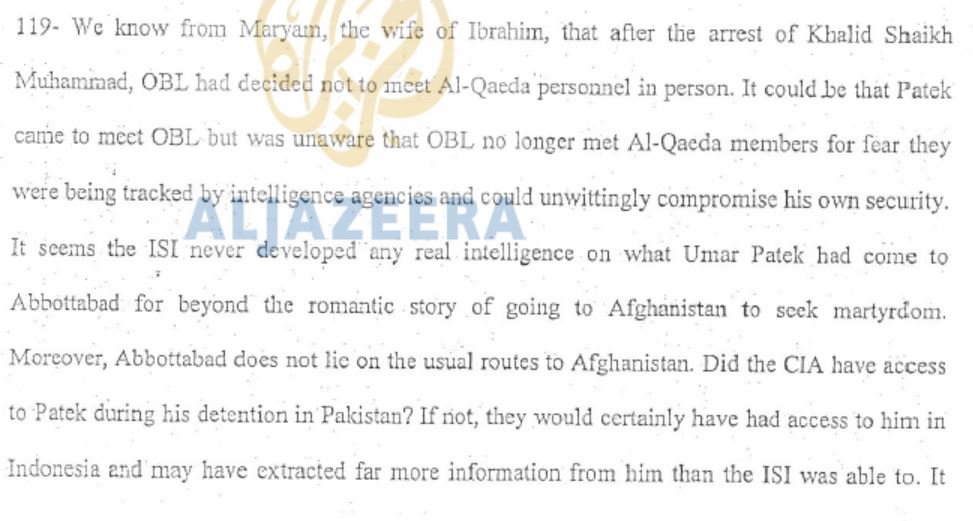
So the arrest of Patek aroused at least some concern, but it was not followed up on. The testimony of the wife of one of the couriers, Maryam, got into a very interesting analysis of the Patek situation, though, with the commission offering some incisive deductions:

Patek part 1


And after a page break:

Patek part 2


Almost nobody had paid any attention to Patek’s arrest being so close in time and location to the bin Laden raid. Well, one foul-mouthed blogger did, a year ago this week:

But there’s a question that has, AFAIK, never been answered. Patek was arrested in January 2011 in Abbottabad, Pakistan. There have always been suspicions that the arrest of Patek in the city Osama bin Laden was hidden out in (Patek reportedly planned to meet OBL) helped to solidify the case that he was in fact the “Pacer” in the compound. Did Patek help the US get OBL?

Both Marcy and the commission find the interrogation window for Patek to fit extremely well with the timing of the bin Laden raid. The commission also shows considerable insight in noting that despite the efforts by bin Laden to cut off all interaction with the outside world except for the use of his two couriers, at least one high level al Qaeda affiliate may well have known that bin Laden was in Abbottabad.

While the world focuses on the role of following bin Laden’s couriers, it may well be that Patek provided some of the most actionable intelligence on bin Laden being in Abbottabad.

Share this entry

Federal Court Strikes Down Obama DOJ’s State Secrets Defense

In what can only be described as a significant ruling, Judge Jeffrey White in the Northern California District (CAND) has rejected the federal government’s, via the Obama and Holder Department of Justice, assertion of state secrets privilege in the case of Jewel v. National Security Agency and the related consolidated case of Shubert v. Obama.

The full decision of the court is here, and in the critical active language from the court’s own summary states:

Having thoroughly considered the parties’ papers, Defendants’ public and classified declarations, the relevant legal authority and the parties’ arguments, the Court GRANTS the Jewel Plaintiffs’ motion for partial summary adjudication by rejecting the state secrets defense as having been displaced by the statutory procedure prescribed in 50 U.S.C. § 1806(f) of FISA. In both related cases, the Court GRANTS Defendants’ motions to dismiss Plaintiffs’ statutory claims on the basis of sovereign immunity. The Court further finds that the parties have not addressed the viability of the only potentially remaining claims, the Jewel Plaintiffs’ constitutional claims under the Fourth and First Amendments and the claim for violation of separation of powers and the Shubert Plaintiffs’ fourth cause of action for violation of the Fourth Amendment. Accordingly, the Court RESERVES ruling on Defendants’ motion for summary judgment on the remaining, non-statutory claims.

The Court shall require that the parties submit further briefing on the course of this litigation going forward.

Now, before too much celebration is made, there are some sobering aspects of this decision as well. As can be told from the quote above, several counts in both complaints have been dismissed based on sovereign immunity, and the court has questions about the continued validity of the remaining counts and has requested further briefing in that regard.

With the ultimate status of the litigation left for another day, the big news today is the negation of the dreaded state secrets assertion. To say this is a rare occurrence is to be too kind. In fact, the main instance where the privilege was overcome was the al-Haramain litigation, also in CAND, where Judge Vaughn Walker found non-classified evidence sufficient to proceed in the face of the state secrets assertion, and even that case was later reversed and dismissed by the 9th Circuit.

The court in Jewel mapped out the consideration process for the privilege challenge:

The analysis of whether the state secrets privilege applies involves three distinct steps. First, the Court must ascertain whether the procedural requirements for invoking the privilege have been satisfied. Second, the Court must make an independent determination whether the information is privileged. In determining whether the privilege attaches, the Court may consider a party’s need for access to the allegedly privileged materials. See Reynolds, 345 U.S. 19 at 11. Lastly, the “ultimate question to be resolved is how the matter should proceed in light of the successful privilege claim.” El-Masri v. United States, 479 F.3d 296, 304 (4th Cir. 2007).

Noting that the assertion of state secrets must not cause “a complete surrender of judicial control over access to the courts”, Judge White wrote:

Here, having reviewed the materials submitted for review and having considered the claims alleged and the record as a whole, the Court finds that Defendants have timely invoked the state secrets doctrine. Defendants contend that Plaintiffs’ lawsuits should be dismissed as a result of the application of the privilege because the state secrets information is so central to the subject matter of the suit that permitting further proceedings would jeopardize national security. Given the multiple public disclosures of information regarding the surveillance program, the Court does not find that the very subject matter of the suits constitutes a state secret. Just as in Al-Haramain, and based significantly on the same set of facts in the record here, the Court finds that although there are certainly details that the government has not yet disclosed,

because of the voluntary disclosures made by various officials since December 2005, the nature and purpose of the [Terrorist Surveillance Program], the ‘type’ of persons it targeted, and even some of its procedures are not state secrets. In other words, the government’s many attempts to assuage citizens’ fears that they have not been surveilled now doom the government’s assertion that the very subject matter of this litigation, the existence of a warrantless surveillance program, is barred by the state secrets privilege.

507 F.3d at 1200; see also Hepting v. AT&T Corp., 439 F. Supp. 2d 974, 986-88, 991 (N.D. Cal. 2006) (holding that the existence of a program of monitoring the contents of certain telephone communications was no longer a state secret as a result of the public statements made by the President and the Attorney General). Accordingly, the Court does not find dismissal appropriate based on the subject matter of the suits being a state secret. See Totten, 92 U.S. at 107.

White went on to note that there were significant items of evidence in the Jewel case tending to confirm or negate the factual allegations in Plaintiffs’ complaints that would be subject to state secrets exclusion. However, White held that, as a matter of law, the FISA procedural mechanism prescribed under 50 U.S.C. 26 § 1806(f) preempted application of the state secrets privilege in the litigation at bar.

Citing one of the interlocutory appellate decisions in al-Haramain and the underlying logic of then trial judge Vaughn Walker), Judge White said:

In its opinion on remand in the Al-Haramain matter, this district court found that “FISA preempts the state secrets privilege in connection with electronic surveillance for intelligence purposes ….” In re National Security Agency Telecommunications Records Litigation (“In re N.S.A. Telecommunication Records Litig.”), 564 F. Supp. 2d 1109, 1111 (N.D. Cal. 2008). The undersigned agrees and finds that the in camera review procedure in FISA applies and preempts the determination of evidentiary preclusion under the state secrets doctrine. Section 1806(f) of FISA displaces the state secrets privilege in cases in which electronic surveillance yields potentially sensitive evidence by providing secure procedures under which courts can consider national security evidence that the application of the state secrets privilege would otherwise summarily exclude.

Section 1806 of the FISA enabling statutes in Title 50 of the United States Code provides, inter alia;

… whenever any motion or request is made by an aggrieved person pursuant to any other statute or rule of the United States or any State . . . to discovery or obtain applications or orders or other materials relating to electronic surveillance . . . the United States district court … shall, notwithstanding any other law, if the Attorney General files an affidavit under oath that disclosure or an adversary hearing would harm the national security of the United States, review in camera and ex parte the application, order, and such other materials relating to the surveillance as may be necessary to determine whether the surveillance of the aggrieved person was lawfully authorized and conducted.

This finding by Judge White reaffirmed at least some control by federal trial courts of sweeping assertions of state secrets privilege by the Executive Branch. That is, better than nothing, for sure. But it is rather small comfort in light of the finding of qualified immunity extended to the government on the Jewel and Shubert plaintiffs’ statutory claims under FISA.

In discussing the intersection of the FISA claims with related claims by plaintiffs under the Stored Communication Act and Wiretap Act, the court did leave several more general counts of the complaints active. However, there is no way to look at the entirety of Jeff White’s opinion and come away believing the plaintiffs have any clear path to victory in the long run. The Jewel and Shubert cases live on to fight another day, for now, but the handwriting is on the wall for either the 9th Circuit or Supreme Court to deal the death blow down the road.

Share this entry

caught up

Congratulations to the AP, which has caught up to the reporting I did a month ago on the way SOCOM purged their own systems of Osama bin Laden photos (and, apparently, records) and moved them to the CIA.

But it appears that this shell game involved more than just moving all these records to CIA. It appears CIA had to retroactively classify at least the photographs.

As you recall, Judicial Watch (as well as a bunch of other entities) had FOIAed any pictures of the raid. It its motion for summary judgment, JW made several complaints about the government’s FOIA response:

  • The search, particularly at DOD, was inadequate.
  • The government declarations didn’t adequately specify what was included in the pictures (I suspect this was done to hide trophy pictures not shown to Congress or, possibly, even the President).
  • The government declarations don’t prove that all the photos could cause exceptionally grave harm.
  • The description of the classification process was inadequate.

It is the last of these that is most interesting, given the apparent fact that DOD transfered all its photos to CIA (plus my suspicion that a lot of these are trophy photos, not official operational photos).

First, Defendants fail to identify who classified the records. Director Bennett testifies as to who generally has the authority to classify information as TOP SCERET and who generally has the authority to delegate such authority. Bennett Decl. at ¶¶ 14-15. In addition, Director Bennett states that the “Director of the CIA has delegated original TOP SECRET classification authority to me. As an original classification authority, I am authorized to conduct classification reviews and to make original classification decisions.” Id. at ¶ 18. Yet, Director Bennett does not testify that he personally classified the records. Nor does he state that any other authorized official actually classified the records.  If an individual without the proper authority classified the records, Defendants have not complied with the procedural requirements of EO 13526.

Second, Director Bennett does not specifically testify as to when the 52 records were classified. Director Bennett only states that as of September 26, 2011, the 52 records are currently and properly classified. Read more

Share this entry