Glenn Greenwald and David Frum Need to Stop Looking to the Mueller Report for FBI’s Counterintelligence Conclusions

There have been several public controversies in recent days that arise from the fact that there was a Russian counterintelligence investigation that no one sees tangible results of.

The most predictable came when Glenn Greenwald claimed Mueller’s purported silence about blackmail proved that any questions about it amounted to conspiracy mongering.
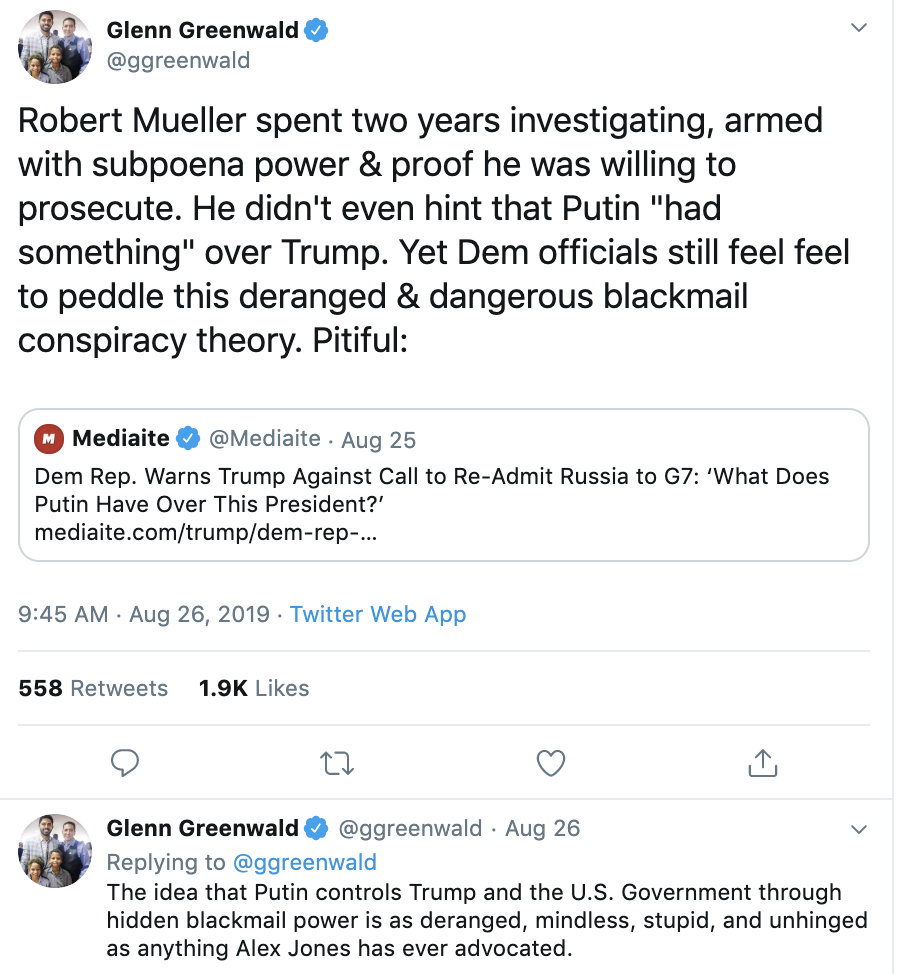
Glenn objects to John Garamendi wondering why Trump continues to push so hard to readmit Russia into the G-7. It’s a question raised by reports of how Trump’s private lobbying to readmit Russia undermined the G-7 even more than his more public lies and intransigence about other topics.

The leaders sat down Saturday evening for their first joint meeting — a dinner of Basque specialties at the foot of the landmark lighthouse of Biarritz. The meal started normally, with a discussion of the fires in the Amazon. It moved on to containing Iran’s nuclear threat. But it went off the rails when Trump blasted leaders for not including Russia.

Trump’s message was that “it doesn’t really make sense to have this discussion without Putin at the table,” according to a European official briefed on the conversation among the leaders.

The official, like others, spoke on the condition of anonymity to discuss the sharp discussions at the summit.

The entire 44-year vision of the G-7 gathering, according to the non-U. S. participants, is to hash out global issues among like-minded democracies. So the discussion quickly turned even more fundamental: Whether the leaders should assign any special weight to being a democracy, officials said.

Most of the other participants forcefully believed the answer was yes. Trump believed the answer was no. The pushback against him was delivered so passionately that the U.S. president’s body language changed as one leader after another dismissed his demand, according to a senior official who watched the exchange. He crossed his arms. His stance became more combative.

[snip]

But having such a forceful advocate for an authoritarian leader inside the room of democracies profoundly shaped the overall tone of the summit, one senior official said.

“The consequence is the same as if one of the participants is a dictator,” the official said. “No community of like-minded leaders who are pulling together.”

There is another possible explanation of course: That Trump is an authoritarian, which would mean that anybody who helped him get elected had a hand in fostering authoritarianism.

That said, Glenn’s argument that Garamendi was engaging in unhinged conspiracy theories by asking the question because after 22 months of investigating, Mueller “didn’t even hint that Putin ‘had something’ over Trump” he might use to blackmail him is an outright error.

First, it assumes that Mueller would have prosecuted someone if Russia’s president had blackmail material over Trump. I’m a bit confused how this would work, even in theory. Does Glenn think Mueller is going to charge the President of Russia with a crime for pressing an advantage over the President of the United States in foreign policy? Even distinguishing blackmail (what Putin would do) from accepting a bribe (what Trump might do in response), did Glenn miss the part where Attorney General Bill Barr, whom Glenn has treated as a credible interlocutor in this matter despite his authoritarian tendencies and his history of covering up Executive abuse, took an especially hard stance against indicting a President?

It is absolutely true that the Mueller Report concluded that the available information did not support a quid pro quo conspiracy, where Russia offered to help get Trump elected in exchange for favorable treatment in the future.

[T]he investigation examined whether these contacts involved or resulted in coordination or a conspiracy with the Trump Campaign and Russia, including with respect to Russia providing assistance to the Campaign in exchange for any sort of favorable treatment in the future. Based on the available information, the investigation did not establish such coordination.

Some information that is known not to have been available to Mueller’s investigation includes an explanation for why Trump’s campaign manager was sharing campaign strategy with an Oleg Deripaska aide at a meeting where they also talked about carving up Ukraine to Russia’s liking — directly related to the event that led to Russia’s G-7 exclusion. Mueller also was unable to get any answers from Trump about discussions of sanctions relief, extending (uniquely even for Trump’s contemptuous responses) even to discussions during the campaign. Mueller also was never able to obtain a definitive answer about whether Mike Flynn asked Sergey Kislyak to hold off on responding to Obama’s sanctions with Trump’s involvement. Mueller also did not get a solid understanding of how the Transition treated Erik Prince’s discussions with Kirill Dmitriev, because both Prince and Steve Bannon deleted their texts that would have explained their inconsistent accounts. In short, Mueller did not establish a quid pro quo. But he also did not have some of the most important information he’d need to assess the question.

More importantly, a quid pro quo amounting to the crime of conspiracy — something Mueller could charge, if it involved people in addition to Trump — is a different thing than blackmail, what Glenn explicitly refers to twice in his tweets. Short of accepting a bribe, that’s a counterintelligence question, not a prosecutorial one. And the Mueller Report explicitly says that all the counterintelligence findings were not in the report, which is by regulation limited to prosecution and declination decisions.

From its inception, the Office recognized that its investigation could identify foreign intelligence and counterintelligence information relevant to the FBI’s broader national security mission. FBI personnel who assisted the Office established procedures to identify and convey such information to the FBI. The FBI’s Counterintelligence Division met with the Office regularly for that purpose for most of the Office’s tenure. For more than the past year, the FBI also embedded personnel at the Office who did not work on the Special Counsel’s investigation, but whose purpose was to review the results of the investigation and to send-in writing-summaries of foreign intelligence and counterintelligence information to FBIHQ and FBI Field Offices. Those communications and other correspondence between the Office and the FBI contain information derived from the investigation, not all of which is contained in this Volume. This Volume is a summary. It contains, in the Office’s judgment, that information necessary to account for the Special Counsel’s prosecution and declination decisions and to describe the investigation’s main factual results. [my emphasis]

If Mueller had found evidence Putin were trying to blackmail Trump, he would have treated it as a counterintelligence concern; it wouldn’t show up in the report, which is why it is so silly that Glenn suggests Mueller’s public statements would discount the possibility of blackmail. Being blackmailed is not a crime. Glenn is — as he has been since he embraced Bill Barr’s summary as a faithful report of what Mueller found — simply misrepresenting (or perhaps ignorant of) the scope of the report, even while relying on Mueller as an authority to dismiss Garamendi’s claim.

Glenn’s claims about Mueller’s silence are all the more inaccurate given Mueller’s testimony before the Intelligence Committee, which itself has a counterintelligence function. Mueller did, explicitly, state that his report does not show Trump to be an agent of Russia.

WENSTRUP: So a member of this Committee said President Trump was a Russian agent after your report was publicly released. That statement is not supported by your report, correct?

MUELLER: That is accurate. Not supported.

But that’s not what Glenn addressed, at all (and it’s also not what the the majority of concerns raised about Trump address). Glenn was making a claim about blackmail, not about being a recruited agent.

In his testimony, Mueller said something very different about blackmail. One of the biggest pieces of news that came out of that day of hearings was Mueller’s statement that the FBI continues to investigate whether Mike Flynn was susceptible to blackmail.

KRISHNAMOORTHI: Since it was outside the purview of your investigation your report did not address how Flynn’s false statements could pose a national security risk because the Russians knew the falsity of those statements, right?

MUELLER: I cannot get in to that, mainly because there are many elements of the FBI that are looking at different aspects of that issue.

KRISHNAMOORTHI: Currently?

MUELLER: Currently.

That may be consistent with reports from a period when Mueller’s investigation was done that multiple US Attorneys districts had equities in Flynn’s 302s, not to mention the disclosure that Ekim Alptekin was working to influence Trump’s policies in ways that go beyond the Gulen related contact.

As to Trump, in Mueller’s longer colloquy with Raja Krishnamoorthi, he confirmed that two potential sources of potential Trump blackmail were not addressed by the report: Trump’s financial ties with Russia and Russian money laundering using Trump businesses.

KRISHNAMOORTHI: Director, since it was outside the purview of your investigation, your report did not reach counterintelligence conclusions regarding the subject matter of your report.

MUELLER: That’s true.

KRISHNAMOORTHI: For instance, since it was outside your purview, your report did not reach counterintelligence conclusions regarding any Trump administration officials who might potentially be vulnerable to compromise of blackmail by Russia, correct?

MUELLER: Those decisions probably were made in the FBI.

KRISHNAMOORTHI: But not in your report, correct?

MUELLER: Not in our report. We avert to the counterintelligence goals of our investigation which were secondary to any criminal wrongdoing that we could find.

Then, in an exchange with Adam Schiff, Mueller agreed hypothetically that acting unethically, particularly if it involves lying about financial issues, could make someone susceptible to blackmail. When Schiff asked explicitly whether a presidential candidate lying about doing business with Russia could expose someone to blackmail, Mueller said he would, “leave that to you.”

SCHIFF: If a presidential candidate was doing business in Russia and saying he wasn’t, Russians could expose that too, could they not?

MUELLER: I leave that to you.

In other words, the most direct thing Mueller has said — after having laid out that if there were counterintelligence concerns stemming from Trump’s lies to hide his willingness to work through a former GRU officer and with sanctioned banks to make an improbably lucrative real estate deal in Moscow relying on the intervention of the Russian government, they wouldn’t be in his report — is that he would leave it to Schiff, or perhaps the House Intelligence Committee tasked with CI, to determine the CI implications of Trump’s lies about the Trump Tower deal. And yet Glenn is complaining about Garamendi raising the question that Mueller himself deferred to Congress.

If Glenn wants to treat Mueller as his authority (he actually wants to treat Bill Barr’s caricature of Mueller as his authority), then he needs to admit that, after acknowledging that the kinds of things Trump and his flunkies did and do may make them susceptible to blackmail, Mueller deferred precisely this issue, as it regards the President, to Congress. He sure as hell didn’t say concerns about them amounted to Alex Jones-worthy conspiracy mongering; he said the opposite.

And while it wasn’t asked in either of the Mueller hearings, the report does not treat two other areas investigators would need to review to determine whether or not Trump was making policy decisions based off a concern that Russia had leverage over him. Probably for very good constitutional reasons, the report doesn’t deal with actions unrelated to the investigation that Trump took as President, such as attempting to overturn the existing sanctions on Russia or slow-walking the further sanctions imposed by Congress. More specifically, however, the Mueller Report doesn’t treat the most alarming incidents between Trump and Russia: Trump’s sharing of highly sensitive Israeli intelligence in the same meeting with Sergei Lavrov where Trump boasted of firing Comey, Trump and Putin’s private conversation about adoptions during the period when Trump was penning a false statement claiming the June 9 meeting was about adoptions, and Trump’s backing of Putin’s claims about the DNC hack in Helsinki, even in the wake of the GRU indictment for the theft. They’re all (especially given precedents about the President’s role in classification decisions and foreign policy) legal, but deeply troubling from a national security perspective. That’s where any counterintelligence analysis of Trump’s compromise by Russia would start, and even though related events are treated in the Mueller Report, these specifically are not.

In short, Glenn’s comment, which would have betrayed ignorance of the scope of the Mueller Report back in March when he started making such claims, is an outright error in light of what Mueller said in Congressional testimony. To the extent anyone in government has made conclusions about Trump’s susceptibility to blackmail (and at least per Mueller’s testimony, FBI is still investigating related issues), that’s not something in the Mueller Report. It’s also not something Mueller deems conspiracy-mongering. Mueller’s report of their criminal charging decisions is by definition silent on that issue.

All that said, Glenn is not alone in this error. He’s joined by many critics of Trump’s coziness with Putin, too. Just this morning, for example, Axis of Evil scribe David Frum made precisely the error Glenn made, suggesting that the silence about counterintelligence issues in Mueller’s Report reflects any conclusion about it. He made it about the same topic, too: Trump’s insistence that Russia should rejoin the G-7.
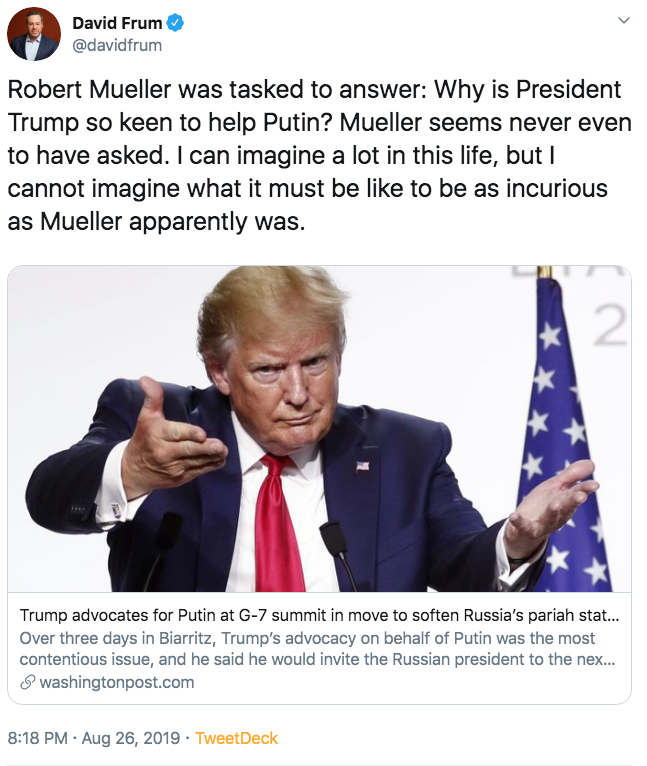
A simple review of the report would explain that Mueller was primarily tasked to prosecute crimes, and a simple review of Mueller’s testimony — the only time he addressed this question explicitly — would show Mueller stating that, “the counterintelligence goals of our investigation which were secondary to any criminal wrongdoing that we could find.”

All that said, it is equally wrong to assume that Mueller’s team and the FBI counterintelligence agents colocated with it didn’t take particular steps to investigate counterintelligence concerns. Last night, in the wake of confirmation that Deutsche Bank had copies of Trump’s tax returns, there was a sketchy single sourced report on MSNBC (which Trump’s lawyer has just aggressively refuted; now MSNBC has retracted it) that unnmaed Russians had co-signed on some DB loans.

To be clear, there are reasons to suspect Deutsche Bank files on Trump and his son-in-law would show suspect behavior. That’s because an earlier NYT story relying on five sources, one of them named — said DB had flagged certain transactions. That report even said the DB declined to submit Suspicious Activity Reports on the transactions.

In the summer of 2016, Deutsche Bank’s software flagged a series of transactions involving the real estate company of Mr. Kushner, now a senior White House adviser.

Ms. McFadden, a longtime anti-money laundering specialist in Deutsche Bank’s Jacksonville office, said she had reviewed the transactions and found that money had moved from Kushner Companies to Russian individuals. She concluded that the transactions should be reported to the government — in part because federal regulators had ordered Deutsche Bank, which had been caught laundering billions of dollars for Russians, to toughen its scrutiny of potentially illegal transactions.

Ms. McFadden drafted a suspicious activity report and compiled a small bundle of documents to back up her decision.

Typically, such a report would be reviewed by a team of anti-money laundering experts who are independent of the business line in which the transactions originated — in this case, the private-banking division — according to Ms. McFadden and two former Deutsche Bank managers.

That did not happen with this report. It went to managers in New York who were part of the private bank, which caters to the ultrawealthy. They felt Ms. McFadden’s concerns were unfounded and opted not to submit the report to the government, the employees said.

Ms. McFadden and some of her colleagues said they believed the report had been killed to maintain the private-banking division’s strong relationship with Mr. Kushner.

After Mr. Trump became president, transactions involving him and his companies were reviewed by an anti-financial crime team at the bank called the Special Investigations Unit. That team, based in Jacksonville, produced multiple suspicious activity reports involving different entities that Mr. Trump owned or controlled, according to three former Deutsche Bank employees who saw the reports in an internal computer system.

Some of those reports involved Mr. Trump’s limited liability companies. At least one was related to transactions involving the Donald J. Trump Foundation, two employees said.

Deutsche Bank ultimately chose not to file those suspicious activity reports with the Treasury Department, either, according to three former employees.

That said, these sources all seem to have reviewed the actual transactions, and there’s nothing as inflammatory as a Russian co-signer. Lawrence O’Donnell’s source reportedly has not seen the documents.

More importantly, the belief there’ll be some criminal hidden grail in Trump’s finances assumes that Mueller never got any of his finances. In the same Intelligence Committee hearing, Mueller declined to comment on whether he had obtained Trump’s tax returns and other financial documents.

KRISHNAMOORTHI: And of course your office did not obtain the president’s tax returns which could otherwise show foreign financial sources, correct?

MUELLER: I’m not going to speak to that.

KRISHNAMOORTHI: In July 2017 the president said his personal finances were off limits, or outside the purview of your investigation and he drew a “red line,” around his personal finances. Were the president’s personal finances outside the purview of your investigation?

MUELLER: I’m not going to get in to that.

KRISHNAMOORTHI: Were you instructed by anyone not to investigate the president’s personal finances?

MUELLER: No.

Mueller did base some of his investigation off of SARs referrals (which, obviously, he wouldn’t haven’t obtained if DB was sitting on them until this got reported several months after Mueller’s investigation shut down); that’s where the investigation of Michael Cohen began. Any investigation into Jared Kushner’s discussions of back channels involving sanctioned Russian banks would surely have subpoenaed bank records. Furthermore, Mueller obtained at least Cohen’s Trump Organization email without asking for it from the company itself (and preserved all of it as soon as he learned about the June 9 meeting).

In other words, there’s a counterpart to those — like Glenn and Frum — erroneously making claims about Mueller’s counterintelligence conclusions based on what is in the report. That’s people assuming that certain kinds of investigation wouldn’t have happened, when we know some form of one did.
Share this entry

Revisiting the First Time President Trump Blabbed Out Classified Information for Political Gain

I’d like to revisit what might be the first time in his presidency that Donald Trump blabbed out highly classified information for political gain. Trump appears to have endangered the investigation into CIA’s stolen hacking tools, all to blame Obama for the leak.

It happened on March 15, 2017, during an interview with Tucker Carlson.

Amid a long exchange where Tucker challenges Trump, asking why he claimed — 11 days earlier — that Obama had “tapped” Trump Tower without offering proof, Trump blurted out that the CIA was hacked during the Obama Administration.

Tucker: On March 4, 6:35 in the morning, you’re down in Florida, and you tweet, the former Administration wiretapped me, surveilled me, at Trump Tower during the last election. Um, how did you find out? You said, I just found out. How did you learn that?

Trump: I’ve been reading about things. I read in, I think it was January 20th, a NYT article, they were talking about wiretapping. There was an article, I think they used that exact term. I read other things. I watched your friend Bret Baier, the day previous, where he was talking about certain very complex sets of things happening, and wiretapping. I said, wait a minute, there’s a lot of wiretapping being talked about. I’ve been seeing a lot of things. Now, for the most part I’m not going to discuss it because we have it before the committee, and we will be submitting things before the committee very soon, that hasn’t been submitted as of yet. But it’s potentially a very serious situation.

Tucker: So 51,000 people retweeted that, so a lot of people thought that was plausible, they believe you, you’re the president. You’re in charge of the agencies, every intelligence agency reports to you. Why not immediately go to them and gather evidence to support that?

Trump: Because I don’t want to do anything that’s going to violate any strength of an agency. You know we have enough problems. And by the way, with the CIA, I just want people to know, the CIA was hacked and a lot of things taken. That was during the Obama years. That was not during, us, that was during the Obama situation. Mike Pompeo is there now, doing a fantastic job. But we will be submitting certain things, and I will be perhaps speaking about this next week. But it’s right now before the Committee, and I think I want to leave it at that. I have a lot of confidence in the committee.

Tucker: Why not wait to tweet about it until you can prove it? Does it devalue your words when you can’t provide evidence?

Trump: Well because the NYT wrote about it. You know, not that I respect the NYT. I call it the failing NYT. They did write on January 20 using the word wiretap. Other people have come out with —

Tucker: Right, but you’re the President. You have the ability to gather all the evidence you want.

Trump: I do, I do. But I think that frankly we have a lot right now and I think if you watch, uh, if you watched the Brett Baier and what he was saying and what he was talking about and how he mentioned the word wiretap, you would feel very confident that you could mention the name. He mentioned it and other people have mentioned it. But if you take a look at some of the things written about wiretapping and eavesdropping, and don’t forget when I say wiretap, those words were in quotes, that really covers, because wiretapping is pretty old fashioned stuff. But that really covers surveillance and many other things. And nobody ever talks about the fact that it was in quotes but that’s a very important thing. But wiretap covers a lot of different things. I think you’re going to find some very interesting items over the next two weeks. [my emphasis]

It was clear even at the time that it was a reference to the Vault 7 files, now alleged to have been leaked to WikiLeaks by Joshua Schulte; the first installment of files were released eight days earlier.

The next day, Adam Schiff, who as the then-Ranking HPSCI member, likely had been briefed on the leak, responded to Trump’s comments and suggested that, while Trump couldn’t have broken the law for revealing classified information, he should nevertheless try to avoid releasing it like this, without any kind of consideration of the impact of it.

Last night, the President stated on Fox News that “I just wanted people to know, the CIA was hacked, and a lot of things taken–that was during the Obama years.” In his effort to once again blame Obama, the President appears to have discussed something that, if true and accurate, would otherwise be considered classified information,

It would be one thing if the President’s statement were the product of intelligence community discussion and a purposeful decision to disclose information to the public, but that is unlikely to be the case. The President has the power to declassify whatever he wants, but this should be done as the product of thoughtful consideration and with intense input from any agency affected. For anyone else to do what the President may have done, would constitute what he deplores as “leaks.”

Trump did reveal information the CIA still considered classified. At the very least, by saying that CIA got hacked, he confirmed the Vault 7 documents were authentic files from the CIA, something the government was not otherwise confirming publicly at that time. (Compare Mike Pompeo’s oblique comments about the leak from a month later.)

His reference to the volume of stolen files may have been based on what the CIA had learned from reviewing the initial dump; court filings make it clear the CIA still did not know precisely what had been stolen.

His reference to a hack, rather than a leak, is an interesting word choice, as the compromise has usually been called a leak. But Schulte’s initial search warrants listed both Espionage and the Computer Fraud and Abuse Act, meaning the government was treating it as (partly) a hacking investigation. And some of the techniques he allegedly used to steal the files are the same that hackers use to obfuscate their tracks (which is unsurprising, given that Schulte wrote some of the CIA’s obfuscation tools).

Perhaps the most damning part of Trump’s statement, however, was the main one: that the theft had taken place under Obama. WikiLeaks’ initial release was totally noncommittal about when they obtained the files, but said it had been “recent[].” By making it clear that the government knew the theft had taken place in 2016 and not more “recently,” Trump revealed a detail that would have made it more likely Schulte would realize they believed he was the culprit (though he knew from the start he’d be a suspect), given that he’d left the agency just days after Trump was elected.

The most damning part of all of this, though, is the timing. Trump made these comments at an unbelievably sensitive time in the investigation.

Tucker did the interview while accompanying Trump to Detroit on March 15, 2017, which means the interview took place sometime between 10:50 AM and 3:30 PM (Tucker said the interview happened at Willow Run Airport, but this schedule says he flew into DTW). Unless it was given special billing, it would have aired at 9PM on March 15.

That means Trump probably made the comments as the FBI was preparing a search of Schulte’s apartment, the first step the FBI took that would confirm for Schulte that he was the main suspect in the leak. Trump’s comments likely aired during the search, before the moment Schulte left his apartment with two passports while the search was ongoing.

CIA had had a bit of advanced warning about the leak. In the lead-up to the leaks (at least by February 3), a lawyer representing Julian Assange, Adam Waldman, was trying to use the Vault 7 files to make a deal with the US government, at first offering to mitigate the damage of the release for some vaguely defined safe passage for Assange. The next day, WikiLeaks first hyped the release, presumably as part of an attempt to apply pressure on the US. Shortly thereafter, Waldman started pitching Mark Warner (who, with Richard Burr, could have granted Assange immunity in conjunction with SSCI’s investigation). On February 17, Jim Comey told Warner to stop his negotiations, though Waldman would continue to discuss the issue to David Laufman at DOJ even after the initial release. Weeks later, WikiLeaks released the initial dump of files on March 7.

An early WaPo report on the leak (which Schulte googled for its information about what the CIA knew before WikiLeaks published) claimed that CIA’s Internal Security had started conducting its own investigation without alerting FBI to the leak (though obviously Comey knew of it by mid-February). The same report quoted a CIA spox downplaying the impact of a leak it now calls “catastrophic.”

By March 13, the day the FBI got its first warrant on Schulte, the FBI had focused on Schulte as the primary target of the investigation. They based that focus on the following evidence, which appears to incorporate information from the CIA’s own internal investigation, an assessment of the first document dump, and some FBI interviews with his colleagues in the wake of the first release:

  • The FBI believed (and still maintains) that the files were stolen from the onsite backup server
  • Schulte was one of a small group of SysAdmins who had privileges to that server (in the initial warrant they said just three people did but have since revised the number to five)
  • The FBI believed (mistakenly) that the files were copied on March 7, 2016, a time when one of the other two known SysAdmins was offsite
  • Schulte had had a blow-up with a colleague that led to him souring on his bosses
  • During the period the CIA was investigating that blow-up, Schulte had reset his administrative privileges to restore his access to the backup server and one project he was working on
  • As part of his August security clearance renewal, some of Schulte’s colleagues said they thought he could be subject to coercion and was not adhering to rules on removable media
  • Just before he left, Schulte created two documents claiming to have raised concerns about the security of the CIA’s servers that (the government claims) he didn’t actually raise
  • Names identifying the two other SysAdmins who had access to the backup server, but not Schulte’s, were included in the initial release
  • In six days since the initial Vault 7 release, Schulte had contacted colleagues and told them he thought he’d be a suspect but was not the leaker

Having obtained a warrant based off that probable cause, on the afternoon of March 13, FBI agents went to conduct a covert search of Schulte’s apartment. The FBI was trying to conduct the search before a trip to Mexico Schulte was scheduled to take on March 16, which (as the affidavit noted) would have been only his second trip outside the US reflected in DHS records. But when the FBI got to Schulte’s apartment, they found a slew of computer devices (listed at PDF 116), making the covert search impractical. So overnight, they obtained a second warrant for an overt search; the FBI obtained that warrant at 1:36 AM on March 14. During that same overnight trip to the magistrate, the FBI also obtained warrants for Schulte’s Google, Reddit, and GitHub accounts.

There’s a lack of clarity about this detail in the public record: the warrant is dated March 14, but it is described as the “March 15 warrant.” The overt search continued through the night in question, so it could either be March 14-15 or March 15-16. The government’s response to Schulte’s motion to suppress the search says, “The Overt Warrant was signed during the early morning hours of March 14, 2017, and the FBI executed the warrant the same day.” But a May 5, 2017 affidavit (starting at PDF 129) says the overt search of Schulte’s apartment took place on March 15.

Whatever day the search happened, it appears that the search started when the lead agent approached Schulte in the lobby of Bloomberg, perhaps as he was leaving work, and asked if he had a role in the leak, which Schulte denied. (This conversation is one basis for Schulte’s false statements charge; the Bill of Particulars describing the interview says it took place on March 15.) The agent got Schulte to confirm he was traveling to Mexico on March 16, then got Schulte to let them into his apartment (Bloomberg is at 120 Park Avenue; Schulte lived at 200 E 39th Street, five blocks away). The search of Schulte’s apartment went through the night. Sometime between 10 and 11 PM, Schulte left his apartment, telling the FBI Agents he’d return around 11:30 PM. By 12:15 AM he hadn’t returned, so the lead FBI Agent went and found him leaving Bloomberg. They told him they had found classified information in his apartment, and asked for his passports. He went back to his workstation to retrieve them, and voluntarily handed them over. The affidavit describes Schulte being put on leave by Bloomberg on March 16, the last day he reported to work at Bloomberg (which would be consistent with the search taking place on the night of March 15-16).

If the search took place overnight on March 14-15, Trump’s statements might have reflected knowledge the search had occurred (and that FBI had found classified information in Schulte’s apartment that would sustain an arrest on false statements and mishandling classified information charges, if need be). If the search took place overnight on March 15-16 (which seems to be what the record implies), it would mean Trump made the comments before the search and they would have been aired on Fox News during it.

In other words, Trump may well have made the comments at a time when FBI was trying to avoid giving Schulte any advance notice because they were afraid he might destroy evidence.

In addition, Trump undoubtedly made the comments (and Schiff highlighted the significance of them) before Schulte had follow-up interviews on March 20 and 21, at which he denied, among other things, ever making CIA’s servers more vulnerable to compromise. If Schulte had read Trump’s comment he’d be more worried about anything akin to hacking.

The question is, how much of what Trump said reflected real knowledge of the investigation, and to what degree should he have known that blurting this out could be unbelievably damaging to the investigation?

Given Trump’s imprecision in speech, his comments could derive entirely from the Vault 7 release itself, or at least a really high level briefing (with pictures!) of the compromise and CIA’s efforts to mitigate it.

But there are two pieces of evidence that suggest Trump may have been briefed in more detail about Schulte as a target.

Jim Comey testified on June 8, 2017 that, in addition to asking him to, “let this [Flynn thing] go,” Trump had asked him about a classified investigation, but that conversation was entirely professional.

WARNER: Tens of thousands. Did the president ever ask about any other ongoing investigation?

COMEY: No.

WARNER: Did he ever ask about you trying to interfere on any other investigation?

COMEY: No.

WARNER: I think, again, this speaks volumes. This doesn’t even get to the questions around the phone calls about lifting the cloud. I know other members will get to that, but I really appreciate your testimony, and appreciate your service to our nation.

COMEY: Thank you, Senator Warner. I’m sitting here going through my contacts with him. I had one conversation with the president that was classified where he asked about our, an ongoing intelligence investigation, it was brief and entirely professional.

Obviously there were a ton of investigations and this conversation could have taken place after Trump made the public comments. But the Vault 7 investigation would have been one of the most pressing investigations in the months before Comey got fired.

More directly on point, in his Presumption of Innocence blog, Schulte describes the interactions with the FBI during the search — which are consistent with them taking place on March 15 — this way (he has not sought to suppress the statements he made that night, which suggests his claims of coercion aren’t strong enough to impress his attorneys):

The FBI set an artificial and misguided deadline on the night before I was to depart NYC for Cancun to prevent me from leaving the country. Despite my insistence with them that the notion someone would flee the country AFTER the publication literally made no sense—if it were me communicating with WikiLeaks then obviously I would have made damn sure to leave BEFORE it happened—they were persistent in their belief that I was guilty. The FBI literally told me that everyone ”up to the top” knew we were having this conversation and that “they” could not afford to let me leave the country. “They” could not afford another national embarrassment like Snowden. “They” would not, under any circumstances, allow me to leave the country. The FBI were prepared and willing to do anything and everything to prevent me from leaving the country including threaten my immediate arrest arrest unless I surrendered my passport. I did NOT initially consent, but the FBI held me against my will without any arrest warrant and even actively disrupted my attempts to contact an attorney. Intimidated, fearful, and without counsel, I eventually consented. I was immediately suspended from work

Schulte’s an egotist and has told obvious lies, especially in his public statements attempting to claim innocence. But if it’s true that the FBI agents told him everyone “up to the top” knew they were having the conversation with him on March 15, it might reflect knowledge that people at least as senior as Comey or Sessions or Pompeo knew the FBI was going to conduct an overt search with one goal being to prevent Schulte from leaving the country. And given the purported reference to Snowden and the way the entire government pursued him, it is not impossible that Trump had been asked to authorize Schulte’s arrest if he didn’t surrender his passports.

In other words, it is certainly possible that when Trump boasted that the CIA’s hacking tools had been stolen under Obama and not under his Administration (an interesting claim to begin with, given the delay in CIA alerting the FBI that WaPo reported), he had been briefed about Schulte within the last 48 hours or even that morning.

To be clear, I’m not suggesting that this comment was a deliberate attempt to sabotage the FBI investigation. Trump has a habit of mindlessly repeating whatever he has heard most recently, so if Trump were briefed on the investigative steps against Schulte on the 14th or 15th, it’s not surprising he brought it up when sitting with Tucker mid-day on the 15th, particularly given that they were discussing surveillance.

But imagine how this would look to the FBI as Trump started engaging in outright obstruction of the Russian investigation, particularly by firing Comey. There’s nothing in the public record that suggests a tie between Schulte’s leaks and Russia. But Schulte’s leaks (most notably the Marble Framework he authored) not only would have made it easier for Russia to identify CIA’s Russian targets, but they would have forced CIA to rebuild during a period it was trying to figure out what had happened in 2016 (and NSA would be in the same position, post Shadow Brokers). When the FBI was trying to keep their focus on Schulte secret for one more day so they could get to his apartment before he started destroying things, Trump sat before a TV camera and made a comment that might have alerted Schulte the FBI did, indeed, believe he was the culprit.

And Trump did so all to blame Obama for a catastrophic leak rather than himself.

Share this entry

Maria Butina’s Lawyer Changes His Story about Her Romance with Paul Erickson

There are a number of inconsistencies and sketchy claims (about who he thinks was targeted by the FBI and the timing of his disclosures) in former Overstock CEO Patrick Byrne’s claims (Sara Carter’s story, NYT story, Fox Interview, Seth Hettena Q&A, Chris Cuomo interview) that he had been a “non-standard” informant for the FBI about Maria Butina.

The short version is that she sought him out in July 2015, telling him Aleksandr Torshin had asked her to do so, then started a sexual relationship with him, then later turned her attention to networking with presidential campaigns. All along the way, Byrne claims, he kept the FBI informed and acted on their requests regarding his relationship with Butina. Then, 9 months after she was arrested, in April 2019 and at a period too late to help her sentencing, he reached out to the FBI and first without counsel (in spite of his claim to Fox that a big Republican lawyer told him he’d go to jail for the rest of his life over this) and then with a lawyer told the FBI what had happened. He attributes coming forward to a conversation with Warren Buffet, though Buffet claims not to know what he was involved with.

I may return to the oddities in Byrne’s story.

For now, however, I’d like to examine what her lawyer Robert Driscoll has claimed about Byrne.

In a letter to John Durham, DOJ’s IG, and OPR (shared with Carter), Driscoll  suggested that he should have been provided details of what Byrne shared with the FBI as Brady information.

By email, letter, phone, and in person, the defense repeatedly pressed the government for any Brady material and was not provided any. In particular, we suggested to the government a strong suspicion that counterintelligence or other FBI investigators used confidential informants (“CIs”) in their investigation of Maria, and that information provided by such witnesses to the government might be relevant to guilt or sentencing. Moreover, we suggested that the government had presented Maria with one or more “dangles” — that is, orchestrated opportunities to provide the government  information unwittingly while being observed.

In writing, the government denied the existence of any such Brady material. Orally, during debrief sessions with Maria, I directly told the government that I believed Patrick Byrne, Chief Executive of Overstock.com, who had a sporadic relationship with Maria over a period of years prior to her arrest, was a government informant. My speculation was flatly denied. My associate Alfred Carry made similar assertions in a separate debrief that he covered and was also rebuffed.

Mr. Byrne has now contacted me and has confirmed that he, indeed, had a “non-standard arrangement” with the FBI for many years, and that beginning in 2015 through Maria’s arrest, he communicated and assisted government agents with their investigation of Maria. During this time, he stated he acted at the direction of the government and federal agents by, at their instruction, kindling a manipulative romantic relationship with her. He also told me that some of the details he provided the government regarding Maria in response was exculpatory — that is, he reported to the government that Maria’s behavior with him was inconsistent with her being a foreign agent and more likely an idealist and age-appropriate peace activist.

[snip]

Byrne evidently informed the government of many meetings with political and other figures that Maria had mentioned to him, often in advance of the meetings themselves. The government did not try to intervene or try to stop any meetings, nor did they express any concern. (This undercuts the government’s position at sentencing that Maria’s activities involved collection of information that could be of “substantial intelligence value to the Russian government” or pose a “serious potential to harm U.S. foreign policy interests and national security” as those same activities were observed and permitted for years.)

At some point prior to the 2016 election, when Byrne’s contact with Maria diminished or ceased, the government asked and encouraged him to renew contact with her and he did so, continuing to inform the government of her activities. Byrne states he was informed by government agents that his pursuit and involvement with Maria (and concomitant surveillance of her) was requested and directed from the highest levels of the FBI and intelligence community.

As time passed, Byrne became more and more convinced that Maria was what she said she was–an inquisitive student in favor of better U.S.-Russian relations–and not an agent of the Russian government or someone involved in espionage or illegal activities. He states he conveyed these thoughts and the corroborating facts and observations to the government.

Now, I absolutely don’t rule out the government withholding information that would be helpful to the defense. They do that far too often, and there are good reasons to doubt the prosecutors in this case. But Driscoll’s claim that this might be a Brady violation is premised on two things: first, that the FBI really considered Byrne an informant — which is what they denied when asked directly — and that the FBI considered anything he gave them to be exculpatory.

In fact, the story Byrne told is actually quite damning to Butina. From the very start, according to what he told Sara Carter, Butina was pursuing him, not vice versa. She told him, from the very start, she had been sent by Torshin and explained (credibly, given Putin’s interests) they were interested in Byrne because of his involvement in blockchain technology. And her offer of a trip to Russia with networking there matched her M.O. in approaching the NRA.

Byrne revealed details about his intimate relationship with the Russian gun right’s activist Butina. Byrne was a keynote speaker on July, 8, 2015 at Freedom Fest, a yearly Libertarian gathering that hosts top speakers in Las Vegas. Shortly after his address, Butina approached him. She told him she was the leader of a gun right’s organization in Russia. He congratulated her, spoke to her shortly, but then “brushed her off.”

The young redheaded Russian graduate student then approached him again over the course of the conference and explained that she worked for the Vice Chairman of the Central Bank of Russia and sent by them to make contact with Byrne.

She also said “Did you know you’re a famous man in Russia in certain circles? We watch your Youtube videos, we know about your relationship with Milton Friedman.”

She said she was appointed to lead Russia’s gun right’s group by Lieutenant-General Mikhail Kalashnikov, who was a Russian general, most notably known for his AK-47 machine gun design. Byrne says he considered the designation by Kalashnikov a significant honor, a signal of a kind he knows some mythical figures make on their way out. Byrne then had an “extensive conversation about Russian history and political situation.  Butina told him that the purpose of her visit was primarily to extend an invitation to Byrne to come to Russia to speak at the Central Bank. After that, there would be a trip to a major resort to meet with various intellectuals and dignitaries from the Russian power structure. Butina told Byrne the event would offer him the opportunity to meet senior Russian officials and oligarchs. She wanted to see Byrne again to start preparing him for such a trip.

Even more significantly, as Byrne tells it, after Butina first suggested she was using a romantic relationship with him as cover to explain their communications, she’s the one who first pushed sex.

He rented a hotel room with two bedrooms because he was under the impression that the romantic texts were simply her way to cover for communicating with him. However, she arrived at the hotel beforehand, occupied the room before Byrne’s arrival, and when he arrived,  she made clear that her flirtatious texts were not simply a disguise.

And Byrne claims he grew quite alarmed by Butina’s interest in networking with political campaigns.

“Eventually, her conversations became less about philosophy and it became clear that she was doing things that made me quite uncomfortable,” stated Byrne. “She was basically schmoozing around with the political class and eventually she said to me at one point I want to meet anyone in the Hillary campaign, the Cruz, the Rubio campaigns.”

Butina had also told Byrne, that Torshin, the Russian politician who she had been assisting while she was in the U.S., had sent her to the United States to meet other libertarians and build relations with political figures.

Byrne also claims he told Butina she needed to disclose her activities to the government, something that directly contradicts what Butina claimed repeatedly during the sentencing process, that, “If I had known to register as a foreign agent, I would have done so without delay.”

Byrne said he warned Butina: “Maria the United States is not like Russia, and knowing powerful people ‘like oligarchs and politicians’ won’t help if the FBI believes a line has been crossed.” Byrne believed Butina was naive but not blameless. He said during the interview, “If you’re reporting to any Russian official  as you’re doing this stuff and not disclosing yourself here, there are these men in black here and they don’t really give a shit who you know here -that’s not going to save you.”

It is true that Butina repeatedly told him she wasn’t a spy and Byrne ultimately became convinced that was true. But even in his description of that, he told Carter that he believed Butina was being used by US and Russian intelligence, not that he believed she had no tie to intelligence.

Although Byrne was concerned about Butina’s possible motives, he eventually became convinced that she was an intellectual being used by both the Russians and American intelligence apparatus. She was stuck between two highly contentious and secretive governments, he claimed. He relayed those concerns to the FBI, he said.

If that’s what he told the FBI, it does nothing to make her any less of an unregistered agent of Russia.

Very significantly, though, Butina’s involvement with Byrne during the period she was supposedly in a meaningful romantic relationship with Paul Erickson refutes the claims her attorneys have made about that relationship.

As I have laid out, from the very start, Driscoll portrayed the government’s claim that she caught Paul Erickson in a honey pot as sexism, with mixed success.

Then there’s the specific government insinuation that Butina was engaged in a honey pot operation. It substantiates this two ways — first, by suggesting she’s not that into Erickson.

Further, in papers seized by the FBI, Butina complained about living with U.S. Person 1 and expressed disdain for continuing to cohabitate with U.S. Person 1.

It also alleges she offered sex for favors.

For example, on at least one occasion, Butina offered an individual other than U.S. Person 1 sex in exchange for a position within a special interest organization.

Driscoll pretty convincingly argues the government misinterpreted this last bit.

The only evidence the government relied on for its explosive claim was an excerpt from an innocuous three-year-old text exchange (attached as Exhibit 3) sent in Russia between Ms. Butina and DK, her longtime friend, assistant, and public relations man for The Right to Bear Arms gun rights group that she founded.

DK, who often drove Ms. Butina’s car and thus was listed on the insurance, took the car for its annual government-required inspection and insurance renewal, and upon completion, texted (according to government translators), “I don’t know what you owe me for this insurance they put me through the wringer.” Ms. Butina jokingly replied, “Sex. Thank you so much. I have nothing else at all. Not a nickel to my name.” DK responded: “Ugh . . . ( ”—that is, with a sad face emoticon.

Aside from the fact that Maria is friends with DK’s wife and child and treats DK like a brother, the reference to sex is clearly a joke.

We still haven’t seen the government response to this, but what Driscoll presents does support his claim this is a “sexist smear.”

But Driscoll’s dismissal of the other claim — that Butina disdained living with Erickson — is far less convincing.

[I]n response to her girlfriend’s own complaints about her boyfriend’s failure to call in three weeks (accompanied by an angry face emoji) that Maria responds that her own boyfriend (Mr. Erickson) has been “bugging the sh*t out of me with his mom” and that she has “a feeling that I am residing in a nursing home.” “Send a link to the dating app[,]”

Driscoll spins this as an attack on Erickson’s now late mother, but doesn’t address the central allegation that she likened living with her much older boyfriend to living in a nursing home. Nor that she started the exchange by saying “let’s go have some fun with guys!!!” because she was “Bored. So there.” Furthermore, Butina seemed concerned that her use of Tinder would become public because she logged in using Facebook.

Though he has been sharing schmaltzy videos of Butina and Erickson with ABC, Driscoll also doesn’t address the fact that as early as May, Butina was proffering to flip on Erickson in fraud charges in South Dakota, which would have the effect of putting her in a position to negotiate permanent visa status independent of him, while limiting her own legal exposure.

Even in her sentencing memo — long after he knew of her relationship with Byrne, according to his public statements — Driscoll claimed she moved to the US in 2016 so she could be in the same hemisphere as Erickson.

On a personal level, Erickson and Maria kept in touch after the 2013 meeting and she began a romantic relationship with him in the following year.

[snip]

She also wished to be in the same hemisphere as her romantic interest. So Maria and Erickson explored both educational and business opportunities for her. This is the genesis of the Description of the Diplomacy Project proposal referenced in the Statement of Offense.

Among the events Butina planned to attend as part of that Diplomacy Project was the July 8-11 Freedom Fest convention where she first sought out Byrne. And before she moved to the US, she was already involved sexually with Byrne, according to his claims.

The portrayal of Butina’s relationship with Erickson as true romance has long been suspect — not only did she offer to flip on him in May 2018 (in exchange for which she might have gotten a permanent visa), but she did flip on him months before her plea deal. But if Byrne’s claims are true, it suggests she was using sexual relationships to help network in the US, and it further suggests Driscoll knew that when making claims about the import of her relationship with Erickson. If the FBI did obtain information from Byrne they chose (justifiably or not) not to release to defense attorneys, it might explain why they believed she was operating as a honey pot: because that’s what Byrne told them happened to him.

In his public comments to the NYT, Driscoll explained that Butina didn’t want to settle down (the implication is, with Byrne; he has claimed she wanted to settle down with Erickson).

“I think she admired him, but I don’t think she was looking to settle down,” Mr. Driscoll said.

In his comments to Carter, he suggests that he suspects there were other sources for the FBI.

Driscoll said there was suspicion that the FBI did not disclose all the information it had on Butina and he stated that he believed “Patrick is not the only one” who was giving information to the FBI.

“We’ve thought of several possibilities and some we are more confidant than others. I’m firmly convinced,” said Driscoll, who shared numerous letters and emails with this reporter that he exchanged with the FBI.

A seemingly disturbed homeless man, Hamdy Alex Abouhussein, who has asked to submit an amicus brief in Butina’s appeal (the public defender whom Judge Tanya Chutkan appointed to make sure that Driscoll had no conflicts when she pled guilty, AJ Kramer, is representing her in her appeal) claimed (incorrectly) that he’s the reason Butina got thrown into solitary and that FBI used Butina as a dangle to entrap him. So he also claims to have tried to provide exculpatory information.

Plainly, one cannot tell exactly when, before accepting Butina’s guilty plea, did Judge Chutkan learn of the jail’s blocking of Abouhussein’s letters to Butina, including his pictures, or the FBI dangle operation. Moreover, as the plea hearing transcript shows, Butina responded to the Judge’s sequence of questions about effectiveness of each of her then-three attorneys3, including the just-appointed for the plea negotiations role, A.J. Kramer4, who was yet to meet Abouhussein (they met outside the courtroom after the plea hearing, see pre-plea email from Abouhussein to Kramer, exh 2). Upon information and belief, Butina approved her attorneys’ performance only because they, under DOJ’s duress and a gag order, never informed her of the FBI dangle operation and surrendered to the prosecutors’ intimidation by keeping the dangle operation out of the public eye and trial record5. Admittedly, choice was either a rock or a hard place.

However, Judge Chutkan did sentence Butina to 18 months in prison after the notice of Abouhussein’s Amicus Brief Docket No. 77 was entered, which means Judge Chutkan was t/me/y presented with the “FBI dangle” and “letters blocked by Butina’s jail” Brady issues. Per Rule 51, this Honorable Court now has a lawful duty to investigate the issue of the FBI’s dangle operation that intentionally built up an oligarch-connected naive student as a false spy before casting her sex lure to hook the homeless Abouhussein, who was attending a public event at the Heritage Foundation to eat the free lunch as usual. Had he swallowed the lure6, any Grand Jury would indict this HamdySandwitch of a spy couple with ties to Putin, which explains Prosecutors’ honeypot sex allegations tainting Butina upon her arrest. Only in America!

So, yeah, there are other allegations, but Driscoll is right to suggest Byrne is more credible than, at least, this one.

But if Byrne’s story is credible, then it’s not clear that it helps Butina, at all, because it undermines the story her defense has been telling for a year.

Given her repeated assertions she’s happy with Driscoll’s representation, it’s unclear the basis for Butina’s appeal. I think the government operated in bad faith when they asked for 18 months, but that’s not a basis for an appeal. I think Driscoll made a mistake both by not arguing more forcibly that given the most relevant comparable sentence on 18 USC 951 charges, that of Carter Page recruiter Evgeny Buryakov’s 30 month sentence, a 9 month sentence would have been proportionate for someone like Butina who was neither recruiting nor operating covertly.

I also think that if Driscoll really cared about the declaration from former Assistant Director of FBI’s Counterintelligence Division, Robert Anderson Jr at her sentencing, he should have questioned what documents Anderson relied upon to judge that Butina was a spotter for Russian intelligence instead of deciding that, “I’m happy to leave the record as it is.” But if Driscoll had reason to believe the FBI had really damning information from Byrne that undercut his claims about Butina’s romance with Erickson, it might explain why he didn’t ask those questions.

The other day, Butina’s lawyer for her appeal AJ Kramer asked for an extension on his deadline to submit Butina’s appeal, which could mean he wants to add claims of Brady violations in her appeal (though he says he needs more time to consult the public record, and Driscoll and his associate Alfred Carry, by Driscoll’s own admission, never put their request for information about Byrne in writing).

But given Byrne’s public claims, it’s not actually clear that will help her case, as it mostly provides an explanation for why the FBI was so insistent on some of the allegations it did make.

Share this entry

Chuck Grassley and Ron Johnson Waste Taxpayer Dollars Looking for Foreign Hackers the One Place They Aren’t

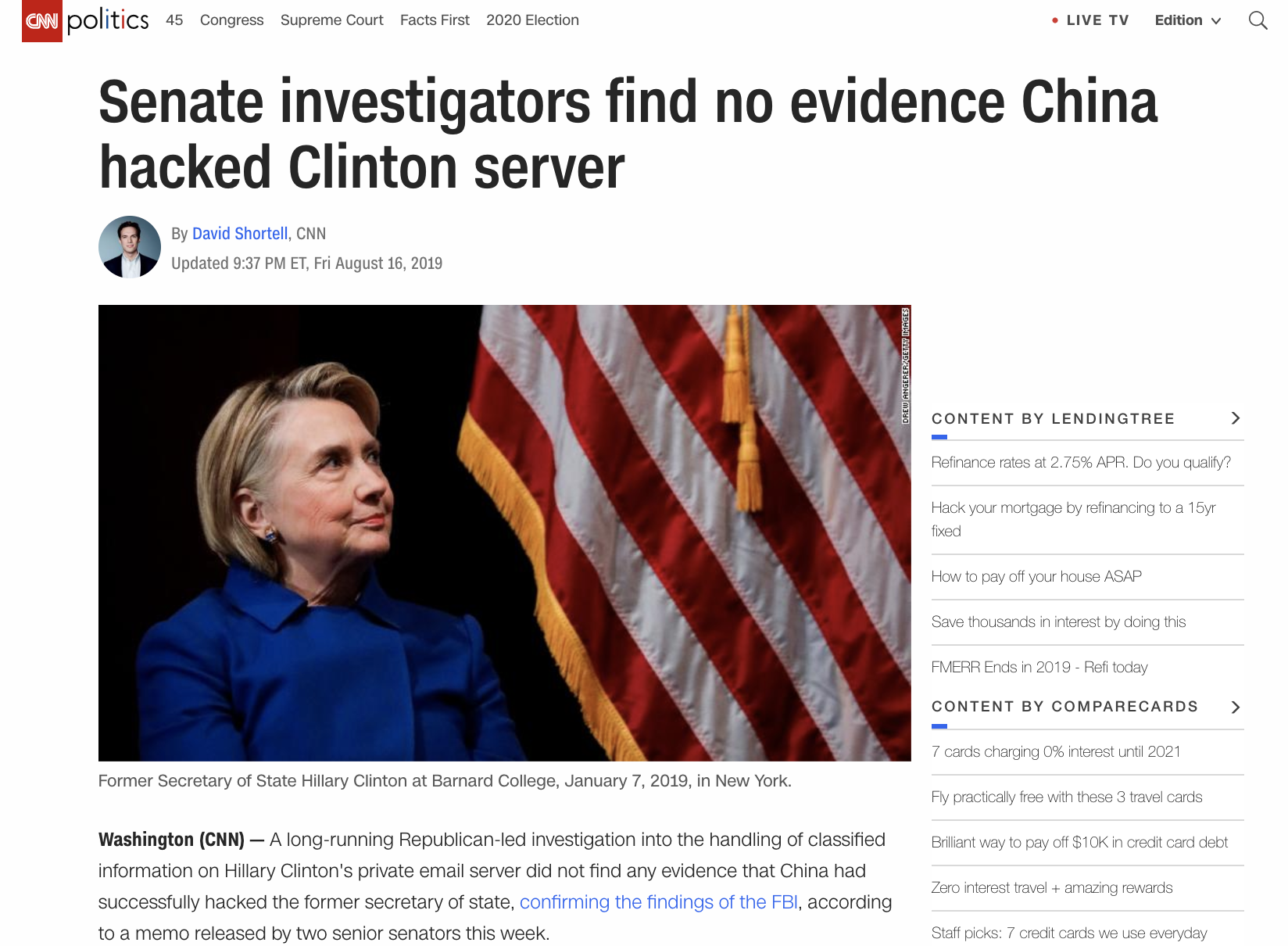
Last Wednesday, majority staffers for the Senate Finance and Homeland Security Committees wrote Chuck Grassley and Ron Johnson a memo that purports to update those Committee chairs of the status of an investigation into —  well, the purpose of the investigation is actually not clear, but ultimately it’s an investigation designed to keep hopes of finding some smoking gun in Hillary’s servers that several other investigations haven’t found, an investigation that Grassley has been pursuing for four years.

As the memo describes, the most recent steps in this “investigation” involve some interviews that were completed and all related backup documentation obtained in April, four months ago.

We pursued this issue by requesting interviews with the two ICIG officials. On December 4, 2018, your staff, along with staff from Senators Feinstein and McCaskill, interviewed ICIG employees Mr. Rucker and Ms. McMillian. On December 20, 2018, you transmitted a copy of an interview summary of the Majority’s questions and the witness’s answers to the ICIG for a classification review. On January 30, 2019, the ICIG provided classified and unclassified versions of the interview summary, and the Office of Senate Security redacted the classified information. On February 28, 2019, the ICIG provided documentary evidence including copies of emails and notes from meetings. On April 9, 2019, the DOJ IG and ICIG provided a summary of their findings related to these Chinese hacking allegations.

The staffers use these investigative steps, completed four months ago, to make two insinuations: that State tried to classify Hillary’s emails as deliberative rather than classified (something long known, and easily explained by the known debate over retroactive classification for the emails).

In addition, the staffers report that one but not a second Intelligence Committee Inspector General employee remarked that FBI Agents seemed non-plussed by their concerns that China had hacked Hillary. The description of that claim in the topline of the memo drops Peter Strzok’s name as its hook.

[A]ccording to one ICIG official, some members of the FBI investigative team seemed indifferent to evidence of a possible intrusion by a foreign adversary into Secretary Clinton’s non-government server. The interview summary makes clear exactly what information Mr. Rucker and Ms. McMillian knew regarding the alleged hack of the Clinton server, as well as the information they shared with the FBI team, including Peter Strzok, the Deputy Assistant Director of the FBI’s Counterintelligence Division in charge of the Clinton investigation.

Wow, that Peter Strzok is some devious asshole, showing no concern about Hillary being hacked by a foreign government, huh? Presumably, that’s the headline the taxpayer funded staffers wanted: BREAKING Peter Strzok doesn’t care about foreign hacking or State trying to protect Hillary.

To the credit of press outlets that did cover this report, they did get what the more relevant conclusion to these documents is: After spending a year double-checking the work of the FBI, these Senate staffers found that the FBI was right when it said it had found no evidence Hillary’s server had been hacked.

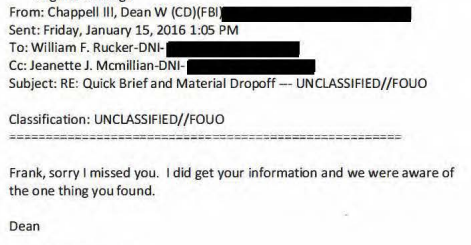
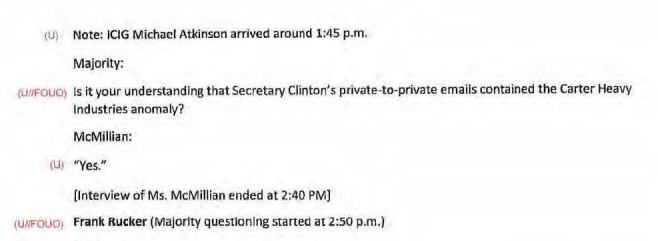
What the backup actually shows is that an ICIG Inspector, Phil Rucker, found an “anomaly” while reviewing Hillary Clinton’s emails, an unknown Gmail for a company called Carter Heavy Industries in her email headers, which he thought could have been used to steal her emails as sent. At a meeting largely designed to explain the ICIG efforts to review Hillary’s email for classified information to Strzok, who had just been promoted to the DAD position at FBI a week earlier, Rucker shared what he found with Strzok and the FBI agent he had already been liaising with, Dean Chappell. The FBI already knew of it, and that same day would confirm the explanation: that tech contractor Paul Combetta had used a dummy email to copy over Hillary’s emails as he migrated Hillary’s email onto a Platte River server.

When interviewed about all this three years later, after Peter Strzok had become the villain in Donald Trump’s Deep State coup conspiracy, Rucker accused Strzok of being “aloof and dismissive” of his concerns.

Mr. Rucker said that Mr. Chappell was normal and professional as he had come to know him to be, but that he didn’t know anything about Mr. Strzok prior to the meeting. Mr. Rucker said that Mr. Strzok seemed to be “aloof and dismissive.” He said it was as if Mr. Strzok felt dismissive of the relationship between the FBI and ICIG and he was not very warm. He said that Mr. Strzok didn’t ask many questions including any about SAP related issues. He said the meeting lasted approximately 30 to 60 minutes and that only people from the FBI attended; there were no employees from DOJ. Mr. Rucker said that he knows that an FBI attorney was present, but he cannot remember the person’s name or even whether it was a man or a woman.

[snip]

Mr. Rucker said that he discussed SAP with the FBI. He said he discussed another of Secretary Clinton’s emails that they were never able to quite figure out. He said he verbally presented this information to Mr. Strzok which lasted only for a minute or so. He said that he doesn’t think he mentioned Carter Heavy Industries by name, but only the appearance of a Gmail address that seemed odd. He said that Mr. Strzok seemed “nonplused” by the info, and that he didn’t ask any follow-up questions. He said that Mr. Chappell seemed familiar with the discovery and he felt like Mr. Chappell was walling Mr. Rucker off intentionally as an investigator would, to protect the investigation.

That last detail — that Chappell seemed familiar with the discovery — is key. In fact, the emails sent in advance of the February 18, 2016 meeting reveal that several weeks earlier, Rucker had already shared this anomaly with Chappell, and Chappell had told him then that he already knew about it.

Along with making accusations about Strzok, Rucker changed his story about how strongly he believed that he had found something significant. The day before Chappell told him the FBI was already aware of the email, Rucker had emailed him that the anomaly was probably nothing.

Additionally, he wanted me to run something that I found in my research of the email metadata past you or someone on the team. It’s probably nothing, but we would rather be safe than sorry.

But when interviewed last year by Senate staffers seeking more evidence against Strzok, Rucker claimed that until a news report explained the anomaly in 2018, he had 90% confidence he had found evidence that China had hacked Hillary’s home server, and still had 80% confidence after learning the FBI had explained it.

Rucker: Mr. Rucker said that he didn’t find any evidence in the remainder of the email review they conducted, but that based on the subpoena issued by the FBI in June 2016 which he learned about this year through a news article, it decreased his confidence level from 90% to 80%.

Meanwhile, the one other ICIG employee interviewed last year, Jeanette McMillan, described what Rucker claimed was dismissiveness as adopting a poker face.

[T]hey provided the information to Mr. Strzok who found it strange. Even before their meeting with Mr. Strzok, Dean Chappell of the FBI informed them that he was aware of the Carter Heavy Industries email address. She said that she doesn’t know whether Mr. Chappell knew before they dropped off the original packet in January 2016, or if he learned of it afterward. News of this email address being found on Secretary Clinton’s emails wasn’t shocking to them, she said, but they took It seriously.

[snip]

[T]he FBI employees in attendance were “poker faced.”

In other words, what the backup released last week actually shows is a tremendous waste of time trying to second guess what the FBI learned with the backing of subpoenas and other investigative tools. To cover over this waste of time, Grassley and Johnson instead pitch this as a shift in their investigation, this time to examine claims that Strzok wasn’t concerned about State arguing that emails weren’t classified (and probably an attempt to examine the document, believed to be a fake, suggesting Loretta Lynch would take care of the Hillary Clinton investigation).

Staff from the Intelligence Community Inspector General’s office (ICIG) witnessed efforts by senior Obama State Department officials to downplay the volume of classified emails that transited former Secretary Hillary Clinton’s unauthorized server, according to a summary of a bipartisan interview with Senate investigators.

In fact, in the “summary” released, McMillan told Senate investigators that, “If anything, there were problems at State with upgrading of information,” exactly the opposite of what Grassley and Johnson claim in their press release.

And that word — summary — should raise a lot of questions. It’s not a transcript; in most cases, the report is a paraphrase of what the witnesses said. Moreover, it’s only a “summary” of what Majority staffers asked. Minority staff questions were not included at all, as best demonstrated by this nearly hour-long gap in the “summary.”

Because of the way Grassley brought this “investigation” with him when he assumed the Chairmanship of the Finance Committee, this release — from Chuck Grassley as Finance Committee Chair and Ron Johnson as Homeland Security Chair — effectively did not involve the Ranking members of the committees that did the work — Dianne Feinstein as Judiciary Ranking member and Claire McCaskill as HSGAC Ranking member.

To put what a colossal misuse of taxpayer funds this is, consider, first of all, that Grassley has been pursuing this for over four years.

Last fall, Majority staffers actually asked Rucker how ICIG came to be involved in the Hillary investigation.

How did ICIG come to be involved with the Secretary Clinton email investigation?

Rucker: – Mr. Rucker said ·that on March 12, 2015, the Senate sent a letter to ICIG requesting assistance regarding a Russian hacker who allegedly broken into Sidney Blumenthal’s email account. He said that the Sidney Blumenthal emails looked legitimate and were not at the SSRP level. He said that [redacted], a former CIA employee who worked with Blumenthal, was the author of most of the material. That was determined in part, he said, based on his writing style. Shortly after wards, he said, ICIG received another Senate request for assistance, this timein relation to the email practices of several former Secretaries of State including Secretary Clinton. He said that through ICIG, he was brought in to assist State in reviewing the email information in June 2015.

But they knew the answer to that. As their own staffers tacitly reminded Grassley and Johnson, Grassley has been pursuing this since 2015.

Your investigation began in March 2015 with an initial focus on whether State Department officials were aware of Secretary Clinton’s private server and the associated national security risks, as well as whether State Department officials attempted to downgrade classified material within emails found on that server. For example, in August 2015, Senator Grassley wrote to the State Department about reports that State Department FOIA specialists believed some of Secretary Clinton’s emails should be subject to the (b)(1), “Classified Information” exemption whereas attorneys within the Office of the Legal Advisor preferred to use the (b)(5), “Deliberative Process” exemption. Whistleblower career employees within the State Department also reportedly notified the Intelligence Community that others at State involved in the review process deliberately changed classification determinations to protect Secretary Clinton.1 Your inquiry later extended to how the Department of Justice (DOJ) and Federal Bureau of Investigation (FBI) managed their investigation of the mishandling of classified information.

That means that this effort — to misrepresent an interview conducted in December as a way to introduce new (and obviously bogus) allegations against Strzok — is a continuation of Barbara Ledeen’s efforts to prove some foreign government had hacked Hillary’s home server, as laid out in the Mueller Report.

Ledeen began her efforts to obtain the Clinton emails before Flynn’s request, as early as December 2015.268 On December 3, 2015, she emailed Smith a proposal to obtain the emails, stating, “Here is the proposal I briefly mentioned to you. The person I described to you would be happy to talk with you either in person or over the phone. The person can get the emails which 1. Were classified and 2. Were purloined by our enemies. That would demonstrate what needs to be demonstrated.”269

Attached to the email was a 25-page proposal stating that the “Clinton email server was, in all likelihood, breached long ago,” and that the Chinese, Russian, and Iranian intelligence services could “re-assemble the server’s email content.”270 The proposal called for a three-phase approach. The first two phases consisted of open-source analysis. The third phase consisted of checking with certain intelligence sources “that have access through liaison work with various foreign services” to determine if any of those services had gotten to the server. The proposal noted, “Even if a single email was recovered and the providence [sic] of that email was a foreign service, it would be catastrophic to the Clinton campaign[.]” Smith forwarded the email to two colleagues and wrote, “we can discuss to whom it should be referred.”271 On December 16, 2015, Smith informed Ledeen that he declined to participate in her “initiative.” According to one of Smith’s business associates, Smith believed Ledeen’s initiative was not viable at that time.272

[snip]

In September 2016, Smith and Ledeen got back in touch with each other about their respective efforts. Ledeen wrote to Smith, “wondering if you had some more detailed reports or memos or other data you could share because we have come a long way in our efforts since we last visited … . We would need as much technical discussion as possible so we could marry it against the new data we have found and then could share it back to you ‘your eyes only.'”282

Ledeen claimed to have obtained a trove of emails (from what she described as the “dark web”) that purported to be the deleted Clinton emails. Ledeen wanted to authenticate the emails and solicited contributions to fund that effort. Erik Prince provided funding to hire a tech advisor to ascertain the authenticity of the emails. According to Prince, the tech advisor determined that the emails were not authentic.283

Remember, Ledeen was willing to reach out to hostile foreign intelligence services to find out if they had hacked Hillary, and she joined an effort that was trawling the Dark Web to find stolen emails. She did that not while employed in an oppo research firm like Fusion GPS, funded indirectly by a political campaign, but while being paid by US taxpayers.

Chuck Grassley is now Chair of the Finance Committee, the Committee that should pursue new transparency rules to make it easier to track foreign interference via campaign donations. Ron Johnson is and has been Chair of the Homeland Security Committee, from which legislation to protect elections from foreign hackers should arise.

Rather than responding to the real hacks launched by adversaries against our democracy, they’re still trying to find evidence of a hack where there appears to have been none, four years later.

Update: For some reason I counted 2015-2019 as five years originally. That has been fixed.

Share this entry

Roger Stone Once Again Limits His Denials

In addition to the government showing that Roger Stone is a disorganized crime figure the other day, Roger Stone submitted a curious filing of his own, in yet another apparent attempt to feed denialist propaganda.

A week earlier, the government made a detailed argument that Stone, in his sustained bid to make his trial an attempt to challenge the government evidence that Russia hacked the DNC, misunderstood what the case was about. All that matters, the government argues, is whether Stone’s lies materially affected the House Intelligence investigation into the Russian tampering.

Stone’s false statements also had a natural tendency to (and in fact did) affect HPSCI’s investigative steps, priorities, and direction—regardless of Russia’s 2016 activities. See United States v. Safavian, 649 F.3d 688, 691-92 (D.C. Cir. 2011) (statements material if they “were capable of influencing the course of the FBI’s investigation”). For example, HPSCI did not subpoena the written communications that Stone claimed not to exist, and HPSCI did not investigate the other intermediary (Person 1) when Stone claimed that Person 2 was his sole intermediary. Moreover, Organization 1’s activities and coordination with Stone were relevant to evaluating the Intelligence Community’s work, to assessing any risks that Organization 1 may pose, and to considering any future actions that should be taken to deter coordination with state and non-state actors seeking to influence American elections. None of these understandings of materiality depends in any way on whether Russia in fact participated in the hacks or transmitted the hacked materials to Organization 1, and therefore Stone’s evidence on that subject is not relevant to the materiality inquiry.4

As part of that discussion, in a footnote, they engage in some counterfactuals to show how, even if some alternative scenarios, including the main one suggested by Stone, were true, his lies would still be material.

4 Even under Stone’s crabbed view of materiality and HPSCI’s investigation, Stone’s statements were still material, regardless of Russia’s exact role. Stone now primarily focuses only on evidence about whether Russia transferred the stolen files. But even if Organization 1 received the files elsewhere, it does not follow that Organization 1 has no connection to Russia’s election interference. For example, Organization 1 could theoretically have received the files from someone who received them from Russia; Russia could theoretically have coordinated its other election interference activities with Organization 1’s posting of stolen documents even if Russia was not Organization 1’s source; and individuals associated with the Trump Campaign could theoretically have played a role coordinating the two. Under any view, Stone’s communications with and about Organization 1 were material, regardless of Russia’s exact role.

As you read this “theoretical” scenario, remember that the campaign considered reaching out to WikiLeaks after the John Podesta files got released. And Roger Stone was — at least in 2018 — among those Trump flunkies who were trying to get Julian Assange a pardon.

The government presents this as theoretical, but it demonstrates, correctly, that WikiLeaks’ role in the operation matters whether or not the person who dealt them one or another set of files was a Russian intelligence officer.

Stone spends much of his response claiming (nonsensically) that because the government wants to introduce a Julian Assange video to establish dates for the public record surrounding certain details (in that case, when it was publicly knowable that WikiLeaks would release more files), it makes the issue of how Russia got the files to WikiLeaks central. In the hands of better lawyers — or at least, lawyers who weren’t playing for a pardon — this argument might have merit. In Stone’s case it doesn’t, in part because he failed to describe what evidence he wanted to introduce, and in part because he doesn’t understand what files Bill Binney, one of his intended witnesses, is talking about (they’re not the John Podesta emails, and so are irrelevant to Stone’s lies).

The government objects to Roger Stone presenting two witnesses who will testify, and demonstrate, that WikiLeaks did not receive the relevant DNC and DCCC data from the Russian state. That evidence will establish that the relevant data was “leaked” to WikiLeaks, not transferred to WikiLeaks by the Russian State. The government claims such evidence will be irrelevant, unfairly prejudicial, and cause delay and would turn the subject matter into a “mini-trial.” The government states: “If a person chooses to make false statements to the government, he or she takes the risk that the false statement is material.” (Motion at 14). But, the government takes the same risk: that the alleged false statements might be deemed immaterial by the jury. 1

Stone should be permitted to present evidence that his answers did not materially affect the congressional investigation because the Indictment makes clear that the investigation was of a “Russian state hack.”

But along the way, Stone includes his own footnote where he (perhaps in an effort to present a quote that denialists like Aaron Maté can quote without context, as Maté has done repeatedly as the useful idiot of both Stone and Concord Management) misrepresents the government’s theoretical as instead genuine curiosity.

1 The government wonders if the Russian state hacked and stole the relevant data and then someone else coordinated the delivery of the data to WikiLeaks. See Dkt. #172 n. 4. The government, nor the Mueller report proved or disproved this scenario. But if WikiLeaks did not receive the data from the Russian state then Stone’s communications with WikiLeaks were immaterial.

Stone is absolutely right that the government doesn’t prove or disprove this scenario. The Mueller Report notes explicitly that,

The Office cannot rule out that stolen documents were transferred to WikiLeaks through intermediaries who visited during the summer of 2016. For example, public reporting identified Andrew Müller-Maguhn as a WikiLeaks associate who may have assisted with the transfer of these stolen documents to WikiLeaks.

The prosecutors in his case aren’t tasked with answering that question. Indeed, if pressed, they could argue that Stone’s lies might well have served to hide firsthand knowledge of how the Podesta emails did get to WikiLeaks, which would make them even more material.

From a legal standpoint, Stone’s argument is unlikely to work, even if it were argued with more legal rigor.

What I’m interested in, however, is how Stone homes in on just one part of the scenario, the hand-off of files to WikiLeaks. The government actually laid out three parts to its theoretical: WikiLeaks got the files stolen by Russia from a cut-out, but also coordinated with Russia on “other election interference activities,” and individuals associated with the Trump campaign played a role coordinating the handoff of the files and WikiLeaks’ other coordination with Russia.

  • Organization 1 could theoretically have received the files from someone who received them from Russia;
  • Russia could theoretically have coordinated its other election interference activities with Organization 1’s posting of stolen documents even if Russia was not Organization 1’s source;
  • Individuals associated with the Trump Campaign could theoretically have played a role coordinating the two.

It’s a series of tantalizing hypotheticals! And while the first two (the second of which is pretty oblique) could independently be true, the last one implies the two would not be independent, but that, instead, someone “associated” with the Trump campaign coordinated the first two steps.

But of course, the government presents all this as a theoretical possibility, not (as Stone falsely claims) as a question they’re seeking, here, to answer.

Stone, however, only deals with the first part of that scenario: “the Russian state hacked and stole the relevant data and then someone else coordinated the delivery of the data to WikiLeaks.” He doesn’t address the possibility that WikiLeaks had some other kind of role. And he definitely doesn’t address the possibility that someone “associated” with the Trump campaign had a role in coordinating the two. In a gesture towards addressing a government hypothetical (in part) that some individual associated with the Trump campaign might have coordinated other election year activities, Stone suggests that the only way the communications of a Trump associate with WikiLeaks would be material would be if the communications involved actual transfer of emails.

This is something Stone has long been doing — making narrowly tailored denials that don’t address some tantalizing possibilities: in this case, that Stone had a role arranging something else with WikiLeaks.

And all the while, Stone drops a suggestion that overstates the uncertainty of what the government knows.

Share this entry

The Government Accuses Roger Stone of Being a Disorganized Figure Who Committed a Crime

The government and Roger Stone are arguing over whether prosecutors can show the Frank Pentangeli clip from the Godfather II at his trial. Last month, the government argued they need to show the clip to explain the context of Stone’s orders to Randy Credico to ““Start practicing your Pantagele.”

The clip of Pentangeli’s testimony is directly relevant to the charge of witness tampering in this case (count 7). To prove that charge, the government must prove that Stone corruptly persuaded or attempted to corruptly persuade a witness (Person 2), intended to interfere in that witness’s testimony, and did so with a current or future proceeding in mind. See 18 U.S.C. § 1512(b)(1); United States v. Edlind, 887 F.3d 166, 172-174 (4th Cir. 2018). Several of the allegedly criminal acts at issue involve Stone’s referencing Pentangeli and Pentangeli’s testimony before Congress. To understand Stone’s messages to Person 2—including what Stone was asking Person 2 to do—it is necessary to understand those references. Taken in context, Stone’s references to Pentangeli and to specific lines spoken by Pentangeli are unmistakable. This clip is highly probative of the meaning of Stone’s communications to Person 2.

[snip]

Watching the movie clip and seeing the context in which Pentangeli delivers the lines that Stone quotes to Person 2 makes clear that Stone’s messages were not mere references to Person 2’s abilities as an impressionist, but rather were a suggestion that Person 2 testify falsely to Congress. The clip is an important piece of evidence on this critical, disputed issue.

In response, in one of their most seriously argued filings, Stone’s team argued the clip would unduly link Stone with the mafia (though they got the role Stone would play in the analogy wrong).

Any reference to “The Godfather” (regardless of which one) brings up a clear and unalienable connection to the Italian-American Mafia. Any attempts to compare the conduct of Stone to that of an alleged mafia member, testifying that he murdered on the orders of ‘the Godfather’ will instantly create a connection in the minds of the jurors that Stone is somehow similar to a murderous mafioso.

[snip]

Stone objects because unlike the other movies and interviews cited by the government, the Godfather trilogy is iconic and its themes and implications are known by most people who are potential jurors. A clip of the movie triggers the implication of the entire series – cold, calculated, violence and crime.3 Once a Mafia connection is made the damage will be done.

In a footnote, Stone’s lawyers suggest that the government didn’t include a transcript because it would alert Judge Amy Berman Jackson to how damning the clip would be. They claim to include a transcript as an exhibit.

The government either assumes the Court is necessarily familiar with the movie clip from the Godfather II, or recognizes that if it were to see it the nature of its improper character evidence and unfairly prejudicial clip would be apparent. The transcript of the scene is presented as Exhibit – 1, the movie clip itself is presented here (click here).

Today, the government responded, in part, by suggesting that showing the clip would not be unfairly prejudicial, it would just fully explain the crime Stone allegedly committed.

As the D.C. Circuit has observed, Rule 403 does not apply to “powerful, or even ‘prejudicial’ evidence” but instead “focuses on the ‘danger of unfair prejudice.’” United States v. Gartmon, 146 F.3d 1015, 1021 (D.C. Cir. 1998) (Court’s emphasis). This means “an undue tendency to suggest decision on an improper basis, commonly, though not necessarily, an emotional one.” Old Chief v. United States, 519 U.S. 172, 192 (1997). While the scene from The Godfather Part II may be dramatic in some sense, Stone chose to reference it, and Rule 403 “does not provide a shield for defendants . . . permitting only the crimes of Caspar Milquetoasts to be described fully to a jury.”

In a footnote, however, they note that the transcript Stone included inaccurately described both the words and actions from the movie.

Stone’s response attached a purported transcript of the clip at issue. See Doc. 171, Ex. 1. This transcript is inaccurate in several respects, including the words transcribed and actions described. The government respectfully suggests that the Court review the film clip itself, and the government can make a copy available for the Court’s review upon request.

In point of fact, they didn’t make the transcription errors themselves; they just used an an early draft of the screenplay they found online. (h/t AL) The miscitation is ironic, though, in part because Stone appears to be prepping a challenge to the accuracy of the transcript of his interview with HPSCI, and also because it’s clear from Stone’s references to the scene in communications to Credico that he knows the scene better than whoever lazily just copied this from the web.

Ultimately, though, it shows that even in Stone’s most aggressively argued motion, his defense is still (as it has been repeatedly) totally disorganized and sloppy.

He might have done better arguing he has nothing in common with The Godfather because he’s a disorganized crime figure.

(h/t WB for the pun.)

Share this entry

Don McGahn Is Not the Most Critical Witness on Impeachment

In the last several days, Jerry Nadler has stated more and more clearly that his committee is conducting an inquiry on whether to file articles of impeachment. Six months after gaining the majority, this feels like a slow walk perhaps intended to time any impeachment vote based on how it will impact the election.

In its press release and complaint seeking to enforce its subpoena against Don McGahn last week, the House Judiciary Committee made an alarming claim: that Don McGahn was the most important witness in its consideration of whether to file for impeachment.

McGahn is the Judiciary Committee’s most important fact witness in its consideration of whether to recommend articles of impeachment and its related investigation of misconduct by the President, including acts of obstruction of justice described in the Special Counsel’s Report.

That claim suggests that the House Judiciary Committee has a very limited conceptualization of its own inquiry and perhaps an overestimation of how good a witness McGahn will be.

McGahn’s probably not as credible as HJC Dems think

I say the latter for two reasons. First, in the early days of the Russian investigation, McGahn overstepped the role of a White House Counsel. For example, even after his office recognized they could not talk to Jeff Sessions about the Russian investigation or risk obstruction, McGahn followed Trump’s orders to pressure Dana Boente on the investigation.

At the President’s urging, McGahn contacted Boente several times on March 21, 2017, to seek Boente’s assistance in having Corney or the Department of Justice correct the misperception that the President was under investigation.326

Curiously, McGahn and Boente’s versions of what happened are among the most divergent in the entire Mueller Report, which might suggest McGahn was less than forthright in testimony that, per footnotes, came in one of his earlier interviews.

Plus, as the Mueller Report acknowledges, the NYT story that triggered one of the key events in the report — where Trump asked McGahn to publicly rebut a claim that he had asked McGahn to fire Mueller, which led him to threaten to resign — was inaccurate in its claim that McGahn had functionally threatened to resign (which was clear in real time). 

On January 26, 2018, the President’s personal counsel called McGahn ‘s attorney and said that the President wanted McGahn to put out a statement denying that he had been asked to fire the Special Counsel and that he had threatened to quit in protest.784 McGahn’s attorney spoke with McGahn about that request and then called the President’s personal counsel to relay that McGahn would not make a statement.785 McGahn ‘s attorney informed the President’s personal counsel that the Times story was accurate in reporting that the President wanted the Special Counsel removed.786 Accordingly, McGahn’s attorney said, although the article was inaccurate in some other respects, McGahn could not comply with the President’s request to dispute the story.787

Put McGahn under oath, and Republicans will ask if he was a source for that story, and if he was, why he oversold what he did. At the very least they’ll beat him up for letting the “#FakeNews NYT” spread lies.

There are far better (tactically and Constitutionally) reasons to impeach

More troubling still, asserting that McGahn is the most important witness — and stating that he’d be a witness in “criminal obstruction” — you prioritize that cause for impeachment over others, causes that might elicit some Republican support or at the very least mobilize the Democratic base.

To my mind, the best cause for impeachment — in terms of cornering Republicans and mobilizing the Democratic base — pertains to Trump’s repurposing of otherwise allocated funding for his Wall. This was an issue about which Republicans themselves had problems. It highlights Trump’s impotence to deliver on his campaign promise that Mexico would pay for his wall. It goes to issues of efficacy on national security issues. And it highlights how Trump has abused authority — authority which goes to the core of separation of powers — to facilitate his attacks on Latino immigrants. Plus, depending on when impeachment was triggered, having focused on the power of the purse would provide a tool to rein Trump in if he survived the election.

Democrats should also focus on Trump’s abuse of the Vacancy Reform Act in his appointments to lead the Consumer Financial Protection Board, DOJ, DOD, and ODNI. Violating the spirit of Consumer Financial Protection Board gave Trump a way to gut an entity meant to protect consumers, something that Elizabeth Warren will be able to magnify better than anyone (all the more so if and when the economy starts to turn south). Appointing Big Dick Toilet Salesman Matt Whitaker to fire Jeff Sessions provides a different way to get to the Russian investigation, and may (if BDTS prevented Mueller from naming Trump in the Roger Stone indictment) focus more attention on the resolution of that case (which has the potential of being both a really damaging trial or a pre-trial pardon). The appointment of Patrick Shanahan as Acting Secretary of Defense provides a way to focus on ethics complaints about his tenure, to say nothing about Trump’s tolerance for familial abuse. And Trump must be held accountable for whatever predictable problems selecting a loyalist over Sue Gordon as Acting DNI will cause — and some of the predictable problems, which might involve North Korea, Iran, or cybersecurity, could be quite damning.

Another impeachment cause that would invoke some of the same issues as the Russian investigation, but in a way that would be more awkward for the President, is Trump’s abuse of security clearances, starting with, but not limited to, Kushner’s (this is an issue where the Oversight Committee has done great work). An inquiry into why Trump gave Kushner clearance would provide a way to get to Kushner’s awkward role in foreign policy, particularly the possibility that he shared US classified information with Gulf oligarchs. If Kushner is found to have shared intelligence allowing Mohammed bin Salman to target Al-Waleed bin Talal or Jamal Khashoggi, it will invoke a slew of issues that will put Republicans in an awkward position (and have the salutary effect of focusing attention on Trump’s refusal to keep the Saudis honest).

Democrats would be idiots if they didn’t make an issue of Trump’s self-dealing, including but not limited to emoluments. It’s likely Republicans would defend the President on this point, but if they do, it can form the basis for legislation to more clearly prohibit such self-dealing going forward if Democrats do well in 2020. In addition, it goes to an issue that was absolutely key to Trump’s supporters, #DrainTheSwamp, but on which he has been (predictably) an utter failure.

Finally, Democrats should include Trump’s refusal to respond to violations of the Presidential Records Act in any impeachment inquiry. It is true that most Administrations have had problems adhering to PRA going back to Poppy Bush (Obama is to a large extent an exception, but Hillary’s avoidance of the Federal Records Act undermines that good record). But when pressed, most prior Administrations have been forced to admit the details of their failures to fulfill the law. Here, Trump has simply refused to respond to all questions about PRA violations. Some of these violations involve key players in the Russian investigation: Jared, KT McFarland, and Bannon. But these same people were involved in other scandals, such as the willingness to sacrifice US standards on nuclear security so that a bunch of Republicans can make $1 million per reactor (again, this would incorporate great work done by OGR).

This is a non-exclusive list. The point is, however, that HJC should frame their impeachment inquiry broadly, partly because some of Trump’s high crimes and misdemeanors have pissed off Republicans in the past, and partly because a failed impeachment trial can still frame Republican obstruction in a way that voters will care about.

Obviously, I think Trump’s conduct during the Russian investigation is important, and it’s all packaged up with a bow. But it’s not even just obstruction. Trump lied under oath in his written responses to Mueller. And Trump cheated to win an election. So even while pursuing impeachment on Russia, it needs to be more broadly conceived than the issues that Don McGahn can address. 

Other witnesses have more to offer than Don McGahn

So even in the emphasis on the Russia investigation, I think there is at least one better witness: Jay Sekulow. Sekulow has done a number of things that don’t qualify for attorney client privilege, such as his conversations directly with Michael Cohen to write a false statement hiding the President’s ties to Russia. That goes directly to Trump’s sworn lies.

Then there’s John Kelly. He was at DHS for the beginning of Trump’s abusive immigration policies. He knows details of Trump’s security clearance abuses (and might actually give a damn about them). He should know details of the PRA violations (and if not, should be accountable for why not). And he knows details of Kushner’s privatized foreign policy (and probably tried to control it). Kelly was a minor witness for Robert Mueller, but should be a key witness to any impeachment inquiry.

Finally, there’s the role of the Office of Legal Counsel and its head Steve Engel in all this. Some of OLC’s opinions enabling Trump’s abusive acts have been every bit as dodgy as John Yoo’s ones. It is the place of DOJ’s oversight committee to review the circumstances of those shitty opinions. While the government would likely fight this testimony particularly aggressively based on deliberative and attorney-client privileges, both John Yoo and Steven Bradbury have testified before, Yoo on an issue (torture) pertaining to abuse. Engel would still be able to testify about patterns of communication and the degree to which Trump dictated outcomes.

I’ll grant you, there are good reasons why McGahn may be a good tactical witness. I suspect that, by the time he testified, McGahn might be prepared to Bigfoot his testimony, not least in an attempt to cleanse himself of the Trump taint. So at that level, he may be a willing, damning witness.

So calling McGahn the most important witness might just be a legal tactic, a means to tie HJC’s obstruction inquiry with witnesses who have been blocked from testifying. And the White House Counsel position (to say nothing of the former White House Counsel position) is one for which there is precedent (under Clinton and Bush) for coerced testimony.

But I hope to hell HJC doesn’t really believe he’s the most important witness.

Share this entry

The Ohr 302 Exemptions

As I noted yesterday, the FD-302s of FBI’s conversations with Bruce Ohr released to Judicial Watch the other day are unremarkable. The scope of Judicial Watch’s request left out the time periods — before Ohr was handed off to another FBI Agent after the election, and after Mueller was hired — that would be the most interesting. But what we do see shows that FBI first reached out to Ohr in an effort to assess the Steele dossier production, and Ohr was able and willing to chase down answers for the FBI that go to issues of credibility. Later, Steele reached out to Ohr in a panic about what would happen as Congress scrutinized his work more closely; in what we see, those conversations were not inappropriate (which is not to say I’m sympathetic to Steele’s concerns, given how he publicized his work). Though given Ohr’s notes, they may have been later in the year; at a minimum, they show how aggressively Steele was trying to prepare a public story that ended up being quite partial.

In my opinion, the FOIA exemptions are the most interesting aspect to the 302s. We can learn a bit from the things DOJ chose (or felt obligated) to protect. Here’s a short guide to FOIA exemptions and here’s DOJ’s more thorough one.

The less interesting redactions are for the following purposes:

  • b7C/b6: Protects privacy, used here to protect everything from Steele’s name to other sources
  • b7D: Protects confidential sources (both Steele and his sub-sources would get some protection)
  • b7E: Protects law enforcement techniques, including the bureaucracy of writing up 302s

The exemption, b3, protects information protected by statute, often the National Security Act. For example, that’s one of the exemptions (along with privacy and law enforcement technique exemptions) used to protect boring bureaucratic details about the case file. But it’s interesting in one instance.

The discussions, starting on PDF 14, of how Steele was panicking about one of his sources are protected for privacy, source, and b3, statute (as well as, sometimes, law enforcement technique).

That’s interesting, because FBI is not saying this person’s identity is classified. Nor is it saying that this person is credibly at risk of being killed, which would be a b7F (which is what they’d use to protect our own recruited agents). But they are according Steele’s source some kind of statutory protection.

The exemption, b1, protects classified information. It’s a measure, in these discussions about someone who used to work as an intelligence officer for an ally and who continues to collect HUMINT, of what the DOJ or other agencies considers genuinely classified (and doesn’t always line up with the initial or FOIA review classification marks on the paragraphs). For example, a paragraph describing how Ohr first met Steele — which appears in unredacted form in Ohr’s congressional testimony as follows — is protected by both a b3 and b1 exemption, presumably to protect references to MI6.

I believe I met Chris Steele for the first time around 2007. That was an official meeting. At that time, he was still employed by the British Government. I went to London to talk with British Government officials about Russian organized crime and what they were doing to look at the threat, and the FBI office at the U.S. Embassy in London set up a meeting. That was with Chris Steele. And there were other members of different British Government agencies there. And we met and had a discussion. And afterwards, I believe the agent and I spoke with Chris Steele further over lunch.

A more interesting redaction appears on PDF 8, in a series of paragraphs where the Agent was asking Ohr whether about his personal knowledge of certain aspects of Steele’s work, such as whether he had witnessed Steele’s meetings with Jon Winer. One of those paragraphs is redacted, in part for b3 and b1 reasons, and classified Secret. Whatever that protects, it’s a reminder that Ohr and Steele had real discussions about organized crime in the past.

By far the most interesting exemptions, however, are what FBI has chosen to protect because of ongoing investigations, exemption b7A, starting with what they have not protected: these conversations, generally.

The frothy right believes that Bruce Ohr should go to prison because he shared information about suspected Russian crimes with other experts in the subject. Ohr’s role in the dossier has presumably been under scrutiny for some time as part of DOJ IG’s investigation into the basis for Carter Page’s FISA application. In addition, Christopher Steele and Glenn Simpson have both been referred to DOJ for suspected lies to Congress, the latter more credibly than the former. With one significant possible exception, there’s nothing in these 302s that has been protected for either of those reasons. Ohr’s earlier and later conversations with Steele would be more pertinent to those inquiries (and there’s reason to believe the later ones are being treated as such), but some of these 302s would clearly be too. But FBI has determined they can release these files. That’s interesting, especially, because of the history of this FOIA:

  • August 6, 2018: Initial Judicial Watch FOIA
  • September 10, 2018: JW sues
  • March 15, 2019: DOJ tells JW the files are being withheld in full
  • March 22, 2019: Conclusion of Mueller investigation
  • April 1, 2019: Status report states that FBI is evaluating impact of conclusion of that investigation on FOIA
  • May 8, 2019: DOJ still considering whether FBI can release the files
  • July 25, 2019: DOJ decides it can release the files in part

As recently as August 5, DOJ said it was “still engaged in internal discussions about the redactions necessary to release the requested records to the public.” In other words, a very recent review of these files has determined that files showing how FBI handled the mid-term discussions between Christopher Steele and Bruce Ohr may be released to the public.

The big possible exception pertains to details of the original conversation on Trump and Russia with Steele.

Steele’s initial conversation

The paragraph describing what Steele first told Ohr back on July 30, 2016 is redacted for b1, b3, and b7A reasons.

The redactions in this passage include the entirety of Steele’s explanation for the “over a barrel” comment, which is interesting because other agencies have released these details (which may name the people boasting they had kompromat on Trump). The paragraph also redacts part of the discussion of Deripaska preparing to bring details on Paul Manafort’s “theft” from him to US authorities. That may be for privacy reasons,  but — assuming the order is the same in the interview and the notes, but it seems Ohr was reading verbatim — both are redacted for ongoing investigation reasons in Ohr’s notes released in December.

If, as seems to be the case, Page was not redacted as part of an ongoing investigation in either of these suggests the early Ohr conversation is not one being scrutinized by DOJ IG on the FISA application (especially given the notes were released in December, well before the IG had come close to finishing, as has been reported).

Note, Ohr turned over notes from during and after the meeting with Steele to the Agent. Just these notes were released in December, meaning the notes he wrote after the meeting must be among the 6 pages of Ohr’s notes withheld in that December release, in part to protect an ongoing investigation (that could be consistent both with the known DOJ IG investigation into the origins of the investigation, and an investigation into those two allegations).

One other thing in that first interview pertains, per the redaction to an ongoing investigation: a discussion of a post-Ukrainian invasion meeting involving Ohr, Steele, and oligarchs (possibly, though not definitely, Russian).


The description seems to match a meeting Steele is known to have set up with Deripaska (though that meeting was in 2015).

Oleg Deripaska

The treatment of one known Deripaska reference and this reference to cultivating oligarchs as sources (earlier in 2016, Steele had been trying to get DOJ to use Deripaska as a source) is particularly interesting given that, what appear to be additional Deripaska references, are also redacted to protect an ongoing investigation.

A significant chunk of the 302 memorializing the February 6, 2017 interview protects an ongoing investigation.

There are good reasons to think this is a reference to Deripaska. Steele worked for Deripaska lawyer Paul Hauser, and Deripaska was interviewed in September 2016. Deripaska would be directly implicated in the election (two months after this interview, Deripaska was sanctioned).

This may reflect a conversation directly with Hauser though, as the Steele reference in this interview was covered in entirely in a WhatsApp chat. Given the redaction, it’s also possible that Ohr took notes, which would be among the 6 pages not turned over because of an ongoing investigation.

And while less definitive, this passage from the February 14 interview of Steele referring to which lawyers he was working for could also be the Hauser work.

Given the withholdings on Ohr’s note from the meeting, the ongoing investigation does pertain to Steele’s client.

If it is Deripaska, it would suggest that Steele was financially dependent on his Deripaska work, as the other client mentioned, Bilfinger, wasn’t paying him (which he complained about to Ohr).

[Note, this note also has what looks like a reference to “Snowden report,” which makes absolutely no sense to me, so I assume I’m misreading it.] Update: This is likely a reference to the report, from the day before, that Russia was offering Snowden to Trump.

It has long been troubling that Steele had an ongoing relationship with Deripaska during the time he worked on the dossier. It’s clear that Deripaska used Steele to misinform DOJ that he was upping the pressure on Manafort, hiding that Manafort was instead making a desperate — and somewhat successful bid — to get back on Deripaska’s payroll.

A good deal of the ongoing investigation redactions in these Ohr 302s suggest DOJ continues to be interested in all that, as well.

Alfa Bank

The other ongoing investigation redactions are far more surprising, as they suggest (though this is far less definitive than the Deripaska tie) that DOJ may continue to investigate … something pertaining to the Alfa Bank allegations.

The initial reference to Alfa Bank, from the November 22, 2016 interview and discussing his September 2016 meeting with Glenn Simpson, is not protected as part of an ongoing investigation — though what appears to be a continuation of a discussion of it is treated as classified.

But a follow-up reference to Alfa bank does seem to be redacted as part of an ongoing investigation. These two paragraphs from the December 12, 2016 interview of Ohr, at PDF 11, have just one exemption explanation, including the b7A ongoing investigation one.

It’s certainly possible that the second paragraph is unrelated, and that’s what pertains to the ongoing investigation. But treating them as the same FOIA exemptions suggests they’re related.

In the same interview, Ohr explained that when he asked Simpson if he was concerned about his personal safety, Simpson,

mentioned that someone called and asked him to find out where all of the Alfa Bank stories were coming from. Simpson did not state this was a threat from the Russians, but that was the impression made upon OHR based upon the timing of the comment and using that story as a response to OHR’s question.

This seems to suggest more than one Alfa Bank story.

Also note two things. First, when the NYT first got the story of Jared Kushner’s “back channel” meeting with Sergey Gorkov, they had it as a meeting with Alfa Bank (though they misspelled it in the same way that Steele’s dossier did). That meeting would take place four days after Simpson raised whatever crazy tip he got, on December 13.

Kushner agreed to meet with Gorkov. 1151 The one-on-one meeting took place the next day, December 13, 2016, at the Colony Capital building in Manhattan, where Kushner had previously scheduled meetings. 1152

Also, during this period, Petr Aven was trying to reach out to Trump’s people on direct orders from Putin.

In December 2016, weeks after the one-on-one meeting with Putin described in Volume I, Section IV.B.1.b, supra, Petr Aven attended what he described as a separate “all-hands” oligarch meeting between Putin and Russia’s most prominent businessmen. 1167 As in Aven’s one-on-one meeting, a main topic of discussion at the oligarch meeting in December 2016 was the prospect of forthcoming U.S. economic sanctions. 1168

After the December 2016 all-hands meeting, Aven tried to establish a connection to the Trump team. Aven instructed Richard Burt to make contact with the incoming Trump Administration

It’s highly unlikely that Simpson got wind of any of those things; we would have heard about it. I raise these other instances not because I think Simpson had them, but because it’s clear Mueller chased these Alfa leads much further than we otherwise knew, and the leads themselves still seem not to have amounted to anything (even while showing that Putin leveraged the threat of election-related sanctions on the one bank that was legally acceptable in the west at the time, Alfa, to get its oligarch to join his efforts to cultivate Trump).

These Alfa allegations all still seem to be fluff. But even so, the redactions in the second reference may suggest there’s something here of continued interest to the FBI.

Update: I’ve taken out Bill Priestap’s name, as that was incorrect reporting when this came out.

As I disclosed last July, I provided information to the FBI on issues related to the Mueller investigation, so I’m going to include disclosure statements on Mueller investigation posts from here on out. I will include the disclosure whether or not the stuff I shared with the FBI pertains to the subject of the post. 

Share this entry

The Unremarkable Bruce Ohr 302s

Last night, Judicial Watch (and DOJ) released some of the FD-302s (FBI interview reports) between Bruce Ohr and the FBI. This post will lay out what they include.

As a reminder, Ohr is a top DOJ expert on Russian organized crime. He has known Christopher Steele since 2007 and Ohr’s wife — who is an expert on Russia — did some work for Fusion GPS during the election that was related to, but not part of, Steele’s work for Fusion. Ohr and Steele had conversations in 2016 about a range of things, including Oleg Deripaska (for whom Steele was doing work and who Steele trusted far more than he should have), Russian doping, and Trump’s ties to Russia.

Starting on July 30, 2016 and continuing through November 2017, Steele shared first his Trump-related information with Ohr, and then his concerns about how his dossier was all blowing up, including his concern for at least one of his sources. After Steele was cut off as a paid source in November 2016, FBI had Ohr communicate with a Supervisor [note, this was incorrectly reported as Bill Priestap when JW released these], who was a top counterintelligence person at FBI, whenever he spoke with Steele as a way to stay in touch with the former British intelligence officer, at first as part of vetting the dossier, and later to monitor where he was at.

This release of 302s is partial (though that’s based on Judicial Watch’s request, not FBI’s response). It doesn’t include any record of Ohr’s conversations with FBI and DOJ prior to November 22, 2016 (which include at least an early August meeting with Andrew McCabe and Lisa Page and a fall meeting with Page, Peter Strzok, Andrew Weissmann, Zainab Ahmad, and Bruce Swartz). It also doesn’t include Ohr’s communications after May 2017. Thus, it explicitly would exclude any information about how Mueller treated the dossier, details of what FBI and Steele did to try to limit Congress’ investigation into the role of the dossier, and whether and how FBI investigated possible false statements from Steele and (especially) Glenn Simpson.

In addition, while DOJ already released a lot of the backup to this (including Ohr’s communications with Steele and Simpson and some but not all of his notes), Judicial Watch has apparently not posted something DOJ already provided them, which is a file “Manafort Chronology” that JW received in an earlier lawsuit (I’ve asked JW for that file; they say they’re still processing it, even though they received it before these 302s). That document would presumably make it clear (as if the investigative team Ohr met with didn’t already) that more of what Ohr passed on to FBI from Steele before the election would pertain to Manafort, not Carter Page.

These meetings covered by the 302s seem to be broken into three groups:

  • November 22 to December 20: FBI’s review of Steele’s reporting process and collection of relevant materials
  • January 25 to February 14: Steele and Simpson express their panic in the aftermath of the dossier publication to Ohr
  • May 8 to 15: Steele’s panic about Congress increases, FBI offers to set up an FBI contact

November 22, 2016

This meeting was obviously an introductory meeting between Ohr and the Agent. He describes how he first met Steele (which partly redacted here but not redacted in his testimony to HJC/OGR). There’s a redacted comment that probably reflects Ohr’s view of Steele’s sources. That probably pertains to one or more oligarchs, because Ohr then explains his own opinion about the willingness of oligarchs to share information; this paragraph has been redacted because of an ongoing investigation, as has the paragraph describing Ohr’s summary of his meeting with Steele in July 2016 (which Ohr told McCabe about within days). There’s a reference to these notes from July (see PDF 31)

When these notes were released in December 2018, both the source for the “over a barrel” comment and Deripaska’s threats against Manafort were protected for ongoing investigation; at least in this paragraph, some of both are unsealed.

Ohr then explains what he knew about the Fusion GPS oppo research project, including that Simpson was passing the information on to “many individuals or entities.”

It’s clear that Ohr was asked about Michael Isikoff’s Yahoo article on Carter Page. Ohr described meeting with Simpson and Steele around that time, but his focus was instead on the Alfa Bank server allegation, which I’l return to.

Pristap also must have asked Ohr whether Steele made up his allegations, which Ohr said he did not believe Steele had done. Ohr explained that “there are always Russian conspiracy theories that come from the Kremlin.” He stated that he believed that Steele was just reporting what he heard, “but that doesn’t make that story true.”

Ohr was also asked about Jon Winer and whether he knew how Steele handled his sources, as well as for contact information for someone, probably Steele.

December 5

Several weeks after the initial meeting, Priestap interviewed Ohr again with follow-up questions about the dossier. He appears to reveal that he never was present when Steele interviewed a source (though there was a meeting he described). He says he was never present for meetings between Steele and Jon Winer. He described his wife Nellie’s research for Simpson. And he explained that Simpson directed Steele to “speak to the press as that was what Simpson was paying” him to do. The Agent apparently asked if Steele went to David Corn on his own or at the direction of Simpson, which Ohr did not know the answer to.

At that meeting, Ohr handed over the “Manafort Chronology” (which may or may not be Nellie’s work), which is the document JW may not have released yet.

December 12

Ohr met with Simpson on December 10 and obtained a copy of the dossier on thumb drive, so met with the Agent to share that and his notes from that meeting (see PDF 32).

At the meeting, Simpson told Ohr the Michael Cohen allegations (though these should and do appear to be the dated October allegations). Simpson shared gossip about some former Trump person (he thought it was Rick Wilson, but Wilson denied it yesterday) who was concerned about Trump’s ties to Russia. He raised Aleksandr Torshin’s outreach to the NRA and shared this article on it, even while noting there was disagreement on his staff about how much money Russia was funneling to the NRA. Simpson disputed NYT’s doubts about the Alfa Bank server (either the Agent or Simpson got the date of the article wrong); in response to an Ohr question about whether he thought he was safe, Simpson said someone had called and “asked him to find out where all of the Alfa Bank stories were coming from.” Simpson told Ohr he still had concerns about Sergei Millian and noted, “Looking at Millian led Simpson’s company to Cohen” (which Simpson would later share with Congress).

Simpson admitted that he asked Steele “to speak to the Mother Jones reporter as  it was Simpson’s Hail Mary attempt.” Note this means that after the Agent asked Ohr who decided to contact Corn, Ohr asked Simpson, and then passed on the answer. From this point forward, Ohr was basically providing FBI information on the Fusion effort.

Finally, Simpson appeared to suggest that much of Steele’s reporting comes from one source but “Simpson does not know his name.” This also seems to be a question Ohr posed after having been asked about it by the Agent. There are almost entirely redacted notes at PDF 33 listing “possible intermediaries” attributed to Simpson, but it’s unclear if Ohr took those notes at that meeting.

December 20

Several weeks after he said he would do so, Ohr met with the Agent and shared Nellie Ohr’s research for Fusion on a thumb drive.

January 23

On January 20, Simpson contacted Ohr in a panic about one of Steele’s sources. The following day, Ohr and Steele spoke about the concerns. The description of those concerns are treated, among other redactions, as legally classified information. The description of what appears to be the person in Ohr’s notes released last year is protected as part of an ongoing investigation (PDF 34-35). One thing Steele told Ohr, though, was that he knew the person was alive and well because he had posted on Facebook.

On the January 21 call, Steele also told Ohr he had spoken with someone in John McCain’s office sometime “prior to October 2016.” Either he’s only telling Ohr part of the story, or the date is wrong, because Steele’s known contacts related to McCain were in December.

January 25

Several days later, Ohr reached out to the Agent again to update him on what Steele had said in a followup. In that call either Steele or Ohr suggested the person might be exposed because of journalists. (PDF 36)

January 27

Several days later Ohr updated Pristap on his latest WhatsApp contact with Steele.

February 6

A few weeks later, Steele called about two things. First, the firing of Sally Yates led him to believe he needed another contact in case Ohr was fired; the Agent asked Ohr to ask Steele if he’d feel comfortable going through the FBI. He also seemed to be passing on information from someone, probably Deripaska, complaining that because of the 2016 election the FBI considered him a “criminal.” There’s a redacted section, and all this redacted information is protected as an ongoing investigation.

At the same meeting, Ohr offered up that Kathleen Kavalec, who was briefing allies on possible Russian tampering in their elections, had also met with Steele several times before the 2016 election. Ohr said that she said Steele’s reporting was generated mainly from [redacted]; which either pertains to a named source or from a reporting source.

February 14

This was mostly a follow-up reporting on a February 11 FaceTime chat with Steele, though Steele described working for two attorneys, one of whom appears to be redacted as part of an ongoing investigation in Ohr’s notes (PDF 37).

Ohr told the FBI he had not yet asked Steele if he’d be comfortable working through an FBI agent.

Note: There are March WhatsApp texts and written notes Ohr took with no corresponding 302. They pertain to Steele’s concerns about Congressional inquiries.

May 8

Ohr reported on a May 3 WhatsApp call with Steele, in which he expressed concerns about Congress’ scrutiny of his role. Steele also told Ohr that Simpson would be heading over to the UK soon and was lawyering up. But he still offered additional information to the FBI, if it was interested. Note, this is the first 302 where a normal listing of both interviewers is used, though there are indications elsewhere that the Agent was accompanied by someone else.

May 12

Ohr reports on a May 10 WhatsApp call in which Steele tells him the Senate Intelligence Committee is seeking information. The FBI asks Ohr to ask if Steele is willing to “have a conversation” with FBI agents in the UK, and Ohr agrees to pass it on.

May 15

After meeting with the FBI on May 12, Ohr contacted Steele to find out whether he’d be willing to talk to the FBI — “nothing more than a conversation with the FBI;” three days alter he said he would.

Steele also said he had information on a conversation between two people.

Update, 12/21/19: Removed Bill Priestap’s name per DOJ IG Report.

Share this entry

It Is False To Claim the Counterintelligence Investigation into Trump Is Unprecedented

There’s a conceit among the frothy right that the counterintelligence investigation into Donald Trump is unprecedented. At a recent hearing with FBI Director Christopher Wray, for example, Josh Hawley set up the question this way.

Hawley: Director Wray, earlier this year I sent the FBI two letter seeking additional information about news reports that the agency, the Bureau, had opened a counterintelligence investigation of the President following the exercise of the President’s constitutional prerogatives to direct foreign policy and otherwise oversee the Executive Branch. I did not receive a response to those letters beyond a form letter acknowledging receipt. And since I have you here and have you under oath, let me just ask you what I want to know. To your knowledge has the FBI ever launched a counterintelligence investigation into another President in American history?

Wray: I don’t know the answer to that question.

Hawley: And so it would be “no” then, since it’s “to your knowledge”? It’s fair to say you’re not aware of one, personally, is all I’m asking?

Wray: It’s fair to say I’m not aware of one.

Hawley: Is it safe to say then, to the best of your knowledge, that such a move would be and is unprecedented?

Wray: Um, well again, we’ve been around for 111 years, so I don’t really know what is precedented or not precedented in that regard.

The question, as framed, is totally bullshit, and Democratic members of Congress should stop letting their colleagues frame what happened to Donald Trump in such a way.

The proper question is, is there precedent that a counterintelligence investigation was opened into a major party candidate (distinguishing from Eugene Debs, into whom I’m sure there was a standing counterintelligence investigation through his presidential runs).

And the answer to that is simple. The precedent is Hillary Clinton.

In 2016, there was a counterintelligence investigation touching on both the Democratic and Republican candidates for President. The one into the Democrat was public. FBI managed it in ways, twice, that had an impact on the race. In addition to that CI investigation, there was also an investigation — predicated in part on oppo research from the Republican party — that involved the candidate’s interactions with foreign leaders. The latter investigation, into the Clinton Foundation, leaked. It leaked so egregiously that the Deputy Director of the FBI was fired for the leak.

The counterintelligence investigation into the Republican candidate was not public. Unlike the investigation into the Democrat, the one into the Republican was also not, at first, predicated against the candidate himself (to be honest, the Clinton email investigation would have been differently, and probably better, handled if Hillary weren’t the only possible target). It did not come to be opened against the guy who was still a candidate when the investigation was opened until he obstructed the investigation by firing the people conducting it.

The proper question for Josh Hawley to ask is, “Is there precedent for a criminal investigation against a sitting president for obstructing the investigation into what his campaign did to get elected?” The answer is easy. Yes. That is what happened with Nixon, and appropriately so.

The thing is, I can guarantee you Republicans would support an investigation into Hillary for obstructing the counterintelligence investigation into her behavior. The reason I can guarantee it is Republicans to this day — from the President on down — think there should be an ongoing investigation into whether Democrats gamed the investigation into Hillary. If Hillary had won, Senate Republicans would have demanded a special prosecutor into Hillary’s server, to say nothing of whether her interactions with foreign leaders were influenced by the Clinton Foundation.

Virtually all the conspiracy theories about the investigation into Trump, from the claims of a coup on down, are premised on granting him, as candidate, the privileges he would get when he became President. Those theories ignore the fact that in 2016, the FBI conducted CI investigations into both candidates. And there’s no question which it treated worse in doing so.

Share this entry