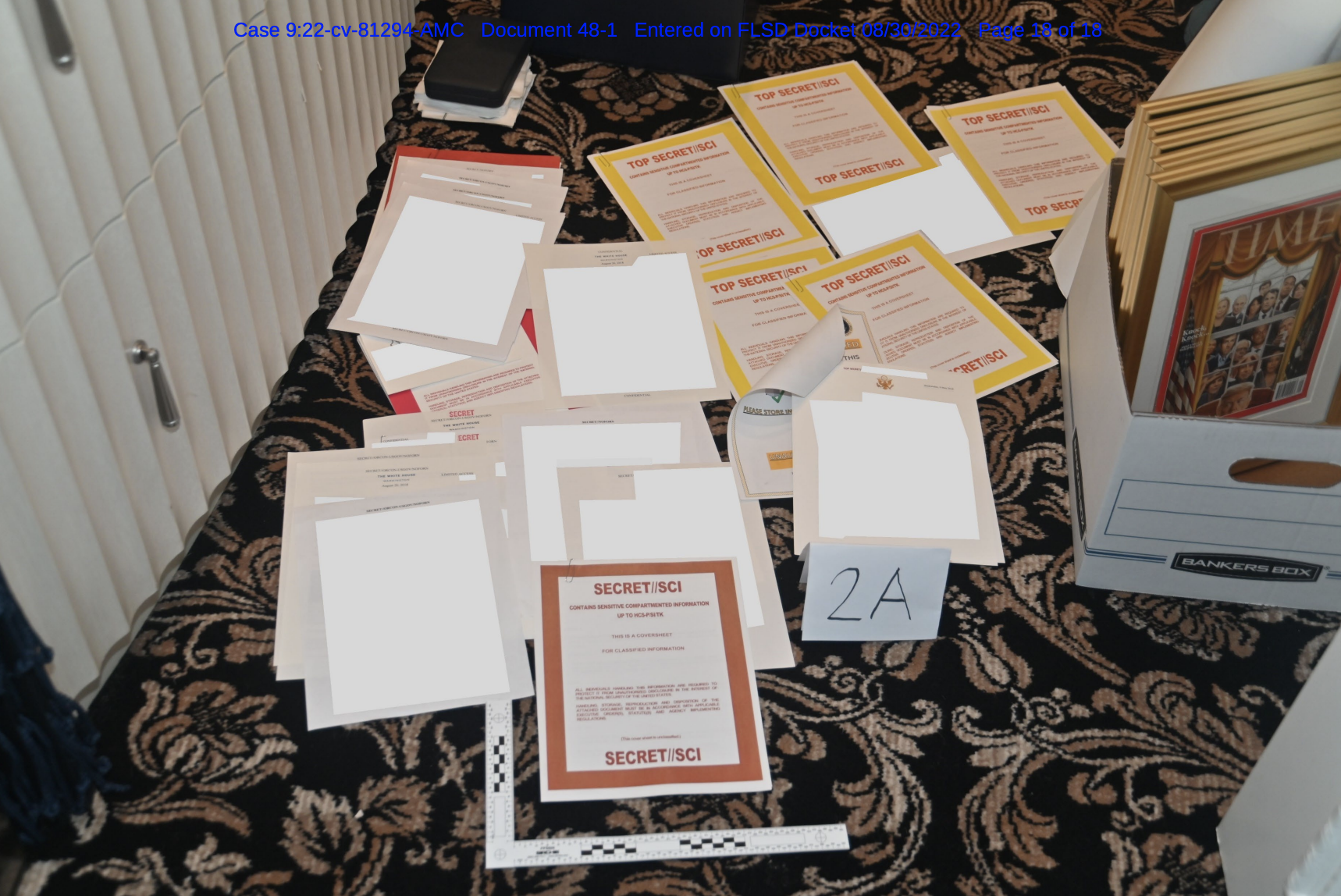
In his 21-page response to Judge Aileen Cannon informing her they want her to reject the government’s request for a stay of her injunction prohibiting the government taking investigative steps using 103 documents marked classified, Trump confesses to obstruction of justice.
Trump admits, over and over, that when the FBI showed up with a warrant authorizing the seizure (in part) of any documents with classification markings, it found such documents on the premises.
[I]t appears such “classified records,” along with the other seized materials, were principally located in storage boxes in a locked room at Mar-a-Lago, a secure, controlled access compound utilized regularly to conduct the official business of the United States during the Trump Presidency, which to this day is monitored by the United States Secret Service.
Mind you, there’s a lie here, as there is in the passage where Trump describes “complying with a subpoena” as “voluntary” production.
Likewise, there was no similar sense of urgency or imminent threat associated with the “classified records” President Trump’s counsel voluntarily turned over on June 3, 2022.
The lie is that these documents weren’t all stored in storage boxes in a room that didn’t comply with the rules set by the Executive Order that still governs classified records. The most sensitive documents — along with most of the empty classification cover folders — were in Trump’s office, an office in which he routinely entertained people (including foreign citizens) not cleared to view classified records.
But even when Trump introduces the crux of his argument that the Presidential Records Act would guarantee him access to documents that are actually found to be Presidential (as opposed to Federal) Records, he doesn’t contest that the government seized documents marked as classified at his property.
Moreover, the ultimate disposition of all the “classified records,” and likely most of the seized materials, is indisputably governed exclusively by the provisions of the Presidential Records Act (“PRA”). See 44 U.S.C. §§ 2201, et seq. The PRA accords any President extraordinary discretion to categorize all his or her records as either Presidential or personal records, and established case law provides for very limited judicial oversight over such categorization. The PRA further contains no provision authorizing or allowing for any criminal enforcement. Rather, disputes regarding the disposition of any Presidential record are to be resolved between such President and the National Archives and Records Administration (“NARA”). Thus, at best, the Government might ultimately be able to establish certain Presidential records should be returned to NARA. What is clear regarding all of the seized materials is that they belong with either President Trump (as his personal property to be returned pursuant to Rule 41(g)) or with NARA, but not with the Department of Justice.
The likely reason why Trump lies about Evan Corcoran responding to a subpoena is because absent that lie, Trump would have to explain to Judge Cannon that every single one of those 103 documents with classification marks was proof that Trump had refused to comply with a subpoena and — via his lawyers, including one who signed this filing — lied to do so.
Nevertheless, the entire 21-page argument about classification (which also concedes that neither he nor Judge Cannon has any authority to review these documents for classification status) is not just gaslighting, but also a serial confession that, Yes, Donald Trump obstructed this investigation.
And that confession is — irrespective of the actual classification status of those documents — an admission that because each of those 103 documents is evidence that Trump obstructed an investigation, they belong in the hands of the FBI to continue their investigation of why Trump obstructed their investigation.
Donald Trump’s lawyers (including the one who failed to understand Trump was exposed to 18 USC 793 and who subsequently made himself a witness in the investigation) are cultivating the belief that they’ve succeeded in stalling the investigation into their client’s efforts to keep highly classified documents in his office and storage closet.
Perhaps they have. I don’t know what will happen. Though I know their track record of predicting what DOJ will do, thus far, has been piss-poor.
What I do know is that nothing would prevent DOJ from interviewing — or even flipping — the Custodian of Records who used to be one of Trump’s lawyers in this matter.
DOJ’s motion for a stay explicitly states that Judge Aileen Cannon’s injunction against using the classified documents seized from Donald Trump for investigative purposes would not shut down the investigation. It lays out several things her injunction would not prohibit.
To be sure, the Court did not enjoin the criminal investigation altogether. For example, the government does not understand the Court’s injunction against the government’s review and use of seized materials for criminal investigative purposes to prevent it from questioning witnesses and obtaining evidence about issues such as how classified records in general were moved from the White House, how they were subsequently stored, and what steps Plaintiff and his representatives took in response to the May 11, 2022 grand jury subpoena. The government also does not understand the Order to bar it from asking witnesses about any recollections they may have of classified records, so long as the government does not use the content of seized classified records to question witnesses (which the Order appears to prohibit).
DOJ maintains that Cannon’s order does not prevent them from questioning witnesses or otherwise obtaining evidence about:
How classified records were moved from the White House to Trump properties
How classified records were stored after they were removed from the White House
What steps Trump and others took in response to the May 11, 2022 grand jury subpoena
Recollections about classified records not relying on those seized on August 8
One person who would know a good deal about these matters, and might have an interest in being rather forthcoming about them if she were interested in minimizing her potential legal exposure, is Trump’s Custodian of Records.
By title, at least, that person would know how classified documents were stored — in Mar-a-Lago and any other Trump properties — after they were removed from the White House. And few people would know more about what steps Trump “and his representatives took in response to the May 11, 2022 grand jury subpoena” than one of those two representatives, the one who signed a declaration certifying that:
Based upon the information that has been provided to me, I am authorized to certify, on behalf of the Office of Donald J. Trump, the following:
a. A diligent search was conducted of the boxes that were moved from the White House to Florida;
b. This search was conducted after receipt of the subpoena, in order to locate any and all documents that are responsive to the subpoena;
c. Any and all responsive documents accompany this certification; and
d. No copy, written notation, or reproduction of any kind was retained as to any responsive document.
I swear or affirm that the above statements are true and correct to the best of my knowledge.
In fact, that Custodian of Records might have real concern she faced legal exposure for one or more crime tied to lying to the FBI:
And all that’s assuming the Custodian of Records isn’t one of the people who shows up on video surveillance moving boxes in and out of the storage room before the “diligent search was conducted” of those boxes.
If the Custodian of Records does show up on that video surveillance, than she might face legal exposure to:
If the Custodian of Records conspired to withhold 103 classified documents, of which 18 were classified Top Secret or above, that Custodian of Records might decide she really wanted to limit her liability in that potentially draconian obstruction-plus-Espionage legal exposure.
All the more so if the Custodian of Records believed she might also have exposure to charges under 18 USC 1512(c)(2) and 18 USC 1512(k) — each of which carries up to a twenty year sentence — for involvement in an attempt to prevent the January 6 2021 vote certification and recognized that information about such activities was of value to other ongoing criminal investigations.
A dark joke has begun circulating among lawyers following the many legal travails of former President Donald J. Trump: MAGA actually stands for “making attorneys get attorneys.”
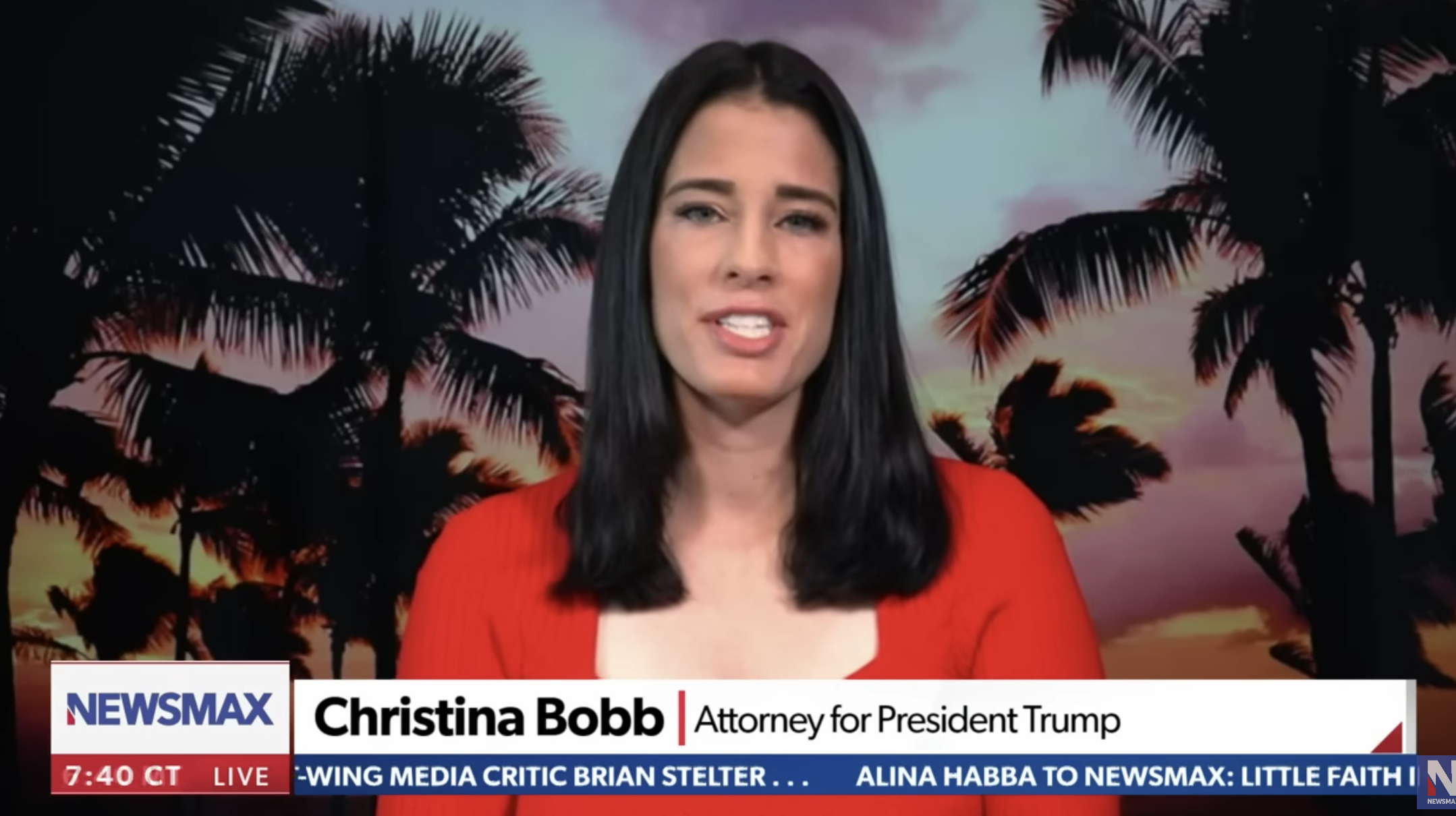
… revealed this piece of news:
Ms. [Christina] Bobb recently retained a lawyer, according to a person familiar with the situation.
Being Trump’s lawyer — being Trump’s associate generally — seems to be a non-stop game of prisoner’s dilemma, a constant weighing of whether he’ll sell you out or provide means to loot the country with impunity.
Years ago, when Trump was President, that prisoner’s dilemma turned out to be pretty easy. He would pardon anyone who lied to keep him out of trouble. So no matter how grave your legal exposure, your real criminal exposure was just a few years (and that’s before Billy Barr started selectively freeing Trump associates under COVID release programs).
But Trump is not President anymore, and short of successful civil war, even in the rosiest possible scenario would not become President again until 2025. In fact, Trump’s own legal problems and his success shutting down women’s access to abortion even makes more immediate potential relief — in the form of a House majority that could undermine DOJ’s ongoing investigations — far less of a sure thing.
Trump’s success at stalling access to classified documents seized on August 8 — and his current lawyers’ rosy prediction they’ve delayed such access until Republicans might win one house of Congress — certainly would be part of that prisoner’s dilemma. After all, until such time as DOJ were able to use 18 Top Secret documents in an Espionage Act indictment, the Custodian of Records probably couldn’t be charged for 18 USC 793(g).
But as I’ve noted before, the Espionage Act was written to dramatically alter these kinds of prisoner’s dilemmas, both because affirmative knowledge of stolen classified documents is enough to reach criminal exposure, and because the conspiracy prong of the statute exposes co-conspirators — even ones who don’t share the same motive as the person who actually possesses a cache of stolen classified documents — to the same stiff punishment as the people who actually possess those documents.
So a smart student of prisoner’s dilemmas might understand that it doesn’t pay to wait to see how Trump’s current efforts at delay work out.
One thing’s clear though: DOJ doesn’t intend to entirely halt the investigation into violations of the Espionage Act and obstruction. Indeed, they have a fair amount of leeway to pursue obstruction charges while Aileen Cannon delays the other part of the investigation. And they have described next steps to include obtaining information uniquely available to Trump’s Custodian of Records.
Go here for emptywheel’s other coverage of Trump’s stolen documents and related resources.
https://www.emptywheel.net/wp-content/uploads/2022/08/Screen-Shot-2022-08-24-at-12.38.48-PM.png12102158emptywheelhttps://www.emptywheel.net/wp-content/uploads/2016/07/Logo-Web.pngemptywheel2022-09-11 10:51:292022-09-11 13:52:4918 USC 793(g): Aileen Cannon’s Order Would Not Forestall Flipping Trump’s Custodian of Records
Last night, Trump and DOJ submitted their competing plans for a Special Master to Judge Aileen Cannon. As I laid out, Trump’s plan is a transparent effort to stall the entire investigation for at least three months, and after that to bottle up documents he stole — those with classified markings and those without — at NARA, where he’ll launch new legal fights in DC to prevent further access.
Judge Cannon has ordered Trump to weigh in on the government’s motion for a partial stay of her order, asking her to permit the investigative team access to any documents marked as classified, by 10AM on Monday. Trump will object for the same insane logic he gave in his Special Master proposal: That if he can get a private citizen Special Master to override the government’s classification determination, then he can declare the documents — even Agency documents that would be government, not Presidential Records — part of his own records at NARA.
Because Trump didn’t share his choices until after close of business day on Friday, both sides also have to inform her what they think of the other’s Special Master suggestions — Barbara Jones (who was Special Master for the review of both Rudy Giuliani’s and Michael Cohen’s devices) and retired George W. Bush appellate judge Thomas Griffith for the government, and retired EDNY and FISC judge Raymond Dearie and GOP partisan lawyer Paul Huck Jr for Trump — on Monday.
Then, if Cannon has not relented on the investigative side for documents marked as classified by Thursday, DOJ will ask for a stay of that part of her decision from the 11th Circuit, pending the rest of their appeal (the scope of which remains unknown and may depend on her other decisions this week).
Cannon’s decision on whether to permit investigators to access the documents marked as classified may provide the government leverage over the Special Master choice, which could create new bases for appeal. None of the choices for Special Master are known to be cleared, much less at the TS/SCI levels that would be needed to review the documents Trump stole, though Dearie, who was on FISC as recently as 2019, surely would be easily cleared as such.
That doesn’t matter for the government’s preferred approach. The Special Master won’t get any known classified document under their approach.
They would, however, under Trump’s approach (which more closely matches Cannon’s current order). And so DOJ will have to agree to give clearance to whatever person ends up as Special Master under the Trump plan.
The same Supreme Court precedent that undergirds all these arguments about classification authority, Navy v. Egan, is specifically a ruling about the Executive’s authority to grant or deny clearances. The government could deny any of the proposed Special Masters clearance — and might well do so, to deny Huck access. Likewise, the government might well deny Trump’s lawyers (at least Evan Corcoran, who is likely either a witness or subject of the obstruction side of the investigation) clearance for such a review as well.
So if Cannon doesn’t grant the government’s motion for a stay, then she effectively gives the government several more levers over her control of the Special Master process.
She probably doesn’t give a damn.
There are two other developments we might expect this week, though.
First, last Wednesday, DOJ asked and Chief Judge Beryl Howell granted permission to unseal the parts of the search warrant affidavit mentioning the same two grand jury subpoenas that she unsealed for mention in DOJ’s response to Trump’s Special Master motion. (I’m looking for the person I owe a hat-tip to this for.) Since receiving that permission, DOJ has not yet gone back to Magistrate Judge Bruce Reinhart to request further unsealing of the affidavit; there’s not even the tell-tale sealed filings in the docket that ended up being prior such requests.
If and when DOJ does ask for further unsealing, it might reveal more information about Trump’s actions — and, importantly for the question of who can be cleared for the Special Master review, Evan Corcoran’s. There are several entirely redacted paragraphs that likely tell what happened in response to the May 11 subpoena. There’s also a likely detailed discussion of the probable cause that Trump — and others — obstructed the investigation, some of which could be unsealed with mention of the surveillance video.
The government response before Cannon didn’t address the evidence of obstruction (or the June 24 subpoena) in much detail. Simply unsealing references of that subpoena in the affidavit might provide more damning information about Trump’s efforts to hide classified documents from DOJ.
More importantly, on Tuesday, the House returns from August recess. It’ll be the first time since the search that both houses of Congress are in town. And in their Motion for a Stay, the government noted (and Judge Cannon did not object) that it did not understand Cannon’s order to prohibit a briefing to “Congressional leaders with intelligence oversight responsibilities.”
5 The government also does not understand the Court’s Order to bar DOJ, FBI, and ODNI from briefing Congressional leaders with intelligence oversight responsibilities regarding the classified records that were recovered. The government similarly does not understand the Order to restrict senior DOJ and FBI officials, who have supervisory responsibilities regarding the criminal investigation, from reviewing those records in preparation for such a briefing.
This seems to telegraph that DOJ plans to brief the Gang of Eight — which includes Nancy Pelosi, Adam Schiff, Kevin McCarthy, Mike Turner, Chuck Schumer, Mark Warner, Mitch McConnell, and Marco Rubio — about what documents Trump stole, possibly this week. Turner and to a lesser degree Rubio have been demanding such a briefing.
And at a minimum, after such a briefing you’d see everyone run to the press and express their opinions about the gravity of Trump’s actions. Because neither DOJ nor Aileen Cannon can prevent these members of Congress from sharing details about these briefings (especially if they’re not classified), you should be unsurprised everyone to provide details of what Trump stole.
That might devolve into a matter of partisan bickering. But two things might moderate such bickering. First, Marco Rubio is on the ballot in November, and Val Demings has already criticized his knee-jerk defense of Trump.
Just as importantly, Mitch McConnell, who badly would like to prevent Democrats from expanding their majority in the Senate and just as badly would like the MAGA Republicans to go away, really doesn’t want to spend the next two months dodging questions about Trump’s crimes.
If not for Trump’s demand for a Special Master, DOJ likely would have put its head down and mentioned nothing of this investigation until after the election. But by demanding one — and by making such unreasonable requests — Trump has ensured that the investigation into his suspected violations of the Espionage Act and obstruction will dominate the news for at least a few more weeks.
Even if DOJ doesn’t brief the Gang of Eight, even if that doesn’t lead to damning new details and recriminations from being made public, the public nature of the Special Master fight will suck all the oxygen out of the next few weeks of campaign season, at least, just as it contributed to Joe Biden enjoying one of the most positive mid-term Augusts for any President in the last half-century.
But if new specifics about Trump’s negligence and efforts to obstruct the investigation are made public, then November’s election will be precisely what Republicans are trying to avoid it being: not just a response to the Dobbs ruling overturning protection for abortion access, but a referendum on the way Republicans have sacrificed American security in their fealty to Donald Trump.
https://www.emptywheel.net/wp-content/uploads/2020/10/COVID-Don.png369304emptywheelhttps://www.emptywheel.net/wp-content/uploads/2016/07/Logo-Web.pngemptywheel2022-09-10 11:30:292022-09-10 17:52:35DOJ Has at Least One Card Left to Play: Congress’ Instinct for Self-Preservation
The government’s plan is a Special Master plan, one that would be finished by mid-October.
Trump’s plan is a plan to steal documents from intelligence agencies and to stall until close to the time — it seems to hope — Jim Jordan gets a gavel in Congress and so can muck up the criminal investigation into Trump’s theft and retheft.
The key differences between the two plans are as follows:
Trump proposes a plan to steal classified documents
Trump argues that even classified documents should go to the Special Master (and before that, his lawyers, including the one who is a witness in this investigation, Evan Corcoran) and effectively lets the Special Master override the decision of the Executive Branch over classification.
Plaintiff believes the Government’s objection to the Special Master reviewing documents they deem classified is misplaced. First, the Government’s position incorrectly presumes the outcome—that their separation of these documents is inviolable. Second, their stance wrongly assumes that if a document has a classification marking, it remains classified in perpetuity. Third, the Government continues to ignore the significance of the Presidential Records Act (“PRA”). If any seized document is a Presidential record, Plaintiff has an absolute right of access to it while access by others, including those in the executive branch, has specified limitations. Thus, President Trump (and/or his designee) cannot be denied access to those documents, which in this matter gives legal authorization to the Special Master to engage in first-hand review.3
Plaintiff anticipates filing a deeper analysis of these issues in upcoming filings.
There are a lot of problems with this claim, including that it treats Trump as the President still and utterly upends the precedent on classification that Trump himself is relying on for his claim to be able to declassify things, Navy v. Egan, not to mention the Obama-era Executive Order that remains the basis for authority over classification (and so was the basis for any claim Trump ever had to classify and declassify things). There is absolutely no basis, anywhere, for a private citizen to override the classification determinations of the Executive Branch, yet that is what Trump is proposing.
Crazier still, Trump envisions government documents with classification marks that his Special Master decides aren’t classified to be Presidential records. That’s not necessarily true! Many of these documents — and certainly the secrets they tell — belong to agencies, not any President. Effectively, this is a plan to convert secret CIA and NSA documents into the private playthings of Donald J. Trump, which he can access in perpetuity.
Under the government’s plan, the Special Master would never receive anything currently marked as classified. The government does note that some of the unmarked documents may be determined by the government to be classified.
As this process moves forward, if the government identifies any potentially classified information within the contents of any of the Seized Materials without Classification Markings, the government will so advise the Court and propose actions to ensure that any such material is handled appropriately.
Trump creates busy work and delay
The government proposes that Trump conduct an initial review and make claims on categorization; anything on which the two sides agree will bypass the Special Master process. Trump says the Special Master should look at everything not in the current potentially privileged bucket.
The government sets as a deadline October 17 for the entire review (implicitly setting a deadline on Trump’s own review too). It places a deadline of September 26 for Trump’s initial review. Trump envisions the process will take 90 days or more (and sets no deadlines for himself).
Trump wants to split the cost for the Special Master, whereas the government proposes Trump paying everything, which would disincent him from stalling indefinitely.
Trump envisions removing documents from investigators’ hands
Under the government plan, non-personal documents will either end up in investigators’ hands (if the Special Master doesn’t deem them to be Executive Privileged) or at NARA (if the Special Master does).
v. For any documents identified as Presidential records – not claimed by Plaintiff as subject to Executive Privilege, those documents shall remain in custody of the government, with copies sent to the Archivist of the United States, and may be used by the government forthwith for any lawful purpose, including in the government’s criminal investigation;
vi. For any documents identified as Presidential records – claimed by Plaintiff as subject to Executive Privilege, copies of those documents will be sent to the Archivist of the United States, and the process under the Presidential Records Act, 44 U.S.C. § 2201 et seq., may thereafter be followed.
Trump envisions Presidential Records to go to NARA, whether or not he succeeds in making an Executive Privilege claim, basically assuming that documents lawfully seized under a warrant should be taken out of the hands of the investigators.
e. Once the Special Master has completed the review process set forth in this Order and any dispute has been fully adjudicated, any documents identified as Presidential records will be returned to the Archivist of the United States, and the process under the Presidential Records Act, 44 U.S.C. § 2204, will be followed to determine the assertion of any restriction on access.
In either case, FBI can obtain a subpoena for documents if they have the need. Trump’s plan just introduces another way to muck up the process.
Trump wants the lawful owner of these documents excluded
The government plan requires the Special Master to consult with NARA before making final decisions about whether something is a Presidential Record or not.
c. In categorizing Seized Materials without Classification Markings as personal items or documents, on the one hand, or Presidential records, on the other hand, the Special Master will consult with the National Archives and Records Administration (“NARA”); the government will facilitate the Special Master’s consultations with NARA; and
Trump wants no involvement from NARA, the lawful owner of anything that is a Presidential Record.
Trump wants no paper trail
Trump wants to do this entire process without leaving a paper trail that the government (or a government appeal) can access. His ostensible logic — purportedly, that the Special Master must review things that even Trump and the government agree upon, which will add to the delay — is transparent bullshit. He says DOJ has already logged the materials (though the categories in question have changed), and so doesn’t need to see Trump’s logs before they get shared with the Special Master.
The principal difference in the parties’ workflow is that Plaintiff sends materials categorized by his counsel directly to the Special Master, while the Government proposes that it review Plaintiff’s categorization by logs to determine if it agrees or disagrees with the categorization. The Government anticipates that it may agree on many of the categorizations and thus minimize the workload of the Special Master and expedite the review. The Plaintiff contends that a full review of all seized documents remains an important part of the Special Master‘s duties, even if the parties ultimately agree as to the return of various seized items. As the Government has already reviewed and categorized the seized materials, the Plaintiff believes a review by the Plaintiff, and submission to the Special Master, is the appropriate process.
And since Trump doesn’t intend to share logs of his attorneys’ determinations with the government, much of the determinations will be made via ex parte discussions with the Special Master.
Because its workflow transmits all categories of documents to the Special Master without logs, Plaintiff proposes authorization for regular ex parte communications on categorization with only the Special Master’s final report and recommendation disclosed to the Government.
This will not only delay the entire process, but will prevent the government from obtaining some materials before determinations on all the documents are done. It will also hide what would surely be outrageous claims of declassification from the government and, ultimately, the public.
And by refusing to share a log with the government, Trump keeps the involvement of an attorney who is already a witness in the criminal investigation out of the hands of the government. And, as noted, this keeps any paper trail out of the hands of any appellate ruling.
Update: Section on logging and ex parte communication added.
https://www.emptywheel.net/wp-content/uploads/2022/08/Screen-Shot-2022-08-31-at-6.40.53-AM.png11481718emptywheelhttps://www.emptywheel.net/wp-content/uploads/2016/07/Logo-Web.pngemptywheel2022-09-10 00:31:402022-09-10 07:47:14Trump Proposes a New Plan to Steal Classified Documents
In her opinion appointing a Special Master in the Trump stolen document case, Judge Aileen Cannon yoked a description of still-sealed information that appears in the privilege review status report to two unrelated mentions about personal effects.
The second factor—whether the movant has an individual interest in and need for the seized property—weighs in favor of entertaining Plaintiff’s requests. According to the Privilege Review Team’s Report, the seized materials include medical documents, correspondence related to taxes, and accounting information [ECF No. 40-2; see also ECF No. 48 p. 18 (conceding that Plaintiff “may have a property interest in his personal effects”)]. The Government also has acknowledged that it seized some “[p]ersonal effects without evidentiary value” and, by its own estimation, upwards of 500 pages of material potentially subject to attorney-client privilege [ECF No. 48 p. 16; ECF No. 40 p. 2]. [my emphasis]
As I laid out here, this passage was shamelessly dishonest. That’s because she treated a subjunctive description of what the government would do if they found “personal effects without evidentiary value” as a concession that they had found such personal effects (in the government’s response she was mangling, they explained why the passports they had already returned to Trump did have evidentiary value). And she double counted materials: she treated the 520 pages of potentially privileged material as a separate item from the references to “medical documents, correspondence related to taxes, and accounting information,” even though those medical and tax documents were in the potentially privileged bucket.
Nowhere in this otherwise dishonest passage, though, did Aileen Cannon claim that the, “medical documents, correspondence related to taxes, and accounting information” were Trump’s own personal documents.
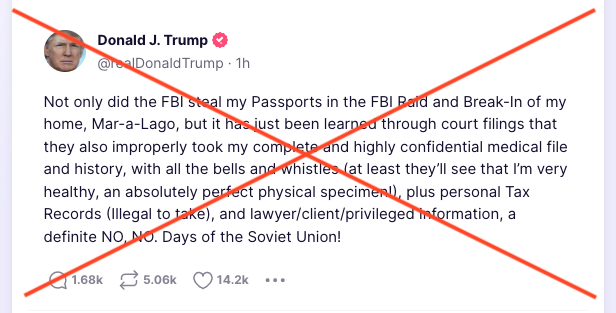
Even Trump, when he tweeted about this, stopped short of claiming these were all documents he owned (though he did claim they had taken “personal Tax Records”).
Nevertheless Cannon’s dishonest reference, yoked as it is to two unrelated references to personal effects, has led people to believe that the medical and tax records on which Cannon based her entire decision to butt into this matter are the personal possessions of Donald Trump.
There is no evidence that’s the case, and lots of reason to believe it’s not.
That’s true, first of all, because unlike the description of the contents of boxes sent to NARA in January (which were described to include “personal records [and] post-presidential records,” the detailed inventory of boxes taken on August 8 doesn’t include such a description.
To be sure: The FBI did seize personal documents. The government’s motion for a stay — written by people who have not seen the materials that Cannon describes as medical and tax records — acknowledges personal records.
Among other things, the government’s upcoming filing will confirm that it plans to make available to Plaintiff copies of all unclassified documents recovered during the search—both personal records and government records—and that the government will return Plaintiff’s personal items that were not commingled with classified records and thus are of likely diminished evidentiary value.
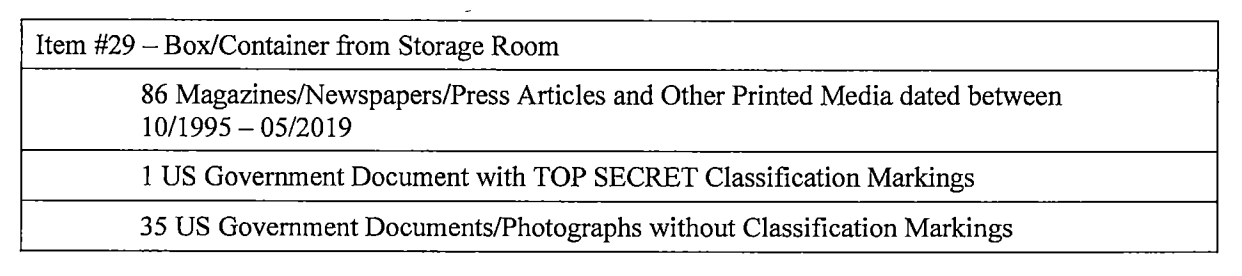
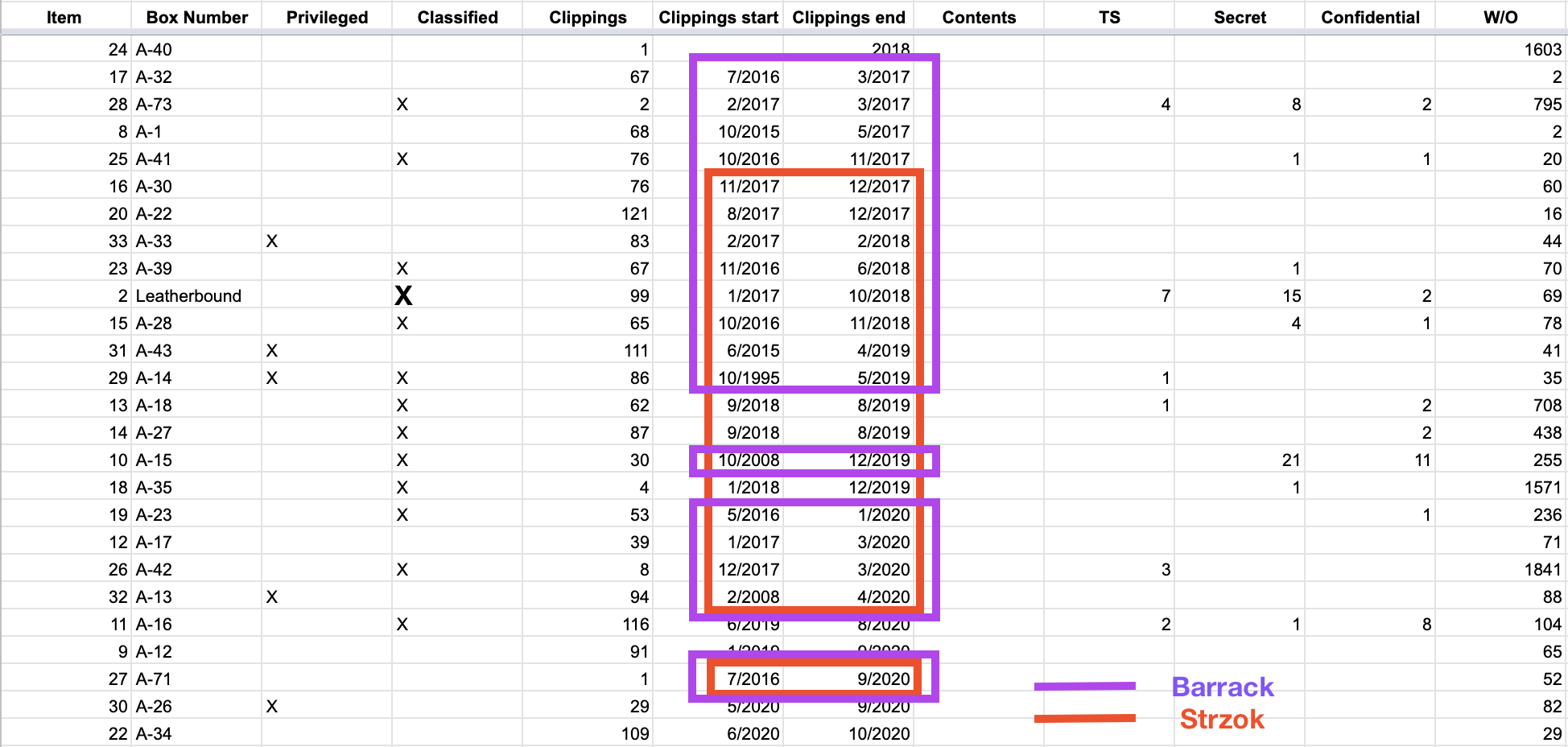
There are personal records: for example, the FBI seized 1,673 press clippings, with a bunch — dated 1995, 2008, 2015, and 2016 — pre-dating Trump’s Presidency, though five of the boxes with some clippings that pre-date Trump’s presidency include documents marked as classified, including one box (A-15) with 32 Secret and Confidential documents, and another (A-14) with a Top Secret document. But when it discusses returning things, it discusses “items.” Those personal items likely include the 19 pieces of clothing or gifts on the inventory (though some of the gifts, if they’re from foreign entities, belong to the US). They also likely include the 33 books that were seized, with 23 seized in one box that contained no documents marked as classified.
The government may be generously agreeing to return a carton of Donny Jr’s shitty books!
And there will be Trump notes. Some of the notes likely will count as personal records under the Presidential Records Act, which include:
A) diaries, journals, or other personal notes serving as the functional equivalent of a diary or journal which are not prepared or utilized for, or circulated or communicated in the course of, transacting Government business;
(B) materials relating to private political associations, and having no relation to or direct effect upon the carrying out of constitutional, statutory, or other official or ceremonial duties of the President; and
(C) materials relating exclusively to the President’s own election to the office of the Presidency; and materials directly relating to the election of a particular individual or individuals to Federal, State, or local office, which have no relation to or direct effect upon the carrying out of constitutional, statutory, or other official or ceremonial duties of the President.
But some will be presidential records (those may be some of the most interesting fights going forward and it’s the logic Tom Fitton used to push Trump to challenge the seizure of his records). Some of the notes will also be shown to include information otherwise treated as classified.
But the medical and tax records cannot be included among the items referred to here, because Jay Bratt, who wrote the government motion, has not seen the records that include medical and tax records, because they are in the potentially privileged bucket. And among those materials, there’s likely to be fewer such personal records (aside from clippings).
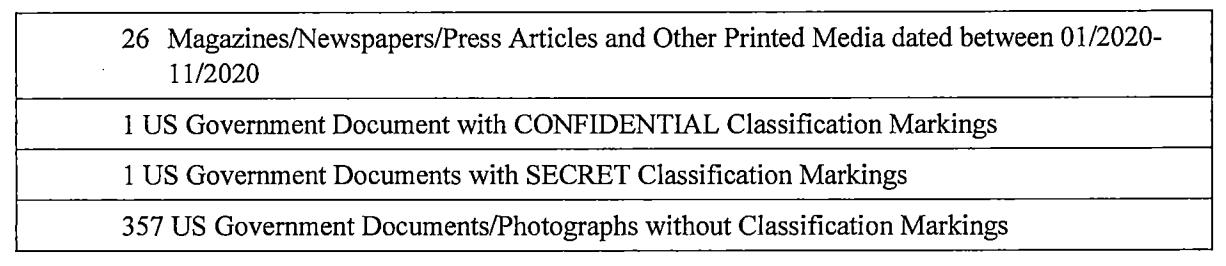
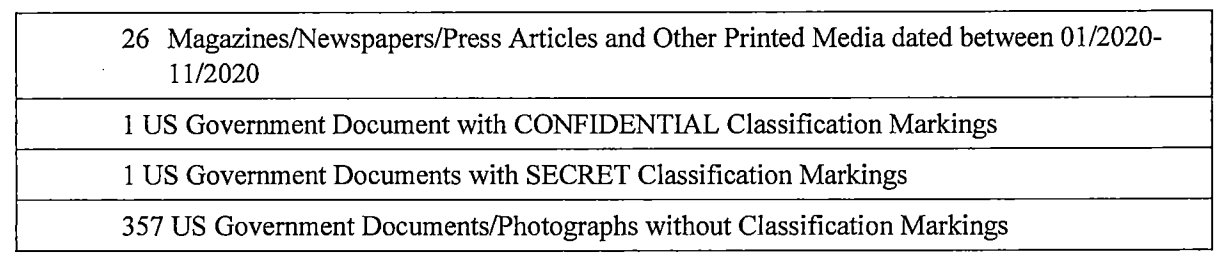
Of those, Item 4 on the inventory, described only as “documents” and elsewhere sourced to desk(s) in Trump’s office, makes up over half the records seized in the potentially privileged bucket (leaving aside clippings). It primarily consists of 357 government documents without classification marks.
Notwithstanding that this set of documents originally included Trump’s passports (which are legally government documents), it makes sense that even if there were other boxes that included the stray personal correspondence, this one did not. That’s because these were items taken out of Trump’s desk, not a box taken with all its contents. This set of documents, of which just a fraction could have since been deemed potentially privileged (because there are only 64 sets of potentially privileged documents), is also the set on which the privilege team would have focused most attention on the day of the search.
The privilege team was there, in Trump’s office, to weed out really obviously sensitive documents.
Plus, there are ready explanations for what kinds of government documents might include, “medical documents, correspondence related to taxes, and accounting information.”
First, as President, Trump had a White House physician. White House physician Ronny Jackson’s records of his ties to Trump would amount to government records. Even the paperwork behind this famously batshit press conference would be government records — and it might explain why Trump proclaimed (in his Tweet) that these records would prove he was a “Perfect Specimen.”
But there are other medical records that Trump might be more likely to stash in his desk drawer, which might also involve lawyers: his COVID diagnosis (and the reckless decision to attend a presidential debate, exposing Joe Biden to the disease), any assumption of Presidential duties by Mike Pence, the infection of numerous people with COVID at the Amy Coney Barrett roll-out, the Secret Service fly-by when Trump returned to the White House, and the decision to seek FDA approval for his access to Regeneron. The records relating to Trump’s bout with COVID by itself could fill a box. And they’re the kind of records that he would — indeed, already has — fought hard to keep from public dissemination.
Similarly, there are known documents that generated reams of government records pertaining to, “correspondence related to taxes, and accounting information.” Two involve the various efforts to obtain Trump’s tax returns from his accounting firm, Mazars, and extended efforts to investigate Trump Organization’s violation of the emoluments clause with Trump International Hotel.
This OLC memo ruling that the Treasury Department should blow off the House Ways and Means Committee request for Trump’s tax returns relates to taxes. This DOJ amicus brief weighing in on the same fight is a government document about taxes and accounting information. All correspondence generating the documents, too, would relate to taxes and accounting information. All would be government documents. Lawyers would have been involved in all parts of the process. All are the kinds of records Trump might stash in his desk drawer and refuse to turn over.
Similarly, this IG Report describes how the General Services Administration ignored how the Emoluments Clause should impact concerns about management of the Old Post Office. The Report itself references both lease (that is, accounting) information and redacted discussions among GSA and other lawyers. It discusses inadequate efforts after the inauguration to shield Trump from management of the hotel, including several discussions of lawyers for Trump Org and his spawn. It’s a government document. It — and all the legal correspondence and lease information it references — would become government documents. It’s another example of the kind of thing that would be a government record addressing accounting records that nevertheless might trigger privilege concerns.
I’m not saying these are the records at issue. I’m saying there’s a long list of known squabbles that would 1) consist of government records 2) involve tons of lawyering 3) would be the kind of thing Trump would want to hoard, and 4) would fit the low standard of potentially privileged as described by the filter lawyers.
There’s one more reason — besides her false treatment of a subjunctive consideration as a concession and her double counting — to suspect that Cannon created a deliberate misunderstanding that these were documents belonging to the former President: The emphasis with which filter attorney Anthony Lacosta focus on her unilateral treatment of still-sealed information in their motion to unseal their status report. The motion describes two ways in which details from the still-sealed filter team report were made public: First, after asking permission to do so and getting the assent of Trump lawyer Jim Trusty, filter attorney Benjamin Hawk described the filter process. Then, without unsealing the report, Cannon’s several references to the still-sealed report in her own opinion. With two of those references (page 15 and footnote 13 on the same page), Cannon described investigative agents finding something that might be privileged and turning it over immediately to the filter team.
To begin, the Government’s argument assumes that the Privilege Review Team’s initial screening for potentially privileged material was sufficient, yet there is evidence from which to call that premise into question here. See In re Sealed Search Warrant & Application for a Warrant by Tel. or Other Reliable Elec. Means, 11 F.4th at 1249–51; see also Abbell, 914 F. Supp. at 520 (appointing a special master even after the government’s taint attorney already had reviewed the seized material). As reflected in the Privilege Review Team’s Report, the Investigative Team already has been exposed to potentially privileged material. Without delving into specifics, the Privilege Review Team’s Report references at least two instances in which members of the Investigative Team were exposed to material that was then delivered to the Privilege Review Team and, following another review, designated as potentially privileged material [ECF No. 40 p. 6]. Those instances alone, even if entirely inadvertent, yield questions about the adequacy of the filter review process.13
13 In explaining these incidents at the hearing, counsel from the Privilege Review Team characterized them as examples of the filter process working. The Court is not so sure. These instances certainly are demonstrative of integrity on the part of the Investigative Team members who returned the potentially privileged material. But they also indicate that, on more than one occasion, the Privilege Review Team’s initial screening failed to identify potentially privileged material. The Government’s other explanation—that these instances were the result of adopting an over-inclusive view of potentially privileged material out of an abundance of caution—does not satisfy the Court either. Even accepting the Government’s untested premise, the use of a broad standard for potentially privileged material does not explain how qualifying material ended up in the hands of the Investigative Team. Perhaps most concerning, the Filter Review Team’s Report does not indicate that any steps were taken after these instances of exposure to wall off the two tainted members of the Investigation Team [see ECF No. 40]. In sum, without drawing inferences, there is a basis on this record to question how materials passed through the screening process, further underscoring the importance of procedural safeguards and an additional layer of review. See, e.g., In re Grand Jury Subpoenas, 454 F.3d 511, 523 (6th Cir. 2006) (“In United States v. Noriega, 764 F. Supp. 1480 (S.D. Fla. 1991), for instance, the government’s taint team missed a document obviously protected by attorney-client privilege, by turning over tapes of attorney-client conversations to members of the investigating team. This Noriega incident points to an obvious flaw in the taint team procedure: the government’s fox is left in charge of the appellants’ henhouse, and may err by neglect or malice, as well as by honest differences of opinion.”).
As Hawk explained (and she ignored) in the hearing, one of these instances involved nothing more than seeing the name of a law firm. The second he struggled to explain, but it was clear he really doesn’t think it’s privileged.
In the second instance, Your Honor, again, I think this is being personally over inclusive in an abundance of caution recognizing the circumstances that we find ourselves in, the second instance was again an item generally speaking — Your Honor, if you can give me a moment just to think on how to frame this.
The second instance was an item where a case team attorney saw that there might be — saw that there might be — saw that there were — bottom line is, Your Honor, I do not believe this information is privileged, but I still want to be respectful, and I want respect the process and Counsel’s opportunity to assert, but it was an instance where, I believe in my view, the case team attorney was exercising extreme caution in identifying a document that could potentially include privileged information and so, exercising that caution, gave it to the case team — or gave it to privilege review team to review, and that Your Honor, as counsel —
And while Hawk doesn’t directly address it, another place where Aileen Cannon unilaterally used information from the privilege review team report is in her claim that there were medical and tax records in the seized materials (see the bolded attribution, above).
Lacosta points to Judge Cannon’s asymmetrical reliance on this information in his motion to unseal the report.
Here, there is no compelling interest in maintaining the sealed status of the Filter Notice in this case, particularly in light of the Court’s reference to it in the Court’s Order appointing a special master. (DE:64 at 6, 15, & n.13.) Moreover, the United States has an interest in the Filter Notice being a part of the public record in this case and thereby equally available to all of the litigants in this matter.
This is a very subtle way of saying that for Bratt to litigate this issue, he needs to have the same information that both Trusty and Cannon are exploiting in their arguments. And, frankly, the public does too, because Cannon is quite clearly flipping normal investigative procedure on its head (again), granting the former President privileges that no criminal suspect in the United States gets.
Judge Cannon has, explicitly, turned the diligence of the investigative team into proof of harm. And because she has engaged in that kind of dishonesty, and because her reference to medical and tax records not only doesn’t deny these are government records, but also accompanies two other dishonest claims (the double counting and the treatment of a subjunctive statement as a concession), we should be very wary to read this claim as anything other than the public record suggests: that these are government records that involve some legal dispute.
Trump chose to use the levers of government to gain financial advantage and because of that there are years and years of government documents that involve legal disputes about his own personal and corporate finances. It should not surprise anyone that some of those materials were in boxes at Mar-a-Lago or stashed in his desk drawer. They are among the secrets he has most jealously guarded.
And unless and until Judge Cannon unseals that report about which she and Trump made asymmetric claims, we should not assume good faith on her part.
Update: Given Peterr’s question about my comment about notes, I elaborated on what I meant and the standard for personal notes under the Presidential Records Act.
https://www.emptywheel.net/wp-content/uploads/2022/09/Trump-Privileged.png313616emptywheelhttps://www.emptywheel.net/wp-content/uploads/2016/07/Logo-Web.pngemptywheel2022-09-09 10:18:432022-09-09 13:01:21Perfect Specimen: Government Records about the Mazars Lawsuit and Trump’s COVID Treatment Would Be Government Records
In this post, I argued that DOJ hopes to use a motion to stay Judge Aileen Cannon’s injunction against using materials seized from Donald Trump in any criminal investigation tactically — basically, to highlight she’s just stalling the investigation.
But I want to flag something that I think will be contentious going forward: Classified documents involving White House Counsel.
In its description of why all classified documents should be exempted from Judge Cannon’s injunction, DOJ noted that classified records cannot belong to Trump, and so he has no basis to make a Rule 41(g) motion. But their explanation of why such records would be excluded from any attorney-client privilege determination is more telling. It only extends to Trump’s personal lawyers.
But that rationale is categorically inapplicable to the classified records at issue in this motion, which are easily identifiable by their markings, are already segregated from the other seized records, and do not include personal records or potentially privileged communications with his personal attorneys.
[snip]
The classification markings establish on the face of the documents that they are government records, not Plaintiff’s personal records. The government’s review of those records does not raise any plausible attorney-client privilege claims because such classified records do not contain communications between Plaintiff and his private attorneys. [my emphasis]
DOJ is right that any classified documents obviously belong to the government.
But Trump’s lawyers don’t even want to cede that point. They refused the motion for a stay with respect to classified documents (which is not surprising, because in the hearing Jim Trusty said they could just make copies of all the classified records).
Counsel for the United States has conferred with counsel for Plaintiff, and Plaintiff opposes the government’s motion.
But there are known government documents in which the White House Counsel were involved that are likely among the ones Trump would most like to withhold: starting with discussions about materials (including a mention of Burisma) excised by the White House Counsel’s office from the transcript of the call between Trump and Volodymyr Zelenskyy.
The particular language used here — specifying that attorney-client privilege only extends to stuff involving Trump’s “personal” or “private” attorneys — suggests there are materials at issue involving Trump’s non-private attorneys, which could be DOJ but is most likely the White House Counsel.
As I have noted, there are three known classified documents that were put in the potentially privileged bucket, at least at the start.
And there’s a Top Secret document stashed along with clippings dating back to 1995 in box 29.
Plus, the packet involving clemency for Roger Stone — while it was not treated as potentially privileged — does include information marked as Secret.
If that involved communications with DOJ or the White House Counsel, I could see Trump trying to claw it back as well.
DOJ says that none of these involve Trump’s personal lawyers. But they’re not ruling out that they involve lawyers you and I paid for, the White House Counsel. And those documents are among the ones I can imagine Trump might care the most about.
https://www.emptywheel.net/wp-content/uploads/2022/08/Screen-Shot-2022-08-03-at-2.02.16-PM.png7821410emptywheelhttps://www.emptywheel.net/wp-content/uploads/2016/07/Logo-Web.pngemptywheel2022-09-08 20:28:212022-09-08 20:48:47A Likely Looming Battle in the Stolen Document Case: Classified White House Counsel Documents
I was out when DOJ submitted a series of documents in Trump’s demand for a Special Master. As I’m sure you’ve heard, the government has informed Judge Cannon they will appeal at least some of her decision, but at this point are asking only for a partial stay of her injunction against using the seized classified records for further criminal investigation.
I take this to be a tactical effort, one designed to make Cannon and Trump’s position less tenable going forward, without any guarantee that Cannon will accede to this request (and I think the request faces even odds at best).
In this post, I’ll attempt to explain why, while the motion for a partial stay may not work, it likely will improve DOJ’s tactical position going forward. There are other parts of this that, I think, are tactical as well. But the main point seems to be to force her to heighten her already egregious stance before DOJ is forced to appeal this.
As I said above, I think DOJ intends the motion for a partial stay to be tactical. I think there’s at least an even chance that Judge Cannon will reject it. If she does, DOJ has told her they will appeal a week from today. As I understand it, that will be a motion for a stay which is separate from the appeal of her ruling more generally, but the 11th Circuit would see the substance of it first. And however batshit the 11th Circuit and SCOTUS judges were who might review it, its substance would be something really modest: That the Executive Branch owns the country’s secrets and needs to protect them.
Plus, SCOTUS has already — in Trump v. Thompson — upheld Executive Privilege assertions less modest than the substance of the stay pending appeal. DOJ might not succeed at the 11th, but they have a good chance of succeeding at SCOTUS, and doing so on accelerated timeframe (in significant part because they are making a credible claim of urgent injury). They’ve narrowed the issue to one they need to reach to be able to investigate stolen classified documents.
The only principle DOJ is asserting in this motion for a stay is that the Executive Branch owns classified information. As I laid out here, Cannon based her decision to butt in on a (largely specious) claim that Trump had personal items included in the seized records. By asking only for a stay for all classified records, the government narrows its Richey argument, noting that Trump cannot own any documents marked as classified.
The second and third factors likewise counsel against exercising equitable jurisdiction with respect to the classified records. Those factors apply only to “the material whose return [the plaintiff] seeks” and to injury resulting from “denial of the return of his property.” Richey, 515 F.2d at 1243. Plaintiff, however, has no right to the “return” of classified records, which are not “his” property. Id. Classified records also are not “personal” to Plaintiff and would not reveal any sensitive personal information. D.E. 64 at 9, 21. Accordingly, Plaintiff has no cognizable “individual” interest in any classified records (or in having a special master review those records), and he cannot be “irreparably injured” if such records are not returned to him. Richey, 515 F.2d at 1243. The Court’s determination that the second and third Richey factors favored the exercise of equitable jurisdiction relied on its finding that Plaintiff had an interest in “at least a portion” of the seized records, including “medical documents, correspondence related to taxes,” “accounting information,” and “material potentially subject to attorney-client privilege,” and that identification of such materials “cannot reasonably be determined at this time.” D.E. 64 at 9.2 But that rationale is categorically inapplicable to the classified records at issue in this motion, which are easily identifiable by their markings, are already segregated from the other seized records, and do not include personal records or potentially privileged communications with his personal attorneys.
Cannon may still not budge! But if she doesn’t, it’ll make the outrageousness of her decision all the more evident, and indefensible.
But even this modest request will cause Trump — and therefore Judge Cannon — a good deal of concern.
Trump has already opposed this motion. (Zoe Tillman emphasized this on Twitter.)
Counsel for the United States has conferred with counsel for Plaintiff, and Plaintiff opposes the government’s motion.
Most notably, it does not concede the import of timely criminal investigation. Without addressing Cannon’s claims to the contrary, the government argued that the single possible injury Trump might face with the sharing of classified records he doesn’t own is in the continuation of the investigation itself.
Plaintiff’s only possible “injury” relates to the government’s investigation itself, but that injury is not legally cognizable. As the Supreme Court has made clear, “the cost, anxiety, and inconvenience of having to defend against” potential criminal prosecution cannot “by themselves be considered ‘irreparable’ in the special legal sense of that term.” Younger v. Harris, 401 U.S. 37, 46 (1971); cf. Cobbledick, 309 U.S. at 325 (“Bearing the discomfiture and cost of a prosecution for crime even by an innocent person is one of the painful obligations of citizenship.”). That is why courts have exercised great caution before interfering through civil actions with criminal investigations or pending cases. See also Deaver v. Seymour, 822 F.2d 66, 69-71 (D.C. Cir. 1987) (applying Younger’s principles with regard to potential federal charges); Ramsden v. United States, 2 F.3d 322, 326 (9th Cir. 1993) (“The mere threat of prosecution is not sufficient to constitute irreparable harm.”). And those fundamental principles strongly support the limited stay the government seeks here.
It noted that it cannot investigate 18 USC 793 (or obstruction of an investigation into that crime) without the classified documents in question.
This case does not involve a pending trial, but the need for the classified records is even more clearly demonstrated and specific here: The government is investigating potential violations of 18 U.S.C. § 793(e), which prohibits unauthorized retention of national defense information. The classified records are not merely relevant evidence; they are the very objects of the relevant criminal statute. Similarly, the government is investigating the adequacy of the response to a grand jury subpoena for all documents in Plaintiff’s possession “bearing classification markings.” D.E. 48 Attachment C. Again, the seized classified records at issue here—each of which the subpoena plainly encompassed—are central to that investigation.
It also talked about FBI’s central role in investigating those 90 empty folders for classified or staff secretary information.
The same is true of the empty folders with “‘classified’ banners” that were among the seized materials here, see D.E. 39-1: The FBI would be chiefly responsible for investigating what materials may have once been stored in these folders and whether they may have been lost or compromised—steps that, again, may require the use of grand jury subpoenas, search warrants, and other criminal investigative tools and could lead to evidence that would also be highly relevant to advancing the criminal investigation.
The government also pointed out the illogic of Cannon’s concession that the Executive has urgent need to conduct its damage review, while unilaterally deciding that they cannot conduct a criminal investigation.
The Court appeared to recognize that a sufficient showing of need can overcome potential assertions of executive privilege by specifying that the government may continue to review and use the classified records in its classification review and national security risk assessment. D.E. 64 at 22-24. That aspect of the order reflects an implicit determination that no potential assertion of executive privilege by Plaintiff could justify preventing the Executive Branch from conducting that review and assessment of the classified records. But under United States v. Nixon, the same is true of the review and use of the information by the government in an ongoing criminal investigation. And it would be especially unwarranted to prohibit that review and use while authorizing other personnel in the Executive Branch to review and use the same information:
All these things are likely to cause her heartburn — and Trump even more! In her opinion last week, Cannon at first denied she was minimizing the import of an ongoing criminal investigation — but then dismissed precedent on the problems with doing that.
None of this should be read to minimize the importance of investigating criminal activity or to indicate anything about the merits of any future court proceeding.
[snip]
The Court is mindful that restraints on criminal prosecutions are disfavored21 but finds that these unprecedented circumstances call for a brief pause to allow for neutral, third-party review to ensure a just process with adequate safeguards.
21 See Younger v. Harris, 401 U.S. 37, 43–44 (1971) (“[C]ourts of equity should not . . . act to restrain a criminal prosecution[] when the moving party has an adequate remedy at law and will not suffer irreparable injury if denied equitable relief.”); Stefanelli v. Minard, 342 U.S. 117, 120 (1951) (explaining that “[t]he maxim that equity will not enjoin a criminal prosecution” applies with greatest force in the context of the federal government interfering with state prosecutions).
If she refuses to let DOJ continue its investigation, which I think is quite possible, it’ll make her intent in objecting — halting any criminal investigation, into Trump or anyone else — all the more clear.
And this motion affirms that the investigation will continue regardless of what Cannon decides (though establishes how much her order is impeding it).
For example, the government does not understand the Court’s injunction against the government’s review and use of seized materials for criminal investigative purposes to prevent it from questioning witnesses and obtaining evidence about issues such as how classified records in general were moved from the White House, how they were subsequently stored, and what steps Plaintiff and his representatives took in response to the May 11, 2022 grand jury subpoena. The government also does not understand the Order to bar it from asking witnesses about any recollections they may have of classified records, so long as the government does not use the content of seized classified records to question witnesses (which the Order appears to prohibit).5 Even so, the prohibition on the review and use of the classified records is uniquely harmful here, where the criminal investigation concerns the retention and handling of those very records, with the concomitant national-security concerns raised by that conduct.
She’s on notice now that she has not succeeded in killing the investigation. She may take further steps to do so, but those, too, would be all the more outrageous if she did.
Finally, and perhaps most effectively, DOJ implies they intend to brief Congress on what Trump stole.
The government also does not understand the Court’s Order to bar DOJ, FBI, and ODNI from briefing Congressional leaders with intelligence oversight responsibilities regarding the classified records that were recovered. The government similarly does not understand the Order to restrict senior DOJ and FBI officials, who have supervisory responsibilities regarding the criminal investigation, from reviewing those records in preparation for such a briefing.
All the Republican members of the Gang of Eight have demanded such briefing, so it’d be hard for them to refuse to receive it. But my guess is this would badly discredit Cannon’s effort to thwart the investigation into Donald Trump.
To refuse this order, Aileen Cannon is going to have to assert that the Federal Government doesn’t own its secrets. I don’t rule out that she’ll do so. But if she does, it’ll make an appeal far more modest, and her malign intent far more obvious.
Update: Attempted to correct the relationship between the appeal of a stay and the appeal proper.
https://www.emptywheel.net/wp-content/uploads/2022/08/Screen-Shot-2022-08-31-at-6.40.53-AM.png11481718emptywheelhttps://www.emptywheel.net/wp-content/uploads/2016/07/Logo-Web.pngemptywheel2022-09-08 18:38:442022-09-11 21:25:54The Tactics of DOJ’s Request for a Partial Stay of Judge Cannon’s Order
The WaPo report that one of the documents seized from Trump’s resort pertained to “a foreign government’s military defenses, including its nuclear capabilities” is currently 27-paragraphs long. Of those 27 paragraphs, three quote Trump’s attorney, Christopher Kise, using the story to claim that the harm Aileen Cannon imagined in her opinion enjoining the government had come to pass.
Christopher Kise, a lawyer for Trump, decried leaks about the case, which he said “continue with no respect for the process nor any regard for the real truth. This does not serve well the interests of justice.”
“Moreover, the damage to public confidence in the integrity of the system simply cannot be underestimated. The responsible course of action here would be for someone — anyone — in the Government to exercise leadership and control. The Court has provided a sensible path forward which does not include the selective leak of unverifiable and misleading information. There is no reason to deviate from that path if the goal is, as it should be, to find a rational solution to document storage issues which have needlessly spiraled out of control.”
[snip]
Kise, the Trump lawyer, cited that part of the judge’s reasoning Tuesday night, saying “the damage to public confidence in the integrity of the system simply cannot be underestimated.” He said the special master appointment by the court provides “a sensible path forward which does not include the selective leak of unverifiable and misleading information. There is no reason to deviate from that path if the goal is, as it should be, to find a rational solution to document storage issues which have needlessly spiraled out of control.”
Seven paragraphs are dedicated to laying out Aileen Cannon’s opinion, including some passages that are so ridiculous, they deserve a factcheck.
She also reasoned that a special master could mitigate potential harm to Trump “by way of improper disclosure of sensitive information to the public,” suggesting that knowledge or details of the case were harmful to the former president, and could be lessened by inserting a special master into the document-review process.
[snip]
Cannon wrote that Trump’s position as a former president means “the stigma associated with the subject seizure is in a league of its own,” and that a “future indictment, based to any degree on property that ought to be returned, would result in reputational harm of a decidedly different order of magnitude.”
The fact that over a third of this story reporting on leaked information about the things found in the search focuses on the manufactured prospect that leaks to the press about the investigation would be worse than leaks of the actual documents advises some caution — especially since several of the claims in the story are attributed to single sources and all are described only to be “familiar with” the search or the matter.
A document describing a foreign government’s military defenses, including its nuclear capabilities, was found by FBI agents who searched former president Donald Trump’s Mar-a-Lago residence and private club last month, according to people familiar with the matter,
[snip]
Only the president, some members of his Cabinet or anear-Cabinet-level official could authorize other government officials to know details of these special-access programs, according to people familiar with the search, who spoke on the condition of anonymity to describe sensitive details of an ongoing investigation.
[snip]
It was in this last batch of government secrets, the people familiar with the matter said, that the information about a foreign government’s nuclear-defense readiness was found.
[snip]
One person familiar with the Mar-a-Lago search said the goal of the comprehensive list was to ensure recovery of all classified records on the property, and not just those that investigators had reason to believe might be there.
[snip]
Investigators grew alarmed, according to one person familiar with the search, as they began to review documents retrieved from the club’s storage closet, Trump’s residence and his office in August. The team soon came upon records that are extremely restricted, so much so that even some of the senior-most national security officials in the Biden administration weren’t authorized to review them. One government filing alluded to this information when it noted that counterintelligence FBI agents and prosecutors investigating the Mar-a-Lago documents were not authorized at first to review some of the material seized.
As described, these sources are familiar with the need to recover certain documents and the complexities about classification and clearance. The description of how, during the search, alarm grew about the sensitivity of the documents is sourced to someone who seems unfamiliar with public details about where this document, by definition, would have been found (in the leatherbound box). While I suspect it’s not, it could even come from someone — like a Secret Service agent onsite or someone watching video remotely — who merely observed the search.
Like I said, while I have no reason to doubt the report (indeed, I think it highly plausible, based on the date, that one of the visible documents in DOJ’s picture from the search pertains to JPCOA and therefore to Iran’s “military defenses, including its nuclear capabilities”), I would caution about the motives of those behind it.
Especially since, for almost a week, Team Trump has been privy to parts of the investigation that Jay Bratt, the prosecutor overseeing the investigation, is not.
Close to the beginning of last Thursday’s hearing, Judge Cannon had the filter lawyers share their status review with Trump’s lawyers.
MR. BRATT: So, Your Honor, we have the two filter attorneys present here. We have not seen it; and, certainly, our main concern would be that there was nothing in there that would then get out and taint members of the investigative side. So I would defer to them as to whether the whole document can be unsealed and provided to Defense or whether only a portion. I’m sort of speaking blindly about it.
[snip]
THE COURT: Good afternoon. My question, Mr. Lacosta, is directed only at the status report not exhibits A or B. What is your position with respect to making that available to Plaintiff’s counsel?
MR. LACOSTA: Your Honor, we have no objection with the pleading itself being made to Plaintiff’s counsel, both the pleading, exhibit A and exhibit B, but we would ask that it remain under seal.
THE COURT: Okay. So for now, please, I’ll ask my team to make those documents available to Plaintiff’s counsel. And because those are lengthier, I’m going to take a 15-minute break for Plaintiff’s counsel to review them. The Court is in a brief recess.
THE COURTROOM DEPUTY: All rise. (Recess was had at 1:11 p.m.; and the proceedings Resumed at 1:26 p.m.)
THE COURT: You may be seated. All right. Has Plaintiff’s counsel had enough time to review that status report?
MR. KISE: We have, Your Honor.
THE COURT: Okay. What is your position on the unsealing of the report itself, minus the exhibits?
MR. KISE: Your Honor, respectfully, we think that both the report itself and the exhibits should remain under seal at this time. The report itself does make some substantive references to privileged material; and, in an abundance of caution, we want to make sure that we don’t get into a situation where there is a waiver claim of some kind. So, respectfully, we would ask the Court to keep it under seal. There may come a time, after we understand a little bit more, where that position could change; but certainly for now, Your Honor, we don’t want to have a waiver situation.
THE COURT: Okay. Well, seeing as it is a joint request at this point to continue the seal as to the filter review team status report and associated exhibits, that document will remain under seal, and the parties should be careful to adhere to that in their presentation today.
This step was actually fairly central to the asymmetry that Cannon used to find some ownership interest in medical and tax documents that Trump might not even own. Bratt couldn’t rebut Cannon’s representations about the material because he is specifically prevented from seeing these materials until after privilege determinations get made.
Significantly, Kise seemed amenable to releasing the content of the material so long as it didn’t involve a waiver of privilege claims.
And Trump just tweeted about precisely this material — material the filter attorney had asked to share with Trump’s lawyers last Thursday, but Cannon prohibited.
There should be no way that a nuclear-related document was mentioned in that privilege progress report. Based on court filings, there are just three items that were initially placed in the potentially privileged bucket that have classification markings.
One is Top Secret (buried along with clippings from 1995!). But at least as described, it doesn’t bear compartment markings.
Trump team has knowledge about things that Jay Bratt does not, but that doesn’t likely extend to that nuclear document.
I mean, Trump likely has knowledge of what documents were in his leatherbound box. But unless he’s confessing to storing that in his closet directly, his team is likely not the source for that part of this story.
On TeeVee this morning, Marco Rubio — who seems to be staking his Senate seat on groveling to Trump — claimed that the only people who have knowledge of the investigation are at DOJ (he also egregiously misstated what happened after Trump refused to fully comply with a subpoena for the marked documents). That’s definitely not true of the most sensitive documents seized there, which an entire apparatus of secrecy must be involved with. But as of last Thursday, we can say with certainty that there are aspects of the investigation that Trump’s team knows more about than the guy leading the investigation.
And Trump is already making claims about things that prosecutors cannot and have not accessed.
https://www.emptywheel.net/wp-content/uploads/2022/09/Trump-Privileged.png313616emptywheelhttps://www.emptywheel.net/wp-content/uploads/2016/07/Logo-Web.pngemptywheel2022-09-07 10:36:592022-09-07 10:41:49Team Trump Knows Details of the Investigation that Jay Bratt Does Not — and Trump’s Already Leaking Them
On Monday, Aileen Cannon told the government that it can only access 11,282 documents legally owned by the National Archives and currently possessed by DOJ to do an assessment of the damage Trump did by storing those records in a poorly-secured storage closet and desk drawer.
We’ll learn more in coming days about how the government will respond to Cannon’s usurpation of the President’s authority over these documents.
But I want to note that there may be competing legal obligations, on NARA at least, that may affect the government’s response.
NARA has been responding to at least four pending legal obligations as the fight over Trump’s stolen documents has gone on:
A series of subpoenas from the January 6 Committee that the Supreme Court has already ruled has precedence over any claims of privilege made by Trump
Two subpoenas from DOJ’s team investigating January 6, one obtained in May, covering everything NARA has provided to the J6C, and a second one served on NARA on August 17; these subpoenas would also be covered under SCOTUS’ ruling rejecting Trump’s privilege claims
Discovery in Tom Barrack’s case, whose trial starts on September 19 (DOJ informed Barrack they had requested Trump White House materials from NARA on April 5)
A subpoena from Peter Strzok in his lawsuit over his firing and privacy act violations
For all of them, NARA has a legal obligation that precedes Judge Cannon’s order. So if any of the material owned by NARA that Cannon has enjoined for Trump’s benefit is covered by these subpoenas and the Barrack discovery request, it will give NARA an additional need to intervene, on top of the fact that Cannon has made decisions about property owned by NARA.
I don’t hold out hope that the August 8 seizure has much pertaining to either January 6 investigation. Given that none of the boxes include clippings that post-date November, its unlikely they include government documents from the same period.
Plus, given the timing, I suspect the more recent subpoena from Thomas Windom to NARA pertains to materials turned over to NARA by Mark Meadows after the Mar-a-Lago search. Because Meadows originally turned those communications over to J6C directly, they would not have been covered by the prior subpoena, which obtained everything NARA turned over to J6C, which wouldn’t have included Meadows’ texts.
Meadows’ submission to the Archives was part of a request for all electronic communications covered under the Presidential Records Act. The Archives had become aware earlier this year it did not have everything from Meadows after seeing what he had turned over to the House select committee investigating January 6, 2021. Details of Meadows’ submissions to the Archives and the engagement between the two sides have not been previously reported.
“It could be a coincidence, but within a week of the August 8 search on Mar-a-Lago, much more started coming in,” one source familiar with the discussions said.
The second subpoena would have been served days after Meadows started providing these texts.
The possibility that some of the documents seized on August 8 would be discoverable in Barrack’s case is likely higher, particularly given the news that Trump had hoarded at least one document about “a foreign government’s nuclear-defense readiness.” Barrack is accused of working to influence White House policy on issues pertaining to UAE, Saudi Arabia, and Qatar that might be implicated by classified documents. If the date of clippings in a particular box reflect the age of the government documents also found in that box, then about 18 boxes seized in August (those marked in purple, above) include records from the period covered by Barrack’s superseding indictment.
That said, whether any such materials would count as being in possession of DOJ is another issue. They are currently in possession of team at DOJ that significantly overlaps with the people prosecuting Barrack for serving as an Agent of the Emirates without telling the Attorney General.
Strzok’s subpoena may be the most likely to cover materials either turned over belatedly or seized on August 8 (though his subpoena was scoped, with DOJ involvement, at a time after the FBI was aware of Trump’s document theft). It asks for:
Records concerning Sarah Isgur’s engagement with reporters from the Washington Post or New York Times about Peter Strzok and/or Lisa Page on or about December 1 and 2, 2017.
Records dated July 1, 2017 through December 12, 2017 concerning or reflecting any communications with members of the press related to Peter Strzok and/or Lisa Page.
Records dated July 1, 2017 through December 12, 2017 concerning or reflecting text messages between Peter Strzok and Lisa Page.
Records dated July 1, 2017 through August 9, 2018 concerning Peter Strzok’s employment at the FBI.
That materials covered by this subpoena made their way at some point to Mar-a-Lago is likely. That’s because of the obsession with records relating to Crossfire Hurricane in the days when Trump was stealing documents — virtually all of those would “concern” Strzok’s FBI employment.
In Mr. Trump’s last weeks in office, Mr. Meadows, with the president’s blessing, prodded federal law enforcement agencies to declassify a binder of Crossfire Hurricane materials that included unreleased information about the F.B.I.’s investigative steps and text messages between two former top F.B.I. officials, Peter Strzok and Lisa Page, who had sharply criticized Mr. Trump in their private communications during the 2016 election.
The F.B.I. worried that releasing more information could compromise the bureau, according to people familiar with the debate. Mr. Meadows dismissed those arguments, saying that Mr. Trump himself wanted the information declassified and disseminated, they said.
Just three days before Mr. Trump’s last day in office, the White House and the F.B.I. settled on a set of redactions, and Mr. Trump declassified the rest of the binder. Mr. Meadows intended to give the binder to at least one conservative journalist, according to multiple people familiar with his plan. But he reversed course after Justice Department officials pointed out that disseminating the messages between Mr. Strzok and Ms. Page could run afoul of privacy law, opening officials up to suits.
None of those documents or any other materials pertaining to the Russia investigation were believed to be in the cache of documents recovered by the F.B.I. during the search of Mar-a-Lago, according to a person with knowledge of the situation.
Hours after that meeting (and a half hour call, from 3:20 to 3:50, between then Congressman Mark Meadows and the Attorney General), Jeff Sessions issued a press release about Strzok and Lisa Page.
Discovery has confirmed that the Attorney General released a press statement via email from Ms. Isgur to select reporters between 5:20 and 8:10 PM on January 22, roughly three hours after Attorney General Sessions returned from the White House. The statements promised, “If any wrongdoing were to be found to have caused this gap [in text messages between Mr. Strzok and Ms. Page], appropriate legal disciplinary action measure will be taken” and that the Department of Justice would “leave no stone unturned.” (See, e.g., Exhibit F). Based on Mr. Strzok’s review of the documents, it does not appear that this statement was planned prior to the January 22 White House meeting. It is not apparent from the documents produced in this action what deliberation lead to the issuance of that statement. For example, Mr. Strzok has not identified any drafts of the press release.
Any back-up to the White House side of that meeting — whether it has made its way back to NARA or not — would be included within the scope of Strzok’s subpoena. And even if NYT’s sources are correct that no Crossfire Hurricane documents were included among those seized in August (an uncertain claim given how much lying to the press Trump’s people have been doing), records covering Strzok’s firing would be broader than that.
The red rectangles, above, show the 17 documents seized in August for which the clippings would be in the temporal scope of Strzok’s subpoena.
I have no idea what happens if some of the boxes seized on August 8 include material responsive to these legal demands on NARA.
But if those boxes do include such materials, then it presents a competing — and pre-exisitng — legal obligation on the lawful owner of these records.
Update: Viget alerted me that I had not put an “X” by the leatherbound box reflecting its classified contents. I’ve fixed that!
https://www.emptywheel.net/wp-content/uploads/2018/09/Screen-Shot-2018-09-11-at-10.32.12-AM.png513927emptywheelhttps://www.emptywheel.net/wp-content/uploads/2016/07/Logo-Web.pngemptywheel2022-09-07 07:41:522022-09-07 11:05:05NARA May Have Pre-Existing Legal Obligations with Respect to Documents Covered by Aileen Cannon’s Order
I mentioned the Richey factors yesterday: the now-11th Circuit precedent laying out factors a judge should consider before nosing into the government’s warranted seizure of a subject’s property. Here’s how Judge Cannon laid them out before deciding she should nose into the government’s business.
In making this determination, the Court relies in part on the factors identified in Richey v. Smith. 515 F.2d at 1245. 9 In that case, the former Fifth Circuit counseled courts to consider, for equitable jurisdiction purposes, whether the government displayed a callous disregard for the movant’s constitutional rights, whether the movant has an individual interest in and need for the seized property, whether the movant would be irreparably injured by denial of the return of the seized property, and whether the movant otherwise has an adequate remedy at law.
As I laid out, Cannon did some crazy-ass stuff to get past the second factor, property ownership. She used materials that Trump might not even own that she herself had prohibited the government to share with Trump’s lawyers last week, then usurped the authority of the President of the United States (among other things), to claim that Trump had a property interest in the 11,000 stolen government documents the FBI seized on August 8.
Her argument about the irreparable harm that Trump faces because the government seized 11,000 documents — some highly classified — that he refused to return is still more appalling. I just want to look at one part of it, but I know you’ll all enjoy the bit where she says it would harm Trump’s reputation to be charged with a crime.
The same reasoning contributes to the Court’s determination that the third factor—risk of irreparable injury—likewise supports the exercise of jurisdiction. In addition to being deprived of potentially significant personal documents, which alone creates a real harm, Plaintiff faces an unquantifiable potential harm by way of improper disclosure of sensitive information to the public.11 Further, Plaintiff is at risk of suffering injury from the Government’s retention and potential use of privileged materials in the course of a process that, thus far, has been closed off to Plaintiff and that has raised at least some concerns as to its efficacy, even if inadvertently so. See infra Discussion III. Finally, Plaintiff has claimed injury from the threat of future prosecution and the serious, often indelible stigma associated therewith. As the Richey court wrote, “a wrongful indictment is no laughing matter; it often works a grievous, irreparable injury to the person indicted. The stigma cannot be easily erased. In the public mind, the blot on a man’s escutcheon, resulting from such a public accusation of wrongdoing, is seldom wiped out by a subsequent judgment of not guilty. Frequently, the public remembers the accusation, and still suspects guilt, even after an acquittal.” 515 F.2d at 1244 n.10; see also In the Matter of John Bennett, No. 12-61499-CIV-RSR, ECF No. 22 pp. 26–27 (S.D. Fla. July 23, 2013) (explaining that, although some courts have rejected Richey’s observation as to the harm posed by indictments, Richey remains binding on district courts in the Eleventh Circuit). As a function of Plaintiff’s former position as President of the United States, the stigma associated with the subject seizure is in a league of its own. A future indictment, based to any degree on property that ought to be returned, would result in reputational harm of a decidedly different order of magnitude.
11 When asked about the dissemination to the media of information relative to the contents of the seized records, Government’s counsel stated that he had no knowledge of any leaks stemming from his team but candidly acknowledged the unfortunate existence of leaks to the press. [my emphasis]
Yes, it is outrageous that Aline Cannon places more value on Trump’s reputation than those of hundreds of people he has falsely accused over his lifetime, most notably the Central Park Five, but also including Hillary Clinton and John Bolton, both of whom he falsely accused of the crime for which he is currently under investigation.
But consider Aileen Cannon’s logic about leaks. Here’s the exchange that, she says, amounts to DOJ’s head of counterintelligence, Jay Bratt, “acknowledg[ing] the unfortunate existence of leaks to the press.”
THE COURT: Let me ask also, there has been some discussion in the filings related to leaks or disseminations of information to the media. Are you aware, Mr. Bratt, of any such dissemination to the media, relative to the contents of the seized records?
MR. BRATT: Not on the part of anybody that I’m working with. Obviously, you know, things — I see the same things in the press that other people do. It’s bad. People are talking. If people on the Government’s side are talking about it, I’m not aware of anybody that we work with that has had contact with the press and certainly don’t condone it in any way.
Bratt not only didn’t say that anyone on the investigative team had leaked to the press, he specifically said no one he was working with did. No one who would have access to the documents — which, remember, were seized from a padlocked closet in a hallway trafficked by hotel staff and potentially visitors and infiltrators, as well as Trump’s desk drawer and, maybe, a hotel safe — none of those people have leaked to the press.
It’s pretty obvious they haven’t, because none of the leaks to the press have been accurate. The vast majority of them, in fact, can be matched to false claims Trump has made in his own filings.
Trump is leaking. The investigative team is not.
Ironically, in her order, Cannon also revealed details about the potentially privileged content seized from Trump. She’s done more leaking than the investigative team has.
And so Judge Aileen Cannon’s remedy for the risk of hypothetical leaks about Trump is to give the seized documents, including documents marked TS/SCI with compartments including, among other things, Human Source Operations, back to Trump and the lawyers who are leaking up a storm, not a single one of whom has a need to know about these Human Source Operations anymore.
Not only does Judge Aileen Cannon’s remedy for a hypothetical threat posed by leaks that haven’t happened yet, but she also has forbidden the government from continuing to criminally investigate Trump and any co-conspirators he might have. She has forbidden the FBI from using the documents to try to chase down any existing leakers of these documents (though she has allowed a damage assessment that will be virtually impossible to do without the FBI side of the investigation).
Judge Cannon is worried about a hypothetical threat to Trump’s reputation posed by the leak of materials seized from his hall closet and desk drawers, and because of that, she has prohibited the FBI from investigating Trump for willingly, knowingly, obstinately leaving stuff about Human Source Operations lying around a hotel targeted by foreign intelligence services.
For a year, Donald Trump left 325 files lying around his club, unsecured. After he gave 184 of them back in January 2022, he went to great efforts to prevent the FBI from reviewing what kind of damage he had done, delaying their access by a month. All the while, he secretly kept at least 141 more of those files in his desk drawer and hall storage room, even after it was public that he had been storing sensitive records in his poorly secured resort. The government subpoenaed him. He stalled again. He gave back 38 of those documents, while still hiding another 103, still lying around his poorly protected club. He bought a padlock, his lawyers have claimed in leaks to the press. Finally, on August 8, the FBI came and seized another 103 documents, still including documents protected as part of highly sensitive compartments that, if disclosed, could get people killed.
Judge Aileen Cannon has ruled that it is more important that Donald Trump’s reputation be protected from hypothetical leaks than that FBI be able to remedy the possibility that leaks facilitated by Donald Trump’s obstinance and neglect could get people killed.
Donald Trump has already been given 18 months in which his obstinance has prevented the government from preventing leaks of the sort that can get people killed. Now, out of fear of hypothetical reputational leaks, Judge Aileen Cannon has mandated that Trump and any co-conspirators be given still more time to get people killed.
https://www.emptywheel.net/wp-content/uploads/2022/09/18nytrump1-superJumbo.webp20481399emptywheelhttps://www.emptywheel.net/wp-content/uploads/2016/07/Logo-Web.pngemptywheel2022-09-06 18:00:082022-09-06 18:01:29Aileen Cannon Prioritized Donald Trump’s Reputation over CIA Assets’ Lives