
Big-Footing Superpower Status Also about Legally Immune Commander in Chief(s)

In a piece making the obvious comparison between fugitive spy Robert Seldon Lady and accused Espionage fugitive Edward Snowden, Tom Englehardt writes off the press silence about presumed American assistance to Lady in fleeing an international arrest warrant as the reality of being the sole superpower.

It’s no less a self-evident truth in Washington that Robert Seldon Lady must be protected from the long (Italian) arm of the law, that he is a patriot who did his duty, that it is the job of the U.S. government to keep him safe and never allow him to be prosecuted, just as it is the job of that government to protect, not prosecute>, CIA torturers who took part in George W. Bush’s Global War on Terror.

So there are two men, both of whom, Washington is convinced, must be brought in: one to face “justice,” one to escape it.  And all of this is a given, nothing that needs to be explained or justified to anyone anywhere, not even by a Constitutional law professor president.  (Of course, if someone had been accused of kidnapping and rendering an American Christian fundamentalist preacher and terror suspect off the streets of Milan to Moscow or Tehran or Beijing, it would no less self-evidently be a different matter.)

Don’t make the mistake, however, of comparing Washington’s positions on Snowden and Lady and labeling the Obama administration’s words and actions “hypocrisy.”  There’s no hypocrisy involved.  This is simply the living definition of what it means to exist in a one-superpower world for the first time in history.  For Washington, the essential rule of thumb goes something like this: we do what we want; we get to say what we want about what we do; and U.N. ambassadorial nominee Samantha Powers then gets to lecture the world on human rights and oppression.

This version of how it all works is so much the norm in Washington that few there are likely to see any contradiction at all between the Obama administration’s approaches to Snowden and Lady, nor evidently does the Washington media.

Englehardt doesn’t mention Sabrina De Sousa’s claims about the CIA’s kidnapping of Osama Mustapha Hassan Nasr (Abu Omar) and Italy’s subsequent prosecution of those involved. Adding her in the mix makes it clear how closely immunity for the Commander in Chief and his top aides is part of this superpower big-footing.

De Sousa, who says she served as an interpreter for the kidnappers on a planning trip, but not in the operation itself, was convicted and sentenced in Italy in part because the government refused to invoke diplomatic immunity (she admits she worked for CIA, but was under official cover).

The kidnapping did not meet US standards for renditions, but Station Chief Jeff Castelli wanted to do one anyway, and pushed through its approval even without Italian cooperation.

Despite concerns with the strength of Castelli’s case, CIA headquarters still agreed to move forward and seek Rice’s approval, De Sousa said. She recalled reading a cable from late 2002 that reported that Rice was worried about whether CIA personnel “would go to jail” if they were caught.

In response, she said, Castelli wrote that any CIA personnel who were caught would just be expelled from Italy “and SISMi will bail everyone out.”

Of her CIA superiors, De Sousa said, “They knew this (the rendition) was bullshit, but they were just allowing it. These guys approved it based on what Castelli was saying even though they knew it never met the threshold for rendition.”

Asked which agency officials would have been responsible for reviewing the operation and agreeing to ask Rice for Bush’s authorization, De Sousa said they would have included Tenet; Tyler Drumheller, who ran the CIA’s European operations; former CIA Director of Operations James Pavitt and his then-deputy, Stephen Kappes; Jose Rodriguez, then the head of the CIA’s Counterterrorism Center, and former acting CIA General Counsel John Rizzo.

De Sousa says the Italians and Americans colluded to protect the highers up, while prosecuting her and other lower level people.

De Sousa accused Italian leaders of colluding with the United States to shield Bush, Rice, Tenet and senior CIA aides by declining to prosecute them or even demanding that Washington publicly admit to staging the abduction.

Calling the operation unjustified and illegal, De Sousa said Italy and the United States cooperated in “scape-goating a bunch of people . . . while the ones who approved this stupid rendition are all free.”

Note, she doesn’t say this, but some of the people in the chain of command for this kidnapping — in both the US and Italy — were also involved in planting the Niger forgeries used to start the Iraq War. And, of course, a number of the Americans were involved in the torture program and its cover-up.

Since then, De Sousa has used all legal avenues to blow the whistle on this kidnapping.

De Sousa said that she has tried for years to report what she said was the baseless case for Nasr’s abduction and her shoddy treatment by the CIA and two administrations.

Her pleas and letters, however, were ignored by successive U.S. intelligence leaders, the CIA inspector general’s office, members and staff of the House and Senate intelligence committees, Rice, former Secretary of State Hillary Clinton and Attorney General Eric Holder, said De Sousa.

Assuming De Sousa’s story is correct (and an anonymous source backs its general outlines), then it adds one more reason why Lady quietly got to return to the US while Snowden will be loudly chased around the world.

What Americans are buying off on — along with superpower status that may defund schools in exchange for empire — with their silence about the disparate treatment of Sady and Snowden, then, is not just the ego thrill of living in a thus far unrivaled state.

It’s also, implicitly, the kind of immunity for the Commander in Chief and executive branch that shouldn’t exist in democratic states.
Share this entry

On the Growing Fight Against America’s Secret Enemies

Cora Currier describes the absurd response she got when she asked for a list of our enemies.

At a hearing in May, Sen. Carl Levin, D-Mich., asked the Defense Department to provide him with a current list of Al Qaeda affiliates.

The Pentagon responded – but Levin’s office told ProPublica they aren’t allowed to share it. Kathleen Long, a spokeswoman for Levin, would say only that the department’s “answer included the information requested.”

A Pentagon spokesman told ProPublica that revealing such a list could cause “serious damage to national security.”

“Because elements that might be considered ‘associated forces’ can build credibility by being listed as such by the United States, we have classified the list,” said the spokesman, Lt. Col. Jim Gregory. “We cannot afford to inflate these organizations that rely on violent extremist ideology to strengthen their ranks.”

Thing is, this is not entirely new. At least until February, the government had been refusing to give Ron Wyden a list of every country in which we’ve used lethal force. And he’s on the Intelligence Committee!

Indeed, Currier suggests one reason this might be classified would be if Obama was fighting these enemies under Inherent Authority.

The AUMF isn’t the only thing the government relies on to take military action. In speeches and interviews Obama administration officials also bring up the president’s constitutional power to defend the country, even without congressional authorization.

But, as Jack Goldsmith notes, something else seems to be going on here, because the response Currier got suggests the list is classified Secret, not whatever Top Secret compartment the government maintained for a year Wyden couldn’t access.

The language of the DOD release suggests that at least a few more groups (or elements of groups), and maybe many more groups (or elements), are on the AUMF “list.”  The existence of a “list” (which was unclear in the May 2013 AUMF hearing), and the fact that there may be at least a few groups (or elements of groups) on it, is itself news in the AUMF-watcher world.  It is also consistent with suggestions and implications in reports, such as in Mark Mazzetti’s book, that the AUMF is being invoked in various ways by DOD Special Operations Forces for non-covert military activities in many countries around the globe.

Third, it is entirely unclear why the USG can acknowledge some groups without unduly “inflating” them, and not others.  And this in turn makes me skeptical of the notion of “inflation.”  To be sure, some groups that are AUMF-able (such as, perhaps, the Haqqani network, a known but not acknowledged U.S. target) perhaps cannot be named because the operations are covert actions and involve deals of non-acknowledgment with foreign governments (or elements of foreign governments).  But that cannot be a comprehensive explanation for DOD’s secrecy.  By stating that disclosure of groups on the list would “reasonably be expected to cause serious damage to the national security,” DOD has tipped off that the list is classified only at the secret (as opposed to top secret) level.  (See Section 1.2 of E.O. 13,256.)  Covert actions are typically classified at the top secret level.  This implies (but does not prove) that some if not all of the AUMF-groups in question are not subjects of covert actions.

But remember: There are two other instances where the government has refused to clarify who is, and is not, an enemy.

When a bunch of people who have talked to, but not assisted, terrorists sued to stop the NSAA’s provisions allowing indefinite detention, the government refused (until it became convenient) to say whether they could be detained or not.

Then, as part of the Bradley Manning charges, the government kept one of the enemies it was going to prove he had aided classified (but ultimately didn’t argue he had aided that enemy in court).

Prosecutors accuse him of “aiding the enemy,” and three in particular: al-Qaida, al-Qaida in the Arabian Peninsula and a “classified enemy” referred to by a Bates number, which is a form of legal document identification.
Three professors of military law – Yale Law School’s Eugene Fidell, Duke University School of Law’s Scott Silliman and Texas Tech University School of Law’s Richard Rosen – told Courthouse News they had never heard of a case involving a “classified enemy.”
After being informed that the phrase stumped the professors, a military spokeswoman insisted that the confusion stemmed from a misunderstanding, because “who the enemy ‘is’ is not classified.”
“What ‘is’ classified is that our government has confirmed that this enemy is in receipt of certain compromised classified information, and that the means and methods of collection that the government has employed to make that determination are classified,” the spokeswoman said in an email.

One thing about all these instances — refusing to share a list of lethal force targeted countries with Ron Wyden, sharing a classified list with Carl Levin only on request, refusing to tell Americans (and one member of parliament from Iceland) whether they are counted as enemies, and refusing to tell Manning which enemy he supposed aided — is that they provide the executive maximum flexibility. That may not be the only thing this extreme secrecy about enemies does. But it is one thing it does do, along with hiding how broad the unilaterally declared war under Inherent Authority is.

It sure does make things confusing, though!

Share this entry

Negative Manning Decision and the Future of Investigative Journalism

imagesLittle more than few hours ago, a critical ruling was handed down by Judge Denise Lind in the Bradley Manning UCMJ prosecution ongoing at Fort Meade. The decision was on based on this motion by the defense seeking dismissal of the “Aiding the Enemy” charge, among others in the prosecution.

To make a long, even if sadly predictable, story short, the motion was denied by Judge Lind and the charge will proceed to determination on the merits. This is, to be sure, a nod to the prosecution (which is actually the standard in such motions for directed verdicts during trials; that is the facts are taken in the light most favorable to the non-moving party, the government). It is also, obviously, a blow to the defense, although undoubtedly an expected one for defense attorney David Coombs. There is a very outside chance of a silver lining I will discuss below.

Julie Tate at the Washington Post sets the table:

The motion to dismiss the charge was filed July 4 by Manning’s civilian defense attorney. He argued that the government had failed to show that Manning “had ‘actual knowledge’ that by giving information to WikiLeaks, he was giving information to an enemy of the United States.” He said the government did introduce evidence “which might establish that PFC Manning ‘inadvertently, accidentally, or negligently’ gave intelligence to the enemy,” but that this was not enough to prove the most serious charge against him, known as an Article 104 offense.

On two separate occasions, Lind, an Army colonel, had questioned military prosecutors about whether they would be pursuing the charge if the information had been leaked directly to The Washington Post or the New York Times. Each time, the prosecution said it would. That troubles advocates for whistleblowers, who fear that the leaking of national defense information that appears online, as it inevitably does, can be construed as assisting the enemy.

If convicted of aiding the enemy, Manning, an intelligence analyst who served in Iraq, could face life in prison.

That describes the motion and the stakes as to Manning. Julie’s article also gives more particulars on the denial this morning, and is worth a read. For a tick tock, please see the continuously good coverage by Kevin Gosztola of Firedoglake.

But as enormous as the stakes are for Bradley Manning, the enterprise of investigative journalism is also on trial, even if in an indirect manner.

Yet another journalist who has tirelessly, and superbly, covered the Manning prosecution, Alexis O’Brien, has written at the Daily Beast, the stakes for investigative journalism are also life and/or death in the face of the security/surveillance state. Citing the in court, and on the trial record, compelling testimony of Professor Yochai Benkler of Harvard Law School, Alexis related:

In a historic elocution in court last week, Prof. Yochai Benkler, co-director of the Berkman Center for Internet and Society at Harvard Law School, told Lind that “the cost of finding Pfc. Manning guilty of aiding the enemy would impose” too great a burden on the “willingness of people of good conscience but not infinite courage to come forward,” and “would severely undermine the way in which leak-based investigative journalism has worked in the tradition of [the] free press in the United States.”

“[I]f handing materials over to an organization that can be read by anyone with an internet connection, means that you are handing [it] over to the enemy—that essentially means that any leak to a media organization that can be read by any enemy anywhere in the world, becomes automatically aiding the enemy,” said Benkler. “[T]hat can’t possibly be the claim,” he added.

Benkler testified that WikiLeaks was a new mode of digital journalism that fit into a distributed model of emergent newsgathering and dissemination in the Internet age, what he termed the “networked Fourth Estate.” When asked by the prosecution if “mass document leaking is somewhat inconsistent with journalism,” Benkler responded that analysis of large data sets like the Iraq War Logs provides insight not found in one or two documents containing a “smoking gun.” The Iraq War Logs, he said, provided an alternative, independent count of casualties “based on formal documents that allowed for an analysis that was uncorrelated with the analysis that already came with an understanding of its political consequences.”

Those really are the stakes in the, now, not all that new age of digital journalism. When the prosecutors in the Manning trial, upon direct questioning by Judge Lind as to whether they would still prosecute Manning if his leaks had been delivered straight to the New York Times or Washington Post, it had to be a wake up call for traditional media. Or so you would think. But, really, the outrage has been far greater over the James Rosen/Fox subpoena that could, and arguably should, be considered relative peanuts.

But, Yochai Benkler is right as to the import of the consideration as to Wikileaks in the Manning case.

In closing, the one slim and thin ray of limited hope from today’s ruling by Denise Lind: If I were Lind and cared at all about the ultimate verdict on Pvt. Bradley Manning, I too would have made this ruling. Why, you ask? Well, because a dismissal on the motion would have been the equivalent of a directed verdict on the law and would be far easier to overturn on appeal than a decision on the merits that the government has not met its burden of proof. Is this possible; sure, it certainly is. Is this likely; no, I would not make any substantial bets on it.

Share this entry

The 3 Hop Scotch of Civil Liberties and Privacy

I was in court, so I didn’t see it, but apparently there was a little hearing over at House Judiciary Committee this morning on “Oversight of the Administration’s Use of FISA Authorities“. There was an august roll of Administration authorities and private experts: Mr. James Cole, United States Department of Justice; Mr. John C. Inglis, National Security Agency; Mr. Robert S. Litt, ODNI; Ms. Stephanie Douglas, FBI National Security Branch; Mr. Stewart Baker; Mr. Steven G. Bradbury; Mr. Jameel Jaffer; and Ms. Kate Martin.

Hmmm, let’s take a look and see if anything interesting occurred (as reported by Pete Yost of AP). Uh, well, there was THIS:

For the first time, NSA deputy director John C. Inglis disclosed Wednesday that the agency sometimes conducts what’s known as three-hop analysis. That means the government can look at the phone data of a suspect terrorist, plus the data of all of his contacts, then all of those people’s contacts, and finally, all of those people’s contacts.

If the average person calls 40 unique people, three-hop analysis could allow the government to mine the records of 2.5 million Americans when investigating one suspected terrorist.
….
The government says it stores everybody’s phone records for five years. Cole explained that because the phone companies don’t keep records that long, the NSA had to build its own database.

Go read all of Yost’s report, there is quite a bit in there that is stunning in the blithe attitude the Administration takes on this hoovering of data and personal information. Also clear: Congress has no real grasp or control of the government’s actions. The Article I brakes are out and the Article II car is accelerating and careening down the road.

Share this entry

The Union Imperfect

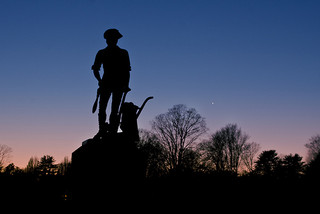
MinuteManStatue_Muffet-Flickr

[photo: Minute Man statue by Muffet via Flickr]

Like Marcy, I find myself pondering today the Declaration of Independence as well as the subsequent system of government set in motion with publication of this influential document.

So much of what our founding fathers protested about the monarchy was the unilateral nature of governance. The signatories quite literally signed their death warrants as they rejected the power of the British crown to govern their lives, so serious were they about the need for self-rule with representation, and oversight to prevent abuses.

Yet here we are, 237 years later, moving toward a unicameral government, witnessing the slow-moving collapse of a democratic republic for which the earliest Americans gave both blood and treasure.

Increasing in number under the last several presidents, the White House has issued classified or secret executive orders and findings—in effect creating law without true oversight by the only body charged with lawmaking, and/or without restraint by the judiciary responsible for ensuring government powers are confined within the limits established by the Constitution.

Congress has failed to adequately exercise its oversight powers to constrain the White House’s execution of laws and and unilateral orders, while permitting departmental employees to lie and misrepresent actions carried out at the orders of the President or subordinate functions.

Congress’s failure to take adequate action with regard to Director of National Intelligence James Clapper’s misrepresentations is but one example. Were the three branches of government truly distinct and acting according their purview, Congress would have demanded an immediate investigation into Clapper’s activities as well as the intelligence functions he oversees, punishing Clapper as appropriate for misleading the people through their representatives.

The judiciary as the third branch has become a rubber stamp function of the plutocracy, set in place by the über-wealthy who co-opted members of Congress with campaign donations, or media sufficient to bully members of Congress to do their bidding. The Court’s composition does not represent the American public, interpreting laws through a perspective shaped and dominated by white male privilege. Read more

Share this entry

Navy v. Egan, not Just Branzburg v. Hayes, Needs Fixed

Today, 340 new journalists will join the 10 or so who have been covering the Bradley Manning prosecution closely for the last several years; his trial starts today at Fort Meade.

Expect to see a bunch of essays on secrecy to mark the beginning of the trial.

This one, in which Steven Coll calls for the Supreme Court to revisit the Branzburg v. Hayes decision that established a spirit but not a law protecting press sources, has already generated a lot of attention.

In the long run, to rebalance the national-security state and to otherwise revitalize American democracy, the United States requires a Supreme Court willing to deepen protections for investigative reporters, as the majority in Branzburg would not.

Among some other minor factual inaccuracies (including what the AP UndieBomb 2.0 leak was originally about), it includes this claim.

[Obama’s] longest-serving advisers are disciplined and insular to a fault; press leaks offend their aesthetic of power.

While I agree Obama’s advisors are insular to a fault, and agree they revel in an aesthetic of power, they do not despise all press leaks. Even aside from the typical policy debate leaks of classified information, the White House has long reveled in “leaking” classified information to selected members of the press, to get the information out there on its own terms. The tactic is not new — it is precisely the A1 cut-out approach the Bush Administration used to get us into the Iraq War. But the Obama Administration may have expanded its use (that is actually the reason Republicans in Congress were demanding investigations of the leaks that followed the AP story, the ones that, unlike the AP, exposed our mole).

Which is why Coll proposes an inadequate solution to what I agree is the key problem.

Obama inherited a bloated national-security state. It contains far too many official secrets and far too many secret-keepers—more than a million people now hold top-secret clearances. Under a thirty-year-old executive order issued by the White House, the intelligence agencies must inform the Justice Department whenever they believe that classified information has been disclosed illegally to the press. These referrals operate on a kind of automatic pilot, and the system is unbalanced. Prosecutors in Justice’s national-security division initially decide on whether to make a criminal case or to defer to the First Amendment. The record shows that in recent years the division has been bent on action.

I’m not opposed to establishing clearer laws about when a journalist’s sources may be protected. But that can be used — as Dick Cheney tried to use it — as a screen for his exposure of Valerie Plame. Protecting journalists’ sources will not only protect real whistleblowers, but it will also protect the system of official leaks that both Bush and Obama have used to accrue power and avoid accountability.

So not only is fixing Branzburg v. Hayes not enough to fix our “unbalanced … bloated national security state,” it doesn’t get at the underlying problem

As a threshold measure, journalists should be calling for the limitation or repeal of the Espionage Act, which is the real stick Obama is using to cut down on unsanctioned leaks. It’s bad enough for whistleblowers to risk losing their clearance, and with it, a well-compensated livelihood. But as soon as you start talking extended prison sentences, as soon as you start accusing whistleblowers of being worse than an enemy’s spy because they shared damning information with the public generally, that’s going to silence unsanctioned leaks.

Just as importantly, this entire structure of abuse of power rests on a different SCOTUS decision, Navy v. Egan, which gives the Executive absolute control over security clearances (and therefore the less powerful leverage usually wielded against whistleblowers, the ability to strip their clearance), but which has been interpreted by Bush and Obama to give the Executive unfettered authority to determine what is secret and what is not. This decision — which is precisely what David Addington told Scooter Libby he could rely on to justify outing Plame on Cheney’s order — is also what the Obama Administration cited when it refused to litigate al-Haramain and in so doing granted the Bush Administration impunity for illegal wiretapping. The Executive’s claim to have unlimited authority to decide what is secret and not is also what prevents the Senate Intelligence Committee from declassifying the torture report on its own authority. It is also the basis for the authority to stall releasing video of US helicopters gunning down a Reuters team to Reuters under FOIA, which led to Manning leaking it to WikiLeaks himself.

The Obama and Bush Administrations have claimed that no one — not Congress, not the Courts — has the authority to review their arbitrary use of secrecy to accrue more power. That claim is an expansive reading of Navy v. Egan, but thus far not one anyone has challenged before SCOTUS. And that is what has enabled them (with the limited exception of the Plame outing) to avoid all consequences for their asymmetric use of leaks.

So, yes, it would be useful if SCOTUS decided that journalists and others engaging in legitimate investigation can protect sources, especially when investigating national security. But until the underlying system — the Executive’s claim that it can abuse secrecy to protect itself — is changed, secrecy will remain a cancer rotting our democracy.

Share this entry

Why Would Jeh Johnson Suggest the Drone and/or Targeted Killing Court Would Be Bipartisan?

I’ll have more to say about Jeh Johnson’s skeptical speech on a drone and/or targeted killing court later.

But I wanted to point to this detail:

Our government finds itself in a lose-lose proposition: it fails to officially confirm many of its counterterrorism successes, and fails to officially confirm, deny or clarify unsubstantiated reports of civilian casualties.

Our government’s good efforts for the safety of the people risks an erosion of support by the people.

It is in this atmosphere that the idea of a national security court as a solution to the problem — an idea that for a long time existed only on the margins of the debate about U.S. counterterrorism policy but is now entertained by more mainstream thinkers such as Senator Diane Feinstein and a man I respect greatly, my former client Robert Gates – has gained momentum.

To be sure, a national security court composed of a bipartisan group of federal judges with life tenure, to approve targeted lethal force, would bring some added levels of credibility, independence and rigor to the process, and those are worthy goals.

In the eyes of the American public, judges are for the most part respected for their independence.

In the eyes of the international community, a practice that is becoming increasingly controversial would be placed on a more credible footing. [my emphasis]

As I understand it, the model under discussion is simply to give the existing FISA Court the additional task of reviewing kill decisions, not creating a new court.Yet the FISA Court — whose judges are appointed by the Chief Justice of the Supreme Court (and therefore, for the entire life of the FISA Court, by a Republican appointee) — is in no way bipartisan.

Read more

Share this entry

18 USC 1119 Foreign Murder and Obama Targeted Kill White Paper

Back in February, when the “White Paper” was first “leaked”, Marcy wrote a fantastic article entitled Article II or AUMF? “A High Level Official” (AKA John Brennan) Says CIA Can Murder You on the issues of Article II authority versus AUMF authority in relation to the Obama targeted killing program. First off, let me say that the the lack of recognition of the presence of both these these respective authorities in the targeted killing program, even among legal commentators I respect greatly, is one of, if not the, most discouraging aspects of the discussion being had. Sadly, the big filibuster by Sen. Rand Paul did not necessarily improve the understanding, and even the New York Times continues to propagate the misdirection and misinformation peddled by the Obama Administration.

I wish to discuss the interaction of the statutory law contained in 18 USC 1119, the “Foreign Murder statute”, with the greater Obama Administration Targeted Killing Program, and the White Paper foundation for it. Specifically I want to point out the circular and disingenuous way in which the White Paper tries to bootstrap itself, and the Administration, around criminal liability for murder in the case of a targeted US citizen such as Anwar Awlaki. Frankly, Marcy let fly with another must read post on 18 USC 1119 and the White Paper yesterday in the wake of the New York Times sop to the Administration, and it filets both the White Paper, and the NYT, open at the seams.

The most important principle to understand about the White Paper’s discussion of 18 USC 1119 is, as Marcy noted, that it is impertinent if the the law of war (formally the “Law of Armed Conflict” or “LOAC”) is truly in play. In short, if the Administration is using the AUMF – military force – in an active battle situation, there is no need for further discussion, whether Mr. Awlaki is a US citizen or not. That, of course is diametrically opposed to what the facts were at the action point with Awlaki, and that we now know.

The truth is the Administration used a civilian agency, the CIA, to kill a US citizen without judicial due process, far from the “hot battlefield” and that is why such a deliberate attempt was made in the White Paper to obfuscate the legal basis for their targeting and killing, and why such a seemingly inordinate time was spent in the White Paper on a traditional criminal law statute, 18 USC 1119.

The statutory language of 18 USC 1119 states:
Read more

Share this entry

Yes, the Government Does Believe the Military Can Use Military Force in the US

I made an error.

In this post, I suggested that debates about whether the 2001 Authorization to Use Military Force constituted an exception to the Posse Comitatus Act ignore that for 7 years — from the time John Yoo wrote a memo on whether the Fourth Amendment inhibited military deployment in the US  in 2001 until the time Steven Bradbury “withdrew” the memo in 2008 — the official position of the Executive Branch was that PCA had been suspended under the AUMF.

Armando Llorens and Adam Serwer have debated — specifically in the context of whether the President could kill Americans within the US – whether PCA applies in this war. And while they’re staging an interesting argument (I think both are engaging the AUMF fallacy and therefore not discussing how a President would most likely kill Americans in the US), what the Yoo memo shows, at the least, is that the folks running the Executive Branch believed, for 7 years, the PCA did not apply.

To be clear, this memo was withdrawn in October 2008 (though not without some pressure from Congress). While the PCA aspect of the opinion is one of the less controversial aspects in the memo, as far as we know it has not been replaced by similar language in another memo. So while this shows that PCA was, for all intents and purposes, suspended for 7 years (as witnessed by NSA’s wiretapping of Americans), it doesn’t mean PCA remains suspended.

My error was in suggesting Bradbury “withdrew” the memo.

He did not.

Instead, Bradbury directed that “caution should be exercised” before relying on it.

The purpose of this memorandum is to advise that caution should be exercised before relying in any respect on the Memorandum for Alberto R. Gonzales, Counsel to the President, and William J. Haynes II, General Counsel, Department of Defense, from John C. Yoo, Deputy Assistant Attorney General, and Robert J. Delahunty, Special Counsel, Office of Legal Counsel, Re: Authority for Use of Military Force to Combat Terrorist Activities Within the United States (Oct. 23, 2001) (“10/23/01 Memorandum”) as a precedent of the Office of Legal Counsel, and that certain propositions stated in the 10/23/01 Memorandum, as described below, should not be treated as authoritative for any purpose.

As noted, he said that five propositions in the Yoo memo should not be treated as authoritative for any purpose.

We also judge it necessary to point out that the 10/23/01 Memorandum states several specific propositions that are either incorrect or highly questionable. The memorandum’s treatment of the following propositions is not satisfactory and should not be treated as authoritative for any purpose:

But then, in a series of bullet points laying out the problems with those five propositions, Bradbury doesn’t always dismiss the outcomes Yoo’s analysis supported, but in several cases accepts the outcomes but simply provides a different basis for supporting them. Read more

Share this entry

Zoe Lofgren Didn’t Vote to Let Presidents Wage Unlimited War, But John Yoo Did

As a series of Presidents continue to claim the September 18, 2001 Authorization to Use Military Force authorizes fairly unlimited power on an unlimited battlefield, I keep coming back to this Tom Daschle op-ed, in which he described how Congress refused to extend the AUMF to US soil.

Just before the Senate acted on this compromise resolution, the White House sought one last change. Literally minutes before the Senate cast its vote, the administration sought to add the words “in the United States and” after “appropriate force” in the agreed-upon text. This last-minute change would have given the president broad authority to exercise expansive powers not just overseas — where we all understood he wanted authority to act — but right here in the United States, potentially against American citizens. I could see no justification for Congress to accede to this extraordinary request for additional authority. I refused.

The op-ed is, as far as I know, the only public statement describing how Congress narrowed a breathtakingly broad claim for military force.

Until Wednesday’s drone hearing, that is.

In response to a comment from John Bellinger that it was appropriate for the Executive Branch to refuse to share its OLC memos with Congress, Zoe Lofgren suggested (1:36 and following) the President was exceeding the terms of the AUMF (she comes very close to saying the President broke the law, but stops herself). She refers to — as Daschle did — negotiations leading up to the AUMF that actually did get passed.

Lofgren: If you take a look at the Authorization to Use Military Force, which all of us voted for — those of us who were here (there was only one no vote in the House) — it says “the President is authorized to use all necessary and appropriate force against those nations, organizations, or persons he determines planned, authorized, committed, or aided the terrorist attacks.” Now, are we to believe that everyone on this list was responsible for the 9/11 attack? I mean, is that the rationale?

Bellinger: No, your exactly right. All four of us agree with you that the 2001 AUMF, which was only about 60 words long — I was involved in drafting it literally almost on the back of an envelope while the World Trade Center was still smoldering — now is very long in the tooth. The good government solution, while extremely difficult and controversial, would be for Congress to work together with the Executive Branch to revise that AUMF. It’s completely unclear about what it covers, who it covers, where it covers.

Lofgren: If I may, I think it’s not as unclear as you suggest. There are — this was a limitation, and there were big arguments about it as you’re, I’m sure, aware, there was a prior draft that was  much more expansive. There was a prior draft that was much more expansive and it was narrowed so we could get bipartisan consensus and it was narrowed for an important reason. And I guess I — yes, the Executive has the ability to keep his legal advice confidential, that’s a long-standing principle, but since it looks like — at least, questions are raised — as to whether the executive is complying with the law, then if he feels he is, then I feel it would be a very positive thing for the Administration to share that legal advice with this committee and with the American people. Read more

Share this entry