CIA Bags O’ Cash Total Tens of Millions of Dollars, But Over $4.5 Billion Left Afghanistan in 2011

Today’s New York Times carries a frank exposure of blatant moves by the CIA to curry favor with Hamid Karzai and high ranking members of Afghanistan’s government through direct cash payments brazenly dropped off at Karzai’s office:

For more than a decade, wads of American dollars packed into suitcases, backpacks and, on occasion, plastic shopping bags have been dropped off every month or so at the offices of Afghanistan’s president — courtesy of the Central Intelligence Agency.

All told, tens of millions of dollars have flowed from the C.I.A. to the office of President Hamid Karzai, according to current and former advisers to the Afghan leader.

Perhaps the most disturbing aspect of these cash payments is that they seem to have been designed in large part to pay off Afghan warlords:

Moreover, there is little evidence that the payments bought the influence the C.I.A. sought. Instead, some American officials said, the cash has fueled corruption and empowered warlords, undermining Washington’s exit strategy from Afghanistan.

And it’s not just any warlords who are being funded by this cash. We learn in the article that the current corruption pay for Rashid Dostum, who committed the largest single war crime in the Afghan war, is now $80,000 per month.

And in the funding of warlords, keep in mind that they form the backbone of David Petraeus’ Afghan Death Squads Local Police under the “direction” of US special operation forces and the CIA. After particularly egregious behavior by one of these groups earlier this year, Karzai first expelled US special forces from Maidan Wardak province and then eventually backed off somewhat on that move. Today’s article suggests that Karzai is trying to play a major role in controlling these groups. Given the main topic of the article, we are left to presume that Karzai’s control is through the allocation of these CIA funds:

Now, Mr. Karzai is seeking control over the Afghan militias raised by the C.I.A. to target operatives of Al Qaeda and insurgent commanders, potentially upending a critical part of the Obama administration’s plans for fighting militants as conventional military forces pull back this year.

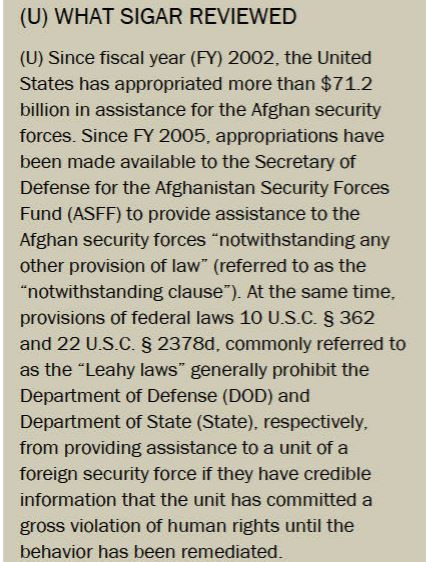
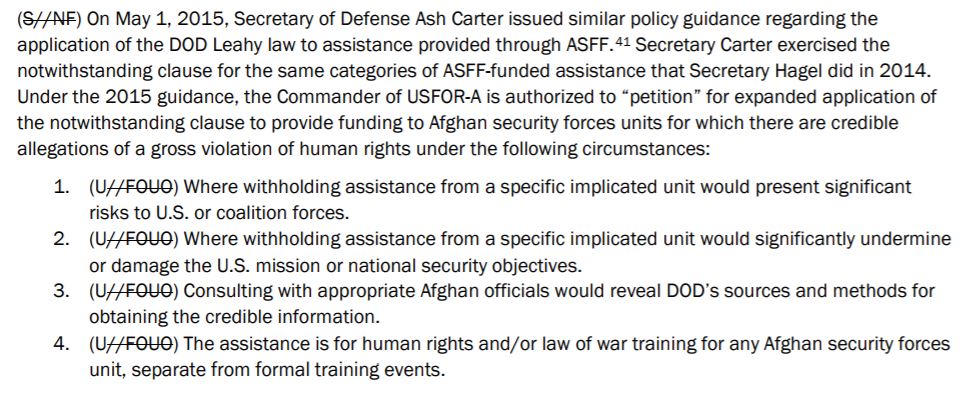
Although an off the books cash influence-buying program that has totaled tens of millions of dollars over the course of a decade sounds like a huge scandal, this is chump change compared to the real theft of US funds in Afghanistan. The Special Inspector General for Afghanistan Reconstruction noted in the January, 2013 report (pdf) that huge sums of cash exit Afghanistan through the Kabul airport:

The U.S. government has long had serious concerns about the flow of cash out of the Kabul International Airport. According to the Congressional Research Service, some $4.5 billion was taken out of Afghanistan in 2011.

Where does all this cash come from? The largest flow of money into Afghanistan of course comes from the US and the biggest program we fund there supports Afghan security forces:

The Congress created the Afghanistan Security Forces Fund (ASFF) to provide the ANSF with equipment, supplies, services, and training, as well as facility and infrastructure repair, renovation, and construction.

Here is a figure from the SIGAR report showing how lavishly the ASFF has been filled with US funds: Continue reading


Feinstein Calls for Review of Her Moratorium on Release of Yemeni Prisoners from Gitmo

Finally sensing that US policy on Yemeni prisoners at Guantanamo is a disaster of epic proportions, and after playing a key role in putting the moratorium on release of Yemeni prisoners into place, Dianne Feinstein on Thursday took the first step toward trying to resolve the crisis before hunger striking prisoners begin to die in large numbers. Feinstein penned a letter to National Security Director Tom Donilon on Thursday, asking for renewed efforts to release those Guantanamo prisoners who have been cleared for release. It is clear that a central step in that process is to review the moratorium on release of cleared Yemeni prisoners.

There is a craven semantics game that is played in the arena of prisoners who have been cleared for release. Government and military officials only ever refer to “detainees” who are cleared for “transfer”, even when those prisoners have been completely cleared of any wrong-doing. Because of that semantics problem, the Guantanamo Review Task Force final report (pdf), issued in January of 2010, provides a muddled description of two groups of Yemeni prisoners who are cleared at various levels for release:

Falling into the category of those who really should be released outright, but classed in the report as “Detainees Approved for Transfer”, we see 29 from Yemen:

29 are from Yemen. In light of the moratorium on transfers of Guantanamo detainees to Yemen announced by the President on January 5, 2010, these detainees cannot be transferred to Yemen at this time. In the meantime, these detainees are eligible to be transferred to third countries capable of imposing appropriate security measures.

A second category of Yemeni detainees cleared for release are those that the government believes still warrant some sort of detention in Yemen. They appear in the category “Detainees Approved for Conditional Detention”:

30 detainees from Yemen were unanimously approved for “conditional” detention based on current security conditions in Yemen.

The status of these prisoners is described further:

After carefully considering the intelligence concerning the security situation in Yemen, and reviewing each detainee on a case-by-case basis, the review participants selected a group of 30 Yemeni detainees who pose a lower threat than the 48 detainees designated for continued detention under the AUMF, but who should not be among the first groups of transfers to Yemen even if the current moratorium on such transfers is lifted.

These 30 detainees were approved for “conditional” detention, meaning that they may be transferred if one of the following conditions is satisfied: (1) the security situation improves in Yemen; (2) an appropriate rehabilitation program becomes available; or (3) an appropriate third-country resettlement option becomes available. Should any of these conditions be satisfied, however, the 29 Yemeni detainees approved for transfer would receive priority for any transfer options over the 30 Yemeni detainees approved for conditional detention.

About that “moratorium” on release of Yemeni prisoners. The review task force report informs us that of 36 Yemeni detainees initially cleared for full release, one was released by court order in September 2009 and another six were released in December 2009. But then the Undie Bomber episode took place on Christmas Day of 2009, and the release of Yemeni prisoners somehow became politically impossible. From the review report: Continue reading


Even as He Joins Tribute to George W. Bush, Obama Capitulates to WMD Fearmongers

Congratulations to Shrub, who today gets his very own (as Jim calls it) Lie Bury.

How appropriate that even as the President who lied us into war with false WMD claims was speaking, the national security establishment was hyperventilating over what some are claiming is “confirmation” that Bashar al-Assad has used chemical weapons.

The reports are based on a letter sent to John McCain and Carl Levin — in response to a request they made 24 hours ago — stating (in part) the following:

Our intelligence community does assess with varying degrees of confidence that the Syrian regime has used chemical weapons on a small scale in Syria, specifically the chemical agent sarin. This assessment is based in part on physiological samples. Our standard of evidence must build on these intelligence assessments as we seek to establish credible and corroborated facts. For example, the chain of custody is not clear, so we cannot confirm how the exposure occurred and in what conditions. We do believe that any use of chemical weapons in Syria would very likely have originated with the Assad regime. Thus far, we believe that the Assad regime maintains custody of these weapons, and has demonstrated a willingness to escalate its horrific use of violence against the Syrian people.

[snip]

Given the stakes involved, and what we have learned from our own recent experience, intelligence assessments alone are not sufficient — only credible and corroborated facts that provide us with some degree of certainty will guide our decision-making, and strengthen our leadership in the international community.

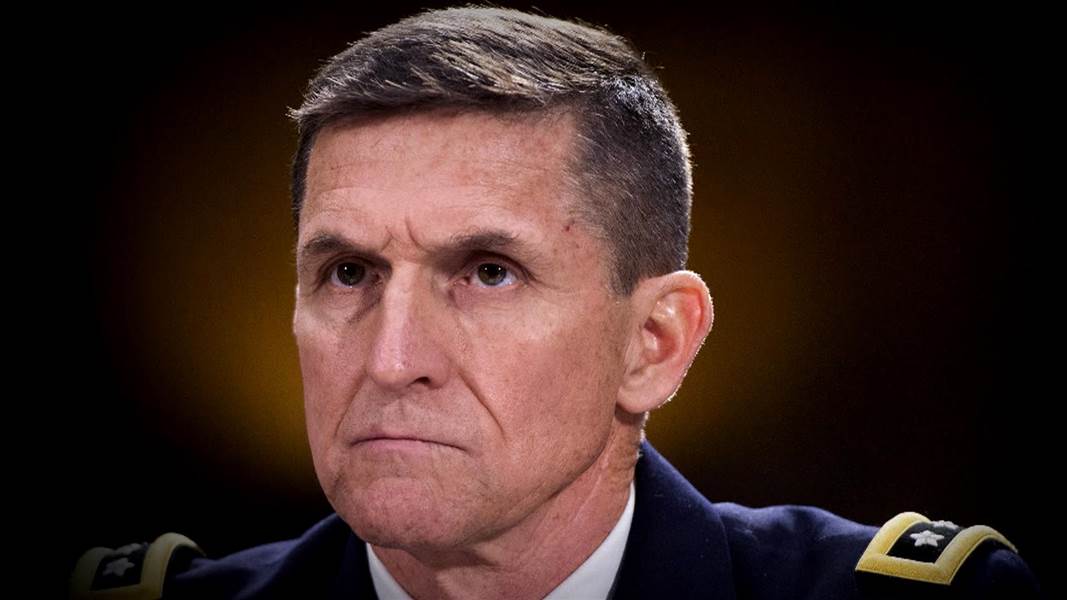
This letter comes a week after, at a Senate Armed Services Committee hearing, Director of National Intelligence James Clapper had suggested whether Syria had used chemical weapons was a policy question, not an intelligence one, and DIA Director Mike Flynn had said (in response to a question about North Korea intelligence) that DIA’s standard for confidence was lower than that of other Intelligence Community Agencies.

The government is saying the following:

  • Some IC members are very confident Assad has used sarin; others are not as confident
  • That judgment is based on physiological evidence (presumably taken from victims), but not “corroborated” by evidence about chain of control
  • That judgment assumes that any chemical weapons used in Syria would come from Assad

And based on that information, McCain and far too many members of the press are saying this “confirms” that Assad used chemical weapons.

Well, if and when we go to war based on WMD this time, Obama will be able to say that Congress was the entity making the most out of carefully caveated intelligence claims, not the President (though John Kerry appears to speaking without nuance).

Update: I’ve changed the headline to try to clarify the relationship between the Bush library ceremony and this release. I’m still not certain I’m happy with it, though, so please let me know if you’ve got suggestions.

Update: Arms Control Wonk’s Jeffrey Lewis commented on this, talking about the implicit shortcomings in the claims above (though with more credibility). In addition, he notes that because we’ve made this a “red line,” it increases the likelihood those who want us to intervene will cross it themselves.

Having set a red line for US involvement to deter Assad, we’ve also created an incentive for certain groups to tell stories that might result in more US assistance.  As I have noted before, these groups don’t appear particularly scrupulous when it comes to the truth.  So, I’d be very, very careful about leaping to conclusions.

And he also observes that even while the evidence might support a claim that someone in Assad’s regime used Sarin, it doesn’t appear to amount to an attack.

Suddenly the constant references to the “small scale” use becomes more clear — we don’t have multiple victims in a single use, as might be expected if the Syrians gassed a military unit or a local community.  At most, we have two events in which only one person was exposed.


For Nobel Peace Prize Winner Obama, Diplomacy Still Afterthought in Afghanistan

The central point argued in Vali Nasr’s book “The Dispensable Nation” is that for the Obama administration, diplomacy took a back seat to the military as the administration took control of the war in Afghanistan from the Bush administration. In fact, the second part of the book’s title is “American Foreign Policy in Retreat”. As the chief aide to Richard Holbrooke, whom Obama chose as his special envoy to Afghanistan and Pakistan, Nasr puts Holbrooke on quite a pedestal in the book, and others have built a bit of a cottage industry around attacking Nasr’s version of events, but I want to concentrate just on the missed opportunity for diplomacy.

Setting aside the arguing over Holbrooke and Nasr, it is clear that Nasr has identified a fatal flaw in Obama’s handling of Afghanistan. Nasr describes a very early opening for negotiations with the Taliban that was squandered:

Around that time, in fall 2009, Holbrooke and I had a meeting with Egypt’s foreign minister. Egypt’s intelligence chief, General Abu Suleiman (who later became vice president when Mubarak fell), was also in the room. At one point he turned to Holbrooke and said, “The Taliban visited us in Cairo.” Holbrooke said, “Really, who came? Do you remember?” Abu Suleiman reached into his bag, pulled out a piece of paper, held it before his face, and read three names. The last one made us all pause. It was Tayed Agha, a relative the Taliban chief, Mulla Omar, as well as his secretary and spokesman, whom we knew to be actively probing talks with the United States on Taliban’s behalf. We knew Tayed Agha to be a player, but we did not know then that he would become America’s main Taliban interlocutor in first secret and later formal talks that began in 2011 (and were made public in February 2012).

Although Holbrooke jumped at the opportunity and presented the case to the Obama administration, they were dismissive of the idea during the critical time that they were developing and then implementing McChrystal’s vaunted surge of troops in Afghanistan. From the Foreign Policy excerpt of the book:

FROM THE OUTSET, Holbrooke argued for political reconciliation as the path out of Afghanistan. But the military thought talk of reconciliation undermined America’s commitment to fully resourced COIN. On his last trip to Afghanistan, in October 2010, Holbrooke pulled aside Petraeus, who by then had replaced McChrystal as commander in Afghanistan, and said, “David, I want to talk to you about reconciliation.” “That’s a 15-second conversation,” Petraeus replied. “No, not now.”

The commanders’ standard response was that they needed two more fighting seasons to soften up the Taliban. They were hoping to change the president’s mind on his July deadline and after that convince him to accept a “slow and shallow” (long and gradual) departure schedule. Their line was that we should fight first and talk later. Holbrooke thought we could talk and fight. Reconciliation should be the ultimate goal, and fighting the means to facilitate it.

The Obama administration did its utmost to undermine Holbrooke’s efforts on the diplomatic front during this time: Continue reading


Senate Armed Services Committee Enters Fantasyland in Hearing on Afghanistan Withdrawal

Yesterday, while much of the world’s attention was focused on emerging details relating to the Boston Marathon bombings on Monday (along with a tiny bit of attention on the Constitution Center’s report on torture that Marcy was banned from improving), the Senate Armed Services Committee held a hearing on the withdrawal of troops from Afghanistan. This was the first hearing for new ISAF Commander General Joseph Dunford since he was confirmed.

I was only able to watch the first half of the hearing as it unfolded, but my overwhelming impression was that the committee felt it could put words into Dunford’s mouth. He mostly went along with that although at one point he finally did get fed up with John McCain speaking for him and pushed back a bit.

Completely missing in the hearing (at least in the part I was able to watch) was any perspective on the real controlling factor on whether the US leaves any troops in Afghanistan after the planned “end of combat operations” set for the end of 2014. The precedent of the Iraq full withdrawal once Iraq refused to grant criminal immunity to any US troops remaining there demonstrates that the Obama administration views criminal immunity as a controlling prerequisite for whether we will leave troops in Afghanistan. To that end, then, negotiation of a Status of Forces Agreement, or SOFA, is the most important step in determining whether we will keep troops in Afghanistan past 2014 and how many there will be.

Despite all the feel-good talk from the Defense Department and Capitol Hill, it seems very unlikely that Afghanistan will agree to grant immunity to US troops. However, an idea was floated by NATO back in February that I viewed as a very thinly veiled offer of an additional $22 billion dollars for Afghan officials to embezzle in return for a grant of immunity. The proposal was in the form of suggesting that NATO (primarily the US) would provide financial support for Afghanistan to maintain its Afghan National Security Force at 352,000 (a number that is more myth than reality) through the end of 2018 rather than reducing the force size by about a third once we leave.

Committee Chair Carl Levin opened the hearing by endorsing this purchase of a $22 billion SOFA. From his transcript of his opening statement:

It is in everyone’s interest to promptly set the conditions for any post-2014 partnership with Afghanistan.  NATO defense ministers have already begun consideration of the size and mission for a post-2014 force in Afghanistan.  One factor that will influence that decision is the size and capacity of the Afghan security forces.  In this regard, the recent decision by NATO defense ministers to support maintaining the Afghan security forces at the current 352,000 level through 2018, rather than reducing the support to a level of 230,000 as previously planned, sends an important signal of our continued commitment to a safe and secure Afghanistan, and may make it feasible for us to have a smaller U.S. and coalition presence after 2014.

Jim Inhofe’s opening statement was a magnificent exercise in ignorance and obfuscation. He chastised Obama for his “precipitous withdrawal” from Iraq and never acknowledged the lack of criminal immunity as the reason for the full and rapid withdrawal. Is there any doubt that if the US had left troops in Iraq without immunity that Inhofe would have been among the first to criticize Obama for leaving them there under those conditions once the first soldier was arrested?

The Tulsa World covered his statement: Continue reading


Afghanistan Confirms Eleven Children Killed in April 6 NATO Air Strike

Partial screen-grab of the Khaama Press article confirming eleven children were killed in the April 6 NATO air strike in Kunar province. Various reports of the strike include this image as well as other photos taken from slightly different angles of the same group of victims.

Partial screen-grab of the Khaama Press article confirming eleven children were killed in the April 6 NATO air strike in Kunar province. Various reports of the strike include this image as well as other photos taken from slightly different angles of the same group of victims.

Khaama Press reports today that a group of investigators appointed by the Afghan government has confirmed that eleven children were killed on Saturday in a NATO air strike in Kunar Province. Although several press reports indicate that NATO has said that it is investigating the strike, I can find no word on the Defense Department or ISAF websites mentioning this strike. The absence of any report from NATO is puzzling, since their site provides near-daily accounts of actions under the heading of “Joint Command Operational Update”.

Here is how Khaama Press relates the confirmation of the deaths:

Head of the Afghan delegation appointed by Afghan president Hamid Karzai to probe NATO airstrike in eastern Kunar province of Afghanistan confirmed at least 11 children and 4 women were killed during raid.

The delegation also added that at least 25 people had suffered casualties during the air raid in this province.

The airstrike was carried out during a joint military operation conducted by Afghan and coalition security forces in Shegal district of eastern Kunar province three days.

The delegation met with the families of the victims after being appointed by president Hamid Karzai.

Two very important details about the strike come in the final paragraph:

At least 7 Taliban militants were also killed during the airstrike, the delegation confirmed adding that 4 residential houses were damaged during the airstrike.

The details that Taliban militants were killed and that more than one house was damaged are important because of the other information that has come out regarding the incident.

The day after the strike, the Washington Post carried an AP article about it. Near the end of the article, AP relayed information that came from a local official:

Afghan officials said the airstrike occurred after a joint U.S.-Afghan force faced hours of heavy gunfire from militants. The joint force was conducting an operation targeting a senior Taliban leader that began around midnight Friday in the Shultan area of Kunar’s Shigal district, according to tribal elder Gul Pasha, who also is the chief of the local council.

The remote area is one of the main points of entry for Taliban and other insurgents trying to move across the mountainous border from neighboring Pakistan, where they enjoy refuge in the lawless northwestern area.

“In the morning after sunrise, planes appeared in the sky and airstrikes started,” Pasha said in a telephone interview, adding that the fighting didn’t end until the evening.

“I don’t think that they knew that all these children and women were in the house because they were under attack from the house and they were shooting at the house,” he said.

There were slightly differing accounts of the death toll.

Pasha said the main Taliban suspect was in the house that was hit and was killed along with a woman and the children, ages 1 to 12, who were members of the suspect’s family.

So Pasha is claiming that the children all belonged to the main Taliban suspect and were in the same house where he was located. That is very interesting considering that in an article published April 8 that also mentioned this attack, Khaama Press featured a government condemnation of the use of civilians as human shields: Continue reading


Navy Releases Cartoon of New Laser Weapon After Non-Productive P5+1 Talks

Yesterday saw several developments in response to the P5+1 talks with Iran ending over the weekend with no new date announced for the next round of talks. AP launched into a discussion of Congress enacting even more sanctions against Iran, although considerable gyrations are needed to identify just what else we could possibly limit after already enacting new sanctions four times since 2010. There also was very little consideration of the damage already done to Iranian citizens. In addition, the video above appeared in articles yesterday for both Wired’s Danger Room and the New York Times announcing a new laser weapon. The laser is said to be able to shoot down drones and to pierce light watercraft, and so it will be deployed in the Persian Gulf. But not until 2014. Maybe that extra time will allow the US to make sure the Filipino Monkey can’t cause any mischief when the weapon is deployed. I’m guessing that the Times is onto something with their observation that the “Pentagon has a long history of grossly inflating claims for its experimental weapons”, especially since the Pentagon’s video, while over three and a half minutes long, has only about a minute and fifteen seconds of real-life footage, with the rest consisting of computer animation. Even Iran’s Fars News has read the accompanying report linked in the Times article where we learn of the limitation of laser weapons:

The laser does, however, have its drawbacks.

Testing has revealed it is disrupted by bad weather: Rain and clouds can scatter the beam, as can smoke, sand and dust.

In addition, due to the nature of the laser beam, these weapons are necessarily “line of sight” weapons, meaning they cannot attack targets that are beyond the horizon in the way that ballistic missiles can. Also, the report points out the issue of “blooming” where the laser beam heats up the surrounding air, making targeting difficult for an object coming straight at the weapon. A bit of what could well be that effect is seen in the live action video, where the path of the laser beam as it hits the target becomes visible just as the target is beginning to burn.

The release of an “official” video announcing the weapon, but relying so extensively on computer animation brings to mind the ridiculous cartoon that George Jahn published during previous discussions of the disputed Parchin complex and Benjamin Netanyahu’s bomb cartoon he used at the UN. When trying to convince the world of the effectiveness of a weapon of ours or the danger of a technology held by an adversary, reliance on cartoons does not instill a high degree of confidence in those who are evaluating the argument.

Today, Iran observed their National Day of Nuclear Technology which commemorates their announcement in 2006 of “completing the nuclear fuel production cycle at laboratory scale”. Iran discussed both the development of new radiomedicines and expansion of uranium mining, but Reuters found only the uranium mining to be worth mentioning. That’s okay, though. It’s not like there is a history of bad things going on when discussing yellowcake and foreign WMD. Oh. Wait.


Washington Post Tries to Ram Petraeus Down Our Throats Again

No. In the name of God, Thor, Zeuss, Cthulhu and the Flying Spaghetti Monster, no. There are few people who personify the vapid, amoral fetid swamp of Washington politics and defense policy more than David Petraeus. Taking a huge part of the blame for propelling Petraeus from a solely military into an entirely political career is the Washington Post, which gave Petraeus a prime op-ed slot in September 2004, where he spewed wildly optimistic numbers on his accomplishments while training Iraqi troops. Petraeus further told us how victory was just around the corner, implying that if only Americans would re-elect George W. Bush, his plan would achieve full fruition. Active military personnel are not supposed to engage in politics, but Petraeus became political with that op-ed and Washington overlooked it, because that’s what Washington does and that’s what the Washington Post does.

Bush rewarded Petraeus for his role in the election by putting him in charge of US troops in Iraq. Petraeus didn’t impress his immediate superior, Admiral Fallon, who termed Petraeus an “ass-kissing little chickenshit” after their first meeting. Once in charge, Petraeus quickly established death squads. Things didn’t go all that well in Iraq, in part because everything Petraeus does fails miserably while he is busy explaining to us what a good job he is doing. By 2007, the Kagan brain-trust came up with the idea of the surge to “save” Iraq. Washington politics and defense policy prostitute Michael O’Hanlon was brought onto the job of helping to sell the surge. In the fall of 2007, an orchestrated  Washington event, complete with a sideshow purchased in the New York Times for the “General Betrayus” ad, gave us Congressional hearings that resulted in approval for the surge. Completely overlooked at that time was the inconvenient fact that a major part of the Iraq plan moving forward from that point involved a total restart of training Iraqi troops because Petraeus failed spectacularly in his previous attempt at training. But Washington and the Washington Post did not call out Petraeus for that failure, because that’s what Washington and the Washington Post do.

Petraeus was next promoted by Bush in late 2008 to Fallon’s previous position in charge of CentCom.  It was quite clear to Barack Obama once he took office that Petraeus had his sights set on becoming president, so Obama made a very interesting move when he sent Petraeus down in rank to take command in Afghanistan after Petraeus’ protege Stanley McChrystal was fired for insubordination in July of 2010. Because lying about training had worked in advancing his career in Iraq, it appears that fudging the numbers on ANSF capabilities was one of the first things Petraeus did once in charge in Afghanistan. He was caught in this by the GAO, who pointed out that criteria for ANSF readiness were being changed to increase the number of troops qualifying for the most advanced classification, but it appears that only SIGAR and I care about those lies. Washington and the Washington Post ignored those dishonest moves by Petraeus, because that’s what Washington and the Washington Post do.

After Petreaus had been in charge in Afghanistan for six months or so, political handlers stepped into the picture to try to burnish his image for a future run for president. Continue reading


Nation Building with Special Forces

Nada Bakos tees up Jackson Diehl’s failed Iraq justification to fail again in Syria post and points out something very basic. Military intervention does not equate with nation-building.

It would be a plausible argument if Diehl had not clearly missed many of the most basic lessons of the Iraq War. For example, he writes that “in the absence of U.S. intervention, Syria is looking like it could produce a much worse humanitarian disaster and a far more serious strategic reverse for the United States.” It is certainly true that Syria is a humanitarian disaster on a regional scale, and that the lack of a clear strategy by the United States for the past two years has limited our ability to shape the nature and trajectory of the conflict today. But the phrase “in the absence of U.S. intervention” suggests a degree of American agency that Iraq showed we simply don’t possess.

Military intervention by the United States cannot spawn democratic governments at will, and it cannot save the local population from violence and chaos. “Shock and awe” do not automatically lead to nation-building or even to regime change without a considerable commitment. To realize those objectives, you need to engage in a clearly articulated strategy of nation-building — a strategy that must encompass the State Department; regional actors such as Turkey, Jordan, and Lebanon (some of which are grappling with their own internal issues); and international, regional, and local non-governmental organizations.

[snip]

The argument that unleashing the U.S. military industrial complex can bring about desired results during a conflict should have been deflated, beaten, and buried by now. The winner of the Iraq War was humility, and it is a prerequisite for a wiser foreign policy.

Bakos’ retort is useful not just for those hawks who want more hot war in Syria, but also against plans to use the Special Forces as our primary tool against the scourge of instability, as promised in this NYT piece today …

Army Special Operations forces can be out there looking at instability, and looking at how to build capabilities.”

General Cleveland said he envisioned preparing his soldiers for two broad missions. “When I am at war, I have to campaign to win,” he said. “When I am not at war, I am campaigning to either shape the environment or I am campaigning to prevent war.”

And even more explicitly in this David Ignatius piece from last week.

The underlying idea is that special forces have proved themselves America’s best weapon against extremists in a turbulent, increasingly borderless world. After the grinding wars in Iraq and Afghanistan, the United States won’t be sending big expeditionary armies abroad anytime soon. America’s heavyweight commands, such as U.S. Central Command in the Middle East and U.S. Pacific Command in Asia, will now focus on potentially adversarial nations such as Iran, China and North Korea.

To fight the small wars, McRaven offers his agile, stealthy and highly lethal network of commandos. Often their missions will involve training and partnering with other nations, rather than shooting. Sometimes, their activities may look like USAID development assistance or CIA political action.

Here’s the logic: Our existing means of exerting influence and building nations aren’t all that effective, so we must have SOF take over those roles.

The existing tool kit hasn’t been very effective: USAID is more of a development contractor than an operational agency; the State Department’s Bureau of Conflict and Stabilization Operations is too small to lead even its own department’s efforts, let alone the government’s; the U.S. Institute of Peace likes its status as an independent adviser, rather than an instrument of national power. And the CIA wants to do less covert action, not more.

Enter the Special Operations Forces.

Ignatius doesn’t apparently consider what Micah Zenko tweeted while watching a Chuck Hagel press conference and DOD cutbacks.

Pentagon will receive $633B this year. State+USAID: $51B. Internal DOD reforms don’t change the USG-wide imbalance.

You’d think someone (besides Zenko) would figure out that turning SOF warriors into development specialists would look at this math and propose more obvious solutions first.

Continue reading


Posted in War

Yet Another Taliban Attack Using Afghan National Army Uniforms

At the height of the green on blue killing outbreak, one aspect that stood out was that the attackers often had access to Afghan military and police uniforms whether they were actual members of these groups or not. As the Taliban shift their targets this year to attacking the Afghan military and government, it appears that the tactic of attackers disguising themselves in official uniforms is continuing. Today, there was a major attack on a court complex (and a nearby bank office) where Taliban attackers were wearing Afghan National Army Uniforms.

From the New York Times:

A group of eight Taliban insurgents dressed in Afghan Army uniforms staged a complex assault on a provincial government compound in Western Afghanistan on Wednesday morning, killing at least six officials and civilians and seizing several hostages in one of the buildings, officials and witnesses said.

/snip/

Officials said that the violence in Farah began after insurgents detonated a Ford Ranger laden with explosives near the entrance of the government compound. Government officials said the Taliban seized the second floor of the provincial court building, which is near the offices of the mayor, prosecutor and the governor, among other officials.

In addition to the at least six people killed in the attack, roughly 75 others were wounded, including women and children, according to hospital officials. Shah Mohammad Noor, head of the regional Court for western Afghanistan, said four of the attackers had been killed so far.

“The firefight is still ongoing,” said Mohammad Akram Khpalwak, the governor of Farah province. “The terrorists are still resisting.”

We learn from Reuters that the timing of the attack was not random, as the court proceedings going on at the time were specifically targeted:

Five militants stormed a court in Afghanistan on Wednesday where Taliban insurgents were standing trial, killing seven people and wounding 75, officials said.

At least one of the attackers blew himself up and a gun battle between Afghan security forces and an insurgent holed up inside the court was going on in the capital of the western province of Farah, near the Iranian border, said provincial deputy governor Mohammad Younis Rasouli.

“They stormed the court as a trial was being held to convict 10 Taliban fighters,” he told Reuters, adding that four civilians and three members of the security forces were killed.

The Taliban claimed responsibility for the attack in a text message to media, spokesman Qari Yousuf Ahmadi said, adding that the insurgents standing trial had been freed in the attack.

I suppose there could be a language or translation issue here, but the matter of fact statement that the “trial was being held to convict 10 Taliban fighters” kind of stands out here as not quite in line with the usual concept of a criminal court proceeding. The willingness of a Taliban spokesman to attach his name to a text claiming credit for the attack while it was still onging is also pretty stunning in its own right.

ToloNews adds that a bank was targeted along with the courthouse:

Several gunmen have launched a coordinated attack on a court building and a private bank branch in western Farah province, killing at least six people and wounding more than 70 others on Wednesday morning, officials said.

/snip/

Two gunmen, wearing Afghan National Army’s uniform, entered the primary court building and two others managed their way into the provincial branch of New Kabul Bank.

Extra forces have been deployed to gun-down the insurgents.

And AFP (via Dawn) informs us that the Taliban were so open in taking credit for the attack that they even posted it on their website:

Taliban militants fighting the US-backed central government immediately claimed they were behind the attack.

“Our fighters attacked several government buildings in Farah according to their planned tactic. They conducted the attack with small arms and grenades,” the group said on its website.

The battle for the hearts and minds of the Afghan public now appears to be between the Afghan government and the Taliban with the US (and NATO) in the process of becoming more spectators than participants.