Our Trade Pact Partners–Colombia and Panama–and Multinational Hezbollah Plots

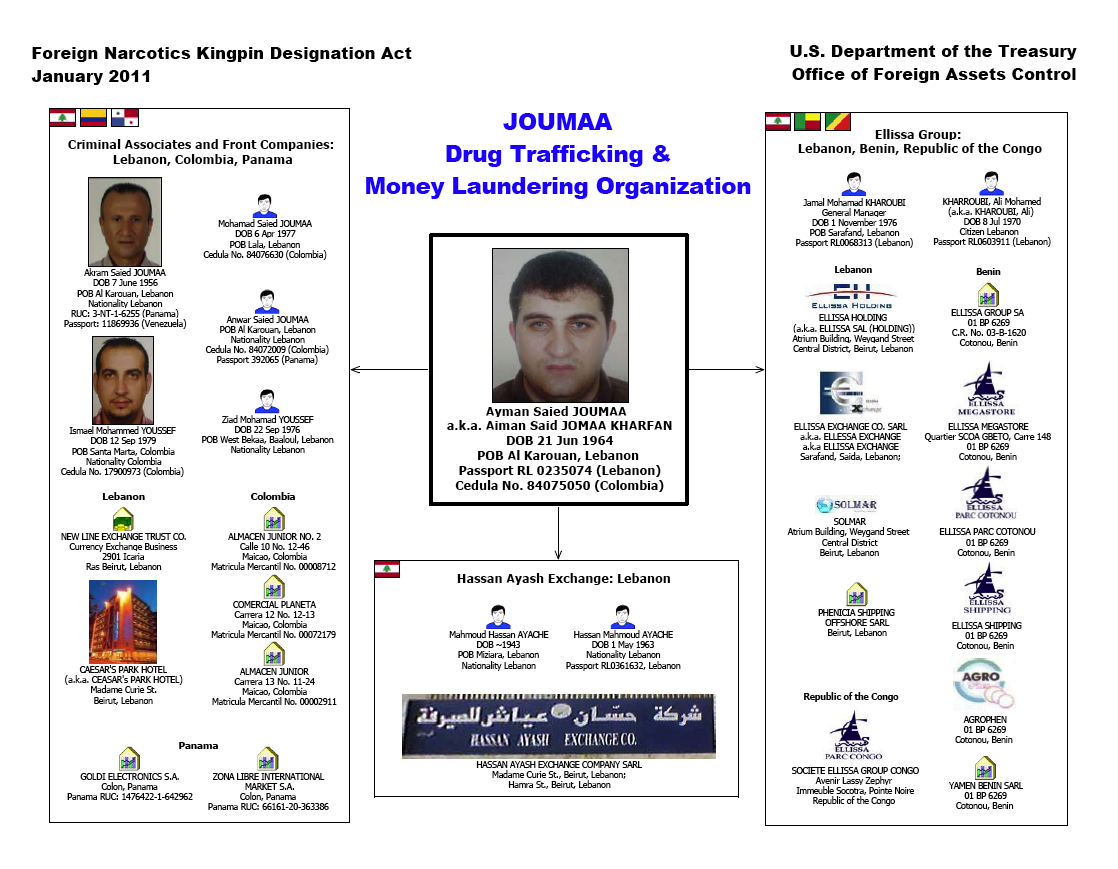
The government continues to crack down on Ayman Joumaa’s Hezbollah-tied money laundering ring, yesterday suing some exchange companies and the auto dealers tied the ring.

The announcement reads like a Bush Axis of Evil speech, emphasizing the role of Hezbollah even though just “tens of millions” of the hundreds of millions involved went via one channel to Hezbollah.

A network of money couriers controlled by Oussama Salhab, an alleged Hizballah operative living in Togo, transported tens of millions of dollars and Euros from Benin to Lebanon through Togo and Ghana.

And another of the key players is actually a Christian group, albeit one closely tied to Hezbollah.

Another drug trafficking organization, which is led by Maroun Saade, is also involved in the transportation and distribution of large quantities of narcotics in West Africa. Saade is a member of the Free Patriotic Movement, a Lebanese Christian organization closely allied with Hizballah, and has provided extensive services to Hizballah members engaged in narcotics trafficking and bulk cash smuggling in West Africa.

And the geography the government paints has the same focus: Lebanon, Benin, and–in their larger claims–Iran and Venezuela.

Funny. They seem to be de-emphasizing two other countries that are–according to the Treasury Department–central to Joumaa’s network: Colombia, where all the drugs derive from, and Panama. Not only does Joumaa have two locations in Panama and three in Colombia, but he and several of his alleged network members carry Colombian or Panamanian ID (one also has a Venezuelan passport).

You know? Two of the three countries we signed trade agreements with this year, between the time Treasury first started cracking down on this network and now? Panama, which opponents of the trade deals noted would probably serve as a vehicle for financial entities to launder money?

Now, I look forward to seeing more of the network–particularly whether this is a drug cartel using the services of a terrorist organization (as it seems) or a(nother) terrorist organization getting into the drugs business. Not to mention whether Manssor Arbabsiar had ties to the auto dealer plot (though he doesn’t appear in the list of 30 sanctioned dealers).

But while you’re watching, it’s worth keeping in mind that the US just strengthened its alliance with two of the key countries involved in this network.

Share this entry

How to Indefinitely Detain Jamie Dimon

Kagro X and I were engaging in a little thought experiment on Twitter to show how easy it would be to solve our dangerous bankster problem by indefinitely detaining them.

It turned out to be pretty easy to do. Here’s how.

First, before you indefinitely detain a bankster, you need to show either that he is,

A person who was part of or substantially supported al-Qaeda, the Taliban, or associated forces that are engaged in hostilities against the United States or its coalition partners, including any person who has committed a belligerent act or who has supported such hostilities in aid of such enemy forces.

Or, you need to show he has supported (using the Iraq AUMF that we’re keeping around to make sure the President’s authority isn’t limited to just al Qaeda),

another international terrorist group that the President has determined both (a) is in armed conflict with the United States and (b) poses a threat of hostile actions within the United States;

Now, making that case with Jamie Dimon is very easy to do, because his company, JP Morgan Chase, has materially helped Iran. We have several pieces of proof it has done so. First, there’s the Treasury Report showing that JPMC:

  • Gave a $2.9 million loan on December 22, 2009 to the Islamic Republic of Iran Shipping Lines, which the Office of Foreign Assets Control has found to be involved in WMD proliferation
  • Advised and confirmed a $2,707,432 letter of credit on April 24, 2009, in which the underlying transaction involved a vessel identified by OFAC as blocked due to its affiliation with the same Iranian shipping line
  • Processed nine wire transfers between April 27, 2006 and November 28, 2008, which totaled $609,308, some of which involved sanctioned Iranian and terrorist entities
  • Transferred 32,000 ounces of gold bullion valued at approximately $20,560,000 to benefit a sanctioned Iranian bank on May 24, 2006

We need no further proof that JPMC has done these things. Not only has JPMC admitted to them, but as Janice Rogers Brown has made clear, we cannot question the Executive Branch’s intelligence reports, so all of OFAC’s claims must be accepted as true for the purposes of indefinite detention. And all of that illegal support for Iran happened while Jamie Dimon was President of JPMC.

But there may even be proof–enough, anyway, to satisfy Rogers Brown–that JPMC materially supported an attempt to deploy a WMD in a terrorist attack on American soil. As I have shown, the bank account to which Manssor Arbabsiar transferred almost $100,000 as downpayment for the alleged Quds Force plot to assassinate Saudi Ambassador Adel al-Jubeir was probably a Chase account. And that affidavit should be enough. The FBI, after all, is an intelligence agency. And Janice Rogers Brown does not find redactions–even much more extensive ones–to in any way impair the reliability of Administration claims to justify indefinite detention.

In other words, the Administration has provided sufficient proof that JPMC materially supported Iran to the tune of at least $23 million in illegal financial transactions.

Now, if Chase is indeed the bank that accepted the downpayment for the Scary Iran Plot, we need no further basis to indefinitely detain Jamie Dimon. After all, the government’s Amended Complaint (from the FBI, an intelligence agency whose reports we cannot question) asserts that Abdul Reza Shahlai was the mastermind behind the Scary Iran Plot, and at the time of the plot, he had already been sanctioned as a supporter of the insurgency in Iraq. That was based on a questionable intelligence report, admittedly, but Janice Rogers Brown says we cannot consider such problems. So if Chase did, indeed, play a role in the Scary Iran Plot, then that’s all we need to indefinitely detain Jamie Dimon as head of the entity that materially supported that terrorist attack.

But even if Chase wasn’t involved in the Scary Iran Plot, the Executive Branch can still indefinitely detain Jamie Dimon. After all, the Executive Branch has been claiming that Iran was harboring al Qaeda since 2003. In addition, an official Executive Branch report–a September 12, 2009 diplomatic cable–includes the following hearsay claim, made by Saudi Arabia’s then Minister of the Interior, now the Crown Prince, Nayif bin Abdulaziz:

Iran has hosted Saudis (all Sunnis) — including Osama bin Laden’s son Ibrahim — who had contacts with terrorists and worked against [Saudi Arabia]

And Janice Rogers Brown has said that so long as it appears in an official government document, any hearsay problem is overcome. And as recent reporting makes clear, there’s even some evidence that Iran was at least aware of, and in some ways facilitated, the 9/11 plot itself. That assertion is based on NSA reports which, as official government documents, would meet Rogers Brown’s standard for claims supporting indefinite detention.

All of which would seem to reach the bar of making Iran a force associated with al Qaeda. I don’t necessarily buy these reports, mind you, but again, it’s not for me to question these official government records. And helping such an associated force access $23 million of funding sure seems to qualify as “substantial support.”

Now let me be clear. I don’t advocate indefinitely detaining Jamie Dimon–or anyone else either, particularly not American citizens, no matter how loathsome or dangerous to the United States. But given that our country maintains it is more important to “incapacitate” terrorists and those who support them than to punish those who did trillions of dollars of damage to our economy, we may well have to treat Jamie Dimon as a material supporter of terrorism to get some justice.

And Jamie? If I were you I would report to an Embassy or some other official government office right away, as the government claims Anwar al-Awlaki should have. Because while Obama seems uninterested in indefinitely detaining American citizens, he has been known to kill those he claimed were particularly dangerous.

Share this entry

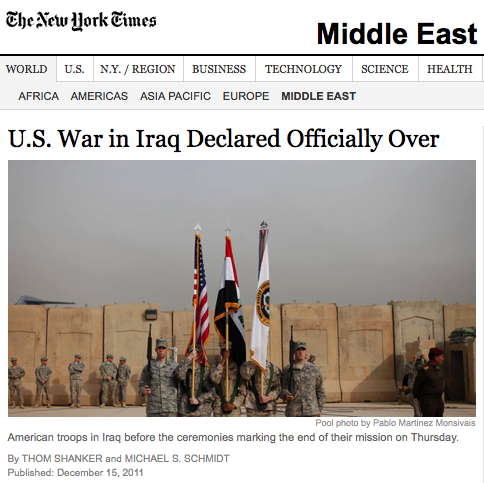
No, the Iraq War Is NOT Over

The NYT, which played a key propaganda role in getting us into the Iraq war, has a 1000-word article telling us the Iraq war has officially been declared over.

And while it is true that the Administration had a campaign event dog and pony show yesterday declaring the war over, it is not.

After all, Rand Paul tried to formally, legally end the Iraq war last month. And 67 Senators refused to do so.

The fact that the Iraq AUMF remains on the books matters. It matters because no matter how many times we wax eloquent about Iraqis controlling their own destiny, Nuri al-Maliki knows that little prevents Obama from bringing in troops again–or dropping drones in his country. Maybe that’s why Maliki is doing unfathomable things like laying a wreath at the military cemetery of the country that has occupied and ravaged his country for 8 years.

And, as I keep noting, the Iraq AUMF serves another purpose. That AUMF’s general language on “terrorism” has been used to authorize the use of “war powers” against people the Executive Branch claims are terrorists who have nothing to do with al Qaeda. The Iraq AUMF has been interpreted by the Executive Branch to authorize a war against all so-called terrorists, not just the terrorists who hit us on 9/11. And based on that argument, it was used to authorize the wiretapping of American citizens in the US.

Credulous journalists may want to accept the Administration’s propaganda about the Iraq war ending. But until we take the expanded powers given to the President pursuant to a vile propaganda campaign away from him, the Iraq war is not over. And Obama should not be able to use it as a campaign line until he actually gives up those powers.

Share this entry

Did Dianne Feinstein’s “Fix” on AUMF Language Actually Authorize Killing American Citizens?

To explain why it caved on its Defense Authorization veto threat, the Obama Administration had the following to say about the affirmation of detention authority.

Ensuring that we track current law and minimize risks associated with legislating on AUMF:

Made our requested modifications to the provision that codifies military detention authority under the September 2001 Authorization for Use of Military Force.  Though this provision remains unnecessary, the changes ensure that we are merely restating our existing legal authorities and minimize the risk of unnecessary and distracting litigation.

That is, the Administration says its past complaints about the AUMF language have been addressed.

On November 17, when Obama issued his veto threat, the AUMF language said:

Congress affirms that the authority of the President to use all necessary and appropriate force pursuant to the Authorization for Use of Military Force (Public Law 107-40) includes the authority for the Armed Forces of the United States to detain covered persons (as defined in subsection (b)) pending disposition under the law of war.

COVERED PERSONS–A covered person under this section is any person as follows:

(1) A person who planned, authorized, committed, or aided the terrorist attacks that occurred on September 11, 2001, or harbored those responsible for those attacks.

(2) A person who was part of or substantially supported al-Qaeda, the Taliban, or associated forces that are engaged in hostilities against the United States or its coalition partners, including any person who has committed a belligerent act or who has supported such hostilities in aid of such enemy forces.

[snip]

(d) CONSTRUCTION.–. Nothing in this section is intended to limit or expand the authority of the President or the scope of the Authorization for Use of Military Force.

The language of the conference bill Obama says he won’t veto says:

Congress affirms that the authority of the President to use all necessary and appropriate force pursuant to the Authorization for Use of Military Force (Public Law 107-40) includes the authority for the Armed Forces of the United States to detain covered persons (as defined in subsection (b)) pending disposition under the law of war.

COVERED PERSONS–A covered person under this section is any person as follows:

(1) A person who planned, authorized, committed, or aided the terrorist attacks that occurred on September 11, 2001, or harbored those responsible for those attacks.

(2) A person who was part of or substantially supported al-Qaeda, the Taliban, or associated forces that are engaged in hostilities against the United States or its coalition partners, including any person who has committed a belligerent act or who has supported such hostilities in aid of such enemy forces.

[snip]

(d) CONSTRUCTION.–. Nothing in this section is intended to limit or expand the authority of the President or the scope of the Authorization for Use of Military Force.

If you haven’t figured it out, the specific language relating to the terms of the AUMF remains precisely the same.

In other words, Congress made no substantive changes to the AUMF language between the time the Administration issued its veto threat and the time it withdrew the threat.

And yet, when Obama issued his veto threat, he had this complaint about it.

Section 1031 attempts to expressly codify the detention authority that exists under the Authorization for Use of Military Force (Public Law 107-40) (the “AUMF”).  The authorities granted by the AUMF, including the detention authority, are essential to our ability to protect the American people from the threat posed by al-Qa’ida and its associated forces, and have enabled us to confront the full range of threats this country faces from those organizations and individuals.  Because the authorities codified in this section already exist, the Administration does not believe codification is necessary and poses some risk.  After a decade of settled jurisprudence on detention authority, Congress must be careful not to open a whole new series of legal questions that will distract from our efforts to protect the country.  While the current language minimizes many of those risks, future legislative action must ensure that the codification in statute of express military detention authority does not carry unintended consequences that could compromise our ability to protect the American people.

There are two explanations for why Obama backed off his veto threat on this point, then. First, we know the Administration did make a request regarding the language in the AUMF clause, though before it issued its veto threat.

As I reported last month, the big change between the original language and the Senate bill in this clause was the removal of the language exempting US citizens from indefinite detention. And that was a change made at the request of the Administration.

The initial bill reported by the committee included language expressly precluding “the detention of citizens or lawful resident aliens of the United States on the basis of conduct taking place within the United States, except to the extent permitted by the Constitution of the United States.”  The Administration asked that this language be removed from the bill. [my emphasis]

So maybe Obama backed off his veto threat because the final bill didn’t specifically exempt Americans from indefinite detention.

There’s the one other change made to this section between Obama’s veto threat and and his retraction of that threat today. DiFi’s cop-out language:

(e) AUTHORITIES–Nothing in this section shall be constructed to affect existing law or authorities relating to the detention of United States citizens, lawful resident aliens of the United States, or any other persons who are captured or arrested in the United States.

The only thing that changed between Obama’s veto threat and his retraction of his threat–though it was depicted as a sop to civil libertarians worried about indefinite detention–is DiFi’s language.

And while DiFi’s amendment seems somewhat duplicative of the “CONSTRUCTION” language–reiterating Obama’s authority under the Afghan AUMF–it is actually more than that. To some degree, it accomplishes the same thing Mark Udall’s wrong-headed amendment did: not only reaffirm the President’s authority under the Afghan AUMF, but also the Iraq AUMF and “any other statutory or constitutional authority” regarding detention.

(2) The Authorization for Use of Military Force Against Iraq Resolution 2002 (Public Law 107-243).

(3) Any other statutory or constitutional authority for use of military force.

As I’ve noted, the Iraq AUMF has served to generalize Presidential claims to war powers against terrorists who have no ties to al Qaeda since at least 2004.

And while the Afghan AUMF and Hamdi and Quirin were–according to Charlie Savage–the primary bases claimed for the Administration’s authority to kill Anwar al-Awlaki (in spite of the fact that AQAP did not exist, and therefore should not really be included in, the 2001 AUMF), the Administration also relied on two SCOTUS cases approving of the use of “deadly force” to prevent the escape of even unarmed suspects who might pose a “significant threat of death or serious physical injury” to others (even if only to the cop using the deadly force).

It also cited several other Supreme Court precedents, like a 2007 case involving a high-speed chase and a 1985 case involving the shooting of a fleeing suspect, finding that it was constitutional for the police to take actions that put a suspect in serious risk of death in order to curtail an imminent risk to innocent people.

The document’s authors argued that “imminent” risks could include those by an enemy leader who is in the business of attacking the United States whenever possible, even if he is not in the midst of launching an attack at the precise moment he is located.

In other words, by affirming all purportedly existing statutory authority, DiFi’s “fix” not only reaffirmed the AUMF covering a war Obama ended today, but also affirmed the Executive Branch’s authority to use deadly force when ostensibly trying to detain people it claims present a “significant threat of death or serious physical injury.” It affirms language that allows “deadly force” in the name of attempted detention.

In any case, it’s one or the other (or both). Either the AUMF language became acceptable to Obama because it included American citizens in the Afghan AUMF and/or it became acceptable because, among other things, it affirmed the Executive Branch’s authority to use deadly force in the guise of apprehending someone whom the Executive Branch says represents a “significant threat.”

My guess is the correct answer to this “either/or” question is “both.”

So DiFi’s fix, which had the support of many Senators trying to protect civil liberties, probably made the matter worse.

In its more general capitulation on the veto, the Administration stated that the existing bill protects the Administration’s authority to “incapacitate dangerous terrorists.” “Incapacitate dangerous terrorists,” “use of deadly force” with those who present a “significant threat of death or serious physical injury.” No matter how you describe Presidential authority to kill Americans with no due process, the status quo appears undiminished.

Update: I added “among other things” because the statutes the Executive Branch has relied on include a bunch of other things besides just the “deadly use of force.”

Share this entry

The Scary Used Car Broker Plot

Consider these two data points. First, Jo Becker reports that the money laundering scheme run by the Canadian Lebanese Bank involved brokering used cars purchased in America.

In that inquiry, American Treasury officials said senior bank managers had assisted a handful of account holders in running a scheme to wash drug money by mixing it with the proceeds of used cars bought in the United States and sold in Africa. A cut of the profits, officials said, went to Hezbollah, a link the organization disputes.

[snip]

Eventually an American team dispatched to look into Mr. Joumaa’s activities uncovered the used-car operation. Cars bought in United States were sold in Africa, with cash proceeds flown into Beirut and deposited into three money-exchange houses, one owned by Mr. Joumaa’s family and another down the street from his hotel. The exchanges then deposited the money, the ostensible proceeds of a booming auto trade, into the Lebanese Canadian Bank, so named because it was once a subsidiary of the Royal Bank of Canada Middle East.

But the numbers did not add up. The car lots in the United States, many owned by Lebanese émigrés and one linked to a separate Hezbollah weapons-smuggling scheme, were not moving nearly enough merchandise to account for all that cash, American officials said. What was really going on, they concluded, was that European drug proceeds were being intermingled with the car-sale cash to make it appear legitimate.

Hezbollah received its cut either from the exchange houses, or via the bank itself, according to the D.E.A. And the Treasury Department concluded that Iran also used the bank to avoid sanctions, with Hezbollah’s envoy to Tehran serving as go-between.

And we only indicted the guy running this plot, Ayman Joumaa, in November, 10 months after Treasury designated Ayman Joumaa as a Specially Designated Narcotics Traffickers.

Of course, November 23 is roughly two months after Manssor Arbabsiar, an Iranian used car broker whose finances had a remarkable uptick in the last two years, during which period he largely left South Texas, was arrested.

And while all of the ties Treasury noted in January were to Colombian drug networks, November’s indictment rolled out this week includes a Los Zetas angle.

It was part of the conspiracy that the defendant and his co-conspirators coordinated the shipment of at least tens of thousands of kilograms of cocaine from Colombia, through Central America and Mexico, to the United States, including but not limited to 85,000 kilograms ofcocaine shipped from Colombia for sale to Los Zetas drug cartel from in and around 2005 through in and around 2007.

I’ll come back to this later–I’m watching Robert Mueller repeat that it’s more important for FBI to entrap Muslim kids than to crack down on financial fraud at SJC.

But I’d suggest that the discovery of Scary Iran Plot as a side angle to Scary Used Auto Broker Plot would explain a lot of the problems with the case.

Update: One other thing: I’m curious why DOJ sealed the Joumaa indictment from November 23 to December 12. I don’t know the answer to that, but it’s worth noting that Hezbollah and Iran rolled up US and Israeli spy rings during that period.


Share this entry

What If We Scrubbed Wachovia Like We Did the Lebanese Canadian Bank?

I’ll have several things to say about Jo Becker’s story on the big Hezbollah money laundering ring. For the moment, I’m most interested in how Treasury Department authorities uncovered the ring: by first declaring Lebanese Canadian Bank a money launderer, providing reason to break it up. When an affiliate of Société Générale agreed to buy the bank, they also agreed to scrub its money laundering accounts. To do so, it specifically had someone beyond the Big Four accounting firm that had “overlooked” the accounts in the past scrub the books, including bringing in John Ashcroft.

As part of its own agreement with Treasury officials, Lebanon’s Central Bank set up a process to scrub the books. But compliance officers at S.G.B.L.’s French partner, Société Générale, were skeptical of the Central Bank’s choice of investigators. One of them, the local affiliate of the international auditing firm Deloitte, had presumably missed the drug-related accounts the first time around, when it served as the Lebanese Canadian Bank’s outside auditor.

And, according to people knowledgeable about Lebanese banking, the central bank’s on-the-ground representative had been recommended to that post by Hezbollah.

As an extra step, to reassure wary international banks, the chairman of S.G.B.L.,  Antoun Sehnaoui, commissioned a parallel audit, with the help of Société Générale’s chief money-laundering compliance officer. And to make sure that his bank did not run afoul of Treasury officials by inadvertently taking on dirty assets, he also hired a consultant intimately familiar with the Patriot Act provision used to take the bank down: John Ashcroft, the former attorney general whose Justice Department wrote the law.

And then it investigated (presumably using pattern analysis) each and every account at the bank.

Initially, the auditors looked only at records for the past year. As they began combing through thousands of accounts, they looked for customers with known links to Hezbollah. They also looked for telltale patterns: repeated deposits of vast amounts of cash, huge wire transfers broken into smaller transactions and transfers between companies in such wildly incongruous lines of business that they made sense only as fronts to camouflage the true origin of the funds.

Each type of red flag was assigned a point value. An account with 1 or 2 points on a scale to 10 was likely to survive. One with 8 or 9 cried out for further scrutiny. Ultimately, the auditors were left with nearly 200 accounts that appeared to add up to a giant money-laundering operation, with Hezbollah smack in the middle, according to American officials. Complex webs of transactions featured the same companies over and over again, most of them owned by Shiite businessmen, many known Hezbollah supporters. Some have since been identified as Hezbollah fronts.

So effectively, they took a bank known to ignore money laundering controls and took it apart, piece by piece, to see all the money laundering it had sheltered.

Compare how the US dealt with Wachovia, which was involved in laundering a far greater chunk of money for drug cartels: $363 billion.

US authorities partly became aware Wachovia was helping cartels launder money when they captured a plane in 2006. In addition, the DEA first noted their role in launder Casas de Cambio money in 2005, and a British whistleblower had identified signs that same year.

But it’s clear that by 2007 officials from top regulators were aware of the problems.

Late in 2007, Woods attended a function at Scotland Yard where colleagues from the US were being entertained. There, he sought out a representative of the Drug Enforcement Administration and told him about the casas de cambio, the SARs and his employer’s reaction. The Federal Reserve and officials of the office of comptroller of currency in Washington DC then “spent a lot of time examining the SARs” that had been sent by Woods to Charlotte from London.

“They got back in touch with me a while afterwards and we began to put the pieces of the jigsaw together,” says Woods. What they found was – as Costa says – the tip of the iceberg of what was happening to drug money in the banking industry, but at least it was visible and it had a name: Wachovia.

But the prosecution of Wachovia wasn’t initiated until after Wells Fargo took it over in 2008. Which means Treasury could have insisted on the same process–an examination of a bank with known problems with money laundering to find all of its criminal clients.

It’s possible Treasury did–or is still doing that. Read more

Share this entry

Iran Seeks Interpol Prosecution of Neoconservatives Jack Keane, Reuel Marc Gerecht

Jack Keane, on left, and Reuel Marc Gerecht, on right.

Multiple news outlets in Iran are reporting that Iran has asked Interpol to prosecute former General Jack Keane (co-author of the Iraq surge) and former CIA operative Reuel Marc Gerecht on the basis of their open calls for the assassination of Iranian figures during a meeting of two House Homeland Security Subcommitttees on October 26.

From Mehr News:

In a letter to Interpol, Iranian National Prosecutor General Gholam Hossein Mohseni-Ejei has called for the prosecution of the U.S. officials, IRNA reported on Monday.

/snip/

According to the online magazine Firstpost, at a session of the committee, Jack Keane, a retired four-star general who helped plan the U.S.-led occupation of Iraq, called for the assassination of the leaders of Iran’s Qods Force in retaliation for their alleged role in a plot to kill the Saudi ambassador to Washington, a claim vehemently denied by Iranian officials.

“Why don’t we kill them? We kill other people who are running terrorist organizations against the United States,” he said.

The other witness, Reuel Marc Gerecht, a former CIA officer who is now a senior fellow at the neoconservative think tank the Foundation for Defense of Democracies, told the committee, “I don’t think that you are going to really intimidate these people, get their attention, unless you shoot somebody.”

The article then goes on to report that Congressmen Peter King, Michael McCaul and Patrick Meehan signed a November 22 letter stating “that the U.S. should undermine Iranian officials and damage the country’s infrastructure through increasing covert operations”.

Fars News Agency claims that Interpol stands ready to help in the effort:

Iran’s Deputy Police Chief Brigadier General Ahmad Reza Radan announced that the International Criminal Police Organization (Interpol) has promised to help Tehran prosecute the two former US officials who had called on the Obama administration to assassinate Iran’s top military commanders.

“The Interpol will take the steps for the prosecution of two Americans who sponsor terrorism,” Radan told FNA on Tuesday. Read more

Share this entry

Defense Authorization Conference Makes Few Changes to Detainee Provisions

According to a press release from Senator Levin’s office, the conference on the Defense Authorization has made few changes to the detainee provisions institutionalizing military detention of alleged terrorists.

With regards to Section 1031, which authorized the indefinite detention of alleged terrorists, the conference bill,

Reaffirm[s] the military’s existing authority to detain individuals captured in the course of hostilities conducted pursuant to the Authorization for the Use of Military Force. No change has been made to the Senate version of this provision, which confirms that nothing in the provision may be “construed to affect existing law or authorities relating to the detention of United States citizens, lawful resident aliens of the United States, or any other persons who are captured or arrested in the United States.”

Section 1032, which mandates presumptive military detention, adds language purporting not to change FBI’s national security authorities (though I don’t understand how that could practically be the case).

Require military detention – subject to a Presidential waiver – for foreign al Qaeda terrorists who attack the United States. This provision specifically exempts United States citizens and lawful resident aliens, authorizes transfer of detainees to civilian custody for trial in civilian court, and leaves it up to the President to establish procedures for determining how and when persons determined to be subject to military custody would be transferred, and to ensure that such determinations do not interfere with ongoing intelligence, surveillance, or interrogation operations. Language added in conference confirms that nothing in the provision may be “construed to affect the existing criminal enforcement and national security authorities of the Federal Bureau of Investigation or any other domestic law enforcement agency with regard to a covered person, regardless whether such covered person is held in military custody.” [my emphasis]

And the conference does change the breathtaking limits on Attorney General authority in the Senate bill I laid out here, apparently adopting the House formulation of requiring the AG to ask permission of the Defense Secretary before the AG does his or her job.

Require the Attorney General to consult with the Secretary of Defense before prosecuting a foreign al Qaeda terrorist who is determined to be covered under the previous section, or any other person who is held in military custody outside the United States, on whether the more appropriate forum for trial is a federal court or a military commission and whether the individual should be held in civilian or military custody pending trial.

It seems to me the language does enough to avoid a veto from the cowardly Obama, but still does terrible damage to both the clarity of national security roles and overall investigative expertise.

Share this entry

The Wild, Wild West: Drones Hunting Down Cattle Rustlers

This story, billed as an account of the first Predator-drone assisted arrest in the US, has all the elements we’ve been expecting from this development.

The drone in question belongs to the Border Patrol; presumably, it operates under the legal black hole built up around borders.

The drones belong to U.S. Customs and Border Protection, which operates eight Predators on the country’s northern and southwestern borders to search for illegal immigrants and smugglers.

[snip]

Congress first authorized Customs and Border Protection to buy unarmed Predators in 2005. Officials in charge of the fleet cite broad authority to work with police from budget requests to Congress that cite “interior law enforcement support” as part of their mission.

The local sheriff used the drone to conduct sophisticated surveillance of his target, the Brossart family.

For four hours, the Predator circled 10,000 feet above the farm. Parked on a nearby road, Janke and the other officers watched live drone video and thermal images of Alex, Thomas and Jacob Brossart — and their mother, Susan — on a hand-held device with a 4-inch screen.
The glowing green images showed people carrying what appeared to be long rifles moving behind farm equipment and other barriers.

What surprised me, though, was the justification for using the drone: $6,000 worth of cows that had wandered into the family’s property.

A search of the property turned up four rifles, two shotguns, assorted bows and arrows and a samurai sword, according to court records. Police also found the six missing cows, valued at $6,000.

Now, to be fair, the cow thieves in question weren’t just your garden variety cow thieves. In a move that ought to remind Conservatives why they used to embrace libertarianism, these cow thieves allegedly belong to the Sovereign Citizen Movement.

The six adult Brossarts allegedly belonged to the Sovereign Citizen Movement, an antigovernment group that the FBI considers extremist and violent. The family had repeated run-ins with local police, including the arrest of two family members earlier that day arising from their clash with a deputy over the cattle.

It’d be nice if the story considered this angle in more detail. Was the sheriff quicker to use this drone because he was targeting the closest thing his district has to terrorists? Is this part of the (also entirely predictable) focus on domestic terrorism for local law enforcement that doesn’t have any Muslim extremists to hunt?

Share this entry

DOJ Doesn’t Think Bloggers Are Media Either–and It May Use NSLs to Get Media Call Records

A number of bloggers are pointing, with concern, to an Oregon case in which a blogger got hit with a $2.5 million defamation judgement.

Oregon law provides special legal protections against defamation lawsuits to journalists associated with traditional media outlets. Such publications are immune from defamation suits unless the defamed individual first requests a retraction. Journalists at recognized media outlets are also protected from revealing confidential sources. Cox argued that she was eligible for protection under both provisions and asked the judge to set aside the verdict.

But Judge Marco Hernandez disagreed. “Although defendant is a self-proclaimed ‘investigative blogger’ and defines herself as ‘media,’ the record fails to show that she is affiliated with any newspaper, magazine, periodical, book, pamphlet, news service, wire service, news or feature syndicate, broadcast station or network, or cable television system,” the judge wrote. “Thus, she is not entitled to the protections of the [Oregon journalist shield] law.”

That result was apparently dictated by the text of the Oregon shield statute, which singles out those specific media technologies for legal protection.

But as Kashmir Hill notes, even aside from the outdated terms of Oregon’s law, the woman in question had set up a series of websites pretty much designed to hurt the reputation (and especially the Google searches) of the firm in question, and then sent an email asking for $2,500 a month for “reputation management” services to undo her work.

The Oregon case, in other words, is more complicated than it has been portrayed.

DOJ Doesn’t Consider Many Bloggers News Media

But while we’re talking about whether bloggers are protected under media guidelines, we probably ought to be looking at DOJ’s recently changed Domestic Investigation and Operations Guide, which also don’t consider bloggers to be protected as media (I wrote about these changes here, but the guidelines themselves have been released, in heavily redacted form). Unlike Oregon, DIOG does include online news in its definition of media (PDF 157).

“News media” includes persons and organizations that gather, report or publish news, whether through traditional means (e.g., newspapers, radio, magazines, news service) or the on-line or wireless equivalent. A “member of the media” is a person who gathers, reports, or publishes new through the news media.

But then it goes on to exclude bloggers from those included in the term “news media.”

The definition does not, however, include a person or entity who posts information or opinion on the Internet in blogs, chat rooms or social networking sites, such as YouTube, Facebook, or MySpace, unless that person or entity falls within the definition of a member of the media or a news organization under the other provisions within this section (e.g., a national news reporter who posts on his/her personal blog).

Then it goes onto lay out what I will call the “WikiLeaks exception.”

As the term is used in the DIOG, “news media” is not intended to include persons and entities that simply make information available. Instead, it is intended to apply to a person or entity that gathers information of potential interest to a segment of the general public, uses editorial skills to turn raw materials into a distinct work, and distributes that work to an audience, as a journalism professional.

The definition does warn that if there is any doubt, the person should be treated as media. Nevertheless, the definition seems to exclude a whole bunch of people (including, probably, me), who are engaged in journalism.

DOJ Has Made It Easier To Investigate Journalists’ Contacts

Though to some degree, it doesn’t matter, because the new DIOG treats the media so poorly in any case. It considers investigations sensitive (and therefore requiring special approvals) only if the member of the news media (or religious or political organization, or academic institution) is the subject of the investigation, not if they are a witness, as media almost always will be in leak investigations.

Just as troubling, the new DIOG seems to make it a lot easier to get news media contact records in national security investigations. Read more

Share this entry