The Conflict between the GOP’s “Hearsay” and “Whistleblower” Defenses

Sometimes Byron York is useful because he clarifies just how stupid and contradictory right wing talking points are.

Today, he claims that, for both the Russian investigation and impeachment, Democrats don’t want anyone to know how the investigation started.

Should the whistleblower have connections to prominent Democrats, exposure of his identity could be embarrassing to the party. And perhaps most of all, reading through the impeachment inquiry depositions that have been released so far, it’s clear that cutting off questions that could possibly relate to the whistleblower has also allowed Democrats to shut off any look at how the Trump-Ukraine investigation started. Who was involved? What actions did they take? Why did some government employees think President Trump’s July 25 call to Ukrainian President Volodymyr Zelensky represented a lost opportunity, or poor judgment, while others thought it represented wrongdoing requiring congressional investigation?

Democrats do not want the public to know. And in that, their position is familiar to anyone who has watched Washington for the last two years: The Democrats’ determination to cut off questions about the origins of the Trump-Ukraine investigation is strikingly similar to their determination to cut off questions about the origins of the Trump-Russia investigation. In both cases, they fought hard to keep secret the origins of investigations that have shaken the nation, deeply divided the electorate, and affected the future of the presidency.

Regarding the Russian investigation, Byron (like most denialists) can’t seem to get his head around the fact that a crime happened — a hostile foreign government hacked political targets — and the FBI started to investigate. They honestly appear to believe the FBI should not investigate hacks, generally, or maybe just not those attributed in real time to hostile foreign actors.

But the claim is even stupider with regards to the impeachment inquiry for reasons laid out right there in the middle of his argument.

It’s not the whistleblower who responded to the July 25 call with shaking anger. It’s not the whistleblower who recognized it was so incriminating, the call record had to be censored and hidden on a Top Secret server.

The people who started the investigation that led to impeachment were all on the July 25 call. Republicans suspect that Alexander Vindman was one of them; they suspect that he was the person who went, “visibly shaken,” and shared details about a ‘crazy,’ ‘frightening’ and ‘completely lacking in substance related to national security'” call with  a colleague who then wrote up his concerns rather than just sharing them with John Eisenberg, who was finding several ways to bury the damning report. But the whistleblower complaint itself describes that “multiple White House officials with direct knowledge of the call” shared their impression of it with the whistleblower. We know, for example, that Mike Pence aide Jennifer Williams agreed with Vindman.

Even Tim Morrison, a fire-breathing Republican who claims he doesn’t think Trump committed a crime, recognized the call was problematic.

Mike Pompeo, the Secretary of State, responded to publicity about the call by lying about being on it, then refusing to testify about it, which isn’t exactly a sign that he thinks it’s a “perfect” call.

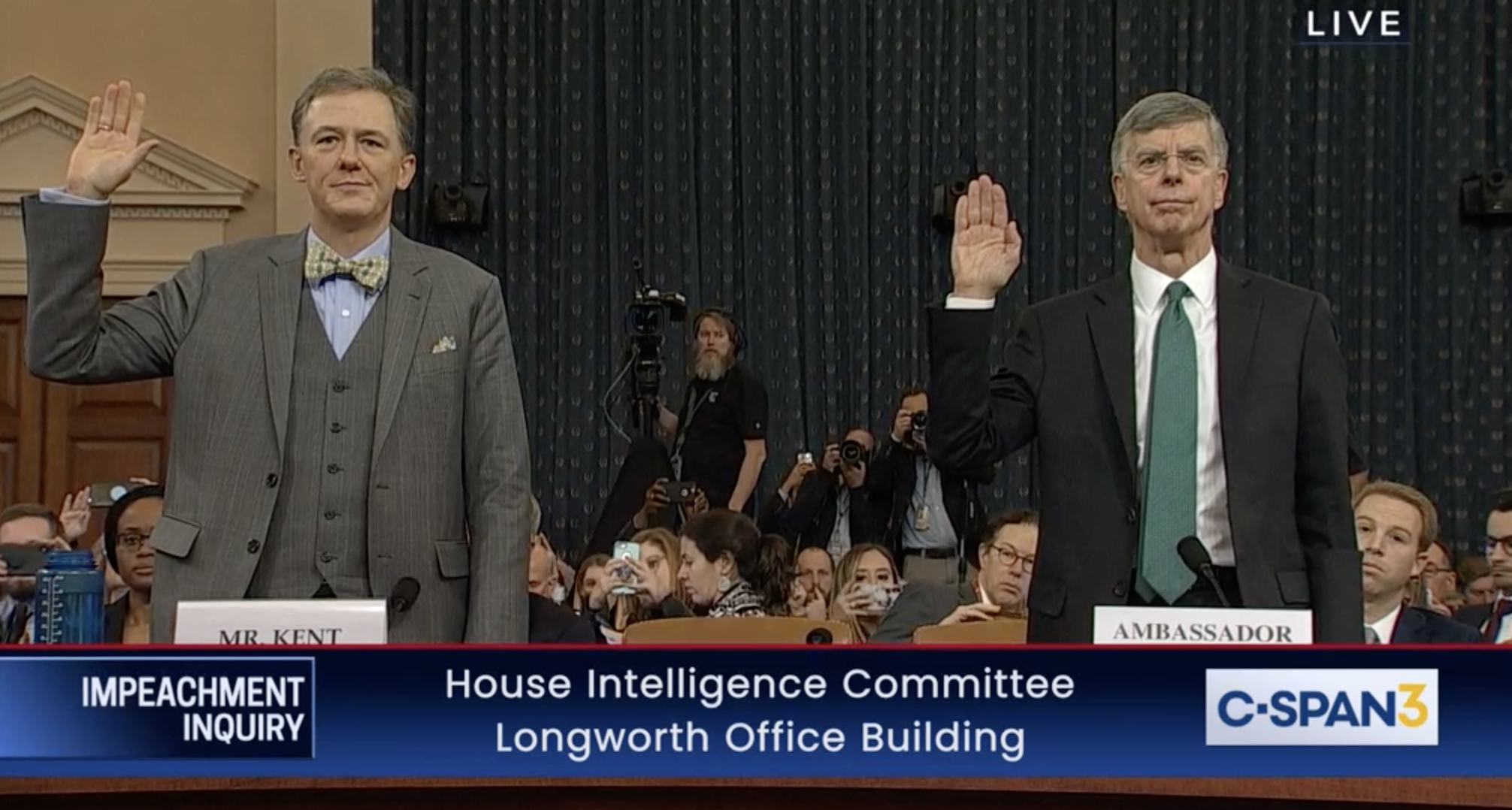
This investigation could not have been “started” by the whistleblower, contrary to what dullards like Byron claim, for the same reason they complain that George Kent and Bill Taylor and Marie Yovanovtich weren’t appropriate witnesses because they weren’t on that call. That’s because the whistleblower wasn’t on the call. Someone — multiple people, as it turned out — had to share details of the call with him before he put all the other dots together in his complaint.

Mind you, the claim of hearsay is false, as all the witnesses have direct knowledge of the wider operation to extort Ukraine. In the case of the whistleblower, for example, Republicans continue to falsely claim he had no direct knowledge of these matters; his description of the July 18 call where OMB announced a hold on aid is not cited to other people.

Still, it’s the larger point that Byron helpfully demonstrates is so stupid. It cannot be true that we need to learn about the whistleblower to understand how all this started and also be true that the whistleblower’s view is meaningless because he was operating exclusively from hearsay. The claim itself underscores that multiple people on the call itself objected when they heard the president extort a foreign leader.

But something more basic is true: This investigation started because the president extorted a foreign leader while a dozen witnesses were listening.
Share this entry

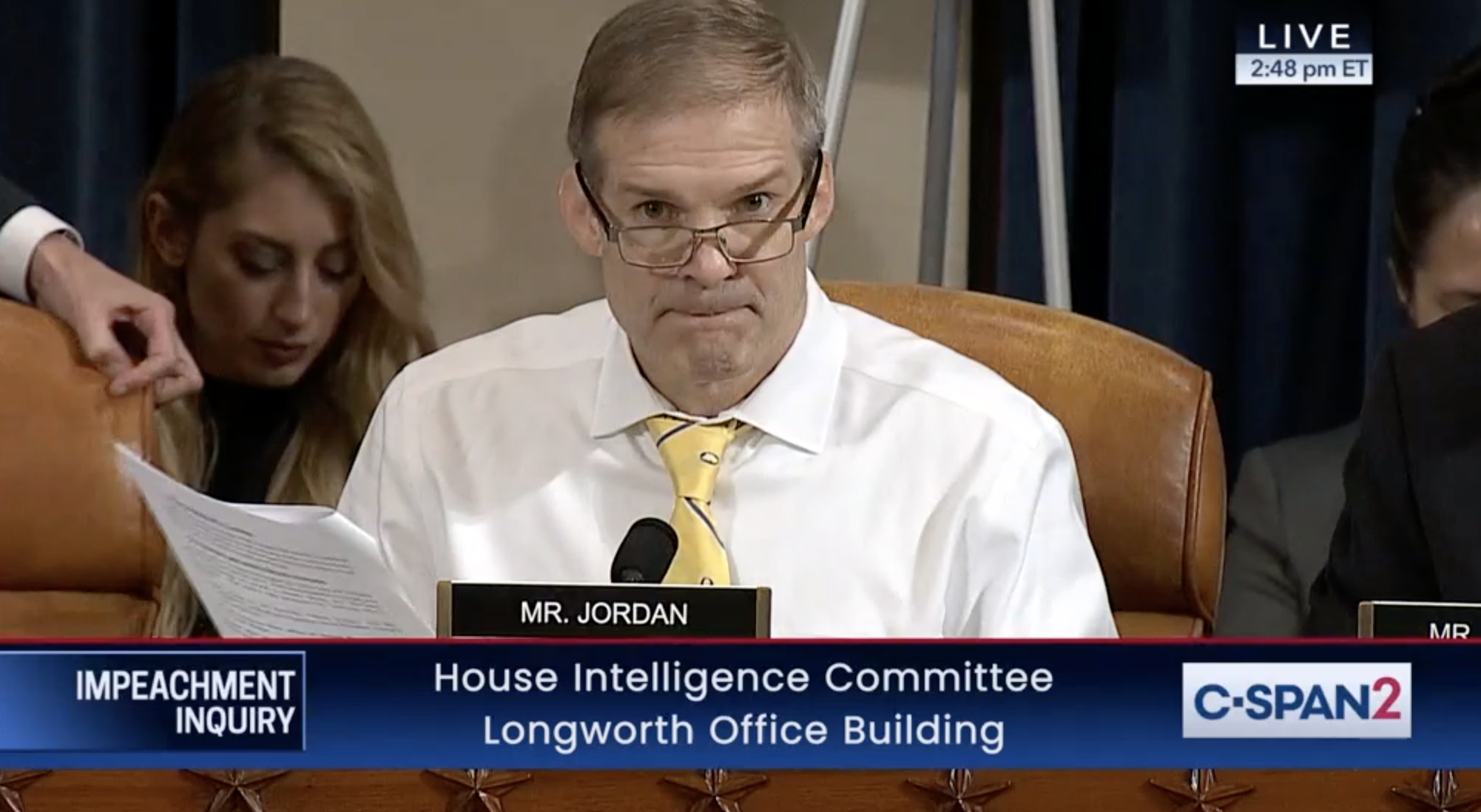
Jim Jordan Accuses Trump of Lying to Mueller in Latest Defense against Impeachment

Among the efforts Republicans employed to excuse the President’s inexcusable behavior in yesterday’s impeachment hearing, they tried to lay out reasons why Trump could legitimately think Ukraine was out to get him. Among the things Steve Castor laid out includes an op-ed Ukraine’s then Ambassador to the US Valeriy Chaly placed in the Hill in early August 2016, laying out how outrageous it was that Trump had recently suggested he would entertain recognizing Russia’s annexation of Crimea.

“Can you see how the simple fact of writing an op-ed, the Ukrainian Ambassador to the US might create a perception that there are elements of the Ukrainian establishment were advocating against then-candidate Trump,” GOP counsel Steve Castor asked about an op-ed in which Ukraine’s Ambassador defended the territorial integrity of his country and invoked resolutions where the US had committed to do so too. “That’s a tremendously sensitive issue in Ukraine,” Marie Yovanovitch explained, as if it weren’t evident.

In spite of how obvious that explanation for the op-ed is, Jim Jordan nevertheless returned to this attack, claiming that the op-ed was an example of an Ambassador trying to influence a host country election and suggesting Yovanovitch was negligent in not telling Ukraine to stop defending its territorial integrity. (Jordan also lobbed the Nellie Ohr attack that even Devin Nunes seems to have recognized constituted an attack on an experienced organized crime researcher being paid by GOP billionaire Paul Singer.)

Republicans are not outraged by John Solomon’s hit job in the Hill targeting an Ambassador who has served presidents of both parties, they’re not outraged that Mike Flynn was writing an op-ed to be placed in the Hill that was paid for by the Turkish state even while getting Top Secret briefings with Trump as candidate.

They are, however, outraged that a Hill op-ed by Ukraine’s Ambassador to the US points out that America has made past commitments to protect Ukraine’s territorial integrity.

But there’s something still crazier about this line of defense.

Chaly’s op-ed could only be viewed as an attack on Trump if he did, in fact, advocate recognizing Russia’s annexation of Crimea. Otherwise, the op-ed would simply be a matter of policy, as Yovanovitch patiently explained to Castor.

And it turns out that Trump has represented, in an answer submitted under oath to Robert Mueller, that he had no policy stance on Crimea. Mueller asked whether the very comments that the Chaly op-ed addressed represented an intention to recognize Russia’s annexation of Crimea.

On July 27, 2016, in response to a question about whether you would recognize Crimea as Russian territory and lift sanctions on Russia, you said: “We’ ll be looking at that. Yeah, we’ll be looking.” Did you intend to communicate by that statement or at any other time during the campaign a willingness to lift sanctions and/or recognize Russia’s annexation of Crimea if you were elected?

1. What consideration did you give to lifting sanctions and/or recognizing Russia’s annexation of Crimea if you were elected? Describe who you spoke with about this topic, when, the substance of the discussion(s).

And while this answer was the most unresponsive among a slew of unresponsive answers, Trump nevertheless stated, under oath, that his statement did not amount to a policy position.

My statement did not communicate any position.

Republicans can’t have this both ways. The only way this op-ed could be an attack on Trump is if Trump really was supporting annexation of Crimea. He may well have been — except he has stated, under oath, that he was not.

Treating this op-ed as an attack on Trump, then, is also an accusation that Trump lied in his sworn answers to Mueller.

Why is Jim Jordan defending President Trump against impeachment by accusing him of lying under oath?

Share this entry

Hours after Donald Trump Witness Tampered in Real Time, Roger Stone Found Guilty of the Same Crime

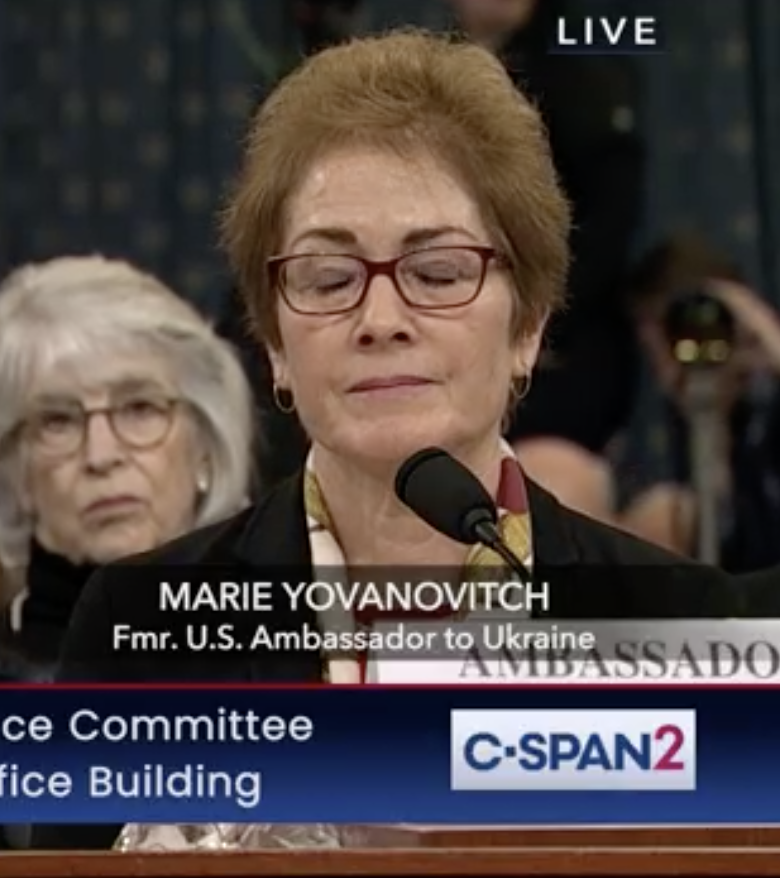
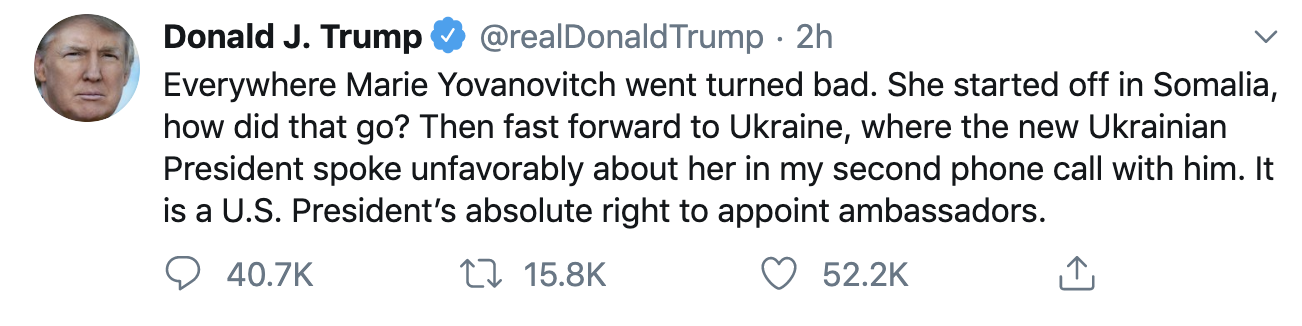
In the middle of today’s impeachment testimony from Marie Yovanovitch Trump lost control of his emotions and attacked the witness.

Adam Schiff interrupted committee counsel Dan Goldman’s questioning, read Yovanovitch the tweet, and asked her how it made her feel.

Yovanovitch said it made her feel intimidated.

Schiff, a former federal prosecutor, knows how to substantiate a witness tampering charge. Even Bret Baier recognized this as such.

During the break in Yovanovitch’s testimony, the jury in Roger Stone’s trial came back with a verdict. They found him guilty on all seven counts. That includes a witness tampering charge for Stone’s efforts to dissuade Randy Credico from testifying before the House Intelligence Committee, the very same committee leading this impeachment hearing.

The courts are just now imposing consequences for Trump’s efforts to cheat to win the 2016 election, even as he attempts to prevent the one court that can try him for imposing consequences for cheating to win the 2020 election.

Share this entry

Impeachment Hearings: Day 2 – Marie Yovanovitch [UPDATE-2]

I’m putting up this post and thread dedicated to today’s hearing which was scheduled to begin at 9:00 a.m. ET. Updates to this post will appear at the bottom.

Former ambassador to Ukraine Marie Yovanovitch is now appearing before the House and opening statements have just finished.

If you’re not within range of television or can’t stream the hearing, you can follow along with these live Twitter threads:

Marcy’s thread

Brandi Buchman for Courthouse News

Law prof and author Jennifer Taub

Some of these feeds also appear in my Trump-Russia Twitter list; open it and refresh periodically.

CNN has a live update page dedicated to today’s hearing.

Washington Post’s live update page here.

Here’s a copy of Yovanovitch’s testimony on October 11 in closed door session, released November 4.

Here’s a copy of Yovanovitch’s written statement submitted today.

If you have other resources you feel are helpful, please share them in comments. Thanks.

UPDATE-1 — 10:28 a.m. ET —

Zelensky was pretty shrewd or innately savvy about the breadcrumbs he left in his interactions with Team Trump.

Trump’s tweet which Daniel Dale embedded as a snapshot:

And of course Trump can’t shut the fuck up; he’s now implied he’s had opposition research done into Yovanovitch’s work history. Why would he need to do that if his actions with regard to Ukraine were totally above board?

Adam Schiff has interrupted questioning to offer Yovanovitch an opportunity to respond to Trump’s tweet denigrating her, amounting to witness intimidation.

UPDATE-2 — 12:35 p.m. ET —

Marcy started a fresh live tweet thread for this afternoon’s testimony by Yovanovitch before the GOP’s counsel and committee members.

Emma Loop with BuzzFeed is now in the hearing room and has also begun a live tweet thread.

Related: If you didn’t hear already, Roger Stone was found guilty on seven counts of obstruction of proceedings, false statements, and witness tampering. Politico’s Darren Samuelson covered the verdict in a thread.

How odd so many of the people close to Trump have been found guilty or pleaded guilty to crimes related to his campaign or work related to Ukraine, Russia, and Turkey.

Share this entry

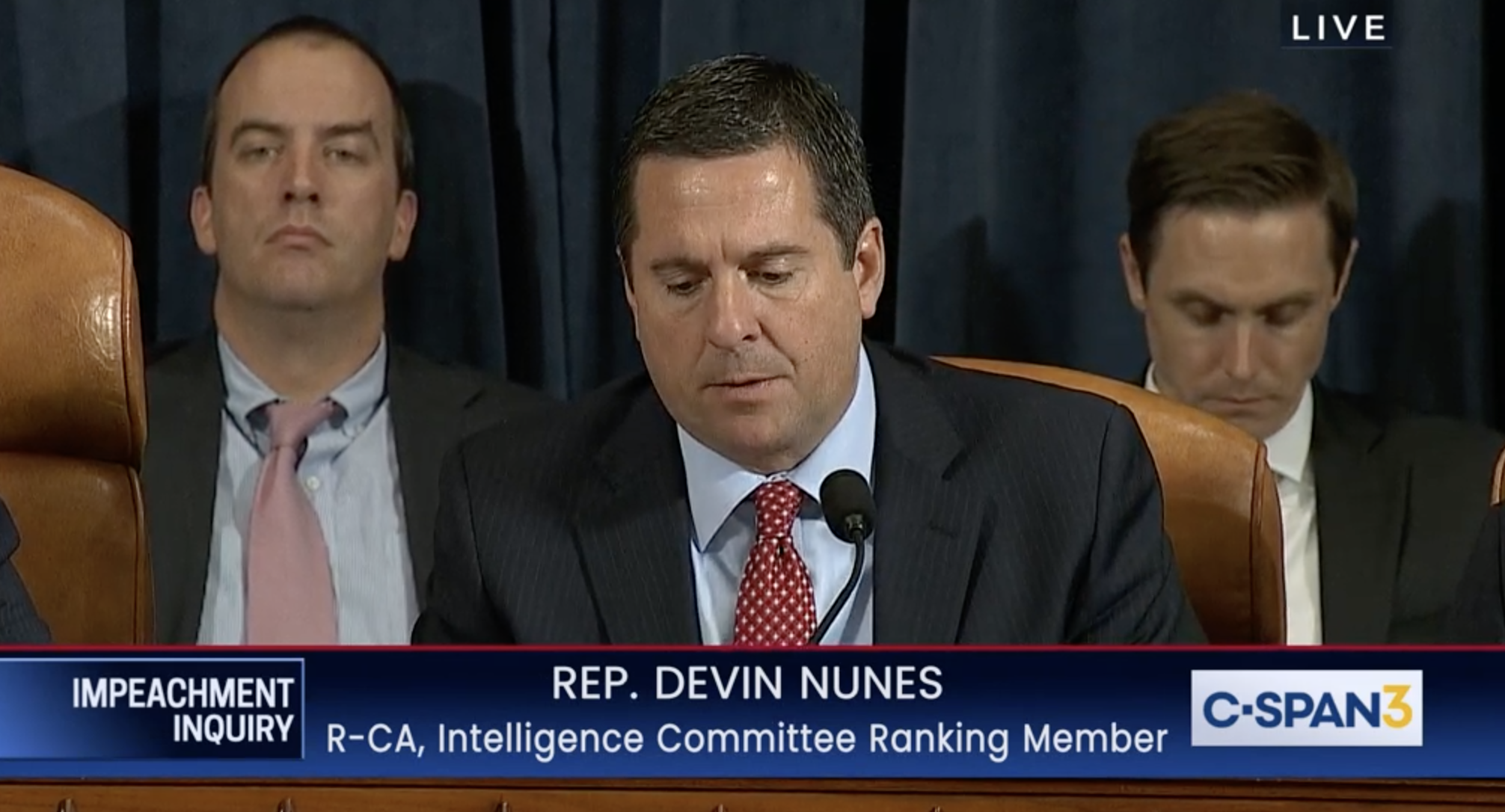
Devin Nunes Calls an Experienced Organized Crime Researcher Funded by Paul Singer a Democratic Operative

There’s a key part of Devin Nunes and Mark Meadows’ defense of the President yesterday that deserves far more attention, both for the way it distorts the factual record and how it suggests that simply being an expert on Russian and Ukrainian organized crime makes one a Democratic operative.

At issue is their bid to make the impeachment inquiry about Nellie Ohr, whom they’ve past falsely suggested had a role in mainlining the Steele dossier into DOJ and FBI. They’ve brought Nellie, the spouse of a key DOJ expert on organized crime, Bruce Ohr, back into their narrative by claiming she testified to Congress that Fusion GPS relied on Ukrainian sources. The idea is that Ohr’s testimony would prove that Trump had good reason to think Ukraine had it in for him in 2016, so could rightly ask Ukraine to investigate whether that amounted to tampering in the election.

Here’s how Nunes laid it out in his demand that Ohr be called to testify:

Nellie Ohr, former contractor for opposition research firm Fusion GPS. In a 2018 interview with the House Judiciary and Oversight Committees, Ms. Ohr stated that, during her work with Fusion GPS that ultimately assisted in the production of the Steele dossier–comprising false allegations against then-candidate Trump–Fusion GPS used information from sources in Ukraine, including Serhiy Leshchenko who recently lost his post from the Ukrainian parliament. Given President Trump’s documented belief that the Ukrainian government meddled in the 2016 election to oppose his candidacy, which forms the basis for a reasonable desire for Ukraine to investigate the circumstances surrounding the election and any potential Ukrainian involvement, Ms. Ohr is a prime fact witness who can assist Congress and the American public in better understanding the facts and circumstances surrounding Ukrainian involvement in the 2016 election.

In his demand, Nunes helpfully provides a footnote, to make it easy to see how many errors he makes in this paragraph. Here’s the passage of Ohr’s testimony before Congress that, Nunes falsely claims, backs his insinuations that Ohr tampered in the 2016 campaign.

GOP counsel Ryan Breitenbach is questioning her.

Q Was there indication from [her boss at Fusion GPS, Jake] Berkowitz or [Glenn] Simpson that they had any inside information as to whether there were suspicious connections with any of President Trump’s orbit of individuals including his family?

A What do you mean by “inside information”?

Q I would say any information that they specifically gave you, in terms of your employment with Fusion GPS, that would indicate that there were some level of connections with President Trump’s family and Russia?

A They would give me leads based on their open-source research and, you know, legal documents and other things.

Q Did they ever indicate that any of their leads were based off of sources of theirs?

A I don’t remember get- — regarding the Trump family, no.

Q Regarding any of the research during this year, 10-, 11-month period, was any — was any research based off of sources of theirs that you were aware of?

A Yes.

Q And who were the sources?

A I recall a — they were mentioning someone named Serhiy Leshchenko, a Ukrainian.

Q And did they give you any indication as to Leshchenko’s connections with them, how they got to know him? Were they doing work for him?

A With Fusion GPS?

Q Correct.

A I am not aware of how they

Q Were you aware of how they had a connection with him?

A I am not aware.

Q But you were aware that he was a source of information that was leading to information that they had, that they were then presenting to you as reasons for following up on opposition research or what research —

A Yes.

Q — that is, on President Trump or his family?

A My understanding is that some — yes. And — yes, it was not necessarily on his family that Leshchenko’s research was on.

Q Are you aware of what his research, or what his source information included?

A His source information, I am not aware.

Q You are just aware that he was a source of —

A Yes.

Q — Glenn Simpson? Or was it a source of Mr. Berkowitz? Or both?

A I am not aware of a differentiation between them. Just a source for Fusion GPS.

Q That is one source. Were there any other sources that you were aware of?

A I don’t think so. I don’t recall that there were.

Q And were you aware of Mr. Leshchenko prior to him being mentioned to you as a potential source of their information?

A Yes.

Q In what way?

A He is very well-known, Ukrainian, anti-corruption activist. So I had read about him in the press.

Q Had you studied him before?

A What do you mean by “studied”?

Q Performed independent research for any prior employer.

A No. I followed him in the — you know, if I saw him mentioned in the press, I read — I read about it.

Q And previous to this particular incoming knowledge from Mr. Simpson or just from Fusion GPS, were you aware of any connections between Mr. Leshchenko — am I saying that name, by the way?

A Yes.

Q — Mr. Leshchenko and President Trump, or anyone in President Trump’s familial orbit or even friendly orbit?

A I was unaware of any connections before that. [my emphasis]

Before this colloquy, Ohr had already testified that she had “no reason to believe” that her work was integrated into the Steele dossier at all. Democratic staffers walked her through passage after passage in the Steele dossier and asked her if her work had provided background for it, which she said it did not. She also had already explained (to both Jim Jordan and Mark Meadows in separate interactions directly) that she, “did online open source research using Russian sources, media, social media, government, you know, business registers, legal databases, all kinds of things.” Ohr’s testimony was backed by Glenn Simpson’s earlier appearances before Congress — including an appearance before HPSCI that Nunes attended; Simpson also said his own research was based off open source research.

Moreover, both the reports Nellie did (PDF 216 to 299) and a table she put together on Trump and his flunkies’ ties to suspect Russians show that the bulk of her research for Fusion preceded the time when Christopher Steele was working on the dossier. Significantly, that means much of Nellie Ohr’s work was paid by GOP billionaire Paul Singer, not the DNC.

So in this passage, Nellie Ohr is talking leads she got from her boss at Fusion, Jake Berkowitz, based off open source research he had done, that she would use to do more open source research, for a project mostly paid for by a Republican billionaire interested in the ties between Trump and Russian organized crime.

And what the passage shows is that:

  • Ohr said the information from Berkowitz came from open source reporting
  • She described herself getting information on Serhiy Leshchenko’s efforts, because he was a very well-known anti-corruption activist who was covered in the press
  • She twice said she was not aware of how Berkowitz and Simpson got their information from Leshchenko
  • She also said she didn’t know where Leshchenko got his information
  • Ohr said that Leshchenko’s reporting wasn’t focused on the Trump family (it almost certainly was focused on Paul Manafort, about whom Ohr wrote a detailed timeline)

In short, the transcript Nunes says supports a demand that Ohr testify does no such thing. Instead, it shows that this side of Fusion’s work relied on open source reporting, and that information on Leshchenko’s efforts was available via open sources. It also shows that Ohr repeatedly denied knowing whether the Fusion focus on Leshchenko was based on anything but open source reporting.

This transcript also shows that if Republicans really wanted to know about how Leshchenko’s work informed Fusion’s work, they should ask Simpson or Berkowitz to testify, because Ohr was only ever working from open sources — that is, doing research, mostly paid for by a Republican billionaire.

That background is all critically important for how Nunes ended yesterday’s testimony. In his closing statement at the hearing, Nunes restated his demand that Schiff permit Republicans to call their chosen witnesses, which he listed as:

  • The whistleblower
  • The folks that he spoke to
  • Numerous Democratic operatives who worked with Ukraine to meddle in the election

Obviously, Nellie Ohr — an experienced researcher on Ukrainian and Russian organized crime — must fall into the latter category.

So on top of all the ways Nunes misrepresented the Ohr’s testimony (or her ability to testify on the issues he claims to want to hear), there’s this. The Ranking Member of the House Intelligence Committee, Devin Nunes, believes that an expert on Ukrainian and Russian organized crime being paid to do open source research by a Republican billionaire must be a Democratic operative.

Share this entry

BREAKING: The First Amendment Is Part of Something Called the Constitution

There’s been a weird phenomenon during the Trump presidency, where journalists and media organizations loudly defend one small part of the Constitution — the one that benefits them personally, the First Amendment — but seem to believe it would be partisan to defend the Constitution and rule of law more generally.

That’s been evident for some time, as news outlets treat the White House arbitrarily revoking credentials as a major news story but treat Trump’s flouting of other limits built into the Constitution as a big old partisan game.

That, to me, is the real problem with this widely panned Jonathan Allen piece deeming yesterday’s impeachment hearing boring. It wasn’t quite so bad as this Reuters piece in the same vein; unlike Reuters, NBC eventually did get around to telling readers about the most shocking news from the hearing, that Gordon Sondland got on an unsecure line to call the President the day after the July 25 call and learned that the only thing Trump cared about was the investigations into his political opponents.

NBC included that news, but placed it in paragraph 17, then dismissed it as a “footnote,” without explaining that this means Sondland got caught, for the second time, lying in his sworn statement to Congress.

Taylor did create a stir when he told the committee one of his aides overheard an ambassador at the center of the story, Gordon Sondland, talking to the president about Ukraine on the phone. Afterward, Sondland told the staffer that Trump cared more about getting Ukraine to open investigations into Biden, a 2020 Democratic presidential candidate, and his son Hunter than about any issues that mattered to the Ukrainians.

But that served as more of a footnote than a headline.

Thirteen paragraphs before he buried the lead, however, Allen pitched yesterday’s events this way, as a measure of whether Democrats had achieved their goal of ousting the president.

But at a time when Democrats are simultaneously eager to influence public opinion in favor of ousting the president and quietly apprehensive that their hearings could stall or backfire, the first round felt more like the dress rehearsal for a serious one-act play than opening night for a hit Broadway musical.

Allen did that in a piece where he emphasized that witnesses Bill Taylor and George Kent spoke from their “nonpartisan roles in government,” and judged that “Republicans poked no real holes in witness testimony.”

In other words, he did that in a piece where he conceded that nonpartisan experts had presented evidence that Trump had improperly tried to extort political benefits from Ukraine by withholding duly appropriated funds. Allen deemed this hearing to be a battle between Democrats and Republicans in a piece where he conceded that the evidence presented showed that President Trump committed a crime, bribery, that the Constitution explicitly says merits impeachment.

Yes, it is the case that not one Republican took a stand for the Constitution yesterday. Even more embarrassing, not a single Republican took a stand to defend their own Constitutional authority, the power of the purse, which Trump also violated when he withheld funding without explaining to Congress why he did so, a violation of the Impoundment Act that Mick Mulvaney has already confessed was a crime.

That seems newsworthy to me, for any journalist whose ability to be one relies on the limits on authority enshrined in the Constitution.

Don’t get me wrong, Allen is not alone in treating support for the Constitution — except, of course, the part journalists have a vested interest in, the First Amendment — as a partisan spat. It’s a general feature of reporting during the Trump Administration that the press picks and chooses which parts of rule of law they will both-sides, and which they will fiercely defend as an unquestioned value.

Just 15 minutes into this hearing, well before poor Jonathan Allen got bored and tuned out, Adam Schiff reminded of when,

Benjamin Franklin was asked what kind of country America was to become. ‘A Republic,’ he answered, ‘if you can keep it.’ The fundamental issue raised by the impeachment inquiry into Donald J. Trump is, can we keep it?

That’s what Adam Schiff said this hearing was about. Not ousting the President. But keeping our Constitutional government.

If the facts were in dispute, this might be fairly deemed by jaded journalists like Allen a partisan attack.

But the facts are not in dispute, as he himself agrees. Which means he utterly mistook the two sides in this matter, in pitching it as a fight between Democratic and Republican strategists. It’s not. It’s a fight between those defending the Constitution and the Republican party.

Share this entry

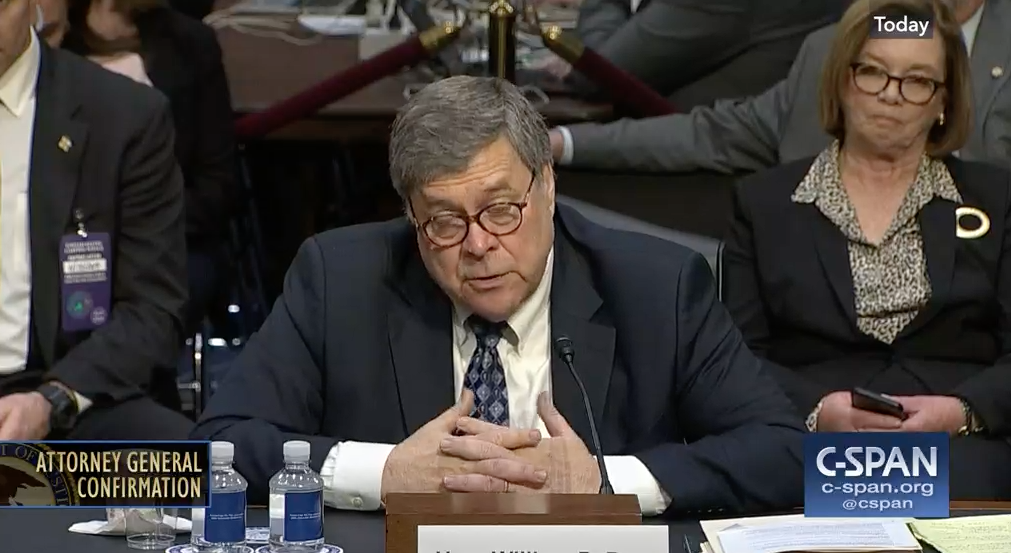
Time to Start Calling Bill Barr “Prosecutor General”

At its core, the Ukraine story is about Rudy Giuliani’s effort to remake the United States in Ukraine’s image.

He’s doing that in two related ways. First, he’s trying to discredit the very notion of investigating a billionaire politician for using his position for personal profit. And, he’s trying to legitimize the selection of top law enforcement officers in a given country based on whether they investigate the political opponents of said billionaire politician.

It’s a two-fold strategy to embrace kleptocracy.

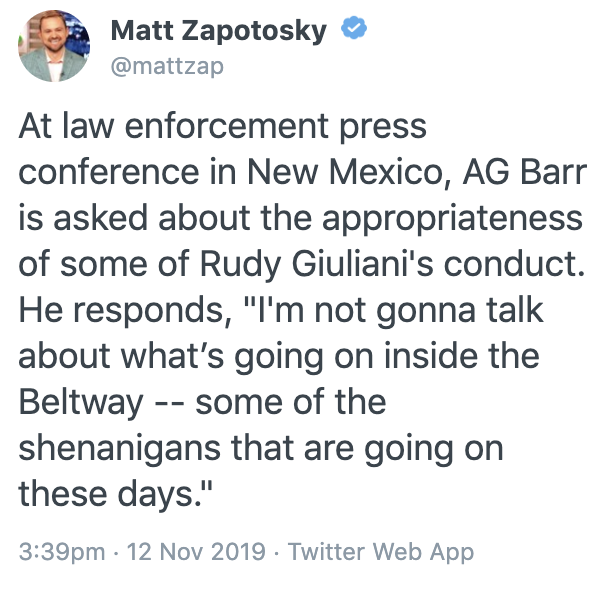
Which is why it’s so interesting that, yesterday, Barr responded to a question about Rudy’s alleged crimes by refusing to comment on “the shenanigans” “going on inside the Beltway.”

Curiously, WaPo’s Matt Zaptosky didn’t reveal that he asked this question, rather than asking Barr about his own obstruction of the investigation into the whistleblower complaint. In many ways, Barr’s activities are even more inappropriate, and it’s time DOJ beat reporters started reporting on that fact.

Rudy and Barr are simply mirror images at this point, both engaged in efforts to turn law enforcement into the tool of one or more corrupt oligarchs. And in his response, Barr suggests that the locus of activity in question is not Madrid or Vienna or the Trump International or any other location where Rudy has held meetings in the service of turning law enforcement into a political tool, but the Beltway, where impeachment is happening.

Which is why I think it’s time to stop calling Barr the “Attorney General of the United States,” and instead, to start calling him the “Prosecutor General,” the term Ukraine uses to refer to the series of prosecutors Ukraine has had who serve the interests of corruption and self-dealing rather than serve law enforcement. After all, Barr was the oligarch-President’s hand-picked choice to come in and not just thwart investigations into the President’s own self-dealing but also to launch investigations into anyone who challenges the President.

Sure, Barr might still believe he’s doing this in the name of corruption. But that’s only true because in the echo chamber he occupies, daring to investigate organized crime amounts to corruption.

As AG, Barr is no better than the corrupt prosecutors that the US has long lectured other countries about. And as such, we should start referring to him using the title he has earned, Prosecutor General.

Update: Zapotosky reported on a question some other reporter (whom he doesn’t credit) asked at that event.

Attorney General William P. Barr said Wednesday that he did not remember President Trump ever asking him to hold a news conference declaring the commander in chief broke no laws in a controversial phone call with the leader of Ukraine, but he acknowledged discussions with the White House on how his department would communicate to the media about the matter.

At an event in Memphis about a Justice Department crackdown on gun violence, a reporter inquired, “Mr. Attorney General, did the president ask you to publicly defend him regarding the Ukrainian call, and if so, why did you not want to do that?”

“If you’re talking about press reports that he asked me to have a news conference, the fact is, I don’t remember any such request,” Barr said. “In fact, my recollection is that I told the White House that we would do what we would normally do, and that is issue a press statement, which we did, and that was not an issue. There was no pushback on that.”

This is basically confirmation that he provided what the White House asked — an exoneration — but that he delegated the actual statement.

Again, it is impossible for DOJ to have done any of the connect-the-dots investigation mandated by post-9/11 reforms. So this is not just confirmation that Barr acceded to the White House request for some kind of exoneration, but also that he responded directly to the White House in whitewashing that investigation.

Share this entry

Trump Team’s Extortion Demands To Ukraine Started Before The April 21 Call To Zelensky

Jim here.

As we prepare for the release of the “transcript” of Donald Trump’s first phone call to Volodymyr Zelensky, it is important to put the call into perspective with events surrounding it in the overall timeline of the Ukraine events at the center of the impeachment inquiry.

Pressure on Poroshenko Administration: January-February 2019

First, it is extremely important to note that Rudy Giuliani, Lev Parnas and Igor Fruman began their campaign to force Ukraine to re-open their investigation into Burisma and to expand it into an investigation of Joe and Hunter Biden, along with an “investigation” of Ukraine meddling in the 2016 US election, before Zelensky was elected. On Friday, the Washington Post filled us in on more details of that effort:

Two associates of Rudolph W. Giuliani pressed the then-president of Ukraine in February to announce investigations into former vice president Joe Biden’s son and purported Ukrainian interference in the 2016 election in exchange for a state visit, and a lawyer for one of the associates said Friday that they were doing so because Giuliani — acting on President Trump’s behalf — asked them to.

The Giuliani associates, Lev Parnas and Igor Fruman, met with then-Ukrainian President Petro Poroshenko in Kyiv, said Edward B. MacMahon Jr., a lawyer for Parnas. He said they were working on behalf of Giuliani, Trump’s personal lawyer, who was operating on orders from Trump.

“There isn’t anything that Parnas did in the Ukraine relative to the Bidens or the 2016 election that he wasn’t asked to do by Giuliani, who was acting on the direction of the president,” MacMahon said.

The article goes on to note that Ukrainian prosecutor Yuriy Lutsenko was also at this meeting, and that there had even been a meeting of Giuliani, Parnas and Fruman with Lutsenko in January.

As a result of this pressure, Lutsenko announced in March that he would investigate the Bidens. This opened the door for the infamous Ken Vogel hatchet job on the Bidens, published in the New York Times on May 1. Buried deep into the article, Vogel did at least grudgingly admit the previous investigation by Ukraine found nothing and that re-opening the investigation was in response to “pressure”:

The decision to reopen the investigation into Burisma was made in March by the current Ukrainian prosecutor general, who had cleared Hunter Biden’s employer more than two years ago. The announcement came in the midst of Ukraine’s contentious presidential election, and was seen in some quarters as an effort by the prosecutor general, Yuriy Lutsenko, to curry favor from the Trump administration for his boss and ally, the incumbent president, Petro O. Poroshenko.

We now know, as described above, that the pressure was applied primarily through Giuliani, Parnas and Fruman rather that through official channels. Returning to the Post article, here is how those efforts worked out:

At the time of the February meeting, Poroshenko was seeking reelection and wanting an official visit to Washington. He ultimately lost and never announced the investigations that Parnas and Fruman asked about, nor did he get the Washington visit he wanted.

The February meeting was also attended by Ukrainian general prosecutor Yuriy Lutsenko, MacMahon said. Lutsenko said in March he was investigating the Bidens, only to reverse course months later.

So, although Lutsenko announced an investigation, Poroshenko never did. Clearly, to the Trump team, the announcement had to come from the top in order to win the prize of the state visit that, at least in the opinion of the Trump team, would have tipped the election to Poroshenko. However, the Lutsenko announcement apparently was sufficient for Vogel and the Times.

Zelensky Elected April 21, 2019

The election in Ukraine took place on April 21 (although there was a preliminary round with no clear winner on March 31), with Zelensky winning in a landslide, 74% to 24% for Poroshenko. Trump’s call to Zelensky took place on April 21, shortly after Zelensky was declared the winner. Kurt Volker noted the call:


So, on the surface, one would expect a transcript of the call only to reflect congratulations on being elected. Volker didn’t specifically state anything else was covered in the call, but did note the US supports Ukraine’s territorial integrity and “counter [Russian] aggression”, sentiments Trump certainly would not have put into the call or Volker’s statement about it.

Of course, since it’s Donald Trump we’re talking about here, all bets are off on what will be in whatever Trump releases, if he does release something. Recall that Trump has called for Republicans to release their own “transcripts” of committee depositions in a very thinly veiled request for doctored transcripts:


Since Trump often operates via projection, we can’t help wondering whether he plans to do some editing on this “transcript” if it is released.

Pressure on Zelensky Administration Begins in May 2019, Before Inauguration

We must also keep in mind that the pressure on Zelensky’s Administration to investigate the Bidens began well before the July 25 phone call and that the first enticement offered in this extortion was Mike Pence attending the inauguration. From the New York Times:

Not long before the Ukrainian president was inaugurated in May, an associate of Rudolph W. Giuliani’s journeyed to Kiev to deliver a warning to the country’s new leadership, a lawyer for the associate said.

The associate, Lev Parnas, told a representative of the incoming government that it had to announce an investigation into Mr. Trump’s political rival, Joseph R. Biden Jr., and his son, or else Vice President Mike Pence would not attend the swearing-in of the new president, and the United States would freeze aid, the lawyer said.

/snip/

The meeting in Kiev in May occurred after Mr. Giuliani, with Mr. Parnas’s help, had planned a trip there to urge Mr. Zelensky to pursue the investigations. Mr. Giuliani canceled his trip at the last minute, claiming he was being “set up.”

Only three people were present at the meeting: Mr. Parnas, Mr. Fruman and Serhiy Shefir, a member of the inner circle of Mr. Zelensky, then the Ukrainian president-elect. The sit-down took place at an outdoor cafe in the days before Mr. Zelensky’s May 20 inauguration, according to a person familiar with the events. The men sipped coffee and spoke in Russian, which is widely spoken in Ukraine, the person said.

Mr. Parnas’s lawyer, Joseph A. Bondy, said the message to the Ukrainians was given at the direction of Mr. Giuliani, whom Mr. Parnas believed was acting under Mr. Trump’s instruction. Mr. Giuliani said he “never authorized such a conversation.”

Note Rudy’s non-denial: he says he never authorized such a conversation, but doesn’t dispute that it took place. Also note that Zelensky did not announce an investigation and Pence did not attend the inauguration.

Although it isn’t mentioned in this article, Rudy’s sudden decision not to attend the May meeting most likely was because he suddenly feared Igor Kolomoisky. From Buzzfeed:

The 56-year-old billionaire was not just a major supporter of Zelensky’s. He owned the television channel that had broadcast the comedy shows in which the newcomer had once played the part of the president of Ukraine, which had made him a household name.

Parnas and Fruman jetted to Israel in late April to meet Kolomoisky, who was living in self-exile after the previous administration took over a bank he founded amid accusations of fraudulent loans and money laundering. (Kolomoisky has vehemently denied the allegations.)

The meeting went badly.

In an interview, Kolomoisky said he was led to believe Parnas and Fruman wanted to talk about their new export business. Instead, he said, they pushed to meet with Zelensky. “I told them I am not going to be a middleman in anybody’s meetings with Zelensky,” he said to reporters for BuzzFeed News and the Organized Crime and Corruption Reporting Project. “I am not going to organize any meetings. Not for them, not for anybody else. They tried to say something like, ‘Hey, we are serious people here. Giuliani. Trump.’ They started throwing names at me.”

Kolomoisky called Parnas and Fruman “fraudsters” in an interview shortly after the meeting. Soon after, a lawyer for the two men filed a claim for damages and told police in Kiev that the oligarch had threatened their lives.

“It was a threat that we took seriously,” said Parnas.

Giuliani jumped into the dispute, denouncing Kolomoisky in tweets as a “notorious oligarch” who “must be held accountable for threats.”

So Rudy stayed behind on the May trip, sending Parnas and Fruman on their own.

Bottom Line

Even if a “transcript” from the April 21 call from Trump to Zelensky is released and contains no extortion demand from Trump for Zelensky to investigate the Bidens, such a demand was indeed delivered to a Zelensky associate less that a month later by Parnas and Fruman. The threat was then carried out when Pence did not attend Zelensky’s inauguration since no investigation was announced.


Share this entry

Why Won’t Sean Hannity Defend Trump against Impeachment Under Oath?

Yesterday, the Republicans released their list of requested witnesses for the public impeachment hearings this week. The list includes:

  • Devon Archer, Hunter Biden’s business partner
  • Hunter Biden
  • Alexandrea Chalupa, the DNC consultant who conducted oppo research on Manafort [corrected] via non-official sources
  • Undersecretary of State David Hale, who gave a private deposition the details of which have not yet leaked
  • Tim Morrison, the NSC staffer who was on the Trump call but has said (in part because saying anything else would implicate him criminally) nothing he heard was a problem
  • Nellie Ohr, whom Nunes falsely accuses of assisting with the Steele dossier, but who collected oppo research on Trump based off leads which were in turn based off open source research
  • Kurt Volker
  • The whistleblower
  • The whistleblower’s sources

I’m amuses me they think Volker will help them, as it reflects their inability to process information as it has come in. In his testimony, Volker made a concerted effort to spin what happened in the least damaging way for Trump. He based much of that defense on the then-operative understanding that Trump had never mentioned Burisma in his conversation with Volodymyr Zelensky, thereby suggesting that that improper request never got beyond Rudy Giuliani to the President. But we now know that Trump did explicitly invoke Burisma in the call, but that it got redacted out by John Eisenberg and others. That is, precisely the detail that Volker used to exonerate the President has now been overtaken by events. Volker will likely spend part of his public testimony backtracking off the stances Republicans believe help the President.

While I assume Schiff will accept the request to call witnesses he himself has asked for depositions, Schiff has already ruled out calling Hunter Biden or the whistleblower.

Still, the most telling part of this list is that the most loyal defender of the President, Sean Hannity, is not on it.

It is now clear that Hannity is a key player in this information operation (unsurprisingly, given what we know about his efforts to coordinate Paul Manafort’s defense). Unlike John Solomon, Hannity’s personal implication in the slimy nest of legal conflicts that the President calls legal representation seem to have ended when Michael Cohen got busted. Unlike Rudy, Hannity’s status as a journalist should protect him from legal liability.

So there’s no reason — besides the fact he’d be under oath — why he shouldn’t be willing to testify about the several key events he played a part in.

For example, Marie Yovanovitch testified that she understands during a period when Hannity was attacking her personally, someone close to Mike Pompeo called Hannity and asked him to either substantiate the charges or stop.

THE CHAIRMAN: And did you ever find out when, you know, the allegations were being made or the attacks were being made by Donald Trump, )r., or Rudy Giuliani, did you ever find out what the Secretary of State’s position, whether the Secretary of State was going to defend you or not, apart from the refusal by the Secretary to issue a statement in your defense?

MS. YOVANOVITCH: What I was told by Phil Reeker was that the Secretary or perhaps somebody around hjm was going to place a call to Mr. Hannity on FOX News to say, you know, what is going on? I mean, do you have proof of these kinds of allegations or not? And if you have proof, you know, telI me, and if not, stop. And I understand that that call was made. I don’t know whether it was the Secretary or somebody else in his inner circle. And for a time, you know, things kind of simmered down.

THE CHAIRMAN: I mean, does that seem extraordinary to you that the Secretary of State or some other high-ranking official would call a talk show host to figure out whether you should be retained as ambassador?

MS . YOVANOVITCH: Wet 1 , I ‘m not sure that’ s exactly what was being asked.

THE CHAIRMAN: Well , they were aski ng i f what basi s they was Hannity one of the people criticizing you?

MS. Y0VANOVITCH: Yes. THE CHAIRMAN: 5o some top administration official was going to him to find out what the basis of this FOX host was attacking you tor?

YOVANOVITCH: Uh- huh.

THE CHAIRMAN: And did you ever get any readout on what the result of that conversation was?

MS. YOVANOVITCH: No, I didn’t, although I was told that it did take place.

Then later in the same deposition, Yovanovitch described how, in an appearance on Hannity’s show, the President pivoted from a question about Russia to focus on Ukraine, which the Ambassador thought might also be targeted at her.

[Dan Goldman] Are you also aware that on the night of April 25th that President Trump went on Sean Hannity’s show and discussed Ukraine?

A Yes. He was asked a question about Russia and he answered by responding about Ukraine.

Q And what was your reaction to that?

A Well, you know, I mean, I was concerned about what this would all mean.

Q In what way?

A Well, obviously, for me personally, not to make it all about me, but for me personally. But also, what does this mean for our policy? Where are we going?

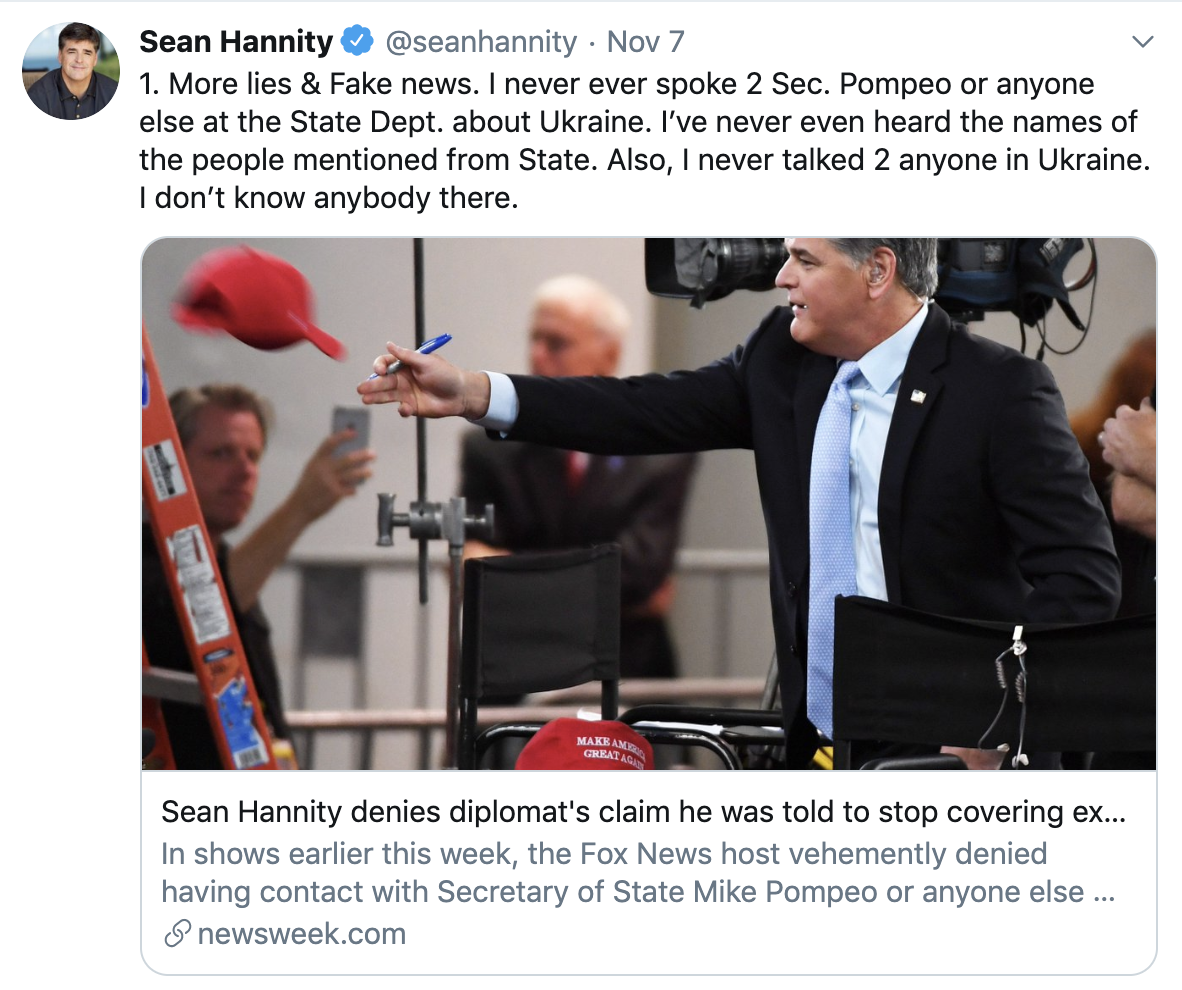
In response, Hannity issued two angry denials on Twitter, not under oath, then linked to a (!!!) now debunked John Solomon piece, as if that did anything but confirm he was part of an information operation.

If Hannity wants to clear his name, surely he’s willing to do so under oath? While there, he can also explain why he keeps bringing Solomon, Joe DiGenova, and Victoria Toensing on his show, and why he doesn’t disclose that the latter two are working for mobbed up Ukrainian oligarch Dmitry Firtash.

Hannity has repeatedly hosted Joseph diGenova and Victoria Toensing, lawyers for Ukrainian oligarch Dmitry Firtash.

According to a Media Matters database, diGenova has appeared on Hannity’s show at least 37 times in 2018 and 2019. His partner Toensing has appeared on Hannity’s show at least 20 times during the same period.

Additionally, Hannity has hosted conservative writer John Solomon over 100 times in 2018 and 2019. Solomon, now a Fox News contributor, is also a client of Toensing and diGenova, and he coordinated with personal Trump lawyer Rudy Giuliani to inject his Ukraine disinformation into the media.

More importantly, when testifying under oath before the impeachment inquiry, Hannity can explain why Rudy’s Ukrainian grifters, Lev Parnas and Igor Fruman, were setting up an interview between him and Ukrainian prosecutor Viktor Shokin in Vienna, where Firtash has been bankrolling this entire influence operation.

While questions in Washington swirl around Shokin’s role in this controversy, Giuliani, Parnas, Fruman had specific plans for the former Ukrainian official up until the day of their arrest. According to those four sources, they told others they were headed to Vienna to help with a planned interview the next day: Shokin, they said, was scheduled to do an interview from the Austrian capital with Sean Hannity.

Through a spokesperson, Hannity said that “we never reveal our sources, potential sources, or persons they may or may not request to interview. Sean Hannity takes the first amendment seriously.”

He might even be able to explain whether, in Attorney General Barr’s visit to Rupert Murdoch’s home the night the grifters got arrested trying to flee the country (and so the night before Hannity was supposed to interview Shokin), he tipped off Hannity not to get on any planes?

Sean Hannity is a far more central fact witness on events associated with the impeachment than Biden, Archer, Chalupa, or Ohr. He’s one of Trump’s most loyal fans, so if there’s a defense of the President to be made, surely he’s willing to make it … under oath.

And yet, either Republicans aren’t willing to risk Hannity’s reputation, or Hannity is unwilling to repeat his claims denying involvement under oath.

Share this entry

Why Did Gucciardo Pay Giuliani Partners For His “Loan” To Fraud Guarantee?

Jim here.

I’ve been troubled by the New York Times’ description of the funds provided by Charles Gucciardo that were used by Lev Parnas to pay Rudy Giuliani for his “consultation” for Fraud Guarantee. The most troubling bit is this:

Mr. Gucciardo, 62, a plaintiff’s lawyer, has not been implicated in any wrongdoing, and there is no evidence that he was involved in the Ukrainian pressure campaign.

That may well be, but there are a number of issues that simply don’t add up here. First, although Gucciardo is not accused at this time of any wrongdoing, it is clear that he engaged deeply with the same set of characters who are at the center of the Ukraine activities driving the ongoing impeachment action in the House of Representatives.

Gucciardo also had made a large donation to America First Action around the same time as the $325,000 donation from Parnas and Fruman. From the Times article, continuing about Gucciardo:

In 2018, he made his biggest donation on record to date — $50,000 to the pro-Trump super PAC America First Action — and attended an event for major donors at the Trump hotel featuring appearances by the president and Donald Trump Jr.

It was there that he met Mr. Parnas and Mr. Fruman, who had recently co-founded a company called Global Energy Producers that donated $325,000 to the PAC.

The next month, Mr. Parnas, Mr. Fruman and Mr. Gucciardo all went on a group trip to Israel, according to people who traveled with them.

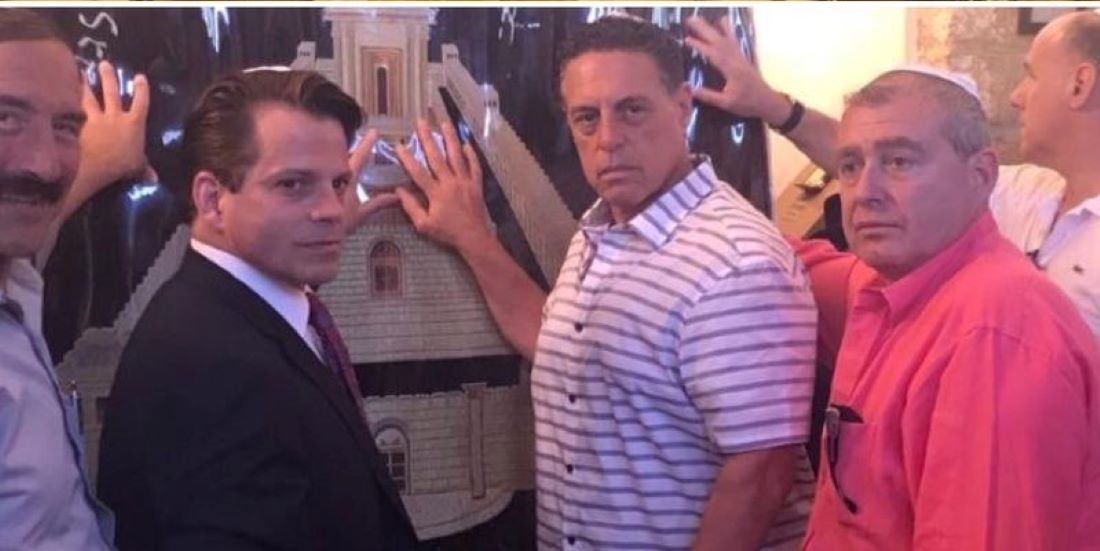
There are even pictures from the trip, reproduced here by the Daily News. Note that in the lower of the paired photos (which is also the featured image of this post), we have from left to right, Joseph Frager, Anthony Scaramucci, Charles Gucciardo (see his profile photo at his website for comaprison) and then Parnas.

First, we are told the funds were a loan that could be converted into a stake in Fraud Guarantee. Continuing from the Times story:

Mr. Gucciardo’s lawyer, Randy Zelin, said Mr. Gucciardo invested in the company because of Mr. Giuliani’s involvement.

“He understood that he was investing in a reputable company that Rudolph Giuliani was going to be the spokesman and the face of,” Mr. Zelin said, comparing Mr. Giuliani’s role to the one he had played for the personal data-security company LifeLock, which ran commercials featuring Mr. Giuliani. “When you think of cybersecurity, you think of Rudolph Giuliani,” Mr. Zelin said.

The company being promoted by Mr. Parnas, Fraud Guarantee, was billed as a way for investors to get insurance against the risk of being defrauded. Mr. Gucciardo’s money was a loan that could be converted into a stake in the company, according to people familiar with the deal.

But, the money didn’t go to Fraud Guarantee:

In an interview, Mr. Giuliani called the arrangement a “perfectly legitimate payment” for which Mr. Gucciardo received “promissory notes that were convertible into a percentage of the company.”

Mr. Giuliani said he “verified the stock agreement” and “felt comfortable getting it from somebody as reputable as him,” adding that, after the payments, “I’ve gotten to know Charles very well. He’s a very honorable man, a very good man.”

Mr. Zelin said Mr. Gucciardo did not pay Mr. Giuliani personally, but rather made his investment by paying one of Mr. Giuliani’s consulting firms, Giuliani Partners. Mr. Gucciardo was “simply one of numerous other investors in the company and is nothing more than a passive investor,” Mr. Zelin said.

Wait. What? Why would Gucciardo have paid Giuliani directly anyway? For a loan convertible to a stake in Fraud Guarantee, the money went to Giuliani Partners instead of Fraud Guarantee?

Why?

Well, that’s where I no longer can buy into Gucciardo being an innocent swept up in the awesomeness of Parnas, Fruman and Giuliani. As has been pointed out many times, Fraud Guarantee mostly never existed. Certainly, by the time these funds changed hands in September and October of 2018, someone investing a half million dollars, and especially if that someone is a high-powered attorney, would be expected to do just a bit of due diligence. For example, here’s Roll Call giving dates for events related to Fraud Guarantee:

In the search for Fraud Guarantee, three names that all appear to have links to Parnas emerged: fraudguarantee.com, Strategic Global Assets LLC and Fraud Guarantee LLC.

Florida Department of State records show that Strategic Global Assets LLC registered fraudguarantee.com as a fictitious name in March 2013. Strategic Global Assets’ corporate filings list Parnas and Florida businessman David Correia as managers. Correia was also among the defendants in the indictment unsealed last week. He was arrested in New York on Monday.

The Florida Department of State dissolved Strategic Global Assets in September 2016 after it failed to file an annual report, records show.

/snip/

lawsuit was filed against Strategic Global Assets for failure to pay rent in Palm Beach County, Fla., in January 2015, and a default judgment in the landlord’s favor came down in July of the same year.

Strategic Global Assets’ official address on state records was changed in September 2015 to that of Correia’s apartment at the time. Correia was listed as the registered agent for Strategic Global Assets in that same filing. He is identified as Fraud Guarantee’s co-founder and chief operating officer on that company’s website.

Florida records show that another company called Fraud Guarantee LLC was dissolved in September 2014 for failing to file an annual report. It’s not clear whether that company was associated with Parnas or Correia, but it shared the same street address that appears for Strategic Global Assets and fraudguarantee.com on Florida court records and an archived copy of the company’s website.

All of that bad info should have made anyone getting ready to invest so much money run away screaming. But in putting the funds into Rudy’s consulting business, they were essentially being hidden from multiple creditors owed funds by Giuliani, Parnas and Fruman.

First, as even the Times article above notes, Giuliani is in the midst of an ugly divorce, and so funds going directly to him would be contested in that ongoing proceeding.

Further, the Parnas and Fruman donation to America First Action was almost immediately the subject of a public complaint filed with the Federal Election Commission. This filing in July was public by the first investment in September of 2018. Further, although the Campaign Legal Center did not bring further attention to it  until 2019, an attorney of Gucciardo’s caliber should have been able to find the ongoing saga of the Pues lawsuit. Here’s a description from USAToday:

A thornier case lingers from a federal judgment that Parnas owes for a movie that never got made.

The Pues Family Trust IRA filed a federal lawsuit in 2011 in New York City seeking repayment of a $350,000 loan to Parnas. The trust’s executor, Michael Pues, described the money in court documents as a bridge loan for a movie with the working title “Anatomy of an Assassin,” while Parnas found more investors.

Parnas denied in a court filing that the money was a loan. Parnas said the movie, which he said was going to be called “Memory of a Killer,” fell apart because of financing problems, including Pues not contributing $1 million as promised.

A judgment in the federal case in March 2016 ordered Parnas to pay the Pues Family Trust $510,435 for the loan and 9% annual interest.

So, Parnas had to be careful about funds flowing through entities he controlled, because the Pues Family attorneys were watching carefully (and in fact pounced on the news of the America First Action donation) and Rudy had to be careful about not having the money go directly to him or his ex-wife would seek the funds. Shouldn’t Gucciardo have asked why the money didn’t just go to Fraud Guarantee? Shouldn’t he have asked why he had to divert funds to Rudy’s consultancy? This just doesn’t add up. Given his deep involvement with these same players, it seems much more likely Gucciardo understood the winks and nudges involved in getting funds to Giuliani in return for his “pro bono” representation of Donald Trump.

Share this entry