The Two Impeachment Treason Trip: Ukraine Charges Rudy Giuliani’s Sources

Yesterday, Ukraine’s SBU charged with treason three of the people from whom Rudy Giuliani sought dirt on the Bidens to help Donald Trump get reelected. The announcement names Andrii Derkach and Kostyantyn Kulyk and describes someone that Politico reports to be Oleksandr Dubinsky.

The allegations say the threesome took $10 million from Russia’s GRU to discredit Ukraine.

“The main task of this organization was to take advantage of the tense political situation in Ukraine and discredit our state in the international arena. For this, the group was getting money from Russian military intelligence. Financing amounted to more than $10 million,” SBU said.

According to SBU, Dubinsky, guided by GRU, spread fake news about Ukraine’s military and political leadership, including claims that high-ranking Ukrainian officials were interfering in U.S. presidential elections. SBU said the Ukraine group was run by GRU deputy head Vladimir Alekseyev and his deputy Oleksiy Savin.

The propaganda described in the announcement preceded but is closely linked to Rudy’s December 5, 2019 trip to Kyiv to obtain dirt from Derkach. This Just Security timeline provides a good summary of how the trip to Kyiv — right in the middle of House impeachment proceedings — fit into Rudy’s year-long effort to find campaign dirt.

Why wasn’t Rudy ever charged?

The US Treasury Department sanctioned Derkach for election interference on September 10, 2020. Treasury added Kulyk, Dubinsky, and several other Derkach associates on January 11, 2021.

On September 26, 2022, EDNY charged Derkach with sanctions violations and money laundering. On January 23, 2023, EDNY superseded that indictment to add Derkach’s wife. On December 7, 2022, EDNY moved to seize a condo it claims the couple owns in Beverly Hills.

The Intelligence Community knew of Rudy’s trip to meet Derkach before he went to Kyiv and warned Trump, but Trump did not care.

The warnings to the White House, which have not previously been reported, led national security adviser Robert O’Brien to caution Trump in a private conversation that any information Giuliani brought back from Ukraine should be considered contaminated by Russia, one of the former officials said.

The message was, “Do what you want to do, but your friend Rudy has been worked by Russian assets in Ukraine,” this person said. Officials wanted “to protect the president from coming out and saying something stupid,” particularly since he was facing impeachment over his own efforts to strong-arm Ukraine’s president into investigating the Bidens.

But O’Brien emerged from the meeting uncertain whether he had gotten through to the president. Trump had “shrugged his shoulders” at O’Brien’s warning, the former official said, and dismissed concern about his lawyer’s activities by saying, “That’s Rudy.”

[snip]

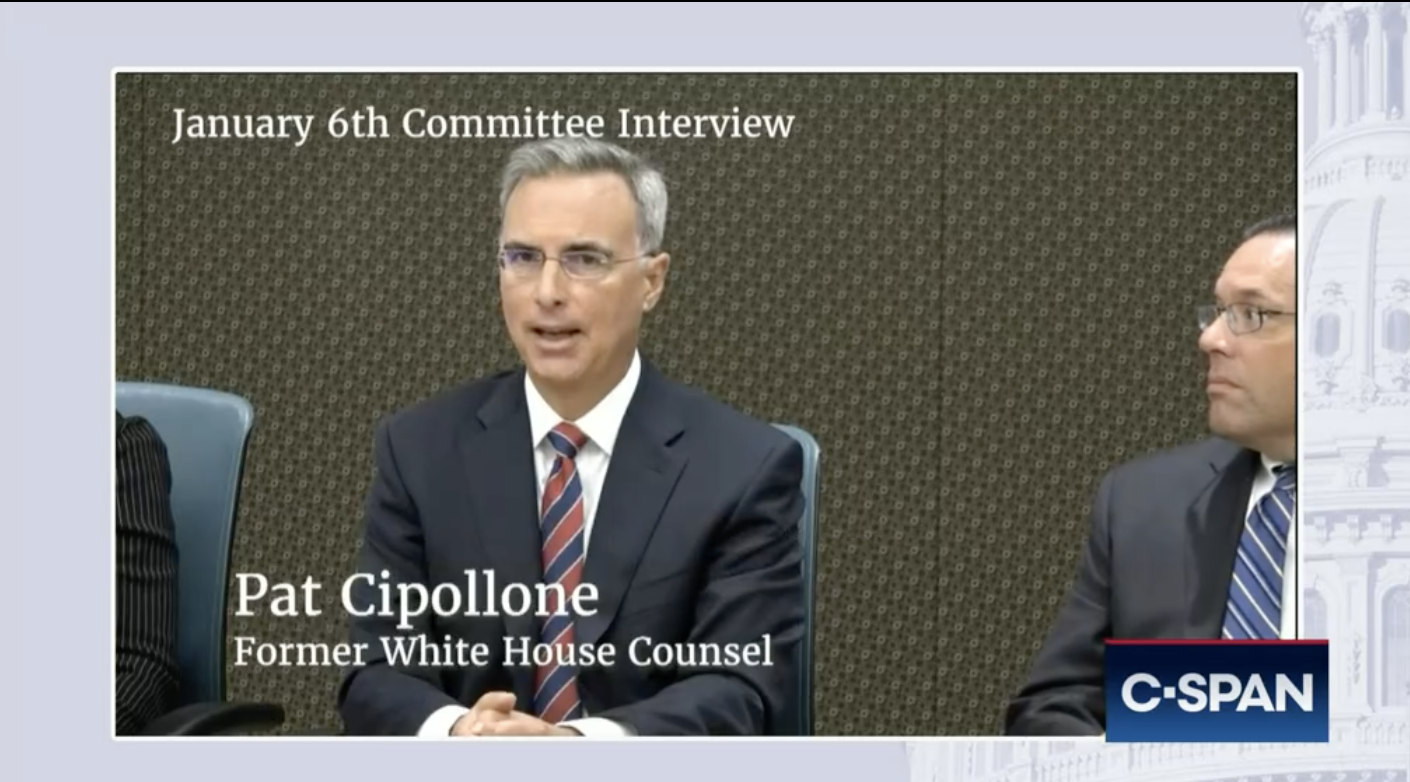
Several senior administration officials “all had a common understanding” that Giuliani was being targeted by the Russians, said the former official who recounted O’Brien’s intervention. That group included Attorney General William P. Barr, FBI Director Christopher A. Wray and White House Counsel Pat Cipollone.

Later reporting made, then retracted a claim, that the FBI had warned Rudy before he made the trip to Kyiv.

At the time Rudy made the trip to Kyiv, he was already under investigation, by SDNY, for serving as an unregistered agent of a different Ukrainian dealing dirt, Yuri Lutsenko, an investigation that grew out of the campaign finance prosecution of Lev Parnas and Igor Fruman. SDNY obtained warrants for Rudy’s iCloud account on November 4, 2019 and, in April 2021, seized 18 devices from the former President’s attorney. That investigation concluded with no charges in August 2022. Rudy’s lawyer, Robert Costello, subsequently revealed that a number of the devices FBI seized in April 2021 were corrupted and therefore useless to the investigation, which likely is a big part of the reason Rudy was not charged by SDNY.

But Rudy was never charged for his ties to known Russian agent Derkach, either. Indeed, the Derkach indictment was written to focus on his NABULeaks site, attacking Ukrainian efforts to combat corruption; it does not mention Rudy (though it does mention that his sanctions pertained to the 2020 election).

Not only wasn’t Rudy charged, but he was permitted to share the information he obtained while in Ukraine directly with DOJ.

How that happened remains among Bill Barr’s most corrupt and complex machinations, one that deserves far more attention given the ongoing efforts to gin up a Ukraine-related impeachment against Joe Biden.

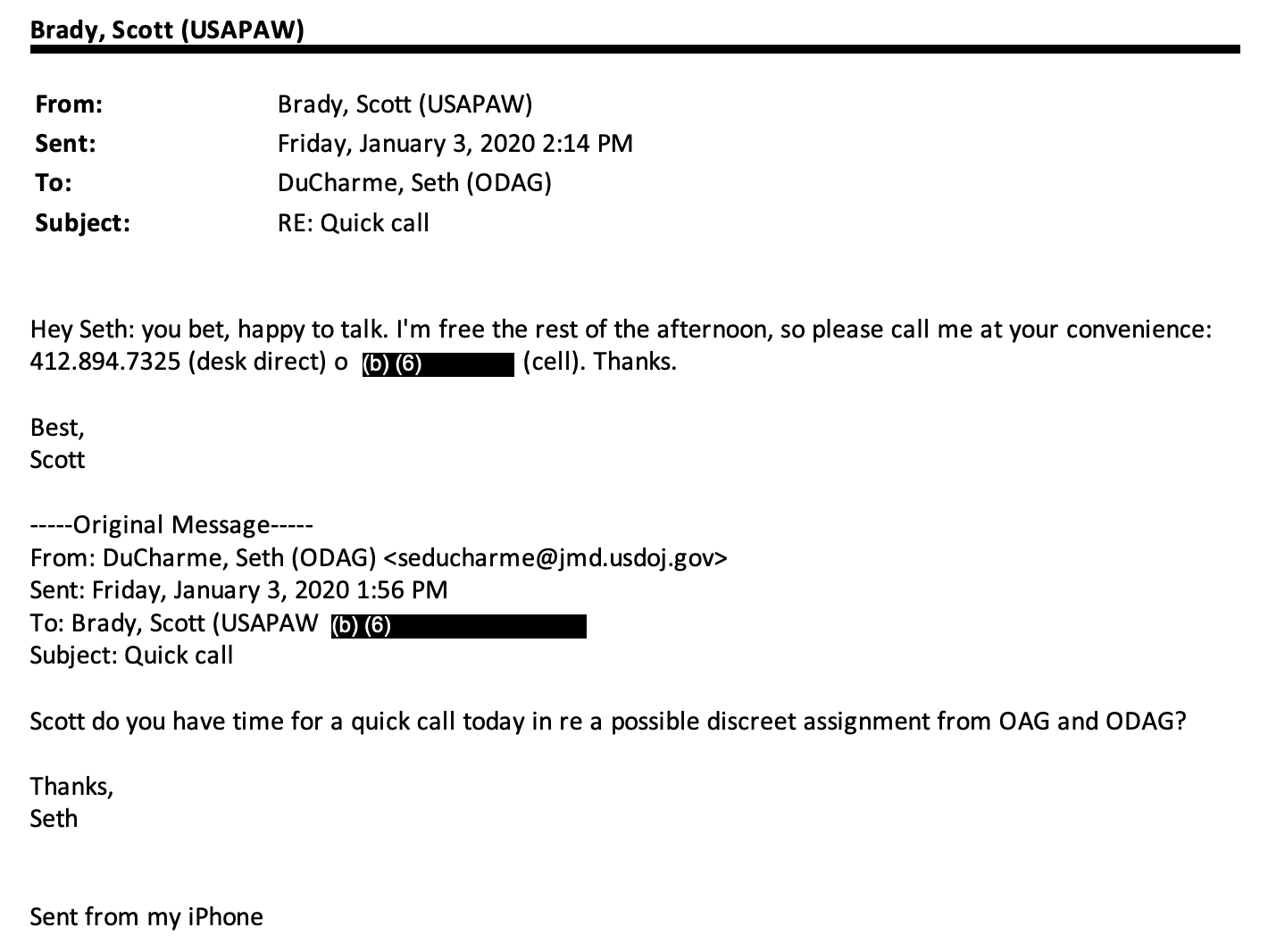
On January 3, 2020 — less than a month after Rudy met Derkach and while Trump’s first impeachment remained pending — Barr tasked Pittsburgh US Attorney Scott Brady with the “discreet” assignment of ingesting dirt from the public, primarily meaning Rudy, to “vet.”

Brady’s recent deposition before the House Judiciary Committee revealed he did little real vetting. What he did do, though, was to query prosecutors in SDNY about the ongoing investigation into Rudy and obtain “interrogatories” from prosecutors in Delaware about the ongoing investigation into Hunter Biden. He also spoke with prosecutors investigating Dmitry Firtash and Ihor Kolomoyskyi, two of three Ukrainian oligarchs from whom Rudy had also solicited dirt.

Brady also spoke with DC investigators who — according to Chuck Grassley — had just one month earlier, right in the middle of the impeachment effort directly tied to Burisma, shut down an investigation into Burisma owner Mykola Zlochevsky, the third Ukrainian oligarch from whom Rudy solicited dirt. From the DC investigators, Brady learned of a passing reference to Hunter Biden in a 2017 informant report, which led Brady to reinterview the same informant. The informant revealed that in a late 2019 phone conversation, one that almost certainly took place during impeachment, Zlochevsky claimed to have bribed Joe Biden in such a way that it would take ten years of searching to find the payoff.

In his HJC deposition, Brady admitted that Rudy did not tell him — and his team did not seek out any information — about the President’s lawyer’s efforts to solicit dirt from Zlochevsky.

Q Okay. But you never asked, for example, the House Permanent Select Committee investigators or anyone associated with that investigation to do a similar inquiry for evidence relating to Zlochevsky?

A No, I don’t believe we did.

Q Okay. And, like you said, you were not aware that this interview had taken place in 2019. Is that fair to say?

A I don’t believe I was, no.

Q Okay. And anyone on your team, as far as you know, was not aware that Mr. Zlochevsky had been interviewed at the direction of Giuliani before your assessment began?

A I don’t believe so.

In September 2020, Brady provided Richard Donoghue with a report on the results of his “vetting.” On October 23, 2020, Brady’s investigators briefed David Weiss’ investigators on the FD-1023 describing the late 2019 Zlochevsky claim of bribery. Weiss claims that aspect of his investigation remains ongoing, and Republicans have made the FD-1023 part of their impeachment inquiry into Joe Biden.

But Barr did more than provide a way for Rudy to share information obtained from a known Russian agent such that it might be used in the investigation into Joe Biden’s son and, now, an impeachment stunt targeting Joe Biden himself. He also ensured that SDNY would not be able to expand their investigation to cover Rudy’s dalliances with Derkach.

On January 17, 2020, Jeffrey Rosen issued a memo making the US Attorney in EDNY — then Richard Donoghue, but Donoghue would swap places in July 2020 with Seth DuCharme, who was at the time overseeing the Brady tasking — a gatekeeper over all Ukraine-related investigations.

Any and all new matters relating to Ukraine shall be directed exclusivelyl to EDNY for investigation and appropriate handling. Unless otherwise directed, existing matters covered by this memorandum shall remain in the Offices and components where they currently are being handled, subject to ongoing consultation with EDNY. Any widening or expansion of existing matters shall require prior consultation with and approval by my office and EDNY.

This memo had the known effect of prohibiting SDNY from following the evidence where their existing investigation into Rudy Giuliani would naturally lead — to Rudy’s relationship with known Russian agent Andrii Derkach.

Geoffrey Berman’s book revealed that Barr also prohibited the New York FBI Field Office — which supports investigations in both SDNY and EDNY — from obtaining the 302s from Brady’s January interviews with Rudy.

There were FBI reports of those meetings, called 302s, which we wanted to review. So did Sweeney. Sweeney’s team asked the agents in Pittsburgh for a copy and was refused. Sweeney called me up, livid.

“Geoff, in all my years with the FBI I have never been refused a 302,” he said. “This is a total violation of protocol.”

This would have prevented SDNY from holding Rudy accountable for any lies he told Brady and prevented EDNY from obtaining Rudy’s first-hand account about where he obtained his dirt and what he had to trade to get it. That may explain why Rudy doesn’t show up in Derkach’s indictment.

But Barr wasn’t done with his efforts to protect Rudy from any consequences for his dalliance with a known Russian agent. In June 2020, Barr fired Geoffrey Berman in an attempt to shut down the ongoing “tentacles” of the investigation into Rudy.

The reason Rudy Giuliani was not charged for soliciting election disinformation from a known Russian agent is that the Attorney General of the United States set up a system that separated the investigation of that Russian agent from the investigation of Rudy, all while channeling whatever disinformation Rudy obtained from Derkach (or Zlochevsky) into the investigation of Joe Biden’s son.

It’s that simple. Bill Barr set up a system that protected Russian disinformation and made sure it could be laundered into the Hunter Biden investigation and also protected the President’s personal lawyer from any consequences for soliciting that Russian disinformation from a known Russian agent.

That’s why Rudy Giuliani wasn’t charged.

How does this relate to the “Hunter Biden” laptop?

The system that Barr set up absolutely has to do with the FD-1023 that remains part of both the Biden impeachment effort and the Hunter Biden criminal investigation.

There’s far less evidence that Rudy’s effort has anything to do with the “Hunter Biden” laptop.

To be sure, Lev Parnas has described that in May 2019 — the month after the laptop ultimately shared with the FBI was dropped off in Wilmington — he first learned that people were shopping a laptop with dirt on Hunter Biden, though he understood it to be one stolen in 2014, not 2019.

At the same time, the BLT Team was exploring many different angles to get information on the Bidens. In June, Giuliani asked me to accompany him to a lunch in New York with Vitaly Pruss, a Russian businessman who claimed to have deep connections to Burisma, including with Hunter Biden’s business partner Devon Archer, and had recommended powerful people to Zlochevsky that he should put on the company’s board. During this meeting, Pruss shared a story with us: He said earlier that year, while doing business related to Burisma, he had taken Hunter Biden to meet Kazakhstan’s minister of foreign affairs, and that Biden had gotten substantially intoxicated with drugs and alcohol on this trip. While he was incapacitated, his laptop was compromised and copied by a representative of FSB (Russia’s secret police) and members of Zlochevsky’s team.

It’s important to note that certain aspects of Pruss’s story are verifiably true. This trip with Hunter Biden did happen, and his computer hard drives were taken and duplicated. But Pruss specified that while the contents of the laptop were personally embarrassing to Hunter Biden – pictures of him doing drugs and surrounded by girls — there was no evidence of financial crimes or any data on his laptop that suggested illegal activities of any other kind, which is the sort of proof that Giuliani desperately needed. Pruss never mentioned anything about the hard drives containing criminal information, only the embarrassing images. It was not until Giuliani began disseminating the story of Hunter Biden’s laptop that the idea of proof of financial and political crimes was introduced.

Parnas also described that he expected to obtain a hard drive from Hunter’s laptop on the trip to Vienna that got preempted by his arrest.

In the early part of October 2019, I got a call telling me to go to Vienna with Giuliani, where the former Chief Financial Officer of Burisma, Alexander Gorbunenko, would meet Giuliani and give us Hunter Biden’s hard drive and answer any questions we had.

The timing of the known laptop parallels Rudy’s efforts in chilling fashion.

The laptop ultimately shared with the FBI was first linked to Hunter Biden’s Apple account in October 2018, at the beginning of Rudy’s efforts to solicit dirt on Biden.

On a November 14, 2018 check, Hunter linked his Fox News pundit shrink to a Russian or Ukrainian-linked escort service he was frequenting at the time — likely the same escort service on which the investigation, now entering its sixth year, was first predicated. But that reference on a check memo line could as easily be explained by addiction or his efforts to cover up or write off such expenses.

Most of the materials on the laptop got packaged up in January and February 2019 while Hunter was again receiving treatment from his Fox News pundit shrink. At the time, Hunter may have had limited access to the Internet, much less the ability to package all that up. The laptop ultimately shared with the FBI was packaged up at a time when Hunter also had a different, older laptop in his possession that was ultimately left at the guest house of the Fox News pundit shrink.

The laptop ultimately shared with the FBI was delivered to the Delaware repair shop — by someone who had access to Hunter Biden’s phone and credit card — in April 2019.

Depending on whether you believe John Paul Mac Isaac or the FBI, JPMI’s father first reached out to the FBI about the laptop hours before or seven days after Parnas was arrested, either October 9 or October 16, 2019. The FBI ultimately obtained the laptop on December 9, 2019, days before the House voted to impeach Donald Trump, and the same month when (per Chuck Grassley) Barr’s DOJ shut down an investigation into Zlochevsky, the guy whose former CFO had been offering Rudy such a hard drive two months earlier. If you can believe JPMI (and you probably can’t), the FBI tried to boot up the laptop before obtaining any known warrant for it.

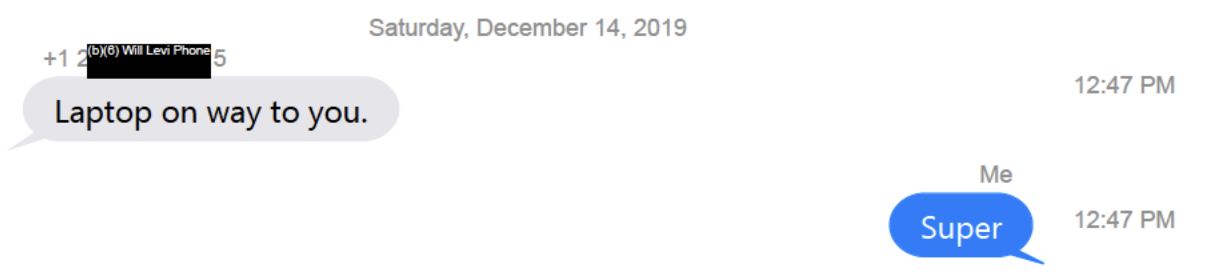
The day after the IRS obtained a warrant for the laptop on December 13, 2019, one of Barr’s aides texted him on his private phone to let him know they were sending him a laptop.

And then months after Barr jerry-rigged a system to ingest dirt from Russian spies into the investigation of Hunter Biden while protecting Rudy, in August 2020, JPMI shared a hard drive of the materials from that very same laptop with Rudy Giuliani, the same guy who had solicited dirt from Burisma in October 2019 and from a Russian agent back in December 2019.

After the NYPost first revealed the laptop, Rudy dismissed concerns that it may have come from Russian spies and even called obtaining it an “extension” of his earlier efforts to obtain such dirt, including (if you can believe Parnas) a laptop from Zlochevsky’s former CFO.

But that’s some Deep State talk, he added. “The chance that Derkach is a Russian spy is no better than 50/50.”

[snip]

Asked, for instance, whether he was concerned if the materials he obtained might in some way be linked to the hacking of Burisma late last year—an act attributed to Russian intelligence—Giuliani said: “Wouldn’t matter. What’s the difference?”

[snip]

Giuliani said he viewed his latest leak to the New York Post as an extension of his years-long efforts to work with Ukrainians to dig up dirt on the Bidens.

According to Scott Brady, Rudy never told him he had obtained the laptop, even though Rudy got it before Brady submitted his report to Donoghue in September 2020.

There are a great deal of remarkable coincidences in the parallel timelines of Barr’s complex system to obtain dirt on Hunter Biden while protecting Rudy and the timeline of the laptop first shared with the FBI and then shared with Rudy. But thus far that’s all they are: coincidences.

There’s not even proof — at least not publicly — that anyone besides Hunter Biden packaged up the laptop that ultimately got shared with the FBI. To the extent someone did, there’s more evidence implicating American rat-fuckers than Russian ones.

There are a great deal of questions about how the laptop got packaged up and the legality of JPMI’s sharing of it with anyone but the FBI. But for now, those are different questions than the questions about Rudy’s efforts to solicit dirt from a Russian agent.

Did John Durham meet these same Russian agents on behalf of Barr?

There’s one more question these charges in Ukraine raise, however: Whether John Durham met with one or several of these men Ukraine now accuses of working for Russian spies.

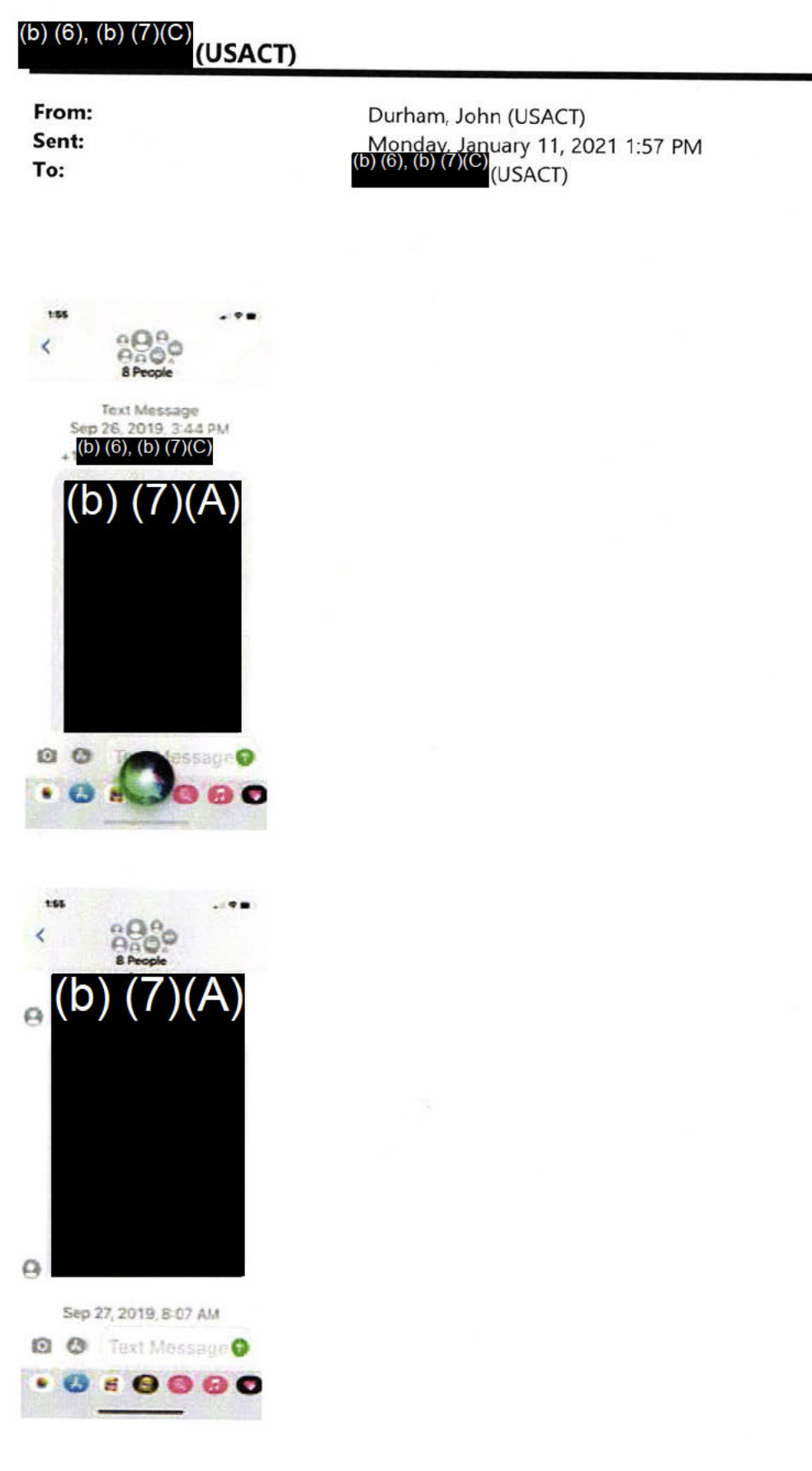
On the day that Treasury sanctioned Kulyk and Dubinsky, January 11, 2021, Durham sent an aide some group chats he had participated in with Barr’s top aides in September 2019, just as the impeachment panic started.

Those group chats, which Durham referred back to on the day Derkach’s associates were sanctioned, seem to have arisen out of a panic Barr had on the morning of September 24, 2019, the day the White House would release the Volodymyr Zelenskyy transcript showing that Trump asked the Ukrainian President to deal dirt on the Bidens to both his Attorney General and personal lawyer.

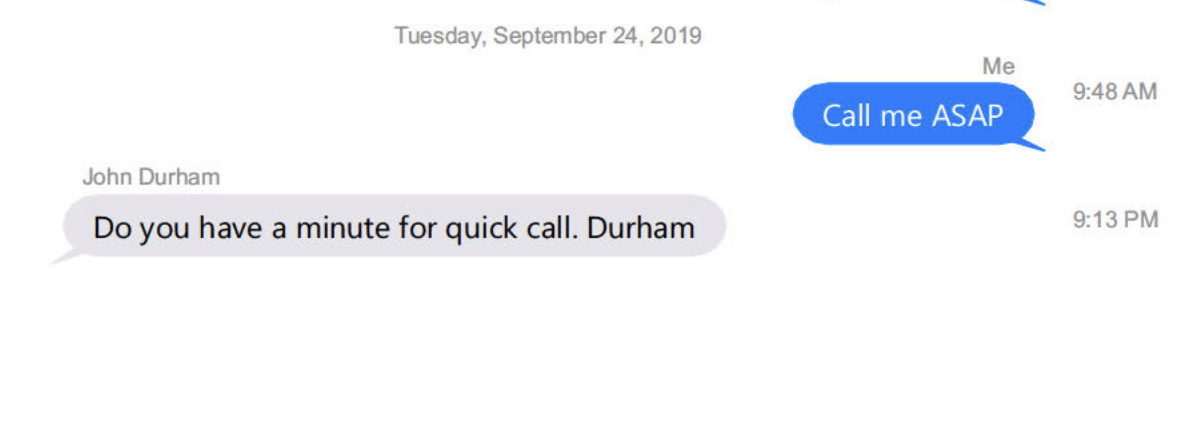
“Call me ASAP,” the Attorney General texted Durham that morning, followed almost twelve hours later by Durham asking to speak, possibly for a second time.

The next day, September 25, DOJ issued a statement revealing that Durham had received information from several Ukrainians who weren’t part of government.

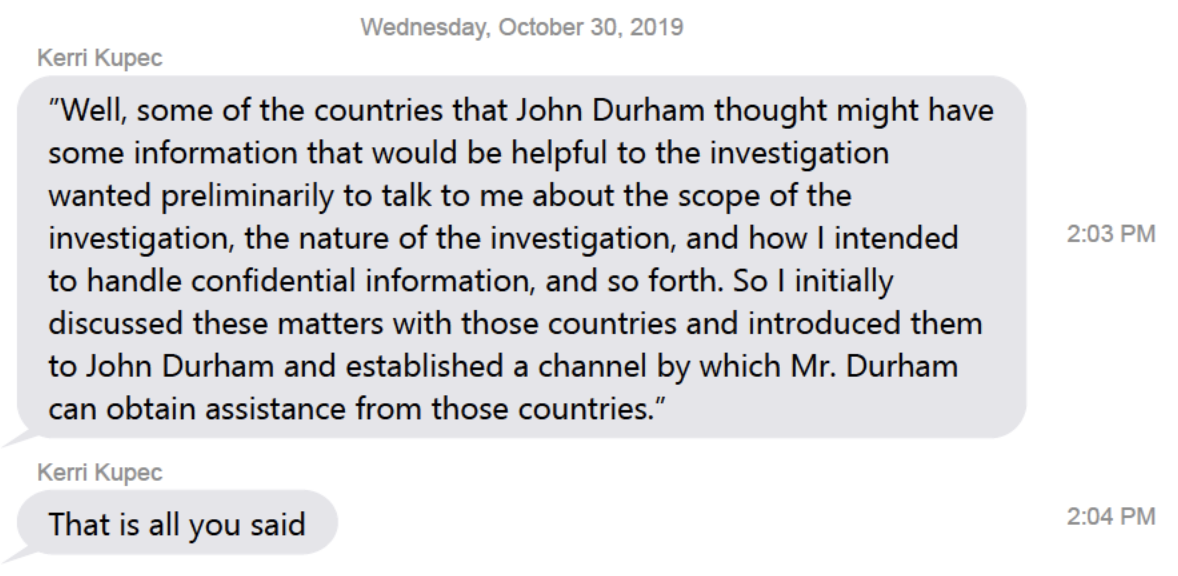
A Department of Justice team led by U.S. Attorney John Durham is separately exploring the extent to which a number of countries, including Ukraine, played a role in the counterintelligence investigation directed at the Trump campaign during the 2016 election,” DOJ spokeswoman Kerri Kupec said Wednesday. “While the Attorney General has yet to contact Ukraine in connection with this investigation, certain Ukrainians who are not members of the government have volunteered information to Mr. Durham, which he is evaluating.”

That’s what led up to the group chats Durham would share months later.

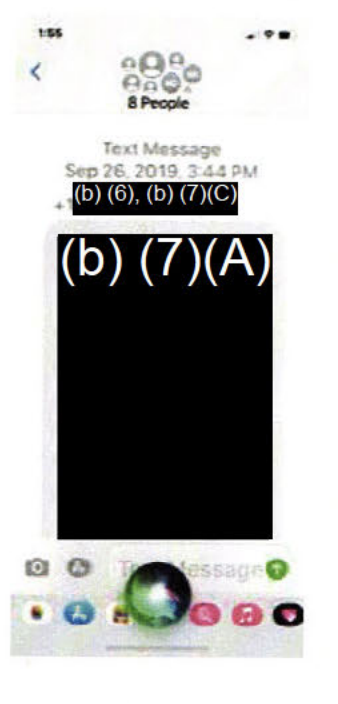
At 3:44 PM on September 26, the day the White House released the whistleblower complaint, someone from Durham’s team — probably Durham himself — participated in a chat with 8 people.

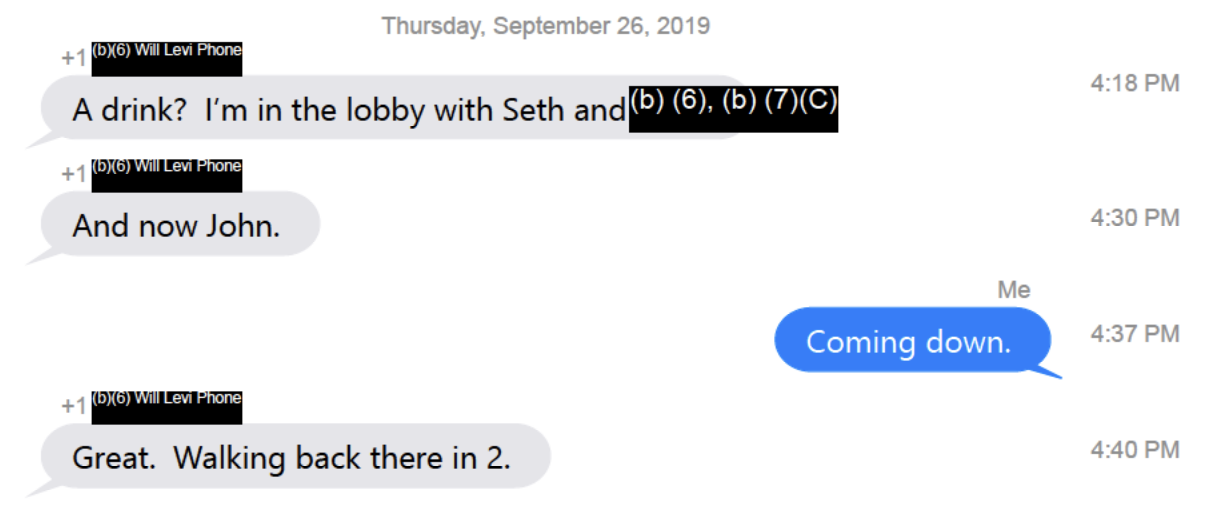
Less than an hour later, a bunch of people — including Will Levi, Seth DuCharme (who would be in charge of Scott Brady’s “vetting” project and then take over any investigation in EDNY), and “John” — convened in a lobby bar together, waiting for Barr to arrive.

The following day, when Kurt Volker resigned, there was another group chat, the second one Durham would share months later.

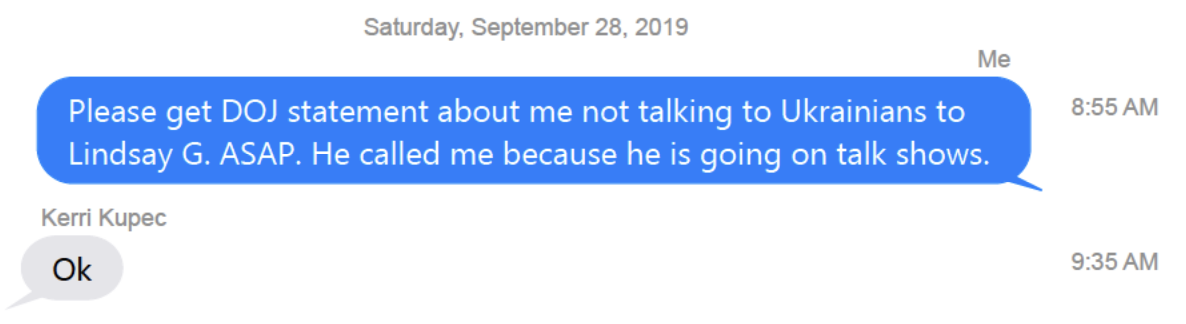
Barr was still focused on CYA regarding his own involvement. In advance of Lindsey Graham going on the Sunday shows that weekend, Barr made sure to get Lindsey his statement claiming not to have spoken to the Ukrainians personally.


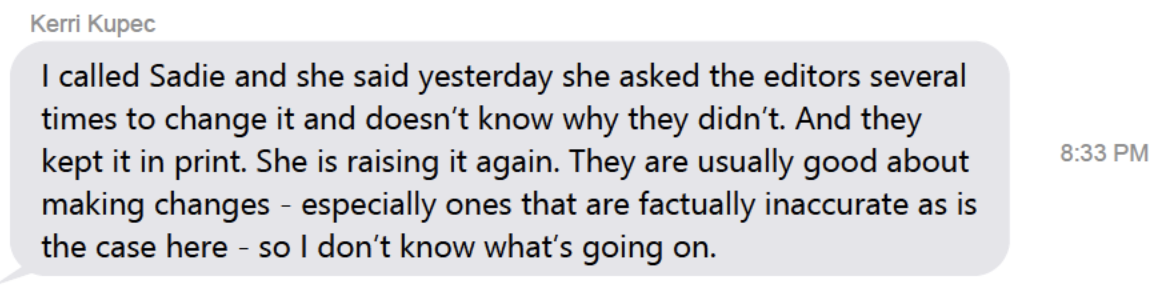
Later on October 2, Kerri Kupec apologized to Barr that “Sadie” hadn’t gotten editors to change a particular story, probably a reference to this WSJ story, which discusses Barr’s request that Trump give introductions to some foreign leaders.

On October 30, the day after the Democrats released the impeachment resolution, Kupec sent Barr the statement he had made about Ukraine back in September.

A minute later Barr sent that statement to Will Levi, with no further comment.

There’s far more about Barr’s panic as impeachment unrolled in 2019, as I laid out here.

The panic likely includes Eric Herschmann, who was then in private practice but who would join Trump’s impeachment defense and then ultimately serve as a babysitter for Trump in the White House. While at the White House, Hershmann pitched the “laptop” to the WSJ before Rudy discredited it.

But one thing is clear: In the wake of the disclosure that Trump asked Zelenskyy to work with Barr in addition to Rudy, Barr attempted to pawn off any contacts with Ukraine onto Durham — an effort that appears to have been discussed in both group chats and a face-to-face meeting in a hotel bar.

And then, over three months later, on the day that Rudy’s sources were sanctioned, two of whom were just charged with treason along with Derkach, Durham revisited those group chats.

That may explain why Barr worked so hard to ensure that Rudy never faced consequences for soliciting disinformation from a known Russian agent.

Update: Fixed timing of Parnas arrest per zscore.

Share this entry

Scott Brady’s “D-I-S-C-R-E-E-T” Vetting : A Marginally More Credible Witness than Gal Luft

About 70% of the way through the House Judiciary Committee interview of former Pittsburgh US Attorney Scott Brady on October 23, he explained how reaching out to FBI’s legal attaché in Ukraine to ask that Legat to reach out to Ukraine’s Prosecutor General fit within the scope of a project Bill Barr had assigned him.

Brady had described the project, hours earlier, as vetting incoming information on Ukrainian corruption received from the public, including but not limited to, Rudy Giuliani, using public information.

[W]e were to take information provided by the public, including Mayor Giuliani, relating to Ukrainian corruption. We were to vet that, and that was how we described it internally, a vetting process.

We did not have a grand jury. We did not have the tools available to us that a grand jury would have, so we couldn’t compel testimony. We couldn’t subpoena bank records.

But we were to assess the credibility of information, and anything that we felt was credible or had indicia of credibility, we were then to provide to the offices that had predicated grand jury investigations that were ongoing.

Brady distinguished between reaching out directly to Ukrainian investigators, the National Anti-Corruption Bureau of Ukraine or the Prosecutor General’s Office, and reaching out via the FBI.

The latter, Brady said, was,

a discreet, nonpublic way of securing information about these cases, including from publicly available documents or dockets, in a way that then wouldn’t, you know raise a flag and make the Ukrainian media, the national media aware? Because we were very concerned– [my emphasis]

“So ‘discreet’ here,” a Democratic staffer clarified, “means quietly, basically. You could do that quietly. Is that fair to say?”

“Yes,” Brady agreed, “quietly, as an investigation is…”

The Democratic staffer interjected, “Okay.”

“Usually conducted,” Brady finished, perhaps recognizing what he had just conceded.

Scott Brady’s misreading of discrete words

Two hours earlier, the same Democratic staffer had walked Brady through the email — one he himself had raised — via which a top Bill Barr aide, Seth DuCharme, had first given Brady his assignment on January 3, 2020.

DuCharme had given Brady that assignment between the time on, December 18, 2019, that the House had impeached Donald Trump for (among other things) asking President Volodymyr Zelenskyy to help Rudy Giuliani and Bill Barr look into the Bidens and Burisma, and the time, on February 5, 2020, that the Senate acquitted Trump.
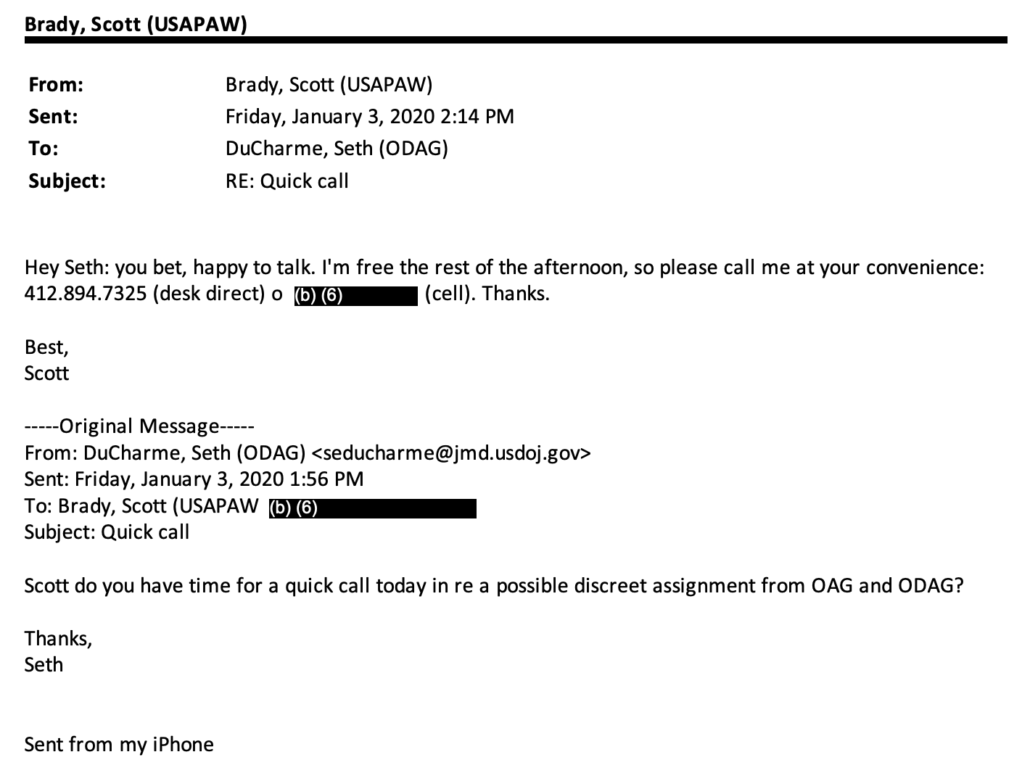
The staffer asked Brady, close to the beginning of the Democrats’ first round of questioning in the deposition, what he took DuCharme to mean by the word, “discreet.”

In spite of the fact that both the staffer and Brady had that email in front of them, an email which spelled discreet, “d-i-s-c-r-e-e-t,” Brady tried to claim that by that, DuCharme meant to give Brady a discrete, “d-i-s-c-r-e-t-e” assignment.

Q And Mr. DuCharme refers to your assignment as a, quote, “discreet assignment,” correct?

A Yes. And I think what he meant by “discreet” was limited in scope and duration.

Q Oh, “discreet” means limited in this case?

A My understanding was that it was “discrete” meaning limited in scope and duration.

Q Okay. Did you think in any way that he was implying that it ought to be kept out of the public, this assignment?

Brady denied that this reference, “d-i-s-c-r-e-e-t,” meant Barr and DuCharme were trying to keep this project quiet, because after all, Bill Barr spoke of it publicly.

A No. I no, because, on the one hand, the Attorney General was speaking publicly of the assignment. However, it should be kept secret, to use your words, just as any investigation would be, any process would be that whether vetting or an investigation between the U.S. attorney’s Office and the FBI or any Federal agency.

Q You mean the information itself that you were discussing or coming upon in the investigation, that should be kept discreet or out of the public eye?

A The investigation, the process, all of that none of that is public

Q Got it.

A when we do that.

The staffer asked whether Brady really meant that Barr was discussing the assignment publicly on January 3, 2020, a month before Lindsey Graham first revealed — days after the Senate had acquitted Trump — that Barr had, “created a process that Rudy could give information and they would see if it’s verified.”

Q And you indicated that you believe that the Attorney General at that time was discussing your assignment publicly? Is that in your recollection, was he doing that publicly on January 3, 2020?

A No. I mean subsequent comments.

Q Okay. So, after it became known that this investigation or assignment had been given to you, Attorney General Barr did make public comments. Is that right?

A Yes.

That gives you some sense of the level of candor that Pittsburgh’s former top federal law enforcement officer, Scott Brady, offered in this testimony. About the most basic topic — how he came to be given this assignment in the first place — he offered two bullshit claims in quick succession, bullshit claims that attempted to downplay the sketchiness of how he came to be assigned a task intimately related to impeachment right in the middle of impeachment.

The word games about “d-i-s-c-r-e-e-t” are all the more cynical given that American Oversight, whose FOIA Brady repeatedly described having read (probably as a way to prepare for the deposition), titled their page on the it “A Possible Discreet Assignment.”

The high risk of deposing Scott Brady

Inviting Scott Brady to testify to the House Judiciary Committee was a high risk, high reward proposition for Jim Jordan.

Brady, if he could hold up under a non-public deposition, might give the Republicans’ own impeachment effort some credibility — at least more credibility than the debunked, disgruntled IRS agents and indicted fugitives that the project had relied on up to this point.

Sure enough, in the wake of his testimony, the usual propagandists have frothed wildly at Brady’s descriptions of how he faced unrelenting pushback as he pursued a project ordered by the Attorney General and “fully support[ed]” by the top management of the FBI. Poor Scott Brady, the right wing wailed, struggled to accomplish his task, even with Bill Barr, Jeffrey Rosen, Chris Wray, and David Bowdich pulling for him.

The right wing propagandists didn’t need the least bit of logic. They needed only a warm body who was willing to repeat vague accusations, including (as Brady, a highly experienced lawyer who should know better did more than once), parroting public claims, usually Gary Shapley’s, about which he had no firsthand knowledge as if he knew them to be fact.

But testifying before House Judiciary also meant being interviewed by staffers of the guy, Jerry Nadler, who first raised concerns about the project after Lindsey blabbed about it. In real time, Nadler established that Bill Barr’s DOJ had set up Brady to ingest material from Rudy Giuliani, then put the US Attorney in EDNY (at the time, Richard Donoghue, but Donoghue would swap places with DuCharme in July 2020) in charge of gate-keeping several investigations into Ukraine. Geoffrey Berman, the US Attorney in SDNY whom Barr fired in June 2020 in an attempt to shut things down, would later reveal that this gate-keeping effort had the effect of limiting SDNY’s investigation into Rudy’s suspected undisclosed role as an agent of Ukraine.

That part has become public: Freeze the investigation into whether Rudy is a foreign agent in SDNY, move any investigation into identified Russian asset Andrii Derkach to EDNY and so away from the Rudy investigation, and set up Scott Brady in WDPA to ingest the material Rudy collected after chumming around with Derkach and others.

What had remained obscure, though, was the role that Brady had with respect to that other “matter[ that] that potentially relate[s] to Ukraine:” the Hunter Biden investigation in Delaware. Indeed, DOJ’s letter to Nadler about it falsely suggested all covered matters were public. It turns out Stephen Boyd, who wrote the letter, was being “discreet” about there being another investigation, the one targeting Joe Biden’s son.

Inviting Scott Brady to a deposition before the House Judiciary Committee as part of an effort to fabricate an impeachment against Joe Biden provided the the same congressional office that first disclosed this corrupt scheme an opportunity to unpack that aspect of it.

It turns out Jerry Nadler’s staffers were undeterred by shoddy word games about the meaning of, “d-i-s-c-r-e-e-t.”

The virgin birth of a “Hunter Biden” “Burisma” search

The central focus of the HJC interview, unsurprisingly, was how an informant came to be reinterviewed in June 2020 about interactions he had with Burisma’s Mykola Zlochevsky months and years earlier, the genesis of the FD-1023 on which Republicans are pinning much of their impeachment hopes, and how and on what terms that FD-1023 got forwarded to David Weiss, who was already investigating Hunter Biden.

Yet it took three rounds of questioning — Republicans then Democrats then Republicans again — before Brady first explained how his team, made up of two AUSAs working full time, himself, two other top staffers, and an FBI team, came to discover a single line in a 3-year old informant report. With Republicans, Brady described that it came from a search on “Hunter Biden” and “Burisma.”

Q And the original FD1023 that you’re referring as information was mentioned about Hunter Bidden and the board of Burisma, how did that information come to your office?

A At a high level, we had asked the FBI to look through their files for any information again, limited scope, right? And by “limited,” I mean, no grand jury tools. So one of the things we could do was ask the FBI to identify certain things that was information brought to us. One was just asking to search their files for Burisma, instances of Burisma or Hunter Biden. That 1023 was identified because of that discreet statement that just identified Hunter Biden serving on the Burisma board. That was in a file in the Washington Field Office. And so, once we identified that, we asked to see that 1023. That’s when we made the determination and the request to reinterview the CHS and led to this 1023. [my emphasis]

That answer — which described Brady’s team randomly deciding to search non-public information for precisely the thing Trump had demanded from Volodymyr Zelenskyy less than a year earlier — satisfied Republican staffers. Again, they weren’t looking for logical answers, much less rooting out Republican corruption; they needed a warm body who might be more credible than Gal Luft.

It took yet another round of questions before the Democrats asked Brady why, if his job was to search public sources, he came to be searching 3-year old informant reports for mentions of Hunter Biden. At that point, the search terms used to discover this informant report came to shift in Brady’s memory, this time to focus on Zlochevsky, not Hunter Biden personally.

Q Okay. And so, in the actually, in the first and second hours, you said pretty extensively that your role was to vet information provided from the public, correct?

A Correct.

Q And so the 1023, the original 1023, was not information provided from the public, correct?

A That’s correct

Q Okay.

A yes.

Q But it came up because you’d received information from Mr. Giuliani and, in your vetting of that information, you ran a search?

A Correct.

Q Okay.

A And just to clarify, I don’t remember if we asked the FBI to search for “Burisma”

Q Right.

A or “Zlochevsky.”

Q Understood.

Searching on “Zlochevsky” and “Burisma” wouldn’t have gotten you to the specific line in a 2017 FD-1023 about Hunter Biden — at least not without a lot of work. Chuck Grassley revealed the underlying informant report came from a 3-year long Foreign Corrupt Practices Act investigation into Zlochevsky that had been closed in December 2019.

December 2019.

Remember that date.

Finding that one line about Hunter Biden in a 3-year investigative file would have been the quintessential needle in a haystack.

Spying on the twin investigations

Perhaps this is a good time to explain a totally new — and alarming — detail disclosed in this deposition.

Scott Brady didn’t just accept information from the public, meaning Rudy, and then claim to vet it before handing it on to other investigations. Brady didn’t just attempt to contact Ukraine’s Prosecutor General — through the Legat and therefore discreetly — to try to get the same cooperation that Trump had demanded on his call with Zelenskyy.

He also quizzed the investigators.

In the guise of figuring out whether open grand jury investigations already had the information he was examining, he asked them what they were doing.

In Geoffrey Berman’s case, this involved an exchange in which Scott Brady — the guy claiming to be working off public files and leads from Rudy — told Berman — the guy with a grand jury investigating Rudy — that Berman was wrong.

Q Okay. Let me be more specific. At some point, the U.S. Attorney for the Southern District of New York, Mr. Berman, wrote you a letter or email that provided information he thought that you should have because of the material that he knew you were reviewing, that he thought might be inconsistent with what you were finding; is that correct?

A That’s correct. And then we wrote him an letter back saying that some of the contents in his letter was incorrect.

Q Okay. So you had some kind of dispute with Mr. Berman about the information that they had versus the information that you had, the subject had seemed inconsistent. Is that fair to say?

A I think there was a clarification process that was important that we shared information and made sure that they especially had an understanding because they had a predicated grand jury investigation, what was in our estimation and our limited purview correct and incorrect. So we wanted to make sure they had the correct information. [my emphasis]

As we’ll see, this is important — nay, batshit crazy — based on what the full sweep of Brady’s deposition revealed about his interactions with Rudy. Because, as Brady conceded by the end of the interview, Rudy probably wasn’t entirely forthcoming in an interview Brady did with Rudy.

But, as described, it doesn’t seem all that intrusive.

In David Weiss’ case, however, Brady described that, after Hunter Biden’s prosecutors refused to tell him what they were up to and he intervened with Weiss himself, using “colorful language,” the Hunter Biden team instructed Brady to put his questions in writing.

Q Okay. And so the I think you said you passed along or, not you personally, but your office passed along interrogatories or questions for them.

A That’s right.

Q That was along the lines of asking them what steps they had taken. Is that fair to say?

A Some limited steps. Correct.

Q Okay. So you were asking them about their investigation to help inform your investigation.

A Yes, to help focus our process so that we weren’t doing anything that, as I mentioned, would be duplicative or would complicate their investigation in any way.

[snip]

Q Okay. And you wanted to know that because you didn’t want to start doing the same investigative steps that they were doing?

A Correct.

Q But you indicated before that you didn’t have the power to get bank records, for example; is that right?

A Correct.

Q So was there a reason that you would need to know whether the other district had subpoenaed something if you weren’t able to subpoena bank records yourself?

A Yes. For example, if we were given a bank account number and wanted to see if they had already looked at that, we would want to know if they had visibility and say, you know: Here’s a bank account that we had received; have you, you know, have you subpoenaed these records, have you can you examine whether this bank account has sent funds into other Burisma-related accounts or Biden-related accounts?

Q So you were looking to sort of use their grand jury or subpoena authority to learn information because you didn’t have that tool in your own investigation?

A We weren’t really looking to learn information about their investigation. We just wanted to know if we needed to do anything with that, to try to corroborate it through perhaps other sources or through the FBI, or if we should even hand it over, again, if it was credible or not credible. If there is nothing to be gained, I don’t want to waste their time if they said: Oh, yeah, we’ve looked at that, and this bank account doesn’t show up anywhere in our records.

Q So, if you had some kind of information or question about a bank account, was there anything stopping you from just passing that onto Delaware without asking them also to tell you whether they had received any information pursuant to a subpoena or any other lawful process?

A We could have, but that wasn’t my understanding of our assignment. Our understanding of the assignment was to really separate the wheat from the chaff and not waste their time with a dump of information, maybe, you know, a percentage of which would be credible or have indicia of credibility. So they have limited resources. They have, you know, a broad tasking. So we didn’t want to waste their time by doing that. We thought it would be more efficient to engage them, ask them: Have you seen this?

Yes, no. And then pass it on, make a determination of what to pass onto them.

Aside from the fact that this sounds like it took more time than simply sending a bunch of bank account numbers to allow the Delaware team to deduplicate — the FBI does have computers as it turns out, and one of the FBI’s best forensic accountants has worked on this investigation — the timing of this matters.

This happened in April and May 2020, so in the months and weeks before Brady’s team did a search on Hunter Biden and Burisma — or maybe it was Zlochevsky and Burisma — and found a 3-year old informant report mentioning the former Vice President’s son.

So Brady sent, and after some back-and-forth, got some interrogatories from Weiss’ team, and then the next month discovered an informant that Delaware presumably hadn’t chosen to reinterview.

“Do not answer” about the vetting

By the point when Brady described randomly searching on Hunter Biden and Burisma — or maybe it was Zlochevsky and Burisma — the former US Attorney had already repeatedly balked when asked if he had vetted anything pertaining to Zlochevsky.

The first time, his attorney, former Massachusetts US Attorney Andrew Lelling and so, like Brady, a former Trump appointee — I think this is the technical term — lost his shit, repeatedly instructing Brady not to answer a question that goes to basic questions about the claimed purpose for this project: vetting leads.

Q All right. The statements that are attributed to Mr. Zlochevsky, did you do any work, you or anyone on your team, to determine whether those statements are consistent or inconsistent with other statements made by Mr. Zlochevsky?

Mr. Lelling. He’s not going line by line from a 1023. He’s not discussing at that level of detail.

Q. Okay. Could you answer the question that I asked you though?

Mr. Lelling. No. Do not answer.

Q. That was not a line-by-line question.

Mr. Lelling. Do not answer the question. You picked the line. You read it. You were asking him

Q. That’s not no, I didn’t. What line did I read from?

Mr. Lelling. Okay. I’m being figurative.

Q. Okay. I’m asking

Mr. Lelling. He is not going to go detail by detail through the 1023.

Q. I’m not asking that. No, I’m not going to ask that. I am asking a general question about whether he tried to determine whether there were consistent or inconsistent statements made by one of the subsources, generally.

Mr. Lelling. Yeah. No. He can’t answer that. This is too much

Q. So we’re going to keep asking the questions I understand he may not want to answer. We’re going to keep asking the questions to make a record. If you decline to answer

Mr. Lelling. Sure. I understand. And some maybe he can. This is

Q. We’re going to keep asking the questions though.

Mr. Lelling. This is a blurry line, a

Q. Understood.

Mr. Lelling. deliberative process question. And I’m sort of making those judgments question by question. So, maybe, categorically, he can’t answer any of the questions you’re about to ask. Maybe he can. So

Q. Well, if you let me ask them, then we can have your response.

Mr. Lelling. Sure.

Q. Fair? Okay. So the subsource, Mr. Zlochevsky, did you make any effort in your investigation to look in public sources, for example, whether Mr. Zlochevsky had made statements inconsistent with those attributed to him by the CHS in the 1023?

Mr. Brady. I don’t remember. I don’t believe we did. I think what our broadly, without going into specifics, what we were looking to do was corroborate information that we could receive, you know, relating to travel, relating to the allegation of purchase of a North American oil and gas company during this period by Burisma for the amount that’s discussed in there. We used open sources and other information to try to make a credibility assessment, a limited credibility assessment. We did not interview any of the subsources, nor did we look at public statements by the subsources relating to what was contained in the 1023. We believed that that was best left to a U.S. attorney’s office with a predicated grand jury investigation to take further.

Brady’s team looked up whether Burisma really considered oil and gas purchases at the time. They looked up the informant’s travel. But did nothing to vet whether Zlochevsky’s known public statements were consistent with what he said to the informant.

Democrats returned to Brady’s description of how he had vetted things, including the FD-1023, later in that round. He was more clear this time that while his team checked the informant’s travel and while he repeatedly described his vetting role as including searching public news articles, his team never actually checked any public news articles to vet what the 1023 recorded about Zlochevsky’s claims.

Q Okay. But open source so, other than witness interviews, you did do some open source or your team did some open source review to attempt to corroborate some of what was in the 1023? Is that fair?

A Just limited to the 1023?

Q Well, let’s start with that.

A Yes.

Q Okay. And what does that generally involve, in terms of the open source investigation?

A It could be looking at it could be looking at public financial filings. It could be looking at news articles. It could be looking at foreign reporting as well, having that translated. Anything that is not within a government file would be open source, and it could be from any number of any number of sources.

Q So, when you look at news reports, for example, would you note if there was a witness referred to in the 1023 that had made a statement that was reported in the news article, for example? Would that be of note to your investigators?

A Relating to the 1023? No. We had a more limited focus, because we felt that it was more important to do what we could with certain of the information and then pass it on to the District of Delaware, because then they could not only use other grand jury tools that were available but, also, we didn’t have visibility into what they had already investigated, what they had already done with Mr. Zlochevsky, with any of the individuals named in this CHS report. [my emphasis]

Scott Brady claimed to search news reports, even in foreign languages. But did not do so about the matter at the core of his value to the GOP impeachment crusade because, he claimed, his team had no visibility into what the Delaware team had already done with Zlochevsky.

Only they did have visibility: they had those interrogatories they got in May.

Having been told by Brady that he didn’t bother to Google anything about what Zlochevsky had said publicly, Democratic staffers walked him through some articles that might have been pertinent to his inquiry, quoting one after another Ukranian saying there was no there there.

Only the claims in the June 4, 2020 article rang a bell for Brady at all, though he did say the others may have made it into a report he submitted to Richard Donoghue (who by that point had swapped roles with DuCharme at Main DOJ) in September 2020.

But as to Brady? The guy who spent nine months purportedly vetting the dirt the President’s lawyer brought back from his Russian spy friends claims to have been aware of almost none of the public reporting on the matters Rudy pitched him. Which apparently didn’t stop him from calling Geoffrey Berman and telling Berman he knew better.

The open source that Scott Brady’s vetting team never opened

Even before they walked Brady through those articles, some appearing days before the informant reinterview, Democratic staffers raised Lev Parnas.

Was Brady familiar with the interview, conducted less than a year before his team reinterviewed the informant, that Parnas claimed Vitaly Pruss did with Zlochevsky on behalf of Rudy Giuliani, the one that had been shared with the House Intelligence Committee as part of impeachment?

Okay. And just to be clear, I think my colleague has already explained this, but this document was provided to investigators on the House Permanent Select Committee on Intelligence in 2019, before your assessment began, in relation to the first impeachment inquiry of President Trump. But you indicated you were not aware that that evidence was in the record of that investigation?

A Correct.

[snip]

Q Okay. So you indicated you’ve never seen this document before. May I actually ask you, before we go through it: You, during the course of your investigation, you asked the FBI or directed others to ask the FBI to review their holdings for any information related to Burisma or Zlochevsky, correct?

A Yes. We asked them, for certain specific questions, to look in open source, as we talked about, and then to look in their investigative files to see if they had intersected with these names or, you know, this topic before.

Q Okay. And they yielded this 2017 1023 that then led you to interview the CHS, correct?

A Yes.

Q Okay. But you never asked, for example, the House Permanent Select Committee investigators or anyone associated with that investigation to do a similar inquiry for evidence relating to Zlochevsky?

A No, I don’t believe we did.

Q Okay. And, like you said, you were not aware that this interview had taken place in 2019. Is that fair to say?

A I don’t believe I was, no.

Q Okay. And anyone on your team, as far as you know, was not aware that Mr. Zlochevsky had been interviewed at the direction of Giuliani before your assessment began?

A I don’t believe so.

One of the Democratic staffers got Brady to agree that, yes, he had found a 3-year old informant report and tried to contact Ukraine’s Prosecutor General, discreetly, but hadn’t bothered to see whether there were relevant materials in the wealth of evidence and testimony submitted as part of the impeachment.

Q Okay. I guess my question was just more based on your own description of your own investigative efforts. I mean, you went on your own, on your own initiative, to search FBI records that had anything to do with Zlochevsky, correct?

A Correct.

Q Or Burisma, but you don’t know what the search term was.

A Correct. There were multiple, but yes. I can’t remember the specific one that uncovered the underlying 1023.

Q Okay. But you didn’t make a similar effort to search the impeachment investigative files that were released and public at that time and dealing with the same matter. Is that

A Correct. To my knowledge, yes

Q Okay.

A that’s correct.

As Brady described, the team he put together to carry out a task assigned during impeachment that closely related to the subject of impeachment, “we were certainly aware” of the ongoing impeachment, but, “I don’t believe that our team looked into the record.”

Brady, at various times, also excused himself from anything pertaining to Lev Parnas because Rudy’s former associate had been indicted.

Mr. Brady. So, just to clarify, without going into detail, because Mr. Parnas had been indicted by SDNY, we didn’t develop any information relating to Mr. Parnas that either Mr. Giuliani gave us or that we received from the public, and we felt that it was best handled by SDNY, since they had that full investigation.

[snip]

[W]e cordoned that off as an SDNY matter. So, any information that we received from Mr. Giuliani, for example, relating to Mr. Parnas, we relayed to SDNY.

In the same way that the scheme Barr set up to gatekeep Ukraine investigations meant SDNY wouldn’t look at Andrii Derkach, because that had been sent to EDNY, Scott Brady wasn’t going to look at Lev Parnas, because he was sending that to SDNY.

That’s important backstory to the FD-1023 being sent to Delaware as if it had been vetted.

The things Rudy didn’t tell Scott Brady

It matters not just because it exhibits Brady’s utter failure to do what he claimed the task was: using open source information to vet material (which does not rule out that his team performed some other task exceptionally well). It matters because, Brady claims, Rudy didn’t tell him any of this.

One of the minor pieces of news in the Scott Brady interview came in an email that Brady and DuCharme exchanged about interviewing Rudy that probably should have — but, like other responsive records, appears not to have been — released to American Oversight in its FOIA.

Q And I’ll get copies for everyone. It’s very short. This is an email from Seth DuCharme to you, subject: “Interview.” The date is Wednesday, January 15, 2020. And, for the record, the text of the email is, quote, “Scott I concur with your proposal to interview the person we talked about would feel more comfortable if you participated so we get a sense of what’s coming out of it. We can talk further when convenient for you. Best, Seth.” And tell me if you recall that email.

A Yes, I do recall it.

Q Okay. And the date, again, is January 15, 2020, correct?

A That’s right.

Q So that was 14 days before the interview that you just described at which you were present, correct?

A Correct.

Q Does that help you recall whether this email between you and Seth DuCharme was referring to the witness that you participated in the interview of on January 29, 2020?

A Yes, it definitely did.

Q Okay. Just for clarity, yes, this email is about that witness?

A Yes, that email is about setting up a meeting and interview of Mr. Giuliani.

Q Okay. So the witness was Mr. Giuliani? That’s who you’re talking about?

A Yes.

Neither the date of this interview nor Brady’s participation in it is new. After the FBI seized his devices, Rudy attempted to use the interview to claim he had been cooperating in law enforcement and so couldn’t have violated FARA laws. And NYT provided more details on the interview in the most substantive reporting to date on Brady’s review, reporting that conflicts wildly with Brady’s congressional testimony.

The new detail in the email — besides that DuCharme didn’t mention Rudy by name (elsewhere Brady explained that all his “discrete” communications with DuCharme were face-to-face which would make them “discreet”) or that the email was written two days before Jeffrey Rosen set up EDNY as a gate-keeper — is DuCharme’s comment that “we” would be more comfortable if Brady participated so “we” got a sense of what was coming out of it.

I don’t want to take this away from you, because I know you and I

A Oh, sure.

Q just have one copy. But just, again, what this email says is, “I concur with your proposal to interview the person we talked about.” And then he says, “Would feel more comfortable if you participated so we get a sense of what’s coming out of it.” Do you see that?

A Uhhuh.

Q Okay.

A Yes.

Q So what did he mean by “we”? Who was he referring to by “we”? Do you know?

A I don’t know.

Q Okay. Is it fair to infer that he is referring to the Attorney General and the Office of the Deputy Attorney General where he was working?

A I don’t know. Yeah, some group of people at Main Justice, but I don’t know specifically if it was DAG Rosen, Attorney General Barr, or the people that were supporting them in ODAG and OAG.

Q Okay. But they wanted to, quote, “get a sense of what’s coming out of it,” correct? A

From the email, yes.

Scott Brady was supposed to vet Rudy, not just vet the dirt that Rudy shared with him.

And on that, if we can believe Brady’s testimony, Brady failed.

As Democratic staffers probed at the end of their discussion on the Parnas materials from impeachment, it was not just that Brady’s own team didn’t consult any impeachment materials, it’s also that Rudy, when he met with Brady on January 29, 2020, didn’t tell Brady that he had solicited an interview in which Zlochevsky had said something different than he did to the informant.

Q Okay. Then the other question I think that I have to ask about this is: This is a prior inconsistent statement of Mr. Zlochevsky that your investigation did not uncover, but it’s a statement that Mr. Giuliani was certainly aware of. Would you agree?

A Yes, if based on your representation, yes, absolutely.

Democratic staffers returned to that line of questioning close to the end of the roughly 6-hour deposition. After Republicans, including Jim Jordan personally, got Brady to explain that he was surprised by the NYPost story revealing that Rudy had the “laptop” on October 14, 2020, Democratic staffers turned to a Daily Beast article, published three days after the first “Hunter Biden” “laptop” story, quoting Rudy as saying, “The chance that [Andrii] Derkach is a Russian spy is no better than 50/50” and opining that it “Wouldn’t matter” if the laptop he was pitching had some tie to the GRU’s hack of Burisma in later 2019.”What’s the difference?”

Using that article recording Rudy’s recklessness about getting dirt from Russian spies, a Democratic staffer asked if Brady was surprised that Rudy hadn’t given him the laptop. Brady’s attorney and former colleague as a Trump US Attorney (and, as partners at Jones Day), Lelling, intervened again.

Q So when you said earlier that you were surprised you hadn’t seen the laptop, were you surprised that Mr. Giuliani didn’t produce it to you?

A Yes

Q And why is that.

Mr. Lelling. I don’t think you can go into that. You can say you were surprised.

Q You can’t tell us why you were surprised?

Mr. Lelling. He can’t characterize his rationale for his surprise. That’s correct.

Q Why is that? Just for the record, what is the reason?

Mr. Lelling. Because it gets too close to deliberative process concerns that the Department has.

Q It’s deliberative process to explain why he was surprised that Giuliani didn’t give him something that Giuliani said he had public access to?

Mr. Lelling. Correct.

Then Democrats returned, again, to Lev Parnas’ explanation of how Vitaly Pruss had interviewed Zlochevsky, this time using this October 24, 2020 Politico story as a cue. Democrats asked Brady if he was aware that, eight months before the vetting task started, Rudy had heard about laptops being offered.

Okay. And what I am asking you is, have you ever heard that during the course of your investigation that Mr. Giuliani actually learned of the hard drive material on May 30th, 2019?

A No, not during our 2020 vetting process, no.

Q Mr. Giuliani never shared anything about the hard drives or the laptop or any of that in his material with you?

Mr. Lelling. Don’t answer that.

Q Oh, you are not going to answer?

Mr. Lelling. I instruct him not to answer.

Q. He did answer earlier that the hard drive. That Mr. Giuliani did not provide a hard drive.

Mr. Lelling. Okay.

Mr. Brady. He did not provide it. We were unaware of it.

Then Democrats explored Parnas’ claim in the Politico story that Zlochevsky said he’d provide dirt, if Rudy helped him curry favor with DOJ (note, the staffers misattributed a statement about extradition in the article, which pertained to Dmitry Firtash’s demand, to Zlochevsky). When they asked Brady if he knew that Zlochevsky had reason to curry favor with DOJ because was accused of money laundering, Brady first pointed to two other jurisdictions where such investigations were public, then asked for legal advice and was advised not to respond.

Q Okay. And according to the article Pr[u]ss told Giuliani at the May 30th, 2019, meeting that Mr. Zlochevsky had stated that he had, quote, “derogatory information about Biden, and he was willing to share it with Giuliani if Giuliani would help Zlochevsky, ‘curry favor with the Department of Justice and help him with an extradition request or other efforts by DOJ to investigate or prosecute Zlochevsky.'” Do you see that allegation in the report?

A I see the first part, I’m sorry. I don’t see the extradition.

Q Okay. So what it says in the article is that Zlochevsky was interested in currying favor with the Department of Justice, correct?

A Yes.

Q Are you aware that Mr. Zlochevsky was accused of money laundering among other financial crimes?

A I’m sorry, by which jurisdiction? I’m aware that there were allegations regarding potential money laundering and Mr. Zlochevsky that were investigated by the U.K. and by Ukrainian prosecutors. Could I just have one second?

Q Sure.

Mr. Lelling. I don’t think he can give you further detail.

The day after this October 23 interview, in which Brady claimed to have randomly discovered the 3-year old informant report that led to the reinterview that led to the FD-1023 Republicans want to build impeachment on by searching on Hunter Biden and Burisma — or maybe it was Zlochevsky and Burisma, Grassley released his letter with a slightly different story than the one Brady offered about how Brady came to learn about the 3-year old informant report.

While Grassley, whose understanding tends to rely on disgruntled right wing gossip, is often wrong in his claims about causality and here only speculates that Zlochevsky came up, Grassley nevertheless revealed a US Kleptocapture investigation into Zlochevsky, one that was opened in 2016 and shut down in December 2019.

Although investigative activity was scuttled by the FBI in 2020, the origins of additional activity relate back to years earlier. For example, in December 2019, the FBI Washington Field Office closed a “205B” Kleptocracy case, 205B-[redacted] Serial 7, into Mykola Zlochevsky, owner of Burisma, which was opened in January 2016 by a Foreign Corrupt Practices Act FBI squad based out of the FBI’s Washington Field Office. This Foreign Corrupt Practices Act squad included agents from FBI HQ. In February 2020, a meeting took place at the FBI Pittsburgh Field Office with FBI HQ elements. That meeting involved discussion about investigative matters relating to the Hunter Biden investigation and related inquiries, which most likely would’ve included the case against Zlochevsky. Then, in March 2020 and at the request of the Justice Department, a “Guardian” Assessment was opened out of the Pittsburgh Field Office to analyze information provided by Rudy Giuliani.

During the course of that assessment, Justice Department and FBI officials located an FD-1023 from March 1, 2017, relating to the “205B” Kleptocracy investigation of Zlochevsky. That FD1023 included a reference to Hunter Biden being on the board of Burisma, which the handling agent deemed at the time non-relevant information to the ongoing criminal financial case. And when that FD-1023 was discovered, Justice Department and FBI officials asked the handler for the Confidential Human Source (CHS) to re-interview that CHS. According to reports, there was “a fight for a month” to get the handler to re-interview the CHS. [my emphasis]

Lev Parnas claimed that Zlochevsky was offering to trade dirt on Biden for favor with DOJ in May 2019, and according to Grassley, in December 2019 — the same month Rudy picked up dirt in Ukraine — DOJ shut down a 3-year old investigation into Zlochevsky, one that was opened during the Obama Administration when Hunter was on the board of Burisma. The source of the tip on the informant is, at least if we can believe Grassley, the investigation on Zlochevsky that got shut down the same month as Rudy picked up his dirt.

Given Brady’s refusal to answer whether he knew about the money laundering investigation, it’s likely he knew about that investigation and so may even have been doing this math as he sat there being quizzed, discreetly, by Democratic staffers. The source of the informant tip his “vetting” operation pushed to the Hunter Biden investigation — the one on which Republicans want to build impeachment — may be the source of Zlochevsky’s interest in trading dirt on Joe Biden in exchange for favor with DOJ.

According to Brady, Rudy didn’t tell him about the earlier events, and his “vetting” team never bothered to look in impeachment materials to find that out.

The possible quid pro quo behind Republicans’ favorite impeachment evidence

To be sure, there are still major parts of this evolving outline that cannot be substantiated. The letter Parnas sent to James Comer doesn’t include the detail from Politico about currying favor (though it does include notice in June 2019 of a laptop on offer).

SDNY found Parnas to be unreliable about these topics (though who knows if that was based on “corrections” from Scott Brady?). As noted, Democratic staffers conflated Dmitry Firtash’s efforts to reach out to Bill Barr with this reported effort to curry favor. In a November 2019 interview not mentioned by Democratic staffers, Pruss denied any role in all this.

But the claimed timeline is this. In May 2019, Vitaly Pruss did an interview of Zlochevsky, seeking dirt on Biden for Rudy. After Rudy erupted at a June meeting because Zlochevsky had none, Pruss floated some, possibly a laptop, if Rudy could curry favor with DOJ. In August, a whistleblower revealed that Trump asked Zelenskyy to help Rudy and Barr with this project, kicking off impeachment in September. In October 2019, Parnas and Rudy prepared to make that trade in Vienna, dirt for DOJ assistance, only to be thwarted by Parnas’ arrest. According to the FBI, six days later (but according John Paul Mac Isaac, the day before the Parnas arrest), JPMI’s father first reached out to DOJ offering a Hunter Biden laptop. In December, a bunch of things happened: Rudy met with Andrii Derkach; the government took possession — then got a warrant for — the laptop, followed the next day by Barr’s aides informing him they were sending a laptop; the House voted to impeach Trump, and if we can believe Grassley — on an uncertain date — DOJ closed the Kleptocracy investigation into Zlochevsky they had opened during the Obama Administration. Sometime in this period (as I noted in this thread, the informant’s handler remarkably failed to record the date of this exchange, but it almost certainly happened after the Zelenskyy call was revealed and probably happened during impeachment), the informant’s tie to Zlochevsky, Oleksandr Ostapenko, interrupted a meeting about other matters to call Zlochevsky which is when Zlochevsky alluded to funds hidden so well it would take 10 years for investigators to find them.

Then, just days into January, DuCharme tasked Brady with ingesting dirt from Rudy, and after consultation with DuCharme, Brady decided he’d attend the interview with Rudy “so we get a sense of what’s coming out of it.” In that interview, Rudy didn’t tell DOJ about the interview that Parnas claims he solicited with Zlochevsky. He didn’t tell Brady he had first heard of laptops on order in June 2019. Nor did he tell DOJ, months later, when he obtained a hard drive from the laptop from John Paul Mac Isaac, still several weeks before Brady submitted a report to Richard Donoghue on the dirt Rudy was dealing.

If you corroborate Parnas’ claims about what happened in May and June 2019, then Zlochevsky’s later comments — possibly made after a DOJ investigation into him got shut down — look like the payoff of a quid pro quo. Remarkably, Brady never factored that possibility into his vetting project because he didn’t actually vet the most important details.

Scott Brady will undoubtedly make a more credible witness than Gal Luft if and when Republicans move to impeach Joe Biden. After all, he’ll be able to show up without getting arrested!

But this deposition made several things clear. First, his task, which public explanations have always claimed was about vetting dirt from Rudy Giuliani, did very little vetting. And, more importantly, if Lev Parnas’ claims to have solicited an interview on behalf of Rudy are corroborated, then Rudy would have deliberately hidden one of the most consequential details of his efforts to solicit the dirt that the DOJ, just weeks after closing an investigation into Mykola Zlochevsky, would set up a special channel to sheep dip into the investigation into President Trump’s opponent’s son.

It turns out that the most senior, credible witness in Republicans’ planned impeachment against Joe Biden actually has more to offer about Trump’s corruption than Biden’s.

Share this entry

NYT Keeps Downplaying Trump’s Past Retribution Tour

Charlie Savage, Maggie Haberman, and Jonathan Swan keep teaming up to write the same story over and over: A second Trump term is going to be bad … really bad.

Just some of these stories, in reverse order from Tuesday’s latest installment, are:

There are several aspects to these stories: a bid to eliminate civil service protections, a personalization of power, and the elevation of people who proved willing to abuse power in his first term: Russel Vought (who helped obstruct the Ukraine investigation), Stephen Miller, and Johnny McEntee (who even before January 6 was making a willingness to invoke the Insurrection Act a litmus test for hiring at DOD), and Jeffrey Clark.

The series, thus far, skirts the language of authoritarianism and fascism.

At the core of the stories is that Trump is going to use a second term for retribution, to which the June 15 article is dedicated.

When Donald J. Trump responded to his latest indictment by promising to appoint a special prosecutor if he’s re-elected to “go after” President Biden and his family, he signaled that a second Trump term would fully jettison the post-Watergate norm of Justice Department independence.

“I will appoint a real special prosecutor to go after the most corrupt president in the history of the United States of America, Joe Biden, and the entire Biden crime family,” Mr. Trump said at his golf club in Bedminster, N.J., on Tuesday night after his arraignment earlier that day in Miami. “I will totally obliterate the Deep State.”

These stories admit that Trump did some of this in his first term. But they describe a process of retribution by the guy who got elected — with abundant assistance from Maggie Haberman — on a platform of “Lock her up!,” who breached the norm of judicial independence 24 days into office when he asked Jim Comey to “let this” Mike Flynn “thing go,” as something that took a while to “ramp up.”

In his first term, Mr. Trump gradually ramped up pressure on the Justice Department, eroding its traditional independence from White House political control. He is now unabashedly saying he will throw that effort into overdrive if he returns to power.

Mr. Trump’s promise fits into a larger movement on the right to gut the F.B.I., overhaul a Justice Department conservatives claim has been “weaponized” against them and abandon the norm — which many Republicans view as a facade — that the department should operate independently from the president.

Yet even though Savage did some important reporting on some of this (reporting that was counterbalanced by Maggie’s central role in helping Trump obstruct criminal investigations), these pieces always vastly understate how much politicization Trump pulled off in his first term, and never describe how that politicization continues at the hands of people like Jim Jordan.

In the spring of 2018, Mr. Trump told his White House counsel, Donald F. McGahn II, that he wanted to order the Justice Department to investigate his 2016 rival, Hillary Clinton, and James B. Comey Jr., the former head of the F.B.I. Mr. McGahn rebuffed him, saying the president had no authority to order an investigation, according to two people familiar with the conversation.

Later in 2018, Mr. Trump publicly demanded that the Justice Department open an investigation into officials involved in the Russia investigation. The following year, Attorney General William P. Barr indeed assigned a Trump-appointed U.S. attorney, John Durham, to investigate the investigators — styling it as an administrative review because there was no factual predicate to open a formal criminal investigation.

Mr. Trump also said in 2018 and 2019 that John F. Kerry, the Obama-era secretary of state, should be prosecuted for illegally interfering with American diplomacy by seeking to preserve a nuclear accord with Iran. Geoffrey S. Berman, a former U.S. attorney in Manhattan whom Mr. Trump fired in 2020, later wrote in his memoir that the Trump Justice Department pressured him to find a way to charge Mr. Kerry, but he closed the investigation after about a year without bringing any charges.

And as the 2020 election neared, Mr. Trump pressured Mr. Barr and Mr. Durham to file charges against high-level former officials even though the prosecutor had not found a factual basis to justify any. In his own memoir, Mr. Barr wrote that the Durham investigation’s “failure to deliver scalps in time for the election” eroded their relationship even before Mr. Barr refused Mr. Trump’s baseless demand that he say the 2020 election had been corrupt.

Where Mr. Trump’s first-term efforts were scattered and haphazard, key allies — including Jeffrey B. Clark, a former Justice Department official who helped Mr. Trump try to overturn the 2020 election — have been developing a blueprint to make the department in any second Trump term more systematically subject to direct White House control.

This effort was in no way haphazard!!! Most FBI personnel involved in the Russian investigation, from Jim Comey down to line analysts, had their careers systematically ruined, with Peter Strzok (who, the actual record of the Russian investigation shows, repeatedly took steps to protect Trump and Mike Flynn, even if he disliked Trump) offered up as an example of what will happen to people who don’t meekly just accept their punishment or, better yet, retreat to the private sector. The exceptions were the cyber guys who completely bolloxed the Alfa Bank investigation and people like Bill Barnett, who misrepresented the steps he himself took to provide “proof” of corruption on the Mueller investigation. That precedent has been sustained as right wingers take out other FBI agents deemed insufficiently loyal, like Tim Thibault, who personally opened an investigation into the Clinton Foundation in 2016 but who was targeted last year because in 2020 he didn’t mainline disinformation about Hunter Biden.

Yes, Bill Barr ordered Geoffrey Berman to investigate John Kerry. But he also set up a complex, systematic structure to halt  any investigation into Rudy Giuliani so the President’s lawyer could get dirt from Russian spies, feed it to Scott Brady, who would then push that information into the investigations of Hunter Biden and others. When Berman and Jessie Liu refused to break (after a good deal of bending to Barr’s will), he fired them both.

Barr didn’t just pressure John Durham to prosecute high-level people: He skipped, hand-in-hand, with Durham as they used Russian intelligence to fabricate an attack on Hillary Clinton, the organizing logic of an investigation that swept up private sector people and who had the temerity to research Donald Trump or — worse!! — to help Hillary recover from a hack-and-leak. The effort even took out academic researchers who were simply trying to keep the US safe from Russian hacking. Trump did get DOJ to investigate Hillary, with investigations lasting the entirety of his presidency, and that investigation included precisely the kind of fabricated evidence and coached testimony that NYT imagines is a hypothetical left for Trump’s second term.

To the extent these stories talk about Trump’s pardons, they do so prospectively. There’s no discussion of how the pardons of Mike Flynn and Roger Stone rival any of the most corrupt in US history, but were necessary to prevent DOJ from developing proof that Trump conspired with Russia.

These articles don’t describe how Congress has served as a wing of this politicization, from the leaks to Mike Flynn in 2018 about how to undermine his own investigation to sham hearings — like the one with George Papadopoulos unencumbered by the documents that would have provide evidence of “collusion,” in which he spewed out conspiracy theories that Bill Barr and John Durham quickly got on a plane to chase. These articles don’t describe how the current unrelenting attempt to manufacture an impeachment out of the detritus of Hunter Biden’s life could not have happened if Bill Barr hadn’t made very systematic attempts to enable Trump’s retribution tour in 2020.

And these articles don’t describe the violent threats that have become routine for anyone deemed insufficiently loyal to Donald Trump. The threats Trump deployed against Lisa Page and Marie Yovanovitch — “she’s going to go through some things” — exist on an unrelenting continuum as the threats against Ruby Freeman and Lesley Wolf and Fani Willis and Don Bacon’s wife.

Yes, it’s important to warn about what Trump plans to do with a second term. But calling Trump’s past retribution “haphazard” is a journalistic cop-out, a way to avoid admitting that we don’t yet fully understand how systematic Trump’s past retribution was or — worse — don’t want to come to grips with our own central role in it.

For a warning to be effective, we have to show the human costs of all the past retribution — the thousands of Jan6ers who had their lives ruined, the significant degradation in US national security, the fear, especially the fear among Republicans — costs that no one, no matter how loyal, will ultimately escape.

Share this entry

By the Time Kevin McCarthy Rolled Out an Impeachment Inquiry, the FBI Had Already Debunked a Key Premise

Yesterday morning, in a desperate bid to keep his gavel, Speaker McCarthy directed three committees, including the House Judiciary Committee, to begin an impeachment query.

As Philip Bump laid out, only one of McCarthy’s justifications for impeachment — that Biden knew more about his son’s business than he stated publicly (but not under oath) — has been substantiated; several of the rest have no basis in fact.

More importantly, just one relates to Biden’s current term as President: the allegation that his Administration has interfered in the investigation into his son. When Bump wrote his column, he noted that David Weiss — the Trump appointed US Attorney whom Biden retained precisely to give independence to the investigation — had disputed the claim.

“Finally, despite these serious allegations,” McCarthy continued, “it appears that the president’s family has been offered special treatment by Biden’s own administration, treatment that not otherwise would have received if they were not related to the president.”

This allegation does have one advantage over the preceding four: It’s actually related to Biden’s time in office as president.

The suggestion here is that the handling of Hunter Biden’s tax and gun case was unfairly lenient, thanks to pressure from the Justice Department. This was alleged by whistleblowers from the IRS who offered testimony in front of Congress. The U.S. attorney leading the Hunter Biden investigation, David Weiss, disputed the allegations.

Only, according to a report from the WaPo, by the time McCarthy made this allegation, it had been even further debunked.

Last Thursday, FBI’s Baltimore Special Agent in Charge Thomas Sobocinski appeared before the House Judiciary Committee. He testified that his memory of a key October 7 meeting conflicts with claims that purported whistleblower Gary Shapley made about the meeting.

Shapley said Weiss told FBI and IRS agents during that meeting that Weiss was not the “deciding official on whether charges are filed.” But Sobocinski, who was also there, said he did not hear Weiss say that and “never felt that [Weiss] needed approval” to bring charges.

Sobocinski, who is the special agent in charge of the FBI’s Baltimore field office, noted there was “bureaucratic administrative process” Weiss had to work through to bring charges outside Delaware but that his understanding was “that [Weiss] had the authority to bring whatever he needed to do.”

“I never thought that anybody was there above David Weiss to say no,” he said.

Pressed again on the issue later in the interview, he said, “I went into that meeting believing he had the authority, and I have left that meeting believing he had the authority to bring charges.”

Gary Shapley’s claims of politicization have been debunked twice now. The key claim of favoritism at the core of impeachment keeps crumbling.

Jim Jordan, at least, knew all this before McCarthy’s impeachment decision.

And yet McCarthy went forward anyway, with even less basis for the inquiry.

Share this entry

As Kevin McCarthy Embraces James Comer’s Wet Dreams of Dick Pics, George Santos Discusses “Paths Forward”

I don’t, yet, have the stomach to write up the shittiness of the Hill reporting on Kevin McCarthy’s embrace of James Comer’s wet dreams of dick pics and SARs.

Suffice it to say access merchants like Jake Sherman are transcribing Big Kev’s preordained decision to back impeachment without mentioning that he is supporting an inquiry because he has no evidence of wrongdoing on Biden’s part, a constitutional abomination.

This WaPo story is the rare story on the development that makes the corruption behind McCarthy’s decision — and his own weakness in adopting it — the story, as it should be.

To appease those lawmakers, Republican leaders are weighing whether to use a potential impeachment inquiry vote as a bargaining chip in the funding negotiations. But even if the inquiry is included in the talks, it’s not certain that Republicans have the necessary 218 votes to pass it. Some lawmakers are staunchly against it, and McCarthy has said that an impeachment inquiry would occur through a vote on the House floor, as opposed to his unilateral decision-making.

“I think it’s abusing the process,” Rep. David Joyce (R-Ohio) said, lamenting how political impeachments have become. “We’ve been good about letting [the] Judiciary and Oversight [committees] run their course, and I’ve not seen a compilation of facts or evidence that had been put together that would convince me or anybody else at the moment that the next step is an impeachment inquiry.”

House Republicans have been investigating whether Biden benefited from his son Hunter’s business dealings, but they have yet to discover evidence directly connecting the two. While they have uncovered allegations that the Justice Department stymied the investigation into Hunter Biden’s financial misdeeds, along with testimony about his penchant for touting the family brandto reel in business deals, investigators on the House Oversight and Judiciary committees have not unearthed any evidence of wrongdoing by the president.

The fact that McCarthy is capitulating to the most radical members of his own party out of desperation makes developments in Brooklyn more significant.

On August 15, EDNY indicted George Santos’ fundraiser, Samuel Miele, for impersonating McCarthy’s former Chief of Staff, Dan Meyer, in conversations with fundraisers.

That case was reassigned, as a case related to Santos‘ own fraud prosecution, to Judge Joanna Seybert. Within a week of the charges, the Miele case shifted to discussions of “possible dispositions,” code for a plea agreement, as suggested in a letter asking for a continuance of even an initial hearing to September 5.

Since that date, the parties have engaged in meaningful discussions about possible dispositions of this matter without the need for a trial. The parties are jointly requesting that the Court exclude the time from today’s date through September 5, 2023, to allow the parties to focus on those discussions instead of trial preparation.

Last week, after EDNY had provided some discovery to Miele, both sides joined in asking for another longer continuance to discuss what was explicitly described as a plea.

The parties now write to advise the Court that the government has made two substantial discovery productions in accordance with Rule 16 of the Federal Rules of Criminal Procedure and that negotiations concerning a potential resolution of this case without the need for a trial are active and ongoing. Under these circumstances, the parties respectfully submit that excluding additional Speedy Trial time to accommodate the defendant’s ongoing discovery review and facilitate plea discussions will serve the ends of justice and outweigh the best interests of the public and the defendant in a speedy trial.

The day after the continuance in Miele’s case, prosecutors in Santos’ case asked for a continuance of a status hearing that had been scheduled for Thursday, in part, to “discuss possible paths forward in this matter.”

Further, the parties have continued to discuss possible paths forward in this matter. The parties wish to have additional time to continue those discussions.

By all appearances, Santos is further from a plea than Miele is, probably for good reason. Miele has testimony against Santos to offer as leverage; Santos has his seat in the House (though depending on the precise nature of his relationship with Andrew Intrater and Viktor Vekselberg, Santos might be able to trade testimony as well).

But this is a public integrity case, and as such, a resignation is one of the things that prosecutors are permitted to use in negotiating a plea deal.

And EDNY is discussing very short timelines, with Miele’s next hearing currently scheduled for October 6, and Santos’ next status hearing scheduled for October 27.

Which is to say that Big Kev may lose the deciding vote that made him Speaker even before discussions of impeachment and shutdowns are resolved.

Share this entry

Right Wing Operatives Say Hunter Biden Shouldn’t Get Same Treatment as Dmitry Firtash

In the wake of the Politico and NYT reports on the collapse of the Hunter Biden plea deal (which I wrote up here), right wing operatives have a remarkable complaint: That the President’s son got worse treatment from DOJ than mobbed up Ukrainian oligarch Dmitry Firtash.

The complaint started with Federalist Faceplant Margot Cleveland (who called the good Politico piece and the problematic NYT piece “virtually identical”).

Margot complains that Hunter Biden’s lawyer Chris Clark attempted to reach out to high level DOJ personnel to raise concerns about the degree to which the investigation into his client had been politicized from the start.

Clark’s efforts to meet with Attorney General Merrick Garland and Deputy Attorney General Lisa Monaco failed.

Ultimately, though, he did get a meeting with Associate Deputy Attorney General Bradley Weinsheimer, who oversees ethical violations at DOJ. As Faceplant Margot helpfully lays out, the meeting happened in the wake of yet another attempt by agents involved in the case — after repeated leaks to the press — to  force Weiss’ hand.

According to Politico, from the fall of 2022 through the spring of 2023, Clark, on behalf of Hunter, sought meetings with high-level Justice Department officials, including the head of the Criminal Division, the head of the Tax Division, the Office of Legal Counsel, the Office of the Solicitor General, Deputy Attorney General Lisa Monaco, and the attorney general himself. Clark finally succeeded in his efforts to meet with a higher-up at Main Justice, when on April 26, 2023, Clark met with Associate Deputy Attorney General Bradley Weinsheimer and Delaware U.S. Attorney Weiss.

Just one week earlier, Mark Lytle, a partner at the law firm Nixon Peabody, had penned a letter to key House and Senate committees informing them that his client, a career IRS criminal supervisory special agent, sought to make “protected whistleblower disclosures to Congress,” concerning an investigation into a politically connected individual. Those whistleblower disclosures, the letter explained, would “contradict sworn testimony to Congress by a senior political appointee,” would show the “failure to mitigate clear conflicts of interests,” and would provide “examples of preferential treatment” and improper political influence. While the whistleblowers did not identify the politically connected taxpayer, Just The News confirmed the allegations concerned Hunter Biden.

So that means that after Hunter’s lawyer spent some six months trying to swing a meeting with top DOJ officials, a meeting materialized a week after news broke of the whistleblowers’ claims that political favoritism prevented them from properly investigating Hunter Biden.

Soon after Weiss, Hunter’s attorney Clark, and Associate Deputy Attorney General Bradley Weinsheimer met in late April 2023 to discuss the Hunter Biden investigation, the House Ways and Means Committee met on May 5, 2023, and received a “proffer” from the whistleblowers’ attorney concerning the testimony their client would provide Congress about the political interference into the Hunter Biden investigation.

Less than a week later, on May 11, 2023, Weinsheimer “thanked Clark for the meeting and told him Weiss would handle the next steps.” Then, on May 15, 2023, “at the request of the Department of Justice,” the two whistleblowers and their entire elite team of IRS investigators were removed from the Hunter Biden investigation. It was the same day, according to the Times’ weekend reporting, that Wolf proposed resolving the investigation into Hunter Biden with only a deferred prosecution agreement.

Margot leaves out a few details about what led up to the removal of the IRS investigators from the case. According to his own testimony, Gary Shapley had been sidelined months earlier, as he continued to resist requests from DOJ that he provide his emails pertaining to the case. According to Ziegler’s testimony, his related cases had already been put on hold.

Margot seeks to blame a meeting in April for things that IRS agents’ own behavior had triggered months (and in Shapley’s case, over a year) earlier.

After Faceplant Margot’s piece, one of Gary Shapley’s attorneys, Tristan Leavitt, got into it.

The thing is, Main DOJ grants audiences to the lawyers of high profile suspects fairly routinely. It’s one of the things you get when you hire a a lawyer of a certain stature.

On behalf of “Hunter Biden” “laptop” disseminator Steve Bannon, for example, “Hunter Biden” “laptop” disseminator Robert Costello met with JP Cooney and two other AUSAs twice in November 2022.

And in fact, as I pointed out in the beginning of an amusing exchange with Leavitt, someone directly tied to the politicized allegations against Hunter Biden availed himself of just that kind of access: Dmitry Firtash.

Unlike Hunter Biden, when Dmitry Firtash leveraged that kind of access, his attorneys — Victoria Toensing and Joe DiGenova  — were granted a meeting with the Attorney General, with Bill Barr, who may or may not have had a role in putting the investigation into Hunter Biden in Delaware in the first place.

In July, the tycoon changed legal teams, replacing longtime Democratic lawyer Lanny Davis with the husband-and-wife team of Victoria Toensing and Joseph diGenova, who appear frequently on Fox News to defend Trump and have served as informal advisers to Trump’s legal team, including Giuliani.

After taking on Firtash’s case, Toensing and diGenova secured a rare face-to-face meeting with Attorney General William P. Barr and other Justice Department officials to argue against the charges, three people familiar with the meeting said.

Barr declined to intercede, the people said.

A Justice Department spokeswoman said that the case “has the support of the department leadership,” adding: “We continue to work closely with the Austrian Ministry of Justice to extradite Mr. Firtash.”

Mind you, Toensing and DiGenova did not succeed in getting DOJ to drop the case against the mobbed up Ukrainian oligarch — though neither did Chris Clark’s meeting with Associate Deputy Attorney General Bradley Weinsheimer succeed in getting David Weiss to drop the case against Hunter Biden.

After Firtash’s success at getting an audience with the Attorney General was disclosed, only Mitt Romney, of all the Republicans in Congress, voiced any problem with the larger corruption aired during Trump’s first impeachment, which included the means and purpose for which Toensing got that meeting. But Republicans now feign outrage that the American citizen targeted in that earlier access campaign might seek a similar meeting.

At least according to Lev Parnas, the Firtash meeting had a direct role in a campaign against Hunter Biden, a campaign that developed in parallel to the criminal investigation and which — at least since Leavitt’s client has gone public — has provably merged.

Rudy first reached out to Parnas in November 2018. Joseph Ziegler first attempted to open the investigation, based on payments to a sex worker network, in November 2018.

In January 2019, per Ziegler’s testimony, Delaware’s US Attorney’s Office first started looking into Hunter Biden. That same month, Rudy and Parnas met with Yuri Lutsenko in New York, where Rudy — who connected Trump in on the phone in the way Republicans falsely alleged Hunter connected his father in to weigh in on the substance of business deals — tried to trade access to Bill Barr in exchange for dirt on Hunter and $200K.

Giuliani continued to receive conspiracy theories from different sources, and remained insistent that there must be some data on the Bidens’ corruption. In late January 2019, my business partner Igor Fruman got word that Yuri Lutsenko, Shokin’s replacement as Ukraine’s Prosecutor General, was in New York and wanted to meet with Giuliani to discuss some legal matters. We set up the meeting in Giuliani’s office on Park Avenue. There, Lutsenko explained he’d requested the meeting because he wanted to sit down with Bill Barr and, Attorney General to Attorney General, discuss the overall problem of Ukrainian and American corruption, including the funneling of Ukrainian money into American institutions. Giuliani stopped Lutsenko and said he wasn’t interested in that, only in information concerning Joe and Hunter Biden. He then added statements to the effect that if Lutsenko wanted a conversation with Barr, he would need to offer a give and take, and Giuliani was interested in details about the Bidens.

[snip]

During the meeting, Giuliani stopped to call President Trump for about 3-5 minutes to update him on how the meeting was going with Lutsenko, and told Lutsenko that Trump was very happy with the help he was giving. He gave Lutsenko the thumbs-up. Lutsenko then promised that if we went to Ukraine, he would help us meet President Poroshenko and other officials who were dealing directly with the Burisma investigation. After the first meeting, Lutsenko kept pressuring Giuliani that he needed to meet Bill Barr. However, Giuliani eventually told Lutsenko he hadn’t provided enough information, and that the only way he could meet Bill Barr was if he retained Giuliani for $200,000. He then gave Lutsenko a “contract”. (It should be noted that Lutsenko refused to pay and to this day has never met Bill Barr.)

A few days later, Giuliani told me that he had decided that it might not be a good look for him to represent Ukrainian officials while representing Donald Trump, and introduced me to attorneys Victoria Toensing and Joseph DiGenova, who he said would represent Lutsenko instead. Later on, Giuliani told me that Toensing and DiGenova had agreed to split the $200,000 retainer fee in some part with him.

In April 2019, Ziegler’s investigation and DE USAO’s investigations were consolidated.

The next month, Rudy’s efforts started to incorporate Firtash, with Toensing and DiGenova again serving as the public face of the effort, but with Rudy allegedly sharing in the spoils.

Near the end of our trip to Paris, we were introduced to one of Igor Fruman’s associates, a friend who happened to be an employee of a Ukrainian oligarch named Dmitry Firtash, who had many political and business connections, including with the head of Burisma, Zlochevsky. When we returned to the U.S., we met with the BLT Team and John Solomon said Firtash’s help would be key because of his relationship with Zlochevsky.

The problem was that Firtash would prove nearly impossible to contact. He was also facing a serious extradition case to the U.S. for a number of bribery, racketeering and other charges since 2014. Solomon and Giuliani put together a package of documents regarding confidential information in Firtash’s case, and had me travel to Vienna in June 2019 to meet with Firtash, letting him know that Giuliani and our whole team were serious and that we could help him if he helped us. From June until the time of my arrest in October 2019, we had ongoing communications with Firtash.

In October 2019 — per notes taken by Leavitt’s client — FBI received the first official outreach from John Paul Mac Isaac about a laptop that appears to have been packaged up, during a period when Hunter Biden’s digital life shows signs of being compromised, after Ziegler had opened the investigation. That happened just days after Rudy, Parnas, and John Solomon had planned to go to Vienna to obtain a different instance of the “Hunter Biden” “laptop,” a trip that was forestalled by Parnas’ arrest and Barr’s warnings to (at least) Fox News.

In the early part of October 2019, I got a call telling me to go to Vienna with Giuliani, where the former Chief Financial Officer of Burisma, Alexander Gorbunenko, would meet Giuliani and give us Hunter Biden’s hard drive and answer any questions we had. My Ukrainian contacts also told me they would have Viktor Shokin in Vienna to give an interview to Sean Hannity of FOX News, because Shokin was supposed to appear in a Viennese court on behalf of Dmitry Firtash, giving sworn testimony in court that would basically be saying what Giuliani wanted him to say – that he was fired because of Joe Biden. (As mentioned earlier, Biden did make statements that he had helped to get Shokin fired, but Ukrainian investigations into the matter some years later concluded that Shokin had been terminated because of multiple cases of corruption while in office.)

I have text messages confirming all these plans, and all are among the materials I submitted to Congress during the first impeachment inquiry. These include messages from Hannity setting up the interview, and messages coordinating that Giuliani, Toensing, and I would go to Vienna to meet Burisma’s ex-CFO Gorbunenko. Just before we were to fly to Austria, there was a meeting at FOX News in Washington, because Solomon was appearing that night on Hannity’s show and Giuliani was appearing on Laura Ingraham’s. The BLT Team got together in a FOX conference room and discussed how we would blow up the story once we got Hunter Biden’s hard drive in Vienna.

Right in the middle of these seeming lockstep parallel investigations of Hunter Biden — by Bill Barr’s DOJ and by the then President’s lawyer all over Europe, and before offers of two laptops — both with ties to Rudy Giuliani — were made, two things happened.

On July 25, 2019, then President Donald Trump got on the phone with Volodymyr Zelenskyy and — after making a quid pro quo tying aid to the announcement of an investigation into Burisma — told Ukraine’s president that both Rudy and Barr would reach out.

I will have Mr. Giuliani give you a call and I am also going to have Attorney General Barr call and we will get to the bottom of it.

[snip]

I will tell Rudy and Attorney General Barr to call.

The next month, in August, Victoria Toensing and Joe DiGenova succeeded in scoring the meeting Firtash wanted with the Attorney General. The Rudy investigation and the Barr investigation met first at Trump’s hotel and then at DOJ. And the day after IRS got a warrant to access the Hunter Biden laptop seemingly packaged up after Joseph Ziegler was already investigating, DOJ told Barr they were sending him a laptop.

Whether or not that Dmitry Firtash meeting was an explicit meeting of the Rudy and the DOJ investigations, whether or not that laptop Barr obtained was the same one Rudy had a role in packaging up, we do know the investigations have since merged.

After the first press blitz about Gary Shapley — arranged in significant part by Tristan Leavitt — Bill Barr raised attention to an FD-1023 obtained via a channel he set up to ensure that Rudy could share information obtained from known Russian spies without being prosecuted for soliciting known Russian spies. In response, Shapley and Ziegler both complained that they hadn’t had access to an informant report the sole operative detail of which involved a 2019 call set up with Mykola Zlochevsky during impeachment, in which he used those politicized discussions to reverse his earlier admissions in order to claim to have made a bribe to Joe Biden. Remarkably, Shapley — lawyered by people with close ties to Chuck Grassley, who released the FD-1023 — claims to have known about the tainted Pittsburgh evidence in real time.

That is, even three years later (or perhaps, especially three years later) the IRS agents who should have seen Hunter Biden’s digital life get attacked if not packaged up for their own consumption are complaining they’re not able to pursue leads obtained via a channel catering to Russian spies.

It’s not surprising that you could look at this timeline and still have right wingers claim that Hunter Biden is the one who got favorable treatment. Those people don’t care if they reveal their cynical hypocrisy in pursuit of attacks on democracy.

What is surprising is that people claiming to be journalists wouldn’t immediately lay out how absurd that is. The “democracy dies in darkness” guys sitting on their own evidence about this stuff have assigned upwards six journalists to cover this story, but few have shown any curiosity about how the known political hit job on Hunter Biden ties to the wails of the sources whose own stories they don’t bother to test.

It is the collective stance of the entire Republican party, save Mitt Romney, that it’s fine for Dmitry Firtash to score a meeting with the Attorney General as part of an alleged quid pro quo to get an investigation into Hunter Biden, but it’s a sign of corruption for Hunter’s lawyers to point out that happened to DOJ.

The Republican party claims it is a sign of corruption to call out their own corruption.

And virtually every Hill journalist is playing along.

Share this entry

SDNY Closes Ukraine Influence Peddling Investigation into Rudy

SDNY just submitted a short note asking Judge Oetken to terminate the appointment of Special Master Barbara Jones because the investigation into Ukrainian influence peddling has been closed.

The Government writes to notify the Court that the grand jury investigation that led to the issuance of the above-referenced warrants has concluded, and that based on information currently available to the Government, criminal charges are not forthcoming. Accordingly, the Government respectfully requests that the Court terminate the appointment of the Special Master, the Hon. Barbara S. Jones.

Robert Costello had sourced stories last spring saying this was the case.

The news came minutes before New York State announced that Jones was being appointed Independent Monitor of the Trump Organization during the state proceedings against it.

Share this entry

One Big Potentially Pending Question: What Happens to Trump’s Impeachment 1.0 Papers?

There’s a comment in DOJ’s response to Judge Aileen Cannon’s order to file an update by tomorrow that caught my attention. DOJ suggests there may be no dispute about whether the stuff it has been pursuing a review of is really privileged.

Although the government will provide the Court more detail in its forthcoming supplemental filing, the government notes that, before the Court issued its Preliminary Order, and in accordance with the judicially authorized search warrant’s provisions, the Privilege Review Team (as described in paragraphs 81-84 of the search warrant affidavit) identified a limited set of materials that potentially contain attorney-client privileged information, completed its review of those materials, and is in the process of following the procedures set forth in paragraph 84 of the search warrant affidavit to address potential privilege disputes, if any.

As I laid out here (and as virtually all journalists are still getting wrong), DOJ used a privilege team for the search on August 8. At least according to Fox News, all the potentially privileged material was inventoried on what I call the SSA receipt (because it was signed by the Supervisory Special Agent, rather than the Special Agent).

I surmised and DOJ has now confirmed that DOJ has been “in the process of following the procedures set forth in paragraph 84 of the search warrant affidavit to address potential privilege disputes, if any.” That means DOJ is using one of these methods:

84. If the Privilege Review Team determines that documents are potentially attorney-client privileged or merit further consideration in that regard, a Privilege Review Team attorney may do any of the following: (a) apply ex parte to the court for a determination whether or not the documents contain attorney-client privileged material; (b) defer seeking court intervention and continue to keep the documents inaccessible to law-enforcement personnel assigned to the investigation; or (c) disclose the documents to the potential privilege holder, request the privilege holder to state whether the potential privilege holder asserts attorney-client privilege as to any documents, including requesting a particularized privilege log, and seek a ruling from the court regarding any attorney-client privilege claims as to which the Privilege Review Team and the privilege-holder cannot reach agreement.

Option c is effectively to invite Trump to provide feedback on the privilege issues, an option that Evan Corcoran has told us DOJ specifically rejected  back on august 11.

Option b is to simply not access the materials; since FBI seized it, it’s likely they saw something on August 8 that made them want to access the materials.

So we can be fairly sure that DOJ is pursuing Option a to get this material, an ex parte review by a judge — the implication is Bruce Reinhart, but it’s possible they’ve involved someone who’s more senior, such as DC Chief Judge Beryl Howell (who is presiding over the grand jury conducting this investigation) or SDFL Chief Judge Cecilia Altonaga — to see whether it is attorney-client privileged.

I want to talk about three categories of documents that might appear to be covered by attorney-client privilege that a judge might otherwise decide are not. DOJ’s suggestion that there may not be a dispute reminds me of how, during the privilege review of Michael Cohen’s phones in 2018, as soon as Judge Kimba Woods ruled that any fight over privilege would have to be public, Trump slithered away and stopped fighting to keep the recordings about hush payments that Cohen kept on his phone away from prosecutors.

In other words, particularly since DOJ completely bypassed any involvement from Trump, I suspect DOJ believes that the materials currently under ex parte review by Reinhart or some other judge may be crime-fraud excepted.

Consider the kinds of materials that, under the warrant, could be seized:

  • Any Presidential or government record created during Trump’s term, which would include most if not all of the subcategory of documents bearing classification marks
  • Documents stored along with (that is, perhaps in the same storage closet) documents bearing classification marks
  • Evidence of the knowing alteration, destruction, or concealment of government and/or Presidential records — basically, of obstruction

If it remains true that all documents with potentially privileged materials are on the SSA receipt, it is likely that there were a chunk of documents — labeled just “documents” seized from his office (where the privilege team did all the initial search) — as well as five boxes that by description were stored with documents bearing classified markings, probably found in the storage room and handed off to the filter team for some reason.

The most obvious set of materials that would appear privileged but might be deemed by a judge to be crime-fraud excepted would pertain to obstruction: Materials that post-date Trump’s Presidency involving lawyers (either the former White House counsels who attempted to get him to return the documents) or his current attorneys, especially including the effort to refuse NARA and DOJ’s requests and/or to provide bullshit information in response to one or more subpoenas. That’s what those documents seized from Trump’s office might consist of.

Another category of documents might include materials involving non-governmental lawyers — Rudy Giuliani or John Eastman are likely possibilities — that appeared on official government records. These materials might pertain to January 6. Particularly given that SCOTUS approved the waived privilege claims over Trump’s governmental files, those seem like an easy decision.

A third category of information pertains to advice White House counsel lawyers gave Trump while still in office outside the context of a legal proceeding (different from the advice the same former White House counsels gave during the extended fight with NARA) that he wants to keep from DOJ. The Bill Clinton precedent would say that NARA at least gets this information, and if there is a legal basis for the FBI to obtain it (such as that it includes classified information, as the White House counsel response to the Zelenskyy-Trump call would be), then it would seem FBI would be able to obtain it. Given Trump’s bid to claim Executive Privilege over certain information, I wouldn’t be surprised if this were a heated issue.

The one set of documents that I think does raise real concerns, though, is Trump’s defense during Impeachment 1.0. At least three members of the White House Counsel staff were part of Trump’s defense team: Pat Cipollone, Patrick Philbin, and Michael Purpua. Taxpayers paid their salaries during the period when they were defending Trump, and so under the Clinton precedent, any files involving them would seem to be government documents covered by the Presidential Records Act. But Trump also had some talking heads — like Alan Dershowitz and Pam Bondi — and one of the real private attorneys who represented him in the Russian investigation, Jane Raskin. Trump’s communications with the later two groups should be privileged.

I’ve asked experts on Richard Nixon and Bill Clinton what happened with their impeachment records. Best as I can tell, many of those records are in the Archives. But I’m still not sure how the special case of Trump’s impeachment defense would be treated.

Update: Removed Eric Herschmann from the list of WH Counsels who represented Trump in impeachment. He was still in private practice then.

Share this entry

Pat Philbin Knows Why the Bodies Are Buried

Back on August 11, I predicted that Pat Philbin would have been one of the witnesses whom DOJ interviewed in advance of the search of Trump’s golf resort.

Pat Philbin is likely the lawyer described in earlier reports who attempted, but failed, to negotiate transfer of Trump’s stolen documents to the Archives.

Longtime Archives lawyer Gary Stern first reached out to a person from the White House counsel’s office who had been designated as the President Records Act point of contact about the record-keeping issue, hoping to locate the missing items and initiate their swift transfer back to NARA, said multiple sources familiar with the matter. The person had served as one of Trump’s impeachment defense attorneys months earlier and, as deputy counsel, was among the White House officials typically involved in ensuring records were properly preserved during the transfer of power and Trump’s departure from office.

But after an extended back and forth over several months and after multiple steps taken by Trump’s team to resolve the issue, Stern sought the intervention of another Trump attorney last fall as his frustration mounted over the pace of the document turnover.

If Philbin was the person who tried but failed to resolve the Archives’ concerns, he is a direct, material witness to the issue of whether Trump had willfully withheld classified documents the Archives was asking for, something the Archives would have made clear in its referral to DOJ. And because of the way the Espionage statute is written (note the Newsweek article, if accurate, mentions National Defense Information, language specific to the Espionage Act), Philbin would have personal legal exposure if he did not fully disclose information about Trump continuing to hoard stolen classified documents. Plus, Philbin has been involved in national security law since the 00s, and probably would like to retain his clearance to represent clients in national security cases.

Yesterday, Maggie Haberman confirmed that I was correct (and also reported that Pat Cipollone was also interviewed; Cipollone may have been the lawyer the Archives called after Philbin failed to get Trump to return the documents).

Mr. Philbin was interviewed in the spring, according to two of the people familiar with the matter, as investigators reached out to members of Mr. Trump’s circle to find out how 15 boxes of material — some of it marked as classified — made its way to Mar-a-Lago. It was unclear when Mr. Cipollone was interviewed.

Mr. Cipollone and Mr. Philbin were two of Mr. Trump’s representatives to deal with the National Archives; they were named to the positions shortly before the president’s term ended, in January 2021. Another was Mark Meadows, the former White House chief of staff.

At some point after National Archives officials realized they did not have Trump White House documents, which are required to be preserved under the Presidential Records Act, they contacted Mr. Philbin for help returning them.

A spokesperson for Mr. Philbin did not immediately respond to a request for comment.

Mr. Philbin tried to help the National Archives retrieve the material, two of the people familiar with the discussions said. But the former president repeatedly resisted entreaties from his advisers.

“It’s not theirs, it’s mine,” several advisers say Mr. Trump told them.

For the reasons I laid out above, it’s unsurprising that FBI interviewed Philbin (and Cipollone, if he is the other lawyer NARA appealed to). This was a referral from NARA, and they would have explained to FBI what CNN explained in February: that NARA had worked patiently with Philbin, but that Philbin failed to persuade Trump to comply with the Presidential Records Act.

Philbin’s early role in DOJ’s investigation is complicated, however, because the investigation implicates (at least!) three legal relationships Philbin has had with Trump:

  1. As a member of the White House Counsel Office that, among other things, first altered, and then withheld the full transcript of the Perfect Phone Call between Trump and Volodymyr Zelenskyy, provided legal advice about classification issues, and also advised staff as Trump’s team packed up
  2. As a member of Trump’s first impeachment defense team, which might have turned out differently if that full transcript had been shared with Congress
  3. As a liaison with NARA at a time when Trump was no longer President, probably formally within the context of his designation as a Trump representative to NARA

Philbin’s ethical obligations and legal exposure from all three of those relationships are different, but knowledge gained from all three positions would be of acute interest to the FBI.

Plus, Philbin has a deep background in national security law from the George W. Bush Administration. He played a key role in the review of John Yoo’s shoddy OLC memos and the related hospital confrontation between Jim Comey and Dick Cheney. Particularly after NARA referred the issue to FBI, it wouldn’t take long for Philbin to have appreciated the problem posed by all those unprotected files sitting in a closet in a golf resort targeted by foreign intelligence services. Nor would Philbin miss the legal gravity under the Espionage Act — for Trump, as well as for anyone who conspired with the person refusing to return stolen classified documents — implicated by Trump’s refusal to turn over what he had taken. And as a lawyer with at least another decade of private practice before him, I imagine Philbin would want to keep his clearance.

Those factors are important because Philbin knows why the bodies are buried — the decision-making process Trump used to handle classified information and the rationale Trump gave him during the period when Philbin was trying to negotiate the documents’ return.

Philbin may not have recent knowledge of where the bodies are buried: where Trump stored documents at Mar-a-Lago. But because he tried to chase these documents down in 2021, he would have a general understanding of what Trump’s storage practices were until such time as someone else inherited the problem, including whether they complied with CFR rules about minimum standards for storing classified documents (DOJ told Trump in June that they did not).

He would have a general idea of what bodies are buried. Because he tried to negotiate their return over the course of months, he would know the general scope of the documents Trump took with him in 2020 and may well have specific knowledge of individual documents NARA identified to be missing. He may know, for example, about specific documents that Trump was particularly opposed to returning. Speaking just hypothetically, that could even include the full transcript of that Perfect Phone Call that Philbin’s office had helped to keep out of the hands of Congress, potentially a violation of 18 USC 1519. It might also include documents Philbin saw in the lead-up to January 6, documents that would have been responsive to the known January 6 Committee subpoenas to NARA for Trump’s records. That means Philbin is among the people who may have been able to confirm to the FBI that documents excluded from the 15 boxes returned earlier this year were at Mar-a-Lago during the period he was negotiating their return. Such information is the kind of thing that the FBI would have included in the subpoena to search MAL.

But the most important thing that Philbin would know from his various interactions with Trump has to do with motive: Why the bodies got buried. Maggie quotes several advisers, possibly including one or both of the two Pats, that Trump told them, “It’s not theirs, it’s mine.” And it may be that’s the only motivation Trump ever expressed to Philbin. Trump is such a narcissist he really may just verbalize his theft of these documents by claiming ownership. But Philbin had firsthand knowledge of other efforts to withhold materials, as evidenced by the Perfect Phone Call transcript. He likely knows of Trump’s habit of ripping up burning eating or flushing damning documents. Philbin was still trying to get Trump to return documents after the time the January 6 Committee was convened, so Trump may have stated to Philbin what Paul Sperry claimed yesterday: that the reason Trump is withholding documents is because he knows NARA is legally obligated to share those documents with J6C.

Given the complex ethical issues he’d face, Philbin might not have been able or willing to share some of what he knows with the FBI, at least not at first. But the risks of an Espionage Act and obstruction investigation, including 18 USC 793g, which can be used to charge anyone involved in refusing to return classified documents even if they don’t share the motive of refusing to return them, might change Philbin’s ethical calculus. An experienced NatSec lawyer like Philbin would know that the Espionage Act carries an affirmative obligation to give classified documents back, particularly if their lawful owner, NARA, has asked. Once FBI got involved, Philbin would want to avoid any legal liability for his failure to convince Trump to comply, and Trump’s continued failure to comply would be a crime that might give Philbin the ethical leeway to do that.

When NARA asked Philbin to help them get those documents back, Philbin failed. That puts him in situation where he may have real incentive to explain both what Trump said to explain his refusal to comply with the Presidential Records Act, but also what, in Philbin’s personal knowledge gained two years as Deputy WHCO, several months during an impeachment defense, and much of a year as Trump’s NARA representative, Trump did when he took steps to make documents covered by the PRA unavailable to the NARA.

Update: As you consider the import of Philbin’s testimony, consider the significance of this reference in the government opposition to further unsealing of the Trump warrant.

Disclosure of the government’s affidavit at this stage would also likely chill future cooperation by witnesses whose assistance may be sought as this investigation progresses, as well as in other high-profile investigations.

Philbin has been subpoenaed in other investigations of Trump. But this passage suggests that if the extent and terms of his cooperation are made public, it may lead him and others to hesitate before cooperating in other investigations.

emptywheel Trump Espionage coverage

Trump’s Timid (Non-Legal) Complaints about Attorney-Client Privilege

18 USC 793e in the Time of Shadow Brokers and Donald Trump

[from Rayne] Other Possible Classified Materials in Trump’s Safe

Trump’s Stolen Documents

John Solomon and Kash Patel May Be Implicated in the FBI’s Trump-Related Espionage Act Investigation

[from Peterr] Merrick Garland Preaches to an Overseas Audience

Three Ways Merrick Garland and DOJ Spoke of Trump as if He Might Be Indicted

The Legal and Political Significance of Nuclear Document[s] Trump Is Suspected to Have Stolen

Merrick Garland Calls Trump’s Bluff

Trump Keeps Using the Word “Cooperate.” I Do Not Think That Word Means What Trump Wants the Press To Think It Means

[from Rayne] Expected Response is Expected: Trump and Right-Wing DARVO

DOJ’s June Mar-a-Lago Trip Helps Prove 18 USC 793e

The Likely Content of a Trump Search Affidavit

All Republican Gang of Eight Members Condone Large-Scale Theft of Classified Information, Press Yawns

Some Likely Exacerbating Factors that Would Contribute to a Trump Search

FBI Executes a Search Warrant at 1100 S Ocean Blvd, Palm Beach, FL 33480

The ABCs (and Provisions e, f, and g) of the Espionage Act

Trump’s Latest Tirade Proves Any Temporary Restraining Order May Come Too Late

How Trump’s Search Worked, with Nifty Graphic

Pat Philbin Knows Why the Bodies Are Buried

Share this entry

Some Likely Exacerbating Factors that Would Contribute to a Trump Search

From the start of the reporting on Trump’s theft of classified documents, commentators have suggested that Trump was only under investigation for violations of the Presidential Records Act or 18 USC 2071.

Reports that in June, one of the four people who met with Trump’s lawyers on this issue was Jay Bratt, head of Counterintelligence & Export Control Section at DOJ, which investigates Espionage, makes it highly unlikely that those are the only things under investigation.

In early June, a handful of investigators made a rare visit to the property seeking more information about potentially classified material from Trump’s time in the White House that had been taken to Florida. The four investigators, including Jay Bratt, the chief of the counterintelligence and export control section at the Justice Department, sat down with two of Trump’s attorneys, Bobb and Evan Corcoran, according to a source present for the meeting.

At the beginning of the meeting, Trump stopped by and greeted the investigators near a dining room. After he left, without answering any questions, the investigators asked the attorneys if they could see where Trump was storing the documents. The attorneys took the investigators to the basement room where the boxes of materials were being stored, and the investigators looked around the room before eventually leaving, according to the source.

Even 18 USC 1924, which prohibits unlawfully taking classified information, would involve complications if the person who stole the materials were the former President. Admittedly, the fact that DOJ had an in-person meeting with Trump before conducting a search might mitigate those complications; Trump may be refusing to return documents rather than just not turning them over.

Still, it’s possible — likely even — that there are exacerbating factors that led DOJ to search Mar-a-Lago rather than just (as they did with Peter Navarro) suing to get the documents back.

Remember, this process started when the Archives came looking for things they knew must exist. Since then, they’ve had cause to look for known or expected Trump records in (at least) the January 6 investigation, the Tom Barrack prosecution, and the Peter Strzok lawsuit. The investigation into Rudy Giuliani’s influence peddling is another that might obviously lead to a search of Trump’s presidential records, not least because the Archives would know to look for things pertaining to Trump’s impeachments.

With that as background, Trump would be apt to take classified documents pertaining to the following topics:

  • The transcript of the “perfect phone call” with Volodymyr Zelenskyy and other documents pertaining to his first impeachment
  • Notes on his meetings with other foreign leaders, especially Vladimir Putin and Saudi royals, including Trump’s July 16, 2018 meeting with Putin in Helsinki
  • Information surrounding the Jamal Khashoggi execution (and other materials that make Jared Kushner’s current ties to Mohammed bin Salman suspect)
  • Policy discussions surrounding Qatar, which tie to other influence peddling investigations (for which Barrack asked specifically)
  • Intelligence reports on Russian influence operations
  • Details pertaining to security efforts in the lead-up to and during January 6
  • Intelligence reports adjacent to Trump’s false claims of election fraud (for example, pertaining to Venezuelan spying)
  • Highly sensitive NSA documents pertaining to a specific foreign country that Mike Ellis was trying to hoard as boxes were being packed in January 2021

For many if not most of these documents, if Trump were refusing to turn them over, it might amount to obstruction of known investigations or prosecutions — Barrack’s, Rudy’s, or Trump’s own, among others. Thus, refusing to turn them over, by itself, might constitute an additional crime, particularly if the stolen documents were particularly damning.

One more point about timing: An early CNN report on these stolen documents describes that a Deputy White House Counsel who had represented Trump in his first impeachment was liaising with the Archives on this point.

Longtime Archives lawyer Gary Stern first reached out to a person from the White House counsel’s office who had been designated as the President Records Act point of contact about the record-keeping issue, hoping to locate the missing items and initiate their swift transfer back to NARA, said multiple sources familiar with the matter. The person had served as one of Trump’s impeachment defense attorneys months earlier and, as deputy counsel, was among the White House officials typically involved in ensuring records were properly preserved during the transfer of power and Trump’s departure from office.

By description, this is likely either John Eisenberg (who hid the full transcript of the perfect phone call but who was not obviously involved in Trump’s first impeachment defense) or Pat Philbin (who was the titular Deputy White House Counsel and was overtly involved in that defense). If it’s the latter, then Philbin recently got a DOJ subpoena, albeit reportedly in conjunction with January 6. If so, DOJ might have recent testimony about documents that Trump was knowingly withholding from the Archives.

Share this entry